JESK
http://jesk.or.kr eISSN:2093-8462Hand Gesture Segmentation Method using a Wrist-Worn Wearable Device
Dong-Woo Lee, Yong-Ki Son, Bae-Sun Kim, Minkyu Kim, Hyun-Tae Jeong, Il-Yeon Cho ETRI (Electronics and Telecommunications Research Institute), SWContents Research Laboratory, Daejeon, 34129
Corresponding Author Il-Yeon Cho
ETRI (Electronics and
Telecommunications Research Institute), SW·Contents Research Laboratory, Daejeon, 34129
Mobile : +82-10-3006-4518 Email : [email protected]
Received : September 30, 2015 Revised : October 05, 2015 Accepted : October 10, 2015
Objective:We introduce a hand gesture segmentation method using a wrist-worn wearable device which can recognize simple gestures of clenching and unclenching ones' fist.
Background: There are many types of smart watches and fitness bands in the markets. And most of them already adopt a gesture interaction to provide ease of use. However, there are many cases in which the malfunction is difficult to distinguish between the user's gesture commands and user's daily life motion. It is needed to develop a simple and clear gesture segmentation method to improve the gesture interaction performance.
Method: At first, we defined the gestures of making a fist (start of gesture command) and opening one's fist (end of gesture command) as segmentation gestures to distinguish a gesture. The gestures of clenching and unclenching one's fist are simple and intuitive. And we also designed a single gesture consisting of a set of making a fist, a command gesture, and opening one's fist in order. To detect segmentation gestures at the bottom of the wrist, we used a wrist strap on which an array of infrared sensors (emitters and receivers) were mounted. When a user takes gestures of making a fist and opening one's a fist, this changes the shape of the bottom of the wrist, and simultaneously changes the reflected amount of the infrared light detected by the receiver sensor.
Results: An experiment was conducted in order to evaluate gesture segmentation performance. 12 participants took part in the experiment: 10 males, and 2 females with an average age of 38. The recognition rates of the segmentation gestures, clenching and unclenching one's fist, are 99.58% and 100%, respectively.
Conclusion: Through the experiment, we have evaluated gesture segmentation performance and its usability. The experimental results show a potential for our suggested segmentation method in the future.
Application: This can be adopted to user interface for fashion apparel such as a smart watch and wrist band.
Keywords: Gesture segmentation, Wearable computer, Adaptive threshold, Smart apparel
Copyright@2015 by Ergonomics Society of Korea. All right reserved.
○ccThis is an open-access article distributed under the terms of the Creative Commons Attribution Non-Commercial License (http://
creativecommons.org/licenses/by-nc/3.0/), which permits unrestricted non-commercial use, distribution, and reproduction in any medium, provided the original work is properly cited.
1. Introduction
The development of wearable computer is a true fusion of fashion and technology.
From electronics part in textile to incorporating textile-based electronics modules into garments and accessories, the IT and fashion industry is re-creating how we use
clothing and apparel in our daily life. Various types and functions of smart watches and wrist bands for healthcare are released in the markets. These products are not just IT devices, but form a new market fusing fashion and IT, and most products offer gesture interfaces. However, a system malfunction that motions in everyday life unintended by a user are recognized as a gesture command, or that a gesture command that a user intends is not recognized occurs frequently. To offer a stably operated system, a method for the system to distinguish noise that can be caused in daily life and a gesture command intended by a user and for a user to easily distinguish them is needed.
Although a gesture recognition system can generally recognize the user's movement with an inertial sensor such as an accelerator sensor and a gyro sensor, it is difficult to distinguish whether the movement is a general behavior or an intended gesture for interface with the device. Gesture segmentation is a technology to distinguish an intended gesture from user's continuous movements. The preceding studies on gesture segmentation include the studies to distinguish user's gestures by shooting user's motions and using an image processing technology (Kahol et al., 2003; Alon et al., 2009; Kulkarni and Lokhande, 2010) and the studies to distinguish gestures from user's motions by attaching several inertial sensors on human body (Junker et al., 2008). These studies, however, have limitations to apply to embedded systems offering small capacity of memory and low computing power like a wearable system. This paper proposes a method to distinguish a hand gesture command using a simple wearable device such as a wrist band.
2. Gesture Segmentation
This study proposes a clenching one's fist (start of gesture: SOG) and unclenching one's fist (end of gesture: EOG) as segmentation gesture delivering user's intention to take a command gesture to the system. Gesture segmentation should be a motion that can be easily recognized in a system, and also easily used by a user. The motion of making and opening a fist can be an easy and intuitive motion from the position of a user. One gesture command to control a device, based on segmentation gesture defined as above, is defined as three consecutive motions: (1) clenching one's fist (2) command gesture and (3) unclenching one's fist.
Figure 1 shows the configuration of a gesture command. With such a configuration, it is possible to make a gesture command by placing desired command gestures between segmentation gestures, SOG and EOG.
For example, a gesture command of 'left', can be defined as (1) clenching one's fist (2) motion moving one's arm from right to left with clenching one's fist (3) unclenching one's fist.
3. Prototype of Wrist-Worn Wearable Device
In order to implement and test the algorithm for recognizing gesture segmentation, we have developed a band type gesture recognition device. The recognition device in this study was developed in a low arithmetic operation and low power structure operated with very simple algorithm using MSP430F5436A, a 16bit MCU of Texas Instrument.
As shown in Figure 2, the infrared (IR) emitting and receiving sensors in array were installed on the strap that can be wrist-worn.
The operation principle is as follows: When a user taking motions of clenching and unclenching his/her fist, the shape of the bottom of his/her wrist changes according to the change of tendons and muscles linked with fingers, and therefore the amount of light received at the infrared receiver changes. By recognizing the change amount of light, the system recognizes the motions of clenching and unclenching one's fist.
Figure 3 shows the change of reflected light amount collected at the receiver using a graph according to changing wrist shape, when a user takes motions. X axis represents time and Y axis the amount of IR. Each line shows the data collected by the IR receiving sensors, and the state of hand is demonstrated at the top of the graph.
Because three IR receiving sensors are mounted on the strap, data of three channels can be obtained. The graph goes up, due to the increase in the amount of light delivered to the receiver, since gap is made between the strap and skin at the bottom of the wrist, as a user makes a fist. When the user opens his/her fist, the amount of light decreases, and thus the graph goes down.
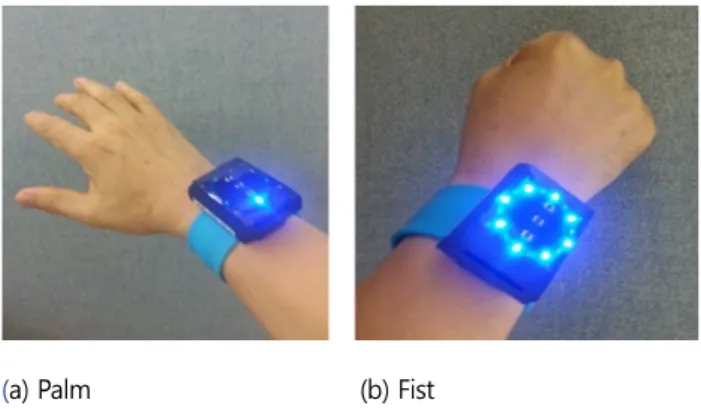
Figure 4 shows the prototype of a gesture recognition device embodied in this study. As show in the figure, only one LED is on, when a user unclenches his/her fist, and all the LEDs are lit in a circle shape, when the fist-clenching state is recognized. In this manner, results can be easily recognized intuitively in an experiment.
4. Algorithm
The main purpose of the algorithm is to recognize whether a user is clenching or unclenching his/her fist. To achieve such a purpose, a problem to decide a threshold in order to judge the two states needs to be solved in view of the strap sensor data characteristics. This paper applied Otsu's threshold (Otsu, 1979) to recognize the relevant state. First, an optimum threshold value that can maximize intra-class distance, simultaneously minimizing the inter-class distance within each channel's class is calculated, after IR data according to each channel's state are collected before the algorithm is operated. In this way, if optimum threshold value was calculated, when data bigger than the threshold come in, they are classified as the fist-clenching state, otherwise as the fist-unclenching state.
The algorithm has two problems in application in reality. The first problem is that data are not accurately measured, and noise is generated, because the locations of sensors vary whenever a user takes a gesture, if the strap worn on the user's wrist is loose.
The second problem is overfitting. Because each user has different shape of wrist, the Otsu's threshold algorithm setting the threshold value with pre-collected data cannot be applied to each user.
To solve such a problem, this study applied the adaptive threshold algorithm that decides a threshold from inputted signals according to time, not by using the threshold decided on the basis of pre-collected data. In addition, this study set a calibration process for customized user application.
When there is no default threshold stored in the system, or recognition results do not match, calibration is carried out. Calibration is a stage to set the initial threshold value, and this is the necessary stage, since the amounts of light received at the receiving sensors are different by user. After data in the fist-clenching and unclenching states for several seconds, respectively, are collected by making a user repeat such motions three or more times, each class' mean value is set as the initial threshold value. In doing so, thresholds are set by each channel (three channels), and consequently three initial thresholds are calculated. The adaptive threshold application process is presented below:
1) Store the IR data measured in the fist-clenching and unclenching states by each channel as the initial (or default) threshold values.
2) By applying the Otsu's threshold algorithm from each channel's stored data, calculate each channel's threshold by using the inter-class distance and intra-class distance.
3) Define each sensor signal's credibility using the inter-class distance and intra-class distance, and decide each channel's weighting factor by using the credibility values.
4) Calculate one unified data and threshold by weighted summing each channel's data and threshold using the weighting factor.
Using the method mentioned above, recognition performance can be improved by lowering the weighting value, and therefore the channels with no good signals are excluded.
5) Decide the state from the unified data and threshold.
6) When new data come in, renew the data and thresholds on the two states.
The algorithm developed in this study was mounted on a wrist-worn gesture recognition device, and its operation in the 12MHz main clock and 6KB memory environment was confirmed.
5. Method
This study carried out a user test targeting 12 participants to evaluate the gesture segmentation recognition performance of a wrist-worn device, which was implemented in this study. Ten males and two females participated in the test, and their average age was 38. Due to different wrist circumferences of people, six different straps were prepared with 5mm gap by each sensor. The tester conducted the test by selecting straps, where sensors can be best-positioned at the bottom of participant's wrist among the six straps before the test. The participants were allowed to practice the segmented gestures concerned for three minutes before the test was undertaken.
The moderator made the participants conduct 20 times of random gestures including segmentation gestures in the experiment.
In this study, only the status of success or failure of SOG and EOG was counted and recorded, and the gesture command between SOG and EO was ignored.
6. Results
Table 1 shows the test result. The recognition rates of SOG and EOG were measured as 99.58% and 100%, respectively. The number of location change was not properly recognized during the 3-minute practice session, because such a change was not properly recognized, and therefore it was the number of device-worn location adjustment by the participants themselves.
7. Discussion
When the infrared graph was measured in the development stage of the wrist-worn wearable gesture device, the data's quality was good in case sensors were precisely positioned at the bottom of participant's wrist. However, the signal was no good when
the sensor is located elsewhere. The reason is that the shape change of the bottom of a wrist is the largest, when a user clenches or unclenches his/her fist. To overcome such a problem, three light receiving sensors were placed on the device developed in this study, and good results on even slight position change were obtained. Also, an effort was made to overcome the problem by giving more weighting to the channels with good signals in the recognition algorithm. However, the recognition rate difference between users was revealed even in the development stage, since the wrist circumference is different depending on person. To solve such a problem in the user test, this study prepared for six straps with different sensor positions according to the length of a strap, and reduced individual variance to the fullest. For commercialization, the development of a device that can adjust sensor's position like adjusting the watch strap length is needed.
In another case, because a user can make and hold a fist in everyday life as well, there is a possibility of malfunction. To solve the problem, the motions can be replaced with such a motion as clenching one's fist twice quickly or holding a fist longer time, which does not frequently take place in everyday life, by using a function to check the time and number to clench one's fist offered in this study.
This study measured the recognition rates of clenching and unclenching one's fist to find out how much the motions of clenching and unclenching one's fist are feasible as user's intended gestures through a gesture segmentation method. In a further study, we plan to undertake a comprehensive study on whether such a gesture segmentation method can be universally used for general users by applying the experiments and analysis methods used in the ergonomic researches.
8. Conclusion
This paper proposed a hand gesture segmentation method that can be applied to smart apparel such as smart watch or a wrist Table 1. The result of user test for gesture segmentation
SOG Number
of successes EOG Number of successes
Wrist circumference
(cm)
Number of location
change
Wearing location
(Left/Right hand) Age Sex
Participant 1 20 20 18 0 R 39 M
Participant 2 20 20 15.9 1 L 30 M
Participant 3 20 20 17.4 0 R 44 M
Participant 4 20 20 16.9 0 L 42 M
Participant 5 20 20 19 2 R 36 M
Participant 6 20 20 17 0 R 42 M
Participant 7 20 20 17 0 R 41 M
Participant 8 20 20 17 0 L 42 M
Participant 9 20 20 17 0 R 26 M
Participant 10 19 20 14.2 0 R 38 F
Participant 11 20 20 16 2 R 39 F
Participant 12 20 20 17.9 1 R 45 M
Recognition
rate 99.58 100.00 - - - 38.67
Average -
band. This study implemented a wrist-worn band prototype system in which the infrared emitter and receiver were arrayed, and evaluated performance and application possibility of the proposed technology through a user test. As a result of the test, the system is a method that can be applied to a wearable system such as smart watch and smart band in consideration of the arithmetic amount of hardware and software. We plan to develop a system that many users can use more stably through undertaking researches to overcome individual variance in the future. The products of fashion and ICT fusion including smart apparel implementing such cutting-edge functions to a watch, bracelet and wrist band, which are conventional fashion accessories, are expected to add value to the traditional fashion products and create a new market by adding value.
Acknowledgements
This work was supported by the ICT R&D program of MSIP/IITP. [B0101-15-0420, Development of Transformational and Slap-on Wearable Device and UI/UX].
References
Alon, J., Athitsos, V., Yuan, Q. and Sclaroff, S., A unified framework for gesture recognition and spatiotemporal gesture segmentation, IEEE Transactions on Pattern Analysis and Machine Intelligence, 31(9), 1685-1699, 2009.
Junker, H., Amft, O., Lukowicz, P. and Tröster, G., Gesture spotting with body-worn inertial sensors to detect user activities, Pattern Recognition, 41(6), 2010-2024, 2008.
Kahol, K., Tripathi, P., Panchanathan, S. and Rikakis, T., Gesture segmentation in complex motion sequences, Proceedings of the International Conference on Image Processing, 105-108, 2003.
Kulkarni, V.S. and Lokhande, S.D., Appearance based recognition of american sign language using gesture segmentation, International Journal on Computer Science and Engineering, 2(3), 560-565, 2010.
Otsu, N., A threshold selection method from gray-level histograms, IEEE Transactions on Systems, Man, and Cybernetics, 9(1), 62-66, 1979.
Author listings
Dong-Woo Lee: [email protected]
Highest degree: PhD, Department of Computer Engineering, Chungnam National University
Position title: Principal Researcher, Wearable Computing Research Section, Electronics and Telecommunications Research Institute Areas of interest: Wearable HCI, Wearable Computing
Yong-Ki Son: [email protected]
Highest degree: MD, Department of (Department of Control and Instrumentation Engineering, Chung-Ang University Position title: Senior Researcher, Wearable Computing Research Section, Electronics and Telecommunications Research Institute Areas of interest: Wearable HCI, Wearable Computing
Bae-Sun Kim: [email protected]
Highest degree: MD, Department of Control and Instrumentation Engineering, Chonbuk National University
Position title: Senior Researcher, Wearable Computing Research Section, Electronics and Telecommunications Research Institute Areas of interest: Wearable Computing
Minkyu Kim: [email protected]; [email protected]
Highest degree: MD, Department of Computer Engineering, Seoul National University Position title: Researcher, Electronics and Telecommunications Research Institute Areas of interest: Artificial Intelligence, Wearable computing
Hyun-Tae Jeong: [email protected]
Highest degree: MD, Department of Electronics Engineering, Chungnam National University
Position title: Director, Wearable Computing Research Section, Electronics and Telecommunications Research Institute Areas of interest: Wearable UI/UX, Human-Computer Interaction
Il-Yeon Cho: [email protected]
Highest degree: Ph.D, Computer Engineering, Chungnam National University
Position title: Head, Future Research Team, SWContents Research Laboratory, Electronics and Telecommunications Research Institute Areas of interest: Wearable Computer, Human Computer Interaction, Textile/Clothing/Fashion Technology