ISSN 1225-6552, eISSN 2287-7630 https://doi.org/10.7853/kjvs.2017.40.2.83
< Original Article >
Veterinary Service
Available online at http://kjves.org
*Corresponding author: Jun Hyung Sohn, Tel. +82-54-850-3319, Fax. +82-54-850-3248, E-mail. [email protected]
돼지에서 분리한 Salmonella Typhimurium의 항생제 내성 양상
손준형
1* ㆍ김미숙
1ㆍ이영미
1ㆍ도재철
2경북동물위생시험소 북부지소1, 경북동물위생시험소 동부지소2
Characteristics of antimicrobial resistant Salmonella Typhimurium isolates from pigs
Jun Hyung Sohn
1*, Mee Suk Kim
1, Young Mi Lee
1, Jae Cheul Do
21North Branch, Gyeongbuk Veterinary Service Laboratory, Andong 36621, Korea
2East Branch, Gyeongbuk Veterinary Service Laboratory, Gyeongju 38101, Korea (Received 25 January 2017; accepted 21 June 2017)
Abstract
59 strains of Salmonella enterica subspecies enterica serovar Typhimurium (S. Typhimurium) were iso- lated from pigs in Gyeongbuk province, collected from 2011 to 2016. The isolates were investigated for the presence of antimicrobial resistance and multi drug resistance patterns. All 59 S. Typhimurium isolates were resistant to at least one of 10 antibiotics used in this study, 100% of S. Typhimurium isolates from pigs were resistant to two or more antimicrobials. As many as 5 isolates of isolates from pigs were resistant to 8 of 10 antimicrobials tested in this study. The ACSTNaGmKNaCf, ACSTGmAuKT/S, ACSTGmKCfT/S resistance phenotype was observed in 3.4%, 3.4%, 1.7% of the 59 isolates, respectively.
Key words : Salmonella Typhimurium, Antimicrobial resistance, Multi drug resistance patterns, Pig
서 론
Salmonella속 균은 세포내 기생세균으로 1886년 Salmon과 Smith에 의해 최초로 보고된 이후 지금까지 2,000종 이상의 혈청형이 알려져 있다. 그 중 Salmonella enterica subspecies enterica serovar Typhimurium (S.
Typhimurium)은 Salmonella enterica subspecies enterica serovar Enteritidis (S. Enteritidis)와 함께 살모넬라성 식중독을 유발하는 주요 병원체이다. 돼지에서 ST는 설사와 장염 등 소화기 질병을 일으키는 세균성 병원 체로 포유자돈부터 비육돈까지 넓은 범위의 일령대 에 감염될 수 있고 전파력이 높아 농장 내 유입시 큰 경제적 피해를 입히고 있다(Olsen 등, 2001; Lee 등, 2007; Steven 등, 2012; Hur 등, 2016). 돼지 농장 내
살모넬라 감염의 주요 요인으로는 돈군의 건강상태, 온도, 오염된 사료, 설치류 등이 알려져 있고 농장 내 전파는 감염동물과의 직접접촉, 오염된 물과 사료의 섭취 등으로 보고되어 있다(Tauxe, 1991; Benenson 등, 1995; Funk와 Gebreyes, 2004).
양돈산업에서 항생제는 감염증의 세균성 질병의 치료와 예방, 성장촉진을 위하여 사용되고 있으나 오ㆍ 남용으로 인한 내성균의 증가가 문제시 되고 있으며 가축에서의 항생제 사용이 사람에서 분리된 항생제 내성균의 출현과의 관련성이 여러 연구자들에 의해 보고되어 있다(Martinez와 Baquero, 2002; Araque, 2009).
이와 같은 위험성 때문에 선진국에서는 1970년대부 터 치료와 사료첨가제로 사용하는 항생제에 대한 규 제를 실시하고 있으며 우리나라에서도 2011년부터 질병 예방 목적 사료첨가제로서의 항생제 사용을 금 지하고 있으나 여전히 치료 목적으로 항생제가 광범
Table 1. Target gene and program of real-time PCR
Pathogen Target gene Fluorophore
Salmonella spp invA VIC
Salmonella typhimurium imp Cy5
Salmonella enteritidis prot6e FAM
50°C, 2 min, 1 cycle/95°C, 10 min, 1 cycle/95°C, 15 sec, 60°C, 1 min, 35 cycles.
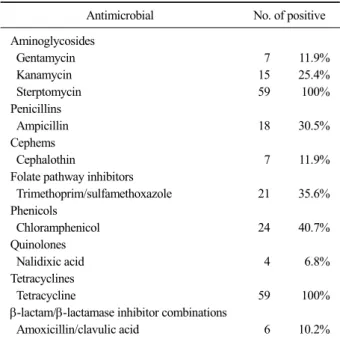
Table 2.Antimicrobial resistance of 59 S. Typhimurium isolates from pigs
Antimicrobial No. of positive Aminoglycosides
Gentamycin 7 11.9%
Kanamycin 15 25.4%
Sterptomycin 59 100%
Penicillins
Ampicillin 18 30.5%
Cephems
Cephalothin 7 11.9%
Folate pathway inhibitors
Trimethoprim/sulfamethoxazole 21 35.6%
Phenicols
Chloramphenicol 24 40.7%
Quinolones
Nalidixic acid 4 6.8%
Tetracyclines
Tetracycline 59 100%
-lactam/-lactamase inhibitor combinations
Amoxicillin/clavulic acid 6 10.2%
위하게 사용되고 있다(Yoo 등, 2014; Hur 등, 2016).
특히 S. Typhimurium은 여러 종류의 항생제에 대한 내성을 가지고 있고 다제 내성 균주 역시 세계적으로 보고되고 있다(Kim 등, 2000; Shahada 등, 2007; Futagawa, 2008). 따라서 이번 연구에서는 돼지 임상시료에서 분리한 S. Typhimurium 59주에 대한 항생제 내성 양 성을 분석하여 질병 치료를 위한 항생제의 적절한 사 용에 활용하고자 한다.
재료 및 방법
공시재료
2011년 6월에서 2016년 5월까지 경상북도 동물위 생시험소로 의뢰된 양돈장 임상시료에서 분리한 59 주를 실험에 사용하였다. 설사, 폐사 등의 임상증상 으로 의뢰된 돼지의 소장, 대장, 분변 및 환경시료에 서 세균을 분리하였고 VITEK-2 Compact 시스템(Bio- Mérieux, France)과 PowerCheckTM Salmonella Triplex Real-time PCR Kit (Kogenebiotechnology, Korea)를 사 용하여 제조사의 매뉴얼에 따라 real- time PCR을 실 시하여 S. Typhimurium을 확인하였다(Table 1). Boiling 법으로 추출한 DNA와 negative control (DNase/RNase free water), positive control을 real time PCR premix가 15 L 포함되어 있는 각각의 strip tube에 5 L씩 분 주하고 CFX 96 real-time system (Bio-rad, USA)장비를 사용하여 결과를 판독하였다. 최종 확인된 균주들은 항생제 감수성 검사를 실시할 때까지 −70°C에서 보 관하였다.
항생제 감수성 검사
59주의 S. Typhimurium에 대한 항생제 감수성 검사 는 Clinical and Laboratory Standards Institute (CLSI) M100-S22 guidelines (CLSI, 2012)에서 제시하는 Disk-
agar method에 따라 실시하고 결과를 분석하였다. 이 번 실험에 사용된 항생제로는 Ampicillin (A, 10 g), Amoxicillin/clavulanic acid (Au, 30 g), Cephalothin (Cf, 30 g), Chloramphenicol (C, 30 g), Gentamicin (Gm, 10 g), Kanamycin (K, 30 g), Nalidixic acid (Na, 30
g), Streptomycin (S, 300 g), Trimethoprim/sulfame- thoxazole (T/S, 1.25/23.75 g), Tetracycline (T, 30 g) 등 10종의 BBLTM Sensi-DiscTM (BD, USA)제품을 사 용되었다. 각 항생제에 37°C에서 24시간 반응시킨 후 발육억제대를 측정하여 판정하였다.
결 과
돼지에서 분리한 S. Typhimurium 59주를 대상으로 실시한 항생제 감수성 검사 결과는 Table 2와 같다.
59주 모두 최소한 1종 이상의 항생제에 대하여 내성 을 가지고 있었으며 특히 sterptomycin과 tetracycline 에 대해서는 59주 모두 100%의 내성을 나타내었다.
Chlorampenicol, trimethoprim/sulfamethoxazole, ampicillin 에서 각각 40.7% (24/59), 35.6% (21/59), 30.5% (18/59) 의 높은 내성을 보였고 kanamycin, gentamycin, cepha- lothin, amoxicillin/clavulic acid에서는 25.4% (15/59), 11.9% (7/59), 11.9% (7/59), 10.2% (6/59)였으며 nali- dixic acid에서 6.8% (4/59)로 가장 낮은 내성을 보였다.
Table 3. Antimicrobial resistance in 59 Salmonella Typhimurium isolates from pigs
Type Pattern No. of isolates (%)
1 ACSTNaGmKNaCf 2 (3.4%)
2 ACSTGmAuKT/S 2 (3.4%)
3 ACSTGmKCfT/S 1 (1.7%)
4 ACSTAuT/S 1 (1.7%)
5 CSTNaGmAu 1 (1.7%)
6 CSTNaKCf 1 (1.7%)
7 CSTGmAuK 1 (1.7%)
8 CSTKCfT/S 1 (1.7%)
9 ACSTAu 1 (1.7%)
10 ACSTK 1 (1.7%)
11 ASTKT/S 1 (1.7%)
12 ACST 1 (1.7%)
13 ASTT/S 2 (3.4%)
14 CSTK 4 (6.8%)
15 CSTCf 2 (3.4%)
16 CSTT/S 2 (3.4%)
17 AST 6 (10.2%)
18 CST 3 (5.1%)
19 STK 1 (1.7%)
20 STT/S 11 (18.6%)
21 ST 14 (23.7%)
돼지에서 분리된 59균주 모두 2종 이상의 항생제에 내성을 가진 것으로 확인되었고 그 중 76.3%에 해당 하는 45개의 균주는 3가지 이상의 항생제에 내성을 보였다. 5개의 균주는 이 실험에 사용된 10종의 항생 제 중 무려 8종에 내성을 나타내었고 24개의 균주가 4가지 이상의 항생제에 내성을 가진 것으로 확인되었 다. 특히 10종의 항생제에 대해 59개의 균주는 21 타 입의 항생제 내성 패턴이 나타났는데 8종의 항생제에 내성을 보인 5주는 3가지 패턴(ACSTNaGmKNaCf 2 주, ACSTGmAuKT/S 2주, ACSTGmKCfT/S 1주)을 보 였고 가장 많은 14개의 균주가 타입 21 (ST)에서 내 성이 관찰되었다(Table 3).
고 찰
사람에서 뿐만 아니라 산업동물 분야에서도 세균 성 병원체의 항생제 내성균이 지속적으로 출현함에 따라 치료에 어려움이 따르고 있는데 다제 내성 S.
Typhimurium의 출현 역시 최근 여러 나라에서 보고 되고 있다. 이번 연구에서 돼지유래 S. Typhimurium 59주를 국내에서 많이 사용되는 10종의 항생제에 대 한 감수성 검사를 실시한 결과 모든 균주가 2종 이상
의 항생제에 내성을 가지는 다제내성균으로 확인되 어 근래의 연구들과 유사함을 알 수 있었다(Chen 등, 2004; Shahada 등, 2007; Graziani 등, 2008).
특히 100%의 내성을 보인 streptomycin의 adenyl- tranferase, phosphotransferase 등 특성화된 R plasmid 효소로 인해 다른 aminoglycosides계 항생제에도 교차 내성이 발생하므로 많은 문제가 발생할 것으로 판단 된다.
항생제별 내성률은 gentamycin이 11.9%로 Poppe 등 (1995), Threlfall 등(1993)의 25.8%, 24.9%에 비해 다 소 낮은 수치를 보였고, kanamycin은 Kim 등(2000)의 연구에서는 내성균이 나타나지 않았고 Moon 등(2016) 의 7.1%에 비해 25.4%의 상대적으로 높은 내성을 보 였다. Ampicillin과 cephalothin, nalidixic acid는 각각 30.5%, 11.9%, 6.8%로 이들 28.6%, 2.0%, 2.0%의 내성 을 확인한 Oh 등(2004)의 견해와 유사하였고, 사료첨 가와 예방목적으로의 사용이 금지되어 있고, 치료용 으로만 사용하도록 권고되어 있는 Amoxicillin/clavulic acidsms 59주 중 6주에서 내성을 보여 9.5%의 내성을 확인한 Moon 등(2016)의 결과와 유사하게 나타났다.
마지막으로 본 연구에서 100%의 항생제 내성을 보인 streptomycin과 tetracycline의 경우 S. Typhimurium 42 주에서 각각 90.5%와 95.2%의 내성을 나타낸 Moon 등(2016)의 결과와 매우 유사함을 확인할 수 있었다.
이번 연구에서 가장 많은 8종의 항생제에 내성을 보인 5주는 3가지 패턴(ACSTNaGmKNaCf 2주, ACSTGmAuKT/S 2주, ACSTGmKCfT/S 1주)을 보였고 6 종의 항생제에 내성을 보인 5주는 각기 다른 5개의 패 턴(ACSTAuT/S, CSTNaGmAu, CSTNaKCf, CSTGmAuK, CSTKCfT/S)으로 나타나 항생제 내성 패턴의 다양함 을 확인할 수 있었다. 또한 sterptomycin과 tetracycline 에 대해서는 100%의 내성을 보이고 다른 항생제에 대해서는 50%이하의 균주에서 항생제 내성을 보였는 데 이와 같은 결과로 돼지에서는 사료 첨가제나 질병 치료를 위해 특정한 몇가지 항생제를 주로 사용하고 있음을 확인할 수 있었고 또한 국내에서 항생제 사용 의 계속적인 관리와 지속적인 항생제 내성 조사가 필 요함을 알 수 있었다.
결 론
2011년 6월에서 2016년 5월까지 돼지 임상재료에 서 분리한 S. Typhimurium 59주에 대한 항생제 감수
성 검사 결과 59주 모두 2종 이상의 항생제에 내성을 가지는 다제내성균으로 나타났다. Streptomycin과 tet- racycline에 대해서는 100%의 내성을 보였고 chlor- amphenicol에 대해서도 40.7%의 비교적 높은 내성을 가지고 있음을 확인하였다. 내성패턴 분석에서는 10 종의 항생제 중 8종에 대하여 내성을 가지는 5개의 균주에서 3가지 내성패턴(ACSTNaGmKNaCf 2주, ACSTGmAuKT/S 2주, ACSTGmKCfT/S 1주)을 확인 할 수 있었다.
REFERENCES
Araque M. 2009. Nontyphoid Salmonella gastroenteritis in pedia- tric patients from urban areas in the city of Merida, Venezuela. J Infect Dev Ctries 3: 28-34.
Baggesen DL, Sandvang D, Aarestrup FM. 2000. Charaterization of Salmonella enterica serovar Typhimurium DT104 iso- lated from Denmark and comparison with isolates from Europe and the United States. J Clin Mirobiol 38:
1581-1586.
Benenson AS, Chin J, Benenson AS, Chin J. 1995. Control of communicable diseases manual. American Public Health Association, Washington DC.
Chen S, Zhao S, White DG, Schroeder CM, Lu R, Yang H, McDermott PF, Ayers S, Meng J. 2004. Characterization of multiple-antimicrobial-resistant Salmonella serovars isolated from retail meats. J Appl Environ Microbiol 70:
1-7.
Cho JK, Kang MS, Kim KS. 2011. Serotypes, antimicrobial re- sistance of Salmonella spp. and plasmid profiles, phage types, PFGE of S. Enteritidis and S. Typhimurium iso- lated from ducks in Daegu-Gyeongbuk province. Korean J Vet Serv 34: 217-226.
Clinical and Laboratory Standards Institute (CLSI). 2012.
Performance standards for antimicrobial susceptibility testing; twenty-second informational supplements (M100- S22). CLSI, Wayne, Pa.
Davis MA, Besser TE, Eckmann K, MacDonald K, Green D, Hancock DD, Baker KN, Warnick LD, Soyer Y, Wiedmann M, Call DR. 2007. Multidrug-resistant Salmonella typhimurium, Pacific Northwest, United States. Emerg Infect Dis 13: 1583-1586.
Funk J, Gebreyes WA. 2004. Risk factors associated with Salmonella prevalence on swine farms. J Swine Health Prod 12: 246-251.
Futagawa-Saito K, Hiratsuka S, Kamibeppu M, Hirosawa T, Oyabu K, Fukuyasu T. 2008. Salmonella in healthy pigs:
Prevalence, serotype diversity and antimicrobial resist- ance observed during 1998-1999 and 2004-2005 in Japan. Epidemiol Infect 136: 1118-1123.
Graziani C, Busani L, Dionisi AM, Lucarelli C, Owczarek S,
Ricci A, Mancin M, Caprioli A, Luzzi I. 2008.
Antimicrobial resistance in Salmonella enterica serovar Typhimurium from human and animal sources in Italy.
Vet Microbiol 128: 414-418.
Guerra B, Schrörs P, Mendoza MC. 2000. Application of PFGE performed with XbaI to an epidemiological and phyloge- netic study of Salmonella serotype typhimurium. Rela- tions between genetic types and phage types. New Microbiol 23: 11-20.
Kim KT, Kim WI, Kim SY, Jang YS, Kim DW, Kim BH. 2000.
Antibiotic resistance and plasmid profile of Salmonella spp isolated from swine in Kyoungbuk province. Korean J Vet Serv 23: 77-91.
Lee KE, Lee Y. 2007. Isolation of multidrug-resistant Salmonella typhimurium DT104 from swine in Korea. J Microbiol 45: 590-592.
Martinez JL, Baquero F. 2002. Interactions among strategies asso- ciated with bacterial infection: Pathogenicity, epi- demicity, and antibiotic resistance. Clin Microbiol Rev 15: 647-679.
Moon JY, Kim WK, Lee KH, Na BJ, Go JC, Sim KS, Patil TA, Hur J. 2016. Characteristics of antimicrobial resistant Salmonella Typhimurium isolates from chicken and pigs.
Korean J Vet Serv 39: 51-57.
Nielsen EM, Torpdahl M, Ethelberg S, Hammerum AM. 2009.
Variation in Antimicrobial resistance in sporadic and outbreak-related Salmonella enterica serovar Typhimu- rium. Emerg Infect Dis 15: 101-103.
Poppe C, Kolar JJ, Demczuk WH, Harris JE. 1995. Drug resist- ance and biochemical characteristics of Salmonella from turkeys. Can J Vet Res 59: 241-248.
Oh YH, Lee YG, Jung YT, Lee H, Kim AK, Kim DI, Park SK, Kim MH. 2004. Molecular Characterization of Multidrug Resistant Salmonella enterica serovar Typhimurium Clinical Isolates in Seoul. Konkuk univ Press. Seoul.
Olsen SJ, DeBess EE, McGivern TE, Marano N, Eby T, Mauvais S, Balan VK, Zirnstein G, Cieslak PR, Angulo FJ. 2001.
A nosocomial outbreak of fluoroquinolone-resistant Salmonella infection. N Engl J Med 344: 1572-1579.
Shahada F, Amamoto A, Chuma T, Shirai A, Okamoto K. 2007.
Antimicrobial susceptibility phenotypes, resistance deter- minants and DNA fingerprints of Salmonella enterica se- rotype Typhimurium isolated from bovine in Southern Japan. Int J Antimicrob Agents 30: 150-156.
Smith P. 2008. Aquaculture and florfenicol resistance in Salmonella enterica Typhimurium DT104. Emerg Infect Dis 14: 1327-1328.
Steven AC, Alison EB, Ronald WG. 2012. Salmonellosis. pp.
821-833. In: Jeffrey J. Zimmerman, Locke A, Karriker, Alejandro Ramirez, Kent J. Schwartz, Gregory W.
Stevenson (ed.). Disease of Swine. 10th ed. A John Wiley & Sons. Ames, Iowa.
Tauxe RV. 1991. Salmonella: A postmodern pathogen. J Food Prot 54: 563-568.
Threlfall EJ, Rowe B, Ward LR. 1993. A comparison of multiple
drug resistance in salmonellas from humans and food animals in England and Wales, 1981 and 1990.
Epidemiol Infect 111: 189-197.
Yoo AN, Cha SB, Shin MK, Won HK, Kim EH, Choi HW, Yoo
HS. 2014. Serotypre and antimicrobial resistance pat- terns of the recent Korean Actinobacillus pleuro- pneumoniae isolates. Vet Rec 174: 223.