• 검색 결과가 없습니다.

Fire Characteristics for Spill Rate of Light oil and Methanol

N/A
N/A
Protected

Academic year: 2021

Share "Fire Characteristics for Spill Rate of Light oil and Methanol"

Copied!
7
0
0

로드 중.... (전체 텍스트 보기)

전체 글

(1)

1.

서 론

세계적으로 환경보호정책에 따라 전기자동차와 하 이브리드 자동차의 보급이 확대되고 있으나, 국내 차 량운행대수의 증가와 경유차량의 인기에 의해 경유소 비가 증대되고 있으며, 한국석유공사 자료에 따르면 지난 2016년 5월에 경유 소비량이 사상 최고치를 경신 하였다 1) .

또한 전자제품/반도체 칩의 제조, 폐수처리, 연료전 지에 사용 등을 포함한 화학, 식품공업에 사용되는 메 탄올은 화학 중간물질로 활용됨에 따라 그 사용처/활 용처 발굴에 따라 사용량 또한 증가되고 있다.

이렇게 사용량이 증가될수록 운송량이 증가될 수밖 에 없는데, 경유는 정유소에서 저유소까지 송유관으로 이송하지만 두 물질모두 주유소/사용처까지의 운송은 탱크로리를 사용하고 있다 2) .

따라서 본 연구에서는 경유와 메탄올 운송을 위한 이동탱크로리의 도로 운행 중 사고 발생 시 적재가연

물의 유출로 인한 화재 위험성을 고찰하고 이에 관한 정성적 , 정량적인 Data를 수집 및 분석하기 위하여 real scale 화재 실험을 하고자 한다.

2.

실험 장치 및 방법

본 연구에서는 이동 탱크로리 적재 가연물의 유출 화 재시 도로에 확산되는 화염에 의한 도로 상부온도와 탱 크로리 주위온도를 측정하기 위하여 화재온도 측정장 치(Multiscan/1200TM)를 사용하였다. Fig. 1과 같은 위 치에 26개의 K-type thermocouple을 지면으로부터 0.8, 1.6 m 높이로 설치하였고 전용 컴퓨터 프로그램을 통하 여 data를 15 sec 간격으로 기록하였다. 화염으로부터 방출되는 복사열유속을 측정하기 위하여 Medtherm사의 Model 5H203-DR1-DIGITAL HEAT FLUX METER 및 Radiant transducer(sensor)를 사용하였고, 설치 위치는 Fig. 2와 같이 실험도로 중심으로부터 3 m~4.5 m (0.5 m 간격 )이다.

Jung Yun Lee ⋅Hong Kim

Department of Convergence Technology for Safety and Environment, Graduate School of Hoseo University (Received September 27, 2016 / Revised October 15, 2016 / Accepted October 19, 2016)

Abstract : In this study, tank truck incidents of road transport of hazardous materials to experimental investigated the potential fire

hazard. Real scale fire was to perform experiments for on this qualitative and quantitative data collection and analysis. Particularly affected by radiant heat from the flames caused and damage estimates range investigated accordingly. Flame temperature, internal temperature of tank and emitted radiation from the flames was investigated. The flame of light oil spill caused a fire at a temperature of about 300℃ high in comparison with the methanol by combustion of diesel and methanol, according to the difference, the flame duration changes varies depending on the Burning rate. Depending on spill rate(30, 60, 90 and 120

min

) and the longer the duration of the flame important factors for the internal temperature of tank lorry rise was found. Road accident in a fire caused by leakage of hazardous was could the higher the damaged. Therefor, Fire suppression activities should be required in particular to be around.

Key Words : tank lorry fire, spill rate, spill fire, fire characteristic, fire period

Corresponding Author : JungYun Lee, Tel : +82-41-533-9567, E-mail : [email protected]

Department of Convergence Technology for Safety and Environment, Hoseo University, 20, Hoseo-ro79beon-gil, Baebang-eup, Asan-si, Choongcheongnam-do 34199, Korea

(2)

경유와 메탄올의 유출속도에 따른 화재특성

Fig. 2. The location of sensors for measuring radiant heat flux from the fires.

탱크로리로부터 가연성 물질의 유출에 따른 화염의 확 산 양상을 실험하기 위하여 설치된 Fig. 1의 실험 도로는 ch13에서 ch17방향으로 -1˚, ch1방향으로 -1˚의 기울기를 가진 길이 10 m, 폭 5 m의 콘크리트 포장도로이다. 실험 에서 사용된 가연물은 경유와 메탄올로써 유출속도를 30

min , 60 min , 90 min 과 120 min 으로 설정하여 1분간 유출과 동시에 점화한 후, 각 센서들로부터의 측정 값을 기록하였다. 실험 당시의 환경은 기온 2℃, 풍속 0.

4~0.8 sec 였다 .

3.

실험 결과 및 분석

경유와 메탄올의 유출속도 변화에 따른 화재 실험에 의하여 측정된 도로 상부온도, 탱크로리 주위온도변화 와 복사열유속을 측정하였다.

3.1 유출속도 30 min 에서의 화재특성

Fig. 3은 경유와 메탄올의 유출속도에 따른 화염 온 도를 나타낸 것이다 . 경유 30 min (see Fig. 3.a-1)의 유 출화재 실험에서 ch12에서 3분15초에 약 250℃의 최고 치를 보였고, 주변 센서위치(ch10, ch11, ch14-16)에서 기록된 화염의 온도는 약 4분15초까지 서서히 증가하고 그 이후에는 다시 서서히 감소하는 양상을 나타내었다 . Fig. 3.a-2의 메탄올 30 min 의 도로 상부 온도는 점화 45초 만에 27.7℃로 증가하였으며, 그래프에 나타나 있 듯이 실험도로 표면을 타고 흘러내려감에 따라 최대온 도 측정 지점이 변동됨을 알 수 있다 . 도로 상부 온도는 평균 15.4℃로 나타났다. 탱크로리 주위 온도 변화(see Fig. 3.b-1 and Fig. 3.b-2)는 두 가연물 모두 화재와 가장 근접한 위치인 ch22에서 가장 높은 측정치를 보였다.

경유실험에서는 4분45초(18.5℃)까지 서서히 증가하는 반면 , 메탄올실험에서는 1분45초 만에 기록최고치(8.

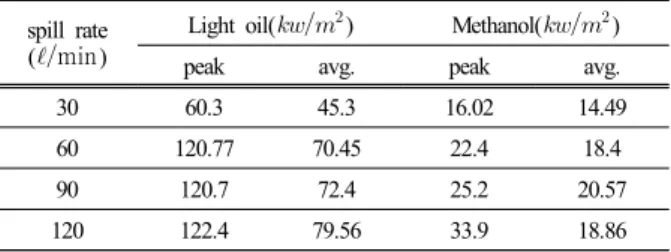
1℃)에 근접한 7.4℃까지 증가하였다. 이는 같은 조건의 경유화재의 온도보다 현저히 낮은 수치이며 , 기록된 복 사열량 명확한 차이를 보였다 . 경유실험에서의 복사열 량은 3 m위치에서 최고 60.3  , 평균 45.3  인데 반하여 , 메탄올 실험에서 최고 16.02  , 평균 14.49  으로 나타났다.

Fig. 3의 경유실험에서의 온도상승 위치가 메탄올 실험에서 기록된 그 것보다 범위가 좁고 장시간 높은 온도로 기록된 것은 경유의 점도가 높아 pool형성 면적 이 적고 , 발열량이 상대적 높기 때문인 것이며, 화재가 장시간 지속된다면 3 m거리의 목재를 착화시킬 수 있 는 충분한 복사열을 방출한다는 것을 의미한다 3-6) .

a) The location of thermocouples on concrete road b) The location of thermocouples for measure around temperature of tank lorry

Fig. 1. The location of thermocouples for measuring temperatures of flame and around of the tank.

(3)

3.2 유출속도 60 min 에서의 화재특성

경유 실험에서 점화후 유출구와 근접한 위치의 온도가 서서히 상승하기 시작해 ch15위치에서 가장 먼저 200℃에 도달하였고 1분45초에 ch16위치(실험도로의 중심)에서 680.5℃의 최고온도를 기록하였다. 동시에 ch9, 10의 승온

속도가 증가하여 4분에 223.8℃의 최고온도를 기록하고 서서히 감소하는 양상을 나타내었다 . 2분 30초부터 ch13, 14에서 기록된 온도가 급격히 상승하는 것이 나타났는데, 이때 복사열유속의 최고치가 120.77  로 기록되었 다 . 경유실험에서의 복사열유속 평균은 70.45  으로

a-1) temperature of light oil fire above the road a-2) temperature of methanol fire above the road

b-1) temperature of light oil fire around the tank lorry b-2) temperature of methanol fire around the tank lorry

c-1) peak and average radiant heat flux of light oil c-2) peak and average radiant heat flux of methanol

Fig. 3. The Variation of measured temperature and radiation heat flux during fire of spill rate 30 min .

(4)

경유와 메탄올의 유출속도에 따른 화재특성

1인치 두께의 foam plastic 또는 Polyurethane foam을 거의 즉시 착화시킬 수 있는 양이다 7) . 메탄올 실험에서는 ch12, 16에서 160~185℃의 최고치를 기록하였으나, 다른 센서 위치에서는 평균 약 50℃의 온도가 기록되었다. 이는 경유 실험에서의 온도와 비교하여 매우 낮은 변화이며, Fig.

4.b-2에 나타난 바와 같이 탱크로리 부위 온도는 약 7℃상 승에 그칠 뿐이었다. 그러나 실험도중 기록된 복사열은 3 m거리에서 최고 22.4  , 평균 18.4  으로 인체의 피부가 6초 이상 노출될 경우 수포를 일으킬 수 있는 양으로써, 노면상부 또는 탱크로리 주위의 온도가

a-1) temperature of light oil fire above the road a-2) temperature of methanol fire above the road

b-1) temperature of light oil fire around the tank lorry b-2) temperature of methanol fire around the tank lorry

c-1) peak and average radiant heat flux of light oil c-1) peak and average radiant heat flux of methanol

Fig. 4. The Variation of measured temperature and radiation heat flux during fire of spill rate 60 min.

(5)

낮아도 인체에 유해할 정도의 위험성이 있다는 뜻이다 8) .

3.3 유출속도 90 min 에서의 화재특성

유출속도 90 min 의 실험에서는 경유와 메탄올 모 두 1분 이내에 ch10의 위치에서 급격한 온도 상승을

보였고 , 이때 기록된 온도는 경유가 410.8℃메탄올이 253.9℃였다. 30과 60 min 의 실험에서의 온도 기록 결과와 비교하여 온도 상승소요시간이 15~30초 빠르게 나타났고 경유실험에서 1분30초부터 ch 13-16위치의 온도가 상승하여 약 4분까지 약 200℃의 온도가 기록

a-1) temperature of light oil fire above the road a-2) temperature of methanol fire above the road

b-1) temperature of light oil fire around the tank lorry b-2) temperature of methanol fire around the tank lorry

c-1) peak and average radiant heat flux of light oil c-2) peak and average radiant heat flux of methanol

Fig. 5. The Variation of measured temperature and radiation heat flux during fire of spill rate 90 min.

(6)

경유와 메탄올의 유출속도에 따른 화재특성

되었고 , 메탄올 실험에서는 ch 7, 8위치에서 온도가 상 승하는 것으로 기록되었는데 점도가 더 높은 경유에 의해 형성된 pool이 메탄올실험에서 보다 더 가까운 거 리에 있다는 것을 의미한다 9,10) . 이렇게 형성된 경유 pool화염이 탱크로리 주위온도를 최고 25℃, 평균 약

7.5℃상승시키는 것으로 나타났다. 최성기인 2분30초 에 3 m의 거리에서 기록된 복사열유속의 최고치는 120.7  , 평균치는 72.4  로, 60 min 의 유 출속도실험과 비교하여 0.07  의 차이를 보였다.

메탄올 실험의 경우, 3 m거리에서 25.2  의 최고

a-1) temperature of light oil fire above the road a-2) temperature of methanol fire above the road

b-1) temperature of light oil fire around the tank lorry b-2) temperature of methanol fire around the tank lorry

c-1) peak and average radiant heat flux of light oil c-2) peak and average radiant heat flux of methanol

Fig. 6. The Variation of measured temperature and radiation heat flux during fire of spill rate 120 min .

(7)

수 있다. 두 실험 모두 탱크로리 주위 온도 변화는 다 른 유출속도를 가진 실험과 비교하여 양상이 다르지 않았고 , 3m거리에서 측정된 복사열유속의 경우, 경유 실험에서는 Table 1과 같이 60, 90 120 min 조건 모 두 ±0.85  의 근소한 차이를 보였다. 또한 평균 치는 79.56  으로 기록되었다. 메탄올의 경우, 120  실험에서 3 m거리의 복사열유속이 최고 33.9  , 평균 18.86  으로 기록되었다.

Table 1. Peak and average radiant heat flux at 3m far of light oil and methanol for spill rate

spill rate (min)

Light oil(

) Methanol(

)

peak avg. peak avg.

30 60.3 45.3 16.02 14.49

60 120.77 70.45 22.4 18.4

90 120.7 72.4 25.2 20.57

120 122.4 79.56 33.9 18.86

4.

결 론

본 연구에서는 탱크로리의 운행중 사고 발생시 적재 위험물의 유출속도에 따른 화재 특성의 변화를 실험적 으로 고찰하였으며 실험도로 상부온도, 탱크로리 주위 온도 및 화염으로부터 방출되는 복사열유속을 측정 , 분석한 결과 다음과 결론을 도출할 수 있었다.

1. 각 유출속도별 실험도로 노면 상부의 온도기록 양상에서 경유화염의 pool이 메탄올의 화염 pool보다 크게 나타났는데, 이는 경유의 점도가 메탄올보다 크 기 때문으로 상대적으로 좁은 공간에서 더 많은 복사 열유속을 방출하기 때문으로 판단된다.

하는 등 화재 진압 활동에 있어 주의가 필요하다.

References

1) Petronet, “Amount of Diesel Consumption in Korea”, 2016.

2) http://www.petroleum.or.kr/ko/sub02/02_8.php, 2016.

3) J. G. Quintire, “Principles of Gire Behavior”, Delmar, U.S.A., 1998.

4) Y. -J. Chung and Eui jin, “Combustion Properties of the Quercus variabilis and Zelkova Serrata Dried at Room Temperature(II)”, Appl. Chem. Eng., Vol. 21, No. 4, Aug., pp. 467-474, 2010.

5) J. Lee, K. Jung and H. Kim, “An Experimental Investigation on Fire Characteristics of Light Oil & Methanol for Spilled Surface”, Journal of the Korean Society of Safety, Vol. 25, No. 6, pp. 103-108, 2010.

6) H. Kim and H. Park, “Experimental Study of Radiation Heat Flux for the Pool and Spill Fire in Petroleum Storage Tanks”, Journal of the Korean Society of Safety, Vol. 19, No. 1, pp.

88-93, 2004.

7) J. G. Quintire and M.Harkleroad, “New concepts for Measuring Flame Spread Properties”, NBSIR 84-2943, 1984.

8) A. M. Stoll and L. C. Greene, “Relationship between Pain and Tissue Damage Due to Thermal Radiation”, Journal of Applied Physiology, Vol. 14, No. 3, pp. 373-382, 1959.

9) http://www.viscopedia.com/viscosity-tables/substances/

diesel-fuel/

10) http://www.viscopedia.com/viscosity-tables/substances/

methanol/

수치

Fig. 2. The location of sensors for measuring radiant heat flux  from the fires.
Table 1. Peak and average radiant heat flux at 3m far of light  oil and methanol for spill rate

참조

관련 문서

Also, the design of an optimal heat sink requires a complete knowledge of all heat transfer characteristics between the heat source and the ambient air

Coadministration of naringenin increased the absorption rate constant (Ka), the area under the plasma concentration-time curve (AUC) and peak concentration (C max

5.16 Overall heat transfer coefficient and convective heat transfer coefficient of hot side according to mass flow rate and inlet temperature (High temperature condition)

To visualize the vari- ation in various transport characteristics (the non-dimen- sional axial velocity and temperature distributions, pressure gradient, rate of heat

χ is the fraction of the emitted light flux absorbed in the water Ф OH is the quantum yield for generation of ·OH radicals... <Example 1>. We assume that for

The average tensile strength value before heat treatment of PLA output was 9.67 N/㎟, and the average tensile strength value after heat treatment was 24.17 N/㎟, which

They suggested that vaporization of a thin layer of liquid between the growing bubble and the heating surface caused removal of heat from the surface, thus lowing

Fig.11 Temperature histories of the hot side and cold side heat exchangers according to time with speaker power(10W).. Fig.12 Temperature histories of the hot