a) 연세대학교 전기전자공학부 Yonsei University
‡교신저자 : 손광훈([email protected])
※This work was supported by Agency for Defense Development under contract. UD100062ID.
․접수일(2011년3월14일),수정일(2011년4월21일),게재확정일(2011년4월21일)
An Edge Profile Adaptive Bi-directional Diffusion Interpolation
Bongjoe Kim a) , and Kwanghoon Sohn a) ‡
Abstract
In this paper, we propose an edge profile adaptive bi-directional diffusion interpolation method which consists of shock filter and level set. In recent years many interpolation methods have been proposed but all methods have some degrees of artifacts such as blurring and jaggies. To solve these problems, we adaptively apply shock filter and level set method where shock filter enhances edge along the normal direction and level set method removes jaggies artifact along the tangent direction. After the initial interpolation, weights of shock filter and level set are locally adjusted according to the edge profile. By adaptive coupling shock filter with level set method, the proposed method can remove jaggies artifact and enhance the edge. Experimental results show that the average PSNR and MSSIM of our method are increased, and contour smoothness and edge sharpness are also improved.
Keyword : shock filter, level set, image interpolation
Ⅰ. Introduction
The aim of image interpolation is to reconstruct a high resolution (HR) image from a single low resolution (LR) image in order to improve visual appearance, and image interpolation is widely required for many areas such as bio- medical image analysis, HDTV and object recognition. In recent years, a large number of interpolation methods based on different techniques have been proposed. Classical line- ar interpolation methods such as nearest-neighborhood, bi- linear and bicubic interpolation treat the image as a low dimensional surface and find a function to approximate this surface. These linear interpolation methods are very fast and have low complexity but they result in jaggies and blurring artifacts adjacent to the edge region due to
smoothing across the edges. To prevent these artifacts, sev- eral edge preserving interpolation methods have been proposed. These edge preserving methods produce better result than the linear interpolation methods because it inter- polate along the edges not across the edges. Edge directed interpolation method [1] was proposed to use an estimate of the high resolution edge map not to smooth across the edges. In [2], they detected edges and fitted them with some templates to improve the visual quality of interpo- lated image. Li et al. [3] estimated the covariance of HR image from the covariance of the LR image by modeling the natural image as a second order locally stationary Gaussian process, and interpolated the missing pixels based on the estimated covariance. However, these edge preserv- ing interpolation methods still suffer from some degrees of blurring and jaggies artifacts.
To solve these problems, we adaptively apply shock fil-
ter and level set method where shock filter enhances edge
along the normal direction and level set method removes
jaggies artifact along the tangent direction. At first, we per-
일반논문-11-16-3-11
some related works. In section Ⅲ, we describe the pro- posed method precisely. In section Ⅳ, we will show our results and compare them with other methods. The con- clusions are given in section Ⅴ.
Ⅱ. Related works
To improve the visual quality of HR image, a large number of interpolation methods have been proposed in recent years. They can be mainly classified into three cat- egories: reconstruction based method, learning based method, and Partial Differential Equation (PDE) based method.
Reconstruction based methods try to modify the image after initial interpolation to improve the visual quality. In [4], a back projection method was proposed to iteratively minimize the reconstruction error determined by back pro- jecting the estimated HR image to LR resolution. It has been observed that ringing artifact may be produced along sharp edges. Guichard et al. [5] estimated the HR image that minimizes the total variation (TV). However, TV based interpolation often over smoothes homogeneous re- gion and makes the result look unnatural because TV mini- mization assumes that the image is almost piecewise constant. Dai et al. [6] proposed soft edge smoothness prior to synthesize a HR image with smooth and sharp edges.
They generated HR image with good perceptual quality, but it is very computational expensive. In [7], they pro- posed feedback control framework which consists of three steps: de-convolution, re-convolution, and pixel sub-
produce good results. Freeman et al. [8] selected the HR patch from the training set based on the middle frequency information, while the contexts of the corresponding HR patch should be consistent with its neighbor. Kim et al. [9]
proposed kernel ridge regression (KRR) method to estimate the high frequency details of the underlying HR image. To reduce time complexity, a sparse solution of KRR is found by combining the kernel matching pursuit and gradient descent. However, learning based approaches are often time consuming, because finding all compatible patches usually requires expensive computation time.
PDE based methods interpolate image according to im- age geometry property. Along edge forward diffusion preserves level curve and removes jaggies artifact.
Orthogonal to edge backward diffusion enhances edge
and reduces blurring artifact. Caselles et al. [10] showed
that the anisotropic diffusion can be used in image
interpolation. Then, many kinds of PDE based methods
are introduced into interpolation. Morse et al. [11] pro-
posed the level set based interpolation method to smooth
the level curve. They assumed smoothness of the level
curve instead of assuming smoothness of intensity and
successively removed the jaggies artifact. However, this
method may destroy some details and cannot eliminate
the blurring artifact. Alvarex et al. [12] proposed the way
of coupling an anisotropic diffusion to shock filter with
a balancing weight between the shock effect and the dif-
fusion effect. However, the weight is a constant and it
is experimentally determined.
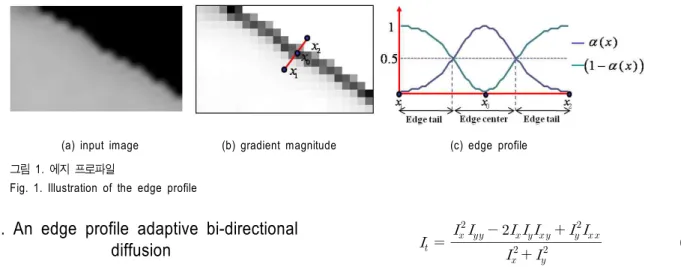
(a) input image (b) gradient magnitude (c) edge profile 그림 1. 에지 프로파일
Fig. 1. Illustration of the edge profile
Ⅲ. An edge profile adaptive bi-directional diffusion
The edges of an image are very important to the visual quality of image and interpolation errors are mainly per- ceived at the edges of image, so we propose an edge profile adaptive bi-directional diffusion method. The selection of diffusion type is determined by the edge profile of the esti- mated HR image to remove jaggies and blurring artifacts simultaneously.
The level set method was first proposed by Osher et al.
[13] and it was used at image interpolation by [11]. The level set equation is written as follows:
∥∇ ∥ (1)
, where is curvature and is the level set flow that caus- es the level set to move in the direction of their normal at a speed proportional to their curvature at time . ∇ is image gradient. The curvature can be calculated from lo- cal derivatives of the image intensity and is defined as follows:
(2)
Substituting this into Eq. (1) and replacing ∥∇ ∥ as
, then level set flow is defined as follows:
(4)
Although jaggies artifact has been successfully removed by using level set method, there is still blurring artifact across the edges. Therefore, [12] coupled anisotropic dif- fusion with shock filter to reduce jaggies and blurring arti- facts simultaneously. Shock filter is an effective method for sharpening edges [14] and it is defined as follows:
∥∇ ∥ (5)
, where is the direction of the image gradient and
is defined as follows:
(6)
Alvarex et al. [12] proposed a new class of filter for edge enhancement by coupling shock filter to the aniso- tropic diffusion with a balancing weight between the shock filter and the anisotropic diffusion. This filter is modeled as follows:
∥∇ ∥ (7)
, where is a balancing weight (positive constant) and
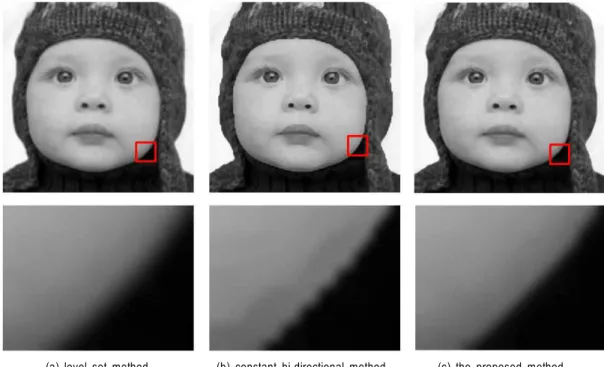
ring artifacts in the image have been removed, this meth- od results in a false piecewise constant image as shown in Fig. 2 (b) because it is not adaptive with respect to image region. Since it is limited to the minimum and maximum gray value of the original image and uses a constant balancing weight, it enhances everywhere and results in unnatural image in some areas. Therefore, we propose a new bi-directional diffusion method for image interpolation which is adaptive to the edge profile. The shock filter (backward diffusion) is performed in the gra- dient direction to the edge tail, incorporating a level set method (forward diffusion) in the isophote line direction to the edge center. The edge profile is a 1-D profile along the gradient direction of the zero crossing pixel in image.
In the edge profile, we let the position of maximum gra- dient magnitude as where zero crossing occurs.
Starting from , we trace a path along the gradient di- rection until the gradient magnitude does not decrease anymore. We refer this 1-D path as the edge profile. The edge profile is divided into two type different regions ac- cording to the gradient magnitude. Since each edge pro- file has different absolute gradient magnitudes, it is not appropriate to use fixed gradient magnitude for dividing edge profile into two regions. We normalize edge profile with maximum gradient magnitude ∥ ∇
∥ . The re- gion which has larger normalized gradient magnitude than 0.5 is denoted as “edge center” and the other region is denoted as “edge tail”. Fig. 1 (a) is input image and Fig. 1 (b) is gradient magnitude image. Fig. 1 (c) is cor- responding edge profile . Our observation is that the blurring artifact is mainly perceived at the edge tail,
∥∇ ∥
, where is positive constant and we set it as
experimentally. The edge profile, , is balancing weight function between shock filter and level set, and it is defined as follows:
∥ ∇ ∥
∥∇ ∥
(9)
The first term on the right of Eq. (8) is used to perform a level set at the edge center according to the weight function and the second term is introduced to perform shock filter at the edge tail according to the weight function . The third term is fidelity term which enforce estimated HR image is close to origi- nal LR image, where describes the process of low pass filtering and down sampling and is original LR image.
For the initial HR image (
), we use bilinear inter- polation method. By coupling shock filter with level set, we develop an edge profile adaptive bi-directional inter- polation method. The proposed method is able to remove the jaggies and blurring artifacts at the edge, and also produces more natural image than [12] as shown in Fig.
2. More importantly, traditional image sharpening meth-
ods mainly increase the gray level difference across the
edges, while its width remains unchanged. However, the
proposed method increases the gray level difference
across the edges and also reduces width iteratively by us-
ing the edge profile as shown in Fig. 3.
(a) level set method (b) constant bi-directional method (c) the proposed method 그림 2. PDE 기반의 보간법 비교
Fig. 2. Comparison of PDE based interpolation
(a) the first iteration (b) edge center (level set) (c) edge tail (shock filter)
(d) the tenth iteration (e) edge center (level set) (f) edge tail (shock filter) 그림 3. 반복적 양지향성 확산 보간법
Fig. 3. Iterative bi-direction diffusion interpolation: jaggies artifact is reduced at the edge center (b) and (e). Increasing the gray level difference
by reducing the width of edge tail (c) and (f).
bicubic method [16]
TV based method [5]
edge directed method [3]
learning method [9]
constant bi-directional method [12]
The proposed method
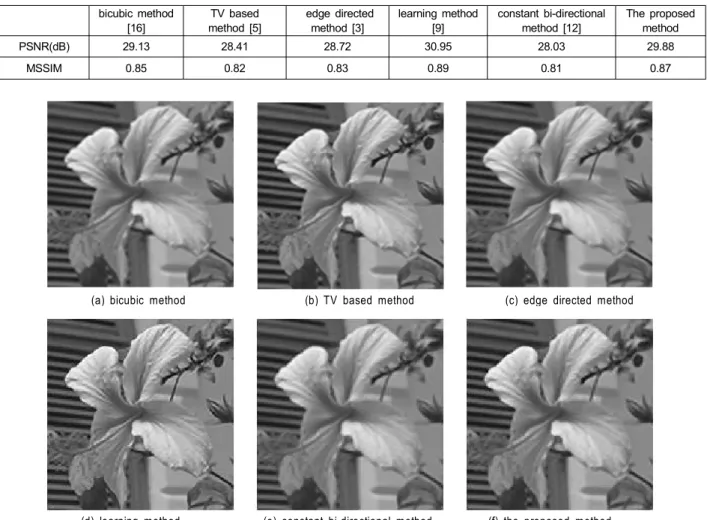
PSNR(dB) 29.13 28.41 28.72 30.95 28.03 29.88
MSSIM 0.85 0.82 0.83 0.89 0.81 0.87
표 1. 성능 비교
Table 1. Comparison of performance
(a) bicubic method (b) TV based method (c) edge directed method
(d) learning method (e) constant bi-directional method (f) the proposed method 그림 4. “flower image" 실험결과
Fig. 4. Results of “flower image”
method [5], edge directed method [3], constant bi-direc- tional method [12], and learning based method [9]. In or- der to evaluate performance measure, we reduce the origi- nal image by a factor 2, using lowpass filtering followed
MSSIM approximates the perceived visual quality of an
image [17]. MSSIM index takes values in [0,1]. It in-
creases as the visual quality increases and can be calcu-
lated as follows:
(a) bicubic method (b) TV based method (c) edge directed method
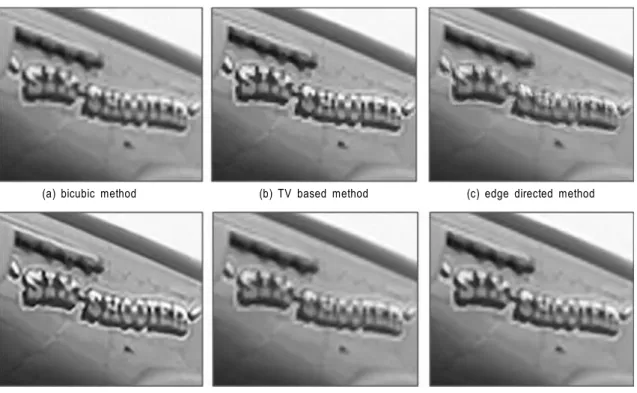
(d) learning method (e) constant bi-directional method (f) the proposed method 그림 5. “Text image" 실험결과
Fig. 5. Results of “Text image”