40(10), 1353~1360(2011) http://dx.doi.org/10.3746/jkfn.2011.40.10.1353
만병초 추출물의 식중독 유발균에 대한 항균효과 및 항산화활성
최무영1†․임태진2
1
상지대학교 식품영양학과
2
상지대학교 동물생명자원학부
Antimicrobial Effects against Food-Borne Pathogens and Antioxidant Activity of Rhododendron brachycarpum Extract
Moo-Young Choi1†and Tae-Jin Rhim2
1Dept. of Food and Nutrition and 2Dept. of Biotechnology in Division of Animal and Life Resources, Sangji University, Gangwon 220-702, Korea
Abstract
This study was performed to investigate the antimicrobial effects against food-borne pathogens and anti- oxidant activity of Rhododendron brachycarpum ethanol-extract. The antimicrobial activity of the extract was determined using a paper disc-diffusion method, and the diameter of the clear zone was measured. The diameter of the clear zone in the presence of 10 mg of extract was maximal against Bacillus cereus among the three tested Gram-positive bacteria and against Escherichia coli O157:H7 among the five tested Gram-negative bacteria. Analysis of the minimum inhibitory concentration (MIC) showed that the extract exhibited a similar efficacy as that of sorbic acid, a well-known chemical preservative. The growth inhibitory effects of the extract at concentrations of 250, 500, 1,000, and 2,000 mg/L on food-borne pathogens were determined against Staphylo- coccus aureus, Listeria monocytogenes, Salmonella Typhimurium, and Escherichia coli O157:H7. Growth of the microorganisms was not affected by the extract at concentrations up to 250 mg/L, but it was significantly (p<
0.05) inhibited by the extract at concentrations higher than 1,000 mg/L. The antioxidant effects of the extract were examined via measurement of DPPH radical scavenging activity, inhibition of reactive oxygen species (ROS) generation using fluorescent dichlorofluorescien (DCF) assay, and prevention of peroxyl radical- and hydroxyl radical-induced supercoiled DNA breakage. The IC
50of the extract for DPPH radical scavenging activ- ity was about half that of α-tocopherol, which was used as a positive control. DCF fluorescence intensity de- creased as the concentration of the extract increased, demonstrating that ROS generation was inhibited in a concentration-dependent manner. The ROS inhibitory effect of the extract was higher than that of ascorbic acid.
The extract prevented supercoiled DNA strand breakage induced by peroxyl radical and hydroxyl radical. Thus, the results of the present study demonstrate that the extract exhibits antimicrobial effects against food-borne pathogens as well as potent antioxidant capacity, suggesting that R. brachycarpum could be used as a natural antibacterial agent and effective antioxidant in food.
Key words: Rhododendron brachycarpum, antimicrobial activity, paper disc-diffusion, DPPH radical scavenging, ROS, supercoiled DNA breakage
†
Corresponding author. E-mail: [email protected]
†
Phone: 82-33-730-0497, Fax: 82-33-738-7652
서 론
최근 식생활의 간편화나 다양화와 더불어 단체급식이나 외식의 기회가 많아지며, 또한, 지구 온난화 현상 및 실내온 도 상승 등 환경변화로 인하여 국내·외 가공식품, 냉동 및 냉장식품과 즉석식품에서 다양한 유해 미생물에 의해 야기 되는 식중독 사고는 증가하고 규모면에서도 집단화·대형화 하고 있는 실정이다. 식품의 부패 및 변질은 주로 미생물 작용에 의해 일어나는데, 이를 방지하기 위해 식품보존제나 방부제 등 다양한 방법들을 사용하여 저장기간의 연장을 시
도하고 있다. 근래에는 소비자의 건강 지향적 요구가 증대되 어 인공합성보존제의 기피현상이 사회전반에서 일어나고 있으며, 또 안정성이 문제시되는 인공합성보존제 대신에 천 연소재로부터 얻은 천연성 성분, 즉 항균성 물질을 이용하여 식품저장 중 일어나는 식품의 변질을 방지하여 식품의 신선 함과 안정성을 동시에 만족시키려는 노력이 수반되고 있다.
따라서 식용 및 약용으로 이용되고 있는 천연물을 이용하여 천연보존제 개발에 대한 많은 연구들이 활발히 진행되고 있 다(1-6).
한편, 인체 내의 자유라디칼은 주로 노화와 질병의 원인으
로 알려져 있는데, 이러한 산화적 손상으로부터 생체조직을 보호하기 위해서는 계속적인 항산화영양소나 항산화제의 섭취가 필요하다(7). 항산화제는 인체 내의 대사과정에서 발 생하는 유해한 활성산소에 의한 지질의 과산화반응 등의 산 화작용을 억제하여 세포막 및 적혈구 파괴를 방지하고, 발암 물질의 생성을 억제하고, 세포의 노화를 억제하는 물질로써, 천연항산화제와 합성항산화제가 있다. BHA(butylated hy- droxyanisole), BHT(butylated hydroxytoluene)와 같은 합 성항산화제는 우수한 항산화능력을 있지만, 과량으로 섭취 할 경우 암 유발 가능성 등의 안정성이 논란이 되고 있다.
따라서 천연물질로부터 안정성과 항산화력이 우수한 물질 을 탐색하는 노력과 항산화제 개발을 위한 연구가 활발히 행해지고 있다(8,9).
만병초(
Rhododendron brachycarpum)는 진달래과 식물 로 별칭으로는 천상초, 뚝갈나무, 풍엽 등 여러 이름으로 불 리고 있다. 우리나라에는 태백산, 지리산 등 해발 700 m가 넘는 곳에서 자란다. 이 만병초는 민간에서는 위, 장의 경련 에 의해 생기는 요배산통, 관절통, 월경불순, 신경통, 고혈압, 강장제, 이뇨제로 효과가 있다. 현재까지 만병초의 재배육종 및 수종의 생육환경에 대한 연구(10)와 flavonoid의 분리 (11), 사람의 암 세포주 등에 대한 세포독성(12)에 대한 연구 가 있으나, 생약학적 기능이나 생리활성 등에 대한 연구는 거의 미비한 실정이다.
따라서 본 연구는 천연보존제 및 항산화제 개발을 위한 연구의 일환으로 만병초를 이용하여 식중독 유발균에 대한 항균력 및 항산화 효과를 검증하여, 새로운 기능성식품이나 식품첨가물 소재로서의 개발가능성을 조사하였다.
재료 및 방법
재료
본 실험에 사용한 만병초는 강원도 태백의 만병초 재배농 가에서 건조된 것을 구입하여 시료로 사용하였다.
사용균주 및 배지
만병초 추출물의 항균실험에 사용한 식중독 유발균주는 그람양성 3균주(
Bacillus cereusKCTC 1012,
Staphylococcus aureusKCTC 1928 및
Listeria monocytogenesKCTC 3569)와 그람음성 5균주(
SalmonellaTyphimurium ATCC 14028,
Yersinia enterocoliticaATCC 23715,
SalmonellaCholeraesuis ATCC 2931,
Escherichia coliKCTC 2441 및
Escherichia coliO157:H7 ATCC 43895) 총 8균주를 사용하 였다. 균의 생육배지로는 모든 균주에 대하여 tryptic soy broth(TSB, BD, Sparks, MD, USA)를 사용하여 30
oC incubator에서 18∼24시간 배양하였다. 항균성 실험에 사용 한 고체배지는 tryptic soy agar(TSA, BD)이었다.
항균성물질의 추출
건조된 만병초 164.8 g을 마쇄하여 수직으로 환류냉각관 을 부착시킨 round flask에 넣어 95% 에탄올(Daejung Chemical & Metals Co., Gyeonggi-do, Korea)을 첨가하여 혼합한 후 heating mantle(E105, Minsung Scientific Co., Seoul, Korea)로 80
oC에서 4시간 강열 환류 추출하였다. 이 과정을 3회 반복하여 얻은 추출액을 여과지(Whatman No.
1)로 여과하여 불순물을 제거하였다. 여과된 용액은 감압농 축기(Eyela N-1 NW, Rikakikai Co., Tokyo, Japan)를 사용 하여 45
oC에서 감압, 농축하였다. 이 농축물을 동결건조기 (Eyela FUD-1200, Rikakikai Co.)로 동결 건조시킨 후 적당 한 농도로 희석하여 사용하였다. 이때 조추출물의 회수량은 26.76 g이었다.
만병초 추출물의 항균활성 측정
항균효과 실험을 하기 위하여 paper disc-diffusion method (13)를 사용하였다. 각 시험균주는 사면배지에서 배양된 것 을 1 백금이를 취하여 10 mL의 TSB배지에 접종한 후 30
oC shaking incubator에서 24시간 배양하였다. 배양한 각 균주 100 μL를 petri dish에 넣고 여기에 멸균된 TSA배지 10 mL 를 분주하여 고루 섞은 후에 완전히 굳힌 다음 멸균된 8-mm paper disc(Roshi Kaisha Ltd., Tokyo, Japan)를 배지표면에 얹고 밀착시킨 후 추출물(2.5, 5.0, 10.0 mg)을 DMSO로 녹인 후 흡수시켜 건조시킨 다음 30
oC incubator에서 24시간 배양 하여 paper disc 주위의 저해환(mm)의 크기를 측정하여 항 균력을 비교하였다. 대조군은 DMSO를 사용하여 동일한 방 법으로 점적하였다.
최소저해농도 측정
최소저해농도(minimum inhibitory concentration, MIC) 는 Choi 등(14)의 방법에 따라 측정하였다. 추출물의 함량이 50 mg/L 간격으로 들어있는 TSA 고체배지에 사면배지에 서 배양된 각 균주 1 백금이를 취해 접종하여 30
oC에서 24시 간까지 배양한 후 육안으로 관찰하여 미생물이 증식되지 않 는 농도를 MIC로 결정하였다.
미생물의 생육곡선 측정
만병초 추출물을 DMSO로 녹인 후 TSB배지에 250, 500, 1,000, 2,000 mg/L 농도별로 첨가하였다. 각 시험 균주는 사 면배지에서 배양된 것을 1 백금이를 취하여 10 mL의 TSB배 지에 접종한 후 30
oC shaking incubator에서 24시간 배양하 였다. 배양한 배양액을 각 100 μL씩 접종하고(10
6cells/mL) 30
oC에서 72시간 배양하면서 spectrophotometer(Beckman DU650, Fullerton, CA, USA)를 사용하여 6시간마다 660 nm 에서 흡광도를 측정하였고, 추출물을 넣은 broth를 blank로 사용하였다.
1,1-Diphenyl-2-picrylhydrazyl(DPPH) 소거활성 측정
DPPH free radical 소거활성은 Malterud 등(15)의 방법에
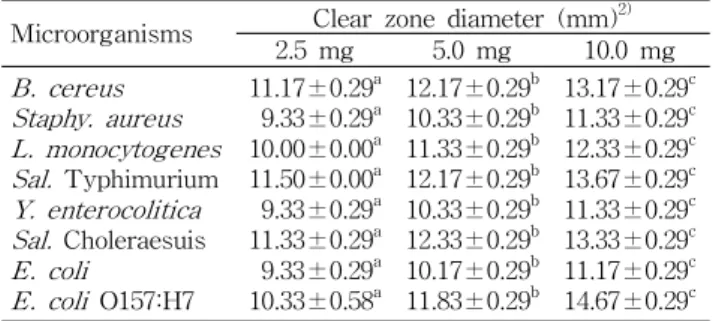
Table 1. Effect of R. brachycarpum ethanol extract on growth inhibiting activities against microorganisms
1)Microorganisms Clear zone diameter (mm)
2)2.5 mg 5.0 mg 10.0 mg
B. cereus Staphy. aureus L. monocytogenes Sal. Typhimurium Y. enterocolitica Sal. Choleraesuis E. coli
E. coli O157:H7
11.17±0.29
a9.33±0.29
a10.00±0.00
a11.50±0.00
a9.33±0.29
a11.33±0.29
a9.33±0.29
a10.33±0.58
a12.17±0.29
b10.33±0.29
b11.33±0.29
b12.17±0.29
b10.33±0.29
b12.33±0.29
b10.17±0.29
b11.83±0.29
b13.17±0.29
c11.33±0.29
c12.33±0.29
c13.67±0.29
c11.33±0.29
c13.33±0.29
c11.17±0.29
c14.67±0.29
c1)
Antimicrobial activity was indicated as diameter of clear zone surrounding paper disc absorbing 2.5, 5.0 or 10.0 mg of soluble solid of R. brachycarpum ethanol extract on TSA plate in- oculated with test microorganisms.
2)
The data are expressed as means±SD of triplicate determi- nations.
a-c
Values with different superscripts within the same row are significantly different at p<0.05.
따라 측정하였다. DPPH 용액(45 μg/mL)을 추출물과 혼합 한 다음 515 nm에서 흡광도의 감소를 30초 간격으로 5분간 측정하였다. Free radical 소거활성은 pyrogallol용액(125 μg/
mL)의 흡광도 감소를 100%로 기준하여 표기하였다. 또한, 양성대조군으로 α-tocopherol을 사용하여 DPPH 소거활성 을 비교 조사하였다.
Reactive oxygen species(ROS) 측정
2',7'-Dichlorofluorescin diacetate(DCFH-DA)로부터 sodium hydroxide 처리에 의해 생성된 DCFH는 ROS에 의 해 dichlorofluorescein(DCF)으로 산화된다. Cell-free sys- tem에서 1 μM H
2O
2와 10 μM FeSO
4로 ROS를 유발시켰다.
추출물과 혼합한 다음 DCF 형성에 따른 형광도 변화는 LeBel 등(16)의 방법에 따라 microplate spectrofluorometer (Gemini XS, Molecular Devices, Sunnyvale, CA, USA)를 사용하여 excitation 파장 488 nm와 emission 파장 525 nm 에서 2분 간격으로 10분간 측정하였다. 형광도 감소는 추출 물 내 항산화물질에 의한 ROS 생성 억제를 나타낸다. 또한, 양성 대조군으로 ascorbic acid를 사용하여 ROS 생성 억제 효과를 비교 조사하였다.
Supercoiled DNA strand 절단
Peroxyl radical에 의한 DNA strand 절단은 Hu 등(17)의 방법에 따라 측정하였다. Supercoiled pBR322 DNA 0.2 μg 에 추출물을 넣고 5 mM 2,2'-azobis(2-methylpropio- namidine) dihydrochloride(AAPH)와 함께 37
oC에서 2시간 배양하였다. 양성 대조군으로 Trolox를 사용하였다.
Hydroxyl radical에 의한 DNA strand 절단은 Hiramoto 등(18)의 방법에 따라 측정하였다. Supercoiled pBR322 DNA 0.2 μg에 추출물을 넣고 0.1 mM H
2O
2와 0.1 mM FeSO
4와 함께 37
oC에서 1시간 배양하였다. 양성 대조군으로 sesamol 을 사용하였다.
배양이 끝난 다음, gel loading buffer를 첨가하고, 0.01%
GelRed nucleic acid stain(Biotium, Hayward, CA, USA)이 포함된 0.8% agarose에서 전기영동을 실시하였다. 자외선 하에서 사진을 촬영한 후, DNA band의 density는 Image J 1.44 program(NIH, Bethesda, MD, USA)을 사용하여 측 정하였으며, 만병초 추출물의 supercoiled DNA strand 절단 억제효과는 supercoiled DNA band의 retention%를 측정함 으로써 조사하였다. Retention%는 [1-(A
sample/A
native)]×100 의 공식으로 계산하였으며, A
sample은 radical과 추출물 처리 시의 supercoiled DNA strand의 양을 나타내며, A
native는 radical과 추출물 무처리 시의 supercoiled DNA strand의 양을 나타낸다.
통계처리
본 실험의 통계분석은 PASW statistics 18.0 program (SPSS Inc., Chicago, IL, USA)을 이용하여 분산분석 하였으 며, 결과는 평균±표준편차로 나타내었다. 실험결과에 대한
유의성 검정은 분산분석을 한 후 p<0.05 수준에서 Duncan's multiple range test를 실시하였다.
결과 및 고찰
만병초 에탄올 추출물의 항균성 검색
Paper disc 방법으로 만병초의 에탄올 추출물을 시험균주 에 적응시켜 항균활성을 측정한 결과는 Table 1과 같다. 각 균주에 대한 항균활성은 disc에 점적한 만병초 추출물의 농 도가 증가함에 따라 항균활성이 높게 나타났다(p<0.05). 그 람양성균인
B. cereus,
Staphy. aureus와
L. monocytogenes에 대해 10 mg/disc에서 저해환의 직경이 각각 13.17±0.29 mm, 11.33±0.29 mm와 12.33±0.29 mm로 나타났고, 그람음 성균인
Sal.Typhimurium,
Sal.Choleraesuis 및
E. coliO157:H7에서는 각각 13.67±0.29 mm, 13.33±0.29 mm 및 14.67±0.29 mm로 나타나, 그람양성균과 그람음성균에서 광범위한 생육 저해 효과가 나타났다. Choi와 Rhim(19)은 개머루덩굴 추출물의 그람양성균인
Staphy. aureus,
L.monocytogenes
와 그람음성균인
Sal.Typhimurium,
Sal.Choleraesuis 및
E. coliO157:H7에 대한 항균력을 보고하였 고, Lee 등(20
)은 매실 착즙액의 농도에 따라 그람양성균과 그람음성균에 대한 항균력 차이가 관찰되었다고 보고한 바 있다. 이와 유사하게 본 실험에서도 만병초 에탄올 추출물의 농도에 따라 항균력의 차이는 다소 있었지만, 식중독 유발균 에 대해 강한 항균력을 나타내었다.
최소저해농도(MIC) 측정
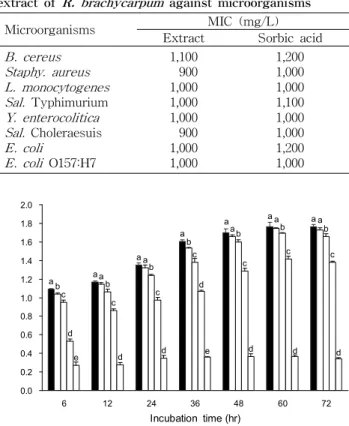
만병초 추출물의 MIC를 측정한 결과는 Table 2와 같다.
사용한 대부분의 그람양성균과 그람음성균에 대한 MIC는 900∼1,000 mg/L로 나타났다. 현재 합성보존료로 많이 사용 하고 있는 sorbic acid의 시험균주에 대한 MIC도 1,000∼
1,200 mg/L로 나타나, 만병초 추출물의 항균활성이 sorbic
Table 2. Minimum inhibitory concentration (MIC) of ethanol extract of R. brachycarpum against microorganisms
Microorganisms MIC (mg/L)
Extract Sorbic acid B. cereus
Staphy. aureus L. monocytogenes Sal. Typhimurium Y. enterocolitica Sal. Choleraesuis E. coli
E. coli O157:H7
1,100 1,000 900 1,000 1,000 1,000 900 1,000
1,200 1,000 1,000 1,100 1,000 1,000 1,200 1,000
a a a a
a a a
a a a b a a b
b b b
c b b c
c c c
d c c
d
d d e d
d d e
0.0 0.2 0.4 0.6 0.8 1.0 1.2 1.4 1.6 1.8 2.0
6 12 24 36 48 60 72
Incubation time (hr)
C e ll g ro w th (O D 6 6 0 n m ) .
Fig. 1. Effects of ethanol extracts of R. brachycarpum on the growth of L. monocytones. Each bar represents the means
± SD of quadruplicate determinations. ■ : control, □ : 250 mg/L,
▨ : 500 mg/L, ▒ : 1,000 mg/L, ▥ : 2,000 mg/L.
a-eValues with differ- ent letters within same group are significantly different at p<0.05.
a a a a
a
a a
b a a a a
a a
c b b b b
b
b c d c
c c c
c
e d d d
d d d
0.0 0.2 0.4 0.6 0.8 1.0 1.2 1.4 1.6 1.8 2.0
6 12 24 36 48 60 72
Incubation time (hr)
C e ll g ro w th ( O D 6 6 0 n m ) .
Fig. 2. Effects of ethanol extracts of R. brachycarpum on the growth of Staphy. aureus. Each bar represents the means±
SD of quadruplicate determinations. ■ : control, □ : 250 mg/L, ▨ : 500 mg/L, ▒ : 1,000 mg/L, ▥ : 2,000 mg/L.
a-eValues with different letters within same group are significantly different at p<0.05.
a a a a a
a a
b b a
b b
a b
b c c c c
b c
d d c
d d c
d e e d e
d e e
0.0 0.2 0.4 0.6 0.8 1.0 1.2 1.4 1.6 1.8 2.0
6 12 24 36 48 60 72
Incubation time (hr)
C e ll g ro w th ( O D 6 6 0 n m ) .
Fig. 3. Effects of ethanol extracts of R. brachycarpum on the growth of Sal. Typhimurium. Each bar represents the means±SD of quadruplicate determinations. ■ : control, □ : 250 mg/L, ▨ : 500 mg/L, ▒ : 1,000 mg/L, ▥ : 2,000 mg/L.
a-eValues with different letters within same group are significantly different at p<0.05.
acid와 유사한 것으로 나타났다.
식중독 유발균 성장에 미치는 영향
최근 빈번하게 발생하는 식중독 유발균 중에서 그람양성 균인
Staphy. aureus와
L. monocytogenes, 그람음성균인
Sal.Typhimurium와
E. coliO157:H7 총 4균주를 선정하여, 각 균주에 대한 성장에 미치는 영향을 조사하였다. Fig. 1에 나타난 바와 같이,
L. monocytogenes의 배양에서 만병초 추 출물을 첨가하지 않은 대조군의 OD
660값은 배양시간에 따라 증가하여 배양 60시간에서는 1.766±0.043로 가장 높게 나타 났다(p<0.05). 그러나 만병초 추출물의 농도가 250과 500 mg/L인 경우, 72시간 배양 후 OD
660값은 각각 1.730±0.020, 1.656±0.034로 나타나 성장억제효과가 관찰되지 않았으나, 2,000 mg/L에서는 OD
660값이 0.339±0.017로 나타나 만병초 추출물이
L. monocytogenes의 성장을 80.1% 억제시켰다 (p<0.05). Jeong 등(21)은 국내산 무화과 완숙과 추출물 25 mg/mL 이상의 농도에서부터
L. monocytogenes의 성장이 억제되었다고 보고한 바 있어, 본 실험에서 사용한 만병초 추출물이 무화과 완숙과 추출물에 비해
L. monocytogenes에 대한 증식억제 효과가 뛰어남을 알 수 있었다.
만병초 에탄올추출물의
Staphy. aureus에 대한 생육저해 정도를 동일한 방법으로 72시간 동안 살펴본 바 Fig. 2와
같다. 만병초 추출물을 첨가하지 않은 대조군의 경우, 배양 후 6시간부터 급속한 균의 증식을 보여 72시간에는 OD
660값 이 최대인 1.772±0.013으로 나타나, 추출물의 첨가 농도가 높을수록 성장이 억제되었다(p<0.05). 2,000 mg/L 첨가군에 서는 배양 12시간에 OD
660값은 0.245±0.022로 나타났지만 배양 72시간에도 OD
660값은 0.268±0.006으로 나타나, 대조 군과 비교하면 84.8%의 성장억제효과를 나타내었다. 따라 서 만병초 추출물의 농도가 높을수록
Staphy. aureus의 성장 을 효율적으로 억제시킬 수 있는 것으로 판단되었다. Chung (22)은 손바닥 선인장 에탄올추출물 농도가 3.0 mg/mL 이상 에서
Staphy. aureus에 대한 증식을 지연시켰다고 보고한 바, 본 실험에서 사용한 만병초 추출물이 손바닥 선인장 추 출물에 비해
Staphy. aureus에 대한 증식억제 효과가 뛰어남 을 알 수 있었다.
만병초 추출물이 그람음성균인
Sal.Typhimurium 생육
저해에 미치는 영향을 측정한 결과는 Fig. 3과 같다. 만병초
a a a a a
a a
b a b b b
a b
c b b c b
b c
d c c d c c d
e d e d
d d e
0.0 0.2 0.4 0.6 0.8 1.0 1.2 1.4 1.6 1.8 2.0
6 12 24 36 48 60 72
Incubation time (hr)
C e ll g ro w th ( O D 6 6 0 n m ) .
Fig. 4. Effects of ethanol extracts of R. brachycarpum on the growth of E. coli O157:H7. Each bar represents the means±
SD of quadruplicate determinations. ■ : control, □ : 250 mg/L, ▨ : 500 mg/L, ▒ : 1,000 mg/L, ▥ : 2,000 mg/L.
a-eValues with different letters within same group are significantly different at p<0.05.
a
b
c
d
d
*
*
0 10 20 30 40 50 60 70 80 90 100
0.1 0.2 0.5 1 2
Concentration (mg/mL)
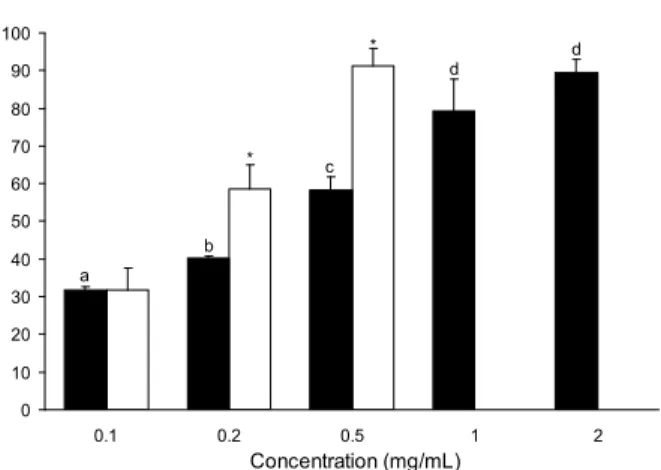
DPPH radical scavenging activity (%) .Fig. 5. DPPH free radical scavenging activities of R. brachy- carpum extracts. Data results were expressed as % radical scavenging activity relative to 100% radical scavenging activity of pyrogallol solution as a reference. Each bar represents the mean±SD of quadruplicate determinations. ■ : extract, □ : α-to- copherol (positive control).
a-dValues with different letters are significantly different at p<0.05.
*p<0.05 when compared with the extract within same group.
추출물이 포함되어 있지 않는 대조군에서는 배양 후 12시간 에 OD
660값이 1.039±0.012, 72시간에는 1.740±0.020으로 나 타나, 배양시간이 경과함에 따라 균의 증식이 증가하였다 (p<0.05). 만병초 추출물의 농도가 높을수록 OD
660값이 감소 하여, 1000 mg/L 농도 첨가 시 배양후 72시간에는 대조군과 비교하여 약 42%의 성장 저해효과를 나타냈다. 특히, 2,000 mg/L 농도를 첨가하였을 경우, 배양 후 72시간에도 OD
660값 이 0.404±0.007로 나타나 대조군에 비해 균의 증식이 약 77% 억제되었다(p<0.05). Bae(23)는 백화사설초의 메탄올 추출물 4,000 ppm 첨가가
Sal.Typhimurium의 증식을 완만 하게 억제시켰다고 보고하였으며, 본 실험에서도 만병초 추 출물이
Sal.Typhimurium에 대한 강한 증식억제효과를 나 타내었다.
만병초 추출물이 식중독균의 생육저해에 미치는 영향을 알아보기 위하여
E. coliO157:H7을 이용하여 성장곡선을 측정한 결과는 Fig. 4와 같다. 모든 배양시간에서 만병초 추 출물 500 mg/L 농도까지 OD
660값은 대조군에 비해 차이가 없었다(p>0.05). 만병초 추출물 2,000 mg/L 첨가군에서 배 양 72시간의 OD
660값은 0.316±0.007로 나타나, 대조군에 비 해 균의 증식이 약 80% 억제되었다(p<0.05). Park(24)은 향 신료로 이용되고 있는 오레가노 0.5% 이상 농도에서
E. coliO157:H7의 성장이 감소한다고 보고한 바 있고, Yang 등(25) 은 우수한 항균활성을 지닌 백운풀이
E. coliO157:H7에 대 해서는 항균효과를 나타내지 않았다고 보고한 바 있다. 그러 나 본 연구에서는 만병초 추출물이
E. coliO157:H7균의 성 장을 효율적으로 억제시켰다. 따라서 본 연구에서는 특정 식중독균을 대상으로 만병초 추출물의 항균활성을 조사하 였으나, 추후 보다 광범위한 식중독 유발 세균에 대한 항균 성 검색이 필요하리라 사료된다.
DPPH radical 소거활성
만병초 추출물의 농도별 DPPH radical 소거활성은 Fig.
5에 나타나 있다. Pyrogallol의 억제율을 100%로 기준하였
을 때 만병초 추출물의 0.1 mg/mL 농도에서 DPPH radical 소거활성은 31.7±1.0%이었고, 추출물 농도가 증가할수록 소거활성도 증가하여 0.2, 0.5, 1 및 2 mg/mL 농도의 추출물 은 각각 40.2±0.8, 58.2±3.7, 79.3±8.5 및 89.6±3.5%의 소거 활성을 나타내었다. 양성 대조군으로 사용된 α-tocopherol의 0.1, 0.2 및 0.5 mg/mL에서 DPPH 소거활성은 각각 31.8±5.7, 58.6±6.4 및 91.3±4.7%로 나타나, 농도가 증가함에 따라 만병초 추출물의 소거활성이 α-tocopherol에 비해 낮았다 (p<0.05). 추출물 농도와 DPPH radical 소거활성 간의 회귀 분석 결과 50%의 radical 소거활성에 필요한 만병초 추출물 의 농도(IC
50)는 0.43 mg/mL로 나타났다. α-Tocopherol의 DPPH IC
50이 0.2 mg/mL인 것과 비교해 볼 때, 만병초 추출 물의 DPPH radical 소거활성이 α-tocopherol의 약 절반임을 알 수 있었다. Park 등(26)은 만병초 추출물의 50% 에탄올 분획의 DPPH 소거활성이 α-tocopherol의 약 40%라고 보고 하여, 본 연구에서도 이와 유사한 결과가 관찰되었다. 그러 나 만병초 추출물의 ethyl acetate 분획의 DPPH radical 소 거활성은 α-tocopherol에 비해 월등히 높게 보고되었다(26).
ROS 생성 억제효과
만병초 추출물의 농도별 ROS 생성 억제에 미치는 효과는 Fig. 6에 나타나 있다. FeSO
4/H
2O
2에 의해 생성된 ROS에 의해 DCFH는 DCF로 산화되며, 이에 따라 DCF 형광도가 증가하게 된다. 따라서 추출물 내 항산화물질이 존재하는 경우, 추출물 첨가에 의해 항산화물질에 의한 ROS 생성이 억제되어 DCF 형광도가 감소하게 된다.
추출물 무첨가 시 DCFH의 산화에 의한 DCF 형광도는
410.3±7.6이었으며, 만병초 추출물의 0.1 mg/mL 농도에서
DCF 형광도는 357.1±3.6로 추출물 무첨가에 비해 낮게
(p<0.05) 나타났다. 추출물 농도가 증가할수록 DCF 형광도
a
b
c
d
*
*
0 50 100 150 200 250 300 350 400 450
Control 0.1 1 5
Concentration (mg/mL)
Fluorescence intensity (arbitrary unit) .
Fig. 6. The effect of R. brachycarpum extracts on inhibition of ROS generation. DCFH oxidation to DCF by FeSO
4/H
2O
2- induced ROS generation in the absence or presence of the extracts was measured for 10 min. Each bar represents the mean±SD of quadruplicate determinations. ■ : extract, □ : ascorbic acid (positive control).
a-dValues with different letters are significantly different at p<0.05.
*p<0.05 when compared with the extract within same group.
(A)
(B)
Fig. 7. Electrophoresis of pBR322 DNA treated with peroxyl radical and hydroxyl radical in the presence of R. brachy- carpum extracts. (A) peroxyl radical was generated by 5 mM AAPH, (B) hydroxyl radical was generated by 0.1 mM H
2O
2, 0.1 mM FeSO
4. Lane 1, DNA alone; Lane 2, DNA+radical; Lane 3, DNA+radical+0.002 mg/mL extracts; Lane 4, DNA+radical+
0.01 mg/mL extracts; Lane 5, DNA+radical+0.02 mg/mL ex- tracts; Lane 6, DNA+radical+0.1 mg/mL extracts; Lane 7, DNA
+radical+0.2 mg/mL extracts; Lane 8, DNA+radical+0.01 mg/mL Trolox (A) or 0.2 mg/mL sesamol (B). N, nicked DNA;
L, linear DNA; S, supercoiled DNA.
Table 3. Retention percent of supercoiled DNA strand with R. brachycarpum extracts in peroxyl radical- and hydroxyl radical-induced pBR322 plasmid DNA breakage
Retention percent
Peroxyl radical Hydroxyl radical Extract (mg/mL)
0.01 0.02 0.1
Positive control 0.2
1)54.7±6.7
a75.1±5.6
b77.0±4.8
c92.4±1.7
d89.9±4.6
dND 16.7±3.3
a64.5±6.9
b75.9±4.0
c94.7±3.8
dSupercoiled pBR322 DNA were treated with 5 mM AAPH (for peroxyl radical generation) or 0.1 mM H
2O
2, 0.1 mM FeSO
4(for hydroxyl radical generation) in the presence of R. brachy- carpum various extracts or positive control. The supercoiled and open circular forms of plasmid DNA were separated on a 0.8% agarose gel. Retention percent of supercoiled DNA band was calculated as described in Materials and Methods. The val- ues are means±SD of triplicate determinations.
1)
0.01 mg/mL Trolox for peroxyl radical- and 0.2 mg/mL ses- amol for hydroxyl radical-induced supercoiled DNA strand breakage.
a-d
Values in the same column with different superscripts are significantly different (p<0.05). ND, not determined.
는 감소하여 1 및 5 mg/mL 농도의 추출물은 각각 247.9±8.2 및 210.3±4.0으로 나타나, ROS 생성은 농도 의존적으로 억 제되고 있음을 알 수 있었다. 양성 대조군으로 사용된 as- corbic acid의 DCF 형광도는 1 및 5 mg/mL 농도에서 각각 270.0±5.8 및 237.2±13.1로, 만병초 추출물에 비해 높게 나 타나(p<0.05), 만병초 추출물의 ROS 생성 억제효과가 as- corbic acid에 비해 우수한 것을 알 수 있었다.
Supercoiled DNA strand 절단 억제효과
DNA 전기영동을 이용하여 만병초추출물 농도별 peroxyl
radical 및 hydroxyl radical에 의해 유도된 DNA strand 절 단에 미치는 효과는 Fig. 7과 Table 3에 나타나 있다. AAPH 처리에 의해 생성되는 peroxyl radical 존재하에, pBR322 DNA의 supercoiled form은 nicked open circular form 및 linear form으로 전환되었다(Fig. 7A). Peroxyl radical 존재 하에 plasmid DNA를 만병초추출물과 함께 배양하였을 때, 추출물 농도가 증가함에 따라 nicked open circular form은 감소한 반면 supercoiled form은 증가하여, 0.2 mg/mL 농도 의 추출물 첨가 시 DNA band pattern은 native(peroxyl radical 무처리) plasmid DNA band pattern과 유사하게 관 찰되었다(Lane 1 vs 7, Fig. 7A 및 Table 3). 또한, 만병초추 출물(0.2 mg/mL)의 peroxyl radical에 의한 DNA strand breaking 억제효과는 양성대조군으로 사용된 Trolox(0.01 mg/mL)와 차이가 없었다(p>0.05).
Fenton 시약인 H
2O
2와 FeSO
4처리에 의해 생성되는 hy- droxyl radical 존재 하에, pBR322 DNA의 supercoiled form 은 nicked open circular form 및 linear form으로 전환되었 다(Fig. 7B). Hydroxyl radical 존재 하에 plasmid DNA를 만병초추출물과 함께 배양하였을 때, 추출물 농도가 증가함 에 따라 nicked open circular form은 감소한 반면 supercoiled form은 증가하여, 만병초추출물은 농도 의존적으로 hydroxyl radical에 의해 유도된 single-strand 절단을 억제하였다.
Peroxyl radical에 대한 supercoiled DNA 절단 실험결과와
는 달리, 0.01 mg/mL 농도까지의 추출물 첨가는 hydroxyl
radical에 의한 supercoiled DNA strand 절단 억제에 영향을
미치지 않았다. 그러나 양파추출물은 0.01 mg/mL 농도에서
약 50%의 retention을 나타내, 만병초 추출물에 비해 hy-
droxyl radical에 대해 탁월한 supercoiled DNA strand 절단
억제효과가 보고된 바 있다(27). 0.2 mg/mL 농도의 만병초 추출물 첨가 시 hydroxyl radical에 대한 supercoiled DNA 의 retention은 75.9%로 나타나 동일한 농도의 양성대조군 인 sesamol에 의한 retention(94.7%)에 비해 낮았고(p<
0.05), peroxyl radical에 대한 추출물의 retentin(92.4%)보다 도 낮게 나타났다. 따라서 만병초 추출물이 hydroxyl radical 에 비해 peroxyl radical에 의해 유도된 supercoiled DNA 절단 억제효과가 높음을 알 수 있었다.
이상과 같이, 본 연구결과는 만병초 추출물이 식중독 유발 균에 대하여 우수한 항균작용과 free radical에 의해 유도된 산화억제능을 나타내어 만병초가 효과적인 천연보존료 및 항산화제로서 이용될 수 있음을 시사하고 있다.
요 약
본 연구는 만병초 에탄올추출물의 식중독 유발균에 대한 항균효과 및 항산화 활성을 조사하였다. 추출물의 항균활성 은 paper disc 방법으로 조사하였다. 추출물을 10 mg/disc 점적한 후 저해환의 크기를 측정한 결과, 그람양성 3균주 중에서
Bacillus cereus에 대해, 그리고 그람음성 5균주 중 에서
Escherichia coliO157:H7에 대한 항균활성이 가장 좋 았다. 최소 억제 농도(MIC)는 현재 합성보존료로 이용되고 있는 sorbic acid와 비슷하게 나타났다. 또한, 만병초 추출물 이 식중독 유발균의 성장에 미치는 효과를 검정하기 위해
Listeria monocytogenes,
Staphylococcus aureus,
SalmonellaTyphimurium과
Escherichia coliO157:H7의 배양액에 250, 500, 1,000 및 2,000 mg/L 농도로 첨가하여 생육을 조사한 결과, 배양시간 별로 250 mg/L 농도까지는 대조군과 차이가 없었으나, 1,000 mg/L 이상의 농도에서는 균의 증식이 억제 되었다. 만병초 추출물의 항산화 효능을 조사하기 위해 DPPH 라디칼 소거활성, ROS 생성 억제 및 supercoiled DNA strand 절단 억제효과를 측정하였다. Pyrogallol의 억제율을 100%로 기준하였을 때, DPPH 라디칼을 50% 억제시키는데 필요한 만병초 추출물의 농도는 양성대조군인 α-tocopherol 의 약 절반으로 나타났다. 추출물의 농도가 증가할수록 DCF 형광도는 감소하여 ROS 생성이 농도 의존적으로 억제되고 있음을 알 수 있었다. 추출물의 ROS 생성 억제효과는 양성 대조군인 아스코르빈산에 비해 높게 나타났다. 또한, 만병초 추출물은 peroxyl radical 및 hydroxyl radical로 유발된 supercoiled DNA strand 절단을 억제시켰다. 따라서 본 연 구결과는 만병초 추출물이 식중독 유발균에 대하여 우수한 항균작용과 항산화능을 나타내어 만병초가 효과적인 천연 보존료 및 항산화제로서 이용될 수 있음을 시사하고 있다.
감사의 글
이 논문은 2010년도 상지대학교 교내연구비 지원에 의해
연구되었으며 연구비 지원에 감사드립니다.
문 헌