• 검색 결과가 없습니다.

PIV measurement on flow characteristics behind a Tetrapod in uniform flow

N/A
N/A
Protected

Academic year: 2021

Share "PIV measurement on flow characteristics behind a Tetrapod in uniform flow"

Copied!
11
0
0

로드 중.... (전체 텍스트 보기)

전체 글

(1)

,

,

, 40

PIV measurement on flow characteristics behind a Tetrapod in uniform flow

Ok-Sok G IM * and Kyeong-Woo L EE

1

Ministry of Land Transport and Maritime Affairs, Mokpo branch office 1101 okam-dong, Mokpo, 530-831, Korea

1

Division of Ocean System Engineering, Mokpo National Maritime University, Mokpo, 530-729, Korea

Costal regions in Korea often suffer severe damages due to wave-induced disasters, storm surge disasters and so on. therefore, many engineers and researchers have devoted their energy to prevent these costal disasters. The development of artificial reefs including sunken vessels is one of their remarkable achievements and various kind of these artificial upwelling structures have been designed and applied.

However, the flow characteristics around a Tetrapod under the water has not been investigated experimentally. So in this article, in uniform flow of circulating water channel and some different velocities, PIV measurement has been conducted on the flow characteristics behind a Tetrapod. The results were analyzed on the flow characteristics of both cases of a Tetrapod. Therefore, it can be concluded that the both cases have its own distinctive flow characteristics behind the bluff body; Case A has an steep upstream flow pattern. On the contrary, Case B has an developed downstream flow pattern in the near wake of the Tetrapod. The velocity gradient at position x 150mm of Case-A appears gently up and down But, the velocity gradient at the same position of Case-B appears better highly up and down

Key words : Artificial reef, Tetrapod, Particle image velocimetry(PIV), Breakwater, Flow pattern

* Corresponding author: [email protected], Tel: 82-16-614-3001, Fax: 82-61-240-7301

(2)

.

, , , ,

. ,

(Tetrapod, TTP) Hudson(1959), Van der Meer(1988)

. 4

. 1949 NEYRPIC

, 1951

. 50%

,

(Yoo et al., 2007).

, ,

(Jang,

2006). Kim

and Hwang(2006)

.

.

. Yang and Kim(2000, 2001)

.

(Rutecki et al., 1985).

.

(Particl Image Velocimetry, PIV)

.

A B

.

.

Fig. 1 .

100 μm PVC( 1.02) .

.

.

5

2mm .

,

.

Fastcam 1280pci, B&W .

500 (125 Frame/sec)

(3)

1280 1024

, 1/10

( 12 )

. 2

(CACTUS 3.1) .

(1)

.

C

fg

f

i

, g

i

.

n2

i 1

(f

i ___

f

i

) (g

i ___

g

i

)

C

fg

_____________________ (1)

n2

i 1

(f

i ___

f

i

)

2

n2

i 1

(g

i ___

g

i

)

2

1000mm,

300mm ,

20 ( 1 ) .

20 .

.

20mm .

u

0.1m/s(0.0053), 0.2m/s(0.0083), 0.3m/s (0.025) 0.4m/s(0.042) .

.

Fig. 2 .

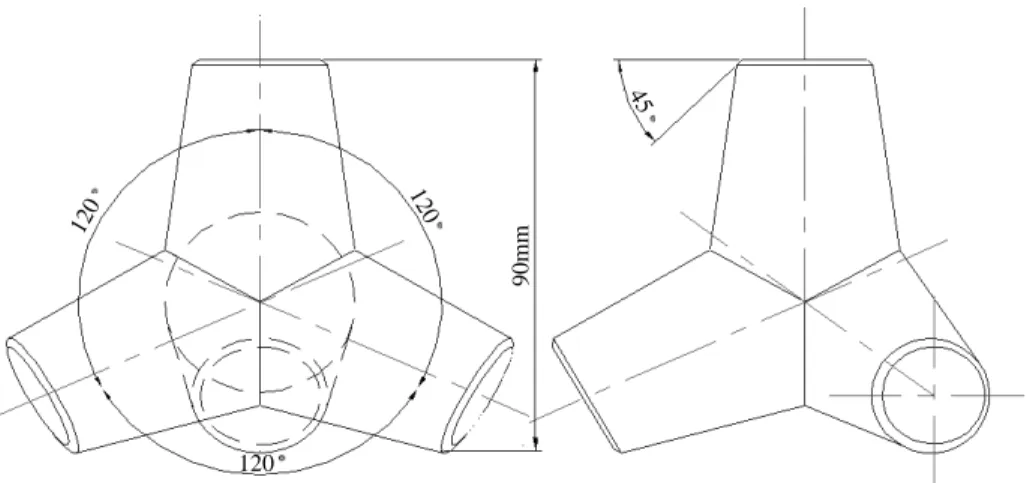
90mm , 4

120

. 3

Fig. 1. Schematic arrangement of PIV system.

Cylindrical Lens

Circulating Water Channel Sheet Light

CCD & Monitoring FAST CAM-X Host Computer, CACTUS 3.1

Argon-Ion Laser

Flow

(4)

2.5mm

.

Fig. 3 2

A B

.

,

3 , 0.5

.

0.1m/s, 0.2m/s, 0.3m/s 0.4m/s

.

1 5

.

X 80 Y 50

.

.

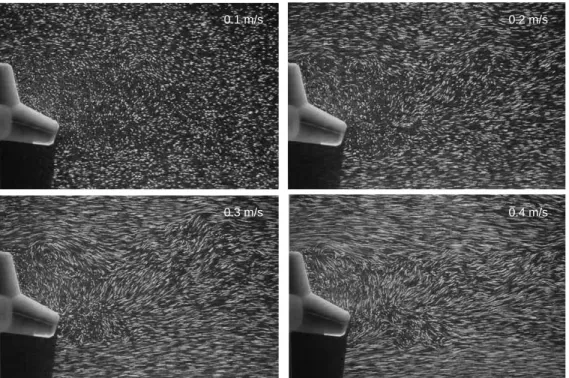
Fig. 4 A

. 0.1m/s

. 0.2m/s

. 0.3m/s 0.2m/s

.

. Fig. 2. Schematic diagram of scaled Tetrapod model; front(left), side(right).

120

120

120

90mm

45

Fig. 3. Configuration of Tetrapod; case-A(left), case-

B(right).

(5)

Fig. 4. Flow visualization of case-A using high resolution camera.

Fig. 5. Flow visualization of case-B using high resolution camera.

0.1 m/s

0.3 m/s 0.4 m/s

0.2 m/s

0.1 m/s

0.3 m/s 0.4 m/s

0.2 m/s

(6)

0.4m/s

.

. Fig. 5 B

. 0.1m/s 0.2m/s A .

. 0.3m/s 0.4m/s

.

.

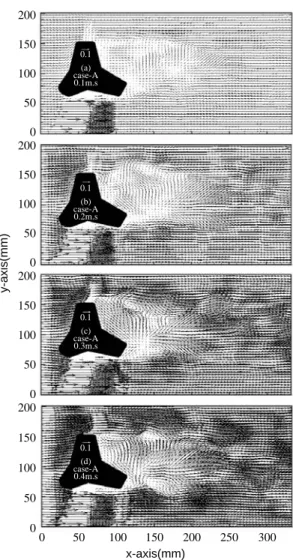
Fig. 6 Fig. 8

(1/10 )

. Fig. 6 A

. ,

, .

.

.

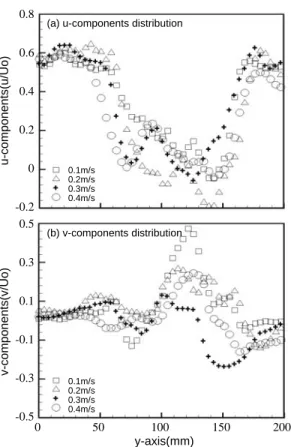
. Fig. 7

x 150mm

u v

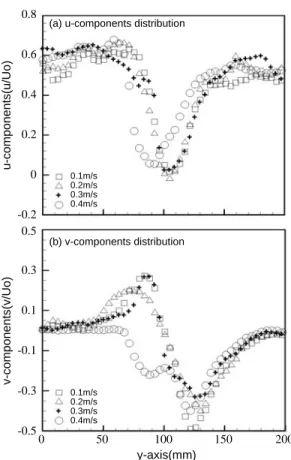
. Fig.

7(a) u y 50 100mm 0.2

. Fig

7(b) v 0.1 m/s y

120

0.2 .

Fig. 8 B A

Fig. 6

. A

. Fig. 6

Fig. 6

Fig. 6. Instantaneous velocity vector field(case-A).

200 150 100 50 0 200 150 100 50 0 200 150 100 50 0 200 150 100 50 0

y-axis(mm)

0.1 (a) case-A 0.1m.s

0.1 (b) case-A 0.2m.s

0.1 (c) case-A 0.3m.s

0.1 case-A (d) 0.4m.s

x-axis(mm)

0 50 100 150 200 250 300

(7)

. Fig. 8(b)

Fig.

8(c)(d)

.

Fig. 9 Fig. 7 u,v

. Fig. 9(a) u Fig. 7(a)

. Fig. 9(a) Fig. 7(a)

. Fig. 9(b) v

, Fig. 7(b)

y 125mm . v

0.5 0.3 A

Fig. 7(b) . ,

u

v .

Fig. 10 Fig. 13

u,v .

.

Fig. 8. Instantaneous velocity vector field(case-B).

200 150 100 50 0 200 150 100 50 0 200 150 100 50 0 200 150 100 50 0

y-axis(mm)

0.1 (a) case-B 0.1m.s

0.1 (b) case-B 0.2m.s

0.1 case-B (c) 0.3m.s

0.1 case-B (d) 0.4m.s

x-axis(mm)

0 50 100 150 200 250 300

Fig. 7. Instantaneous u,v components distribution as a function of inflow at x 150mm(case A).

0 50 100 150 200

y-axis(mm) (a) u-components distribution

0.1m/s 0.2m/s 0.3m/s 0.4m/s

0.1m/s 0.2m/s 0.3m/s 0.4m/s

(b) v-components distribution

u-components(u/Uo) v-components(v/Uo)

0.8

0.6

0.4

0.2

0

-0.2 0.5

0.3

0.1

-0.1

-0.3

-0.5

(8)

4 500 (125frame /sec)

. Fig. 10 A

, . , Fig. 10 Fig. 6 40

.

. ,

. (x 130,

y 80)

.

3 . ,

. Fig. 11

Fig. 10. Time-mean velocity vector field(case-A).

200 150 100 50 200 0

150 100 50 0 200 150 100 50 0 200 150 100 50 0

y-axis(mm)

0.1 case-A (a) 0.1m.s

0.1 (a) case-A 0.2m.s

0.1 (a) case-A 0.3m.s

0.1 (a) case-A 0.4m.s

x-axis(mm)

0 50 100 150 200 250 300

Fig. 9. Instantaneous u,v components distribution as a function of inflow at x 150mm(case-B).

0 50 100 150 200

y-axis(mm) (a) u-components distribution

0.1m/s 0.2m/s 0.3m/s 0.4m/s

0.1m/s 0.2m/s 0.3m/s 0.4m/s

(b) v-components distribution

u-components(u/Uo) v-components(v/Uo)

0.8

0.6

0.4

0.2

0

-0.2 0.5

0.3

0.1

-0.1

-0.3

-0.5

(9)

x 150mm u, v

. Fig. 11(a)

u , Fig.

7(a) A

u y 50 100mm

, Fig. 13(a)

. Fig. 11(b) v

. 0.1m/s 0.3

0.3m/s 0.2

. 0.2m/s 0.4m/s

0.1 .

Fig. 12 B

. A

.

. Fig. 12(d)

.

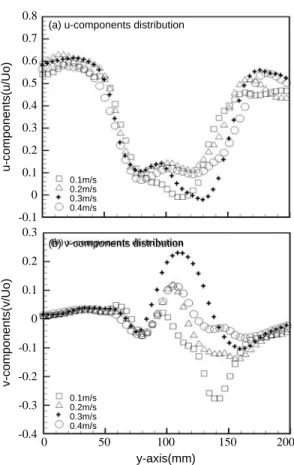
Fig. 13 B u,

v ,

Fig. 12. Time-mean velocity field(case-B).

200 150 100 50 0 200 150 100 50 0 200 150 100 50 0 200 150 100 50 0

y-axis(mm)

0.1 case-B (a) 0.1m.s

0.1 (a) case-B 0.2m.s

0.1 (a) case-B 0.3m.s

0.1 (a) case-B 0.4m.s

x-axis(mm)

0 50 100 150 200 250 300

Fig. 11. Time-mean u,v components distribution as a function of inflow at x 150mm(case-A).

0 50 100 150 200

y-axis(mm) (a) u-components distribution

0.1m/s 0.2m/s 0.3m/s 0.4m/s

0.1m/s 0.2m/s 0.3m/s 0.4m/s

(b) v-components distribution

u-components(u/Uo) v-components(v/Uo)

0.8

0.7

0.6

0.5

0.4

0.3

0.2

0.1

0

-0.1

0.3

0.2

0.1

0

-0.1

-0.2

-0.3

-0.4

(10)

. u

y 150mm

. Fig. 13(b) v , A

.

PIV

4

.

2 . A

. B

.

. 2 PIV

4 3

.

.

Buckley, R.M. and G.J. Hueckel, 1985. Biological processes and ecological development on an artificial feef in Puget Sound, Washington. Bull.

Mar. Sci., 37, 50 69.

Hudson, R. Y., 1959. Laboratory investigation of rubble mound breakwater. Proc. A.S.C.E., 85, 93 121.

Jang, E.S., 2006. Experimental study of stability of Tetrapods armoring sloping breakwater backed by caissons. M. Thesis, Seoul University, Korea, pp.

15 37.

Kim, D.S. and S.B. Hwang, 2006. Characteristics of oceanographic environment in a sea area for the building of artificial upwelling structure. J. the Fig. 13. Time-mean u,v components distribution as a

function of inflow at x 150mm(case-B).

0 50 100 150 200

y-axis(mm) (a) u-components distribution

0.1m/s 0.2m/s 0.3m/s 0.4m/s

0.1m/s 0.2m/s 0.3m/s 0.4m/s

(b) v-components distribution

u-components(u/Uo) v-components(v/Uo)

0.8

0.7

0.6

0.5

0.4

0.3

0.2

0.1

0

-0.1

0.3

0.2

0.1

0

-0.1

-0.2

-0.3

-0.4

(11)

Korean Society of Marine Environment & Safety, 12(1), 9 14.

Van der Meer, J. W., 1988. Stability of cubes, Tetrapods and Accropods. American Society of Civil Engineers, 59 68.

Yang, C.K. and H.J. Kim, 2000. A study on the characteristics of the flow around a sunken vessel. J.

the Korean Society of Ocean Engineers, 14(4), 9 16.

Yang, C.K. and H.J. Kim, 2001. A numerical and experimental study on the flow characteristics

around artificial fisheries reefs by using sunken vessel. J. Ships & Ocean Engineering, 31, 1 10.

Yoo, J.W., M.W. Lee, C.G. Lee, C.S. Kim, J.S. Kim and J.S. Hong, 2007. Evaluation of the effect on cubic artificial reefs in Kyonggi Bay, west coast of Korea by unsing fish trap. J. Kor. Soc. Fish. Tech. 43(2), 126 139.

2008 7 18

2008 7 28 1

2008 8 6

수치

Fig. 1. Schematic arrangement of PIV system.
Fig. 3. Configuration of Tetrapod; case-A(left), case- case-B(right).
Fig. 4. Flow visualization of case-A using high resolution camera.
Fig. 6. Instantaneous velocity vector field(case-A).
+4

참조

관련 문서

In this study, gas turbine engine inlet duct was designed to satisfy uniform flow at aerodynamic interface plane (AIP). The flow characteristics inside the

With regard to this assumption, the flow characteristics by the conventional methods are distorted seriously by both of the eccentricity of the swirl center and

In this study, intake valve angle is selected as a main parameter for the assessment because the main flow direction to cylinder governed by this angle has the strongest

and Mudawar, I., 2005, Two-phase flow in high-heat-flux micro-channel heat sink for refrigeration cooling applications:Part II-heat transfer characteristics,

Abstract: The flow characteristics and heat transfer augment on the periodically arranged semi-circular ribs in a rectangular channel for turbulent flow has

In order to examine flow characteristics according to the shape of the meandering low flow channel in the compound cross section typed straight channel, we assumed the

In this study, the hydrokinetic (HK) model was modified and applied to a 3D sudden contraction-expansion channel flow, and the characteristics of the HK model flow were

Our goal is to show the intermittent characteristics of the acceleration in turbulent channel flow, which is expected to be different from the one in isotropic turbulence,