• 검색 결과가 없습니다.

Bonding Performance of Glulam Reinforced with Textile Type of Glass- and Aramid-Fiber, GFRP and CFRP

N/A
N/A
Protected

Academic year: 2021

Share "Bonding Performance of Glulam Reinforced with Textile Type of Glass- and Aramid-Fiber, GFRP and CFRP"

Copied!
7
0
0

로드 중.... (전체 텍스트 보기)

전체 글

(1)

*1 Received on November 29, 2010; accepted on January 28, 2011

*2 Department of Forest Biomaterials Engineering, College of Forest & Environmental Sciences, Kangwon National University, Chunchon 200-701, Korea

Corresponding author : Soon-Il Hong (e-mail: [email protected])

Bonding Performance of Glulam Reinforced with Textile Type of Glass- and Aramid-Fiber, GFRP and CFRP* 1

Keon-Ho Kim*

2

and Soon-Il Hong*

2†

ABSTRACT

To evaluate the bonding performance of reinforced glulam, the textile type of glass fiber and aramid fiber, and the sheet type of glass fiber reinforced plastic (GFRP) and carbon fiber reinforced plastic (CFRP) were used as reinforcements. The reinforced glulam was manufactured by inserting reinforcement between the outmost and middle lamination of 5ply glulam. The types of adhesives used in this study were polyvinyl acetate resins (MPU500H, and MPU600H), polyurethane resin and resorcinol resin. The block shear strengths of the textile type in glass fiber reinforced glulam using MPU500H and resorcinol resin were higher than 7.1 N/mm

2

, and these glulams passed the wood failure requirement of Korean standards (KS). In case of the sheet types, GFRP reinforced glulams using MPU500H, polyurethane resin and resorcinol resin, and CFRP reinforced glulams using MPU500H and polyurethane resin passed the re- quirement of KS. The textile type of glass fiber reinforced glulam using resorcinol resin after water and boiling water soaking passed the delamination requirement of KS. The only GFRP reinforced glulam using MPU500H after water soaking passed the delamination requirement of KS. We conclude that the bonding properties of adhesive according to reinforcements are one of the prime factors to determine the bonding performance of the reinforced glulam.

Keywords : Glass fiber reinforced plastic (GFRP), Carbon fiber reinforced plastic (CFRP), Textile type (glass fiber, aramid fiber)

1. INTRODUCTION

Wood used as bending member in wood structure is failed at the tensile part which in- cludes knot and joint. The reinforcement of glu- lam must have especially high stiffness and high modulus of elasticity. The research on fi- ber reinforced plastic (FRP) was done to re-

inforce bending failure (Gilfillan, 2003). Steel

plate or glass fiber reinforced plastic (GFRP) is

used as reinforcement, and then researches on

carbon fiber reinforced plastic (CFRP) and ara-

mid fiber reinforced plastic (AFRP) have been

increased. Researches using FRP in the finger

joint, butt joint and bolted connection has been

progressed.

(2)

(GT) (AT) (GS) (CS)

Fig. 1. Reinforcement Materials (GT-textile type of glass fiber, AT-textile type of aramid fiber, GS-GFRP and CS-CFRP).

There were two typical FRP methods to re- inforce wood. The wet lay-up method is to wrap wood members with fabric reinforcement (Sonti and GangaRao, 1995; GangaRao, 1997).

It may pollute wood surface and wood color by exposing fiber, and prevent wood from being humidified. The second method is to bond FRP pultruded plates to glulam beams, using adhe- sive (Davalos et al., 1992a; Dagher et al., 1996;

Tingley et al., 1997). The bonding performance is one of the important factors to determine the strength of the reinforced glulam using FRP pultruded plates. Therefore, adhesive and bond- ing performance between wood and reinforce- ment have been studied much. The bonding per- formance is divided into mechanical strength and environmental strength. The mechanical strength is resistance to failure of bonded mate- rials against mechanical load, and the environ- mental strength is resistance to failure of bond- ed materials against environment, such as water, rain, humidity, sunlight, Ultraviolet rays, low and high temperature, etc (The adhesion Society of Japan, 1991). Raftery et al. (2009) studied the effects of adhesives on hygrothermal com- pliance after bonding the sheet type of GFRP and wood with adhesives, such as phenol re- sorcinol formaldehyde, melamine urea form- aldehyde, polyurethane and emulsion polymer isocyanate. Davalos e t al. (2000) studied bond- ing parameters by investigating the effects of adhesives under wet-dry exposure condition af-

ter bonding the sheet type of GFRP and wood with adhesives, such as phenol resorcinol form- aldehyde and epoxy. The bonding performance between the sheet type of GFRP and wood has been studied continually, because the sheet type of GFRP is mainly used to reinforce a beam member itself. The textile type of glass fiber is thinner than the sheet type of GFRP, and so can reinforce a connection member in wood structure.

However, the bonding performance between the textile type of glass fiber and wood has not been studied much.

This study was conducted to compare the ef- fects of different types of adhesives on the per- formance of wood-reinforcement bonded inter- faces of reinforced glulam using Larix.

2. MATERIALS and METHODS 2.1. Materials and Reinforcements

The bonding performance of reinforced glu- lam was conducted, using Korea Larix ( Larix kaempferi Carr.). The length, width and thick- ness of lamina was 1,000, 100 and 30 mm, respectively. The average moisture content of lamina was 12.9% and the average specific gravity was 0.52.

In this study, the textile and sheet types of

reinforcements were used. In textile types, glass

fiber (GT) and aramid fiber (AT) were used as

reinforcement materials, and the thickness of

(3)

Type of resin

Shape of reinforcement Textile type Sheet type

GT AT GS CS

MPU500H PVGT PVAT PVGS PVCS MPU600H PSGT PSAT PSGS PSCS Resorcinol Resin RRGT RRAT RRGS RRCS

Polyurethane

Resin PUGT PUAT PUGS PUCS

Table 1. Specimens on reinforcements and adhesives in reinforced glulam

Fig. 2. Production process of specimens for tests.

both reinforcements was 0.5 mm. Glass fiber was 3 mm wide bundle, and aramid fiber was 1.5 mm wide bundle. These fiber bundles were arranged in the shape of grid. The two sheet types of reinforcements were GFRP (GS) and CFRP (CS), of which the thicknesses were 1.3 mm. The difference between textile type and sheet type was the fiber orientation. The fibers of GFRP and CFRP were pultruded in parallel to the direction of length.

2.2. Manufacturing of Reinforced Glulam

Glulam was consisted of five laminae. It was reinforced between the outmost and middle lamination. The size of reinforced glulam was 1,000 mm long and 100 mm wide, and the thickness of reinforcements was 150 + 2t mm (t is the thickness of reinforcement). Glulams were manufactured using different types of reinforce- ments and adhesives. Four different types of ad- hesives were used to test the bonding performance.

The PV specimens were bonded with MPU500H which is polyvinyl acetate resin made in Okong company, and the PS was bonded with MPU 600H. The PU and RR specimens were bonded with polyurethane resin and resorcinol resin, respectively.

2.3. Block Shear Test

The block shear test of the reinforced glulam was done by KS F 3021. In each block shear test, 6 specimens were used and so total speci- men number was 120. The block shear test was conducted, using Instron 4482, and the loading speed was 1 mm/min until the specimens was failed.

2.4. Delamination after Water/Boiling Water Soaking

The delamination performance conducted ac- cording to KS F 3021. Two delamination tests, such as water soaking and boiling water soak- ing, were done. For delamination test, 75 mm long specimens were cut from reinforced glulam.

Four specimens were made for delamination test after water soaking and boiling water soaking, and so the total number of specimens was 160.

To determine the shape of the layer between wood and reinforcement before and after de- lamination test, the microphotos of cross sec- tions of specimens for delamination test were taken, using Microscope MM-40. The micro- photos of delamination were taken at the center and 10 cm apart from the end of adhesive layer in the cross section. After delamination test, the microphotos were taken again.

The specimens for delamination after water

(4)

Table 2. Shear strength of reinforcement-wood interface

Specimens

Shear Strength (N/mm

2

)

Wood failure

(%) Specimens

Shear Strength (N/mm

2

)

Wood failure

(%) Specimens

Shear Strength (N/mm

2

)

Wood failure

(%) Specimens

Shear Strength (N/mm

2

)

Wood failure (%) Ave. Ratio of

strength Ave. Ave. Ratio of

strength Ave. Ave. Ratio of

strength Ave. Ave. Ratio of strength Ave.

PV

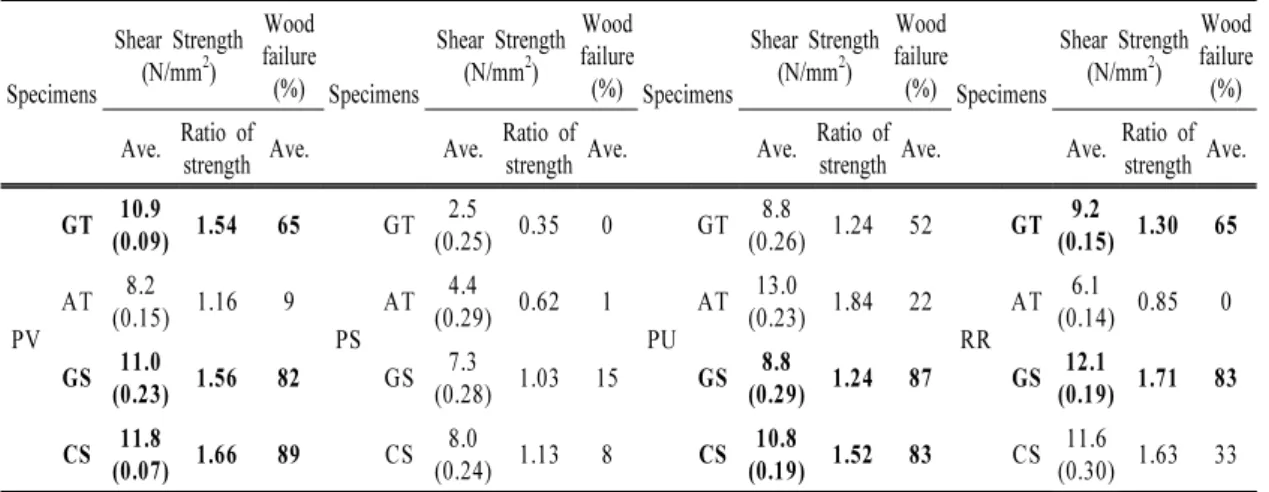
GT 10.9 (0.09) 1.54 65

PS

GT 2.5 (0.25) 0.35 0

PU

GT 8.8 (0.26) 1.24 52

RR

GT 9.2 (0.15) 1.30 65

AT 8.2 (0.15) 1.16 9 AT 4.4 (0.29) 0.62 1 AT 13.0 (0.23) 1.84 22 AT 6.1 (0.14) 0.85 0

GS 11.0 (0.23) 1.56 82 GS 7.3 (0.28) 1.03 15 GS 8.8 (0.29) 1.24 87 GS 12.1 (0.19) 1.71 83

CS 11.8 (0.07) 1.66 89 CS 8.0

(0.24) 1.13 8 CS 10.8 (0.19) 1.52 83 CS 11.6 (0.30) 1.63 33 Note: In the current KS F 3021 standards the allowable shear strength is 7.1 N/mm

2

. The acceptance limit of

wood failure ratio is above 65%. Numbers in bold = passed, parenthesis is coefficient of variation.

(PV-wood failure) (PS-reinforcement failure)

(PU-wood failure) (RR-wood failure) Fig. 3. Photographs of failure of GT reinforced glu-

lams according to types of adhesive.

soaking were soaked for 24 hours at room tem- perature, and then were put into an oven at 73°C for 24 hours. The specimens for de- lamination after boiling water soaking were boiled in boiling water (100°C) for 4 hours and then were soaked in water at about 20°C for an hour. After water soaking, they were put into the oven at 73°C for 24 hours. The de-

lamination of specimens which were wider than 3 mm was measured at the cross section of bonding layer except the crack of wood caused by dry and knots.

3. RESULTS and DISCUSSION 3.1. Block Shear Strength

The block shear strengths of reinforced glu-

lams are shown in Table 2. Shear strengths of

GT specimens were higher than 7.1 N/mm

2

, ex-

cept that of PSGT, which is the shear strength

requirement of Korean Standards Association

(KSA). The wood failure rates of reinforced

glulams using PV resin and RR resin passed the

requirement of KS as higher than 65%, which

is the standard failure requirement of KS. After

shear test, the adhesive layers in the wood fail-

ure of tested PS specimens were cured less,

compared to those of other specimens. In case

of the textile types of glass fibers, PS resin did

not easily penetrate, and Fig. 3 shows that the

failure of GT was caused by the weak cohesion

between bundles of glass fibers in parallel and

(5)

Table 3. Resistance to water soaking delamination on reinforced glulam

Specimens Delamination after water soaking (%) Delamination after boiling water soaking (%)

GT AT GS CS GT AT GS CS

PV

Reinforcement to

wood 14.5 16.2 1.5 4.9 50.4 58.3 45.8 29.2

Wood only 1.6 10.5 2.2 5.9 30.0 61.8 36.1 30.6

PS

Reinforcement to

wood 15.6 4.6 64.0 32.1 33.3 45.4 64.2 51.8

Wood only 54.9 35.9 33.5 8.6 94.9 87.1 73.7 84.6

PU

Reinforcement to

wood 52.6 27.1 22.5 36.4 47.0 55.8 31.5 39.9

Wood only 67.8 57.2 17.2 44.6 79.4 85.1 58.8 91.5

RR

Reinforcement to

wood 1.7 17.6 32.0 21.7 1.6 35.9 33.9 9.5

Wood only 0.0 0.0 0.0 0.0 0.3 0.0 0.0 0.0

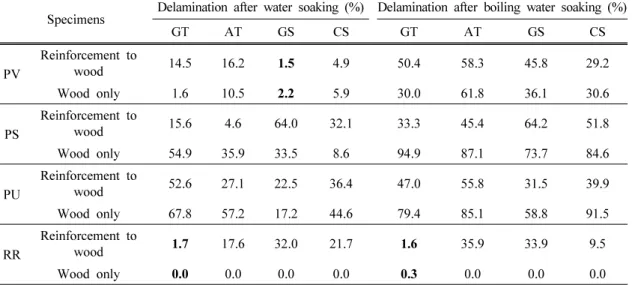
Note : In the current KS F 3021 standards the allowable delamination ratio is 5%. Numbers in bold = passed.

perpendicular to grain. The textile type of ara- mid fiber passed the shear strength requirement of KS except those of PV and PU specimens, but did not pass the wood failure requirement of KS.

The GS reinforced glulams passed the shear strength requirement of KS, and passed the wood failure requirement of KS except those of PS specimens. In case of CS reinforced glu- lams, PV and PU specimens passed the shear strength and wood failure requirement of KS.

Therefore, it is considered that the important factors for the bonding performance of re- inforced glulams are not only shear strength be- tween materials but also cohesion by adhesive between reinforcements.

3.2. Delamination of Reinforced Glulam

The delamination test of reinforced glulams is necessary because the adhesive layer is affected by temperature and humidity fluctuations ac- cording to the service condition and environment.

Table 3 shows the result of delamination test af-

ter water and boiling water soaking according to the types of reinforced glulams. The delamination was worse after boiling water soaking than after water soaking except that of reinforced glulam using RR resin. The delamination after water soaking of the GS reinforced glulam in PV specimens passed as less than 5% according to KS F 3021. GT reinforced glulam using RR resin after water and boiling water soaking passed the delamination requirement of KS on wood to wood and wood to reinforcement. In case of PS and PU specimens, the delamination after water and boiling water soaking did not pass.

3.3. Failure modes of Wood-Reinforcement Interfaces

In case of reinforced glulam using the textile type of reinforcements, the failure modes of ad- hesives were different from those of sheet types in the block shear test and the delamination test.

Based on the result of delamination test, the

failure modes of GT reinforced glulam were ob-

(6)

(a) PVGT (b) PSGT

(c) PUGT (d) RRGT

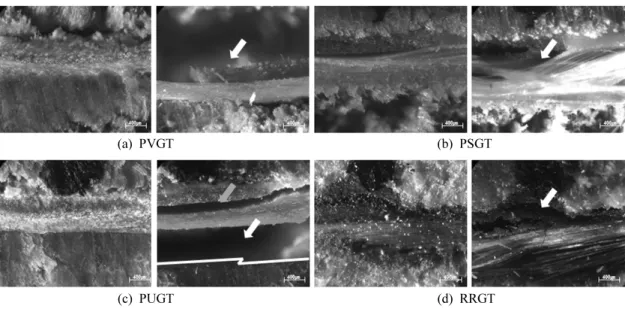
Fig. 4. Micrographs of bonding layer according to types of adhesives in the textile type of glass fiber (note that arrows marked the failure mode of bonding layer).

served, using microscope. PV resin in the GT reinforced glulam penetrated into the bundles of glass fiber, and the GT was hardened like the sheet type. Fig. 4(a) shows that the orthogonal bundles of glass fiber are bonded and hardened due to the good penetration of PV resin. The failure of GT glulam occurred at the adhesive layer between wood and reinforcement (arrow).

For reference, it is more difficult that adhesive penetrates adhesive into aramid fiber than into the glass fiber. The adhesive layers of PS speci- mens were thicker than those of PV specimens, and as shown by the arrow in Fig. 4(b), the failures of the adhesive layers occurred at re- inforcements because it is not easy that PS resin penetrates into the reinforcements. The RR resin in GT specimens penetrates easily into re- inforcements, and the failures of those were caused by the hardened glass fiber broken (arrow in Fig. 4(c)). It is easy that PU resin penetrates into the textile type of glass fiber, but the failures of PU specimens occurred at the adhesive layers between wood and reinforce-

ment (white arrow), and between bundles of glass fibers (gray arrow) due to the weak cohe- sion of PU resin (Fig. 4(d)). Through the micro- photos of specimens, it was observed that the cohesions between textile types of reinforce- ments are important in the bonding perform- ance, and they are affected by the penetration rate into reinforcements.

4. CONCLUSIONS

Based on the block shear test and the de- lamination test, the bonding performance of re- inforced glulam was evaluated, and the follow- ing conclusions were derived from this study.

1) In case of reinforced glulams using the

textile types of reinforcements, GT reinforced

glulams using only PV and RR resin, passed the

block shear strength and wood failure require-

ment of KS. In case of the sheet types, GS re-

inforced glulams using PV, PU and RR resin,

and CS reinforced glulams using PV and PU

resin passed the block shear strength and wood

(7)

failure requirement of KS.

2) The GT reinforced glulam using RR resin passed the delamination requirement of KS after water and boiling water soaking. The only GS reinforced glulam using PV resin passed the de- lamination requirement of KS after water soaking.

This study shows that the bonding perform- ances of reinforced glulams are influenced by resins and reinforcements. In textile types of re- inforcements, the important properties of resins were the hardening and penetration of adhesives.

ACKNOWLEDGEMENT

This research was supported by Basic Science Research Program through the National Research Foundation of Korea (NRF) funded by the Ministry of Education, Science and Technology (2009-0075285).

REFERENCES

1. Gilfillan, J. R., S. G. Gilbert, and G. R. H.

Patrick. 2003. Journal of reinforced Plastics and composites 22(15): 1373∼1388.

2. Sonti, S. S. and H. V. S. GangaRao. 1995. 50th Annual Conf. Composites Institute, Cincinnati.

3. GangaRao, H. V. S. 1997. Wood Des. Focus pp.

13∼18.

4. Davalos, J. F., E. Barbero, and U. Munipalle.

1992. in Structures Congress X, pp. 47∼50, ASCE, SanAntonio, TX.

5. Dagher, H. J., T. Kimball, B. Abdel-Magid, and S. M. Shaler. 1996. National Conf. on Wood Transportation Structures.

6. Tingley, D. A., C. Gai, and E. Giltner. 1997. J.

Compos. Constr. 1(4): 160∼167.

7. HANDBOOK OF ADHESIVES. 1991. Adhesion Society of Japan.

8. Raftery, G. M., A. M. Harte, and P. D. Rodd.

2009. International Journal of Adhesion and Adhesives 29(2): 101∼110.

9. Davalos, J. F., P. Z. Qiao, and B. S. Trimble.

2000. Journal of Composites Technology &

Research, JCTRER 22(4): 224 ∼231.

수치

Fig. 1. Reinforcement Materials (GT-textile type of glass fiber, AT-textile type of aramid fiber, GS-GFRP and CS-CFRP).
Table 1. Specimens on reinforcements and  adhesives in reinforced glulam
Table 2. Shear strength of reinforcement-wood interface Specimens Shear Strength (N/mm2) Wood failure  (%) Specimens Shear Strength (N/mm2) Wood failure  (%) Specimens Shear Strength (N/mm2) Wood failure  (%) Specimens Shear Strength (N/mm2) Wood  failure
Table 3. Resistance to water soaking delamination on reinforced glulam
+2

참조

관련 문서

The purpose of this study was to evaluate the microleakage of composite resins(Filtek ™ Z250), resin-reinforced glass ionomer cements (Fuji II LC ® ), and traditional

Summerscales, "An investigation into the effects of fabric architecture on the processing and properties of fibre reinforced composites produced by resin

Effects of vacuum, mold temperature and cooling rate on mechanical properties of press consolidated glass fiber/PET composite , Composites Part A: Applied Science

However, the short beam strength of the basalt fiber reinforced composites was higher than those of the glass fiber reinforced composites in the case of the Vacuum

Finally the relationship of the weight rate in fiber content of the product and fiber orientation function J and that of the injection molding condition and fiber

Bonding type: covalent, ionic, metallic, van der waals, hydrogen bond Glass has one of those bonding. Glass has one of

local clusters with atomic scale are difficult to identify by conventional observation tools of microstructure.... Free volume and the glass transition Free volume and

– Short fiber or whisker reinforced composites (e.g. Continuous fiber or sheet reinforced MMCs)..