• 검색 결과가 없습니다.

Development Process of FPGA-based Departure from Nucleate Boiling Ratio Algorithm Using Systems Engineering Approach

N/A
N/A
Protected

Academic year: 2021

Share "Development Process of FPGA-based Departure from Nucleate Boiling Ratio Algorithm Using Systems Engineering Approach"

Copied!
8
0
0

로드 중.... (전체 텍스트 보기)

전체 글

(1)

In Sok Hwang, Jae Cheon Jung

*

Department of NPP Engineering, KEPCO International Nuclear Graduate School

Abstract : This paper describes the systems engineering development process for the Departure from Nucleate Boiling Ratio (DNBR) algorithm using FPGA. Current Core Protection Calculator System (CPCS) requirement and DNBR logic are analyzed in the reverse engineering phase and the new FPGA based DNBR algorithm is designed in the re-engineering phase. FPGA based DNBR algorithm is developed by VHSIC Hardware Description Language (VHDL) in the implementation phase and VHDL DNBR software is verified in the software Verification & Validation phase. Test cases are developed to perform the software module test for VHDL software modules. The APR 1400 simulator is used to collect the inputs data in 100%, 75%, and 50% reactor power condition. Test input signals are injected to the software modules following test case tables and output signals are compared with the expected test value. Minimum DNBR value from developed DNBR algorithm is validated by KEPCO E&C CPCS development facility. This paper summarizes the process to develop the FPGA-based DNBR calculation algorithm using systems engineering approach.

Key Words : Core Protection Calculator System, Field Programmable Gate Array, Departure from Nucleate

Boiling Ratio, VHSIC Hardware Description Language, systems engineering

(2)

1. Introduction

It is widely accepted that the complexity of the development life cycle is increasing as technology evolves rapidly. The complexity of system development requires a high degree of understanding of needs, requirements, and makes manufacturing, operation, and maintenance processes more complex. This could increase risk and hinder innovation. The departure from nucleate boiling ratio (DNBR) algorithm in the Core Protection Calculator System (CPCS) is one of the most complex algorithms used in the nuclear power plant safety critical system.

Applying systems engineering approach to DNBR algorithm development could increase the efficiency of life cycle and more thoroughly verify requirements.

The CPCS is to protect the reactor from exceeding the safety limit by monitoring reactor core conditions and to generate the DNBR trip signal and the local power density (LPD) trip signal during plant operation [1]. The DNBR is the ratio between the critical heat flux (CHF) and the maximum local heat flux. If the DNBR is lower than the safety limit, it would cause the formation of vapor layer, causing reduction in heat transfer capability between reactor coolant and fuel rods. The CPCSs are installed in Advanced Power Reactor 1400 (APR1400) such as Shin-Kori Nuclear Power Plants (NPPs) 3&4 and Barakah 1,2,3&4 NPPs in United Arab Emirates (UAE). These systems are developed based on the Programmable Logic Controller (PLC) platform.

The Field Programmable Gate Array (FPGA) is Hardware Description Language (HDL) device, which are a type of large scale integrated

circuit where the internal hardware architecture is configured for a specific application according to the user needs after production of the chip.

FPGA based systems can be made simpler and easier to test and qualify for safety application comparing with PLC based systems. And FPGA supports longer lasting availability and faster response time, and reduces vulnerability to cybersecurity attacks. FPGAs are generally viewed by regulatory bodies as diverse from software based systems, and provide a higher level of diversity due to the different nature of their components [2].

The main objective of this research is to develop the FPGA-based DNBR algorithm using VHSIC Hardware Description Language (VHDL). An in-depth analysis of the current CPCS is performed to identify the whole CPCS algorithm, and new FPGA based DNBR algorithm is designed. 100%, 75%, and 50% reactor power data are obtained using KEPCO Inter- national Nuclear Graduate School (KINGS) APR1400 simulator and used to test the DNBR algorithm. Minimum DNBR value from developed DNBR algorithm is verified by KEPCO E&C CPCS development facility.

2. Methodology

2.1 Vee model for development process

The popular systems engineering Vee diagram

provides a view of life cycle development with

explicit relationships shown between requirements

and systems definition and the developed and

validated product [3]. The Vee model describes

a software systems engineering process from

software concept development to software in-

tegration and test. In order to design the

(3)

development process of FPGA-based DNBR algorithm, the Vee model is designed as shown in figure 1. First, current Advanced Power Reactor 1400 (APR1400) CPCS requirements are identified to understand the system and CPCS specification and software requirement documents are analyzed in reverse engineering process. Current software algorithms are analyzed using CPCS simulator tool. This process cor- responds to the software concept development and analysis, which decompose the current CPCS software to develop the new one. Second, new simplified DNBR algorithm is designed based on the current DNBR software in re- engineering process. System requirements of DNBR algorithm are defined and the simplified DNBR Enhanced Functional Flow Block Diagrams (EFFBDs) are developed using Core 9 software tool. This process corresponds to the software design process. Third, in implementation process, simplified DNBR MATLAB codes are developed based on the EFFBDs. The MATLAB software tool is used to develop and simulate each module of DNBR software algorithm. And MATLAB software codes are converted to the VHDL codes by HDL Coder in MATLAB. This

process corresponds to the software coding process. Fourth, DNBR VHDL codes are verified by test cases and validated with system requirements in V&V and integration process.

2.2 Systems Engineering Management Plan The Systems Engineering Management Plan (SEMP) is the top-level plan for managing the Systems Engineering (SE) effort. The creation of the SEMP involves defining the SE processes, functional analysis approaches, what trade studies will be included in the project, schedule, and organizational roles and responsibilities, to name a few of the more important aspects of the plan [4]. Early in the project, the SEMP should be provided to show how the project will be managed and handled.

In this project, the SEMP defines how the FPGA-based DNBR algorithm project will be organized, structured, conducted, and controlled.

It covers purpose, scope, applicable documents and tools, organization structure, responsibilities, task deliverable, schedule, and work breakdown structure (WBS). Through the project, WBS progress is updated and the SEMP is revised.

The WBS is shown in Figure 2.

2.3 Reverse Engineering Process

Software reverse engineering is the process of analyzing a software system to identify the systems components and their inter relationships and create representations of the system in another form or at a higher level of abstraction [5].

Current APR1400 CPCS requirements are analyzed and listed in reverse engineering process. The CPCS software consists of six interdependent programs: Coolant Mass Flow

[Figure 1] Vee model for FPGA-based CPCS DNBR

algorithm

(4)

Program (FLOW), DNBR and Power Density Update Program (UPDATE), Power Distribution Program (POWER), Static DNBR and Power Density Program (STATIC), Trip Sequence Program (TRIPSEQ), and CEAC Penalty Factor Program [6]. Requirements of each program are used to understand the function, data flow, input, local, and output signals. In order to analyze the software algorithm of CPCS, the Sim Core Simulator is used, which is de- veloped by KHNP to simulate the APR1400 CPCS software.

2.4 Re-Engineering Process

Software re-engineering is the examination and alteration of a subject system to re- constitute it in a new form and the subsequent implementation of the new form [5].

The new simplified DNBR algorithm is designed in re-engineering process. Based on the analysis of current APR1400 CPCS software,

new requirements for simplified DNBR algorithm are defined. System requirements are necessary to design, implement, and verify the new DNBR algorithm. High LPD, CEA Withdrawal Prohibit (CWP), Asymmetric Steam Generator Transient (ASGT) trip, and Variable Overpower Trip (VOPT) are not considered in this paper.

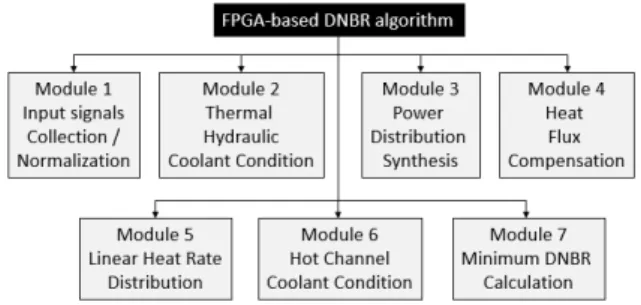
Figure 3 shows the functional architecture of simplifid DNBR algorithm which consists of seven modules. The Module 1 receives all input signals and normalizes them to use in this algorithm. Pressurizer pressure, reactor coolant pump speed, ex-core detector, cold leg temperature, hot leg temperature, and CEA positions are transmitted from instrumentation to the module 1. The normalized input signals are used for all modules. The Module 2 calculates thermal hydraulic coolant condition.

It generates enthalpy-temperature ratio of water feeding steam generator 1 & 2, pumps legs 1 & 2, and normalized average cold leg specific volume. The module 3 receives CEA position and normalized ex-core detector power and generates relative power in axial nodes of pseudo hot pin and average of hot pin power distribution. The module 4 performs heat flux compensation and calculates maximum com- pensated core average power (FCALC1). The module 5 calculates hot pin heat flux distribution

[Figure 2] WBS Structure

[Figure 3] Functional architecture

(5)

and linear heat rate distribution. The module 6 receives hot pin heat flux distribution and linear heat rate distribution and calculates corrected mass flux for hot channel and enthalpy for hot channel. Final module 7 calculates all DNBR values and selects minimum DNBR value.

In re-engineering process, EFFBDs are developed for seven modules of new DNBR algorithm using Core 9 software. It represents the flow of control through sequencing of functions and constructs as well as the data interactions overlaid to present a more com- plete picture [7]. Figure 4 shows an EFFBD of Module 4 “Heat flux compensation” which describes input signals, output signals, functions, and flow controls.

2.5 Implementation Processs

Based on the functional block diagram and modeling diagram which are generated in re-engineering process, all seven modules are developed using Matlab software tool. Input and output signals are defined in codes and function is developed in each module. Output signals of each module are verified by com- paring with Sim Core simulator data.

After developing matlab software codes, these matlab codes are converted to the VHDL

using HDL coder of matlab software. Test bench is needed to convert from matlab code to VHDL code. These VHDL codes can be implemented in FPGA board.

2.6 V&V and Integration Process

This process is to verify and validate the implementation of CPCS DNBR algorithm based FPGA for the software level as the safety critical software for this system, to specify systematic approach to be used as a tools for the software engineering process of digital computer based I&C system. Software verification and validation is recommended by IEEE 1012-2012 and software V&V is associated with software life cycle [8]. DNBR algorithm verification process is performed by system verification plan and DNBR algorithm validation by system validation plan.

3. Verification

Verification activities are performed as follow sequence.

1) Get input data from KINGS APR1400 simulator

2) Develop test cases for seven modules 3) Perform software module test for seven

VHDL modules

4) Compare test outputs with KEPCO-ENC CPCS development facility output

3.1 Software Module Test Cases

The KINGS APR1400 simulator is used to collect the inputs data and the final minimum DNBR at 100%, 75%, and 50% of reactor power. Four reactor coolant pump speed, cold leg temperature, hot leg temperature, primary

[Figure 4] EFFBD of Module 4

(6)

pressure, ex-core neutron flux, and CEA subgroups position are selected to develop the software module test cases. These input data are inserted to predeveloped Matlab algorithm to check the outputs for each module for verifying the results from VIVADO. Each module has different inputs and outputs at each power level. One of software module test cases is described in table 1. The input signals are inserted to predeveloped Matlab algorithm to check the outputs for each modules to be the references for verifying the results from VIVADO.

3.2 Software Simulation

Module test case inputs are inserted to VIVADO simulator to verify the outputs with Matlab results. The input values are converted to hexadecimal equivalent representation ac- cording to the designed word length and fraction length. When input values are entered to the

VHDL software modules in hexadecimal by test case, hexadecimal output values are displayed in VIVADO simulation and written in the test result report.

3.3 Comparison with KEPCO E&C CPCS development facility

The KEPCO E&C CPCS development facility has been used to develop, verify and validate the CPCS software for Shin-kori 3&4 and Barakah Nuclear Power Plants 1,2,3&4. Input and output information of KEPCO E&C CPCS development facility could be used to compare with input and output signals of FPGA based DNBR algorithm. Final minimum DNBR values are verified comparing with CPCS development facility’s DNBR outputs.

4. Results

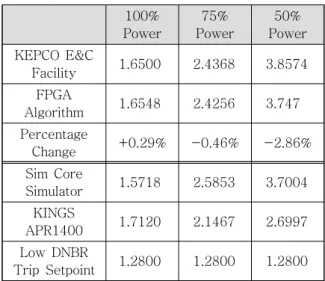
Table 2 shows the minimum DNBR values of FPGA based DNBR algorithm, KEPCO E&C facility, percentage change, and low DNBR trip setpoint.

<Table 1> Software module test case

Module 2 Thermal Hydraulic Coolant Condition Input signal Output signal Name Value (hexa) Name Value (hexa)

TCMAX 22B.5 HIN 22B.0

PR 8CD.6 HFG 19F.D

TH1 266.A HF 2BD.A

TH2 266.C VIN 0.058

TC1 22B.4 GIN 2F1.0

TC2 22B.5 M5 1.06E

TH 266.B M6 1.06E

N1 1 MC 1.06E

N2 1 XL FFFF.A3E1

N3 1 CPOUT1 1.086

N4 1 CPOUT2 1.086

TC 22B.5 CPIN1 0.0FF0

CPIN2 0.0FF0

VC 0.F9B8

<Table 2> Comparison minimum DNBR with KEPCO E&C facility

100%

Power 75%

Power 50%

Power KEPCO E&C

Facility 1.6500 2.4368 3.8574 Algorithm FPGA 1.6548 2.4256 3.747

Percentage

Change +0.29% -0.46% -2.86%

Sim Core

Simulator 1.5718 2.5853 3.7004 KINGS

APR1400 1.7120 2.1467 2.6997

Low DNBR

Trip Setpoint 1.2800 1.2800 1.2800

(7)

The final DNBR calculation deviations between CPCS development facility in KEPCO E&C and FPGA-based DNBR algorithm are +0.29% at 100% power, -0.46% at 75% power, and – 2.86% at 50% power. And minimum DNBR values of FGPA based DNBR algorithm are more closed to the KEPCO E&C CPCS devel- opment facility outputs than Simcore simulator and KINGS APR1400 simulator outputs.

5. Conclusion

This paper shows the development process of FPGA based DNBR algorithm using systems engineering approach. Applying systems engin- eering approach to DNBR algorithm development increases the efficiency of life cycle and verifies software requirements more thoroughly.

The Vee model is used to develop the DNBR algorithm, which shows the software systems engineering process including reverse engineering and re-engineering approach. The SEMP defines how the FPGA-based DNBR algorithm project will be organized, structured, conducted, and controlled. Current APR1400 CPCS requirement and DNBR algorithm are analyzed in the reverse engineering process and FPGA based DNBR algorithm design and development are done in the re-engineering process. After design and development, DNBR algorithm is converted to VHDL language in the imple- mentation process. And DNBR algorithm is verified and validated in the V&V process.

Test cases are developed to perform the software module test for seven modules using matlab and input signals and expected output signals are defined in each test cases. The APR1400 simulator is used to collect the input

data in 100%, 75%, and 50% reactor power condition. Test input signals are entered to the VHDL software modules following test case tables and output signals are compared with the expected test value.

In 100%, 75%, and 50% reactor power cases, minimum DNBR values of FGPA based DNBR algorithm are more closed to the KEPCO E&C CPCS development facility outputs than Simcore program and KINGS APR1400 simulator outputs.

It means FPGA based DNBR algorithm is closed to the current APR1400 CPCS DNBR algorithm.

Further work is planned to develop the LPD algorithm and integrate with DNBR algorithm to make the FPGA-based CPCS.

References

1. NPP Systems - Core Protection Calculator System, Text Book for BNPP NPP, Revision 2, p.1.

2. IAEA Nuclear Energy Series NP-T-3.17 Application of Field Programmable Gate Arrays in Instrumentation and Control Systems of Nuclear Power Plants, p.3~43.

3. Systems Engineering Principles and Practice, Alexander Kossiakoff, Second edition, p36-37, 355-407.

4. INCOSE Systems Engineering Handbook Fourth edition, p106-108.

5. Elliot J. Chikofsky, James H. Cross II, Reverse Engineering and Design Recovery:

A Taxonomy, IEEE, January 1990, p.15~16 6. KEPCO & KHNP, Functional Design Re- quirements for a Core Protection Calculator System for APR1400, Revision 0, 2014.

7. Vitech corporation homepage, http://www.

(8)

vitechcorp.com/resources/core/onlinehelp/d esktop/Views/Enhanced_Function_Flow_Bloc k_Diagram_(EFBD).

8. IEEE 1012, IEEE standard for system and software verification and validation, 2012.

9. Donghwi Jeon, Jaecheon Jung, Design architecture of simplified core protection calculator system algorithm, Nuclear Eng- ineering and Design, 2017.

10. Restu Maerani, Software verification process and methodology for the development of FPGA-based engineered safety features system, Nuclear Engineering and Design, 2017.

11. IAEA Nuclear Energy Series No. NP-T- 1.5, Protecting against Common Cause Failures

in D igital I&C Systems of Nuclear Power Plants.

12. Peter L. Hung, Core Protection Calculator System: Past, Present, and Future, ICONE18- 29001.

13. Hyen-Jeong Kim, Field Programmable Gate Array-based I&C Safety System, ISOFIC/

ISSNP 2014.

14. IEC 62566, Nuclear power plants – Instru- mentation and control important to safety - Development of HDL-programmed integrated circuits for systems performing category A functions, 2012.

15. NUREG/CR-7006, Review Guidelines for

Field-Programmable gate Arrays in Nuclear

Power Plant Safety Systems, 2009.

수치

Figure  3  shows  the  functional  architecture  of  simplifid  DNBR  algorithm  which  consists  of  seven  modules
Table 2 shows the minimum DNBR values of  FPGA  based  DNBR  algorithm,  KEPCO  E&amp;C  facility, percentage change, and low DNBR trip  setpoint.

참조

관련 문서

An efficient algorithm for mining association rules in large databases. An effective hash-based algorithm for

The used output data are minimum DNBR values in a reactor core in a lot of operating conditions and the input data are reactor power, core inlet

• i) The very high uncertainties associated with modern engineering seismology should be and can be absorbed through the engineering means like the capacity design principle. •

Development of the Most Appropriate Algorithm for Estimating Personal Dose of Radiation Workers under High Exposure Rate and Non-homogeneous Radiation Field in Nuclear

For the system development, data collection using Compact Nuclear Simulator, data pre-processing, integrated abnormal diagnosis algorithm, and explanation

This section describes the overall structure of the diagnostic algorithm for abnormal situations using ANN. 6 illustrates the functional architecture of the diagnostic

In order to process massive signal data of the multi-beam side scan sonar, the effective signal processing algorithm based on the quadrature method is developed, which can

In this paper, the crack detection algorithm of micro-electro mechanism systems(MEMS) based grid-type sensor is comprehended for detecting micro cracks using