산재예방예산-산재율 모델의 감쇠 및 탄성 특성이 제어성능에 미치는 영향
최 기 흥
한성대학교 기계시스템공학과 (2012. 3. 30. 접수 / 2013. 2. 15. 채택)
Effects of Damping and Elastic Nature on the Control Performance of a Safety Budget-Industrial Accidents Model
Gi Heung Choi
Department of Mechanical Systems Engineering, Hansung University (Received March 30, 2012 / Accepted February 15, 2013)
Abstract : In this study, the effect of damping and elastic nature on the control performance of a safety budget-industrial accident rate model in Korea is examined first. The effectiveness of such dynamic model in establishing safety policies is shown with a simple propor- tional-integral(PI) feedback control mechanism. Control performance of the safety system model is explained in view of maximizing the effect of IAPF and minimizing the absolute amount of IAFP. Control performance is then evaluated and proved to be effective to prevent and reduce the industrial accidents. Implications in feedback control of a safety system model suggested to optimization of safety policies are also explored. Without proper restructuring of the safety system, it would not be possible to hit the target industrial accident rate. Even if the control objective is met, the amount of industrial accident prevention fund required to reduce the industrial accident rate from the current level to the target level would be far beyond the social consensus.
Key Words : industrial safety, safety budget, industrial accident, PI control, safety policy
†Corresponding Author: Gi Heung Choi, Tel: 02-760-4322, Email: [email protected]
Department of Mechanical Systems Engineering, Hansung University, 116, Samseongyo-ro 16-gil, Seongbuk-gu, Seoul 136-792, Korea
1. Introduction
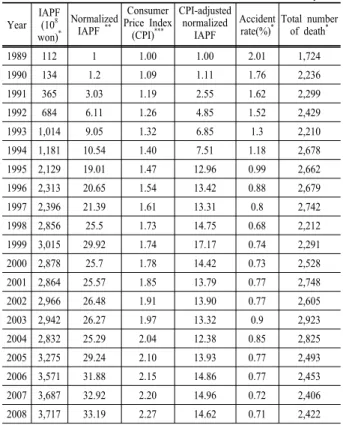
Safety activities by government, industries and non-go- vernment organizations(NGOs), in general, require the safety budget whose source may vary depending on the types of those activities. Design of safety-guaranteed industrial environ- ment is, in particular, important since it determines the ul- timate outcomes of industrial activities involving safety of workers. Looking back the past 20 years, the accident rate in Korea drastically reduced to less than half of that in 20 years ago. Despite the increasing efforts to prevent and reduce the industrial accidents these days, however, the accident rate stays almost constant over the last few years. Table 1 shows such point clearly. Since 1997, the rate had not improved much around a value between 0.7% and 0.8%.
Safety policies and safety management of in industrial work places in Korea is known to be non-systematic and inef- ficient, which result in more than 2,400 cases of death in the year 2008. In 2008, 95,806 workers had been reported inju- red. Compared to the current safety management system, more
realistic and efficient safety management system is, therefore, required to prevent the industrial accidents and minimize the related property damages.
It is noticed from Table 1 that the current safety ma- nagement system is neither able to cope with the increasing demand for safer work place nor it is effective in terms of reducing the accidents and saving lives of workers and properties of industries. Then, a new method to enhance the overall performance of safety management system must be devised and implemented. Among many safety policies that affect the safety of workers in general, safety budget is known to have the fastest and most significant influence on preventing and reducing industrial accidents. Another advan- tage of safety budget over the other safety policies is that it is easily controlled and, therefore, easy to evaluate its per- formance. Attention needs to be paid to industrial accident prevention fund(IAPF) among various types of safety budget which is distributed and controlled by either the government or the government agency such as Korea Occupational Safety and Health Agency in Korea. Its control performance for
Table 1. Industrial accident prevention fund(IAPF), accident rate and total number of death in industrial accident over the 20 years1)
Year IAPF (108 won)*
Normalized IAPF **
Consumer Price Index
(CPI)***
CPI-adjusted normalized
IAPF
Accident
rate(%)* Total number of death*
1989 112 1 1.00 1.00 2.01 1,724
1990 134 1.2 1.09 1.11 1.76 2,236
1991 365 3.03 1.19 2.55 1.62 2,299
1992 684 6.11 1.26 4.85 1.52 2,429
1993 1,014 9.05 1.32 6.85 1.3 2,210
1994 1,181 10.54 1.40 7.51 1.18 2,678 1995 2,129 19.01 1.47 12.96 0.99 2,662 1996 2,313 20.65 1.54 13.42 0.88 2,679 1997 2,396 21.39 1.61 13.31 0.8 2,742 1998 2,856 25.5 1.73 14.75 0.68 2,212 1999 3,015 29.92 1.74 17.17 0.74 2,291 2000 2,878 25.7 1.78 14.42 0.73 2,528 2001 2,864 25.57 1.85 13.79 0.77 2,748 2002 2,966 26.48 1.91 13.90 0.77 2,605 2003 2,942 26.27 1.97 13.32 0.9 2,923 2004 2,832 25.29 2.04 12.38 0.85 2,825 2005 3,275 29.24 2.10 13.93 0.77 2,493 2006 3,571 31.88 2.15 14.86 0.77 2,453 2007 3,687 32.92 2.20 14.96 0.72 2,406 2008 3,717 33.19 2.27 14.62 0.71 2,422
*: Yearbook, Korea Occupational Safety and Health Agency (KOSHA)
**: IAPF was normalized using the value in the beginning year 1989
***: National Statistical Office of Korea
prevention of industrial accidents also needs to be evaluated in relationship with the accident rate.
Previous study showed the control performance of safety budget such as IAPF to prevent and reduce the industrial accidents1,2). Specifically, the effect of IAPF on the safety per- formance in Korea was statistically examined and the role of IAPF was addressed to reduce the related accidents. This study is a continuation of the previous study and focuses on ela- borating the effects of damping and elastic natures of safety system model with a simple proportional-integral(PI) feed- back control mechanism in establishing safety policies. The control performance of the safety system model is then exp- lained in view of maximizing the effect of IAPF and mini- mizing the absolute amount of IAFP. Implications in feed- back control of safety system model suggested to optimiza- tion of safety policies are also explored.
2. Safety budget-accident rate relationship
Fig. 1 graphically shows the trends of IAPF and the indus- trial accident rate over the past 20 years(from 1989 to 2008).In the figure, IAPF was first adjusted using consumer price index over the past 20 years in Table 1, and then normalized using the value in the beginning year 1989. The industrial accident rate was also normalized for comparison purpose to
Fig. 1. Comparison of the normalized IAPF and the industrial accident rate over the past 20 years in Korea.
fit to the form
(1)
where (=0.3) is the target value of accident rate (accident rate in Japan), is the actual (current) accident rate and is the proportionality constant. is the difference between the accident rate (0.71) in the last year of the past 20 year period (2008) and the target value (0.3) and multiplied by a scaling factor for comparison. Ignoring various factors that might affect the accident rate other than safety budget, the figure indicates a striking similarity and, therefore, a remar- kable correlation between them. This implies that one can model a system that has the normalized IAPF as input and the accident rate as output.
The continuous time model that best matches the input-out relationship (IAPF-Industrial accident rate relationship) was identified to be [3]
(2)
The model in Eq.(2) was identified to minimize the root mean squared error between the model output and the actual output.
3. A Framework for Control Mechanism
In order to model the IAPF-industrial accident rate rela- tionship and find a useful mechanism that can control the accident rate, a feedback model of safety management system was suggested in Fig. 21-3). In the figure, the system model (open-loop system) is a work place-process or worker- be- havior model with IAPF as the input and the actual industrial accident rate as the output. Any difference between the target accident rate (input to the feedback system) and the actual accident rate (output of the feedback system) works to drive physical and social efforts to improve safety environ ment.Fig. 2. Feedback control model of industrial accident prevention fund-industrial accident rate relationship.
The actual rate is the result of all the safety activities based on the physical and social feedback.
Table 1 clearly indicates that as the safety budget for pre- vention of industrial accidents is saturated over the last se- veral years, the industrial accident rate appears to converge to the value of 0.7% and stays constant thereafter. Table 1 also implies that the accident rate does not seem to converge to the target value which is 0.3 or so in Japan and major Euro- pean countries. Such tendency strongly implies that the safety budget such as IAPF needs to be increased to further dec- rease the accident rate to a level in advanced countries.
Assuming that a safety system model of work place- process or worker-behavior model in Korea has a typical second order system as noted in Eq.(2) with IAPF as the input, the safety system in Eq.(2) can be rewritten in a more generic form as:
(3)
where b and km signify the damping nature and the elastic nature of the safety system model respectively.
Statistical data in Table 1 indicates that the safety system model in Korea has a form of type zero system(N=0 in Eq.
(3)) and so does the system transfer function. Type zero sys- tem has no pole on the origin of s-plane and, therefore, inhe- rently has no integral action in the system4).
4. Effects of Damping and Elastic Nature on the Safety System Model
In the previous work, simulation study was performed to see whether the control objective can be met with proportio- nal control (P-control) only1) using the safety system model given in Eq.(2). Starting with IAPF which was 371.6 billion won in 2008, extra fund needed to hit the target rate by the year 2030 which is 22 years after 2008 was calculated. A type zero system with P-control only has no pole on the
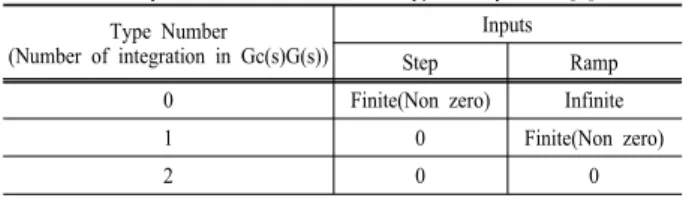
Table 2. Steady state error for different type of systems [2]
Type Number (Number of integration in Gc(s)G(s))
Inputs
Step Ramp
0 Finite(Non zero) Infinite
1 0 Finite(Non zero)
2 0 0
origin of s-plane and, therefore, can’t make the permanent error (error between the accident rate and the target rate) zero as shown in Table 2. Extra fund needed, however, was within the manageable range. The current safety system model coupled with only P-control tends to find an equilibrium state with less input (IAPF) and permanent error.
Any safety policy based on the error between the target rate and the actual (current) rate will fail to track the target accident rate in this case.
In order to eliminate the permanent error between target accident rate and the actual rate, one needs to include an integral action of the form given in Eq.(4) in the feedback controller:
(4)
The appropriate gains for proportional and integral actions in the PI controller can be found to drive the actual accident rate to the target value.
In Eq.(3) and Eq.(4), one can find numerous combinations of system models and PI controllers to accomplish the control objective. Different combinations of both the damping nature (damping factor b) and the internal elastic nature (elastic factor km) in a safety system model were, for example, tested to see their effect on the permanent error. A fixed values of kp=1 and ki=1 were used for simplicity of simulation. For compatibility of simulated data with those in the previous study, data in the year 2008 was used as the reference for prediction of the future trend.
As noted in Eq.(2), the current safety system model in concern inherently has stronger internal elastic nature than the damping nature. The elastic nature in safety system works to store the energy to drive the accident. The damping nature, on the contrary, acts to dissipate the accident-driving energy.
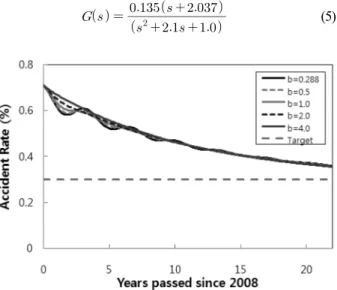
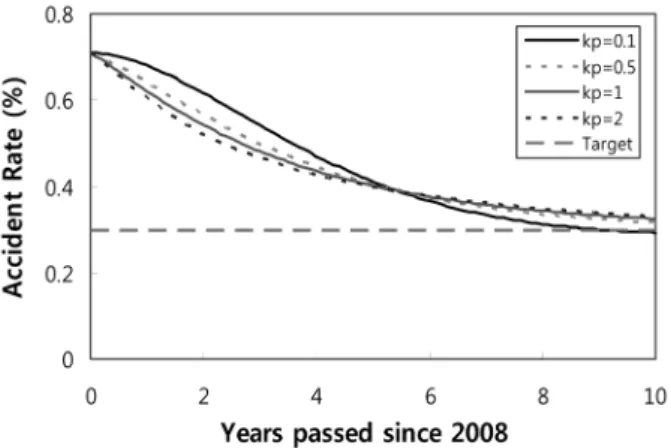
The current safety system model has, then, to be altered so that the system exhibits more damping but less elastic nature in it3). Fig. 3 through Fig. 5 show the effect of damping nature, elastic nature and both, respectively, for different com- binations of these factors in Eq.(3). In Fig. 3, it appears that the damping factor has a minimal effect on the behavior of the safety system model, whereas the elastic factor in Fig. 4 has a significant effect. In Fig. 5, it is apparent that there is a combination of the damping factor and the elastic factor that
gives the optimum result without going beyond the target value. These values were found to be 2.1 and 1.0, respec- tively as in Eq.(5).
(5)
Fig. 3. Accident rate over the next 22 years with PI-action for dif- ferent values of damping factor in Eq.(5). The elastic factor km was set to 3.0.
Fig. 4. Accident rate over the next 22 years with PI-action for dif- ferent values of elastic factor in Eq.(5). The damping factor b was set to 1.0
Fig. 5. Accident rate over the next 22 years with PI-action for dif- ferent values of damping factor and elastic factor in Eq.(5).
Fig. 6. Root-locus of the current safety system model in Eq.(2).
Fig. 7. Root-locus of the new safety system model in Eq.(5).
Fig. 8. Accident rate over the next 22 years with PI-action in the feed- back loop and the closed-loop poles located on the root locus with the imaginary parts in the safety system model in Eq.(2)3).
The transfer function of the current safety system in Eq.
(2) has the root-locus shown in Fig. 6. The closed-loop pole on the real axis will prevent any oscillatory behavior of the responses. According to the figure, gain that gives the stable closed-loop pole on the real axis at -5.94 should have a value greater than 91.1 for the values of kp=1 and ki=1, which means the substantial amount of effort or IAPF to hit
the target rate. The gain that gives the stable closed-loop pole on the real axis at -3.36 for transfer function in Eq.(5), however, was 41.7 for the value of kp=1 and ki=1, which will lead to less effort or IAPF needed. Rougher and oscil- latory transition from the current safety situation to the target is expected with the closed-loop poles located elsewhere in the safety system model in Eq.(2) as seen in Fig. 83). The- refore, with the new safety system model in Eq.(5), less ef- fort or IAPF would be expected to hit the target rate.
When the safety system model modified to the one with more internal damping but with less elastic nature as in Eq.(5) is used the simulated result is shown in Fig.9 and Fig.10. The integral control gain ki was set to 1 for the simulation. The target accident rate was achieved within 10 years or so with a more effective and efficient safety system model. What these figures imply is that effort in industrial safety activities in Korea needs to be directed toward modifying the internal structure of safety system. Such transition of direction of safety-securing effort may cost a little but be a more efficient way to reduce the accident rate to a target level, compared to a budget needed without restructuring of the safety system model.
Fig. 9. Accident rate over the next 22 years with PI-action in the feedback loop.
Fig. 10. Extra safety budget needed to accomplish accident rate in Fig. 9 over the next 22 years.
In view of restructuring the safety system model in Korea, any safety activity or culture has to be altered to nullify or mi- nimize the inherent elastic nature, which will in turn lead to laws, regulations and policies of the nation suitable to the workplaces and management policy of the company that is prior to other policies. This will make the safety activities more effective and efficient. Dissipation of the accident-dri- ving energy by the stronger damping nature will be made pos- sible by reward which is connected to safety task or con- tingent to safety performance and education or training of workers and managers. The safety performance may be mea- sured actively and regularly by the government. The workers and companies need to have the ability to undertake such edu- cation or training.
6. Conclusions
In this study, the effect of damping and elastic nature on the control performance of a safety budget-industrial accident rate model in Korea was examined first. Control performance of a simple feedback system with PI action was proved to be effective in preventing and reducing the industrial accidents.
Without proper restructuring of the safety system, it would not be possible to hit the target industrial accident rate. Even if the control objective is met, the amount of industrial ac- cident prevention fund required to reduce the accident rate from the current level to the target level would be far be- yond the social consensus. As simulation examples suggest, the damping factor has a minimal effect on the behavior of the safety system model, whereas the elastic factor has a sig- nificant effect. More effective and efficient safety system model with stronger internal damping nature but with weaker elastic nature then needs to be devised and implemented in the future.
Acknowledgement
This study was financially supported by Hansung Univer- sity in the year of 2011.
References
1) Gi Heung Choi, “A Framework for Control of Safety Bu- dget-Industrial Accidents Relationship”, Int. J. Safety, Vol. 7, No. 2, pp. 1~4, 2008
2) Gi Heung Choi, “Control of Industrial Safety Based on a Safety Budget-Industrial Accidents Model and Its Impli- cations to Industrial Safety Policies”, Proc. APSS, Jeju, Korea, 2011
3) Gi Heung Choi, “Control Strategy for Industrial Safety Based on Dynamic Modeling of Safety Budget-Industrial Accidents
Relationship”, J. KOSOS, Vol. 26, No. 6, pp. 1~6, 2011 4) R. Dorf and R. Bishop, Modern Control Systems, 11th Ed.,
Addison-Wesley, 2008