신규 섬유질 분해성 젖산균 Enterococcus sp. TO-94를 이용한 오미자의 발효 특성
류일환*·이어진*·권지웅*·이강수**·권태오*†
*원광대학교 생명자원과학대학, **전북대학교 농업생명과학대학
Fermentation Property by Novel Cellulolytic Lactic Acid Bacteria Enterococcus sp.
TO-94 on Omija ( Schizandra chinensis Baillon)
Il Hwan Ryu*, Eoh Jin Lee*, Ji Wung Kwon*, Kang Soo Lee** and Tae Oh Kwon*†
*College of Life Science and Natural Resources, Wonkwang University, Iksan 570-749, Korea.
**College of agriculture & life sceince, Chonbuk National University, Jeonju 561-756, Korea.
ABSTRACT : The use of cellulolytic lactic acid bacteria in new method to prepare high nutrition complementary foods was investigated. For the screening of cellulolytic lactic acid bacteria, more than 1,150 bacterial colony were isolated from diluted infant feces samples. A typical strain which appeared the most excellent cellulolytic activities was identified novel acidophilic
Enterococcus sp. TO-94 through the results of morphological, biochemical and chemotaxonomic characteristics and 16S rDNA sequencing. The optimal lactic acid fermentation conditions of Omija( Schizandra chinensis Baillon) by Enterococcus
sp. TO-94 were as follows: pH and temperature were 3.0 and 37 ℃ , respectively, and fermentation time was 20hrs. The fruc- tose and glucose were major free sugar and the contents were 5.83 and 4.30 ㎎ /g after fermentation, respectively. The con- tents of lactic acid and acetic acid were 9.84 ㎎ /g and 2.08 ㎎ /g after fermentation, respectively. The vitamin B
1, B
2, niacin, folic acid and C were major vitamin in the fermented broth, the contents were 1.5~3 times higher than those of initial fer- mentation time. Also, the contents of polyphenol and anthocyanine were 3.8 and 1.2 times higher than those of initial fer- mentation time.
Key Words : Enterococcus sp. TO-94, Cellulolytic Lactic Acid Bacteria, High Health Food, Omija ( Schizandra chinensis Baillon)
서 언
오미자는 오미자 나무과에 속하는 낙엽성 덩굴식물로 혈압 강하 , 항암 , 항노화 , 면역조절 및 항균활성 등 다양한 생리 기 능이 보고되어 있으며 (Ahn
et al., 2000a; Ames
et al., 1993; Cho
et al., 2007; Devy and Gautier, 1990; Takashi
et al., 2002; Kamei
et al., 2003), 오미자 특유의 붉은색을 내는 색소인 anthocyanine 은 항산화 활성이 있는 것으로 알려
져 있다 . 다섯 가지 맛을 내는 오미자는 다양한 기능성과 더
불어 천연 유색음료의 비중이 높아지는 세계 음료시장의 추세 에 따라 상품성이 높은 원료로 주목 받고 있다 (Lee
et al., 2006).
또한 최근 들어 식품의 발효를 통해 생성되는 유기산 및 분 해산물들이 건강에 좋다는 연구 결과 등이 발표되면서 발효식 품의 인기는 점점 높아지고 있는 실정이다 (Ahn
et al.,
2000b; Doh
et al., 2010; Hong
et al., 2006; Kim
et al., 2007; Kim
et al., 2009b). 그러나 통상적으로 오미자의 특성 안정화를 위하여 60 ℃ 안팎의 저온에서 물 추출을 행하나 수 율 및 활성 또한 적어 실효성이 없다 (Lee
et al., 2006;
Kim
et al., 2004). 또한 과일 자체에 포함된 당의 함량이
4.05% 로 미생물 영양원으로 사용되기에 턱없이 부족한 양으
로 발효에 적합하지 않으며 (Hyun
et al., 2002), 초기 pH 가
2.5 로 저산성 성질을 나타내므로 발효 미생물의 생육에도 적
합하지 못하다 . 그러나 젖산균은 저산성 조건에서 생육이 가
능하며 유산발효하여 식품의 부패를 방지하고 bacteriocin 과 같 은 항균물질을 분비하여 식중독균 및 장내 부패세균의 억제효 과를 가지는 미생물이다 (Park and Chang, 2003). 모든 젖산 균은 생태적 , 대사적 , 영양 요구적 특성이 유사하다 . 첫 번째 유사성은 혐기적 조건에서 최종산물인 젖산을 생성하고 , 두 번 째 유사성은 영양학적으로 아미노산 , 펩타이드 , 핵산유도체 , 비
†Corresponding author: (Phone) +82-63-850-6681 (E-mail) [email protected]
Received 2010 October 16 / 1st Revised 2010 December 7 / 2nd Revised 2010 December 13 / Accepted 2010 December 16
타민 , 염 , 지방산 등이 구비된 조건에서만 탄수화물을 젖산으 로 바꾸는 특성을 갖고 있다 (Thomsen
et al., 2007). 오미자 는 당 함량의 부족으로 이 또한 적합하지 않다 . 탄수화물의 함량을 증가시키기 위하여 상업적 효소의 사용 시 오미자의 낮은 pH 조건에서 활성을 나타내는 효소의 구입이 원활하지 않을 뿐 아니라 제품 생산 비용의 상승 및 생산 시 추가 공 정에 대한 설비 추가의 필요 등을 고려 할 때 , 실용성이 없다 .
그러나 , 최근 전분질 원료를 가수분해할 수 있는 젖산균을 이용하여 저영양의 소재로부터 중량 증가 및 고에너지 보충용
식품의 개발을 위한 다양한 연구가 시도되고 있다 . Songre-
Ouattara 등 (Songre
et al., 2009) 은 땅콩 슬러지 전분을
Lactobacillus plantarum
A6 를 사용하여 부분 분해 시 중량의 증가를 나타내었다고 보고하였다 . 그 외 Corn (Nakamura, 1981), potato (Chatterjee
et al., 1997), Cassava (Giraud
et al., 1991a, 1991b) 등 amylaceous raw material 을 발효시키 는
Lactobacillus amylovorus,
Lactobacillus plantarum등이 보고되어 있다 . 또한 Thi (Thi
et al., 2007) 와 Nguyen 등
(Nguyen
et al., 2007) 은 rice/soybean 을
Lactobacillusplantarum
으로 발효하여 영양 보충성 식품을 개발하였다고 보
고하는 등 다양한 연구가 진행되고 있으나 cellulolytic 또는 pectiolytic 유산균 및 특성에 대하여 보고된 예는
Lacto- bacillus coryniformissubsp.
torquens를 사용하여 kraft pulp mill 을 가수분해하여 젖산을 생성 하였다는 Remedios 등
(Remedios
et al., 2003) 의 보고 외에는 그 예를 찾기 어렵다 .
본 연구는 저산성을 나타내고 발효성 당이 부족하며 높은 섬유질 함량을 갖는 오미자를 고영양 식품으로 개발하기 위하 여 섬유질 분해능을 갖는 젖산균을 분리 , 동정하고 그 균을
이용한 오미자의 발효특성을 조사하였다 .
재료 및 방법1. 실험재료
본 연구에 사용된 오미자는 전북 장수군에서 재배된 오미자 생과를 구입하여 − 20 ℃에서 냉동 보관 하면서 사용하였다 .
2. 섬유질 분해 활성을 갖는 유산균의 분리
유산균을 분리하기 위해서 생후 2 개월 미만의 영아 분변을 총 17 종 수집하였다 . 수집된 영아 분변은 여과 후 적정 배율 로 희석하였다 . 희석액은 Lactobacilli MRS (Difco Co., France) 배지에 도말 후 37 ℃ 24 시간 배양하였다 . 배양 후 형 성된 콜로니는 2% CaCO
3가 첨가된 MRS 배지에 tooth picking 하여 투명환을 형성하는 균주를 1 차 선별하였다 . 1 차
선별된 균주를 dextrose 와 ammomium citrate 를 제외시키고
10 g/L carboxymetyl cellulose 를 Lactobacilli MRS agar 에 획선 접종하고 37 ℃ 24 시간 배양하였다 . 배양 후 1% congo
red 용액으로 염색하고 1% NaCl 용액으로 세척하여 노란색의 투명환을 형성하는 균주를 최종 선별하고 gram 염색 (BD Co.,
U.S.A) 을 하여 현미경하에서 형태학적 특성을 관찰하였다 .
3. 유산균의 동정
1) 형태 및 배양학적 특성
분리균주의 크기와 형태는 Gerhatdt 등 (Gerhatdt
et al., 1981) 의 방법에 따라 gram 염색하여 광학현미경 (Nicon, FK- IIA, Japan) 으로 관찰하였다 . Glucose-nutrient agar 배지 , skim milk 배지 , Luria-Bertani 배지에서 생육한 집락의 형태 ,
크기 , 색깔 등을 관찰하였고 , 반유동고체배지 (tryptose 1.0%, sodium chloride 0.5%, agar 0.5%) 에 배양하여 운동성을 조사 하였다 .
2) 생리학적 특성
균주의 생리적 특성으로는 casein 분해능 , 전분 분해능 , gelatin 액화력 , 당 발효성 , indole 생성능 , nitrate 환원력 , catalase 와 oxidase 생성능을 조사하였다 . 선별된 균주의 생리 학적 성질은 microbiology laboratory manual (Cappuccino and Sherman, 1987; Komagata and Suzuki, 1987) 에 따랐다 .
3) 생물학적 특성
분리균주의 생물학적 특성은 Bochner 등 (Bochner
et al., 2001) 과 Lee 등 (Lee
et al., 2002) 의 방법에 준하여 측정하 였다 . 분리균주를 nutrient limited medium (Resasoner and Geldreich, 1985) 에서 24 시간 전배양한 후 멸균 saline 으로 적 정 농도까지 현탁하고 , 각종의 carbon source, nitrogen source, phosphate source, sulfur source, autotrofic supplement
및 inhibitory compound 가 포함된 Biolog
TMGP microplate
에 150 ㎕ 씩 분주하여 microplate 를 4~24 시간 동안 배양하였 다 . 이 기간 동안 세포의 호흡활동으로 각종 source 들이 산화 하게 되고 plate 에 포함된 tetrazolium 염료는 보라색을 형성하 게 된다 . 이 패턴을 biolog data base 를 사용하여 표준균주와 유사도를 비교하였다 .
4) 화학적특성
균주의 화학적 특성은 Komagata 와 Suzuki (Komagata and Suzuki, 1987) 의 Method in Microbiology, Miller (Miller, 1959) 의 Microbial Identification System (MIS) 에 준하여 분 석하였다 . 분석방법으로는 세포벽내의 fatty acid type, DNA base composition (G+C mole content), DNA sequence 등을
조사하였다 .
균주의 whole cell fatty acid 조성을 확인하기 위하여 gas
chromatography (GC, HP 6890) 를 사용하였다 . 표준지방산으
로는 Hewlett-Packard (HP) 사에서 제공하는 표준 지방산
(calibration standard kit) 을 사용하였으며 균주의 배양은
Sabouraud's agar (Difco, USA) 배지를 사용하여 30 ℃에서
24 시간 동안 배양한 후 배양된 균체를 시험관에 취한 후
saponification reagent (45 g sodium hydroxide, 150 ㎖ metha- nol, 150 ㎖ D.W) 을 1 ㎖를 가한 후 30 분간 100 ℃에서 중탕 후 유수에 냉각하였다 .
비누화된 균체를 6 N HCl 과 methanol 2.6 : 1 혼합물 2 ㎖
를 가한 후 80 ℃에서 10 분간 methylation 시키고 , hexane 과
methyl tert-butyl ether 1 : 1 (v/v) 혼합물 1.25 ㎖를 가한 후
10 분간 상온에서 천천히 진탕한 후 하층액을 제거하여 세포
지방산을 추출하였다 . 5.4% NaCl 로 세척 후 분석용 시료로 하였다 . 분석용 시료는 GC 를 사용하여 분석후 MIDI 사의 균 주 동정 프로그램인 sherlock program 을 통하여 분석하였다 .
16S rDNA 유전자 분석은 Wizard Genomic DNA Prep Kit (Promega) 를 사용하여 , PCR 을 행하였다 . 이때 반응조건은
94 ℃ 1 분간 denaturation, 60 ℃ 1 분 30 초간 anneal 시킨 후 , 72 ℃ 1 분간 extend 하였으며 , 이 조작을 총 30 cycle 을 반복 하였다 . 이때 사용한 primer 는 27F (5'AGAGTTTGATCM TGGCTCAG) 와 1492r (5'TACGGYTACCTTGTTACGACTT)
이었다 . Amplified fragmemt (16S rDNA region) 를 pGEM T Easy vector (Promega) 에 삽입하고 , host cell 로
E. coliDH5a 를 사용하여 일반적인 molecular cloning 방법에 의하여
transformation 시킨 후 , Wizard Plus SV miniprep DNA purification system 을 이용하여 plasmid 를 mini-preparation 시 키고 , automated DNA sequencer (ABI 3700, Applied Biosystems Inc.) 를 사용하여 sequencing 하였다 . Alignment 는
Clustal X (ver. 1.8) software 를 사용하여 , sequence 를 rRNA
이차구조를 참고하여 alignment 한 후 , simmilarity 값을 구하
였다 . 또한 advanced blast search 를 통하여 genebank 의 염기 서열과 비교하였고 (Lee
et al., 2002), treeview (ver. 1.66) 를 이용한 phylogenetic tree 의 dendrogram 은 neighbor-joining analysis (Lee
et al., 2002) 방법에 의하여 작성하였다 . 이때
tree 의 scale bar 는 0.1 substitution per site 를 의미한다 .
4. 유산균의 섬유질 분해 활성 측정
분리 균주의 섬유질 분해능은 CMCase 의 활성 및 Pectinase
활성을 측정하여 확인하였다 . CMCase 의 활성도는 DNS 방법
(Miller, 1959) 에 의하여 CMC 로부터 유리된 환원당을 정량하 여 측정하였다 . 즉 , 이 실험의 표준 측정을 위하여 증류수에 녹인 CMC (1.0%, w/v) 500 ㎕ , 200 mM Na-citrate 완충용액
(pH 5.5) 250 ㎕와 효소 용액을 혼합하여 최종 1 ㎖로 한 후 55 ℃에서 1 시간 30 분 동안 반응시켰다 . DNS 시약 3.0 ㎖와 glucose 용액 (0.1 ㎎ / ㎖ ) 0.1 ㎖을 첨가하여 반응을 정지시키고
5 분 동안 끓인 다음 식힌 후 550 ㎚에서 흡광도를 측정하였
다 . 생성된 환원당의 양은 glucose 표준용액을 사용하여 작성한
표준곡선으로 부터 구하였다 . 효소의 활성도 1.0 unit 는 CMC 를 기질로 하여 55 ℃ 조건하에서 1 분 동안에 1.0 µ㏖ glucose 에 상응하는 환원당을 생성하는 효소의 양으로 정의하였다 .
5. 유산균의 배양 방법
섬유질 분해 유산균
Enterococcussp. TO-94 는 40%
glycol 용액에서 − 80 ℃에서 보관하면서 실험에 사용하였다 . 균
의 증식은 1% CMC 가 첨가된 MRS 배지에 10% 접종하여
37 ℃에서 24 시간 배양한 후 spectronic 401 spectrophotometer (Milton Roy, paris, France) 를 사용하여 600 ㎚에서 균의 생 육 (A600 vs. cfu/ ㎖ ) 을 측정하였다 . 배양 후 14,000 × g 에서
10 분간 원심분리 하여 균체를 모았다 . 이 균체를 physiological sterile 용액 (0.9%, w/v saline) 에 세척 후 동일 조건으로 재
원심분리 하여 오미자 발효의 접종균으로 사용하였다 . 발효 동
안 유산균의 성장은 단계희석 후 생균수를 측정하였다 .
6. 발효조건
Enterococcus
sp. TO-94 에 의한 오미자의 발효는 다음과 같 이 행하였다 .
냉동 보관한 오미자에 동량 (v/v) 의 정제수를 첨가한 후
homogenizer 를 사용하여 씨가 분쇄되지 않게 주의하면서 파쇄
하였다 .
유산 발효를 위한 starter 를 접종하기 위하여 오미자 분쇄액 은 과피에 존재하는 오염균을 제거하기 위하여 고온 단시간 살균법에 의하여 75 ℃에서 10 분간 가열 살균을 실시하였다 . starter 로 사용된
Enterococcussp. TO-94 는 생리 식염수에 희 석하여 8.0 log cfu/ ㎖를 접종하고 37 ℃ 72 시간 배양하면서 제
반 분석을 행하였다 .
7. pH 및 산도의 측정
발효과정 동안 4 시간마다 pH 는 pH meter (sp-701, Suntex Inc. Korea) 를 사용하여 측정하였으며 산도는 AOAC 법 (1990)
에 의하여 발효액 20 ㎖를 pH 가 8.3 에 도달할 때까지 0.1 N NaOH 용액으로 적정한 후 0.1 N NaOH 소요량을 lactic acid (%) 함량으로 환산하였다 .
8. 당도 및 유리당의 측정
발효과정동안 4 시간 마다 발효액을 취하여 당도계 (Master- M, Atage, Tokyo, Japan) 를 사용하여 당도를 측정하였고 , 유
리당은 멤브레인 필터 (0.45 µM) 로 여과 후 Shiseido HPLC system (Shiseido, Tokyo, Japan) 으로 분석하였다 . 유리당의 분 석 조건은 Table 1 과 같다 .
산도 (%) = 0.1 N NaOH 소비량 × NaOH 역가 × acid factor (0.0090)
시료의 부피
9. 유기산의 측정
오미자 발효물의 유기산의 측정은 2008 년도 건강 기능성 식
품공전에 준하여 C18 카트리지에 ACN/DW (1:1) 10 ㎖에 오미자 발효액 10 ㎖를 가하여 초기 용출액 4~5 ㎖를 제거 후 Shiseido HPLC system (Shiseido, Tokyo, Japan) 을 사용 하여 측정하였다 . 유기산의 분석 조건은 Table 1 과 같다 .
10. 비타민의 측정
오미자 발효물 중의 비타민 함량은 건강 기능성 식품공전 미량 성분시험법에 준하여 Shiseido HPLC system (Shiseido, Tokyo, Japan) 을 사용하여 측정하였다 . 비타민의 분석 조건은
Table 2 와 같다 .
11. 총 페놀성 화합물의 측정
오미자 발효물을 10 배 희석한 5 ㎖에 Folin-Ciocalteu 시약
5 ㎖ 를 가하여 혼합하고 3 분후 10% Na
2CO
3용액 (w/v)
5 ㎖ 를 넣어 진탕하고 실온에서 방치한 후 700 ㎚에서 비색
정량 하였다 . Tannic acid 를 표준물질로 작성한 검량곡선으로 부터 총 페놀성 화합물의 함량을 측정하였다 .
12. Antocyanine의 측정
오미자 발효물 10 ㎖를 0.1% HCl-80% MeOH 용액 (v/v) 40 ㎖에 혼합하고 24 시간 진탕 추출하였다 . 추출된 색소는 3,000 × g 에서 10 분간 원심분리 하여 얻어진 상등액을 0.1%
HCl-80% MeOH 용액 (v/v) 으로 100 ㎖로 정용한 후 528 ㎚ 에서 비색정량 하였다 . Cyanidine 을 표준물질로 작성한 검량 곡선으로부터 anthocyanine 함량을 측정하였다 .
결과 및 고찰
1. Enterococcus sp. TO-94의 분리 및 동정
오미자 젖산발효를 위하여 섬유질 분해능을 갖는 유산균의 분리는 희석한 생후 2 개월 미만의 영아의 분변액을
Lactobacilli MRS 배지에 배양하여 colony 를 형성하는 균주를 선발하고 , 선발된 균주에서 2% CaCO
3가 첨가된 MRS 배지 에서 투명환을 형성하고 , carboxymetyl cellulose (CMC) 가 포 함된 MRS 배지에서 congo red 염색시 노란색의 투명환을 형
성하는 균주를 최종 선별하였다 . 선별된 균주 TO-94 는 산성
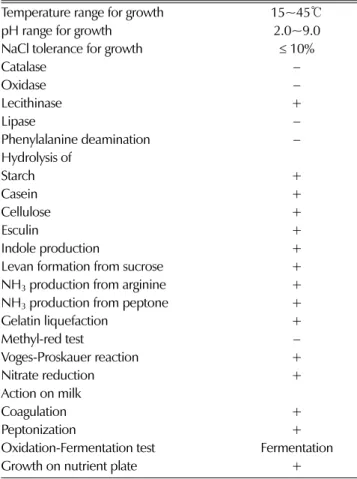
평판배지 (pH 3.0) 에서의 colony 형태는 원형이었고 , 색깔은 밝은 유백색이었으며 표면은 볼록하고 매끄러운 상태였다 . 또 한 산성 액체배지에서 생육은 좋았고 혐기성이었으며 , 균체의 침전현상을 나타내었다 (data not shown). TO-94 의 physio- logical 특성을 Table 3 에 나타내었다 . 생육 pH 범위는
2.0~9.0 이었고 , 생육온도 범위는 15~45 ℃이었다 . 또한 염농도 10% 까지 생육이 가능하였으며 , catalase 음성 , oxidase 음성
및 starch, casein 을 가수분해하였으며 , cellulose 가수 분해능
Table 2.Operation condition of Shiseido HPLC system for the analysis of vitamins in Omija fermentation.
Column
Capcell pak C18 UG 120 (3.0
×250
㎜)
Temperature 40
℃Injection volume 10
㎕Mobile phase
B
1, B
6, Nicine, Folic acid A: DW 957
㎖+ MeOH 25
㎖+ PicB7 20
㎖B: DW 500
㎖+ MeOH 500
㎖+ PicB7 20
㎖B
2A: 10
㎖NaH
2PO
4in DW(1 L)(pH 5.5)
B: MeOH A : B = 78 : 22
Pantothenate, B
5, C 20
㎖NaH
2PO
4(pH 2.1) : ACN = 98 : 2 Cyanocobalamin, Biotine A: 5 mM KH
2PO
4+ 0.1% Phosphoric acid
B: 5 mM KH
2PO
4/MeOH = 80/20 A : B = 500 : 10
K MeOH
Flow rate 1
㎖/min
Detector
PDA detector 210
㎚, 248
㎚
UV detector 200
㎚, 270
㎚ Table 1.Operation condition of Shiseido HPLC system for the
analysis of free sugars and organic acid in Omija fermen- tation.
Free sugars Organic acid Column Asahipak NH2P-50
4E (4.6
×250
㎜) Prevail Organic acid, 5 um (4.6
×250
㎜)
Temperature 35
℃40
℃Injection volume 20
㎕10
㎕Mobile phase 78% ACN 25 mM KH2PO4, pH 2.5
Flow rate 1
㎖/min 1
㎖/min
Detector RID PDA detector 210
㎚은 양성이었다 . 또한 indole 생산능을 갖고 있었고 , arginine 과
peptone 으로부터 NH
3를 생산하였으며 , 중성의 영양배지에서도 생육이 확인되었다 . 당 발효성 실험에서 L-rhamnose 를 이용하
지 못하였으나 glucose, sucrose, raffinose 는 잘 이용하였다 . glucose 를 비롯한 일부 당으로부터 산을 생산하였으나 , 모든 당에서 gas 는 생산되지 않았다 .
Biolog
TMGP Microplate 를 사용한 biological assimilation test 에서
Lactococcus lactis와 약 43.3% 및
Streptococcus thermophilus의 약 20.7% 유사도를 나타내어 새로운 미생물일
가능성이 있는 것으로 판단하였다 .
세포 지방산 성분을 검토한 결과 , Table 4 에서와 같이 주성 분은 16 : 0 과 19 : 0 cyclopropane w8c 로 각각의 함량은
22.29% 와 24.37% 를 나타내었다 . 특이적으로 19:0 cyclop- ropane w8c 와 17:0 cyclopropane 의 함량이 높게 나타났다 . 이 는
Leuconostoc속 유산균은 평균 11.29% 와 0.38% 를 가지고 있으며 (Lee
et al., 1996), 또한
Enterococcus속의 유산균은 17:0 cyclopropane 없이 19:0 cyclopropane w8c 만 미량 (2.5%) 가지고 있고 (Grazia
et al., 2004),
Streptococcus속 및
Lactobacillus속 유산균의 경우 39.8% 및 10.7% 를 함유 하고 있다는 보고 (Thi
et al., 2007) 와 비교 시 일치하는 점 을 찾을 수 없었다 . Reference 와 비교 한 결과도
Leuco- mostoc pseudomesenteroides와는 약 33.6% 의 유사도를 나타 내었으며 ,
Lactobacillus fermentum과는 약 22.9%,
Tetrageno- coccus halophila와는 약 21.5% 의 유사도를 보였다 .
Entroco- ccus faeciumIFO13712 와 비교한 결과 (Youko
et al., 2003)
를 Table 4 에 나타내었다 . Table 4 에서 보는 바와 같이 비교 가 불가능 할 만큼 많은 차이를 보이고 있어 지금까지 보고되 지 않은 새로운 미생물일 가능성이 높다 .
Clustal X (ver. 1.8) software 를 사용하여 16S rDNA 유전 자 alignment 를 행한 결과 1674 bp. 의 염기서열을 결정하고
또한 이를 근거로 reference 와 비교하여 similarity (%) 를 구한
결과 , 이 균주는
Enterococcus속에 속하는 세균으로 판명되었
Table 3.Physiological properties of the strain TO-94.
Temperature range for growth 15~45
℃pH range for growth 2.0~9.0
NaCl tolerance for growth
≤10%
Catalase
−Oxidase
−Lecithinase +
Lipase
−Phenylalanine deamination
−Hydrolysis of
Starch +
Casein +
Cellulose +
Esculin +
Indole production +
Levan formation from sucrose +
NH
3production from arginine +
NH
3production from peptone +
Gelatin liquefaction +
Methyl-red test
−Voges-Proskauer reaction +
Nitrate reduction +
Action on milk
Coagulation +
Peptonization +
Oxidation-Fermentation test Fermentation
Growth on nutrient plate +
− : negative, + : positive
Fig. 1.
The phylogenetic tree of
Enterococcussp. TO-94.
으며 , 실험균주는
Enterococcus faecium의 표준균주와 95.7%
유사도를 나타내어 가장 가까운 균이라 할 수 있으나 , 세포 지방산 및 생물학적 유사도 시험 결과 같은 종의 균이라고 볼
수는 없었다 . 그러므로 새로운 종이라 판단하여
Enterococcussp. TO-94 라 명명하였다 . 또한 neighbor-joining method (Saitou and Nei, 1987) 에 의하여 계통수 (phylogenetic tree)
를 작성하고 그 결과를 Fig. 1 에 나타내었다 . 이때 tree 의
scale bar 는 0.1 substitution per site 를 의미한다 .
2. Enterococcus sp. TO-94의 생육 곡선
일반적으로 유산균은 당을 발효하여 유산을 생성하는 미생 물로 식품의 부패 및 식중독 유발균의 생육을 억제하는 등 다 양한 기능성을 부여하는 미생물이다 . 본 연구에서는 오미자의
생과를 발효하기 위하여 cellulolytic 활성을 나타내는 유산균
Enterococcus
sp. TO-94 를 MRS 배지 및 오미자 파쇄액에 각각 접종하여 37 ℃에서 배양하면서 4 시간 간격으로 균의 생 육을 비교하였다 . 그 결과 Fig. 2 에 보인 바와 같이 MRS 배 지에서는 접종 4 시간부터 대수 증식기가 시작되어 12 시간 후
Table 4.Fatty acid composition of total membrane lipid extracted Entrococcus faecium IFO13712 and strain TO-94.
Fatty acid % of fatty acid in membrane
Entrococcus faecium IFO13712 TO-94
C12:0 iso 0.07 0.20
C14:0 iso ND ND
C14:0 nomal 0.34 4.87
C15:0 iso ND ND
C15:0 anteiso ND ND
C15:0 nomal ND ND
C16:0 w7c alcohol ND ND
C16:0 iso ND ND
C16:0 nomal 8.22 22.29
C16:1 nomal ND ND
C16:1 w11c ND ND
C16:1 w9c 0.25 ND
C17:0 iso 0.11 ND
C17:0 Cyclo ND 0.61
C17:0 anteiso ND ND
C17:1 w10c iso ND ND
C17:1 anteiso ND ND
C18:0 nomal 0.05 1.70
C18:1 nomal 1 ND
C18:1 w9c 81.72 ND
C18:1 w7c ND 11.96
C18:11 methyl w7c ND 0.43
C18:2 nomal ND ND
C19:0 Cyclo w9c 9.24 ND
C19:0 Cyclo w8c ND 24.37
ND: Not Detection.
에 정지기에 도달하였다 . 반면 오미자 파쇄액에 접종시 접종
8 시간 까지 유도기가 지속되었으며 , 대수 증식기 또한 20 시간 까지 지속되었다 . 이는 발효에 이용되는 당의 함량이 4.05% 로
(Choi
et al., 2008) 과실 자체에 발효성 당이 거의 없고 영양 원으로 이용될 수 있는 성분이 적기 때문인 것으로 판단되며 ,
발효가 진행됨으로 인해 비 발효성 고분자 성분이 분해되면서 유산균의 생육이 증가되는 것으로 판단된다 . 이는 오미자의 효
소추출물이 젖산균의 선택적 생육 증진을 가져 온다는 Ryu 등
(Ryu
et al., 2007) 의 보고와 일치하는 결과를 나타내었다 .
3. 발효과정중 당도 및 유리당 함량의 변화
Enterococcus
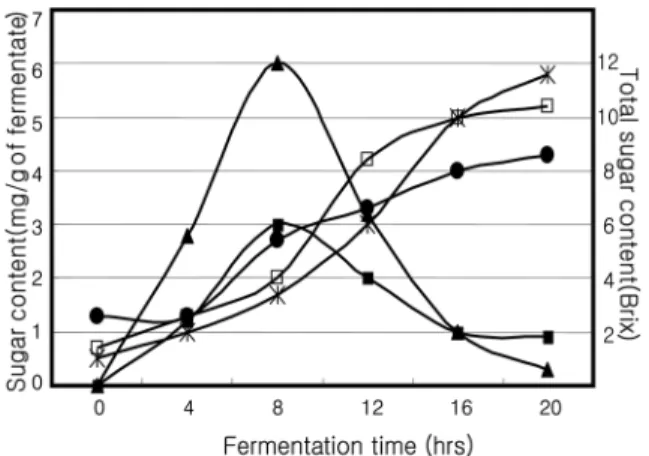
sp. TO-94 에 의한 오미자의 발효 과정 중 유 리당 함량 및 총당의 함량변화를 조사한 결과를 Fig. 3 에 나 타내었다 . Fructose 및 glucose 의 함량은 발효 20 시간 후 5.83 및 4.30 ㎎ /g 으로 발효과정 동안 증가하였으나 , 이당류인
sucrose 및 maltose 는 발효 8 시간 후 6.0 및 3.0 ㎎ /g 으로 증 가되었으나 발효 20 시간 후 각각 0.35 와 0.90 ㎎ /g 으로 감소되 었다 . 이는 초기에는
Enterococcussp. TO-94 에 의한 비발효 성 당의 분해에 기인하여 이당류의 증가가 나타났으며 , 이후 균 생육의 영양원으로 사용된 것으로 판단된다 . 이 결과는 rice/soybean 을
Lactobacillus plantarumA6 에 의해 발효 시 sucrose 를 발효한 반면 glucose 의 함량이 증가하였다는 Thi 등 (Thi
et al., 2007) 의 보고와 일치하는 결과를 보였다 . 이는
Enterococcus
sp. TO-94 가 젖산 생성의 탄소원으로 cellulose
를 사용함을 알 수 있는 결과이다 . 또한 , Giraud 등 (Giraud
et al., 1991a, 1991b) 은 sucrose 가 충분히 감소된 뒤에 전분 의 발효가 일어나며 그 이후 fructose 와 glucose 의 생성이 증 진된다고 보고하였다 .
또한 , total sugar 의 함량이 1.8 Brix 에서 10.2 Brix 로 약 5
배 증가하였다 . 이는 탄소원의 부족으로 발효식품의 개발이 어 려운 오미자의 발효식품의 개발에도 큰 역할을 할 것으로 판 단된다 .
4. 발효과정 중 유기산 함량의 변화
Enterococcus
sp. TO-94 에 의한 오미자의 발효 과정 중 유 기산의 함량변화를 측정한 결과를 Table 5 에 나타내었다 . 발 효 과정 중 다양한 유기산의 변화가 측정되었다 . 젖산의 주산 물인 lactic acid 의 함량이 0 에서 9.84 ± 0.12 ㎎ /g 으로 상승되 었으며 특이적으로 acetic acid 와 L-tartaric acid 의 함량 또한 0.38 ± 006 에서 2.08 ± 0.18 ㎎ /g 와 0 에서 1.83 ± 0.08 ㎎ /g 으로 상승되었다 . 반면 , oxalic acid, formic acid 와 malic acid 의 함량이 감소하는 결과를 보였다 . 또한 citric acid 함량은 변화 를 나타내지 않았다 . 이는
Enterococcussp. TO-94 균의 발효 특성으로 판단된다 .
Lactobacillus manihotivoransOND 30,
L. fermentumOgi E1,
LeconostocSt3-28 을 starch 배지에서 배양시 24 시간 후 lactic acid 및 acetic acid 의 함량이 30~50% 증가하였다는 Mette 등 (Mette
et al., 2007) 의 보고
및
Lactobacillus plantarumA6 에 의해 발효시 acetic acid 의 함량이 1.5~2.5 배 상승하였다는 Thi 등 (Thi
et al., 2007) 의 보고와 유사한 결과를 보였다 . 이 결과들은 다당류를 탄소원 으로 사용하는 젖산균의 공통된 발효특성으로 판단된다 .
Fig. 2.
Growth of strain
Enterococcussp. TO-94 in Omija grinding solution and MRS broth.
■: Omija grinding
solution,
●: MRS broth
Fig. 3.Sugar change during fermentation of Omija by strain
Enterococcus
sp. TO-94.
■: Maltose,
▲: Sucrose,
●: Glucose,
※: Fructose,
◇: Total sugar content
.Table 5.
Organic acids change during fermentation of Omija by Enterococcus sp. TO-94.
Organic acids content (
㎎/g of fermentate) 0 hr 20 hrs after
Oxalic acid 0.18±0.07 0.03±0.01
*L-tartaric acid ND 1.83±0.08
Formic acid 2.20±0.06 ND
**L-malic acid 18.91±0.30 14.17±0.36
L-lactic acid ND 9.84±0.12
Acetic acid 0.38±0.06 2.08±0.18
Citric acid 37.41±0.46 36.35±0.60
Succinic acid ND ND
*Each value represents the mean±SD (n = 3). **ND: Not Detection.
5. 발효과정 중 비타민 함량의 변화
Enterococcus
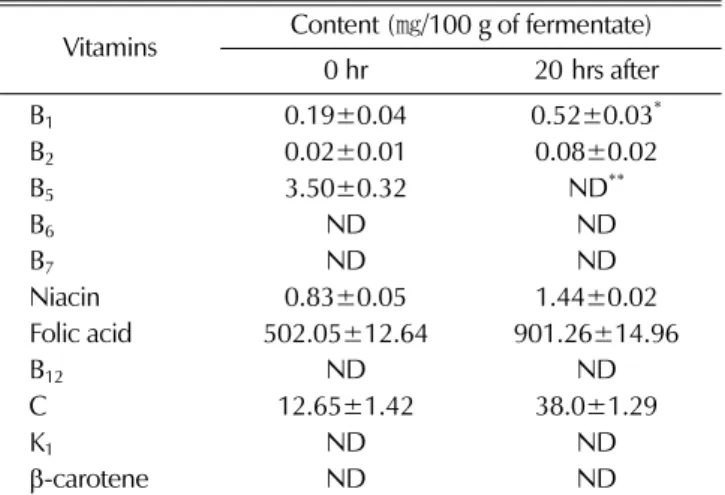
sp. TO-94 에 의한 오미자의 발효 과정 중 비 타민의 함량변화를 측정한 결과를 Table 6 에 나타내었다 . 비 타민 B
1, B
2, niacin, folic acid 및 C 가 주를 이루고 있으며
발효 전에 비하여 모든 비타민이 약 1.5~3 배 가량 증가하였다 .
발효 전 함량은 분쇄 착즙한 것으로 용출의 효율성에 관련이 있는 것으로 판단된다 .
Enterococcussp. TO-94 에 의한 오미 자의 발효 과정 중 세포벽을 구성하는 섬유질의 분해에 의해 용출 효율이 증가함으로써 함량이 증가된 것으로 판단된다 .
오미자는 열수 및 물과 알코올 추출이 주를 이루고 있어
(Kim
et al., 2009a; Choi
et al., 2008; Kwon and Park, 2008; Osawa, 1994) 비타민 함량에 대한 예를 찾아보기 어렵 다 . 이는 가온 및 용매에 의한 비타민의 소실 및 용해도 저하 에 기인한 것으로 판단된다 . 따라서 섬유소 보호능을 갖는 유 산균에 의한 발효방법은 영양적으로 더욱 향상된 오미자 식품 의 개발에 유용한 것으로 판단된다 .
6. 발효과정 중 polyphenol 및 anthocyanine 함량의 변화
Enterococcus
sp. TO-94 에 의한 오미자의 발효 과정 중
polyphenol 및 anthocyanine 의 함량변화를 측정한 결과를
Table 7 에 나타내었다 .
Polyphenol 의 경우 발효초기 0.211 ± 0.005% 에서 20 시간 후
0.823 ± 0.017% 로 약 3.8 배 증가하였으며 , anthocyanine 의 경 우 또한 45.23 ± 1.19 ㎍ / ㎖에서 51.40 ± 1.32 ㎍ / ㎖로 약 1.2
배 상승하였다 . 그러나 polyphenol 과 anthocyanine 의 함량 증
가는 큰 차이를 나타내었다 . Polyphenol 의 경우 추출용매로
ethanol 의 함량이 증가하거나 추출온도의 상승시 높게 나타나
는 것이 일반적인 특징이다 (Osawa, 1994). 항산화능을 포함 한 다양한 생리 활성을 나타내는 phenolic compound 는 높은
온도에서 또는 ethanol 의 사용시 더 많이 추출된다 (Kim
et al., 2004). 본 연구의 결과 또한 발효과정동안 polyphenol 의 함량이 증가하였으나 50% ethanol 추출시 0.98% 의 함량을 나 타내었다는 Kim 등 (Kim
et al., 2009a) 의 결과보다는 낮은 함량을 나타내었다 . 그러나 물 추출시 0.58% 보다는 높은 함
량을 나타내어 polyphenol 의 함량증가에도 비교적 효과적임을 알 수 있었다 .
감사의 글
본 연구는 2009 년도 장수오미자클러스터사업단 (JOC) 연구 개발사업에 의해 이루어 졌으며 이에 감사를 드립니다 .
LITERATURE CITED
Ahn DJ, Kwak YS, Kim MJ, Lee JC, Shin CS and Jeong KT.
(2000a). Screening of herbal plant extracts showing antimicrobial activity against some food spoilage and pathogenic microorganisms. Korean Journal of Medicinal Crop Science. 8:109-116.
Ahn SW, Kim MH, Chung WT, Hwang B, Seong NS and Lee HY.
(2000b). Enhancement of alcohol fermentation yield by adding the extract of dried Rehmannia glutinosa Liboschitz.Korean Journal of Medicinal Crop Science. 8:351-361.
Ames BN, shigenaga MK and Hagen TM.
(1993). Oxidants, antioxidants, and the degenerative diseases of aging.Proceedings of the National Academy of Sciences. 90:7915- 7922.
AOAC
(1990). Officinal methods analysis (15th edn). Association of Official Analytical Chemists. Arlington, VA, USA.Bochner BR, Gadzinski P and Panomitros E.
(2001). Phenotype microarrays for high-throughput phenotypic test and assay of gene function. Genome Research. 11:1246-1255.Cappuccino JG and Sherman N.
(1987). Microbiology a laboratory manual.2nd Ed. p. 52-80. Benjamin and Cummings, California. USA..Chatterjee M, Charkrabarty SL, Chattoadhyay BD and Mandal RK.
(1997). Production of lactic acid by direct fermentation of starchy wastes by an amylase-producing Lactobacillus. Biotechnology Letters. 19:873-874.Cho IS, Han YH, Lee GY and Park KY.
(2007). Search for medicinal plants on improvable effect intestinal microflora.Korean Journal of Medicinal Crop Science. 15:26-29.
Table 6.
Vitamins change during fermentation of Omija by Enterococcus sp. TO-94.
Vitamins Content (
㎎/100 g of fermentate) 0 hr 20 hrs after
B
10.19±0.04 0.52±0.03
*B
20.02±0.01 0.08±0.02
B
53.50±0.32 ND
**B
6ND ND
B
7ND ND
Niacin 0.83±0.05 1.44±0.02
Folic acid 502.05±12.64 901.26±14.96
B
12ND ND
C 12.65±1.42 38.0±1.29
K
1ND ND
β
-carotene ND ND
*Each value represents the mean±SD(n = 3). **ND: Not Detection.
Table 7.
Polyphenol and anthocyanine change during fermentation of Omija by Enterococcus sp. TO-94.
Content
0 hr after 20 hrs after Polyphenol (%) 0.211±0.005 0.823±0.017
*Anthocyanine (
㎍/
㎖) 45.23±1.19 51.40±1.32
*Each value represents the mean±SD (n = 3)
Choi EO, Lee BS, Park YS, Seo EO and Chung BW.
(2008).Extraction condition from Schizandra chinensis Baill on for beverage development of high scizandrin concentration. Korean Journal of Biotechnology and Bioengineering. 23:271-275.
Devy C and Gautier R.
(1990). New perspectives on the biochemistry of superoxide anion and efficiency of superoxide dismutase. Biochemical Pharmacology. 39:399-405.Doh ES, Chang JP, Lee KH and Seong NS.
(2010). Ginsenoside change and antioxidation activity of fermented ginseng. Korean Journal of Medicinal Crop Science. 18:255-265.Gerhatdt P, Murray RGE, Costilow RN, Nester EW, Wood WA, Krieg NR and Phillips GB.
(1981). Chemical composition "Manual of methods for general bacteriology". p.328-364. American Society for Microbiology, Washington, USA.
Giraud E, Lelong B and Raimbault M.
(1991a). Influence of pH and initial lactate concentration on the growth of Lactobacillus plantarum. Applied Microbiology and Biotechnology. 36:96-99.Giraud E, Brauman A, Keleke S, Lelong B and Raimbault M.
(1991b). Isolation and physiological study of an amylolytic strain of Lactobacillus plantarum. Applied Microbiology and Biotechnology. 36:379-383.
Grazia FM, Ricci G, Mora D and Manachini PL.
(2004).Molecular analysis of artisanal italian cheeses reveals Enterococcus italicus sp. nov. International Journal of Systematic and Evolutionary Microbiology. 54:1717-1721.
Hong SW, Kim JY, Lee BK and Chung KS.
(2006). The bacterial biological response modifier enriched Chungkookjang fermentation. Korean Journal of Food Science and Technology.38:548-553.
Hyun HK, Kim HJ and Jeong HC.
(2002). A study on determining chemical compositions of Schizandra chinensis. Korean Journal Plant Research. 15:1-7.Kamei R, Kadokura M, Kitagawa Y, Hazeki O and Okigawa S.
(2003). 2'-Benzyloxychalcone derivatives stimulate glucose uptake in 3T3-L1 adipocytes. Life Sciences. 73:2091-2099.Kim CH, Kwon MC, Kim HS, Bae GJ, Ahn JH, Choi GP, Choi YB, Ko JR and Lee HY.
(2007). Enhancement of immune activities of Kadsura Japonica Dunal. through conventional fermentation process. Korean Journal of Medicinal Crop Science. 15:162-169.Kim HK, Na GM, Ye SH and Han HS.
(2004). Extraction characteristics and antioxidative activity of Schizandra chinensis extracts. Korean Journal of Food Culture. 19:484-490.Kim SI, Sim KH, Ju SY and Han YS.
(2009a). A Study of antioxidative and hypoglycemic activities of Omija(Schizandra chinensis Baillon) extract under variable extract conditions. The Korean Journal of Food and Nutrition. 22:41-47.Kim SS, Ha JH, Jeong MH, Ahn JH, Yoon WB, Park SJ, Seong DH and Lee HY.
(2009b). Comparison of biological activities of fermented Codonopsis lanceolata and fresh Codonopsis lanceolata. Korean Journal of Medicinal Crop Science. 18:255-265.Komagata K and Suzuki KI.
(1987). In method in microbiology. Academic Press. 19:161-207.Kwon HJ and Park CS.
(2008). Biological activities of extracts from Omija (Schizandra chinensis Baillon). Korean Journal ofFood Preservation. 15:587-592.
Lee JS, Chun CO, Kim HJ, Joo YJ, Lee HJ, Park CS, Ahn JS, Park YH and Mheen TI.
(1996). Analysis of cellular fatty acid methyl ester (FAMEs) for the identification of Leuconostoc strains isolation from Kimchi. Journal Microbiology. 34:225-Lee JS, Lee KC, Chang YH, Hong SG, Oh HW, Pyun YR and
228.Bae KS.
(2002). Paenibacillus daejeonensis sp. nov., a novel alkaliphilic bacterium from soil. International Journal of Systematic Bacteriology. 52:2110-2123.Lee WY, Choi SY, Lee BS and Park JS.
(2006). Optimization of extraction conditions from Omija(Schizandra chinensis Baillon) by response surface methodology. Korean Journal of Food Preservation. 13:252-258.Mette HT, Jean PG and Pauli K.
(2007). Batch fermentations on synthetic mixed sugar and starch medium with amylolytic lactic acid bacteria. Applied Microbiology and Biotechnology. 74:540-Miller GL.
546. (1959). Use of dinitrosalicylic acid reagent for determination reducing sugar. Analytical Chemistry. 31:426-428.Nakamura LK.
(1981). Lactobacillus amylovorus a new starch- hydro- lyzing species from cattle waste-corn fermentations.International Journal of Systematic Bacteriology. 31:56-63.
Nguyen TT, Loiseau G, Icard-Verniere C, Rochette I, Treche S and Guyot JP.
(2007). Effect of fermentation by amylolytic lactic acid bacteria, in process combinations, on characteristics of rice/soybean slurries: A new method for preparing high energy density complementary foods for young children. Food Chemistry. 100:623-631.Osawa T.
(1994). Novel natural antioxidant for utilization in food and biological system. In, V.V. Garcia & E.M. Mendoza(Eds).Postharvest biochemistry of plant food material in the tropics.
Japan Scientific Societies Press. Tokyo. Japan. 241-251.
Park YS and Chang HG.
(2003). Lactic acid fermentation and biological activities of Rubus coreanus. Journal of the Korean Society of Agricultural Chemistry and Biotechnology. 461:367-Remedios Y, Belen MA, Luis AJ and Carlos PJ.
375. (2003).Production of D(−)-lactic acid from cellulose by simultaneous saccharification and fermentation using Lactobacillus coryniformis subsp. torquens. Biotechnology Letters. 25:1161-1164.
Resasoner DJ and Geldreich EE.
(1985). A new medium for the enumeration and subculture of bacteria from potable water.Applied and Environmental Microbiology. 49:1-7.
Ryu IH, Kwon TO, Lee KS and Yun YG.
(2007). Enzymological evaluation of bowel inflammation inhibitory activity and intestinal microbial flora improvement by enzymatic hydrolysate of Schizandrae Fructus. Korean Journal of Pharmacognosy.38:364-371.
Saitou N and Nei M.
(1987). The neighbor-joining method; a new method for reconstructing phylogenetic trees. Molecular Biology and Evolution. 4:406-425.Songre-Ouattara LT, Mouquet-River C, Icard-Verniere C,
Rochette I, Diawara B and Guyot JP.
(2009). Potential of amylolytic lactic acid bacteria to replace the use of malt for partial starch hydrolysis to produce African fermented pearl millet gruel fortified with groundnut. International Journal ofFood Microbiology. 130:258-264.
Takashi N, Kawada T, Goto T, Yamamoto T, Taimatsu A, Mataui N, Kimura K, Saito M, Hosokawa M, Miyashita K and Fushiki T
. (2002). Dual action of isoprenols from herbal medicines on both PPARgamma and PPARalpha in 3T3-L1 adipocytes and HepG2 hepatocytes. FEBS Letters. 514:315-322.Thi TTN, Jean PG, Icard-Vernièreb C, Isabelle R and Gérard L.
(2007). Effect of high pressure homogenization on the capacity of Lactobacillus plantarum A6 to ferment rice/soybean slurries to prepare high energy density complementary food.Food Chemistry. 102:1288-1295.
Thomsen MH, Guyot JP and Kiel P.
(2007). Batch fermentations on synthetic mixed sugar and starch medium with amylolytic lactic acid bacteria. Applied Microbiology and Biotechnology.74:540-546
Youko S, Mizuho M, Satoshi H, Yoichi K, Shinichi K and Jun S.
(2003). Characterization of Enterococcus faecium mutants resistant to mundticin KS, a class IIa bacteriocin. Microbiology.149:2901-2908.