Corresponding Author: Ju-Yul Lee
Department of Health Administration, Namseoul University 21 Maeju-ri Seobuk-gu Cheonan 331-707 Korea
Tel: +82-41-580-2333, Fax: +82-41-580-2926, E-mail: [email protected] Article submitted 20 November 2009, Revised 10 December 2009, Approved 12 December 2009
Sex Workers' Satisfaction and Intention to Use Sexually Transmitted Disease Examination Service in Korea
Jung-Whan Lee, Ju-Yul Lee*†
Department of Sociology, Cheongju University
*Department of Health Administration, Namseoul University
Ⅰ. Introduction
Sexually transmitted diseases (STDs) are not only widespread but also a major public health challenge around the world (UNAIDS, 1998; WHO, 2007). First of all, the risk of STD infection is much higher than other diseases in respect that it is mainly transmitted through sexual activities driven by a basic instinct. Since most people who are infected with STD have acquired the disease furtively from extramarital sex which is morally not permissible in the society, it is not a disease to trace sources of infection easily. STDs often exist without symptoms. In women with gonococcal and/or chlamydial infections there may be no symptoms in up to 70% of cases (UNAIDS, 1998). Whether symptomatic and asymptomatic, STD infections can lead to the development of serious complication.
The most serious complications and long-term consequences of untreated STDs tend to be in women and newborn babies. These can include cervical cancer, pelvic inflammatory diseases, fetal wastage and related maternal mortality. Chlamydial infections and gonorrhoea are important cause of
infertility in women and pneumonia in infants with far-reaching social consequences. In adults, syphilis can lead to serious cardiac, neurological and other consequences, which can ultimately be fatal.
Furthermore, STDs facilitate the transmission of HIV infection.
In respect that STDs are usually spread through sexual relations, sex workers faces a significant risk of STD infection and transmission (Kim and Lee, 1999; Cho et al., 2006; CDC, 2008). Considering the vulnerability of sex workers to STD, Korean government implements a STD control program with a special attention to sex workers (KCDC, 2009). Under the program, sex workers are required to report themselves to local public health centers and get regular STD screening check ups. If found to be infected with STD, they are not allowed to work until cured.
The STD control program, however, has
undergone a great change with the implementation
of the Act on the Prevention of Prostitution and
Protection of Victims Thereof and the Act on the
Punishment of Intermediating In the Sex Trade and
Associated Acts (hereafter, Special Law on Sex
Trade) in September 2004. The number of people who are subject to registration to public health centers for STD examination decreased from 156,000 in 2003 to 129,000 in 2004, 117,000 in 2006 and 101,000 in 2007 (KCDC, 2007, 2008).
Especially, decrease in registration by direct commercial sex workers who work mostly in red-light districts was noticeable. Their number of registration dropped almost 70% from 5,922 in 2003 to 1,914 in 2006. Like the case of registration, the number of people who received treatment for STDs at public healths centers also decreased sharply from 36,000 in 2003 to 31,000 in 2004 and 15,000 in 2006.
There are few disputes over an argument that the implementation of the anti-prostitution law has made a great contribution to the decrease in the numbers of registration for STD examination and STD treatment by sex workers. It is, however, questionable whether the implementation of the Special Law on Sex Trade actually reduced the numbers of sex workers and sex trades and resulted in the decrease in the number of registration for STD examination. At the onset of the law, there could be a decline in numbers of sex trades and sex workers with an introduction of tougher measures against sex trade. Adopting a 'zero-tolerance' approach to the sex trade and the trafficking of women, the anti-prostitution law stipulates that brothel owners can be put in prison for up to 10 years with a maximum fine of 100 million won. The state can confiscate any financial gains acquired by selling sex. Buying sex was also made criminal offence punishable by up to one year in jail and 3 million won in fines.
Recent reports and data, however, reveal that the impact of the anti-prostitution law just lasted a short period time. Except for cosmetic change, the
lucrative sex trade is still very much around. The only difference is that since the law was enforced, the sex trade has evolved in various ways. More visible outlets such as red-light districts have taken the brunt of the law because it is relatively easy to crack down on the more obvious targets, such as red-light areas. The still-strong demand for commercial sex rather has spawned a massive underground industry of massage parlors, saunas, girlie bars, motels and internet sites that provide easier access to sex for sale. In a society where there are plenty of outlets that are not strictly selling sex but carry that option depending on clients' requirements, the squeeze on one side is certainly helping business on the other, a case of bubble effect.
According to National Police Agency (NPA) records, the figure of brothers in red-light districts decreased gradually from 1,696 in 2004 to 1,097 in 2006 and 935 in 2008 (NPA, 2007, 2008). At the same time, the number of sex workers in the red-light districts fell down from 5,717 in 2004 to 2,508 in 2007. Contrary to the direct and traditional sex trade segment, however, the new and indirect sex trade businesses show different features. The number of alternative locations where sex can be bought - karaoke bars, rest-tels, barber shops and massage parlors - increased from 111,663 in 2003 to 132,553 in 2005 and 169,104 in 2008 (NPA, 2008). Among the 12,077 arrests for sex trade for the 6 months period between January and June in 2008, 5,392 cases (44.6%) occurred in rest-tels, 2,170 cases (18.0%) on the internet, 1,624 cases (13.4%) in barber shops and massage parlors and 2,891 cases (21.7%) in other locations while 273 cases (2.3%) in red-light districts (Segyeilbo, 2008).
The internet and mobile phones are emerging as key
conduits for prostitution. The report on internet
prostitution published by the state-run Korea Internet Safety Commission found that internet sex-trade websites increased from 2,556 in 2004 to 6,126 as of June of 2007, and sites which incited others to lewd acts went from 3,211 to 6,992 in the same period (Chosunilbo, 2007).
Given the circumstances that there are few obvious evidences supporting that the number of sex trades and sex businesses reduced after the passage of the Special Law on Sex Trade, the decrease in the number of STD examinations taken by sex workers can be a serious public health problem to the Korean society. Sex with sex workers who are infected with STD but do not know the infection results in more spread of STD. If the sex workers who are infected with STD but know little about it because they did not take STD examinations do not receive proper treatment in time they would also confront their health worsening with complications and long-term consequences of STDs.
A STD examination program provides an opportunity for sex workers to learn their status of STD infection. Knowledge of STD infection can help them make decisions to protect themselves and their sexual partners from infection. STD examination has also been proven to be an effective means of promoting changes in behavior and is highly cost-effective in reducing the prevalence of STDs by interrupting their transmission, reducing the duration of infection and preventing the development of complications in those infected (Sweat et al., 2000; Thielman et al., 2006). Now that policies and laws on sex trade such as the current Special Law on Sex Trade are hardly changeable in reality, one of the best alternatives to prevent STD infection among sex workers is to elicit more sex workers to take STD examinations.
A starting point for promoting the use of STD
examination service among sex workers is an understanding of their attitudes towards the service.
This study examines how sex workers perceive the current STD examination service and how the perceptions are related with sex workers' intention to use the service. Although there have been many studies on conditions of STD infection among sex workers, little is known about the attitudes of sex workers towards STD examination and factors influencing their willingness to seek the examination. The results from the study could contribute to the identification of issues and problems that the current STD examination service has and provide data for developing and improving STD prevention programs for sex workers.
Ⅱ. Methods
1. Variables
Since this study intends to identify sex workers' perceptions of STD examination service and to investigate their effects on the intention of sex workers to use the service, variables in the study are classified into three types including independent, dependent and control variables. The independent variable is sex workers' perceptions of STD examination service, which were assessed by sex workers' satisfaction with the current STD examination. Generally, the patients' satisfaction with medical care service is rather complex and multidimensional because of its various aspects.
This study adapted the Patient Satisfaction Questionnaire (PSQ) developed by Ware and his colleagues to measure the sex workers' satisfaction (Ware et al., 1976a, 1976b; Ware et al., 1983).
Although PSQ is composed of seven aspects of
medical care including technical quality, interpersonal manner, communication, financial aspects of care, time spent with doctor, accessibility of care, and general satisfaction, this study adopted five of them except financial aspects of care and time spent with doctor because STD examination service for sex workers at public health centers is free of charge and because there are not many cases that sex workers meet doctors for STD examination at public health centers. In addition, aspects of ‘interpersonal manner’ and ‘communication’ are merged into a new aspect of ‘interpersonal relation’ because the two aspects have in common that they both include an interaction process between patients and doctors.
Each sub-scale consists of items rated using a 5-point Likert-type scale ranging from strongly disagree (1) to strongly agree (5). Higher scores indicate a stronger satisfaction with the STD examination service.
Each satisfaction scale is measured by following items: satisfaction with technical quality with five items (“The office where I get STD examination is hygienically clean and well organized,” “The public health center I visited is well equipped with facilities and instruments for STD examination,”
“Medical staffs are careful to check everything when examining me,” “Sometimes doctors make me wonder if their diagnosis is correct,” and “My doctors are very competent and professional”);
satisfaction with interpersonal relation with four items (“Medical staffs act too businesslike toward me,” “Medical staffs treat me in a very friendly,”
“Sometimes medical staffs use medical terms without explaining what they mean,” and “Medical staffs are good about explaining about what I have a doubt”); satisfaction with accessibility of medical care with four items (“I am able to get STD examination whenever I need it,” “Procedures to get
STD examination are simple,” “I am usually kept waiting for a long time to get STD examination,”
and “The results of STD examination come out fast”); and general satisfaction with two items (“I am very satisfied with the STD examination I received at public health centers,” and “Medical staffs examination me for STDs with sincerity”).
The dependent variable is sex workers' intention to use the STD examination service. It was measured with two items: “How much do agree or disagree that I will continue to use the STD examination service provided by public health centers”; and “How much do agree or disagree that I have recommended my colleagues to use the STD examination service provided by public health centers.” Each of the intention measures was assessed using a 5-point agree-disagree scale with higher scores indicating stronger intention to use the STD examination service. The study adopted control variables to clarify the relationship between sex workers' satisfaction with STD examination service and intention to use it. Control variables included in analysis are age (in years), education (in years attended school), period of working in sex businesses (in months) and monthly income.
2. Data
The data for this study come from a survey conducted in April 2007 among sex workers who had an experience of using STD examination service provided by local public health centers in Korea.
The samples was drawn from by multi-stage
sampling procedure, in which we first chose 36
public health centers participating in the National
STD Surveillance System (NSTDSS) across the
nation and 30 public health centers selected
randomly from the ones which are not participating
in the system, then, we sampled sex workers from the selected health centers in the proportion of age.
The resulting sample size was 1,020 sex workers consisted of 720 sex workers from health centers participating in NSTDSS and 300 sex workers from health centers not participating in NSTDSS.
Self-administerd questionnaires were distributed to the selected sex workers by the help of staffs at the health centers. From the original sample of 1,020, 767 questionnaires were eligible yielding a survey response rate of 75 percent.
3. Analysis
The data was analyzed in three steps: analysis of measurement scale and confirmation of latent variable, descriptive data on variables, and regression models of general satisfaction and intention to use the STD examination service based on factors of satisfaction with specific aspects of the service and socioeconomic variables. Prior to the analysis, responses to the negative statements were reverse coded.
Ⅲ. Results
First of all, the analyses of measurement scales were conducted for the internal consistencies of all multi-item measures. Cronbach alpha on the five subscales ranged from .60 to .76: .76 for technical quality with five items; .66 for interpersonal relation with four items; .60 for accessibility of medical care with four items; .72 for general satisfaction with two items; and .67 for intention to use the STD examination service with two items. The assessment of internal reliability demonstrated acceptable internal consistency considering the small number of
items in each scale.
Since the aspects of medical care were theoretically developed and measured by multi-items, the five concepts - technical quality, interpersonal relation, accessibility of medical care, general satisfaction, intention to use the STD examination service - are considered as distinct latent variables, respectively (Ware et al., 1976a, 1976b; Ware et al., 1983). To examination the possibility that the five concepts are empirically distinct, we performed confirmatory factor analyses with three latent constructs using the AMOS procedure (Arbuckle, 1999). Overall, the confirmatory factor analysis lends moderate support to the argument that the five latent constructs measure five different dimensions. The indices for model fit show an acceptable fit for the measurement model with a goodness of fit index (GFI) of 0.889, an adjusted goodness of fit index (AGFI) of 0.844, a comparative fit index (CFI) of 0.874 and a root mean square error of approximation (RMSEA) of 0.092 (see Figure 1). The values for the all indices are very close to the criteria recommended in the literature, suggesting that the model provides a representation of the relationships among the variables in the proposed model (Arbuckle, 1999;
Hair et al., 2006).
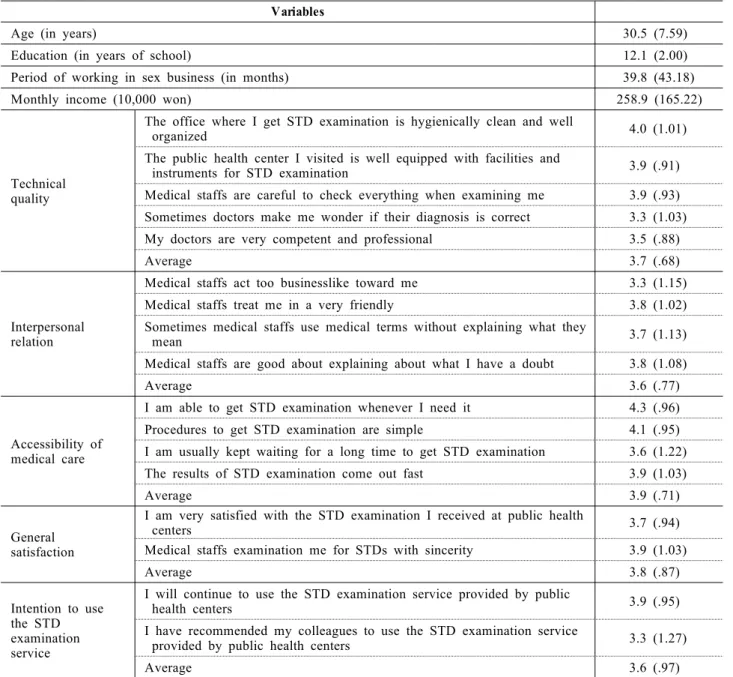
Table 1 shows some characteristics of respondents and descriptive statistics about variables in the analysis. The mean age of the respondents is 30.5 years old and their average years of formal schooling is 12.1. The average period of working in the sex business is about 40 months and the mean of their monthly incomes is about 2.6 million won.
On the scales for medical care, the mean scores of
all 17 items ranged from 3.3 to 4.3, higher than the
median score 3, suggesting a positive view of every
aspect of the STD examination service. Among the
T2 T3 T4 T5 R1 R2 R3 R4 A1 A2 A3 A4 G1
I2 T1
I1 G2
Technical quality
Interpersonal relation
Accessibility of care
General satisfaction
Intention to use e1
e2 e3
e5 e4
e6 e7 e8 e9 e10 e11 e12 e13 e14 e15 e16 e17
Figure 1. Confirmatory factor analysis of measurement scales
scales, the highest ratings were given to accessibility of medical care (3.9), followed by general satisfaction (3.8), technical quality (3.7), interpersonal relation (3.6), and intention to use STD examination service (3.6).
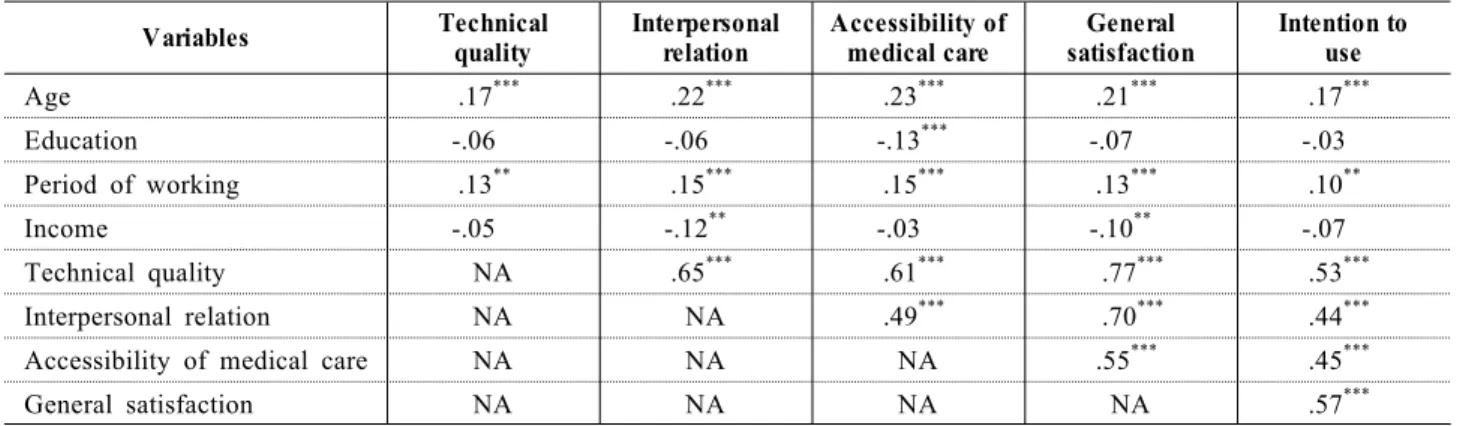
Table 2 exhibits correlation coefficients between the scaled variables and socioeconomic variables.
Both age and period of working in sex business are strongly correlated with all the scaled variables in
a positive direction. Education is correlated only with accessibility of medical care in a negative direction. Income is also negatively correlated with interpersonal relation and general satisfaction.
Correlations between the scaled variables showed
very strong coefficients in a positive direction,
ranging from .44 between technical quality and
intention to use STD examination service to .77
between technical quality and general satisfaction.
Variables
Age (in years) 30.5 (7.59)
Education (in years of school) 12.1 (2.00)
Period of working in sex business (in months) 39.8 (43.18)
Monthly income (10,000 won) 258.9 (165.22)
Technical quality
The office where I get STD examination is hygienically clean and well
organized 4.0 (1.01)
The public health center I visited is well equipped with facilities and
instruments for STD examination 3.9 (.91)
Medical staffs are careful to check everything when examining me 3.9 (.93) Sometimes doctors make me wonder if their diagnosis is correct 3.3 (1.03) My doctors are very competent and professional 3.5 (.88)
Average 3.7 (.68)
Interpersonal relation
Medical staffs act too businesslike toward me 3.3 (1.15)
Medical staffs treat me in a very friendly 3.8 (1.02)
Sometimes medical staffs use medical terms without explaining what they
mean 3.7 (1.13)
Medical staffs are good about explaining about what I have a doubt 3.8 (1.08)
Average 3.6 (.77)
Accessibility of medical care
I am able to get STD examination whenever I need it 4.3 (.96)
Procedures to get STD examination are simple 4.1 (.95)
I am usually kept waiting for a long time to get STD examination 3.6 (1.22)
The results of STD examination come out fast 3.9 (1.03)
Average 3.9 (.71)
General satisfaction
I am very satisfied with the STD examination I received at public health
centers 3.7 (.94)
Medical staffs examination me for STDs with sincerity 3.9 (1.03)
Average 3.8 (.87)
Intention to use the STD examination service
I will continue to use the STD examination service provided by public
health centers 3.9 (.95)
I have recommended my colleagues to use the STD examination service
provided by public health centers 3.3 (1.27)
Average 3.6 (.97)
Note: The numbers in parentheses are standard deviations.
Table 1. Means and standard deviations of variables in the analysis
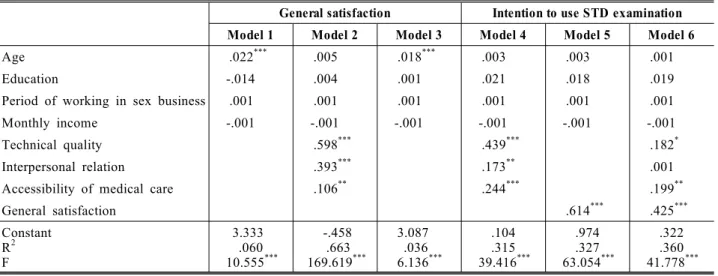
We estimated a series of regression equations to examine the ways in which socioeconomic status and satisfaction with the three specific dimensions of STD examination service affect general satisfaction and intention to use the service, and the extent to which the socioeconomic background characteristics and satisfaction with the specific
dimensions of the service intervene between general
satisfaction with STD examination service and
intention to use the service. In model 1 and 2 shown
in Table 3, we predict general satisfaction as a
function of respondent's characteristics and
satisfaction with concrete aspects of STD
examination service. In model 3, 4 5 and 6, we
Variables Technical
quality Interpersonal
relation Accessibility of
medical care General
satisfaction Intention to use
Age .17
***.22
***.23
***.21
***.17
***Education -.06 -.06 -.13
***-.07 -.03
Period of working .13
**.15
***.15
***.13
***.10
**Income -.05 -.12
**-.03 -.10
**-.07
Technical quality NA .65
***.61
***.77
***.53
***Interpersonal relation NA NA .49
***.70
***.44
***Accessibility of medical care NA NA NA .55
***.45
***General satisfaction NA NA NA NA .57
***Note: NA means ‘not applicable’.
*
: p<.05,
**: p<.01,
***: p<.001
Table 2. Corelation coefficients for aspects of medical care
estimate intention to use STD examination service as a function of respondent's characteristics plus specific and general satisfaction with STD examination service to examine whether and to what extent they intervene between all exogenous variables and intentions to use STD examination service. These models also tell whether the differences in intention to use STD examination service are a result of differences in general satisfaction with the service or differences in satisfaction with specific aspects of the service or differences in socioeconomic attributes of respondents.
In model 1 in which only the socioeconomic variables are included to predict general satisfaction, increases in age leads to a positive effect on general satisfaction. Except the variable, none of the socioeconomic variables are significant in the model. In model 2 in which the specific aspects of STD examination service are added to model 1, all the aspects of the service are strongly associated with general satisfaction, such that higher levels of satisfaction with technical quality, interpersonal relation and accessibility of medical care are associated with higher levels of general satisfaction.
As the aspects of the service are included in the model, the effect of age on general satisfaction shown in model 1 lost their significance.
The model 3, 4, 5 and 6 aim to examination the
hypothesis that satisfactions with various dimensions
of STD examination service intervene between
individuals's socioeconomic characteristics and their
intention to use the service. In model 3, only age
is significant predictor of intention to use STD
examination service while other socioeconomic
variables are not as in model 1. In model 4 in which
specific aspects of STD examination service are
added to the set of independent variables in model
3, intentions to use the service is strongly associated
with the aspects of the service. That is, positive
intention to use STD examination service tends to
increase with satisfaction with technical quality,
interpersonal relation and accessibility of medical
care. As the aspects of the service are included in
the model, the effect of age on the intention shown
in model 3 lost their significance. In model 5 in
which general satisfaction is added to model 3 as a
predictor, the level of intention to use STD
examination service is likely to rise with general
satisfaction.
General satisfaction Intention to use STD examination Model 1 Model 2 Model 3 Model 4 Model 5 Model 6
Age .022
***.005 .018
***.003 .003 .001
Education -.014 .004 .001 .021 .018 .019
Period of working in sex business .001 .001 .001 .001 .001 .001
Monthly income -.001 -.001 -.001 -.001 -.001 -.001
Technical quality .598
***.439
***.182
*Interpersonal relation .393
***.173
**.001
Accessibility of medical care .106
**.244
***.199
**General satisfaction .614
***.425
***Constant R
2F
3.333 .060 10.555
***-.458 .663 169.619
***3.087 .036 6.136
***.104 .315 39.416
***.974 .327 63.054
***.322 .360 41.778
***+
: p<.1,
*: p<.05,
**: p<.01,
***: p<.001
Table 3. Regression equation coefficients predicting general satisfaction and intentions to use STD examination service
Model 6 incorporates all the independent variables in the analysis. Among the variables, technical quality, accessibility of medical care and general satisfaction significantly associated with the dependent variable, intention to use STD examination service. Intention to use STD examination service is likely to increase with technical quality, accessibility of medical care and general satisfaction. More satisfaction with technical quality, accessibility of medical care and more retention of general satisfaction, therefore, tend to influence sex workers to use STD examination service provided by public health centers. Importantly, satisfaction with STD examination service accounts for a large degree of the variation, raising R
232.4% from 3.6% in model 3 to 36.0% in model 6. Comparing Model 4, however, there are changes in effects of the concrete aspects of medical care on the intention. As general satisfaction is included in the model 6, the effects of technical quality and accessibility of medical care on intention to use STD examination service decreased and the effect of interpersonal relation lost
its significance. Accordingly, a larger part of R
2in Model 5 can be attributable to general satisfaction.
Of the variables, general satisfaction is the most salient one to predict intention to use STD examination service and the persistence of its strong effect on the attitudes indicates that general satisfaction has a significant impact on sex workers' intention to use STD examination service, even when holding constant other variables. Satisfaction with technical quality and accessibility of medical care also maintain their positive effects on intention to use STD examination service. In contrast, the effect of interpersonal relation which appeared very strongly in predicting intention to use STD examination service in model 4 disappears as general satisfaction is considered into the analysis.
The positive effect of age also lost their significance with an addition of various aspects of medical care in the analysis.
The effects of general satisfaction on the specific
aspects of medical care imply that whereas general
satisfaction plays an important role in mediating the
impact of interpersonal relation on intention to use STD examination service, it partially mediates the relationship between technical quality, accessibility of medical care and sex workers' intention to use STD examination service. That is, the results suggest that intention to use STD examination service is influenced not only by general satisfaction but also by individual dimensions of the service such as technical quality and accessibility of medical care. Although the effects of technical quality and accessibility of medical care are influenced by general satisfaction, their persistent effects on intention to use STD examination service indicate that satisfactions with technical quality and accessibility are different from general satisfaction.
Ⅳ. Discussion and Conclusion
The major goal of this study is to identify a general overview of sex workers' perceptions of STD examination service. The findings reveal that sex workers have a positive view of the service, suggesting that most of them are satisfied with the current STD examination service provided by local public health centers. In predicting general satisfaction and intention to use STD examination service, no socioeconomic variable plays a significant role. Among the specific dimensions of medical care, technical quality and accessibility of medical care affect both general satisfaction and intention to use STD examination service while interpersonal relation has influence only on general satisfaction. The data also indicate that the most important determinant of sex workers' intention to use STD examination service is their general satisfaction with the service. The greater the satisfaction the more likely sex workers to have
intention to use STD examination service.
While general satisfaction is the most important determinant of intention to use STD examination service it only partially intervenes between satisfactions with specific aspects of medical care and intention to use STD examination service. As general satisfaction is included in the analysis, the effects of interpersonal relation on intention to use the service become insignificant, suggesting that the association between them could be spurious.
Technical quality and accessibility of medical care, however, continue to exert a direct effect on the intention even after considering general satisfaction.
The independent effects of technical quality and accessibility of medical care indicate that general satisfaction is not just a sum or representation of satisfactions with specific dimensions of medical care.
The results that the level of sex workers' satisfaction with the current STD examination service is high and that their intention to use the service is strong have important implications for STD prevention policies and programs. Although conflicting with Special Law on Sex Trade to some extent in reality, the existing laws related with communicable diseases such as Communicable Disease Prevention Act, HIV/AIDS Prevention Act, and Rules on Health Examination for Employees in Hygiene Sector still officially provide a justification for STD examination programs. Under the laws STDs are classified into a legal infectious disease which must be tackled by health authorities that undertake prevention, surveillance, deterrence to spread, and aftercare of communicable diseases.
With the legal grounds, the demand and need for
STD examination service by sex workers further the
current STD examination programs. In addition, as
advocates for Special Law on Sex Trade also insist
an improvement of human rights for sex workers considering them as social victims, few of them may want sex workers left vulnerable to STD infection by any means. Health authorities aiming at health maintenance, health promotion and health protection for the people, thus, need to continue their STD control programs actively and effectively regardless of the Special Law on Sex Trade.
References
Arbuckle, J.L. 1999. AMOS User's Guide. Chicago:
Smallwaters Corporation.
CDC (Centers for Disease Control and Prevention).
2008. Division of STD Prevention Strategic Plan 2008- 2013. Washington D.C.: CDC.
Cho, Kyung-Soon, Na, Young-Ran, Joe, Hyeon- Cheol, Lee, Jung-Hee and Jung, Myung-Ju.
2006. Distribution of Sexually Transmitted Viral Diseases in Busan. The Korean Journal of Microbiology 42(3):177-184.
Chosunilbo. 2007. 8 October. Variant Forms of Sex Trade Mocking Special Law on Sex Trade.
Hair, J., William Black, Barry Babin, Rolph Anderson and Ronald Tatham, 2006. Multivariate Data Analysis. Upper Saddle River, NJ: Pearson Education.
KCDC (Korea Centers for Disease Control and Prevention). 2007. Current Status of Registrants for STD Examination. KCDC.
_____. 2008. Record of STD Examination by Registrants for Periodic STD Examination.
KCDC.
_____. 2009. 2009 STD Control Guidelines. KCDC.
Kim, Joung-soon and Ju-hyun Lee. 1999. Current Occurrence of Sexually Transmitted Diseases Including AIDS and Its Prevention Strategies.
Korean Journal of Public Health 36(1):1-11.
NPA (National Police Agency). 2007. Current Conditions of Red-light Districts. NPA.
_____. 2008. Current Conditions of Red-light Districts, Control over Sex Trades, and Sex Businesses. NPA.
Segyeilbo. 2008. 22 September. Over Half of Sex Trades Uncovered Occur in Variant Forms of Business such as Massage Parlors.
Sweat, M., Gregorich, S., Sangiwa, G., Furlonge, C., Balmer, D., Kamenga, C., et al. 2000.
Cost-effectiveness of Voluntary HIV-1 Counselling and Examination in Reducing Sexual Transmission of HIV-1 in Kenya and Tanzania. Lancet 356:113-121.
Thielman, N.M., Chu, H.Y., Ostermann, J., Itemba, D.K., Mgonja, A., Mtweve, S., et al., 2006.
Cost-effectiveness of Free HIV Voluntary Counselling and Examination through a Community-based AIDS Service Organization in Northern Tanzania. American Journal of Public Health 96:114-119.
UNAIDS (The Joint United Nations Programme on HIV/AIDS). 1998. The Public Health Approach to STD Control. Geneva: UNAIDS.
Ware, J.M. Snyder and W. Wright. 1976a.
Development and Validation of Scales to Measure Patient Satisfaction with Medical Care Services. Vol, I, Part A: Review of Literature, Overview of Methods, and Results Regarding Construction of Scales. Springfield, VA:
National Technical Information Service.
Ware, J.M., Snyder and W. Wright. 1976b.
Development and Validation of Scales to Measure Patient Satisfaction with Medical Care Services. Vol, I, part B: Results Regarding Scales Constructed from the Patient Satisfaction Questionnaire and Measure of Other Health Care Perceptions. Springfield, VA: National Technical Information Service.
Ware, J.M., Snyder, W. Wright and A. Davies. 1983.
Defining and Measuring Patient Satisfaction with Medical Care. Evaluation Program Planning 6:247-263.
WHO (World Health Organization). 2007. Global Strategy for the Prevention and Control of Sexually Transmitted Infections: 2006-2015.
Geneva: WHO.
ABSTRACT
Objectives: The purpose of this study is to examine how sex workers perceive the current STD examination service and how the perceptions are related with sex workers' intention to use the service.
Methods: The data for this study came from a survey among sex workers who had an experience of using STD examination service provided by local public health centers. Sex workers' perceptions to STD examination service and their intention to use the service were measured with multiple items adapted from the Patient Satisfaction Questionnaire (PSQ) developed by Ware and his colleagues.
Results: Most sex workers are satisfied with the current STD examination service provided by local public health centers and they have a strong intention to use the service. In predicting general satisfaction and intention to use STD examination service, few socioeconomic variables play a significant role. Among specific dimensions of STD test service, technical quality and accessibility of the service affect both general satisfaction and intention to use the service in a positive direction. The most important determinant of sex workers' intention to use STD examination service is their general satisfaction with the service.
Conclusion: With the existing laws that still officially justify STD examination programs, the demand and need for STD examination service by sex workers further the current STD examination programs. Health authorities which aim at health maintenance, health promotion and health protection for the people, thus, need to continue their STD control programs actively and effectively regardless of the Special Law on Sex Trade.
Key Words: STD examination service, Sex workers, Special Law on Sex Trade
<국문초록>