Introduction
Soil organic carbon has been known as the most important factor for soil fertility, soil tillage, crop production, and soil sustainability (Bauer and Black, 1994; Lal et al., 1997). Changes in agricultural management either increase or decrease SOC in soils.
SOC storing into the soils through agricultural management can result in the sequestration of atmospheric CO
2, thereby mitigating the current increase in atmospheric CO
2at least partially (Sampson and Scholes, 2000). In addition to the environmental benefits of soil C sequestration, consideration has also been given to the implementation of a carbon credit trading system which may provide economic incentives for C sequestration initiatives (Marland et al., 2001). West and Post (2002) presented a global analysis of SOC
sequestration rates as affected by tillage and crop rotation from 67 long-term agricultural experiments from around the world. They indicated that increased C sequestration is obtained by decreasing soil disturbance, such as changing from conventional to no-tillage systems, or by enhancing rotation complexity. They noted that soil carbon sequestration rates in response to either of these types of management practice changes can have a delayed response, reaching peak sequestration rates between 5 and 10 yr after initiation and then decliningto near zero after 15 to 20 yr. Similar conclusions have been reported in a review by Lal et al. (1998) based on results from Franzluebbers and Arshad (1996). Lal (2007) offered that mitigation strategies are identified and implemented immediately to stabilize the climate. In this regard, principles of soil science must be used to adopt three strategies: (i) sequester C in terrestrial ecosystems notably soils, wetlands and trees; (ii) enhance use efficiency of input needed in soil management practices,
Received : 18 May 2007 Accepted : 20 July 2007*Corresponding author: Phone : +82312900299, E-mail : [email protected]
Long-term Impact of Single Rice Cropping System on SOC Dynamics
Won-Kyo Jung,
*Sun-Kwan Kim, Byung-Yul Yeon
1, and Jae-Seung Noh
National Institute of Agricultural Science and Technology, RDA, Suwon, 441-707, Korea
1
National Institute of Crop Science, RDA, Suwon, 441-707, Korea
Global warming and climate changes have been major issues for decades andvarious researches have reported their impact on our environment. According to recent researches, increased carbon dioxide (CO
2) concentration in the atmosphere is considered as a dominant contributor to global climate changes and thus numerous researches were conducted to control CO
2concentration in the atmosphere. Soil management practices, such as reducing tillage intensity, returning plant residues, and enhancing cropping system have recommended for restoring organic carbon into the soils effectively. However, few studies on soil carbon sequestration have reported for Korean paddy soils. Therefore, evaluation of soil organic carbon (SOC) dynamics in the long-term single rice cropping system is essential in order to find out potential capacity of paddy field as a carbon sink source. The objective of this research was to evaluate SOC dynamics on the long-term single rice cropping system. Research was conducted in the research farm at National Institute of Agricultural Science and Technology, Rural Development Administration, Suwon.
Long-term phosphorus and potassium fertilization and lime application didn't significantly affect on SOC compared to controls. We found that SOC contents were increased continually at the long-term composting plots with enhanced rate of carbon storage. In conclusion, continuous incorporation of plant residues (i.e., composting) is recommended to effectively sequester soil carbon for Korean paddy soils. This result implies that continuous composting in a paddy field may contributenot only for increasing SOC in the soils but also for mitigating global warming through reducing carbon dioxide emission into atmosphere. Therefore, we recommend that a strategy or policy measures to encourage farmers to return plant residues continuously for mitigation of global warming as well as soil fertility is being developed.
Key words: Soil organic carbon, carbon sequestration, long-term rice cropping system
such as tillage, irrigation, fertilizer, and pesticides and (iii) produce biomass and crop residues are retained on the soil as mulch or amendment.
Korean paddy field has long been managed with implementation of intensive soil management practices including plowing prior to transplanting for improving rice production. Since chemical fertilizer became the most crucial factor and mechanization replaced the animal power, intensive soil management has leaded rice production in Korea. Soil organic carbon content in rice paddy soil has been rapidly decreased mainly because of intensive plowing and inappropriate fertilization. Jung (2007) summarized that national average of soil organic carbon content has been decreased continually since 1940's. It is also true that rice productivity has increased for the same period of time. Jung (2007) also pointed that rice productivity hit the peak in 1990's and has slightly decreased thereafter. Korean paddy areas showed exactly same trend with rice production. This could be interpreted that the major focus of Korean agriculture has shifted from production-oriented farming to grain quality-oriented farming since 1990's. In 1990's, the concept of environment-friendly agriculture has introduced for Korean farmers who were interested in producing high quality agricultural products without negative impacts on environment such as water, air and soil. Because of quality-oriented farming, people realized the importance of appropriate soil management to protect the foundation of production.
On the other hand, global warming became an issue for all nations. IPCC (2007) reported that concentration of green house gases (GHG) has been seriously increased in atmosphere. Mainly increasing of fossil fuel might be the major factor to increase GHG in atmosphere. Stopping use of fossil fuels completely and using of alternative energy, which doesn't produce GHGs,could be the only answer to solve the global warming problem ultimately.
But unfortunately current technologies are not available to provide the answers not only for ceasing of fossil fuel use but also for using of alternative energy. Since IPCC (1996) announced that agricultural practices may contribute to mitigate global warming through carbon sequestration, which is the processes of storing carbon from atmosphere into the soil. Numerous researches have been doing to find out the best agricultural practices to improve storage rate carbon into the soil. Previous researches suggested that changing tillage practice, appropriate nutrients management, control of soil
erosion, and residue returnmay contribute to improve soil organic carbon sequestration. Rice has long been cultivated in Koreas as a staple crop for years. Previous researches documented that agricultural management practices, such as residue application and reduced tillage intensity, are being promoted to increase biomass incorporation into SOC pools, enhance soil quality, and sequester atmospheric CO
2(Follett, 2001; Lal et al., 1998; Mann et al., 2002; Paustian et al., 2000; Uri, 2001).
It is important to examine these practices in long-term studies because of the amount of time required for many of these management practices to significantly change SOC content.
While it has been well established the tillage and residue management practices influence on SOC in cropland, continuous long-term rice cropping experiment is rare. Therefore, such experiments are essential for evaluating potential of SOC pool for continuous rice cropping system in Korea. In this research, we presented results from this long-term experiment testing of temporal SOC dynamics under different treatments. The objective of this research was to evaluate the effects of long-term single rice cropping practices on SOC dynamics in the paddy field.
Methods and Materials
Site description A long-term rice cropping experiment plots were established in 1954 and are located at the research farm in National Institute of Agricultural Science and Technology, Suwon, Korea (37。 16´27″N, E126。 59´36″E). Field consists of approximately 0.17 ha and is located near research farms, adjacent to a plain paddy field near to reservoir. The soil in the research field is described as a Gangseo soil by the National Institute of Agricultural Science and Technology (NIAST, 2000).
The Gangseosoil is a moderately well-drained and moderately rapid permeability (coarse-loamy, mixed, nonacid, mesic family of Fluvaquentic Eutrudepts).
These soils have grayish brown fine sandy loamy Ap
horizon and mottled brown to dark brown, yellowish
brown or grayish brown fine sandy loam cambic B
horizon. C horizons are brown to dark brown with
grayish brown mottles and have stratified loamy fine
sand to loam textures. They are developed in coarse
loamy alluvial materials on broad continental alluvial
plains. Management practices were described in Table 1.
Experiment plot description The plots were designed as a completely randomized. Each plot is approximately 6.3m by 8.3 m. Fertilizationpractices and cultivation varieties were shown in Table 2. Water was irrigated from Seoho reservoir until 1986 and thereafter changed to ground water was used for irrigation because of reservoir water contamination. Silicate was applied with 400 kg ha
-1and lime was applied to neutralize soil pH until 6.5. Rice straw compost was applied with 7,500 kg ha
-1for each treatment plot.
Soil sampling and analysis Soil samples were collected in early April prior to plowing for each year.
Samples were taken from the 0- to 15-cm depth in each plot. Each sample was composite of 5 to 10 replicates.
Sample soil was sieved to pass a 2.0-mm screen (visible pieces of crop residues and roots removed) and dried at the air temperature. Soil organic carbon was determined by wet combustion method. Ground soil samples (i.e., 0.2 to 0.3 g) were used to digest with K
2Cr
2O
7by heating at 200 ℃ for 2 hours and were titrated using diphenylamine
Year
Before 1970 1971-1978 1979-1985 After 1986
175 100 150 110
75 75 86 70
75 75 86 80
1969-1978 1979-1985 1986-2004 2005-
Jinheung Milyang23
Daechung Samkwang Rice variety Year
K P
N
--- kg ha-1--- Table 1. Fertilization and rice variety for long-term rice cropping experiment.
Plot
"
Neutralized to pH 6.5 by soil test
‡Ammonium nitrate Urea
1 2 3 4 5 6 7 8 9 10 11 12 13 14 15 16 17 18 19 20 21 22 23 24 25 26 27
None None None None None None None None None None None None None None None None C C C C C C C C C C C
A‡ A U
U A A None None A A U U A A None None A A A A U U U U A A A
None None None None P P None None None None None None P P None None P P None None None None P P P P None
None None None None K K None None None None None None K K None None K K None None None None K K K K None
None S None
S None
S None
S None
S None
S None
S None
S None
S None
S None
S None None None S None
None None None None None None None None L L L L L L L L None None None None None None None None L L L Lime"
Silicate 400 kg ha-1 K
P N
Fertilizer Soil amendment
Compost 7,500 kg ha-1
Table 2. Fertilizer and soil amendment treatment at the long-term single rice cropping field.
indicator.
Results and Discussion
Soil organic carbon dynamics on a long-term rice cropping field No significant effects of nitrogen fertilization on SOC content was found in a long-term single rice cropping field for 1980's, 1990's, and 2000's.
Significant difference (p=0.04) of SOC content was only found with nitrogen fertilization in 1969-1979.
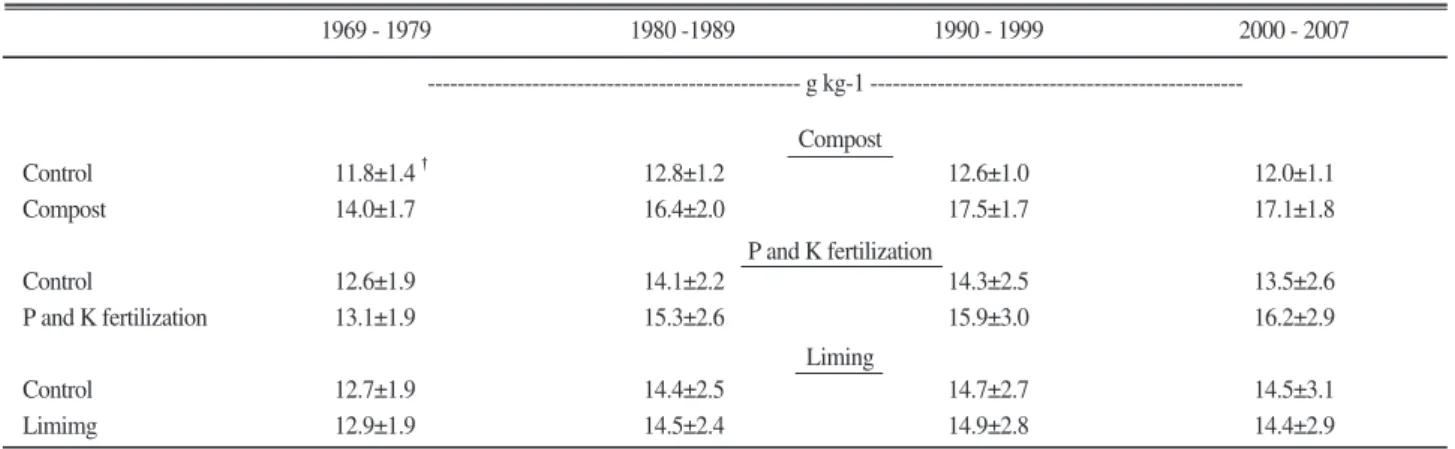
Continuous phosphorus and potassium fertilization hadn't significantly affected on SOC contents in 1969-1979, however, significant difference of SOC content was found thereafter (Table 3). Long-term composting hadsignificantly affected on SOC contents in a single rice cropping field since 1969. Long-term silicate application hadn't significantly affected on SOC contents in a single rice cropping field (Table 4).
SOC content in none composting treatment plots hit the peak (12.8 g kg
-1) for 1980's and tended to decreased
Source of variation df
F-value
1969 - 1979 1980 -1989 1990 - 1999 2000 - 2007
P F-value P F-value P F-value P
Nitrogen Nitrogen contrast
Ammonium nitrate vs. Urea None vs. nitrogen Phosphorus and Potassium Compost
Silicate Lime
2
1 1 1 1 1 1
3.16
1.80 4.52 0.01 109.17 0.03 3.60
0.041
0.181 0.031 0.981
<0.001 0.871 0.061
1.52
1.94 1.01 4.17 296.17 0.01 3.01
0.221
0.161 0.321 0.041
<0.001 0.911 0.081
2.79
2.37 3.08 14.82 861.17 4.01 4.65
0.061
0.131 0.081
<0.001
<0.001 0.051 0.031
1.73
1.91 1.72 88.25 718.17 1.92 11.34
0.181
0.171 0.191
<0.001
<0.001 0.171
<0.001 Table 4. Analysis of variance of SOC content in a long-term rice cropping field.
"
Mean±standard deviation
2000 - 2007 1990 - 1999
1980 -1989 1969 - 1979
--- g kg-1 ---
11.8±1.4 "
14.0±1.7
12.6±1.9 13.1±1.9
12.7±1.9 12.9±1.9
12.8±1.2 16.4±2.0
14.1±2.2 15.3±2.6
14.4±2.5 14.5±2.4
12.6±1.0 17.5±1.7
14.3±2.5 15.9±3.0
14.7±2.7 14.9±2.8
12.0±1.1 17.1±1.8
13.5±2.6 16.2±2.9
14.5±3.1 14.4±2.9 Control
Compost
Control
P and K fertilization
Control Limimg
Table 3. Treatment impacts on SOC content in a long-term rice cropping system.
Compost
P and K fertilization
Liming
Fig. 1. Effect of long-term composting on SOC contents. Fig. 2. Effect of long-term liming on SOC contents.
thereafter while SOC content of continuous composting treatment plots had rapidly increased until 1980's and had slightly increased thereafter. SOC content in the long- term continuous composting treatment plots were increased to 18, 28, 39, and 43% for 1970's, 1980's, 1990's and 2000's, respectively (Fig. 1). This result showed that continuous composting may contribute accumulation of soil carbon into the soils.
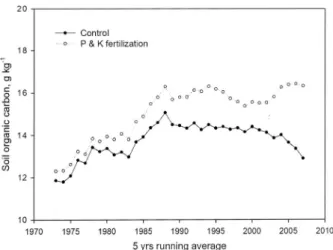
Long-term liming hadn't significantly affected on SOC storage into the soils (Fig. 2). Long-term phosphorus and potassium fertilization hadn't significantly affected on SOC storage into the soil until 1980's, but SOC content of P and K fertilization treatment plots were increased from 11 to 20% after 1990's compared to control plots (Fig. 3).
Storing carbon into the soils through appropriate soil management may contribute mitigate carbon dioxide concentration into atmosphere. In this research, we found that long-term continuous composting resulted in greater SOC storage in a single rice cropping field. This result imply that continuous composting in a paddy field may contribute not only for increasing SOC in the soils but also for mitigating global warming through reducing carbon dioxide emission into atmosphere. Therefore, we recommend that continuous returning of plant residues in the paddy field has to be encouraged for producers, consumers, and police makers.
References
Bauer, A., and A.L. Black. 1994. Quantification of the effect of soil organic matter content on soil productivity. Soil Sci. Soc. Am. J.
58:185 193.
Follett, R.F. 2001. Soil management concepts and carbon sequestration in cropland soils. Soil Tillage Res. 61:77 92.
Franzluebbers, A.J., and M.A. Arshad. 1996. Soil organicmatter pools during early adoption of conservation tillage in northwestern Canada. Soil Sci. Soc. Am. J. 60:1422 1427.
Intergovernmental Panel on Climate Change (IPCC). 1996. Climate change 1995. Cambridge Univ. Press, New York.
IPCC. 2007. Climate change. Fourth Assessment Rep.
Intergovernmental Panel on Climate Change, WMO, Geneva, Switzerland.
Jung, Won Kyo. 2007. Storing carbon in paddy land. Korean J. Soil Sci. Fert. 40:83-84.
Lal, R. 1997. Residue management, conservation tillage and soil restorationfor mitigating greenhouse effect by CO2-enrichment.
Soil Tillage Res. 43:81 107.
Lal, R. 2007. Soil Science and the Carbon Civilization. Soil Sci.
Soc. Am. J. 71:1425 1437
Lal, R. J. Kimble, and R. Follett. 1997. Soil quality management for carbon sequestration. p. 1 8. In R. Lal et al. (ed.) Soil properties and their management for carbon sequestration. United States Department of Agriculture, Natural Resources Conservation Services, National Soil Survey Center, Lincoln, NE.
Lal, R., J.M. Kimble, R.F. Follett, and C.V. Cole. 1998. The potential of U.S. cropland to sequester carbon and mitigate the greenhouse effect. Sleeping Bear Press, Chelsea, MI.
Mann, L., V. Tolbert, and J. Cushman. 2002. Potential environmental effects of corn (Zea mays L.) stover removal with emphasis on soil organic matter and erosion. Agric. Ecosyst.
Environ. 89:149 166.
Marland, G., K. Fruit, and R. Sedjo. 2001. Accounting for sequestered carbon: The question of permanence. Environ. Sci.
Policy 4:259 268.
Paustian, K., J. Six, E.T. Elliott, and H.W. Hunt. 2000. Management options for reducing CO2emissions from agricultural soils.
Biogeochemistry 48:147 163.
Sa´, Joa˜o Carlos de M., Carlos C. Cerri, Warren A. Dick, Rattan Lal, Solismar P. Venske Filho, Marisa C. Piccolo, and Brigitte E.
Feigl. 2001. Organic Matter Dynamics and Carbon Sequestration Rates for a Tillage Chronosequence in a Brazilian Oxisol. Soil Sci.
Soc. Am. J. 65:1486 1499.
Sampson, R.N., and R.J. Scholes. 2000. Additional human-induced activities Article 3.4. p. 181 281. In R.T. Watson et al. (ed.) Land use, land-use change, and forestry: A special report of the Intergovernmental Panel on Climate Change. Cambridge University Press, New York.
Uri, N.D. 2001. Conservation practices in US agriculture and their impact on carbon sequestration. Environ. Monit. Assess. 70:323 344.
West, T.O., and W.M. Post. 2002. Soil organic carbon sequestration rates by tillage and crop rotation: A global data analysis. Soil Sci.
Soc. Am. J. 66:1930 1946.
Fig. 3. Effect of long-term P & K fertilization on SOC contents.
이산화탄소 등 온실가스의 농도 증가로 인한 지구온난화 에 따른 기후의 변화 및 환경적 영향이 증가하고 있 으며 토양내 유기탄소의 축적을 통해 대기 중 이산화탄소등 온실 가스의 감축을 효과적으로 제어할 수 있는 방법들이 연구되어 보고되고 있으나, 우리나라의 논의 경우에는 토양유기탄소의 토양 축적에 관한 연구가 매 우 적게 보고되고 있다. 따라서 우리나라 주요 경지 이용형태인 논에 대해서도 토양중 탄소를 축적할 수 있는 토양관리 방법의 연구가 매우 필요하게 되었다. 본 연구는 농촌진흥청 농업과학기술원 동일비료 및 개량제 처 리 장기시험 포장에서 퇴비, NPK 비료, 석회, 및 규산등의 처리구별 토양유기탄소의 동태를 분석하였다. 연구 결과 인산, 칼리 및 석회의 시용은 장기간 시용한 이후에 처리한 구에서 미처리구에서 보다 토양유기탄소의 함량이 높게 나타났다. 한편 퇴비 시용구의 경우 퇴비 미시용구에서 보다 퇴비 시용구에서 토양유기탄소의 함 량이 지속적으로 증가하는 것으로 나타났으며 시간이 지날수록 유기탄소축적비율도 증가하는 것으로 나타났 다. 결론적으로 단일 논 작부체계하에서 장기간 지속적인 퇴비의 시용 결과 토양 중 유기탄소의 효과적인 축 적이 이루어 졌다. 따라서 우리나라 논에서 중 유기탄소의 축적을 위하여 퇴비의 지속적인 시용을 제안하고자 한다.
동일비료장기연용 논에서 토양유기탄소의 변동
정원교*·김선관·연병열1·노재승 농업과학기술원, 1작물과학원