불안장애의 추나 치료에 대한 중의학 최신임상연구 동향
이지은
1, 최진봉
1, 김지훈
11동신대학교 한방재활의학과
Review of Current Research Trends in Chuna Manual Therapy for Anxiety Disorders in China.
Ji-Eun Lee, K.M.D.
1, Jin-Bong Choi, K.M.D.
1, Ji-hoon Kim, K.M.D.
11
Department of Korean Rehabilitation, College of Korean Medicine, Dong-Shin University
Objectives : This study was conducted to investigate current research trends in Chuna manual therapy for the treatment of anxiety disorders in China.
Methods : Using China Academic Journal and Pubmed, we performed a literature search of studies that were published from 2010 onwards. In total, 15 published studies were included in our analysis.
Results : Of the 15 analyzed studies, nine were randomized controlled trials, two were non-randomized controlled trials, and four were case reports. Of the total patients, 80% were treated daily and received ≤30 treatments in total (excluding one study). In most studies(11 out of 15, 73.33%) , the total effective rate of treatment was used to measure the outcome, with the Hamilton Anxiety Rating Scale being used most frequently. The case report demonstrated a therapeutic effect > 90%. In the control study, except for the two studies that reported significant improvement in the follow-up period, all of the measures were significantly improved (P<0.05) after treatment compared with before treatment. The An(按) and Rou(?) methods were the most frequently used. The Chuna method is categorized into four types: 1) It is performed around shoulders, neck, and face; 2) performed around abdomen, back, and neck; 3) performed on the whole body; 4) performed at the simply-stimulated acupoints. The most commonly used acupoint was Taiyang (Ex- HN 5), and the most frequently used acupoints were predominantly distributed in the head, face, and neck.
Conclusions : This study demonstrated that Chuna manual therapy has significant effects when used as a treatment for anxiety disorder, warranting further investigation.
Keywords : Chuna, Anxiety Disorders, Research trend
Received : 2019. 05. 15 Reviewed : 2019. 06. 11 Accepted : 2019. 06. 12
■ Corresponding Author주
Jin-Bong Choi, Department of Korean Rehabilitation, College of Korean Medicine, Dong-Shin University, Naju City 58245, Republic of Korea
Tel : (062) 350-7219 Fax : (062) 350-7551 E-mail : [email protected]
Ⅰ. 서 론
불안장애에는 극도의 공포, 불안 및 이 둘과 관련 된 행동의 장애의 특성을 지닌 질환들이 포함되는 것으로 여기에는 공황장애, 범불안장애 및 분리불안 장애, 선택적 함구증, 공포증 등이 포함되어 있다.
공포와 불안은 상호 중복되는 부분이 있지만 공포가 싸움-도피 행동을 위해 자율신경의 각성을 보인다 면 불안은 미래의 위험에 대한 조심 및 회피행동을 통해 감소된다. 공황발작은 공포반응의 특유한 형태 로서 불안장애 중에서도 두드러진 특징을 보인다
1).
이중 근래의 현대인들에게서 많이 보이는 공황장 애는 평생 유병률이 4.8%로 비교적 흔한 질환에 속 하며 증상으로 인한 고통과 더불어, 직업 활동 또는 가정 내 생활 기능에 심각한 장해를 겪고 있고, 이로 인해 더욱 삶의 질이 저하된다. 또한 환자의 4-80%
에서 우울증이 합병되고 자살의 우려가 있어 사회적 으로 큰 부담을 초래하고 있다
2). 또한 공황장애 외 에도 불안장애는 불안의 정도가 과도하거나 발달상 의 적정한 시기를 넘어서 지속되며 치료하지 않는 경우 지속적으로 유지 된다
1).
2017년 한 해 불안장애(F40, F41)로 치료받은 환 자는 약 70만 명으로 매년 증가하는 추세이며
3)서양 의학에서는 약물치료가 가장 많이 활용되고 있으나 약물 투여 후에도 불응성을 보이거나, 재발되는 경 우가 많아 현재에는 인지행동치료와 약물치료를 병 행하는 치료를 제시하고 있다
4). 이러한 인지행동치 료 외에도 호흡 운동
5)이나 바이오피드백
6)을 통하여 불안장애를 완화 할 수 있다는 연구가 보고되고 있 으며 한의학에서도 한약, 침과 같은 한방치료와 더 불어 Emotional Freedon Techniques요법 (EFT)
7), 마음 챙김 명상
8), Stress Reduction Program(SRP)
9), 미술치료
10), 인지행동 치료
11,12)등 의 심리치료방법이 활용된 증례보고가 주를 이루고 있다.
한의 치료 중 추나 치료는 장부 기능에 대해서 경 락 기혈을 통하여 음양평행 조절작용을 하는 치료방
법으로, 경락은 전신에 퍼져있어서 장부(臟腑)에 연 결되고, 장부(臟腑), 피모(皮毛), 근육(筋肉), 골격 (骨格), 뇌(腦) 등의 조직과 통하며, 또 기혈이 운행 되는 통로이므로 추나 치료는 체표의 경락을 통하여 내장기능을 조절 할 수 있다. 이러한 전인적인 관점 의 추나 치료 뿐 만 아니라 프랑스의 정골 의학자인 Jean-pieere Barral의 내장수기 요법과 흉추와 늑 골의 추나를 통하여 흉곽의 가동성을 회복하여 호흡 기능, 중추신경계와 내분비계 정상화를 유도할 수 있다
13). 그러나 불안장애관련 추나 치료에 대한 국내 연구로는 공항장애 환자 1례에서 추나 요법 중 수기 이완법과 침 치료를 병행하여 호전된 1례만이 존재 하여
14)국내의 임상적 연구는 부족한 실정이다. 이에 저자는 2010년 이후 중국에서 진행된 불안장애의 추나 치료에 관련된 논문을 분석하여 불안장애에 대 한 다양한 추나 치료기법을 소개하고 연구방법을 분 석하여 향후 국내에서 시행될 연구에 도움이 되고자 본 연구를 시행하였다.
Ⅱ. 연구 대상 및 방법
1. 논문의 검색
중국 내 불안장애에 관한 추나 치료의 연구동향을 살펴보고자 두 명의 연구자가 독립적으로 2019년 4 월까지 Pubmed와 中國知識基礎設施工程(CNKI)에 등록된 논문을 검색하였다. 한문 검색어로는 焦 症, 不安障碍, 焦 障碍, 恐症, 恐慌障碍, 恐障 碍, 恐怖症, 恐 症, 選擇性緘默症, 推拿, 手法, 按 摩, 捏脊를 사용하였으며 영문 검색어로는 anxiety disorder, panic disorder, phobia, selective mutism, Chiropractic, Manipulation, tuina, chuna, chinese massage를 조합하여 검색하였고 논문의 검색은 2019년 04월 19일까지 진행되었다.
Շ
2. 논문의 선별
논문 선정기준은 불안장애 환자를 대상으로 한 연 구이며, 최신 연구 동향 및 치료기법을 파악하기 위 해 2010년 이후로 발표된 임상 논문을 대상으로 하 였고, 중의학과 양방의 복합치료 등의 분야를 다룬 논문도 포함하였다. 중의학 논문이 아닌 것, 중복 논 문, 종설 및 개인 학설 등과 같은 비 임상 논문, 불 안장애로 진단되지 않은 경우는 제외하였다. 검색어 를 통해 나온 논문을 1단계로 제목과 초록을 검토하 여 문헌을 선별하였고, 2단계로 전문을 통하여 상기 항목을 재확인하였다. 위 방법에 따라 총 3명의 연
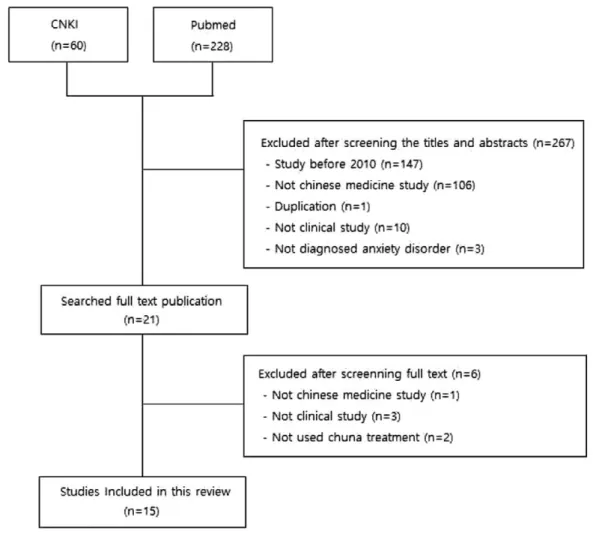
구자가 의견합의를 이룬 총 15편의 논문을 최종적으 로 선택하였다(Fig. 1).
Ⅲ. 결 과
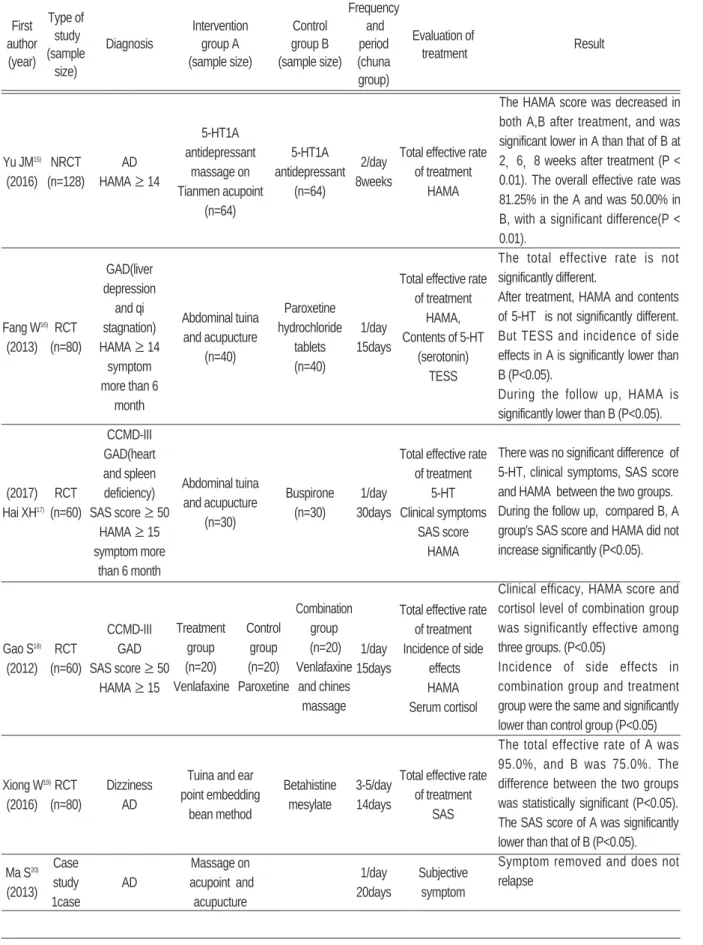
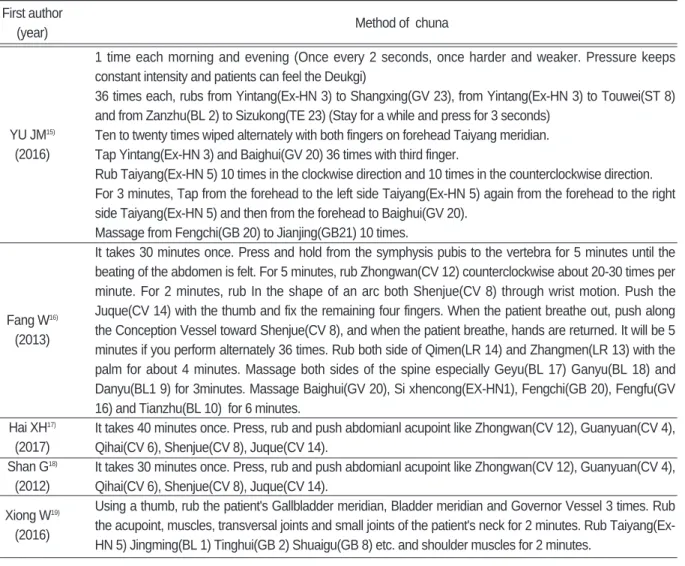
최종적으로 선택된 논문의 전체적인 내용을 분석 하여 임상 연구 형식, 연구 대상의 진단명과 진단방 법, 군 간의 치료 방법, 추나 치료 기간 및 횟수, 평 가지표, 치료결과를 요약하고(Table Ⅰ) 각 연구에 서 활용된 추나 방법을 요약하였다(Table Ⅱ).
Fig. 1. Flow chart of selection process.
Table Ⅰ. Analysis of Chuna Manual Therapy for Anxiety Disorders in China.
Type of Frequency
First
study Intervention Control and
Evaluation of author
(sample Diagnosis group A group B period
treatment Result
(year)
size) (sample size) (sample size) (chuna group)
5-HT1A
antidepressant 5-HT1A Total effective rate Yu JM
15)NRCT AD
massage on antidepressant 2/day
of treatment (2016) (n=128) HAMA ≥ 14
Tianmen acupoint (n=64) 8weeks
HAMA (n=64)
GAD(liver
depression Total effective rate
and qi Paroxetine of treatment
Fang W
16)RCT stagnation) Abdominal tuina
hydrochloride 1/day HAMA, (2013) (n=80) HAMA ≥ 14 and acupucture
tablets 15days Contents of 5-HT symptom (n=40)
(n=40) (serotonin)
more than 6 TESS
month CCMD-III
GAD(heart Total effective rate
and spleen
Abdominal tuina of treatment
(2017) RCT deficiency)
and acupucture Buspirone 1/day 5-HT Hai XH
17)(n=60) SAS score ≥ 50
(n=30) (n=30) 30days Clinical symptoms
HAMA ≥ 15 SAS score
symptom more HAMA
than 6 month
Total effective rate
CCMD-III of treatment
Gao S
18)RCT GAD 1/day Incidence of side
(2012) (n=60) SAS score ≥ 50 15days effects
HAMA ≥ 15 HAMA
Serum cortisol
Tuina and ear Xiong W
19)RCT Dizziness
point embedding Betahistine 3-5/day Total effective rate (2016) (n=80) AD
bean method mesylate 14days of treatment SAS
Ma S
20)Case Massage on
1/day Subjective (2013) study AD acupoint and
20days symptom 1case acupucture
The HAMA score was decreased in both A,B after treatment, and was significant lower in A than that of B at 2 , 6 , 8 weeks after treatment (P <
0.01). The overall effective rate was 81.25% in the A and was 50.00% in B, with a significant difference(P <
0.01).
The total effective rate is not significantly different.
After treatment, HAMA and contents of 5-HT is not significantly different.
But TESS and incidence of side effects in A is significantly lower than B (P<0.05).
During the follow up, HAMA is significantly lower than B (P<0.05).
There was no significant difference of 5-HT, clinical symptoms, SAS score and HAMA between the two groups.
During the follow up, compared B, A group's SAS score and HAMA did not increase significantly (P<0.05).
Clinical efficacy, HAMA score and cortisol level of combination group was significantly effective among three groups. (P<0.05)
Incidence of side effects in combination group and treatment group were the same and significantly lower than control group (P<0.05) The total effective rate of A was 95.0%, and B was 75.0%. The difference between the two groups was statistically significant (P<0.05).
The SAS score of A was significantly lower than that of B (P<0.05).
Symptom removed and does not relapse
Combination Treatment Control group
group group (n=20)
(n=20) (n=20) Venlafaxine
Venlafaxine Paroxetine and chines
massage
Massage on Liang
RCT Specific
acupoint General care 1/day Total effective rate JB
21)(n=100) phobia
and general (n=100) 1day of treatment
(2013) MDAS ≥ 10
care(n=100) MDAS
Auricular acupoint
Pan ZY
22)RCT CCMD-III AD massage and Psychology
2/week HAMA
(2017) (n=36) HAMA ≥ 14 psychology consultation
9 weeks SAS
consultation (n=18) (n=18)
CCMD-III Tuina, acupuncture Ma Y
23)RCT
GAD and paroxetine Paroxetine 1/day PSQI (2016) (n=60)
HAMA ≥ 14 (n=30) (n=30) 10days HAMA
Case Total effective rate
Jiang Z
24)study AD Tuina 1/1day of treatment
(2018)
100case 10day Subjective
symptom
Zhang Self massage on
Self massage Total effective rate YL
25)RCT
AD acupoint and
on acupoint 1/1day
of treatment
(2017) (n=40) acupuncture
(n=20) 30times (n=20) SAS
Self massage on Total effective rate Yi TJ
26)RCT acupoint and Self massage
1/1day of treatment (2015) (n=76) AD
acupuncture on acupoint
1month SAS
(n=38) (n=38)
HAMA
Self massage on Total effective rate
Wei NRCT acupoint and Self massage
1/day of treatment YH
27)(n=160) AD
acupuncture on acupoint
30times SAS
(2014)
(n=80) (n=80)
HAMA
Case Specific Massage on acupoint,
Total effective rate Sun RH
28)study phobia moxibustion and 1/day
of treatment (2010)
40case TAS psychological 15days
regulation TAS
Type of Frequency
First
study Intervention Control and
Evaluation of author
(sample Diagnosis group A group B period
treatment Result
(year)
size) (sample size) (sample size) (chuna group)
The total effective rate of A was 64.0%, and B was 22.0% with statistically significant (P<0.05).
MDAS in A is significantly lower than B (P<0.05).
HAMA and SAS scores of the two groups were significantly improved (P<0.05).
the improvement of SAS scores in A was significant (P<0.05).
PSQI, HAMA scores and symptom were significantly reduced in the two groups, which was more obvious in A (P<0.05).
40 cases were cured, 35 cases were markedly effective, 15 cases were improved, 10 cases were ineffective.
90% of A were effective.
The total effective rate of the B(65%) was significantly lower than that of the A(95%). Statistically significant (P<0.05) the decrease in SAS score was significantly lower in the B than A, Statistically significant (P<0.05) The total effective rate of the B(81.6%) was significantly lower than that of the A(97.4%). Statistically significant (P<0.05) the decrease in SAS and HAMA was significantly lower in the B than A, Statistically significant (P<0.05)
The total effective rate of the B(80%) was significantly lower than that of the A(93.8%). Statistically significant (P<0.05) the decline degree of SAS and HAMA was significantly lower in the B than A, Statistically significant (P<0.05)
90% of A were effective. (below 15)
Wang Case AD Massage on
LJ
29)study SAS acupoint and music 1/day SAS
(2015) 32case SCL-90 therapy 10days SCL-90
HAMA : Hamilton Anxiety Scale (In Korea : Hamilton Anxiety Rating Scale(HARS)) GAD : Generalized Anxiety Disorder AD : Anxiety Disorder TESS: Treatment Emergent Side -Effect Scale SAS: Self-rating Anxiety cale MDAS : Modified Dental Anxiety Scale PSQI : The Pittsburgh Sleep Quality Index TAS: Test Axiety Scale SCL-90 : Symptom checklist-90
Type of Frequency
First
study Intervention Control and
Evaluation of author
(sample Diagnosis group A group B period
treatment Result
(year)
size) (sample size) (sample size) (chuna group)
Anxiety, somatization, and obsessive- compulsive symptoms were very significant, and interpersonal sensitivity, depression, and hostile mood changed significantly.
Statistically significant (P<0.05)
First author
Method of chuna (year)
YU JM
15)(2016)
Fang W
16)(2013)
Hai XH
17)(2017) Shan G
18)(2012) Xiong W
19)(2016)
1 time each morning and evening (Once every 2 seconds, once harder and weaker. Pressure keeps constant intensity and patients can feel the Deukgi)
36 times each, rubs from Yintang(Ex-HN 3) to Shangxing(GV 23), from Yintang(Ex-HN 3) to Touwei(ST 8) and from Zanzhu(BL 2) to Sizukong(TE 23) (Stay for a while and press for 3 seconds)
Ten to twenty times wiped alternately with both fingers on forehead Taiyang meridian.
Tap Yintang(Ex-HN 3) and Baighui(GV 20) 36 times with third finger.
Rub Taiyang(Ex-HN 5) 10 times in the clockwise direction and 10 times in the counterclockwise direction.
For 3 minutes, Tap from the forehead to the left side Taiyang(Ex-HN 5) again from the forehead to the right side Taiyang(Ex-HN 5) and then from the forehead to Baighui(GV 20).
Massage from Fengchi(GB 20) to Jianjing(GB21) 10 times.
It takes 30 minutes once. Press and hold from the symphysis pubis to the vertebra for 5 minutes until the beating of the abdomen is felt. For 5 minutes, rub Zhongwan(CV 12) counterclockwise about 20-30 times per minute. For 2 minutes, rub In the shape of an arc both Shenjue(CV 8) through wrist motion. Push the Juque(CV 14) with the thumb and fix the remaining four fingers. When the patient breathe out, push along the Conception Vessel toward Shenjue(CV 8), and when the patient breathe, hands are returned. It will be 5 minutes if you perform alternately 36 times. Rub both side of Qimen(LR 14) and Zhangmen(LR 13) with the palm for about 4 minutes. Massage both sides of the spine especially Geyu(BL 17) Ganyu(BL 18) and Danyu(BL1 9) for 3minutes. Massage Baighui(GV 20), Si xhencong(EX-HN1), Fengchi(GB 20), Fengfu(GV 16) and Tianzhu(BL 10) for 6 minutes.
It takes 40 minutes once. Press, rub and push abdomianl acupoint like Zhongwan(CV 12), Guanyuan(CV 4), Qihai(CV 6), Shenjue(CV 8), Juque(CV 14).
It takes 30 minutes once. Press, rub and push abdomianl acupoint like Zhongwan(CV 12), Guanyuan(CV 4), Qihai(CV 6), Shenjue(CV 8), Juque(CV 14).
Using a thumb, rub the patient's Gallbladder meridian, Bladder meridian and Governor Vessel 3 times. Rub the acupoint, muscles, transversal joints and small joints of the patient's neck for 2 minutes. Rub Taiyang(Ex- HN 5) Jingming(BL 1) Tinghui(GB 2) Shuaigu(GB 8) etc. and shoulder muscles for 2 minutes.
Table Ⅱ. Method of Chuna
1. 임상 연구 형식
총 15편의 논문 중 무작위 대조군 시험(RCT)
16-19,21-23,25,26)
은 9편으로 60.0%를 차지했고, 비 무작위
대조군 시험(NRCT)
15,27)은 2편으로 13.3% 였으며, 증례 보고
20,24,28,29)가 4편으로 26.7% 였다.
2. 연구 대상의 진단명과 진단 방법
진단 기준을 살펴보았을 때 범불안장애(General anxiety disorder)로 진단 된 연구
16-18,23)가 4편으로 26.7%였고, 불안장애의 하위 진단명을 표시하지 않 고, 불안장애(Anxiety disorder)로만 진단 된 연구 First author
Method of chuna (year)
Ma S
20)(2013) Liang JB
21)(2013) Pan ZY
22)(2017)
Ma Y
23)(2016)
Jiang Z
24)(2018)
Zhang YL
25)(2017) Yi TJ
26)(2015) Wei YH
27)(2014) Sun RH
28)(2010) Wang LJ
29)(2015)
After laying the patient comfortably talk and rub both Neiguan(PC 6) and Laogong(PC 8) for about 20 minutes. Rub Sanyinjiao(SP 6), Yongquan(KI 1), Yintang(Ex-HN 3), Jingming(BL 1), Zanzhu(BL 2) Shenting(GV 24) and Taiyang(Ex-HN 5). Sweep the five meridians in the head, neck and Fengchi(GB 20).
Before treatment, using the thumb, push both Neiguan(PC 6) and Shenmen(HT 7) for about 3-5minutes.
During treatment, push Hegu(LI 4) with the thumb and second finger for about 3-5 minutes.
Rub 20 times every morning and every evening(Twice a day). Stimulates the ear acupoints(Shenmen, Xin, Gan, Dan, Jiaogan, Sanjiao, Pizhixiaxue) by attaching seeds of Melandrium firmum Rohrbach. Once in three days, change to opposite ear.
Lay the patient down and push the thumb in a spiral shape 5-6 times from Yintang(Ex-HN 3) to Shenting(GV 24). Press Taiyang(Ex-HN 5) with thumb or third finger. Rub the face with finger from Yintang(Ex-HN 3) to Taiyang(Ex-HN 5) along the eyebrow. Rub up to Touwei(ST 8) and reach Shenting(GV 24) along with the hair line. And then rub down to Yintang(Ex-HN 3) again. Massage the eyeball in ∞ shape 3 times. Rub around the nose and mouth 3 times in the clockwise direction and 3 times in the counterclockwise direction.
Sweep Baighui(GV 20), Si xhencong(EX-HN1), Touwei(ST 8), Yintang(Ex-HN 3), Tianzhu(BL 10), Taiyang(Ex-HN 5), Fengfu(GV 16), Xiaguan(ST 7) and Yingxiang(LI 20) for about 5-6 times. Push shoulder acupoint like Fengchi(GB 20), Tianzong(SI 11) and Jianjing(GB21) etc
It takes 30 minutes once. Massage the patient's back of Jiaji acupoint and Backshu point for 10 minutes.
Massage the neck for about 2-3 minutes and then push Fengchi(GB 20) and Fengfu(GV 16) for 1minute.
Using thumb, massage for 2minutes from Taiyang(Ex-HN 5) to Yintang(Ex-HN 3) and push up to eyebrow then reaching Taiyang(Ex-HN 5). Rub Yintang(Ex-HN 3) for 1 minute. Massage temples in the clockwise direction for 2 minutes. Massage Touwei(ST 8), Shentang(BL 44), Baighui(GV 20), Si xhencong(EX-HN1) 3- 5 times and last push Qiaogong. Push Yanglingchuan(GB 34), Zusanli(ST 36) and Sanyinjiao(SP 6).
Massage the upper arm for 2-3 minutes, and then press for one minute each of Jianjing(GB21), Binao(LI 14), shousanli(LI 10), Neiguan(PC 6) and Shenmen(HT 7).
Massage 8x8 Fengchi(GB 20), Taiyang(Ex-HN 5), Zhongwan(CV 12), Baighui(GV 20), Neiguan(PC 6), Qihai(CV 6) and Danzhong(CV 17).
Massage 8x8 Fengchi(GB 20), Taiyang(Ex-HN 5), Baighui(GV 20) and Neiguan(PC 6)
Massage 8x8 Fengchi(GB 20), Taiyang(Ex-HN 5), Zhongwan(CV 12), Baighui(GV 20), Neiguan(PC 6), Qihai(CV 6) and Danzhong(CV 17).
Push Taiyang(Ex-HN 5) Anmian, Neiguan(PC 6), Danzhong(CV 17), Shenmen(HT 7), Taichong(LR 3) and Sanyinjiao(SP 6) for 2 minutes with both hands.
Massage for 2 minutes each Baighui(GV 20), Taiyang(Ex-HN 5), Fengchi(GB 20), Neiguan(PC 6), Qihai(CV
6), Danzhong(CV 17), Zhongwan(CV 12), Shenmen(HT 7), Taichong(LR 3), Sanyinjiao(SP 6), Zusanli(ST
36), Yongquan(KI 1) and Yuzhen(BL 9).
15,19,20,22,24-27,29)
가 9편으로 60.0%였으며, 공포증으로 진단된 연구
21,28)가 2편으로 13.3% 였다. 이들 중 현 재 국제적 진단 표준인 DSM-4 또는 5를 사용한 연 구는 전무했으며, 중국 내 전문 서적을 기준으로 진 단한 연구
16-18,22,23)가 5편이며 이 5편 중 4편이 中國 精神障碍分類及診斷標准 : Chinese classification of mental disorders (CCMD-3)를 통하여 진단되 었다. 진단 과정 중 사용된 척도로는 Hamilton Anxiety Scale(HAMA)이 6례로 가장 많았고 3회 이하로 사용된 척도로는 Self-rating Anxiety Scale(SAS), Treatment Emergent Side - Effect Scale(TESS), Modified Dental Anxiety Scale(MDAS), The Pittsburgh Sleep Quality Index(PSQI), Test Anxiety Scale(TAS), Symptom checklist-90(SCL-90)이 있었다.
3. 추나 치료 기간 및 횟수
치료 간격은 12편의 연구
16-18,20,21,23-29)가 매일 1회 치료를 진행하였으며 나머지 3편의 연구는 매일 3 회에서 5회 가량 진행한 연구
19)1편, 이틀에 한번 진 행한 연구
15)1편, 일주일에 2회 진행한 연구
22)가 1편 있었다. 치료 기간으로 15일 이하 치료한 연구
16,18,19,21,23,24,28,29)
는 8편이었으며 이 중 1편
21)은 1회의
치료에 그쳤고 15일 초과 30일 이하(한 달 포함)로 치료한 연구
17,20,25-27)는 5편이었으며, 30일 초과 치료 한 연구는 2편 이었다.
4. 평가지표
총 11편의 연구
15-19,21,24-28)에서 별도의 총유효율을 평가지표로 사용했으며, 총 유효율을 제외하였을 때 크게 설문지를 활용하는 경우나 혈액검사를 확인하 는 경우가 대부분으로 증례보고 연구
20,24)2례에서만 환자의 주관적인 증상을 통하여 평가를 시행하였다.
설문평가 도구는 진단 시에 사용한 평가 척도를 재 이용한 경우가 많았으며, HAMA, SAS, TESS,
MDAS, PSQI, TAS, SCL-90이 사용되었고 설문 평가지로 HAMA를 단독 사용한 경우
15,18)2편, SAS 를 단독 사용한 경우
19,25)2편이 있었으며, 공포증의 경우 TAS와
28), MDAS를
21)단독 사용한 경우 각각 1 편 외에는 평가 척도를 혼용해서 사용하였다
16,17,22,23,26,27,29)
. 혈액검사는 특히 양방 약을 사용한 대
조군 검사에서 시행되었는데, 총 6개의 연구 중 3편 의 논문에서 혈중 세로토닌 양을 측정하거나
16,17), 코 르티솔의 농도를 측정하였다
18).
5. 치료결과
증례보고 3편
20,24,28)에서는 90% 이상의 치료 효과 를 보였다 발표되었으며, 10편
15,18,19,21-23,25-27,29)의 대조 군 시험에서는 평가지표 모두 치료 전에 비해 치료 후가 개선되었고, 통계적으로 유의미한 결과를 얻었 다 발표하였다. 나머지 2편의 연구
16,17)에서는 추적관 찰 기간에서 유의한 호전을 보였다 발표하였는데, 이를 자세히 살펴보면 房
16)등은 치료 후 복부 추나 군에서 92.5%, 양방약 복용 대조군에서 95%의 치 료율을 얻었고, 두 군 간의 유의미한 차이는 없었으 며(p>0.05), 치료 군과 대조군 모두 혈장 5- HT(Serotonin)의 농도와 HAMA가 치료 전보다 낮 아졌지만 두 군 간의 유의미한 차이는 없었다고(p⋎
0.05) 발표하였다. 유의미한 차이를 보인 것은 치료
후 복부 추나 군에서 TESS 와 부작용 빈도에서 양
방약 복용 군과 비교했을 때 유의미하게 낮았고, 추
적관찰 기간에서 HAMA가 대조군에 비해 유의미하
게 낮았다(P⋏0.05). 또 海
17)등의 연구에서도 비슷
한 결과를 보였는데, 치료 후 복부 추나 군에서
92.59%의 유효율과 55.56%의 치료율을 보였고,
대조군은 각각 86.96%, 52.2%였지만, 두 군 간의
유의미한 차이는 없었고(p⋎0.05), 양 군 모두 치료
후 5-HT(Serotonin)와 HAMA, SAS의 점수는 유
의미하게 감소했지만(P⋏0.05), 두 군 간의 유의미
한 차이는 없었다. 환자의 불면증, 건망증, 신경증과
같은 임상적인 증상에서도 유의미한 차이가 없다고
발표했다(p⋎0.05). 하지만 위의 연구와 비슷하게 치료 3개월 후 재검사상 HAMA와 SAS의 증가율이 대조군에서 유의미하게 증가하였으나, 치료 군에서 는 유의하게 증가하지 않았다(P⋏0.05).
6. 추나 방법
추나 방법으로 중국 전통 추나 수기법인 안법(按 法)과 유법( 法)이 가장 많이 사용되었으며, 이와 함께 추법(推法), 말법(抹法), 박법(拍法), 찰법(擦 法), 날척법(捏脊法), 염법(捻法), 곤법(滾法)등이 병 용되었다.
추나의 시행 위치에 따라 어깨·목·안면부의 혈
위를 중심으로 추나를 시행하는 방법과 복부·등·
목 의 혈위를 중심으로 추나를 시행하는 방법, 전신 의 혈위를 통한 추나 방법, 단순히 혈위를 자극하는 방식으로 나뉘었다. 먼저 어깨·목·안면부의 혈위 를 중심으로 시행한 추나는 3편
15,19,23)이었으며, 복 부·등·목 의 혈위를 중심으로 추나를 시행한 연구
는 3편
16-18)이었고, 혈위가 전신에 산포되어 추나를
시행한 연구는 2편
20,24)이었다. 단순히 혈위를 누르 고 자극한다 표현된 연구
21,22,25-29)가 7편으로 혈위는 전신 산포된 경우가 5편, 귀
22)와 수부
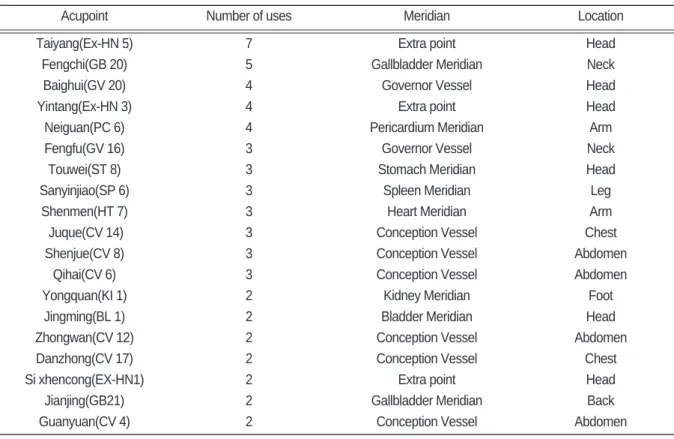
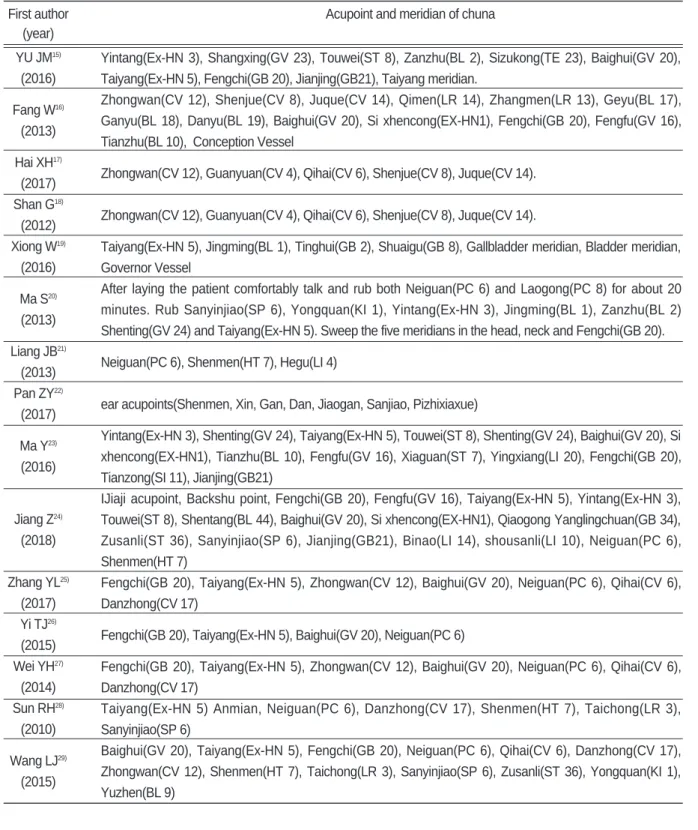
21)가 각각 1편 씩 이었다. 추나 시 다용된 혈위와 각 추나 별 사용 된 혈위는 아래에 정리하였다(Table Ⅲ)(Table Ⅳ).
Acupoint Number of uses Meridian Location
Taiyang(Ex-HN 5) 7 Extra point Head
Fengchi(GB 20) 5 Gallbladder Meridian Neck
Baighui(GV 20) 4 Governor Vessel Head
Yintang(Ex-HN 3) 4 Extra point Head
Neiguan(PC 6) 4 Pericardium Meridian Arm
Fengfu(GV 16) 3 Governor Vessel Neck
Touwei(ST 8) 3 Stomach Meridian Head
Sanyinjiao(SP 6) 3 Spleen Meridian Leg
Shenmen(HT 7) 3 Heart Meridian Arm
Juque(CV 14) 3 Conception Vessel Chest
Shenjue(CV 8) 3 Conception Vessel Abdomen
Qihai(CV 6) 3 Conception Vessel Abdomen
Yongquan(KI 1) 2 Kidney Meridian Foot
Jingming(BL 1) 2 Bladder Meridian Head
Zhongwan(CV 12) 2 Conception Vessel Abdomen
Danzhong(CV 17) 2 Conception Vessel Chest
Si xhencong(EX-HN1) 2 Extra point Head
Jianjing(GB21) 2 Gallbladder Meridian Back
Guanyuan(CV 4) 2 Conception Vessel Abdomen
Table Ⅲ. Frequently Used Acupoint
First author Acupoint and meridian of chuna (year)
YU JM
15)(2016) Fang W
16)(2013) Hai XH
17)(2017) Shan G
18)(2012) Xiong W
19)(2016) Ma S
20)(2013) Liang JB
21)(2013) Pan ZY
22)(2017) Ma Y
23)(2016)
Jiang Z
24)(2018) Zhang YL
25)(2017) Yi TJ
26)(2015) Wei YH
27)(2014) Sun RH
28)(2010) Wang LJ
29)(2015)
Yintang(Ex-HN 3), Shangxing(GV 23), Touwei(ST 8), Zanzhu(BL 2), Sizukong(TE 23), Baighui(GV 20), Taiyang(Ex-HN 5), Fengchi(GB 20), Jianjing(GB21), Taiyang meridian.
Zhongwan(CV 12), Shenjue(CV 8), Juque(CV 14), Qimen(LR 14), Zhangmen(LR 13), Geyu(BL 17), Ganyu(BL 18), Danyu(BL 19), Baighui(GV 20), Si xhencong(EX-HN1), Fengchi(GB 20), Fengfu(GV 16), Tianzhu(BL 10), Conception Vessel
Zhongwan(CV 12), Guanyuan(CV 4), Qihai(CV 6), Shenjue(CV 8), Juque(CV 14).
Zhongwan(CV 12), Guanyuan(CV 4), Qihai(CV 6), Shenjue(CV 8), Juque(CV 14).
Taiyang(Ex-HN 5), Jingming(BL 1), Tinghui(GB 2), Shuaigu(GB 8), Gallbladder meridian, Bladder meridian, Governor Vessel
After laying the patient comfortably talk and rub both Neiguan(PC 6) and Laogong(PC 8) for about 20 minutes. Rub Sanyinjiao(SP 6), Yongquan(KI 1), Yintang(Ex-HN 3), Jingming(BL 1), Zanzhu(BL 2) Shenting(GV 24) and Taiyang(Ex-HN 5). Sweep the five meridians in the head, neck and Fengchi(GB 20).
Neiguan(PC 6), Shenmen(HT 7), Hegu(LI 4)
ear acupoints(Shenmen, Xin, Gan, Dan, Jiaogan, Sanjiao, Pizhixiaxue)
Yintang(Ex-HN 3), Shenting(GV 24), Taiyang(Ex-HN 5), Touwei(ST 8), Shenting(GV 24), Baighui(GV 20), Si xhencong(EX-HN1), Tianzhu(BL 10), Fengfu(GV 16), Xiaguan(ST 7), Yingxiang(LI 20), Fengchi(GB 20), Tianzong(SI 11), Jianjing(GB21)
IJiaji acupoint, Backshu point, Fengchi(GB 20), Fengfu(GV 16), Taiyang(Ex-HN 5), Yintang(Ex-HN 3), Touwei(ST 8), Shentang(BL 44), Baighui(GV 20), Si xhencong(EX-HN1), Qiaogong Yanglingchuan(GB 34), Zusanli(ST 36), Sanyinjiao(SP 6), Jianjing(GB21), Binao(LI 14), shousanli(LI 10), Neiguan(PC 6), Shenmen(HT 7)
Fengchi(GB 20), Taiyang(Ex-HN 5), Zhongwan(CV 12), Baighui(GV 20), Neiguan(PC 6), Qihai(CV 6), Danzhong(CV 17)
Fengchi(GB 20), Taiyang(Ex-HN 5), Baighui(GV 20), Neiguan(PC 6)
Fengchi(GB 20), Taiyang(Ex-HN 5), Zhongwan(CV 12), Baighui(GV 20), Neiguan(PC 6), Qihai(CV 6), Danzhong(CV 17)
Taiyang(Ex-HN 5) Anmian, Neiguan(PC 6), Danzhong(CV 17), Shenmen(HT 7), Taichong(LR 3), Sanyinjiao(SP 6)
Baighui(GV 20), Taiyang(Ex-HN 5), Fengchi(GB 20), Neiguan(PC 6), Qihai(CV 6), Danzhong(CV 17), Zhongwan(CV 12), Shenmen(HT 7), Taichong(LR 3), Sanyinjiao(SP 6), Zusanli(ST 36), Yongquan(KI 1), Yuzhen(BL 9)
Table Ⅳ. Acupoints Used in Chuna
Ⅳ. 고 찰
불안이란 미래의 위협에 대한 예측에서 발생하는 인간이 가지는 정상적인 감정현상의 하나로, 현대사 회가 복잡해지고 요구하는 것이 많아짐에 따라 사람 들이 흔하게 느낄 수 있는 정서 상태이다. 불안은 기 본적으로 미래의 위험과 위협에 대해 심리적 반응으 로, 생활 속에서 발생할 수 있는 불행을 미리 대비하 는 적응적인 기능을 가지고 있다. 그러나 불안한 사 람들은 대개 불안의 원인을 모르는 경우가 많으며, 불안의 정도가 과도하면 현실 적응에 영향을 미치는 경우가 많아, 불안장애는 삶의 질을 하락시키는 요 인이 될 수 있다
30).
한의학적으로 불안은 驚悸, 의 범주에 속하 며, 驚悸, 은 가슴이 뛰고 잘 놀라며, 마음이 불 안한 것을 자각하는 증후로, 대개 맥박이 불규칙하 게 느끼는 경우가 많다. 현대인에게 보이는 불안장 애의 병리는 心膽虛怯으로 각종 원인에 의해 心膽虛 怯 이르게 된 환자는 일단 어떤 일이 있으면 크게 놀 라게 되며, 이러한 증상이 그치지 않고 계속되고 점 점 증가하여, 조금만 두렵고 무서운 일을 당해도 심 계가 발생하면서 병이 발생하게 된다고 하였다
31).
이에 관한 한의학적 치료의 원칙은 병이 주로 心 에 있고, 증후가 虛가 주가 되므로 補虛 하는 것을 기본 원칙으로 하여 心膽虛怯의 변증에 益氣養心, 鎭痙安神 하는 치법을 사용하였고
31), 근래의 한의학 연구에서는 한약 및 침 치료와 같은 기본적인 한방 치료와 함께 심리치료를 병행하여 치료하려는 노력 이 이루어지고 있다.
心身合一의 의학인 한의학의 정체적인 관점으로 보았을 때, 추나 치료 또한 체표의 경락과 기혈을 통 하여 장부기능을 조절 할 수 있으나, 현재 국내의 추 나를 통한 불안장애 연구는 1례에 그치고 있어, 연 구가 부족한 상황이다.
따라서 본 연구를 통하여 불안장애의 추나 치료에 대한 최근 연구동향을 분석하고 실제 임상에서 활용 할 수 있도록, 추나 방법, 혈위, 치료 효과 등에 관
한 자료를 제시하여 추후 시행될 연구에 도움이 되 고자 하였다. 이를 위하여 본 연구에서는 중의학에 서 이루어진 임상연구를 중심으로 연구 동향을 살펴 보았다.
본 연구는 2010년부터 2019년까지 최근 10년간 중국에서 시행된 불안장애에 관하여 추나 치료를 진 행한 임상논문을 분석한 것으로 중국에서는 불안장 애를 焦 症이라 하며, 불안장애의 하위 진단명인 공황장애( 恐障碍, panic disorder), 선택적 함구 증(選擇性緘默症, selective mutism), 공포증(恐怖 症, phobia) 등을 각각 중국어와 영어로, CNKI와 Pubmed를 통하여 검색하였고 총 15개의 논문이 연 구대상으로 선택되었다.
본래 DSM- 5에 불안장애에 속한 진단명은 분리 불안장애, 선택적함구증, 특정공포증, 사회불안장애 (사회공포증), 공황장애, 광장공포증, 범불안장애 등 이 있지만, 각각의 단어에 특정 키워드가 포함되어 있으므로 본 연구에서는 특정 키워드를 중심으로 검 색을 시행하였다.
총 15편의 논문 중에서 9편은 무작위로 대조군을 설정한 RCT 시험이었고, 2편은 대조군을 설정하였 지만 무작위로 배정하였다는 언급이 없는 NRCT 시 험이었으며, 4편은 증례 보고였다. 그러나 무작위로 대조군을 설정하였다 언급된 연구 중 2편의 연구에 서는 선정, 제외 기준을 언급하지 않고‘불안장애로 진단된 환자’ 라는 것만 명시되었으며, 5편의 연구에 서는 선정 제외 기준만을 명시하였고, 무작위 분배 방식을 언급한 연구는 2편이었다. 이를 미루어 보아 최근 중국에서 시행 된 불안장애의 추나 임상연구가 체계적으로 진행되었다고 보기 어렵고, 결과를 전적 으로 신뢰하기에 어려움이 있을 것으로 사료된다.
연구대상의 진단 방법에서 우리나라와 가장 큰 다
른 점은, 우리나라에서는 정신질환을 진단함에 있어
정신질환 진단 및 통계편람(Diagnostic and
Statistical Manual of Mental Disorders, DSM)
또는 국제질병사인분류(The International
Statistical Classification of Diseases and
Related Health Problems, ICD)를 차용하는데 반 하여 중국 내 정신질환 진단 기준인 CCMD-3를 사 용하였다. CCMD-3에 따르면 불안장애는 신경증 의 하위 개념으로 신경증에는 공포증(광장, 사회 공 포증 포함) 불안장애, 공황장애, 범불안장애, 강박장 애, 신체형 장애 등이 포함되어 있으며, 선택적 함구 증과 분리불안 장애는 과 운동성 장애의 범주에 포 함되어 있다
32). 현재 우리나라에서는 DSM-5를 사 용하여, 강박장애는 독립된 범주로 분리되어있으며, 신체형 장애는 신체 증상 및 관련 장애로 변경되었 고, 관련 질병명들의 변경이 있었다
31). 양 국가의 정 신질환을 분류하는 기준이 다름으로 인하여, 중국 내 연구에서 불안장애로 진단되어 치료받은 환자가 국내에서는 다른 방식으로 진단 될 가능성을 볼 수 있었다.
이 외에 진단 방법과 평가지표를 살펴볼 때, 가장 많이 사용된 HAMA는 국내에서는 해밀턴 불안척도 (Hamilton Anxiety Rating Scale)라 불리며
‘HARS’ 로 표기되는데 이것은 1959년에 개발된 불 안 평가 척도로 정신적, 신체적 불안증상을 측정할 수 있다
33). 총 14문항으로 구성되어 있으며 각 문항 당 0-4점이 매겨지고, 총점은 1-70점까지 매겨질 수 있다. 그러나 우울장애와 불안장애를 변별하는 민감도가 낮다는 문제가 있다34). SAS는 1971년 Zung에 의해 개발된 자가 평가 불안 척도로 총 20 문항으로 구성되어 있으며, 1-4점의 리커트 척도로 매겨진다
35). MDAS는 1995년 Hnmphris에 의해 개발된 치과 불안을 평가하는 척도로 치과 진료 내 상황, 불안을 묻는 항목과 예기불안 총 5개의 문항 으로 구성되어 있으며 총 5-25점의 점수가 나올 수 있다
36). PSQI는 1989년 Buysse에 의해 개발되어 수면 방해를 측정하는데 사용되는 수면 질 평가척도 로 지난 한 달간의 수면의 질과 불편한 정도를 측정 하는 설문지이다. 수면의 질, 입면기간, 수면시간, 일상적인 수면 효율성, 방해, 수면제의 사용, 주간기 능장애 등 7가지 요소로 나뉘어 총 19문항으로 이루 어져 있으며 0-21점의 범주를 가진다
37). TAS는
1977년 Sarason에 의해 개발된 시험에 대한 불안 정도를 파악하는 척도로 시험에 대한 개인의 태도와 시험 전후의 감정 및 신체적 긴장과 관련된 총 37개 의 문항으로 구성되어 있다
38). SCL-90 은 1970년 대 Derogatis 등이 정신건강을 진단하기 위하여 90 개의 문항으로 이루어진 SCL-90을 개발하였고, 1983년에는 현재 사용되는 개정판 SCL-90-R을 발표하였다. 90개의 문항은 신체화, 강박증, 대인예 민성, 우울, 불안, 적대감, 공포, 불안, 편집증, 정신 증의 9가지 영역의 증상을 포함하여 전반적인 정신 건강을 평가할 수 있도록 발행되었다
39). 이 중 평가 지표로 사용된 TESS는 논문 내외적으로 정확한 언 급이 없어 정확한 평가도구로서의 의의를 파악할 수 없었다.
위와 같은 평가 지표를 통해 결과적으로 추나를 사용한 군에서 대부분 통계적으로 유효한 효과를 거 두었다고 발표되었다. 각 연구별 추나 행위를 비교 해 보았을 때, 대부분 혈위를 위주로 치료를 진행하 였으며 혈위를 문지르고 누르는 방식으로 자극을 가 하였다. 이것은 근막 추나의 한 기법으로 정의되며 현재 근막추나는 두경부, 체간부, 상·하지, 복부의 근막의 경결, 긴장 및 단축으로 인한 기혈순환 부전, 급·만성의 통증과 기능장애에 사용되는 추나이며
13)