Risk Factors for Falls Among Elderly People Living in the Rural Community
Jong-im Won, Ph.D., P.T.
Dept. of Physical Therapy, Daewon Science College
Abstract
1)Falling is a serious problem associated with aging. Unintentional injury, which most often results from falling, is one of the leading causes of death in elderly people. The purpose of this study is to investigate the risk factors of falls and to compare characteristics of people who fall with that of non-fallers among the rural community-dwelling elderly of Korea. A sample of 201 people, living in the community, aged 60 years and over was taken from the members of a center for seniors located in Jecheon city. The mean age of the participants was 70.5 years of age. The participants are comprised of 151 women and 50 men.
Eighty four of the 201 participants (41.8%) fell during the previous year. Twenty two of the fallers (26.2%) fell down more than two times. It was found that fallers had poorer eyesight, multiple chronic diseases and a more difficult time walking than non-fallers. In the logistic regression analysis of falls, only the difficulty of walking one kilometer (OR=2.4) and chronic diseases (OR=2.5) have shown an in- creased risk of falls. The risk of recurrent falls is, in addition, influenced by the difficulty of walking one kilometer. The result of our study shows that the impairment of mobility was the strongest risk factor of recurrent falling.
Key Words: Fall; Risk factor; Rural community.
Introduction
Falling is one of the most serious problems asso- ciated with aging. Unintentional injury, which most often results from falling, is the sixth leading cause of death in people age 65 and older (Sattin, 1992).
Approximately 1 in 10 falls results in a serious in- jury, such as hip fractures, other fractures, subdural hematomas, other serious soft tissue injury, or head injury (Nevitt et al, 1991).
The year-incidence of falling in community-dwell- ing people of 65 years of age and over is 25% to 40%. This percentage rises with age and the fall rates for people aged 80 years and over are approx- imately 50% a year (Campbell et al, 1989; Tinetti et al, 1988). Fifty percent of elderly people who fall are recurrent fallers (O'Loughlin et al, 1993; Stalenhoef et al, 1999). Falls are usually caused by the inter- action of many factors, including environment, past
experiences, judgment, vision, hearing, proprioception, strength, neurological and cardiovascular status, pol- ypharmacy, and other factors (Hindmarsh and Estes, 1989; Vassallo et al, 2002). Lower extremity muscle weakness is a significant risk factor for falls, in- creasing the odds of falling fourfold. Also, a history of falling and gait or balance deficits increases the risk three fold (Rubenstein and Josephson, 2002).
The high fall incidence in older adults is costly in terms of both health care dollars and quality of life.
Direct and indirect costs associated with falls total 75~100 billion dollars in the United States (Moreland et al, 2003). Falls represent a disability among older people, and pose a serious threat to their physical health and psychological well-being. Independently of other health conditions, falls are associated with re- stricted mobility; a decline in the ability to carry out activities such as dressing, bathing, shopping, or housekeeping; and an increased risk of placement in Corresponding author: Jong-im [email protected]
a nursing home (Kosorok et al, 1992). In addition, self-imposed functional limitations due to the fear of falling can cause post-fall anxiety syndrome. Fear of falling may also lead to a decrease in physical activity, reduced muscle strength, and a reduction in the range of joint movement and physical endurance, thereby further increasing the risk and further decreasing quality of life (Legters, 2002; Tinetti et al, 1994).
The consequences of falls are confined to the older people themselves. They not only place a burden on family members, but also strain the economic re- sources of health-care institutions. Because of this, there is a need to better understand their cause and why some people are predisposed to multiple falling episodes. For better understanding and the designing of preventive strategies for elderly fallers, we need to investigate risk factors for falling.
The elderly population of Korea is rapidly growing.
But only a limited number of studies about falling of the elderly have been conducted. Moreover, most of these studies in Korea have focused on the metro- politan residents not rural community dewellings.
The purpose of this study was to investigate the risk factors of falls and to compare characteristics of the fallers with that of non-fallers among the rural community-dwelling elderly in Korea.
Methods Subjects
A sample of 201 people, living in the commun- ity, aged 60 years and over was taken from the members of a center for seniors located in Jecheon city. To qualify for participation, volunteers had to be at least 60 years of age, live independently in the community and be able to walk unaided.
Individuals were excluded if they were cognitively impaired or deaf. Participants were comprised of 151 women and 50 men. The mean age of partic- ipants was 70.5 years.
Field procedures and apparatus
Face-to-face interviews were conducted by trained interviewers. The questionnaire included items on the number of falls, self-perceived causes of falls, the num- ber of times for the need of medical attention because of falls, fear of falling, location of falls, self-reported eyesight, mobility, frequency and intensity of physical activity, medication use, and any medical conditions.
In the questionnaire, a 'definition of a fall' is giv- en as any unintentional coming down to the ground or to a lower level. 'Fallers' were defined as partic- ipants with more than one fall in the previous year.
'Recurrent fallers' were defined as participants with more than two falls in the previous year.
Fear of falling was measured by asking re- spondents to rate their fear of falling on a 4-point scale 'not at all, somewhat afraid, fairly afraid, very afraid'. Respondents were asked self-perceived caus- es of falls. Perceptions for the causes of falls in old- er people included factors such as loss of balance, weakness, dizziness, inattention, poor eyesight, haz- ardous environmrnts. In location of falls, participants were asked to report whether they were inside or outside the home when they had fallen. Visual im- pairment refers to self-reported eyesight measured on a 3-point scale ranging from excellent to poor.
Mobility was assessed as the self-rated degree of difficulty walking one kilometer on a flat surface.
This was measured on a 5-point scale ranging from 'no difficulty' to 'cannot do it at all'. For intensity of physical activity, respondents were asked to list up to two types of energetic or mild physical activity. Frequencies of physical activity ranged from 'not done' to more than four times a week, with 3 levels of response. Medication use was measured by recording the number of prescribed medications usu- ally taken by respondents. In health and medical conditions, respondents were shown a list of medical conditions and asked to indicate which conditions they had at the time. The list included high choles- terol, diabetes, high blood pressure, arthritis, heart diseases, respiratory diseases, anemia, low back pain.
Variable Fallers (n1=84) Non-fallers (n2=117)
n % n %
Age (Mean±SD) 70.2±4.4 70.8±4.9
Sex (F/M) 65/19 86/31
Number of falls (1/≥2) 62/22 73.8/26.2
Fear of falls (Non fear/Fear) 34/50 40.4/59.6 79/38 67.5/32.5
Table 1. Characteristics of participants
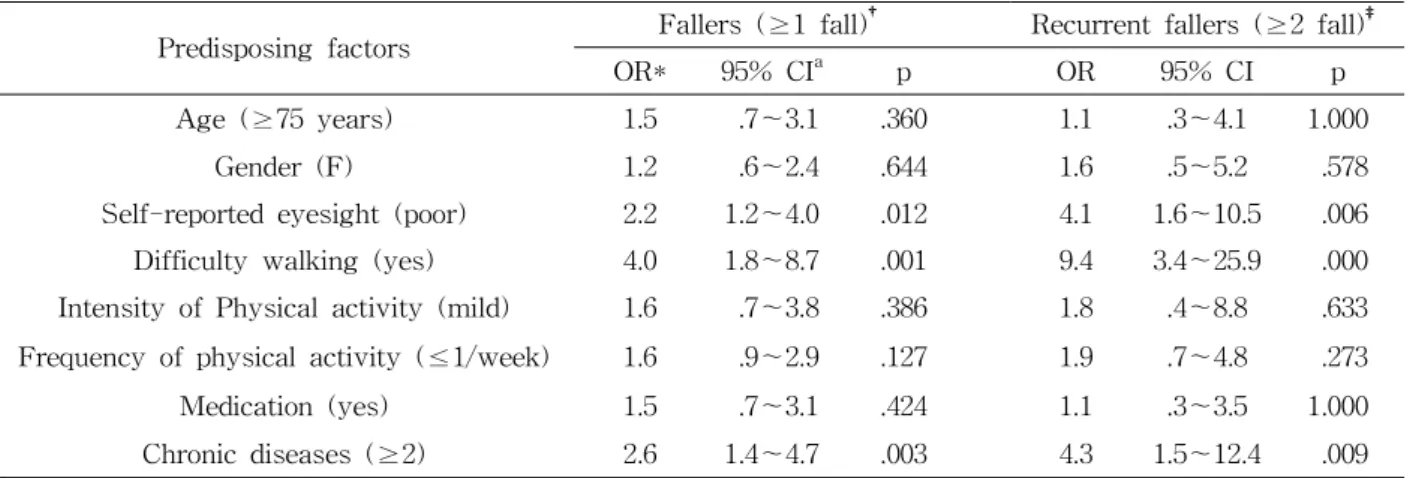
Predisposing factors Fallers (≥1 fall)† Recurrent fallers (≥2 fall)‡
OR* 95% CIa p OR 95% CI p
Age (≥75 years) 1.5 .7~3.1 .360 1.1 .3~4.1 1.000
Gender (F) 1.2 .6~2.4 .644 1.6 .5~5.2 .578
Self-reported eyesight (poor) 2.2 1.2~4.0 .012 4.1 1.6~10.5 .006
Difficulty walking (yes) 4.0 1.8~8.7 .001 9.4 3.4~25.9 .000
Intensity of Physical activity (mild) 1.6 .7~3.8 .386 1.8 .4~8.8 .633 Frequency of physical activity (≤1/week) 1.6 .9~2.9 .127 1.9 .7~4.8 .273
Medication (yes) 1.5 .7~3.1 .424 1.1 .3~3.5 1.000
Chronic diseases (≥2) 2.6 1.4~4.7 .003 4.3 1.5~12.4 .009
†"Fallers" (≥1) versus "Non-fallers".
‡"Recurrent fallers" (≥2) versus "Non-fallers".
*OR: Odds ratio.
aCI: Confidence interval.
Table 2. Risk factors of falls and recurrent falls Statistical Analysis
Participants were divided into fallers, recurrent fallers and non-fallers based on fall status. Direct relationships of independent variables according to fall status were tested by chi-square analysis. The independent variables tested were self-reported eye- sight, mobility, frequency of physical activity, medi- cation use, and any medical conditions. Predictors of falls and multiple falls were investigated by logistic regression using non-fallers as a reference and ad- justing for age and gender. The strengths of the as- sociations obtained from the logistic regression anal- ysis were quantified by odds ratios and 95% con- fidence intervals. The statistical software program for chi-square and logistic regression were SPSS 12.0. A significant level of p<.05 was selected for all statistical tests.
Results
Eighty four of the 201 participants (41.8%) fell down during the previous year. The mean ages of fallers and non-fallers were 70.8 years and 70.2 years. The rate of fallers among females was 43%;
men, 38%. Recurrent fallers falling with more than two times consisted of 26.2% of fallers. Fallers were more likely to express greater fear of falling than non-fallers (OR=3.1) (Table 1).
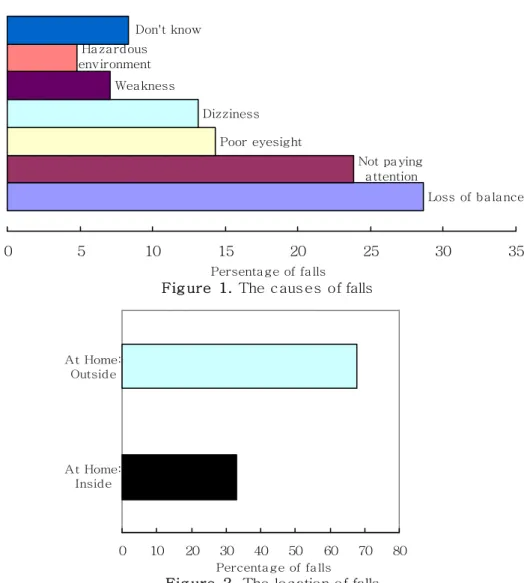
The cause of falls was determined from the par- ticipants' answers in the qustionnaire. A summary of the findings is presented in Figure 1. Loss of bal- ance was the most prevalent cause, accounting for 28.6% of falls. Not paying attention was the 2nd most common cause of falls (23.8%), followed by poor eyesight (14.3%), dizziness (13.1%), weakness
Risk factor B† S.E.‡ OR* p 95% CIa
Age (≥75 years) .35 .44 1.4 .432 .6~3.4
Gender (F) -.13 .37 .9 .737 .4~1.8
Self-reported eyesight (poor) .51 .34 1.7 .131 .9~3.3
Difficulty walking (yes) .89 .43 2.4 .041 1.0~5.7
Chronic diseases (≥2) .92 .35 2.5 .008 1.3~5.0
Frequency of physical activity (≤1/week) .20 .34 1.2 .555 .6~2.4
Medication (yes) .29 .46 1.3 .525 .5~3.3
†B: Regression coefficient.
‡S.E.: Standard error.
*OR: Odds ratio.
aCI: Confidence interval.
Table 3. Logistic regression analysed by fallers (≥1) versus non-fallers
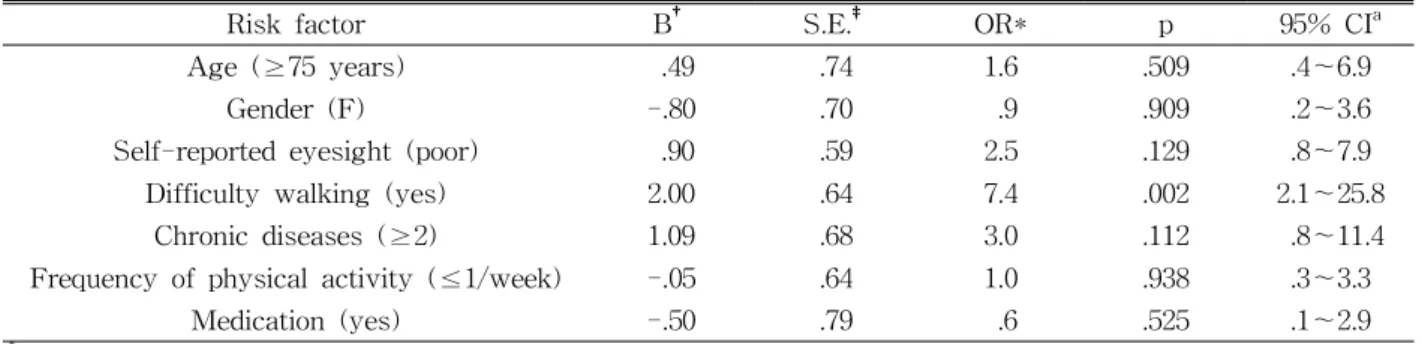
Risk factor B† S.E.‡ OR* p 95% CIa
Age (≥75 years) .49 .74 1.6 .509 .4~6.9
Gender (F) -.80 .70 .9 .909 .2~3.6
Self-reported eyesight (poor) .90 .59 2.5 .129 .8~7.9
Difficulty walking (yes) 2.00 .64 7.4 .002 2.1~25.8
Chronic diseases (≥2) 1.09 .68 3.0 .112 .8~11.4
Frequency of physical activity (≤1/week) -.05 .64 1.0 .938 .3~3.3
Medication (yes) -.50 .79 .6 .525 .1~2.9
†B: Regression coefficient.
‡S.E.: Standard error.
*OR: Odds ratio.
aCI: Confidence interval.
Table 4. Logistic regression analysed by recurrent fallers (≥2) versus non-fallers
(7.1%), and hazardous environment (4.8%).
The location of falls are presented in Figure 2.
Falls were more likely to occur outside of home than inside of home (67.9% and 32.1%, respectively).
Table 2 shows the variables measured in relation to falls and recurrent falls. It was found that fallers had poorer eyesight, multiple chronic diseases and more difficulty walking than non-fallers. Poor eye- sight was related falls (OR=2.2) and recurrent falls (OR=4.1). Difficulty walking one kilometer was related to falls (OR=4.0) and recurrent falls (OR=9.4). Also, if people had more than two medical conditions, there was a relation to falls (OR=2.6) and recurrent falls (OR=4.3). The OR of recurrent fallers was higher by about two times than fallers with poor eyesight, dif- ficulty walking and multiple chronic diseases.
In the logistic regression analysis of falls, only diffi- culty walking (OR=2.4) and chronic diseases (OR=2.5) have an increased risk of falls in general (Table 3).
The recurrent falls is, in addition, influenced by the difficulty walking one kilometer (Table 4).
Discussion
The purpose of this study was to investigate the risk factors of falls and to compare characteristics of the fallers with that of non-fallers among the rural community-dwelling elderly in Korea. According to this study, the rate of falls among participants was 41.8%. This ratio exceeds the 20%~31% typically reported for representative samples of commun-
Not pa ying a ttention Poor eyesight
Dizziness Wea kness
Loss of ba la nce Ha za rdous
environment
Don't know
0 5 10 15 20 25 30 35
Persenta ge of fa lls
Fig ure 1. The caus es of falls
At Home:
Outside
At Home:
Inside
0 10 20 30 40 50 60 70 80 Percenta ge of fa lls
Fig ure 2. The location of falls
ity-dwelling older adults in Western countries (Gill et al, 2005; Morris et al, 2004; Stalenhoef et al, 1999).
On the other hand, this ratio is similar to that of the other studies about metropolitan-dwelling Korean eld- erly people (Jung et al, 2006; Sohng et al, 2004).
'In the community' represents a heterogeneous group, ranging from the very fit and independent old person living at home to the frail and dependent pa- tient in residential care. In this study, the subjects were participated in center-based programs for se- niors, where elderly people who stay at home were excluded. By this reason, the ratio of falls among the rural community-dwelling elderly has the possibility of under-estimating.
Falling is a multifactoral problem due to both in- trinsic and extrinsic risk factors, and usually a com- bination of factors is responsible. Intrinsic risk fac- tors are patient-related factors such as cognitive im- pairment, balance and gait disorders, use of sedatives and hypnotics, history of stroke, advanced age, ar- thritis of the knees and a high level of dependence.
Extrinsic risk factors are environmental and housing conditions (Stalenhoef et al, 1997). In general, mobi- lity impairment, cognitive impairment, and use of medications, especially sedatives, have been identified as important risk factors for falls in previous studies (Campbell et al, 1989; Myers et al, 1991; Tinetti at al, 1988).
In this study, risk factors of falls were self-re- ported eyesight (OR=4.1), chronic diseases(OR=4.3) and difficulty of walking (OR=9.4). In the logistic re- gression analysis of falls, only difficulty walking (OR=2.4) and chronic diseases (OR=2.5) have an in- creased risk of falls in general. By Graafmans et al (1996), level of physical activity was especially re- lated to recurrent falls. Also, in our study, the risk of recurrent falls is influenced by the difficulty of walking one kilometer (OR=7.4). The result of this study shows that mobility impairment was the strongest risk factor.
Fear of falling is a major component of the
"post-fall syndrome", but this fear can also develop in individuals who have not experienced any falling episodes (Bhala et al, 1982; Murphy and Isaacs, 1982). Fear of falling can lead to loss of confidence and reduced activity, resulting ultimately in a loss of independence (Vellas et al, 1987). By Vellas et al (1997), fear of falling is reported at 32% of fallers.
However, in our study, fear of falling is reported at 59.6% of fallers. Fallers were more likely to express greater fear of falling than non-fallers (OR=3.1).
By Bath and Morgan (1999), indoor falls were as- sociated with frailty, while outdoor falls were asso- ciated with compromised health status in more active people. Hill et al (1999) reported that the more than half of all falls occurred outdoors away from home.
In our study, Falls were more likely to occur outside of the home than inside of home (67.9% and 32.1%).
It could be influenced by the characteristics of sub- jects; active older.
The limitation of this study is retrospectively de- signed depending on an elderly persons' memory.
Also, extrinsic risk factors such as concrete environ- mental hazards were not included. However, this study has a meaning that researched the rate of falls and risk factors of falls of the elderly who live in the rural community.
The prevention of falls is an integral part of the management of old people, and those caring for them must take into account supervision of mobility, support
in moving around, and restriction of exposure to risk (van Weel et al, 1995). Physical therapists are one group of providers who primarily focus on improving, maintaining, or limiting the decline in the physical function of an older person. So, it shows that physical therapists should know the risk factors of falls.
Conclusion
Falling is one of the serious problems associated with aging. By this study, eighty four of the 201 participants (41.8%) fell during the previous year.
Twenty two of the fallers (26.2%) fell down more than two times. It was found that fallers had poorer eyesight, multiple chronic diseases and more diffi- culty walking than non-fallers. Especially, the diffi- culty of walking was the strongest risk factor of re- current falling. For a diminishing risk of falls, there needs to be improvement in mobility. Group-based exercise can be one of the effective programs for improving mobility. To control chronic disease and eyesight is important, too.
References
Bath PA, Morgan K. Differential risk factor profiles for indoor and outdoor falls in older people liv- ing at home in Nottingham, UK. Eur J Epidemiol. 1999;15(1):65-73.
Bhala RP, O'Donnell J, Thoppil E. Ptophobia. Phobic fear of falling and its clinical management. Phys Ther. 1982;62(2):187-190.
Campbell AJ, Borrie MJ, Spears GF. Risk factors for falls in a community-based prospective study of people 70 years and older. J Gerontol.
1989;44:M112-M117.
Gill T, Taylor AW, Pengelly A. A pop- ulation-based survey of factors relating to the prevalence of falls in older people. Gerontology.
2005;51(5):340-345.
This article was received September 6, 2006, and was accepted October 20, 2006.
Graafmans WC, Ooms ME, Hofstee HM, et al. Falls in the elderly: A prospective study on risk fac- tors and risk profiles. Am J Epidemiol.
1996;143(11):1129-1136.
Hill K, Schwarz J, Flicker L, et al. Falls among healthy, community-dwelling, older women: A prospective study of frequency, circumstances, consequences and prediction accuracy. Aust N Z J Public Health. 1999;23(1):41-48.
Hindmarsh JJ, Estes EH Jr. Falls in older persons.
Causes and interventions. Arch Intern Med.
1989;149(10):2217-2222.
Jung YM, Lee SE, Chung KS. Prevalence and asso- ciated factors of falls according to health status in elderly living in the community. Journal of the Korean Gerontological Society. 2006;26(2):291-303.
Kosorok MR, Omenn GS, Diehr P, et al. Restricted activity days among older adults. Am J Public Health. 1992;82(9):1263-1267.
Legters K. Fear of falling. Phys Ther. 2002;82(3):264-272.
Moreland J, Richardson J, Chan DH, et al.
Evidence-based guidelines for the secondary prevention of falls in older adults. Gerontology.
2003;49(2):93-116.
Morris M, Osborne D, Hill K, et al. Predisposing factors for occasional and multiple falls in older Australians who live at home. Aust J Physiother. 2004;50(3):153-159.
Murphy J, Isaacs B. The post-fall syndrome. A study of 36 elderly patients. Gerontology.
1982;28(4):265-270.
Myers AH, Baker SP, Van Natta ML, et al. Risk factors associated with falls and injuries among elderly institutionalized persons. Am J Epidemiol.
1991;133(11):1179-1190.
Nevitt MC, Cummings SR, Hudes ES. Risk factors for injurious falls: A prospective study. J Gerontol. 1991;46(5):M164-M170.
O'Loughlin JL, Robitaille Y, Boivin JF, et al.
Incidence of and risk factors for falls and in- jurious falls among the community-dwelling elderly. Am J Epidemiol. 1993;137(3):342-354.
Rubenstein LZ, Josephson KR. The epidemiology of falls and syncope. Clin Geriatr Med. 2002;18(2):141-158.
Sattin RW. Falls among older persons: A public health perspective. Annu Rev Public Health.
1992;13:489-508.
Sohng KY, Moon JS, Song HH, et al. Risk factors for falls among the community-dwelling elderly in Korea. Taehan Kanho Hakhoe Chi.
2004;34(8):1483-1490.
Stalenhoef PA, Crebolder HF, Knottnerus JA, et al.
Incidence, risk factors and consequences of falls among elderly subjects living in the community:
A criteria-based analysis. Eur J Public Health.
1997;7(3):328-334.
Stalenhoef PA, Diederiks JP, de Witte LP, et al.
Impact of gait problems and falls on functioning in independent living persons of 55 years and over: A community survey. Patient Educ Couns.
1999;36(1):23-31.
Tinetti ME, Mendes de Leon CF, Doucette JT, et al.
Fear of falling and fall-related efficacy in rela- tionship to functioning among community-living elders. J Gerontol. 1994;49(3):M140-M147.
Tinetti ME, Speechley M, Ginter SF. Risk factors for falls among elderly persons living in the community. N Engl J Med. 1988;319(26):1701-1707.
van Weel C, Vermeulen H, van den Bosch W. Falls, a community care perspective. Lancet.
1995;345(8964):1549-1551.
Vassallo M, Sharma JC, Allen SC. Characteristics of single fallers and recurrent fallers among hospi- tal in-patients. Gerontology. 2002;48(3):147-150.
Vellas B, Cayla F, Bocquet H, et al. Prospective study of restriction of activity in old people af- ter falls. Age Ageing. 1987;16(3):189-193.
Vellas BJ, Wayne SJ, Romero LJ, et al. Fear of fall- ing and restriction of mobility in elderly fallers.
Age Ageing. 1997;26(3):189-193.