Development of a Vertical polarized Leaky-wave Waveguide Slot Array Antenna for Receiving the Ku-band Direct
Broadcasting Satellite Signals
Gye Jae Lim
요 약
위성방송수신 및 위성 양방향 인터넷, VSAT 등의 위성통신서비스를 차량 이동 시에도 이용할 수 있기 위해서는 차량 에 탑재하기 용이하도록 소형이며 높이가 낮은 안테나 구조가 요구된다. 또한 중위도 지역에서 평면 안테나 상태로 45도 빔틸트 특성을 갖고, Ku 밴드의 위성통신용으로 충분한 고이득을 얻기 위해, 빔폭이 좁고 사이드로브가 적으며 저손실 구 조의 배열안테나 개발이 필요하다.
본 논문에서는 이러한 성능을 만족시키기 위해, 진행파형 누설파 모드를 기초로 한 수직 편파로 동작하는 도파관 종방 향 슬롯 배열안테나를 제안하였다. 16개 누설파 소자의 배열안테나 이득은 30 dBi 이었으며, 빔폭은 4.9도, 사이드로브 레 벨은 -20 dB 이하, 중심주파수에서 빔틸트 각도는 45도를 얻었다. 급전선로는 도파관의 병렬급전 방식으로 설계하여 광대 역, 저손실 특성을 얻을 수 있었다.
키워드: 위성통신용 안테나, 마이크로파 도파관 안테나, 빔틸트 안테나, 누설파 모드, 슬롯 배열안테나
ABSTRACT Small size and low profile antenna for mobile vehicular-top-mounted is needed in satellite communication services such as DBS, Satellite Internet and VSAT. In middle latitudes, the development of an array antenna which has the conformal, low profile and 45 degree beam tilted configuration, and has the high gain with sharp beamwidth, low sidelobe and low loss is required for Ku-band satellite communication.
In this paper, in order to meet with these performances, an array antenna consisting of the vertical polarized waveguide longitudinal slots based on the leaky-wave mode of traveling wave antenna is proposed. An array antenna consisting of 16 leaky-wave elements is showing 30 dBi of gain, 4.9 degree of beamwidth, below than -20 dB of sidelobe level, 45 degree of beam tilt angle in center frequency. Feed network designed by waveguide cooperated feed shows good performance of wideband and low loss.
Key Words : Satellite communication antenna, microwave waveguide antenna, beam tilt antenna, leaky-wave mode, slot array antenna
1. Introduction
The high gain antennas with beam tracking in motion vehicles are being developed for the efficient services from satellites. But there are some difficulties because of various physical limits.
The conventional large size parabola based antennas for DBS (Direct Broadcasting Satellite) and VSAT (Very Small Aperture Terminal) are used on the fixed position, on the large vehicle or on the ship. But it is impossible to mount on small vehicles because the size and weight is too large.
From few years ago, the efforts to design these antennas which meet with properties of low profile, conformal, low weight, low size and low loss are
on-going. [1-3]
Recently, the design using a microstrip antenna and feed circuit or phase shifters is not recommended because the low gain due to those lossy properties. So to maximize the gain by minimizing the loss, the design using a waveguide antenna and feed circuit is preferred. Also for the beam tilt method, a leaky-wave antenna is used instead of using the phase shifter.
In this paper, the design method and example of DBS, VSAT and satellite communication antenna in which are proper to optimal physical configurations are proposed, and best gain and performance in the array antenna are analyzed.
Basic concepts for the design are followings;
leaky-wave antenna is needed for the low profile
* Dept. of Information and Communication Engineering, Kwandong University 522 Naegok-dong, Gangneung-city, KOREA 210-701 Email : [email protected]
and beam tilt, waveguide slot array is needed for the conformal type, and waveguide cooperated feed circuit is needed for the low loss.
As an example, an array antenna in 12.5GHz band is designed having the size of "280mm (length) X 340mm (width) X 7.7mm (height)", the gain of 30 dBi, and the bean tilt of 45 degree.
2. Theory of leaky-wave antenna In middle latitudes, the elevation angle to geostationary satellite is about 45 degree.
Therefore, the height of conventional antenna with broadside beam is "antenna length X cos 45"
because this antenna is tilted itself to orient to satellite. But for the low profile antenna, it is preferable to tilt the beam instead of the antenna itself. It is generally possible by using the leaky-wave antenna as a kind of traveling wave antenna. [4-8]
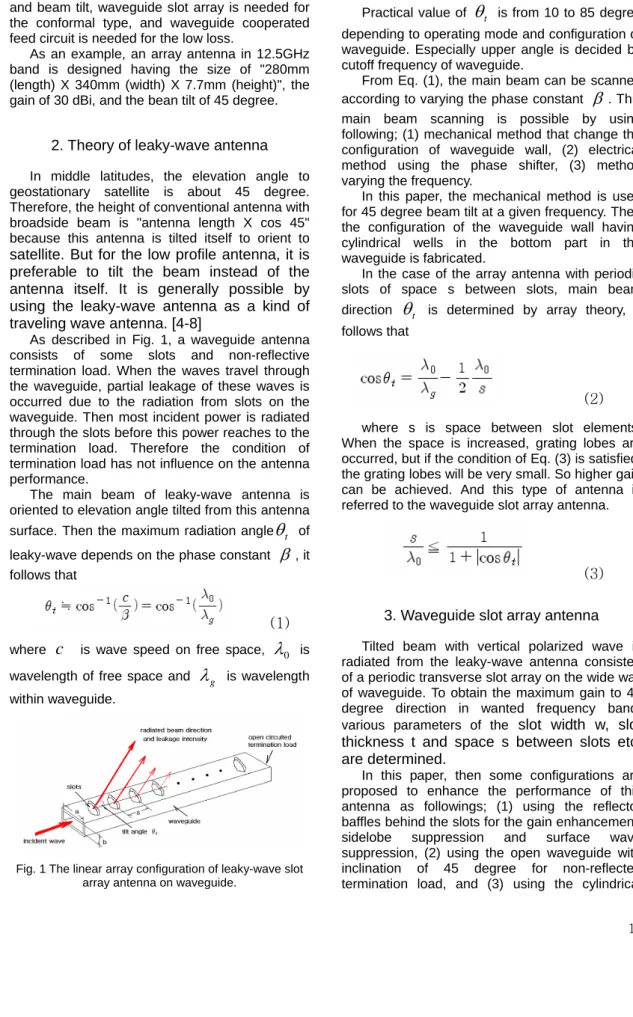
As described in Fig. 1, a waveguide antenna consists of some slots and non-reflective termination load. When the waves travel through the waveguide, partial leakage of these waves is occurred due to the radiation from slots on the waveguide. Then most incident power is radiated through the slots before this power reaches to the termination load. Therefore the condition of termination load has not influence on the antenna performance.
The main beam of leaky-wave antenna is oriented to elevation angle tilted from this antenna surface. Then the maximum radiation angleθt of
leaky-wave depends on the phase constant β , it
follows that
(1) where c is wave speed on free space, λ0 is wavelength of free space and λg is wavelength within waveguide.
Fig. 1 The linear array configuration of leaky-wave slot array antenna on waveguide.
Practical value of θt is from 10 to 85 degree depending to operating mode and configuration of waveguide. Especially upper angle is decided by cutoff frequency of waveguide.
From Eq. (1), the main beam can be scanned according to varying the phase constant β. This main beam scanning is possible by using following; (1) mechanical method that change the configuration of waveguide wall, (2) electrical method using the phase shifter, (3) method varying the frequency.
In this paper, the mechanical method is used for 45 degree beam tilt at a given frequency. Then the configuration of the waveguide wall having cylindrical wells in the bottom part in the waveguide is fabricated.
In the case of the array antenna with periodic slots of space s between slots, main beam direction θt is determined by array theory, it follows that
(2) where s is space between slot elements.
When the space is increased, grating lobes are occurred, but if the condition of Eq. (3) is satisfied, the grating lobes will be very small. So higher gain can be achieved. And this type of antenna is referred to the waveguide slot array antenna.
(3)
3. Waveguide slot array antenna Tilted beam with vertical polarized wave is radiated from the leaky-wave antenna consisted of a periodic transverse slot array on the wide wall of waveguide. To obtain the maximum gain to 45 degree direction in wanted frequency band, various parameters of the slot width w, slot thickness t and space s between slots etc.
are determined.
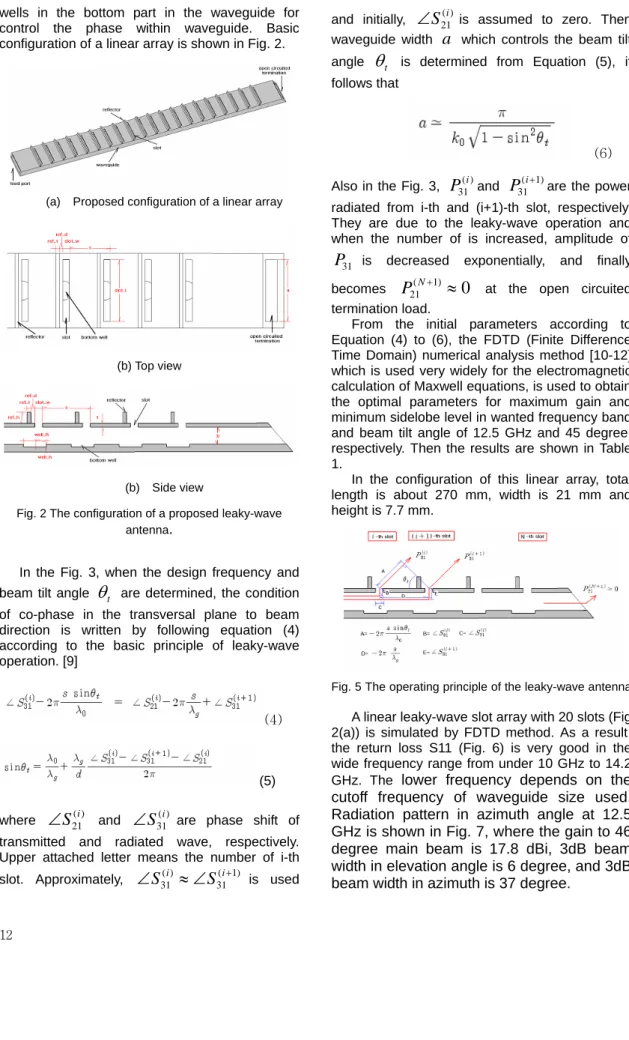
In this paper, then some configurations are proposed to enhance the performance of this antenna as followings; (1) using the reflector baffles behind the slots for the gain enhancement, sidelobe suppression and surface wave suppression, (2) using the open waveguide with inclination of 45 degree for non-reflected termination load, and (3) using the cylindrical
wells in the bottom part in the waveguide for control the phase within waveguide. Basic configuration of a linear array is shown in Fig. 2.
(a) Proposed configuration of a linear array
(b) Top view
(b) Side view
Fig. 2 The configuration of a proposed leaky-wave antenna.
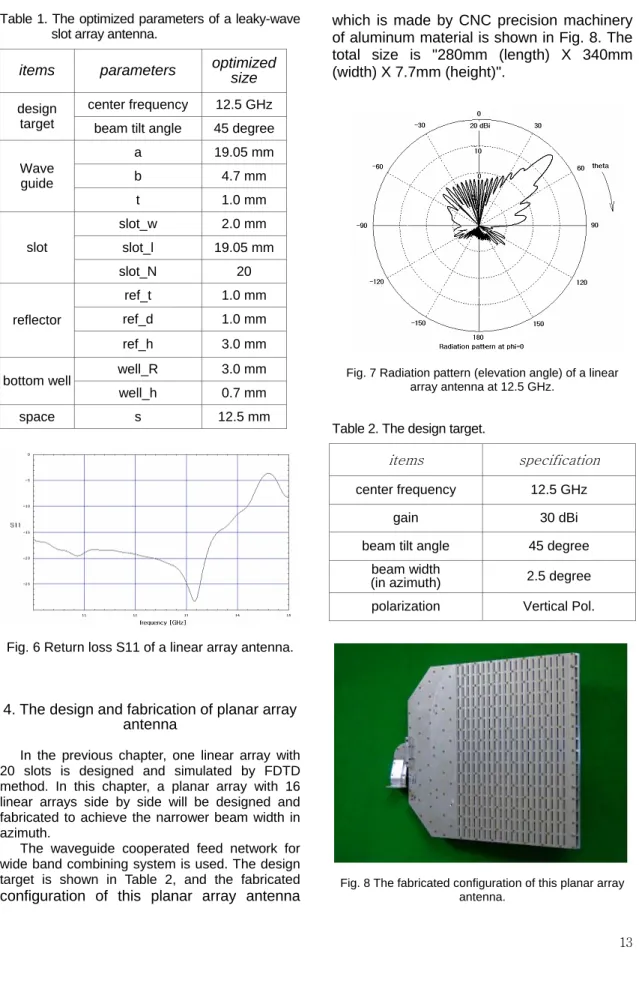
In the Fig. 3, when the design frequency and beam tilt angle θt are determined, the condition of co-phase in the transversal plane to beam direction is written by following equation (4) according to the basic principle of leaky-wave operation. [9]
(4)
(5)
where ∠S21(i) and ∠S31(i) are phase shift of transmitted and radiated wave, respectively.
Upper attached letter means the number of i-th slot. Approximately, ∠S31(i) ≈∠S31(i+1) is used
and initially, ∠S21(i) is assumed to zero. Then waveguide width a which controls the beam tilt angle θt is determined from Equation (5), it follows that
(6) Also in the Fig. 3, P31(i)and P31(i+1)are the power radiated from i-th and (i+1)-th slot, respectively.
They are due to the leaky-wave operation and when the number of is increased, amplitude of
P31 is decreased exponentially, and finally becomes P21(N+1) ≈0 at the open circuited termination load.
From the initial parameters according to Equation (4) to (6), the FDTD (Finite Difference Time Domain) numerical analysis method [10-12]
which is used very widely for the electromagnetic calculation of Maxwell equations, is used to obtain the optimal parameters for maximum gain and minimum sidelobe level in wanted frequency band and beam tilt angle of 12.5 GHz and 45 degree, respectively. Then the results are shown in Table 1.
In the configuration of this linear array, total length is about 270 mm, width is 21 mm and height is 7.7 mm.
Fig. 5 The operating principle of the leaky-wave antenna.
A linear leaky-wave slot array with 20 slots (Fig.
2(a)) is simulated by FDTD method. As a result, the return loss S11 (Fig. 6) is very good in the wide frequency range from under 10 GHz to 14.2 GHz. The lower frequency depends on the cutoff frequency of waveguide size used.
Radiation pattern in azimuth angle at 12.5 GHz is shown in Fig. 7, where the gain to 46 degree main beam is 17.8 dBi, 3dB beam width in elevation angle is 6 degree, and 3dB beam width in azimuth is 37 degree.
Table 1. The optimized parameters of a leaky-wave slot array antenna.
items parameters optimized size center frequency 12.5 GHz design
target beam tilt angle 45 degree
a 19.05 mm
b 4.7 mm
Wave guide
t 1.0 mm
slot_w 2.0 mm
slot_l 19.05 mm
slot
slot_N 20
ref_t 1.0 mm
ref_d 1.0 mm
reflector
ref_h 3.0 mm
well_R 3.0 mm
bottom well
well_h 0.7 mm
space s 12.5 mm
Fig. 6 Return loss S11 of a linear array antenna.
4. The design and fabrication of planar array antenna
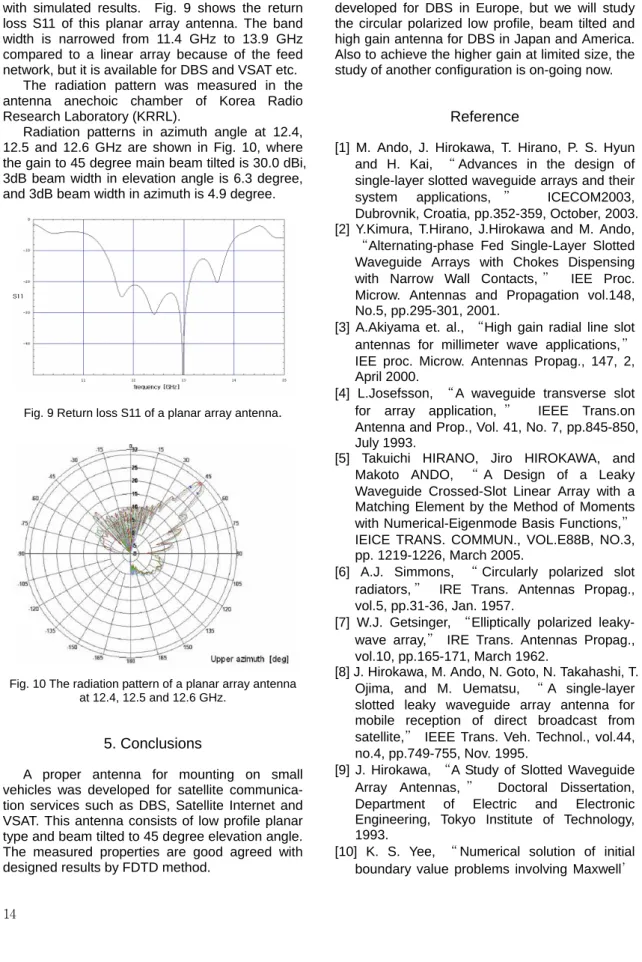
In the previous chapter, one linear array with 20 slots is designed and simulated by FDTD method. In this chapter, a planar array with 16 linear arrays side by side will be designed and fabricated to achieve the narrower beam width in azimuth.
The waveguide cooperated feed network for wide band combining system is used. The design target is shown in Table 2, and the fabricated configuration of this planar array antenna
which is made by CNC precision machinery of aluminum material is shown in Fig. 8. The total size is "280mm (length) X 340mm (width) X 7.7mm (height)".
Fig. 7 Radiation pattern (elevation angle) of a linear array antenna at 12.5 GHz.
Table 2. The design target.
items specification
center frequency 12.5 GHz
gain 30 dBi
beam tilt angle 45 degree beam width
(in azimuth) 2.5 degree
polarization Vertical Pol.
Fig. 8 The fabricated configuration of this planar array antenna.
The measured results are very good agreed with simulated results. Fig. 9 shows the return loss S11 of this planar array antenna. The band width is narrowed from 11.4 GHz to 13.9 GHz compared to a linear array because of the feed network, but it is available for DBS and VSAT etc.
The radiation pattern was measured in the antenna anechoic chamber of Korea Radio Research Laboratory (KRRL).
Radiation patterns in azimuth angle at 12.4, 12.5 and 12.6 GHz are shown in Fig. 10, where the gain to 45 degree main beam tilted is 30.0 dBi, 3dB beam width in elevation angle is 6.3 degree, and 3dB beam width in azimuth is 4.9 degree.
Fig. 9 Return loss S11 of a planar array antenna.
Fig. 10 The radiation pattern of a planar array antenna at 12.4, 12.5 and 12.6 GHz.
5. Conclusions
A proper antenna for mounting on small vehicles was developed for satellite communica- tion services such as DBS, Satellite Internet and VSAT. This antenna consists of low profile planar type and beam tilted to 45 degree elevation angle.
The measured properties are good agreed with designed results by FDTD method.
Now only a vertical polarized antenna is developed for DBS in Europe, but we will study the circular polarized low profile, beam tilted and high gain antenna for DBS in Japan and America.
Also to achieve the higher gain at limited size, the study of another configuration is on-going now.
Reference
[1] M. Ando, J. Hirokawa, T. Hirano, P. S. Hyun and H. Kai, “ Advances in the design of single-layer slotted waveguide arrays and their system applications, ” ICECOM2003, Dubrovnik, Croatia, pp.352-359, October, 2003.
[2] Y.Kimura, T.Hirano, J.Hirokawa and M. Ando,
“Alternating-phase Fed Single-Layer Slotted Waveguide Arrays with Chokes Dispensing with Narrow Wall Contacts, ” IEE Proc.
Microw. Antennas and Propagation vol.148, No.5, pp.295-301, 2001.
[3] A.Akiyama et. al., “High gain radial line slot antennas for millimeter wave applications,”
IEE proc. Microw. Antennas Propag., 147, 2, April 2000.
[4] L.Josefsson, “A waveguide transverse slot for array application, ” IEEE Trans.on Antenna and Prop., Vol. 41, No. 7, pp.845-850, July 1993.
[5] Takuichi HIRANO, Jiro HIROKAWA, and Makoto ANDO, “ A Design of a Leaky Waveguide Crossed-Slot Linear Array with a Matching Element by the Method of Moments with Numerical-Eigenmode Basis Functions,”
IEICE TRANS. COMMUN., VOL.E88B, NO.3, pp. 1219-1226, March 2005.
[6] A.J. Simmons, “ Circularly polarized slot radiators, ” IRE Trans. Antennas Propag., vol.5, pp.31-36, Jan. 1957.
[7] W.J. Getsinger, “Elliptically polarized leaky- wave array,” IRE Trans. Antennas Propag., vol.10, pp.165-171, March 1962.
[8] J. Hirokawa, M. Ando, N. Goto, N. Takahashi, T.
Ojima, and M. Uematsu, “ A single-layer slotted leaky waveguide array antenna for mobile reception of direct broadcast from satellite,” IEEE Trans. Veh. Technol., vol.44, no.4, pp.749-755, Nov. 1995.
[9] J. Hirokawa, “A Study of Slotted Waveguide Array Antennas, ” Doctoral Dissertation, Department of Electric and Electronic Engineering, Tokyo Institute of Technology, 1993.
[10] K. S. Yee, “ Numerical solution of initial boundary value problems involving Maxwell’
s equations in isotropic media,” IEEE Trans.
Antennas Propagat., vol. 14, pp. 302-307, Mar.
1966.
[11] A. Taflove, “Review of the formulation and applications of the finite-difference time- domain method for numerical modeling of electromagnetic wave interactions with arbitrary structures,” Wave Motion, vol. 10, no. 6, pp. 547-582, 1988.
[12] A. Taflove and M. E. Brodwin, “Numerical solution of steady-state electromagnetic scattering problems using the time-dependent Maxwell ’ s equations, ” IEEE Trans.
Microwave Theory Tech., vol. MTT-23, no. 8, pp. 623-630, 1975.
저 자 임 계 재(Gye-Jae Lim) 정회원
1983년 2월: 동국대학교 전자공학과 졸업 1988년 8월: 동국대학교
전자공학과 석사 1993년 2월: 동국대학교
전자공학과 박사 1994년 2월–현재:
관동대학교 전자정보통신공학부 교수
<관심분야> 전자장 및 전파전파, 무선통신공학, 위성통신 공학