• 검색 결과가 없습니다.

A Study on the Method to Improve Manufacturing Process Using Motion Analysis Solution

N/A
N/A
Protected

Academic year: 2021

Share "A Study on the Method to Improve Manufacturing Process Using Motion Analysis Solution"

Copied!
7
0
0

로드 중.... (전체 텍스트 보기)

전체 글

(1)

1. Introduction

The world market in the age of the infinite global competition due to deepening of cost competitiveness

and oversupplies maximizes productivity through structural improvement for manufacturing competitiveness.

Especially, various improving activities such as

A Study on the Method to Improve Manufacturing Process Using Motion Analysis Solution

Hyun-Jong Kim

1

, Jae-Gun Yoo

2

, Jung-Wan Hong

2*

1

Dept. of Smart Convergence Consulting, Han-Sung University, Seoul, Korea

2

Dept. of Industrial and Management Engineering, Han-Sung University, Seoul, Korea

동작분석 솔루션을 활용한 제조공정개선 방법연구

김현종1, 유재건2, 홍정완2*

1한성대학교 스마트융합컨설팅학과, 2한성대학교 산업경영공학과

Abstract Efficiency of Process in manufacturing industry is a critical factor to connect directly to competitiveness of product. In particular, due to FTAs with various worlds around the world, the domestic and overseas manufacturing industries are facing intense competitions, and it requires elaborate task management system for shortening production time.

This study aims at seeking how to raise efficiency of manufacturing process, using motion analysis solution.

When improving the process of manufacturing after verifying optimization using motion analysis solution, it can save costs for additional process, modification, or supplement. It can also deduce practical effect to improve productivity of companies.

It is expected that the study will contribute to improve wastes in the work field and task assignment efficiency, to shorten time replacing equipment, to measure standard time, and to standardize task system.

Key Words : motion study, task Standardization, process analysis, process design, production process

요 약 제조업에 있어 공정의 효율성은 제품의 경쟁력과 직결되는 중요한 요소이다. 특히 최근 여러 국가와 FTA체결로 인해 국내외 제조업이 치열한 경쟁에 직면함에 따라 생산시간을 보다 단축하기 위한 정교한 작업관리 시스템이 요구되고 있다.

본 연구에서는 동작분석 솔루션을 활용하여 제조공정의 효율성을 제고하는 방안을 모색하고자 한다.

동작분석 솔루션을 활용하여 최적화 검증 후 제조공정을 개선할 경우 추가적인 공정 수정 또는 보완에 소요되는 비용을 절감할 수 있으며, 기업의 생산성 향상이라는 실질적 효과를 도출할 수 있다.

본 연구를 통해 작업현장의 낭비개선, 작업편성효율개선, 기종교체시간 단축, 표준시간 측정 및 작업시스템 표준화 등을 구현할 수 있다.

주제어 : 동작연구, 작업표준, 공정분석, 공정설계, 생산공정

* This research was financially supported by Han-Sung University.

*Corresponding Author : Jung-Wan Hong ([email protected]) Received May 3, 2018

Accepted June 20, 2018

Revised June 3, 2018 Published June 28, 2018
(2)

motion study, task study, process analysis method, measuring task, setting task standard by standardization of work method and time through education for managers and workers, and improvement of work method and work environment, are made in order to design efficient manufacturing process and to improve productivity[1].

This study aims at seeking efficient method of manufacturing process removing unnecessary motion elements through use of motion analysis solution.

The previous method has a characteristic to measure efficiently worker’s time consisting of repeated tasks in the field, in general. It is just used for measuring work time.

Therefore, it is not proper to standardize task management system. That is, the study is distinctive in its availability to compare and analyze the measure work time, to design optimal task management system through editing and simulation based on these compared and analyzed results.

2. Theoretical Review

2.1 Motion Study

Motion study understands sufficiently work contents on workers and equipment by process. After that, it figures out the entire load of workers and equipment through time study. Work process means that work contents, methods and non-added-value work are improved without elements for safety, environment, and quality, and then work amount of added-value are increased and loads of workers and equipment are distributed evenly through process re-arrangement[2.3].

2.2 Types of Motion Study 2.2.1 Micro Motion Study

Taking a picture was introduced to analyze a worker’s motion in detail, and it is a method to record worker’s motion in high-speed video and to analyze it in order to figure out what kind of basic motions it

consists of.

2.2.2 Cycle Graph

To figure out the record of traces of motions of worker, it is to attach small lamps on several body parts of the worker such as fingers and elbows, and to take a picture in longtime exposure. The motions of worker’ body make the traces to be represented as lines consist of a series of light. If the record of traces of motions is simple and consistent here, it is recognized as more efficient.

2.2.3 Chrono cycle Graph

Cycle graph provides the record of motion traces of a worker but it is not available to visualize the most detailed part of motion. In particular, task requiring precise and quick micro-motion is not available for segmenting with unit element. In order to solve this problem, when attaching flickering lamp and taking a picture of it with some ratio for some time, the moments to turn on flickering lamp only are taken, and the record of traces of motion is observed and recorded in form of dotted lines, showing a series of dots.

That is, in proportion to speed of motion, it is available to calculate traces of motions and temporal elements easily.

2.2.4 Therblig: Simultaneous Motion Cycle Chart

All the extracted record based on the methods as described above, can compose ‘simultaneous motion cycle chart’, and all motions including ‘searching for’,

‘grabbing’, and ‘releasing’ by a worker are categorized into 18 basic motions. And then, work motions are analyzed in simple and clear forms, and it is available to draw compositions and time of motions in specific parts of body[4].

2.2.5 Process Chart

Gilbreth also invented the process chart for figuring

out work flow clearly by marking workers’ motions as

(3)

well as process with signals and schemes. Process chart marks tasks with five factors(operation, transportation, inspection, delay, and storage).

2.3 The Definition of Work Management Work management is that a company investigates and studies works and processes required for production with the actual workers as subjects in order to produce economically products with consistent level of quality and quantity in production process.

Work management have goals of exploration of work motion proper to physical and psychological function of workers who conduct it, improvement and standardization of work method, material, equipment, and instrument, determination of standard work amount and standard work time, and training of workers.

2.4 Methods to Measure Tasks 2.4.1 Time study

In time study, using stop watch or film analysis, the given work was separated into motion element available for measuring time, and individual time is repeatedly measured for getting an average time. If setting standard work method, through training workers, during time study, the works should continue to conduct the set standard work method.

Currently, this method is most frequently used for task measuring method. This method is useful for short-term and repeated task. Time study with stop watch is made by setting time standard through observation on a workers several times, and applying it to many workers who conduct the same task.

Frequency of measuring tasks has a function relations with variableness of measured time, reliability level required for work time to be estimated, required accuracy. In spite of it, time study is considerably accurate method to measure tasks, and is used for evidence of incentive or in claiming about the standard.

The biggest demerit of time study is psychological effect on workers. Some workers oppose to set time standard using stop watch during work. As a result,

workers conduct tasks slowly, change work method or use other means to fabricate the standard[5].

2.4.2 Predetermined time standards

PTS method is to use predetermined standard time value according to characteristics and the given conditions in a group of basic motions from all tasks analyzed in detail for work method done by a worker, to find the time spent for worker’s work motion from the predetermined table and to classify it and to sum time values of the work motion in order to calculate the determined time of the work.

For merit of PST method, it is not necessary to make additional rating. Also, it is not to use stop watch, saving measuring time and cost. In addition, under the controlled condition, it can be applied and composed to many workers. It does not need to modify performance scheme by the analyzer in order to set a standard, not causing stop of the work. Therefore, it is available to set standard before conducting it[6].

However, decomposing motions and weighting them is different by analyzer who has different method to decompose task into element, and estimated time may be different, and composition of basic motion may be also different. Therefore, it is problematic to say that PTS method is always more accurate than time study[7,8].

2.4.3 Standard data

Standard method is to apply standard time based on standard data when managing time spent for motion element works derived from time studies in the past as database. That is, it is to apply it directly from standard data, or to calculate and to sum time based on it, in order to calculate the value of normal time for the work. Then, multiplying spare time for private affairs, fatigue, and delay by workers to this normal time, it is to calculate standard time for the work.

Standard data method is used mainly for measuring

direct labor, and it is especially useful for repeated

mass work.

(4)

Standard data method has merit compared to time study using stop watch. Standard database used as DB for time spent for each motion element work has been previously used, and the standard time by it can be accepted by managers and workers. And if using standard data, it is available to prevent stopping of work by time study and to save costs. Mass production of a new product and changes in work method can be evaluated by spending less time and cost. It is also useful for setting standard for work which has not been conducted before[9].

2.4.4 Historical data

Historical data method is set its standard based on data in the past.

In order to measure tasks based on data from the past, it is to record time spent for individual worker or manager to complete each task.

Depending on tasks, historical data method is preferred, because it can be developed and used as standard itself. For this method, it is not necessary to measure field work with stop watch. It can promote improvement without setting a new standard with flexibility for work methods. This method is especially effective when it is connected to incentive policies. In this case, the purpose is to deduce continuous improvement compared to the goal in the past.

2.4.5 Work sampling

Work sampling is a method that a worker is observed in random and the ratio of time consumed for the actual certain activities is measured to set a standard. This method is useful for repeated task, group task and those not limited by time. Lots of data made by work sampling is useful for setting standards, and analyzing work method, and costs, as well.

Unlike time study, work sampling method does not require measuring work time. Actually, this method is not made by continuous observance on a certain task but the researcher observes a machine or a worker in random, and marks the contents of the activities.

Work sampling can be used to compose work manual and to assign personnel in proper place and time.

When estimating it using work sampling, there may be subtle deviations. That is, when observing the tasks and classifying task and waste, if observing time is different, even though frequency of observation is same, the results may be subtly different, and all the estimated measures are considered as different form the actual values in general. And it should be understood as finding ratio of an approximate value for the actual consumed time.

3. Methods to Apply Motion Analysis Solution

It is to activate the motion and time study after converting video clips to PC readable format such as MP4, MOV, ASF, WMV, MPEG, AVI, and MKV. You can easily do motion analysis on PC and also possibly select and play (standard motion set-up, standard time verification) the deleted portions after distinguish unnecessary parts. On PC, it is possible to control the speed of video frame or immediately move the video clip to designated place, simply with a mouse. The capacity of unit analysis is feasibly minimum 0.4 (about 0.2 second) per 1 element to maximum 999 elements to 1 period[10].

The reanalysis function lets movement elements to combine, divide, movement of start or ending position, avoid action during analysis. And it makes eligible to do frame play, repeat play, and backward play, screen capture (storing in clipboard) at potential position within the movement elements, as well as play or edit of the analyzed movement elements. Also, it is possible to do compare and analysis of two video clips simultaneously (workable with two same clips). The methods to be used are as follows[11].

3.1 Task Analysis Method

(5)

Measuring task is done by running videos from 0.01x speed to 10x speed, and watching and analyzing motions. Using mouse scroll, it can segment motion in detail into non-added value motion and added value motion for each unit of motion with unit 0.1 second.

Each segmented motion element can be converted and printed by excel data and graph after classifying them with item or with type. The order of task analysis is made by clarification of the analysis purpose, preparation of analysis, observation of task, checking order of task, measuring time, arranging data, and drawing graphs, and reviewing improvements[12].

3.2 Comparative Analysis Method

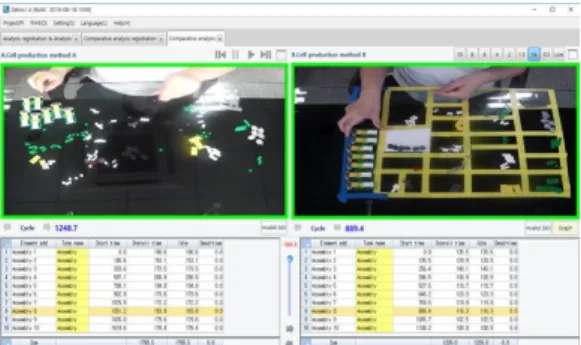
In order to standardize task management system, work to set optimized standard motions and to verify standard time spent for standard motion should be accompanied. Therefore, by registering project or stranding tasks with different time by skillfulness of workers to motion analysis solution separately, and inputting many videos by worker corresponding to the registered project or stranding work, it is available to compare and analyze the same motion of task[13].

For the comparative analysis, as seen in Fig. 1, through comparisons such as work methods, work order, and part allocation, it is available to search for unnecessary motions by workers and work methods requiring skills, and it can be applied to design devices for automation of work. In addition, it enables to compare each dynamic element before and after improvements and to improve work time.

Fig. 1. Comparative Analysis

3.3 The Analysis Method of Stranding Personnel and Machines

Stranding task is a process connecting personnel and equipment, and its purposes include clarification of task distribution between person and person, between person and machine, and between machine and machine, of unbalance of work amount, and figuring out the status of delay, waste, and non-operation. The analysis order is done by observing work time, arranging data, composing stranding work analysis chart, summing, and reviewing improvements.

3.4 Multiple-Task Activity Analysis Method It is a method to analyze the entire process of tasks by workers and machines in the process of manufacturing, and its aims at shortening rest time, and raising use of workers and machines through rearrangement of task group and improvement of work method.

Motion analysis solution can conduct analyses such as measuring time on multi-tasking and editing invalid motion, and is available for simulation.

3.5 Line Balancing Efficiency Analysis Method Line balancing analysis is a methods aiming at raising balancing efficiency by saving balance loss in line task. By measuring time values by process, it is presented in pitch and diagram, and the deviation is figured out visibly, clarifying the points of improvements. When conducting production with flow work method, the important factor is line balance. If line balance is not made, delay of supplied products occurs in processes of delay and waiting, and it is impossible to use sufficiently equipment and efforts, the biggest characteristic of the flow work method[14].

Motion analysis solution is available for editing or

simulating in order to reduce the entire work by

selecting and running the videos of detailed tasks,

measuring the time, and distributing the detailed task

requiring maximum time as a result of measuring it,

and the analysis order consists of classifying tasks,

(6)

measuring time of each task, arranging data and extracting problems, and reviewing improvement.

Like this, by measuring and analyzing precisely specific time and motions included in tasks by both machines and personnel by motion analysis solution using video, removing wastes, and setting better order or combination of tasks, it is very proper as to standardize task management system, and to improve innovatively production efficiency as an instrument for innovative activities[15].

4. Conclusion

It is urgently required for efficient manufacturing process in order to respond immediately to diversified demands of market.

Motion analysis is to measure stop location of motion, to observe and analyze specific time and motions included in tasks by both machines and personnel in detail to remove wastes, and to set better order or combination of tasks.

In the industries, it is necessary to apply this motion analysis method, but most of companies think that it is a professional work, and do not use it sufficiently.

Motion analysis solution is currently used in various fields of small and medium-sized businesses. Watching screen of the work recorded as video, the analysis works consisting of setting standard time and work, comparing and analyzing through process allotment, stranding work between personnel and machines, multiple –task activities, and line balancing are accurately and simply done with using mouse and keyboard for simulation by unit of process. Also, based on the analyzed process data, it can be used for various purposes such as improving work through removing wastes, educating workers, transmitting technologies, and composing reports.

As described above, by supplementing and solving mutually these problems through use of motion analysis solution and standardizing the system, it is

available to innovate productivity. Through it, it is available to improve wastes and line balancing efficiency, to shorten time for replacing equipment, to measure standard time, and to standardize tasks.

Motion analysis solution using video will contribute tremendously to increase production efficiency for small and medium-sized businesses.

For limitations of analytic ability due to manual motion analysis in the current motion analysis solution, motion elements are one by one and manually analyzed by human personnel based on video taken for analyzing motions of machines and humans to improve the process.

It means that it takes long time to analyze motions, providing an environment having to apply sampling methods not the entire test.

Because of characteristic of sampling method, it cannot rightly represent those of an original population with limitations in its analysis results, causing to limit searching for various patterns of motions.

Therefore, it is necessary to develop technology to reduce analysis time by replacing the existing human manual work with automatic computer vision.  

REFERENCES

[1] C. H. Seo. (2012). A study on difference in key success factors of Production Process for acquisition of flexibility, 26-31.

[2] S. Y. Lee. (2015).. Production management theory on products and services. 424-426.

[3] F. C. Barnes. (1983). Principles of Motion Economy:

revisited, reviewed, and restored, Proceedings of the Southern Management Association.

[4] G. W. Kim. (2002). The Site of Photography in Scientific Management (With Emphasis on Gilbreths’ Motion Study). 41-46

[5] Benjamin W. Niebel. (1972). Motion and Time Study.

[6] S. Nallusamy, V. Saravanan. (2016). Lean Tools Execution in a Small Scale Manufacturing Industry for Productivity Improvement-A Case Study, 9(35).

[7] D. J. Yang. (2002). A Study on the Production Facility

and Work Method Improvement Through MODAPTS.

(7)

10-17.

[8] D. H. Baek. (2009). A comparison of MODAPTS and MOST in Assembly Line, 2-4.

[9] J. M. Yang.(2002). Improvement of effective ways of Teaching in One Transistor Reflex Radio Assembly Class – by Time Study, 5-7.

[10] Y. H. Cho. (2015). Manufacturing convergence simulation system effect for the degree of perfection improvement of the new product, Journal of digital Convergence , 13(6), 91-103.

[11] H. J. Kim. (2015). Motion Analysis Method of Utilizing Videos and the Case study, 18.

[12] L. H. Soo. (1989). A Study on the Measurement Method of Standard Time. 2-18.

[13] www.stepi.re.kr. Science and Technology Policy Institute.

[14] S. Vislavath, P. Srivastava, M. Aziz and A. Sharma.

(2016). Line Balancing Heuristics for Productivity Enhancement in Beverage Factory, 9(36)

[15] www.kpc.or.kr. Korea Productivity Center

김 현 종(Hyun-Jong Kim) [정회원]

▪2015년 2월 : 인천대학교 일반대 학원 경영학과 (경영학석사)

▪2015년 9월 ~ 현재 : 한성대학교 일반대학원 스마트융합컨설팅학 과 (컨설팅학 박사과정)

▪2000년 12월 ~ 현재 : SC사업부 부장

▪관심분야 : 스마트팩토리, IOT, SCM, MIS, MES, POP R&D 기회

▪E-Mail : [email protected]

홍 정 완(Jung-Wan Hong) [정회원]

▪1994년 2월 : 서울대학교 대학원 산업공학과 (공학박사)

▪1994년 7월 – 1996년 2월 : 한국 전자통신연구소 선임연구원

▪1996년 3월 – 현재 : 한성대학교 산업경영공학과 교수

▪관심분야 : Process Innovation, Consulting Methodology, Performance Evaluation, Service Science

▪E-Mail : [email protected]

유 재 건(Jae-Gun You) [정회원]

▪1992년 8월 : University of Houston, 산업공학과 (공학박사)

▪1993년 3월 – 1996년 2월 : 한국 전자통신연구소 선임연구원

▪1996년 3월 – 현재 : 한성대학교 산업경영공학과 교수

▪관심분야 : 데이터베이스 설계, 제조공정 및 자동화, 스 마트제조

▪E-Mail : [email protected]

수치

Fig.  1.  Comparative  Analysis

참조

관련 문서

Therefore, this study aims to reveal the educational value of modern early childhood learners' emotional cultivation and to present a method of art

Currently, the method of radioactive strontium( 90 Sr) analysis uses the nitric acid method and resin method.. The act of nitric acid method and

The high value added of the mold manufacturing industry is a core task for all industries, and the need for mold development is expected to increase further,

Kinematics : study of the geometry of motion. Relates displacement, velocity, acceleration, and time without reference to the cause of motion. Kinetics : study of

In the proposed method, the motion of focused object and the background is identified and then the motion vector information is extracted by using the 9

직무분석에 일반적으로 사용되는 주요한 분석 방법으로는 최초 분 석법(New Analysis Method), 비교 확인법(Verification Method), 그룹 토의

Reference 7 contains a derivation (also by the Newtonian method) of a system of nonlinear equations for the elastic bending and rigid pitching motion of a cantilever rotor

For this reason, in this study, comparing the traditional manufacturing process and relatively high temperature of exhaust gas heat and CO2 laser