Research in Plant Disease pISSN 1598-2262, eISSN 2233-9191 www.online-rpd.org
The Korean Society of Plant Pathology
This is an open access article distributed under the terms of the Creative Commons Attribution Non-Commercial License (http://creativecommons.org/licenses/
by-nc/4.0/), which permits unrestricted non-commercial use, distribution, and reproduction in any medium, provided the original work is properly cited.
Research Article Open Access https://doi.org/10.5423/RPD.2019.25.1.16
잿빛곰팡이병원균 Botrytis cinerea 균주 종류별 장미 발병 정도의 차이
Difference of Gray Mold Severity at Roses Causedby Botrytis cinerea Strains
황규현 1* · 홍승민1 · 이영순2 · 이현주3 · 서명훈1
1경기도농업기술원 원예연구과, 2경기도농업기술원 버섯연구소, 3경기도농업기술원 환경농업연구과
Kyu-Hyon Hwang 1*, Seung-Min Hong1, Young-Soon Lee2, Hyun-Ju Lee3, and Myeong-Whoon Seo1
1Division of Horticulture Research, Gyeonggido Agricultural Research & Extension Services, Hwaseong 18388, Korea
2Mushroom Research Institute, Gyeonggido Agricultural Research & Extension Services, Gwang-ju 12805, Korea
3Division of Environmental Agricultural Research, Gyeonggido Agricultural Research & Extension Services, Hwaseong 18388, Korea
Botrytis cinerea is the pathogen for a gray mold generating problems during the cultivation and transporta- tion of roses. But there is little information about the difference of the symptom severity caused by gray mold on rose varieties and pathogen strains. 16 strains were collected from the rose cultivation area to confirm the degree of disease occurrence against strains and each variety. Collected 16 strains were identified based on the sequences analysis of ITS region of ribosomal DNA by using specific primers. The sequence analysis was performed by comparing the sequences to find a difference. To confirm the difference in disease occurrence for each strains, the difference was classified from 0 to 5 stages using charmant variety as a control. The data was confirmed through Kruskal-Wallis ANOVA. The result showed the significant difference in the pathogenic- ity caused by strains. WNG6_5 showed the lowest pathogenicity with 0.24 and WNG6_3 showed the highest with 3.20. The difference between two strains were almost 3.0. In addition, nine varieties of roses were more investigated with three strains such as the strains of WNG6_5, Hwa_1, and WNG6_3. The result showed that the Love Letter variety showed resistance and the Ice Bear variety was sensitive to three strains. Taken togeth- er, this study showed the significant difference by the interactions of rose varieties and gray mold strains.
Keywords: Botrytis cinerea, Pathogenicity, Rose, Strain, Variety
서 론
절화장미의 유통 중 잿빛곰팡이병 발생은 상품성을 현저하게
떨어뜨리고, 여름철 수출 시 내외부 온도 차이에 의해 더욱 피해 가 증가한다(Elad, 1988; Kwon 등, 2014).잿빛곰팡이병은 병원균 의 한 종류인 Botrytis cinerea에 의해서 발생하며 퇴화된 화경에 서 쉽게 발병한다. 잎에서 발병할 경우 잎의 가장자리나 선단부 가 데친 것 같이 변색된 병반이 생기고 잎이 오그라들며, 오래 되 면 잿빛곰팡이 포자가 형성된다(Kwon 등, 2014; Williamson 등,
*Corresponding author Tel: +82-31-229-5794 Fax: +82-31-229-5963 E-mail: [email protected] ORCID
https://orcid.org/0000-0002-4510-1222
Received January 12, 2019 Revised March 26, 2019 Accepted March 26, 2019
2007). Botrytis cinerea에 의해 발병하는 잿빛곰팡이병은 여러 균 주별로 유전적, 형태학적인 구명과 발병도 등을 조사한 결과 들 이 발표되었다(Amselem 등, 2011; Fu 등, 2017; Kerssies 등, 1997;
Kumari 등, 2014; Mirzaei 등, 2009; Van Der Vlugt-Bergmans 등, 1993). 또한, 잿빛곰팡이병의 발병정도의 차이는 유전적으로 여 러가지 요인이 밝혀져 있고(Fu 등, 2017; Kerssies 등, 1997; Mirzaei 등, 2009),균주와 기주(품종)간의 상호작용에 의하여 달라진다 고 보고된 바 있다(Choquer 등, 2007; Nakajima 와 Akutsu, 2014).
이러한 발병정도의 차이를 나타나게 하는 원인 물질로 BcSAK1, NADPH oxidases 등이 보고되었다(Movahedi 와 Heale, 1990;
Nakajima 와 Akutsu, 2014; Segmüller 등, 2007, 2008; Siewers 등, 2005). 온실 내부와 외부에서 수집한 균주간의 차이를 구명한 결 과는 보고된 바 있으나(Asadollahi 등, 2013), 장미에서 분리한 균 주를 사용하여 발병정도를 균주 및 기주(품종)별로 구명한 연구 는 보고된 바가 없었다. 본 연구는 장미에서 잿빛곰팡이병의 발 병정도가 균주와 숙주 사이의 상호작용에 따라 차이를 나타내 는지를 확인하고자 수행하였다.
재료 및 방법
병원균 수집. 서울시립대에서 WNG 1_1등 11개 균주, 국립
원예특작과학원에서 11_172 등 3개 균주를 분양 받았으며, 경 기도농업기술원 장미재배하우스에서 Hwa_1 등 2개 균주를 수 집하였다(Table 1).
병원성 검정을 위한 장미 품종. 잿빛곰팡이병 균주별, 장미 품종별 병원성 검정을 위하여 사용한 장미 품종은 경기도농업 기술원 장미재배하우스에서 재배되고 있는 샤만트 품종 외 9 품종을 사용하였고, 병원성 검정에 사용한 꽃잎은 30% 개화한 화경에서 채취한 꽃잎을 사용하였다.
병원균 동정. 잿빛곰팡이병원균을 PDA 평판배지에 24oC에 서 배양하여 분생포자의 형태와 분생자경 형태 등 균학적 특징 을 조사하여 동정하였으며, 유전적으로는 곰팡이의 ITS (Inter- nal Transcribed Spacer)부분을 PCR (Polymerase Chain Reac- tion)을 통해 확인하였다. 곰팡이 유전자 추출은 QUIGEN사의 genomic DNA 추출용 키트를 사용하였으며, 기존에 Botrytis cinerea 동정에 사용하였다고 보고된 C729primer (F 5’-AGCTC- GAGAGAGATCTCTGA-3’; R 5’-CTGCAATGTTCTGCGTGGAA-3’) 와 BC108 (F 5’-ACCCGCACCTAATTCGTCAAC-3’), BC563 (R 5’
-GGGTCTTCGATACGGGAGAA-3’) primer를 이용하여 동정하 고(Rigotti 등, 2006), C729 primer를 사용하여 증폭된 부분은
Table 1. Information of collected Botrytis Cinerea strains
Strain Collected area Separation source Source of Strain
11_172 Suwon Rose National Institute of Horticultural and Herbal Science
13_270 Suwon Rose National Institute of Horticultural and Herbal Science
13_278 Suwon Rose National Institute of Horticultural and Herbal Science
Hwa_1 Hwaseong Rose Gyeonggi-do Agricultural Research and Extension Services
Hwa_2 Hwaseong Rose Gyeonggi-do Agricultural Research and Extension Services
WNG1_1 Wonju Rose University of Seoul
WNG1_2 Wonju Rose University of Seoul
WNG3_1 Wonju Rose University of Seoul
WNG4_1 Wonju Rose University of Seoul
WNG4_2 Wonju Rose University of Seoul
WNG5_1 Wonju Rose University of Seoul
WNG6_1 Wonju Rose University of Seoul
WNG6_2 Wonju Rose University of Seoul
WNG6_3 Wonju Rose University of Seoul
WNG6_4 Wonju Rose University of Seoul
WNG6_5 Wonju Rose University of Seoul
sequencing을 통하여 최종적으로 확인하였다.
병원균 접종액 준비. 병원균 접종을 위한 Botrytis cinerea는 PDA (Potato Dextrose Agar) 평판 배지에 24oC에서 암조건으로 10시간, 청색광 조건에서 14시간 배양하였다. 배양 후 14일 정 도 지난 배지에 Tween20가 5%정도 첨가된 멸균수를 넣고 스 프레더를 이용하여 균사와 포자를 긁어모았다. 모아진 원액을 거즈를 겹친 곳에 통과시켜 균사를 걸러내었다. 원액을 광학현 미경을 사용하여 3회 정도 포자 수를 측정하고, 원액에 멸균수 를 첨가하여 포자농도 2 × 10⁷ 개/ml solution이 되도록 희석하 였다. 여기에 동일한 양의 40% Glycerol을 넣어 1 × 10⁷ 개/ml stock solution을 만들었다. Stock solution 1 ml과 PDB (Potato Dextrose Broth) 9 ml을 섞어 포자농도 1 × 10⁶ 개/ml 용액을 만들고 이 용액 1 ml과 PDB 2.3 ml을 섞어 포자농도 3 × 10⁵ 용 액을 만들어 접종하는데 사용하였다(Fu 등, 2017).
병원성 검정방법. 습도를 유지할 수 있는 플라스틱박스에 킴타올을 깔고 증류수를 30 ml씩 적셔준 뒤, 품종별로 장미 꽃 잎 20개씩을 꽃잎의 바깥 부분이 위를 향하도록 올린 후 꽃잎 의 중앙 부분에 병원균 현탁액(포자농도 3 × 10⁵ 개/ml)을 피 펫을 이용하여 2 ul씩 접종하였다. 병원균을 접종한 플라스틱 상자는 20 ± 2oC 인큐베이터에 두고 24 hr 간격으로 병반의 크 기를 발병도 0~5로 조사하였다(Fu 등, 2017).
통계분석. 실험으로부터 얻은 결과는 R 프로그램을 이용 하여 분석하였으며, 균주별 병원성의 차이는 처리구간의 유의 성 P<0.05수준에서 Bonferroni correction을 한 LSD (Least Significant Difference) 검정을 통해 확인하고 그룹화하여 표시 하였다. 품종에 따른 Botrytis cinerea의 발병정도의 차이는 자료 를 alignment와 ranking과정으로 변형하여 분석하는 Aligned Rank Transform 방법을 활용하여 P<0.05수준에서 분석하였다 (Wobbrock 등, 2011).
결과 및 고찰
잿빛곰팡이 병원균 수집 및 분리 동정. 수집한 16개 균주 를 PDA배지를 이용하여 병원균을 배양하였을 때 형태적으 로 동일한 모습을 관찰하였고(Fig. 1), 유전적으로 C729primer 와 BC108, BC563primer를 사용하여 확인한 결과 모든 균주가 Botrytis cinerea임을 확인하였다. C729primer를 사용하여 ITS 영역을 증폭한 PCR 산물을 sequencing하고 그 결과를 mul- tiple alignment를 통해 비교해본 결과 수집된 균주간의 큰 차
이가 없었으며, Botrytis cinera와 ITS영역의 염기서열이 일치하 는 것을 확인할 수 있었다(Fig. 2).
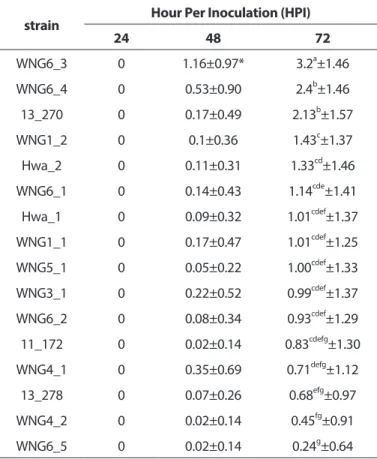
Botrytis cinerea 균주별 병원성. 수집된 Botrytis cinerea 16균주를 장미 품종인 샤만트 품종에 접종하고 균주간의 차 이를 72시간까지 확인하였다. 수집된 균주 간에는 병원성의 차이가 나타났으며, 병은 72시간까지 진행속도의 차이가 있 Fig. 1. Morphological characteristics of collected Botrytis cinerea strains.
Fig. 2. Multiple alignment result of collected Botrytis cinerea strains.
었으나 지속적으로 증가하였다. 발병정도의 통계분석을 위하 여 shapir-wilk 검정을 통해 정규성을 확인한 결과 정규성을 만 족하지 않아 비모수검정인 Kruskal-Wallis ANOVA (Analysis of variance)를 수행하였고, 균주에 따른 발병정도가 0.05 수 준에서 유의적으로 차이가 있었다(Table 2). 이러한 균주간 의 차이를 Bonferroni correction을 한 LSD검정을 통해 확인 하고 그룹화하여 표시하였다(Table 2). 균주 간 발병정도의 차 이는 WNG6_3의 경우 3.20로 가장 발병정도가 심하였으며, WNG6_4, 13_270 균주가 2.4, 2.13으로 다음으로 발병정도가 심하였고, WNG6_5 균주가 0.24로 발병정도가 가장 약해 균주 의 차이로 인한 병원성의 차이는 거의 3.0 정도의 차이를 보였 다(Table 2). 이러한 균주간 발병정도의 차이를 바탕으로 품종 간의 차이를 확인할 시험에 균주 WNG6-5, Hwa-1 및 WNG6-3 을 선발하여 사용하였다. 이러한 결과는 온실의 내부와 외부에 서 수집한 균주에서 병원성의 차이 및 균주간의 유전적인 차이 를 확인한 Kerssies 등(1997)의 결과와 비슷하였다.
품종에 따른 Botrytis cinerea 병원성 차이. 샤만트 품종에 대한 병원성의 차이를 기준으로 병원성을 상, 중, 하 단계로 나 누어 3종의 균주 WNG6_3, Hwa_1, WNG6_5를 선발하고 볼라 레 등 9개의 장미 품종 및 계통에 대하여 품종 및 병원균주에 따 른 병원성의 차이를 확인하였다. 그 결과 샤만트 품종을 기준으 로 선발된 3개의 균주에 대하여 러브레터 품종이 저항성을 나타 내었으며, 아이스베어 품종이 감수성을 보였다(Fig. 3). 발병정도 의 차이를 통계적으로 분석한 결과, 품종 및 병원균의 종류에 따른 차이가 0.001 수준에서 유의적으로 존재하였으며, 교호작 Table 2. Difference of severity by Botrytis cinerea strains
strain Hour Per Inoculation (HPI)
24 48 72
WNG6_3 0 1.16±0.97* 3.2a±1.46
WNG6_4 0 0.53±0.90 2.4b±1.46
13_270 0 0.17±0.49 2.13b±1.57
WNG1_2 0 0.1±0.36 1.43c±1.37
Hwa_2 0 0.11±0.31 1.33cd±1.46
WNG6_1 0 0.14±0.43 1.14cde±1.41
Hwa_1 0 0.09±0.32 1.01cdef±1.37
WNG1_1 0 0.17±0.47 1.01cdef±1.25
WNG5_1 0 0.05±0.22 1.00cdef±1.33
WNG3_1 0 0.22±0.52 0.99cdef±1.37
WNG6_2 0 0.08±0.34 0.93cdef±1.29
11_172 0 0.02±0.14 0.83cdefg±1.30
WNG4_1 0 0.35±0.69 0.71defg±1.12
13_278 0 0.07±0.26 0.68efg±0.97
WNG4_2 0 0.02±0.14 0.45fg±0.91
WNG6_5 0 0.02±0.14 0.24g±0.64
Values are expressed as the mean ± standard error of the mean.
Different superscripts, a~g, within columns denote a significant difference by LSD test at p < 0.05.
* Disease score rate ( 0 = clear drop, no visible infection, 1 = <25%
infection, 2 = 25-50% infection, 3 = 50-75% infection, 4 = 75-90%
infection, 5 = >90% infection)
Fig. 3. Boxplot by accession A) and Strain B), Interaction effect plot of Strain C) and Accession D).
용의 효과가 존재하였다(Table 3). 이러한 결과는 기존에 보고되 었던 논문에서 제시한 장미 품종과 병원균간의 상호작용에 따 라 달라진다는 결과와 크게 다르지 않았다. 잿빛곰팡이병 병 원성의 차이는 기존 문헌에 MAP kinase, NADPH oxidase, Pectin methylesterase, botrydial, oxalic acid 등에 따라 나타난다고 보 고된 바 있으며, 이러한 물질들이 장미 품종과 병원균 균주에 따 른 병원성의 차이를 나타내는데 기여하고 있을 것으로 추정된다 (Nakajima 와 Akutsu, 2014; Segmüller 등, 2007, 2008; Siewers 등, 2005; Zimand 등, 1996). 본 연구의 결과에서는 병원성의 차이를 나타나게 하는 원인물질은 밝히지 못하였으며 향후 이에 대한 추 가 연구가 필요할 것으로 보인다.
적 요
잿빛곰팡이병은 Botrytis cinerea가 원인균으로 알려져 있으 며 장미 재배와 유통 시에 문제가 되고 있다. 그러나 병원균 균 주와 장미 품종에 따른 발병정도의 차이를 연구한 결과가 없어 이를 구명하고자 하였다. 장미 재배 지역에서 분리한 균주를 수 집하고 병원 균주별 장미 품종별 발병정도를 확인한 결과는 다 음과 같다. 서울시립대에서 11종, 국립원예특작과학원에서 3종, 경기도농업기술원 장미재배온실에서 2종을 분리하였으며, 분 리한 균주를 ribosomal DNA의 ITS region에 특이적인 primer 를 사용하여 동정하였고, sequencing을 통해 염기서열을 비교 한 결과 큰 차이가 없음을 확인하였다. 잿빛곰팡이 균주별 발 병정도의 차이를 확인하기 위해 장미 품종인 샤만트 품종에 대 하여 Botrytis cinerea 균주별 발병정도의 차이를 0-5의 단계로 나누어 조사하고, Kruskal-Wallis ANOVA를 통해 분석한 결과, 균주에 따라 병원성이 유의적으로 차이를 나타냈다. WNG6_5 의 경우 0.24 로 병원성이 가장 낮았으며, WNG6_3의 경우 3.20 로 병원성이 가장 높아, 균주별 병원성의 차이는 거의 3.0 정도 의 차이를 보였다. 장미 9품종에 대한 발병정도의 차이를 확인 하기 위해 균주 WNG6_5, Hwa_1, WNG6_3을 선발하여 분석 한 결과 러브레터 품종이 3가지 균주에 대해 저항성을 보였으
며, 아이스베어 품종이 감수성을 나타내었다. 본 연구를 통해 장미 품종 및 병원균의 종류에 따라 발병정도의 유의적인 차이 와 교호작용의 효과가 존재함을 확인할 수 있었다.
Acknowledgement
본 논문은 농촌진흥청 공동연구사업(과제번호: PJ012793)의 지원에 의해 이루어진 것임.
References
Amselem, J., Cuomo, C. A., van Kan, J. A. L., Viaud, M., Benito, E. P., Couloux, A. et al. 2011. Genomic analysis of the necrotrophic fungal pathogens Sclerotinia sclerotiorum and Botrytis cinerea.
PLoS Genet. 7: e1002230.
Asadollahi, M., Fekete, E., Karaffa, L., Flipphi, M., Árnyasi, M., Esmaeili, M. et al. 2013. Comparison of Botrytis cinerea populations iso- lated from two open-field cultivated host plants. Microbiol. Res.
168: 379-388.
Choquer, M., Fournier, E., Kunz, C., Levis, C., Pradier, J. M., Simon, A.
et al. 2007. Botrytis cinerea virulence factors: new insights into a necrotrophic and polyphageous pathogen. FEMS Microbiol.
Lett. 277: 1-10.
Elad, Y. 1988. Latent infection of Botrytis cinerea in rose flowers and combined chemical and physiological control of the disease.
Crop Prot. 7: 361-366.
Fu, Y., van Silfhout, A., Shahin, A., Egberts, R., Beers, M., van der Vel- de, A. et al. 2017. Genetic mapping and QTL analysis of Botrytis resistance in Gerbera hybrida. Mol. Breed. 37: 13.
Kerssies, A., Bosker-van Zessen, A. I., Wagemakers, C. A. M. and van Kan, J. A. L. 1997. Variation in pathogenicity and DNA polymor- phism among Botrytis cinerea isolates sampled inside and out- side a glasshouse. Plant Dis. 81: 781-786.
Kumari, S., Tayal, P., Sharma, E. and Kapoor, R. 2014. Analyses of ge- netic and pathogenic variability among Botrytis cinerea isolates.
Microbiol. Res. 169: 862-872.
Kwon, S., Choi, G., Kim, K. and Kwon, H. 2014. Control of Botrytis cinerea and postharvest quality of cut roses by electron beam Table 3. Result of Aligned Rank Transform(ART) ANOVA table factored by rose accession and Botrytis cinerea strains
Variable Dfa Df.resb F value Pr(>F)
Accession 8 2,673 60.0308 2.22e-16 ***
Botrytis_Strain 2 2,673 113.5039 2.22e-16 ***
Accession:Botrytis_Strain 16 2,673 4.9051 4.5784e-10 ***
aDf = Degrees of Freedom
bDf.res = Residual Degrees of Freedom
*p<.05, **p<.01, ***p<.001
irradiation. Korean J. Hortic. Sci. Technol. 32: 507-516.
Mirzaei, S., Mohammadi Goltapeh, E., Shams-Bakhsh, M., Safaie, N.
and Chaichi, M. 2009. Genetic and phenotypic diversity among Botrytis cinerea isolates in Iran. J. Phytopathol. 157: 474-482.
Movahedi, S. and Heale, J. B. 1990. The roles of aspartic proteinase and endo-pectin lyase enzymes in the primary stages of in- fection and pathogenesis of various host tissues by different isolates of Botrytis cinerea Pers ex. Pers. Physiol. Mol. Plant Pathol.
36: 303-324.
Nakajima, M. and Akutsu, K. 2014. Virulence factors of Botrytis cine- rea. J. Gen. Plant Pathol. 80: 15-23.
Rigotti, S., Viret, O. and Gindro, K. 2006. Two new primers highly specific for the detection of Botrytis cinerea Pers.: Fr. Phyto- pathol. Mediterr. 45: 253-260.
Segmüller, N., Ellendorf, U., Tudzynski, B. and Tudzynski, P. 2007.
BcSAK1, a stress-activated mitogen-activated protein kinase, is involved in vegetative differentiation and pathogenicity in Botrytis cinerea. Eukaryot. Cell 6: 211-221.
Segmüller, N., Kokkelink, L., Giesbert, S., Odinius, D., van Kan, J. and Tudzynski, P. 2008. NADPH oxidases are involved in differentia- tion and pathogenicity in Botrytis cinerea. Mol. Plant-Microbe
Interact. 21: 808-819.
Siewers, V., Viaud, M., Jimenez-Teja, D., Collado, I. G., Gronover, C. S., Pradier, J. M. et al. 2005. Functional analysis of the cytochrome P450 monooxygenase gene bcbot1 of Botrytis cinerea indicates that botrydial is a strain-specific virulence factor. Mol. Plant- Microbe Interact. 18: 602-612.
Van Der Vlugt-Bergmans, C. J. B., Brandwagt, B. F., Vant’t Klooster, J. W., Wagemakers, C. A. M. and van Kan, J. A. L. 1993. Genetic variation and segregation of DNA polymorphisms in Botrytis cinerea. Mycol. Res. 97: 1193-1200.
Williamson, B., Tudzynski, B., Tudzynski, P. and van Kan, J. A. L. 2007.
Botrytis cinerea: the cause of grey mould disease. Mol. Plant Pathol. 8: 561-580.
Wobbrock, J. O., Findlater, L., Gergle, D. and Higgins, J. J. 2011. The aligned rank transform for nonparametric factorial analyses using only anova procedures. In: Proceedings of the SIGCHI Con- ference on Human Factors in Computing Systems, pp. 143-146.
Vancouver, BC, Canada.
Zimand, G., Elad, Y. and Chet, I. 1996. Effect of Trichoderma harzia- num on Botrytis cinerea pathogenicity. Phytopathology 86: 1255- 1260.