미세먼지 관련 호흡기질환 임상연구 동향
유이란1†, 김진후1†, 양원경1,2, 김승형2, 박양춘1,2
1대전대학교 한의과대학 폐계내과학교실, 2대전대학교 동서생명과학연구원
Clinical Research Trends in Respiratory Diseases Related to Particulate Matter
Yee Ran Lyu1†, JinHoo Kim1†, Won-kyung Yang1,2, Seung-hyeong Kim2, Yang-Chun Park1,2
1Division of Respiratory System, Dept. of Internal Medicine, College of Korean Medicine, Dae-Jeon University
2Institute of Traditional Medicine and Bioscience, Dae-Jeon University
ABSTRACT
Objectives: This study aimed to review the clinical research trends in respiratory diseases related to particulate matter (PM) to help design clinical studies on herbal medicine that protects against PM.
Methods: We searched three international databases (Pubmed, EMBASE, and CENTRAL) to investigate clinical studies on respiratory diseases related to PM and to analyze their study design, respiratory-related disease, inclusion/exclusion criteria, study period, outcome measure, study results, measurement method of PM and range of PM.
Results:A total of 18 studies were finally selected, including 13 observational studies and 5 randomized controlled trials.
The selected studies showed an increasing trend from 1985 to 2018 and were conducted mostly in North America, followed by Europe and Asia. Subject disease and age were decided in variety by each study objective, although asthma accounted for the majority. For the outcome assessment, pulmonary function test was mostly used for lung function. Quality of life questionnaires and biomarkers in blood and sputum were also used.
Conclusion: A well-designed clinical study on herbal medicine that protects against PM is needed, and this study is expected to be used as base data.
Key words:particulate matter, respiratory disease, clinical studies, herbal medicine
Ⅰ. 서 론
대기오염으로 인한 사회적⋅경제적 문제 및 인 체유해 영향에 대한 심각성이 제기되면서 전 세계 적으로 대기오염에 대한 관심이 늘어나고 있다. 경 제협력개발기구(OECD)에 따르면 대기오염으로 인
한 전 세계 조기사망자수가 2010년 300만 명에서 2060년 600~900만 명으로 증가할 것으로 보고되었 으며, 우리나라의 경우 이로 인한 조기사망자수가 2010년 359명에서 2060년에는 1,109명으로 급증할 것으로 예상되고 있어
1이에 따른 추가대응이 필수 적인 상황이다. 대기오염 물질 중 미세먼지가 최근 건강을 위협하는 가장 심각한 물질로 인식되고 있 으며
2우리나라 정부에서도 이에 따른 미세먼지 종 합대책을 국정과제로 지정하여 2014년에는 169억 원, 2015년 179억 원, 2016년 3,881억 원, 2017년 4,834억 원의 사업비를 책정하여 다각도로 대책 방안을 추
․투고일: 2019.06.07, 심사일: 2019.07.08, 게재확정일: 2019.07.08
․교신저자: 박양춘 대전광역시 서구 대덕대로 176번길 75 대전대학교 둔산한방병원 한방내과
TEL: +82-42-470-9126 FAX: +82-42-470-9486 E-mail: [email protected]
†These authors contributed equally to this work.
진하고 있다
3.
미세먼지는 공기 중의 총 부유분진(TSP, Total Suspended Particles) 중 직경 10 μm 이하의 먼지 (PM, particulate matter)로 정의되며, 지름이 10 μm 보다 작은 미세먼지(PM
10)와 지름이 2.5 μm보다 작은 초미세먼지(PM
2.5)로 나뉜다
4. 미세먼지가 발 생한 지역이나 계절, 기상조건 등에 따라 입자의 크기와 구성은 다양하지만
5, 일반적으로는 황산염, 질산염, 탄소류, 광물 등으로 구성된다
6. 미세먼지 는 입자의 크기가 매우 작아 인체 내로 더 깊숙이 침투하여 다양한 인체 내 염증반응을 일으키며
7사 망률의 증가, 심혈관계 영향, 호흡기계 영향, 암 발 병률 증가 등에 대한 관련성이 여러 미세먼지의 건 강유해평가 연구들에서 보고되었다
8. 이러한 위험 때문에 2013년 세계보건기구(WHO) 산하 국제암연 구소(IARC)는 대기오염물질 가운데 미세먼지를 1 급 발암물질로 지정하여 권고 기준을 두고 있다
9.
특히 호흡기계와 관련하여 미세먼지는 하부 기 관지 및 폐 실질까지 침착되어 폐기능 감소, 만성폐 쇄성폐질환(COPD, chronic obstructive pulmonary disease), 천식 및 폐암환자 발생 증가, 하기도 및 호흡기계 증상 증가 등을 초래한다고 발표되었으 며
10, 미세먼지가 활성산소 생성을 증가시켜 염증 반응을 유발시킨다는 것이 대표적으로 밝혀진 기 전이다
11. 질병관리본부에 따르면, 미세먼지(PM
10) 농도가 10 μg/m
3증가할 때마다 만성폐쇄성폐질환 (COPD)으로 인한 입원율은 2.7%, 사망률은 1.1%
증가한다고 보고되었으며, 미세먼지(PM
2.5) 농도가 10 μg/m
3증가할 때마다 폐암 발생률이 9% 증가 하는 것으로 나타나
12호흡기질환자는 미세먼지에 장기간 노출되지 않도록 권고하고 있다.
미세먼지로 인한 사회⋅경제적 손실이 증가하고 미세먼지로부터 인체 호흡기계 질환을 예방하기 위한 대책이 시급한 시점에서, 본 연구에서는 미세 먼지의 호흡기 관련 임상연구 동향을 조사하여 연 구 방법 및 특성에 대해 알아보고 향후 이를 위한 임상연구 방법을 모색하는데 도움이 되고자 하였
다. 또한, 지금까지 미세먼지를 포함하는 다양한 대기오염의 호흡기 관련 연구들이 많이 진행되어 왔으나, 본 연구에서는 미세먼지의 호흡기영향 관 련 연구에 초점을 맞추고자 미세먼지로 국한하여 관련 문헌들을 조사하고 분석하였다.
Ⅱ. 연구대상 및 방법
1. 연구 대상
본 연구에서는 미세먼지 관련 호흡기질환 임상 연구 동향을 조사하기 위하여 PubMed, EMBASE, the Cochrane Central Register of Controlled Trials (CENTRAL)의 3가지 해외 데이터베이스를 검색 원으로 사용하였으며, 2019년 05월까지 발표된 관 찰연구와 중재연구를 포함하는 모든 임상연구를 대상으로 조사하였다. 언어는 영어로 제한을 두었으 며, 미세먼지와 관련된 용어가 다양하여 particulate matter의 MeSH Term으로 Pubmed에서 제시된 Entry Term만을 사용하여 다음의 검색식으로 검 색하였다(Particulate Matter[Title] OR Airborne Particulate Matter[Title] OR Particulate Matter, Airborne[Title] OR Air Pollutants, Particulate [Title] OR Particulate Air Pollutants[Title] OR Pollutants, Particulate Air[Title] OR Ambient Particulate Matter[Title] OR Particulate Matter, Ambient[Title]) Filters: Clinical Trial; Humans.
[검색 일시] : 2019년 05월 08일
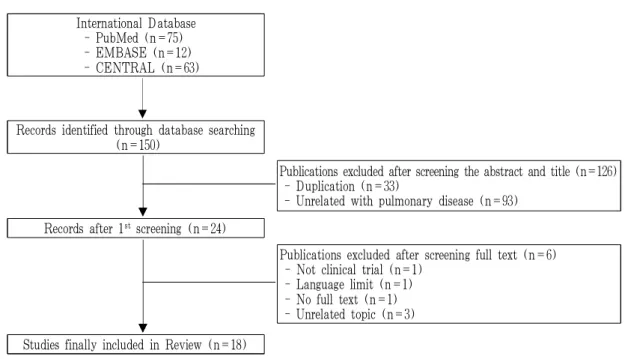
검색 결과 총 150편의 논문이 검색되었으며 1차 적으로 제목 및 초록을 검토하여 중복되는 논문, 호흡기질환과 관련되지 않은 논문을 배제하여 24 편의 논문을 선별하였다. 원문을 바탕으로 2차 screening을 시행하여 원문을 찾을 수 없는 경우 (n=1), 임상연구가 아닌 경우(n=1), 영어가 아닌 경우(n=1), 미세먼지가 major topic이 아닌 경우 (n=3)를 제외하여 최종적으로 18편의 논문
13-30을
연구대상으로 선정하였다(Fig. 1).
International Database - PubMed (n=75) - EMBASE (n=12) - CENTRAL (n=63)
Records identified through database searching (n=150)
Publications excluded after screening the abstract and title (n=126) - Duplication (n=33)
- Unrelated with pulmonary disease (n=93) Records after 1stscreening (n=24)
Publications excluded after screening full text (n=6) - Not clinical trial (n=1)
- Language limit (n=1) - No full text (n=1) - Unrelated topic (n=3) Studies finally included in Review (n=18)
Fig. 1. Flowchart of study selection process.
2. 연구 방법
두 명의 연구자(LYU, KIM)가 독립적으로 제목 및 초록과 원문을 바탕으로 선정 기준에 맞지 않 은 문헌을 배제하였으며, 의견이 불일치하거나 합 의가 이루어지지 못할 경우 제 3의 연구자(PARK) 에게 자문을 구하여 최종 포함여부를 결정하였다.
본 연구에서는 최종 선정된 총 18편 문헌들의 연구개요 및 특성, 연구 종류 및 디자인, 대상 질 환, 대상자 수 및 특성, 연구 및 중재 기간, 평가 변수, 연구 결과, 미세먼지 관련 측정 범위 및 방법 에 대하여 분석하고 고찰하였다.
Ⅲ. 결 과
1. 연구개요 및 특성
미세먼지는 실내⋅외에서 모두 발생하여 인체 내 유해영향을 미치며, 본 연구에서 최종 선별된 18편의 논문 중 실외 미세먼지의 호흡기 영향에 관 한 연구가 15편, 실내 미세먼지의 영향을 보고자 한 연구가 3편에 해당되었다.
미세먼지 관련 호흡기질환 임상연구의 연도별 분포는 1985년을 시작으로 2018년까지 점차 증가하 는 추세를 보였으며, 1980년대 1편, 1990년대 1편, 2000년대 5편, 2010년 이후 현재까지 11편의 관련 논문들이 발표되었다(Fig. 2). 기존의 대기오염 연구 에서는 총 먼지(TSP), 먼지 등의 다양한 지표로 평 가가 이루어졌으나, 1980년대 중반 이후부터 상대적 으로 작은 크기의 입자상 물질인 미세먼지(PM)에 초점이 맞춰지게 되면서 미세먼지 관련 연구가 1980 년대 중반 이후 점차 증가해온 것을 볼 수 있다.
Fig. 2. Number of articles in chronological sequence.
해당 연구들이 시행된 지역은 대부분 북미와 유 럽 그리고 일부 아시아 국가들이었으며, 미국 및 캐나다가 10편으로 가장 많은 수를 차지하였다. 그 외, 중국 3편, 일본 1편, 덴마크 1편, 과테말라 1편
의 지역 분포를 보였으며, 유럽의 여러 국가 및 전 세계 55개 국가들을 대상으로 한 연구가 각각 1편 씩 존재하였다(Table 1).
First
author Article title Year Region Study design Subject
condition
# of subjects
Ages (years)
Air pollution monitoring 1 Kleinman,
M. T.
13Controlled exposure to a mixture of SO2, NO2, and particulate air pollutants: effects of human pulmonary function and respiratory symptoms.
1985 USA RCT (cross-over) Healthy 20 18-55
ZnSO
4, (NH4)
2SO
4,
NO
2, SO
22 Wang, B
14Particulate matter, sulfur dioxide, and pulmonary function
in never-smoking adults in Chongqing, China. 1999 China Cross-sectional
study Healthy 1,075 35-60 PM
2.5, SO
23 Gong, H.
15Controlled exposures of healthy and asthmatic volunteers
to concentrated ambient fine particles in Los Angeles. 2003 USA RCT (cross-over)
double-blind Asthma 24 18-45 CAP
4 Slaughter, J. C.
16Effects of ambient air pollution on symptom severity
and medication use in children with asthma. 2003 USA Retrospective
cohort study Asthma 133 5~12 PM
2.5, PM
10, CO 5 Schildcrout,
J. S.
17Ambient air pollution and asthma exacerbations in children:
an eight-city analysis. 2006 USA,
Canada
Retrospective
cohort study Asthma 990 5~12
CO, NO
2, SO
2, O
3,
PM
106 Bedada, G. B.
18Urban background particulate matter and allergic sensitization
in adults of ECRHS II. 2007 Europe Cross-sectional
study Healthy 6,470 20-44 PM
2.5, SO
27 Qian, Z.
19Interaction of ambient air pollution with asthma medication
on exhaled nitric oxide among asthmatics. 2009 USA Retrospective
cohort study Asthma 119 12-65 NO
2, PM
10, O
3, SO
28 Anderson, H. R.
20Ambient particulate pollution and the world-wide prevalence of asthma, rhinoconjunctivitis and eczema in children:
Phase One of the International Study of Asthma and Allergies in Childhood (ISAAC).
2010 51
countries
Cross-sectional
study Healthy 513,153 6-7,
13-14 PM
109 Roy, A.
21)Ambient particulate matter and lung function growth in
Chinese children. 2012 China Prospective
cohort study Healthy 3,273 6-12 PM
2.5, PM
1010 Karottki, D. G.
22An indoor air filtration study in homes of elderly:
cardiovascular and respiratory effects of exposure to particulate matter.
2013 Denmark RCT (cross-over)
double-blind Healthy 49 >51 CAP 11 Alexis,
N. E.
23Patients with asthma demonstrate airway inflammation
after exposure to concentrated ambient particulate matter. 2014 USA RCT (cross-over)
single blind Asthma 10 18-45 PM
12 Guarnieri, M.
24)Lung function in rural guatemalan women before and after a chimney stove intervention to reduce wood smoke exposure results from the randomized exposure study of pollution indoors and respiratory effects and chronic respiratory effects of early childhood exposure to respirable particulate matter study.
2015 Guatemala Prospective
cohort study Healthy 265 39-84 CO
13 Kariisa, M.
25Short- and long-term effects of ambient ozone and fine particulate matter on the respiratory health of chronic obstructive pulmonary disease subjects.
2015 USA Retrospective
cohort study COPD 1,218 39-84 PM
2.5, O
314 Zhou, Y.
26Association between exposure to ambient particulate matter and chronic obstructive pulmonary disease: results from a cross-sectional study in China.
2016 China Cross-sectional
study COPD 5,993 ≥20 PM
2.5, PM
1015 Meliton, A. Y.
27Short-term acute exposure of healthy humans to particulate matter induces differential gene expression in lung immune cells.
2017 USA RCT Healthy 6 18-40 PM
2.516 Watanabe, M.
28A panel study of airborne particulate matter composition versus concentration: Potential for inflammatory response and impaired pulmonary function in children.
2017 Japan Prospective
cohort study Healthy 339 10~12 SPM, PM
2.5, SO
2, NO
2, O
317 Holm, S. M.
29Cooking behaviors are related to household particulate matter exposure in children with asthma in the urban East Bay Area of Northern California.
2018 USA Prospective
cohort study Asthma 35 6~10 PM
2.518 Pirozzi, C. S.
30Short-Term Particulate Air Pollution Exposure is Associated with Increased Severity of Respiratory and Quality of Life Symptoms in Patients with Fibrotic Sarcoidosis.
2018 USA Retrospective cohort study
Fibrotic
Sarcoidosis 16 18-70 PM
2.5, O
3Table 1. Characteristics of the Studies Included in the Review
2. 연구 종류 및 디자인
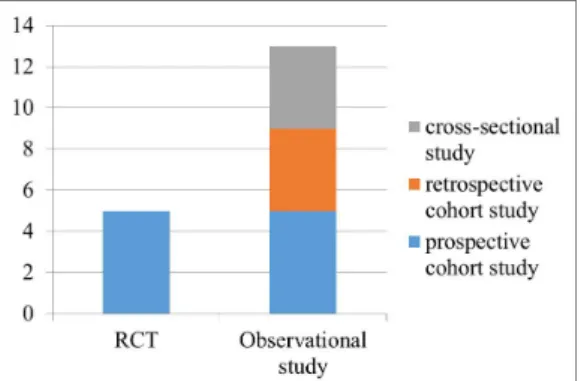
최종 선별된 18편의 논문은 크게 관찰연구와 시 험연구로 분류될 수 있으며 관찰연구가 13편, 시험 연구가 5편에 해당된다. 대다수를 차지하고 있는 13편의 관찰연구 중 단면연구는 4편, 코호트 연구 는 9편에 해당되며, 코호트 연구의 경우 전향적 코 호트 연구가 4편, 후향적 코호트 연구가 5편에 해 당된다(Fig. 3).
중재가 있는 시험연구 5편은 모두 무작위대조 임상실험(Randomized controlled trial, RCT)으로 미세먼지 혹은 대조물질을 대상자에게 노출시켜 각 군의 차이를 보고자 하였다. 시험 설계는 이중 맹검으로 시행된 경우가 3편, 단일 맹검으로 시행 된 경우가 1편, 명시되지 않은 경우가 1편 있었으 며, 그 중 4편에서는 cross-over 디자인으로 설계되 었다(Table 1).
Fig. 3. Study design of selected studies.
3. 연구 대상 질환
본 연구에서 조사된 호흡기 관련 대상 질환은 천식 7편, 만성폐쇄성폐질환(COPD) 2편, 섬유성 사르코이드증 1편으로 천식 관련 연구가 가장 많 았으며, 그 외의 논문에서는 건강인을 대상으로 하 여 호흡기관련 폐기능, 호흡기 부작용, 알레르기 반응, 유전자발현에의 영향 등을 보고자 하였다 (Table 1).
4. 연구 대상자 수 및 특성
연구 대상자 수는 관찰연구의 경우 최소 16명에 서부터 최대 513,153명까지 다양하였으나 1,000명이 상의 대규모로 진행된 연구가 많았으며, 시험연구 에서의 대상자 수는 평균 21.8명으로 최소 6명에서 최대 49명까지의 분포를 보여 비교적 대상자 수는 적은 편이나 대부분 cross-over로 설계되어 이를 보 완하였다.
대상자의 연령은 소아와 성인 등으로 다양하였 으며, 소아를 대상으로 한 경우가 6편, 성인을 대상 으로 하는 경우가 10편, 소아와 성인 모두를 대상 으로 하는 경우가 2편에 해당되었다. 구체적으로 소아의 경우 5~12세, 6~10세, 10~12세, 12~13세 등의 여러 연령을 대상으로 연구가 진행되었으며, 성인의 경우도 18~45세, 18~70세, 35~60세, 51세 이상 등으로 대상자의 연령대가 연구 대상 질환 및 목적에 따라 다양하게 설계되었다. 천식의 경우 고령자는 포함시키지 않고 45세 이하로 한정시키 는 연구가 많았으며, 만성폐쇄성폐질환(COPD)의 경우 39~84세까지로 대상자의 연령 범위를 넓게 설정하거나 나이의 상한을 두지 않는 등으로 고령 자를 포함시켜 질환의 역학 및 특성을 고려하기도 하였다. 기타 연구 목적에 따라 노인들의 심폐기능 의 변화를 보고자 하는 연구에서는 51세 이상의 대 상자만 포함시키는 경우 및 폭넓게 소아와 성인 모 두를 대상자로 포함시키기는 연구도 있었다(Table 1).
기타 미세먼지 관련 임상연구에서는 대상자 모
집 시 특징적으로 대상자의 거주지가 미세먼지 측
정 장소 혹은 대로로부터 가까운 곳에 위치한 자
로 제한을 두거나 흡연자 혹은 실내에서 석탄을
사용하는 경우는 연구에서 배제시키는 경우를 볼
수 있다. 관찰연구 5편에서 대상자의 거주지가 미
세먼지 측정 장소로부터 1~2 km 혹은 80 km이내
인 자로 제한을 두었으며, 실내 미세먼지의 영향을
보기 위한 1편의 시험연구에서는 외부 미세먼지의
농도 영향을 균일하게 하기 위한 노력으로 대상자
의 거주지가 대로로부터의 35 m 이내인 자로 제한
하여 모집을 진행하였다
22. 또한 실내에서 석탄을 사용하는 경우를 제한하는 연구
14및 흡연자를 연 구대상자에서 제외된 경우
14,19,23,27는 4편의 논문에 서 볼 수 있었다.
5. 연구 및 중재 기간
관찰연구 중 단면연구를 제외한 9편의 코호트 연구에서의 연구기간은 평균 26.8개월로 최소 1개 월에서부터 최대 10년까지의 분포를 보였으며, 연 구기간이 2년인 경우가 가장 많았다. 연구기간이 1 개월인 연구 2편은 모두 전향적 코호트 연구로 미 세먼지의 단기 영향을 보고자 하였으며, 나머지 7
편의 연구에서는 모두 최소 2년 이상을 관찰하여 결과를 도출하였다(Table 2).
시험연구 5편 중 4편의 논문은 실외 미세먼지의 영향을, 1편의 논문은 실내 미세먼지의 영향을 보 고자 하였으며 이에 따라 중재 기간이 다르게 설 정되었다. 실외 미세먼지의 영향을 보고자하는 4편 의 연구에서 중재 기간은 2시간 혹은 2시간 15분이 었으며, 그 중 cross-over 디자인으로 설계된 3편의 연구에서 wash out 기간은 2~4주로 설정되었다.
실내 미세먼지의 영향을 보는 1편의 연구의 중재 기간은 14일로 설정되었으며 cross over 디자인으 로 설계되었다(Table 3).
First author
Observation period
Subject
data source Inclusion/exclusion criteria Outcome measures PM
update Results
Wang, B 1995.01
-1995.12 survey
1) adults 35 to 60 years of age who had never smoked and did not use coal stoves for cooking or heating 2) restricted to administrative staff members and officials
at the study sites within 1km of the air monitoring site
1) lung function (FEV
1, FVC, FEV
1/FVC%)
daily
Significant difference of FEV
1between the urban and suburban areas.
Slaughter, J. C.
1993.11
-1995.09 Seattle CAMP
1) children from 5 through 12 years of age 2) mild-to-moderate asthma, as defined by the presence
of symptoms or by the use of an inhaled bronchodilator at least twice weekly or the use of daily medication for asthma
3) excluded if the concentration of methacholine causing a 20% decrement in forced expiratory volume in 1 second (FEV
1PC
20), was greater than 12.5 mg/mL and any other clinically significant conditions.
1) inhaler use
2) asthma severity daily
PM
2.5, PM
10, and CO concentrations significantly associated with asthma severity and medication use in a population of children with mild-to-moderate asthma severity.
Schildcrout, J. S.
1993.11
-1995.09 CAMP
1) children from 5 through 12 years of age 2) mild-to-moderate asthma, as defined by the presence
of symptoms or by the use of an inhaled bronchodilator at least twice weekly or the use of daily medication for asthma
3) excluded if the concentration of methacholine causing a 20% decrement in forced expiratory volume in 1 second (FEV
1PC
20), was greater than 12.5 mg/mL and
any other clinically significant conditions.
4) excluded if we were able to verify that the centroid of the ZIP or postal code in which they lived was greater than 50 miles (80 km) from the nearest Aerometric Information Retrieval System pollutant monitor
1) inhaler use 2) asthma severity 3) sum of the two within-subject pollutant effects
daily
CO, NO
2were significantly associated with asthma severity and medication use in a population of children with mild-to-moderate asthma severity.
Bedada,
G. B. 1990-2000 survey
1) aged 20-44 years
2) responded to the main questionnaire
3) presence of air pollution measurement in the particular centre
4) presence of IgE measurement
1) allergic sensitization (IgE)
annually
Regional air pollution is not associated with allergic sensitization among adults in ECRHS II.
Table 2. Summary of Observational Studies
Qian, Z. 1997.02
-1999.01 SOCS
1) aged 12-65 years 2) nonsmokers 3) asthmatics
4) presence of samplings of eNO
1) eNO
Measurements daily
NO
2and PM
10were significantly associated with an increase in exhaled nitric oxide (eNO) and medication could not counteract airway inflammation effects of air pollution.
Anderson,
H. R. 1999 ISAAC 1) 6-7, 13-14 year old children from a self-completed questionnaire at school
1) prevalence of asthma, rhinoconjunctivitis, eczema
annually
PM
10has no association with the prevalence of childhood asthma, rhinoconjunctivitis or eczema.
Roy, A. 1993-1996 survey
1) children 6–12 years in 8 districts within the 4 cities 2) their families had no plans to move within 3 years 3) their homes were within 2 km of the schools
1) lung function (FEV
1, FVC) daily
PM
2.5and PM
10significantly associated with lung function growth.
Guarnieri, M.
2008.12 -2009.03
RESPIRE + survey
1) aged 15-50 years
2) all using traditional indoor open fires
1) lung function (FEV
1, FVC) 2) wood Smoke
Exposure Assessment : EB co, personal CO tube measurements
-
No association between lung function and early randomization to a chimney stove or personal wood smoke exposure
Kariisa,
M. 1998-2002 NETT 1) aged 39-84
2) sever bilateral emphysema
1) lung Function (FEV
1, FVC) 2) respiratory
Outcomes : Respiratory morbidity, St.
George’s Respiratory Questionnaire
daily
Significant association between air pollution and respiratory function and symptoms of severe COPD subjects
Zhou, Y. 2012-2015 survey
1) aged≥20 years
2) COPD (defined as a post-bronchodilator FEV
1/FVC less than 70%)
1) lung function (FEV
1, FVC) 2) Questionnaire and
risk factors for COPD : revised from the international BOLD (Burden of Obstructive Lung Diseases) study, including possible risk factors for COPD
annually
PM concentration was strongly associated with increased COPD prevalence and declined respiratory function.
Watanabe, M.
2015.02.01
-2015.02.28 survey
1) students aged 10-12 years in four elementary schools in Matsue City
2) all subjects lived within a 1-km radius from the schools which these four elementary schools were within 10 km of each other
1) morning peak expiratory flow (PEF) 2) THP1 cells 3) IL-8
daily
IL-8 levels were significantly associated with SPM and PM
2.5and no significant
relationships between PEF, SPM, and PM
2.5.
Holm, S.
M.
2015.11 2016.11 2016.04
survey
1) children aged 6-10
2) physician-diagnosed asthma but no other major illnesses
3) excluded if they had severe asthma exacerbation requiring systemic steroids in the last 3 months, not compliant with asthma medications, using albuterol daily and not on maximal controller therapy, a smoker in the home was a minor, another participant's sibling or their parent or adult smoker was functionally illiterate in written English
1) Asthma severity 2) household factors
: hood fan use, presence of a cigarette smoker, distance from the highway, presence of pets, heater use and outdoor PM2.5 levels
monthly
The relationship between mean
PM
2.5and asthma severity
approached significance for
persistent versus intermittent
asthma for every 5 μg/m
3increase in the monthly mean
PM
2.5level.
First
author Intervention duration Inclusion/exclusion criteria Outcome measures (time frame) Results
Kleinman, M. T.
1) control : NaCl 2) test : NaCl + ZnSO4,
(NH4) 2SO4, NO2, SO2
2 h 15 min (wash-out 3-4 weeks)
1) aged between 18-55 2) absense of any medical
contraindications as determined by lung function test and an abbreviated cardiac stress test
1) pulmonary function (pre, post) : FVC, FEV
1, FEV
2, PEFR, FEF
50%, FEF
75%, TLC, RV, CV/VC%, CC/TLC%, delta N2, total resistance of the respiratory tract (R) 2) exposure relatable symptoms (pre, post, 1, 7 day)
not significant
Gong, H.
1) control : FA (filtered air)
2) test : CAP (concentrated ambient air)
2h (wash-out
14 days)
1) aged 18-45 2) healthy and asthmatic
nonsmoking volunteers screened by history and physical examination, lung function tests, submaximal exercise stress test, and pregnancy test for females 3) asthmatics tested for atopy
and nonspecific bronchial hyper-reactivity
1) symptom questionnaire (pre, post, 4 hours, 2 days) 2) blood pressure (pre, post, 4 hours, 2 days) 3) heart rate (pre, post, 4 hours, 2 days) 4) SaO2 (pre, post, 4 hours, 2 days)
5) lung function (FEV1, FVC) (pre, post, 4 hours, 2 days) 6) venous blood sampling (IL-6 and IL-8, serum amyloid A,
ICAM-1, fibrinogen, factor VII, and von Willebrand factor, fibrinogen, factor VII, and von Willebrand factor) (pre, post, 4 hours, 2 days)
7) sputum (IL-6, IL-8, ECP) (2 days)
8) Holter ECG (entire first and second intervals, ventricular and supraventricular arrhythmia incidence, measures of heart rate variability) (pre-4 hours, 4 hours-2 days)
not significant
Karottki, D. G.
1) control : sham air filtration 2) test : active air
filtration
14 days
1) aged over 51 years and living in Greater Copenhagen in non-smoking apartments within 350 m (min 25 m, max 1000 m) from major roads (>10,000 vehicles per day)
1) blood pressure (day 0, 2, 7, 14)
2) peripheral arterial tonometry (day 0, 2, 7, 14) 3) lung function (FEV
1, FVC) (day 0, 2, 7, 14)
4) biomarkers in blood (C-reactive protein (CRP), hemoglobin, leukocytes, lymphocytes, monocytes, granulocytes, CD31, CD62L, CD11b, CD49d, CC16, SPD) (day 0, 2, 7, 14)
not significant
Alexis, N. E.
1) control : FA (filtered air)
2) test : CAP (concentrated ambient air)
2h (wash-out 4 weeks)
1) asthmatics aged 18-45 2) nonsmokers with mild to
moderate disease severity
1) BW, BAL : PMNs, IL-1b, IL-8, IL-6, TNF-a, CD40 ligand (CD40L), E-selectin, soluble vascular cell adhesion molecule-1 (sVCAM1), plasminogen, fibrin, C-reactive protein (CRP), fibrinogen, soluble intercellular adhesion molecule-1 (sICAM-1), myeloperoxidase (MPO), CD11b/CR3, CD64/FcgRI, CD40, CD86/B7.2, CD16/FcgRIII, low-affinity IgE receptor (CD23) (20 hours)
2) lung function (FEV
1, FVC) (pre, 20 hours)
significant
Meliton, A. Y.
1) control : FA (filtered air)
2) test : PM (diesel exhaust particles)
2 h
1) non-smoker subjects 2) between the ages of 18 and 40 3) no history lung disease or
active medical problems
1) RNA sequencing (differential expressed genes (DEGs))
(24 hours) significant
Table 3. Summary of Randomized Controlled Trials
6. 평가 변수
본 연구는 다양한 호흡기관련 질환을 포함하고 있어 해당 질환 및 연구 목적에 따라 보고자 하는
평가변수 또한 다양하게 설정되었다. 호흡기와 관 련하여 가장 많이 사용된 평가변수는 폐 기능이었 으며 총 9편의 논문에서 폐기능검사(spirometer)를
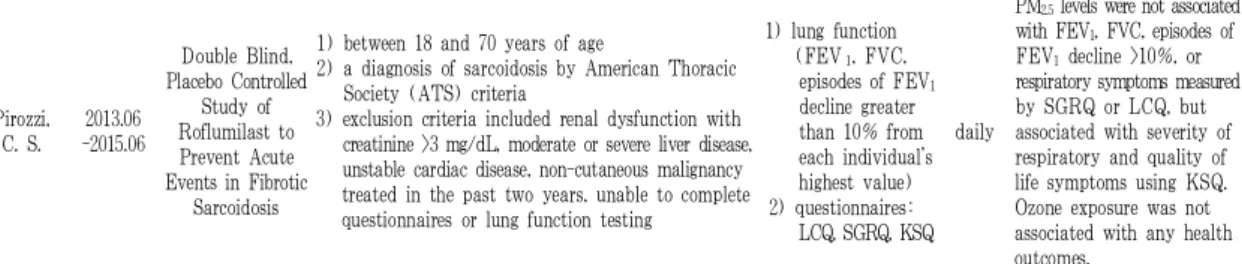
Pirozzi, C. S.
2013.06 -2015.06
Double Blind, Placebo Controlled
Study of Roflumilast to Prevent Acute Events in Fibrotic
Sarcoidosis
1) between 18 and 70 years of age
2) a diagnosis of sarcoidosis by American Thoracic Society (ATS) criteria
3) exclusion criteria included renal dysfunction with creatinine >3 mg/dL, moderate or severe liver disease, unstable cardiac disease, non-cutaneous malignancy treated in the past two years, unable to complete questionnaires or lung function testing
1) lung function (FEV
1, FVC,
episodes of FEV
1decline greater than 10% from each individual’s highest value) 2) questionnaires:
LCQ, SGRQ, KSQ daily
PM
2.5levels were not associated with FEV
1, FVC, episodes of FEV
1decline >10%, or respiratory symptoms measured by SGRQ or LCQ, but associated with severity of respiratory and quality of life symptoms using KSQ.
Ozone exposure was not associated with any health outcomes.
CAMP : childhood asthma management program, SOCS : Salmeterol off Corticosteroids study, ISAAC : phase one of the international study of asthma
and allergies in childhood, RESPIRE : randomized exposure study of pollution indoors and respiratory effects, NETT : National emphysema treatment
trial study
하여 1초간 노력성 호기량(FEV1, forced expiratory volume in one second) 및 노력성 폐활량(FVC, forced vital capacity)을 측정하였다. 호흡기 관련 증상 설문 을 시행한 경우는 7편에 해당하였으며 그 중 호흡기 관련 삶의 질 평가척도인 St. George’s Respiratory Questionnaire(SGRQ)을 사용한 경우가 3편에서 있 었고 그 외 Leicester cough questionnaire(LCQ)와 King’s Sarcoidosis Questionnaire(KSQ)가 1편의 연 구에서 사용되었다. 혈액검사를 시행하여 염증 반 응 혹은 응고 관련 인자를 보고자 하는 경우는 5편 에서 나타났으며, IL-8을 보는 경우가 3편에 해당 하였고 그 외 IL-6, serum amyloid A, ICAM-1, fibrinogen, factor VII, von Willebrand factor, fibrinogen, IgE를 측정하였다. 기관지폐포세척(BAL, bronchoalveolar lavage fluid)과 기관지세척(BW, bronchial wash)에서 PMNs, IL-1b, IL-6, IL-8, TNF-a을 측정한 경우와 객담에서 WBC, neutrophil, IL-6, IL-8를 측정하는 경우도 각각 1편의 논문에 서 볼 수 있었다. 기타 질환 특이적인 척도로 천식 환자들의 경우 천식 중증도 평가를 시행한 경우가 3편에서 나타났으며, 연구 목적에 따라 혈압, 말초 동맥 긴장도, Holter ECG, 6분 보행검사, SaO2, PEFR, eNO, RNA sequencing이 측정되었다(Table 2, 3).
7. 연구 결과
미세먼지가 인체 호흡기에 미치는 영향을 연구 한 총 18편의 논문 중 통계적으로 유의미한 결과는 관찰연구에서 9편, 시험연구에서 2편에서 보고되었 으며, 그 외의 연구에서는 호흡기와의 연관성만 제 시되었다. 다만, 단기 노출 평가를 진행한 5편의 무 작위배정 연구에서는 2편에서만 유의미한 결과가 도출되어 미세먼지의 단기 노출이 호흡기에 미치 는 영향은 일관된 결과를 보이지 않는 것으로 볼 수 있다(Table 2, 3).
8. 미세먼지 관련 자료 1) 미세먼지 범위
각 연구에서는 미세먼지를 포함한 다양한 대기 오염물질을 측정하여 호흡기 질환과의 관련성을 보고자 하였으며 연구마다 측정하는 대기오염물질 의 종류와 크기는 다양하였다. 13편의 관찰연구 중 1편의 실내 미세먼지 관련 연구를 제외한 12편의 논문에서 PM 농도 측정값을 사용하였으며, 그 중 PM
2.5만을 측정한 경우가 6편, PM
10만을 측정한 경 우가 3편, PM
2.5와 PM
10모두를 측정한 경우가 3편 에 해당되었다. 미세먼지와 함께 측정된 대기오염 물질로는 SO
2, NO
2, O
3, CO가 있었으며 SO
2는 5편, O
35편, NO
23편, CO 3편에서 측정되었다.
5편의 시험연구에서 대상자에게 노출되는 중재 물질로 사용된 미세먼지의 구성과 농도는 연구마 다 상이하였다. 실외 미세먼지 연구에서는 중재물 질로 CAP(concentrated ambient air)가 2편, PM (particulate matter)이 1편, 기타 복합물(NaCl + ZnSO
4, (NH
4)
2SO
4, NO
2, SO
2)이 1편에서 사용되었 고, 대조물질로는 FA(filtered air)가 3편, NaCl이 1 편에서 사용되었다. 중재물질로 사용된 CAP 혹은 PM 은 용어의 차이는 있으나 모두 PM 농도 101.8~250 μg/cm
3의 분포를 보이는 대기오염물질로 실제 외 부 미세먼지와 동일하게 구성하고자 하였다. 실내 미세먼지 연구에서는 sham air filtration, active air filtration을 사용하여 양측 실내 미세먼지 농도에 차이를 두어 농도 별 평가변수를 측정하여 비교하 였다(Table 1).
2) 미세먼지 측정방법
관찰연구에서 미세먼지 측정은 직접 측정하거나 각 국가 또는 지역에서 제공하는 기상 자료를 사 용하였다. 분석 시 미세먼지 농도는 일일, 월별 혹 은 연간 평균값을 사용하였으며 측정값의 오차를 줄이기 위하여 동일 시각에 측정하거나 측정 장비 의 질 평가를 지속적으로 시행하였다(Table 2).
시험연구 중 실내 미세먼지 관련 연구에서는 침
실과 거실 2곳에서 2주 동안 미세먼지 농도를 측정
하였고 그 외 4편의 연구에서는 대상자의 노출이
이루어지는 좁은 방안의 농도를 노출시간 동안 측
정하였다.
Ⅳ. 고 찰
세계보건기구(WHO)는 미세먼지 노출에 의한 장⋅단기 건강영향평가에서 미세먼지가 단기적으 로는 폐의 염증반응 및 호흡기증상의 악화를 일으 키고, 장기적으로는 COPD의 급성악화 및 사망률 의 증가와 폐암 발생위험도 증가, 하기도 증상 증 가, 폐기능 저하, 폐기능 감소 속도 증가에 영향을 미치는 것으로 보고하였다
4. 미세먼지는 체내에 침 착되고 일부는 혈액을 따라서 전신을 순환하면서 산화 스트레스와 염증 반응을 일으키게 되며
31,32, 산화스트레스, 기도개형, 선천면역 및 후천면역 등 의 기전에 의해 인체에 영향을 미친다
33.
전 세계적으로 1980년대 중반 이후 입자의 크기 가 작을수록 인체의 건강에 미치는 영향이 크다는 결과들이 발표되면서
34미세먼지가 중요한 대기오 염 물질로 인식되기 시작하였으며, 우리나라에서도 국립환경과학원을 중심으로 2000년도부터 미세먼 지에 대한 특성 분석 및 건강 관련 다양한 연구들 이 이루어졌다
35. 이에 본 연구에서도 다양한 대기 오염 물질 중 미세먼지에 초점을 맞추어 미세먼지 로 국한하여 문헌조사를 시행하였다. 본 연구에서 최종 선별된 18편의 논문들 또한 1985년부터 2018 년까지 점차 증가하는 추세를 보였으며, 위 연구들 은 북미, 유럽 및 일부 아시아 국가들에서 발표되 었다. 국내에서도 미세먼지의 천식
36및 폐암
12, 호 흡기질환자 입원 일수
37등에 미치는 영향에 대한 연구가 진행되어 왔으나, 장기 노출 영향 평가 및 다양한 호흡기 질환에의 연구 결과는 아직 부족한 실정이다
38.
최종 선별된 18편의 논문들을 고찰한 결과, 지금 까지의 미세먼지 관련 임상연구들은 대부분 관찰 연구로 진행되었으며 장⋅단기의 미세먼지 노출 영향을 보기 위해 코호트 연구 형태로 설계된 경 우가 가장 많은 것을 관찰 할 수 있었다. 무작위배
정 임상시험(RCT)의 경우 인체에 유해하다고 판 단되는 미세먼지를 대상자에게 직접 노출시키는 것에 대한 윤리적인 문제 및 장기 노출 평가가 어 렵다는 측면에서 거의 이루어지지 않았으며, 본 연 구에서 조사한 5편의 무작위배정 임상시험 논문들 에서 또한 위의 한계점을 보완하기 위하여 노출시 키는 중재물질을 비교적 안전한 질산염 및 황산염 등의 복합물로 재구성하거나 농도를 실제 대기 중 의 미세먼지 농도와 비슷한 수준으로 설정하는 등 의 노력을 기울였다. 향후 미세먼지의 건강 영향 관련 임상 연구들 또한 무작위배정 임상시험으로 진행되기에는 연구의 한계 및 윤리적인 문제점이 있을 것으로 생각되며
39그 외의 연구 형태로 임상 연구가 진행되어야 할 것이다. 지금까지 가장 많이 시행된 코호트 연구의 경우 처음부터 연구 목적으 로 연구 대상자들을 모집하여 자료를 수집하는 ‘전 향적 코호트 연구’ 또는 기존 자료를 기반으로 이 미 수집된 자료를 이용하여 분석하는 ‘후향적 코호 트 연구’ 형태로 연구의 목적에 따라 설계되어 진 행되어 왔다. 전향적 코호트 연구는 결과에 의해 예측 변수 측정값이 영향 받는 것을 방지하므로 변수들을 보다 정확하게 측정할 수 있다는 장점이 있으나 시간과 비용이 많이 들고 빈도가 낮은 결 과를 분석할 때에는 효율이 떨어진다는 단점이 있 다
40. 반면, 후향적 코호트 연구는 예측변수의 특성 및 품질에 관해 연구자의 역할이 제한되어 있어, 보다 정확한 예측 변수의 측정을 위해 전향적 연 구 형태로 설계된 다양한 연구가 진행될 필요가 있으며, 장기간의 관찰 기간을 기반으로 한 후향적 코호트 연구 또한 진행되어야 할 것으로 생각된다.
따라서, 향후 한약제제의 항 미세먼지 효과에 대한
임상연구 설계 시에도 무작위배정 임상시험으로
설계하는 것은 여러 한계 및 제한이 있으므로, 대
상자의 거주지 혹은 작업환경 등에서의 미세먼지
노출 정도를 고려한 코호트 등의 관찰 연구 형태
를 고려해 볼 수 있을 것이다. 또한, 최근 실내 미
세먼지의 유해성에 대한 관심이 늘어나고 있는 시
점에서
41, 한방진료에서 사용되고 있는 뜸 치료 등 과 관련하여 한방의료기관 내의 실내미세먼지 영 향에 대한 연구 등이 고안될 수 있을 것이다.
미세먼지의 호흡기 영향에 대한 연구들은 천식
16,17,19,23,29,42
관련 연구가 가장 많이 보고되었으며
COPD
25,26, 간질성폐질환
30및 건강인의 폐기능 혹
은 호흡기 증상 관련 연구
13,14,18,20-22,24,27,28들이 진행 되어 왔다. 대상자의 질환 및 연령은 연구 목적에 따라 다양하게 설정될 수 있으며 미세먼지 관련 연구에서는 대상자 모집 시 대상자 및 동반 거주 자의 흡연력, 거주지와 대로와의 거리, 반려동물 유무 및 실내 환경 등을 동시에 조사하여 혼란 변 수(confounding factor)에 대한 고려가 반드시 필요 하다. 호흡기 영향을 평가하기 위한 평가도구로는 폐기능검사
13-15,21-26,30가 대표적이며 호흡기 증상 관 련 설문지
15,25,26,30, 혈액 및 객담에서의 biomarker
15,18,19,22-24,28