Successful Rechallenge with Imatinib in a Patient with Chronic Myeloid Leukemia Who Previously Experienced Imatinib Mesylate Induced Pneumonitis
Seong Woo Go, M.D.
1, Boo Kyeong Kim, M.D.
1, Sung Hak Lee, M.D.
2, Tae-Jung Kim, M.D.
2, Joo Yeon Huh, M.D.
1, Jong Min Lee, M.D.
1, Jick Hwan Hah, M.D.
1, Dong Whi Kim, M.D.
1, Min Jung Cho, M.D.
1, Tae Wan Kim, M.D.
1and Ji Young Kang, M.D.
1Departments of
1Internal Medicine and
2Pathology, The Catholic University of Korea College of Medicine, Seoul, Korea
Imatinib mesylate is a targeted therapy that acts by inhibiting tyrosine kinase of the bcr-abl fusion oncoprotein, which is specific to chronic myeloid leukemia (CML), and the c-transmembrane receptor, which is specific to gastrointestinal stromal tumors. Interstitial pneumonitis is a rare adverse event of imatinib therapy. It is clinically difficult to distinguish from infectious pneumonia, which can frequently occur due to the underlying disease. The standard treatment for imatinib-induced pneumonitis is to discontinue the medication and optionally administer corticosteroids. However, there are a few cases of successful retrial with imatinib. We describe a case of successful rechallenge of imatinib in a patient with imatinib-induced interstitial pneumonitis and CML without a recurrence of the underlying disease after 3 months of follow-up.
Keywords: Leukemia, Myelogenous, Chronic, BCR-ABL Positive; Imatinib; Lung Diseases, Interstitial
Philadelphia-positive acute lymphocytic leukemia and gastro- intestinal stromal tumors (GIST) to inhibit c-transmembrane receptor (c-kit), and platelet derived growth factor (PDGF) tyrosine kinase
1. However, imatinib has various side effects and commonly causes pleural effusion and general edema.
Additionally, nausea, muscle cramps, abdominal pain, skin rash, and diarrhea can occur. The incidence of severe respira- tory adverse events is very rare and, in particular, interstitial pneumonitis is extremely uncommon, with a incidence of 0.2% to 1.3%
2. In Korea, to our knowledge, only three cases of imatinib-induced pneumonitis have been reported, which developed in two patients with CML and one with GIST
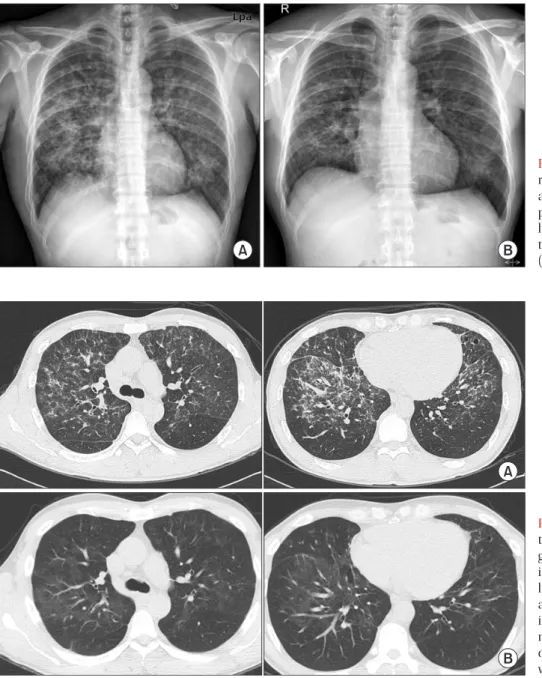
3,4. Moreover, there has been no reports of successful rechallenge with imatinib. Herein, we describe a case of imatinib-induced interstitial pneumonitis in a patient with CML, who improved by temporarily stopping the drug and starting steroid therapy.
The pateint was restarted on imatinib to control the underly- ing disease without recurrence of the pneumonitis at the 3 month follow-up.
Copyright © 2013
The Korean Academy of Tuberculosis and Respiratory Diseases.
All rights reserved.
Introduction
Imatinib is a protein tyrosine kinase inhibitor that acts on the bcr-abl gene of the abnormal Philadelphia chromo- some in chronic myeloid leukemia (CML). It is also used in
CASE REPORT
http://dx.doi.org/10.4046/trd.2013.75.6.256ISSN: 1738-3536(Print)/2005-6184(Online) • Tuberc Respir Dis 2013;75:256-259
256
Address for correspondence: Ji Young Kang, M.D.
Department of Internal Medicine, Seoul St. Mary’s Hospital, The Catholic University of Korea College of Medicine, 222 Banpo-daero, Seocho-gu, Seoul 137-701, Korea
Phone: 82-2-2258-6060, Fax: 82-2-596-2158 E-mail: [email protected]
Received: Apr. 29, 2013 Revised: Jun. 24, 2013 Accepted: Sep. 16, 2013
cc