배출가스 저감장치에 따른 Euro 5 경유 대형버스의 유해대기오염물질 배출특성
홍희경
*
ㆍ문선희*
ㆍ정택호*
ㆍ김선문*
ㆍ서석준*
ㆍ김정화*
ㆍ정성운†
ㆍ홍유덕*
Emission Characteristics of Hazardous Air Pollutants from Diesel Heavy Duty Buses for Euro 5 according to After-treatment Systems
Heekyoung Hong, Sunhee Mun, Taekho Chung, Sunmoon Kim, Seokjun Seo, Jounghwa Kim, Sungwoon Jung and Youdeog Hong
Key Words: Emission characteristics( 배출특성), VOCs(휘발성유기화합물), Aldehydes(알데히드류), PAHs(다환방향족 탄화수소), Diesel heavy duty buses(경유 대형버스), HAPs(유해대기오염물질)
Abstract
Emission characteristics of regulated (NOx, PM, CO, NMHC) and unregulated (VOCs, aldehydes, PAHs) air pollutants were investigated for diesel heavy duty buses equipped with different after-treatment systems (DPF+EGR and SCR) under urban driving cycle. The combustion temperature and the working temperature of SCR catalysts were important to make impact on NOx emissions, whereas PM emissions were low. The alkane groups dominated NMVOCs emissions, making 42.6~59.4% of sum of the NMVOCs emissions. Especially, alkane emissions of DPF+EGR-equipped vehicle included DOC had 14.9~15.5% higher than those of SCR-equipped vehicle due to low efficiency of oxidation catalyst. In the case of indi- vidual NMVOCs, n-nonane and propylene emissions highly occupied for DPF+EGR and SCR, respectively. Formaldehyde emissions among aldehydes were the highest and PAHs emissions were hardly detected except naphthalene and phenanthrene.
The NMHC speciation has been shown to be the highest of the formaldehyde ranged 20.8~21.5%. The results of this study will be contributed to establish Korean HAPs emission inventory for automobile source.
1. 서 론
2015 년 국가 대기오염물질 배출량 중 도로이동오염원 의 일산화탄소(CO), 질소산화물(NOx), 미세먼지(PM
2.5), 휘발성유기화합물(VOCs) 배출량은 각각 31.0%, 31.9%, 8.9%, 4.6% 로 높은 비율을 차지하고 있다
(1). 최근 국내 에서는 자동차에서 배출되는 CO, HC, NOx, PM과 같은
규제물질은 강화되었으며, VOCs, 알데히드류(Alde- hydes), 다환방향족탄화수소(PAHs) 등의 유해대기오염 물질(Hazardous Air Pollutants; HAPs)은 관심이 확대되고 있다. 자동차에서 배출되는 HAPs는 가스상 및 입자상 물 질로 나누어진다. 가스상물질에는 벤젠, 톨루엔과 같은 방향족 탄화수소와 그 유도체로 이루어진 VOCs와 특유 의 독특한 냄새가 나는 알데히드류가 있으며, 입자상 물 질은 용해성 및 비용해성 유기화합물로 구분된다. 용해성 물질은 벤조(a)페렌, 크실렌 등 다환방향족탄화수소 (PAHs) 가 포함되어 있으며, 비용해성물질은 금속 등 무기 물이 포함되어 있다
(2). 대기 중의 유해대기오염물질은 미 량으로 존재하지만 직접적이고 장기적인 노출로 인하여 인체에 암을 유발하거나, 기형아 출산 등 심각한 질병을 (Recieved: 2 Oct 2018, Recieved in revised form: 9 Nov
2018, Accepted: 12 Nov 2018)
*
국립환경과학원 교통환경연구소
†
책임저자, 회원, 국립환경과학원 교통환경연구소 E-mail: [email protected]
TEL: (032)560-7614 FAX : (032)561-7013
유발하는 것으로 알려져 있다
(3).
VOCs 는 포화증기압이 높아 대기 중으로 쉽게 증발되 고, 대기 중에서 NOx와 광분해 반응에 관여하여 이차 적인 오존생성에 기여하는 광화학스모그의 전구물질로 알려져 있다. 특히 벤젠은 백혈병, 골수종, 임파종 등을 유발하는 것으로 보고되었다
(2,4). 알데히드류는 -(CH)=O 의 카르보닐기가 붙어있는 유기화합물의 한 종류이며
(2), 탄화수소의 불완전 연소에 의해 형성된다
(5). 알데히드류 중에서 포름알데히드는 노출될 경우 정서적 불안정, 기 억력 상실, 정신집중의 곤란 등을 유발하는 것으로 알려 져 있다
(3). Nelsone et al. (2008)에 따르면, 경유 대형차 량에서 배출되는 VOCs 중 Formaldehyde 29.8 mg/km, Acetaldehyde 13.2 mg/km, Benzene 6.1 mg/km, Tolu- ene 3.4 mg/km 순으로 높게 배출되었다
(6). George et al. (2014)는 최신 후처리시스템을 부착한 경유 대형차 량의 VOCs에서 Carbonyls, Formaldehyde, Acetalde- hyde 가 주요 성분이며, 총 VOCs 중 72% 이상을 차지 하는 것으로 보고하였다
(7). 또한 국내 연구에 따르면, 후처리장치가 부착된 경유 대형차량에서 NMVOCs의 주요 구성성분은 Propylene 11.3~16.1%, Benzene 15.5%, 1-Butene 10.3~11.3% 로 나타났다
(8).
PAHs 는 경유 자동차 배출가스의 입자상물질에 많이 포 함되어 있으며, 연료의 불완전 연소 시 생성 가능성이 높 은 것으로 알려져 있다. 특히 PAHs 중 벤조(a)피렌은 대 기오염물질 중 발암성이 있는 것으로 나타났다
(2). 경유 대 형차량에서 배출되는 PAHs의 경우, 경유매연여과장치 (Diesel Particulate Filter; DPF) 장착시 90% 이상 저감되는 반면, 미장착시 총 PAHs에서 가스상 PAHs의 비율이 높은 것으로 보고되었다
(9). 국내의 경우 경유 대형버스의 규제 물질에 비해 미규제물질인 유해대기오염물질에 대한 배 출특성 및 구성성분비 연구자료가 부족한 실정이다.
이에 본 연구에서는 현재 운행 중인 경유 대형버스를 대상으로 대형차동력계를 이용하여 도심주행모드에서 규제오염물질(NOx, PM, CO, NMHC) 및 미규제오염물 질(VOCs, aldehydes, PAHs)의 배출특성을 분석하고, NMHC 구성성분비를 도출하고자 한다.
2. 연구방법
2.1 시험차량
본 연구에서는 국내 등록된 경유 대형버스 중 점유율 이 높은 차량으로 2대를 선정
(10)하였으며, 시험차량의
제원은 Table 1에 나타내었다. 대상차량의 배출허용기준 은 Euro 5로 후처리장치인 DPF + 배기가스재순환장치 (Exhaust Gas Recirculation, EGR) 또는 선택적환원촉매장 치(Selective Catalytic Reduction, SCR)가 장착되어 있다.
2.2 시험모드
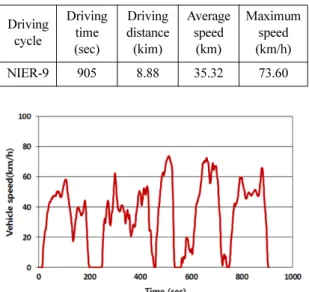
시험모드는 국립환경과학원에서 국내 도로 운행조건 을 반영하여 개발한 평균차속별 모드인 NIER 모드를 사 용하였다. 본 연구에서는 국내 대형차량의 운행속도
(11,12)를 고려하여 NIER-9 모드를 적용하였으며, 최대 승차인 원 50%를 반영하여 냉간 및 열간시동 조건에서 각 3회 이상 시험하였다. 시험모드의 제원은 Table 2와 Fig. 1에 나타내었다.
Table 1 Specification of test vehicles Vehicle ID Bus 1 Bus 2 Displacement (cc) 12,742 10,964 GVW (kg) 15,330 16,375 Max power (ps/rpm) 430/1900 425/1800 Aftertreatment system DPF
*+EGR SCR
Model year 2012 2013
Emission standards Euro 5 Euro 5
*
Diesel oxidation catalyst is added as a part of DPF
Table 2 Specification of driving cycle Driving
cycle
Driving time (sec)
Driving distance (kim)
Average speed
(km)
Maximum speed (km/h) NIER-9 905 8.88 35.32 73.60
Fig. 1 Driving pattern of NIER-9 mode
2.3 측정장치 및 시험방법
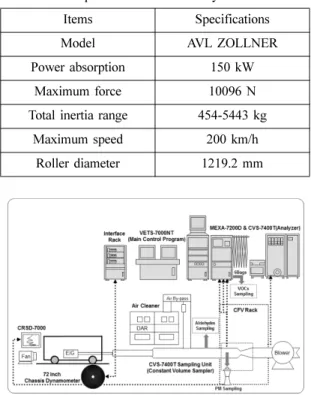
2.3.1 차대동력계 배출가스 측정장치 및 시스템 차대동력계는 자동차가 실제 도로를 주행할 때 가속, 정속, 감속, 정지 등을 반복하는 과정을 동력계상에서 그대로 재현하여 모사 주행할 수 있도록 자동차에 부하 를 걸어주는 장치이며, 측정 장치는 차대동력계, 시료채 취 장치, 보조운전 장치, 희석터널, 입자상물질 측정장 치, 배출가스분석기로 구성되어 있으며 제원은 Table 3 에 나타내었다. Fig. 2~3에 배출가스 측정시스템 계통도
및 시험모습을 나타내었다. 배출가스 측정은 시험차량 이 차대동력계의 롤러 위에서 각 시험모드를 주행할 때 배기관으로부터 배출되는 가스를 정용량시료채취장치 (CVS-7400T, Horiba) 에 일정량의 공기로 희석한 후 시 료채취 백에 채취하여 배출가스 분석기로 분석하며, 희 석터널은 고온에 의한 입자상물질의 변화를 배제시키고 대기조건으로 제어하기 위해 시료채취 온도가 52
oC 이 내로 유지되도록 외부공기와 배기가스를 희석시키는 역 할을 한다.
2.3.2 배출가스 분석방법
배출가스 분석기(MEXA-7200D, Horiba)는 배출가스 중 CO, THC, NOx를 분석할 수 있는 장치로서, 분석원 리는 CO는 비분산적외선분석법(NDIR; Nondipersive Infrared), THC 는 열식수소염이온화검출법(HFID; Heated Flame Ionization Detector), NOx 는 화학발광법(CLD;
Chemiluminescence Detector) 을 사용하였다.
2.3.3 PM 시료채취장치
입자상물질은 차대동력계에서 주행할 때 배출가스를 일정비율로 공기와 희석시켜 입자상물질을 채취하는 방 식(MEXA-7200D accessory, Horiba)을 이용하였다. 이 장치들은 희석터널에서 배기가스의 일부를 채취하여 외 부공기로 희석시킨 후, 입자상물질은 석영여지(Φ47 mm) 에 포집하는 장치이다. 여과지에 포집된 입자상물질의 무게를 측정하기 위해서는 마이크로 밸런스(CP2P-F, Sartorius) 를 사용하며, 여과지에 포집된 입자상물질의 정확한 측정을 위하여 온도 25±5
oC 및 상대습도 30~70%
로 유지된 무게측정실(Weighing chamber)내에서 측정하 였다.
2.3.4 휘발성유기화합물 분석방법
차량주행 동안 대형 시료채취백에 포집된 배출가스를 분석이 끝난 후 Purge line을 통해 5 L 용량의 테들러백 (Tedlar bag) 에 시료를 채취하였다. 또한 희석공기 중에 포함된 오염물질의 양을 보정하기 위하여 희석공기도 동시에 포집하여 배출량 정량 시 배경농도로 활용하였 다. VOCs는 EPA TO-14A
(13)방법으로 분석하였으며, 열탈착장치(Unity2, Markes)를 통한 시료농축 및 전처리 과정은 시료가 Nafion dryer를 통해 수분이 제거되고 Purge & Trap 을 거치면서 Unity의 Cold trap에 –15
oC 상 태에서 VOCs 성분이 저온농축된 시료를 300
oC 로 가열 및 탈착하여 GC/MS(Agilent 7890B/Almsco BenchTOF- Fig. 2 Schematic diagram of exhaust emission test system
Table 3 Specification of chassis dynamometer Items Specifications
Model AVL ZOLLNER
Power absorption 150 kW Maximum force 10096 N Total inertia range 454-5443 kg
Maximum speed 200 km/h Roller diameter 1219.2 mm
Fig. 3 Overview of chassis dynamometer
Select, Markes) 로 주입 및 분석하였다. 질량분석기의 검 출기는 ToF(Time of Flight)를 사용하였다. GC 분석 온 도조건은 30
oC 에서 30분의 지속시간으로 시작하여 200
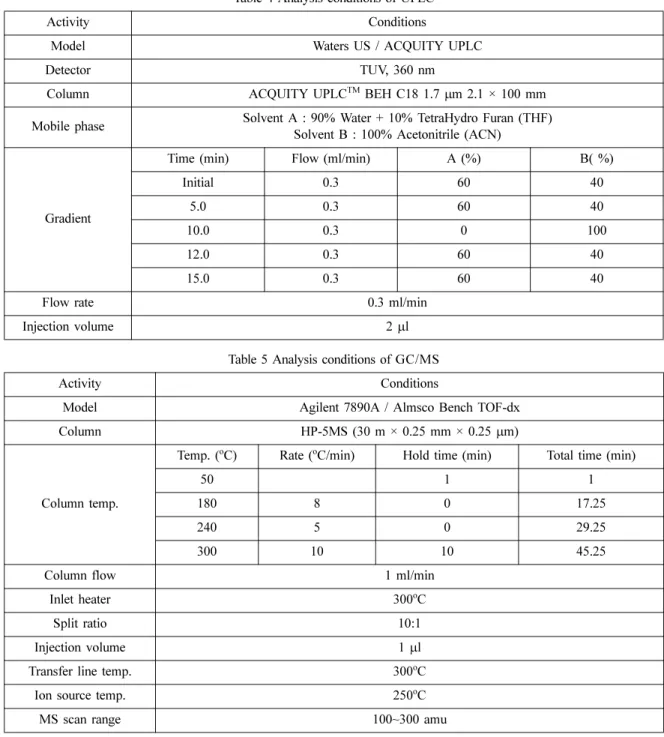
oC 까지 승온 후 최종 77.33분 동안 분석하였다. 표준 물질은 오존생성에 기여하는 전구물질(Precusor)이 혼합 된 56종 물질 100 ppb 표준가스(56 Components, Supelco) 를 사용하였으며 Table 3에 분석조건을 나타내었다.
2.3.5 알데히드류 분석방법
알데히드류의 시료채취는 오존스크러버를 전단에 붙 인 DNPH 카트리지(Waters)를 연결시키고 Dilution air vent line 또는 Dilution tunnel에 연결되어있는 밸브에 연결하여 희석된 배출가스를 2 L/min의 유량으로 시료 채취 후 전처리를 진행하기 전까지 -4
oC 이하의 냉동고 에 보관하였다. 추출 용매는 Acetonitrile를 사용전 GHP Filter(47 mm, 0.2 µm)에 필터링한 후, 카트리지의 추출 에 사용하였으며 추출량은 5 mL로 하였다. 2 mL 전용 Vial 에 시료를 분취하여 EPA TO-11A
(14)방법으로
UPLC(Ultra Performance Liquid Chromatography) 로 분석 하였다. 표준물질은 13종 물질이 혼합된 40 µg/mL 표준 용액(Carbonyl-DNPH Mix 1, Supelco)을 사용하였으며 Table 5 에 분석조건을 나타내었다.
2.3.6 다환방향족탄화수소 분석방법
다환방향족탄화수소는 석영여지에 입자상물질을 채 취하였으며, 24±4시간 항온·항습 시킨 후에 전처리를 하 였다. 포집한 전단 및 후단 필터를 가속용매추출기의 11 mL 추출 셀에 넣고, 추출 시 오차발생을 방지하기 위해 셀의 빈 공간을 규조토로 채웠다. 가속용매추출기 는 고온·고압에서 시료추출을 진행하며 온도 100
oC, 압 력 2000 psi 상태에서 15분간 Dichloromethane 약 20 mL 추출하였다. 추출한 시료는 자외선에 의해 PAHs가 해리 되지 않도록 알루미늄호일로 추출용기를 감싸주었고 추 출액은 질소가 연결된 농축기에서 약 1 mL 정도 1차 농 축한 후 헥산 3 mL를 넣고 최종 1 mL로 2차 농축을 하 였으며 농축된 시료는 Vial에 담고 내부표준물질 5종을
Table 3 Analysis conditions of TD and GC/MS
Activity Conditions
Thermal Desorber
Model Markes International / Unity2
Purge Prepurge time (min) 1
Trap prepurge time (min) 1
Sample Sampling time (min) 20
Sample flow rate (ml/min) 10
Trap desorber
Trap low temp (
oC) -15
Trap high temp (
oC) 300
Trap hold time (min) 5
Split flow (ml/min) 30
GC/MS
Model Agilent 7890B / Almsco Bench TOF-Select Column DB-1 (60 m × 0.32 mm × 3 µm)
Column flow 2 ml/min
Column temp.
Temp (
oC) Rate (
oC/min) Hold (min) Total (min)
30 0 30 30
150 5 10 64
200 15 10 77.33
Transfer line temp. 200
oC
Ion source temp. 200
oC
Mass scan range 35~350 amu
주입한 후 분석하였다. PAHs 분석은 EPA TO-13A
(15)방 법으로 분석하였으며, GC 분석 온도조건은 50
oC 에서 1 분의 지속시간으로 시작하여 300
oC 까지 승온 후 최종 45.25 분 동안 분석하였다. 표준물질은 16종 물질이 혼합 된 100 µg/mL 표준용액(PAHs Mix, Supelco)을 사용하 였으며 Table 5에 분석조건을 나타내었다.
3. 연구결과
3.1 규제오염물질 배출특성
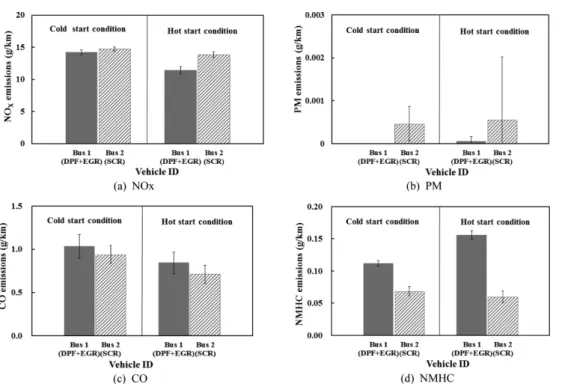
평균차속모드인 NIER-9모드(35.3 km/h)를 냉간 및 열 간시동 조건에서 시험한 배출가스 저감장치별 경유 대 형버스의 규제오염물질 배출특성 결과를 Fig. 4에 나타 Table 4 Analysis conditions of UPLC
Activity Conditions
Model Waters US / ACQUITY UPLC
Detector TUV, 360 nm
Column ACQUITY UPLC
TMBEH C18 1.7 µm 2.1 × 100 mm Mobile phase Solvent A : 90% Water + 10% TetraHydro Furan (THF)
Solvent B : 100% Acetonitrile (ACN)
Gradient
Time (min) Flow (ml/min) A (%) B( %)
Initial 0.3 60 40
5.0 0.3 60 40
10.0 0.3 0 100
12.0 0.3 60 40
15.0 0.3 60 40
Flow rate 0.3 ml/min
Injection volume 2 µl
Table 5 Analysis conditions of GC/MS
Activity Conditions
Model Agilent 7890A / Almsco Bench TOF-dx Column HP-5MS (30 m × 0.25 mm × 0.25 µm)
Column temp.
Temp. (
oC) Rate (
oC/min) Hold time (min) Total time (min)
50 1 1
180 8 0 17.25
240 5 0 29.25
300 10 10 45.25
Column flow 1 ml/min
Inlet heater 300
oC
Split ratio 10:1
Injection volume 1 µl
Transfer line temp. 300
oC
Ion source temp. 250
oC
MS scan range 100~300 amu
내었다.
NOx 는 냉간 및 열간시동 조건 모두 DPF+EGR 부착 차량이 SCR 부착차량보다 유사하거나 소폭 낮게 배출 되었다. NOx는 일반적으로 고온 연소영역에서 형성되 며, EGR이 작동되는 차량은 SCR 부착차량보다 낮은 연소온도 조건으로 인해 상대적으로 NOx 배출이 낮은 것으로 판단된다
(16~18). 또한 도심 주행특성 고려한 NIER-9 모드는 가감속이 많고 정지구간이 다수 존재하 여 SCR 작동을 위한 충분한 온도에 이르는 비율이 낮 으므로 SCR 부착차량이 DPF+EGR 부착차량보다 소폭 높게 배출된 것으로 사료된다. PM의 경우, DPF 부착차 량은 거의 배출되지 않았으며, SCR 부착차량도 유사한 경향을 나타내며 낮게 배출되었다.
CO 는 냉간시동 조건이 열간시동 조건보다 1.2~1.3 배 높게 배출되었으며, 냉간시동 조건이 높은 연소 불 안정성과 낮은 촉매활성도로 판단된다
(4). NMHC 은 EGR 부착차량이 SCR 부착차량보다 1.6~2.6배 높게 배출되었다. 이는 EGR 작동으로 연소온도가 낮아져 불완전 연소 비율이 높아짐에 따라 높게 배출된 것으 로 판단된다
(19,20). 또한 NMHC는 낮은 연소온도 조건 에서 배출되는 미연 탄화수소의 화학적 반응에 의해서 도 형성될 수 있다
(21,22).
3.2 미규제오염물질 배출특성
Fig. 5 에 NMVOCs(Non-methane Volatile Organic Com- pounds) 의 그룹별 구성성분을 나타냈으며, Alkane 계열 은 DPF+EGR 부착차량이 57.5~59.4%, SCR 부착차량은 42.6~43.9% 로 가장 높은 비율을 차지하였다. 특히 경유 산화촉매장치(Diesel Oxidation Catalysts, DOC)가 내장 된 DPF 부착차량이 SCR 부착차량보다 Alkane 계열 비 율이 14.9~15.5% 높게 나타났다. 이는 Alkane 계열이 DOC 에서 다른 물질에 비해 산화효율이 낮은 것으로 판 단된다. Knafl et al. (2006) 및 Bohac et al. (2006)에 따 르면 DOC를 통과하는 Alkynes 및 Alkenes는 대부분 반 Fig. 4 Emission characteristics of (a) NOx, (b) PM, (c) CO and (d) NMHC according to after-treatment system for cold and
hot start conditions
Fig. 5 NMVOCs composition according to vehicle type
for cold and hot start conditions
응성이 좋으며 다음으로 Aromatics, Alkanes 순으로 나 타났다
(23,24).
Table 6 의 NMVOCs 개별물질 배출량은 DPF+EGR 및 SCR 부착차량과 차이를 나타내고 있다. DPF+EGR 부착차량은 Alkane 계열인 n-Nonane, Dodecane, n-Dec- ane, Undecane 등이 높게 배출된 반면, SCR 부착차량은 Alkene 계열인 Propylene 5.78~6.66 mg/km로 가장 높게 배출되었다. NMVOCs 개별물질은 후처리장치, 엔진 시 동조건, 차량유형에 따라 영향을 받으며, 이는 경유연료 의 불완전 연소시 발생하기 때문으로 알려져 있다
(25).
Figure 6 에 나타낸 바와 같이 알데히드류 배출량은 Formalehyde (8.67~14.61 mg/km) > Acetaldehyde (3.66~5.09 mg/km) > Acrolein (1.50~2.46 mg/km) 순으로 Formalde- hyde 가 60.1~68.9%로 가장 높은 비율을 차지하였다.
Kumar et al. (2011) 연구에 따르면 알데히드류는 탄화수 소의 불완전 연소에 의해 형성되며, 알데히드류 중에서 Formalehyde 가 가장 높게 배출될 수 있다고 하였다
(5).
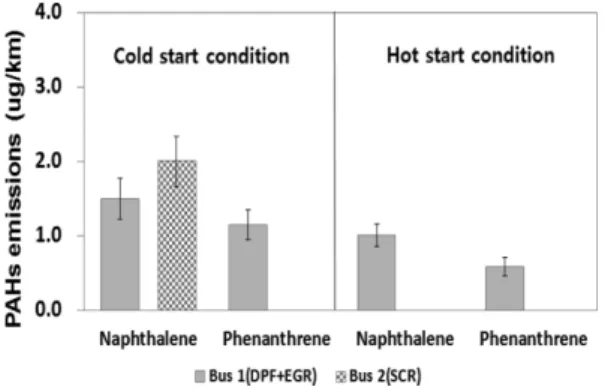
PM 중 PAHs 16종 분석결과, 2종을 제외하고 검출되 지 않았으며, Naphthalene 1.01~2.00 µg/km, Phenan- threne 0.58~1.15 µg/km로 미량으로 배출되었다(Fig. 7).
시험차량인 저감장치가 부착된 Euro 5 경유 대형버스는
Table 6 Comparison of the five major chemical components in NMVOCs emissions from the diesel heavy duty buses for (a) cold and (b) hot start conditions
(a) Cold start condition (unit : mg/km)
Rank Bus 1 (DPF+EGR) Bus 2 (SCR)
Compounds Emission Compounds Emission
1 n-Nonane 3.91 Propylene 6.66
2 Dodecane 3.10 Benzene 3.46
3 n-Decane 1.70 n-Nonane 1.98
4 Propylene 1.54 Undecane 1.66
5 1-Butene 1.53 n-Decane 1.60
(b) Hot start condition (unit : mg/km)
Rank Bus 1 (DPF+EGR) Bus 2 (SCR)
Compounds Emission Compounds Emission
1 n-Nonane 4.73 Propylene 5.78
2 n-Decane 2.27 Benzene 2.93
3 Undecane 1.63 n-Nonane 1.97
4 n-Octane 1.55 1,2,4-Trimethylbenzene 1.71
5 1-Butene 1.51 n-Decane 1.66
Fig. 6 Emission characteristics of aldehydes according to
vehicle type for (a) cold and (b) hot start condi-
tions
PM 이 매우 낮게 배출되었기 때문에 PAHs 성분이 거의 검출한계 이하로 나타났다. Hu et al. (2013)는 후처리장 치가 부착된 대형 경유차량은 총 PAHs의 90% 이상을 효율적으로 줄일 수 있는 것으로 보고하였다
(9).
경유 대형버스의 유해대기오염물질 구성성분비는 NMHC 배출량을 기준으로 NMVOCs 및 Aldehydes의 각 물질별 비율을 산정하여 상위 10순위 물질을 표 7에 나타내었다. 저감장치 및 시동조건에 상관없이 Formal- dehyde 가 15.5~23.2%로 가장 높게 배출되었으며, 다음 으로 DPF+EGR 부착차량은 n-Nonane 12.3~12.5%, SCR 부착차량은 Propylene 15.5~15.7%를 차지하였다. EEA Fig. 7 Emission characteristics of PAHs according to vehi-
cle type for (a) cold and (b) hot start conditions
Table 7 Comparison of the ten major chemical components in NMHC emissions from the diesel heavy duty buses with (a) cold and (b) hot start conditions
(a) Cold start condition (unit : %)
Rank Bus 1(DPF+EGR) Bus 2(SCR)
Compounds Speciation Compounds Speciation
1 Formaldehyde 15.5 Formaldehyde 20.8
2 n-Nonane 12.3 Propylene 15.7
3 Dodecane 10.6 Benzene 8.2
4 Acetaldehyde 6.2 Acetaldehyde 7.5
5 n-Decane 5.4 n-Nonane 5.0
6 1-Butene 4.9 Acrolein 3.7
7 Propylene 4.9 n-Decane 3.7
8 m,p-Xylene 4.5 Methylcyclohexane 3.4
9 n-Octane 4.2 Undecane 3.4
10 Undecane 3.4 1-Butene 3.3
(b) Hot start condition (unit : %)
Rank Bus 1 (DPF+EGR) Bus 2 (SCR)
Compounds Speciation Compounds Speciation
1 Formaldehyde 23.2 Formaldehyde 21.5
2 n-Nonane 12.5 Propylene 15.5
3 Acetaldehyde 9.9 Benzene 8
4 n-Decane 5.7 Acetaldehyde 7.5
5 Acrolein 5.6 n-Nonane 5
6 Undecane 4.7 n-Decane 4.3
7 1-Butene 4.3 Methylcyclohexane 4.0
8 n-Octane 4.2 n-Octane 3.6
9 m,p-Xylene 3.7 Undecane 3.3
10 Propylene 3.4 n-Heptane 2.9
(2016) 의 대형차 NMVOC speciation 결과에 따르면, Formaldehyde 가 8.4%로 가장 높은 비율을 나타냈다
(26).
4. 결 론
본 연구는 배출가스 저감장치(DPF+EGR 및 SCR)가 부 착된 Euro 5 경유 대형버스를 대상으로 규제물질 및 미규 제물질의 배출특성을 조사하여 다음과 같은 결론을 도출 하였다.
(1) 규제물질 분석결과, DPF+EGR 부착차량이 SCR 부착차량보다 상대적으로 낮은 연소온도 조건으로 NOx 는 감소, NMHC는 증가경향을 나타냈다. 또한 PM은 미 량 배출되었다.
(2) NMVOCs 그룹별 구성비율은 DOC가 내장된 DPF 부착차량이 SCR 부착차량보다 Alkane 계열 이 14.9~15.5% 높게 나타났다. 이는 Alkane 계열이 DOC에 서 다른 물질에 비해 산화효율이 낮은 것으로 판단된다.
NMVOCs 개별물질은 DPF+EGR 부착차량은 Alkane 계 열인 n-Nonane, SCR 부착차량은 Alkene 계열인 Propyl- ene 이 가장 높게 배출되었다.
(3) 알데히드류는 Formalehyde, Acetalehyde, Acrolein 순으로 높게 배출되었고, 특히 알데히드류 중 Formale- hyde 는 60.1~68.9%로 가장 높은 비율을 차지하며 불완 전연소에 의한 영향을 크게 받는 것으로 판단된다. 또한 PAHs 는 Naphthalene, Phenanthrene 제외하고 검출되지 않았으며, Euro 5 경유 대형버스에서 PM이 매우 낮게 배출되었기 때문으로 판단된다.
(4) 기존 연구와 달리, 배출가스 저감장치(DPF+EGR, SCR) 및 엔진 시동조건(냉간, 열간)을 고려하여 경유 대 형버스 유해대기오염물질 구성성분비를 각 물질별로 산 정한 결과, Formaldehyde 가장 높게 나타났다.
(5) 본 연구의 경유 대형버스의 유해대기오염물질 배 출특성 및 구성성분비 실측자료는 국내 도로이동오염원 의 HAPs 배출량 산정체계 구축 및 대기오염 저감정책 을 위한 기초자료로 활용될 것으로 기대된다. 또한 실측 자료의 대표성 확보를 위해 향후 보다 많은 시험대수가 필요할 것으로 판단된다.
후 기
본 논문은 환경부의 재원으로 국립환경과학원의 지원
을 받아 수행하였습니다(NIER-2017-01-01-078).
참고문헌