Original article KOREAN JOURNAL OF APPLIED ENTOMOLOGY
한국응용곤충학회지 ⓒ The Korean Society of Applied Entomology
Korean J. Appl. Entomol. 53(4): 399-408 (2014) pISSN 1225-0171, eISSN 2287-545X
DOI: http://dx.doi.org/10.5656/KSAE.2014.10.0.059
Four New Species of the Genus Pholcus (Araneae: Pholcidae) from Korea
Bo Keun Seo*
Department of Biology, Keimyung University, Daegu 704-701, Korea
한국산 유령거미속(거미목: 유령거미과)의 4 신종
서보근*
계명대학교 생물학과
ABSTRACT: Four new species of Pholcus, Pholcus chiakensis n. sp., P. gajiensis n. sp., P. juwangensis n. sp. and P. palgongensis n. sp., are described and figured. The key for the new species, along with the seventeen species previously recorded from Korea, is also provided.
Key words: Key, New species, Pholcus chiakensis, Pholcus gajiensis, Pholcus juwangensis, Pholcus palgongensis
초 록: 유령거미속의 4신종, Pholcus chiakensis n. sp. (치악유령거미; 신칭), P. gajiensis n. sp. (가지유령거미; 신칭), P. juwangensis n. sp. (주왕유 령거미; 신칭), P. palgongensis n. sp. (팔공유령거미; 신칭)을 기재한다. 그리고 기지의 17종과 함께 신종들의 검색표를 제공한다.
검색어: 검색표, 신종, 가지유령거미, 주왕유령거미, 치악유령거미, 팔공유령거미
*Corresponding author: [email protected]
Received October 23 2014; Revised October 31 2014 Accepted November 3 2014
Pholcid spiders are small to medium sized (1-10 mm), with six or eight eyes. Pholcidae currently contains 78 genera and 1407 species (World Spider Catalog, 2014), and has a worldwide distribution. However, most of the biodiversity is concentrated in the tropics and subtropics (Huber, 2003, 2005, 2011).
Pholcus is the largest genus in Pholcidae and can be distinguished from other genera by the fairly long legs, the male chelicerae with three pairs of apophyses, the male bulb with uncus and appendix, and the sclerotized epigynum with a knob (Huber, 2011). This genus currently contains 306 species (World Spider Catalog, 2014) and the distribution is largely restricted to the Old world (Huber, 2011).
Among 170 species known to date from the Palaearctic region, twenty species were recorded from Korea (Paik, 1978;
Namkung and Kim, 1990; Kim and Lee, 2004; Seo, 2004; Kim
and Yoo, 2008, 2009; Kim and Park, 2009; Huber, 2011), of which sixteen species are endemic being found only in the limited areas of the Korean peninsula (World Spider Catalog, 2014).
The purpose of this contribution is to describe four new species and to provide the key for species of Korean Pholcus.
However, three species, P. kwangkyosanensis, P. parkyeonensis, and P. pojeonensis, are not included in the key because they cannot be reliably distinguished from other congeneric species by dubious measurements (Huber, 2011), rough descriptions, and unclear photographs.
Materials and Methods
Specimens were examined and measured under a stereo- microscope (Leica S8APO, Singapore). Photographs were taken with a digital camera (Leica DFC 420) and the images were combined using image stacking software (i-Solution, Future Science Co. Ltd., Taejeon, Korea).
The following abbreviations are used in the text and figures:
Somatic morphology - c, carapace length; Leg I, length of leg I;
Fem. I, length of femur I; Tib. I, length of tibia I; Met. I, length of metatarsus I; Tar. I, length of tarsus I; Fem I l/d, femur I length divided by femur I diameter. The sequence of leg segments in measurement data is as follows: total (femur, patella, tibia, metatarsus, tarsus). Eye area - AER, anterior eye row; ALE, anterior lateral eye; ALE–PLE, distance between ALE and PLE; AME, anterior median eye; AME–ALE, distance between AME and ALE; AME–AME, distance between AMEs; AME–
PME, distance between AME and PME; PER, posterior eye row; PLE, posterior lateral eye; PME, posterior median eye;
PME–PLE, distance between PME and PLE; PME–PME, distance between PMEs. Palp and genital organ in the illustrations - a, appendix of genital bulb; b, genital bulb; e, embolus; k, epigynal knob; p, process of uncus; pp, pore plate of internal genitalia; pr, procursus of male palp.
All measurements in the text are given in millimeters. The examined specimens are deposited in the National Institute of Biological Resources (NIBR), Ministry of Environment, Korea.
Taxonomic Accounts
Family Pholcidae Koch, 1850 Genus Pholcus Walckenaer, 1805
Pholcus Walckenaer, 1805: 80. Type species: Aranea phalangoides Fuesslin, 1775: 9
Key to species of Korean Pholcus
1. Carapace with broad median mark ··· 2
- Carapace with radiated stripes ··· 4
2(1). Uncus of genital bulb conical ··· P. phalangioides - Uncus of genital bulb elongated ··· 3
3(2). Appendix of genital bulb T-shaped ··· P. zichyi - Appendix of genital bulb triangle ··· P. manueli 4(1). Genital bulb with appendix ··· 5
- Genital bulb without appendix ··· 14
5(4). Male palpal procursus with dorsal spine ··· 6
- Male palpal procursus without dorsal spine ··· 9
6(5). Uncus of genital bulb rounded ··· P. montanus - Uncus of genital bulb pointed ··· 7
7(6). Ventral apophysis of palpal trochanter branched ··· P. simbok - Ventral apophysis of palpal trochanter unbranched ···· 8
8(7). Appendix of genital bulb Y-shaped ··· P. woongil - Appendix of genital bulb hook-shaped ··· P. gajiensis n. sp. 9(5). Ventral apophysis of palpal trochanter branched ··· 10
- Ventral apophysis of palpal trochanter unbranched ···· 13
10(9). Uncus of genital bulb with a process ··· 11
- Uncus of genital bulb without a process ··· 12
11(10). Uncus process originates from proximal part close to genital bulb ··· P. chiakensis n. sp. - Uncus process originates from distal part ··· P. socheunensis 12(11). Appendix of genital bulb very small ··· P. kwanaksanensis - Appendix of genital bulb simple rod-shaped ··· P. okgye 13(9). Uncus of genital bulb with hooked tip ··· P. yeongwol - Uncus of genital bulb without hooked tip ··· P. palgongensis n. sp. 14(4). Male palpal procursus with dorsal spine ··· 15
- Male palpal procursus without dorsal spine ··· 19
15(14). Uncus of genital bulb with a process ··· 16
- Uncus of genital bulb without a process ··· 17
16(15). Ventral apophysis of palpal trochanter branched ··· P. sokkrisanensis - Ventral apophysis of palpal trochanter unbranched ··· P. gosuensis 17(15). Uncus of genital bulb rounded ··· P. joreongensis - Uncus of genital bulb pointed ··· 18
18(17). Ventral apophysis of palpal trochanter branched ··· P. nodong - Ventral apophysis of palpal trochanter unbranched ··· P. juwangensis n. sp. 19(14). Uncus of genital bulb rounded ··· 20 - Uncus of genital bulb serrated ··· P. extumidus 20(19). Ventral apophysis of palpal trochanter blunt
··· P. crassus - Ventral apophysis of palpal trochanter pointed
··· P. acutulus
Pholcus chiakensis n. sp. (Figs. 1A-E, 2A-H)
Type material. Holotype: ♂, area around Daegok campsite on Mt. Chiak (37° 23′ 40″ N, 128° 03′ 13″ E, alt. 390 m), Socho-
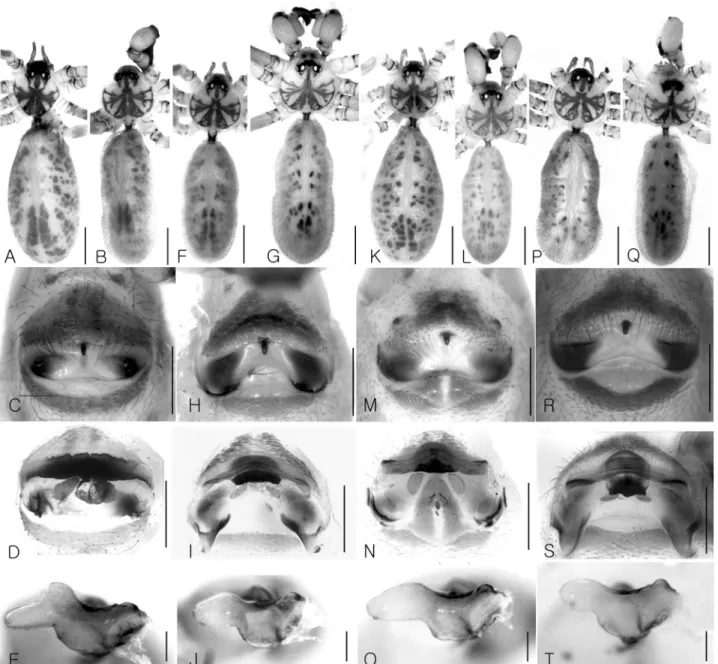
Fig. 1. A-E; Pholcus chiakensis. F-J; Pholcus gajiensis. K-O; Pholcus juwangensis, P-Q; Pholcus palgongensis. A, F, K, P; female, dorsal view.
B, G, L, Q; male dorsal view. C, H, M, R; epigynum. D, I, N, S; internal genitalia, dorsal view. E, J, O, T; trochanter of male palp, posterior view.
Scale lines: 0.1 mm (trochanter), 0.5 mm (epigynum and internal genitalia), 1.0 mm (dorsal view of male and female).
myeon, Weonju, Gangweon-do, 31. vii. 2007, S. Y. Kim. Paratype:
1♂, 2♀♀, same data as holotype; 1♂, 2♀♀, area around Guryong Temple in Mt. Chiak (37° 19′ 33″ N, 127° 57′ 33″ E, alt. 153 m), other data same as holotype; 2♀♀, a mountainside (37° 23′ 27″ N, 128° 03′ 19″ E, alt. 434 m), 2.8 km north of the peak of Mt. Chiak, other data is the same as holotype; 7♂♂, 2
♀♀, a mountainside (37° 22′ 48″ N, 128° 07′ 31″ E, alt. 538 m), 6.5 km east-northeast of the peak of Mt. Chiak, Gangnim-myeon, Hoengseong-gun, Gangweon-do, 21. vii. 2010, J. C. Lim.
Etymology. The specific name, chiakensis, is derived from the type locality, Mt. Chiak.
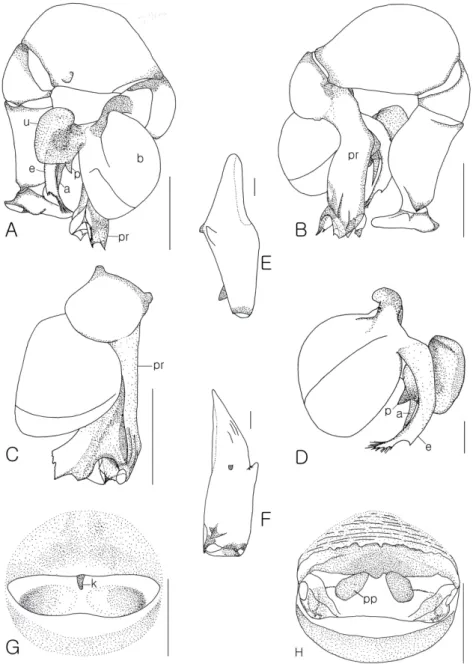
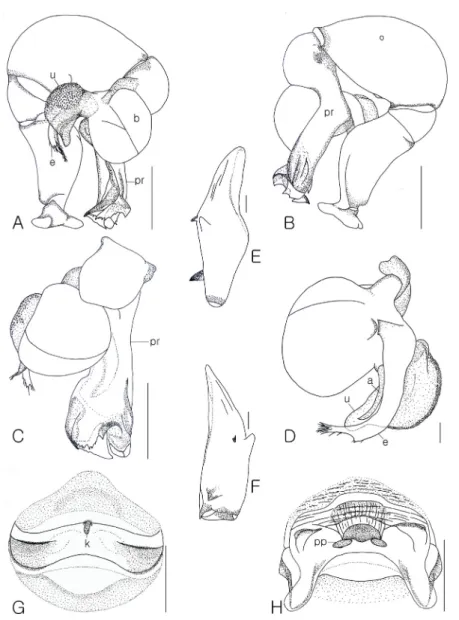
Diagnosis. The males of P. chiakensis n. sp. are very similar to those of P. montanus Paik, 1978 in the round uncus, needle shaped appendix, and weakly sclerotized embolus. However, P. chiakensis can be easily distinguished by the pointed small process of uncus and the procursus without a spine (Fig. 2A-D).
The female of P. chiakensis also resembles P. crassus Paik, 1978 in the shape of epigynum, but not in the shapes of the
Fig. 2. Pholcus chiakensis. A; left male palp, prolateral view. B; ditto, retrolateral view. C; left genital bulb and procursus, dorsal view. D; left genital bulb, retrolateral view. E; left chelicera, dorsal view. F; ditto, prolateral view. G; epigynum. H; internal genitalia, dorsal view. Scale lines: 0.1 mm (D-F), 0.5 mm (the rest).
pore plates and the sclerotized transverse plate of internal genitalia (Figs. 1C-D, 2G-H).
Description. Male (holotype). Total length 5.50 (with clypeus).
Habitus as in Figure 1B. Carapace 1.75 long (with clypeus), 1.62 wide, almost circular and yellow, with brown radiated stripes connecting anterior median eyes, lateral and posterior sides from linear median furrow; cervical groove distinct;
cephalic region remarkably raised; clypeus brown, height 4.7 times of diameter of AME. Ocular area darkened around eye
triads and AME. AER 0.64, PER 0.72. Eye ratio, PME = PLE >
ALE > AME (15:14:10). AME-AME and AME-ALE 0.03 respectively, PME-PME 0.21, AME-PME 0.05, and PME-PLE and ALE-PLE contiguous. Median ocular quadrangle, posterior side > height >anterior side (38:28:21). Chelicera brown, with a sclerotized apophysis distally, and an unsclerotized apophysis and a small nodules proximally (Fig. 2E-F). Sternum 1.12 wide, with four pairs of darkened patches along margin, and fused with darkened labium. Labium 0.33 wide. Legs yellow;
femora brown except its distal parts; each distal part of femur with a brown ring; tibiae with four brown rings; faint pseudoseg- ments on distal tarsi. Leg measurements: I 40.35 (10.30, 0.70, 10.10, 16.95, 2.30), II 27.25 (7.40, 0.60, 6.90, 11.00, 1.35), III 18.65 (5.40, 0.60, 4.50, 7.15, 1.00), IV 24.95 (7.05, 0.60, 6.35, 9.55, 1.40). Fem. I l/d 34.33. Tib. I l/d 50.50. Leg I/c 23.06. Fem.
I/c 5.89. Tib I/c 5.77. Met I/c 9.69. Pat. I+tib. I/c 6.17. Met.
I/tar. I 7.37. Met. IV/tar. IV 6.82. Abdomen 3.60 long, 1.55 wide, and cylindrical; dorsum yellow with brown dots. Palpal organ (Figs. 1E, 2A-F); trochanter with a branched, blunt ventral apophysis; tibia with a small nodule ventrally; procursus with membranous, sclerotized elements distally and without spine on low elevation; bulb with round uncus which has a pointed small process, long curved embolus with feather-like transparent tip, and needle shaped appendix.
Female (paratype). Total length 5.30 (with clypeus). Habitus as in Figure 1A. Carapace 1.60 long (with clypeus), 1.50 wide;
clypeus height 4.3 times of diameter of AME. AER 0.65, PER 0.70. Eye ratio, PME = PLE = ALE > AME (13:10). AME-AME 0.04, AME-ALE 0.03, PME-PME 0.21, AME-PME 0.08, and PME-PLE and ALE-PLE contiguous. Median ocular quadrangle, posterior side > height >anterior side (37:26:21). Sternum 0.94 wide. Labium 0.34 wide. Legs yellow; femora and tibiae with four brown rings respectively; faint pseudosegments on distal tarsi. Leg measurements: I 32.55 (8.20, 0.65, 8.10, 13.40, 2.20), II 22.40 (6.10, 0.60, 5.50, 8.70, 1.50), III 16.20 (4.60, 0.60, 3.90, 6.10, 1.00), IV 22.50 (6.40, 0.60, 5.60, 8.50, 1.40). Fem. I l/d 27.33. Tib. I l/d 54.00. Leg I/c 20.34. Fem. I/c 5.13. Tib I/c 5.06. Met I/c 8.38. Pat. I+tib. I/c 5.47. Met. I/tar. I 6.09. Met.
IV/tar. IV 6.07. Abdomen 3.55 long, 1.60 wide. Epigynum transversely elongated with a pair of large concave plates and a brown knob anteriorly and medially; internal genitalia with a pair of European pear-shaped pore plates and a sclerotized transverse plate anteriorly (Figs. 1C-D, 2G-H).
Distribution. Korea (Gangweon-do).
Pholcus gajiensis n. sp. (Figs. 1F-J, 3A-H)
Type material. Holotype: ♂, Unmun valley (35° 38′ 30″ N, 129° 02′ 18″ E, alt. 673 m), 4.1 km northeast of the peak of Mt.
Gaji, Unmun-myeon, Cheongdo-gun, Gyeongsangbuk-do, 15.
x. 2010, J. C. Lim. Paratype: 1♀, same data as holotype; 1♂, 2♀♀, mountainside (35° 36′ 50″ N, 129° 01′ 19″ E, alt. 803 m),
1.9 km east-southeast of the peak of Mt. Gaji, Sangbuk-myeon, Ulju-gun, Ulsan, 26. viii. 2005, C. W. Lee; 1♂, 1♀, mountain foot (35° 46′ 49″ N, 129° 01′ 25″ E, alt. 717 m), 17.9 km north- northeast of the peak of Mt. Gaji, Sannae-myeon, Gyeonju-si, Gyeongsangbuk-do, 26. viii. 2005, C. W. Lee.
Etymology. The specific name, gajiensis, is derived from the type locality, Mt. Gaji.
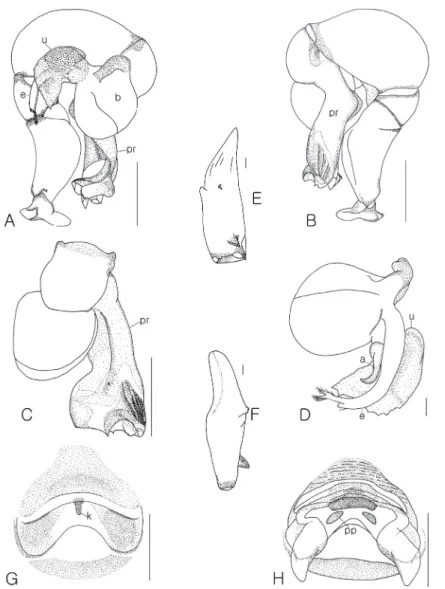
Diagnosis. The males of P. gajiensis n. sp. are similar to those of P. extumidus Paik, 1978 in the serrate uncus and weakly sclerotized embolus, but can be easily distinguished from the latter by having a hook-shaped appendix (Fig. 3A-D). The females of P. gajiensis are also similar to those of P. extumidus in the shape of epigynum, but different in the shapes of the pore plates and the sclerotized plate of internal genitalia (Figs. 1H-I, 3G-H).
Description. Male (holotype). Total length 6.00 (with clypeus).
Habitus as in Figure 1G. Carapace 1.70 long (with clypeus), 1.65 wide, almost circular and yellow, with brown radiated stripes connecting anterior median eyes, lateral and posterior sides from linear median furrow; cervical groove distinct;
cephalic region remarkably raised; clypeus brown, height 5.8 times of diameter of AME. Ocular area darkened around eye triads and AME. AER 0.70, PER 0.78. Eye ratio, PLE > ALE >
PME > AME (14:13:11:10). AME-AME and AME-ALE 0.05 respectively, PME-PME 0.26, PME-PLE 0.03, AME-PME 0.04, and ALE-PLE contiguous. Median ocular quadrangle, posterior side > height >anterior side (41:27:24). Chelicera brown, with a sclerotized apophysis distally, and an unsclerotized apophysis and a small nodules proximally (Fig. 3E-F). Sternum darkened except yellow margin, 1.11 wide, and fused with dasrkened labium. Labium 0.36 wide. Legs yellow; femora brown except its distal parts; each distal part of femur with a brown ring; tibiae with four brown rings; faint pseudosegments on distal tarsi. Leg measurements: I 49.50 (12.80, 0.70, 12.70, 20.80, 2.50), II 33.60 (9.40, 0.80, 8.40, 13.50, 1.50), III 21.80 (6.50, 0.60, 5.40, 8.20, 1.10), IV 29.60 (8.60, 0.70, 7.50, 11.30, 1.50). Fem. I l/d 32.00. Tib. I l/d 63.50. Leg I/c 29.12. Fem. I/c 7.53. Tib I/c 7.47. Met I/c 12.24. Pat. I+tib. I/c 7.88. Met. I/tar.
I 8.32. Met. IV/tar. IV 7.53. Abdomen 4.15 long, 1.70 wide, and cylindrical; dorsum yellow with brown dots. Palpal organ (Figs. 1J, 3A-F); trochanter with a blunt ventral apophysis;
tibia with a small nodule ventrally; procursus with distinctive
Fig. 3. Pholcus gajiensis,. A; left male palp, prolateral view. B; ditto, retrolateral view. C; left genital bulb and procursus, dorsal view (arrow points at spine). D; left genital bulb, retrolateral view. E; left chelicera, dorsal view. F; ditto, prolateral view. G; epigynum. H; internal genitalia, dorsal view. Scale lines: 0.1 mm (D-F), 0.5 mm (the rest).
prolateral process and a short spine on low elevation; bulb with serrate uncus, weakly sclerotized embolus with feather-like transparent tip, and hook-shaped appendix.
Female (paratype). Total length 5.10 (with clypeus). Habitus as in Figure 1F. Carapace 1.50 long (with clypeus), 1.45 wide;
clypeus height 5 times of diameter of AME. AER 0.61, PER 0.65. Eye ratio, PLE > ALE > PME > AME (14:13:12:9). AME- AME 0.03, AME-ALE 0.04, PME-PME 0.21, PME-PLE 0.03, AME-PME 0.08, and ALE-PLE contiguous. Median ocular quadrangle, posterior side > height >anterior side (35:28:20).
Sternum 1.04 wide. Labium 0.35 wide. Legs yellow; femora and tibiae with four brown rings respectively; faint pseudoseg- ments on distal tarsi. Leg measurements: I 33.20 (8.30, 0.70,
8.30, 13.80, 2.10), II 22.10 (6.10, 0.60, 5.50, 8.50, 1.40), III 16.70 (4.70, 0.60, 4.00, 6.20, 1.20), IV 22.80 (6.60, 0.60, 5.60, 8.60, 1.40). Fem. I l/d 20.75. Tib. I l/d 41.50. Leg I/c 22.13. Fem.
I/c 5.53. Tib I/c 5.53. Met I/c 9.20. Pat. I+tib. I/c 6.00. Met.
I/tar. I 6.57. Met. IV/tar. IV 6.14. Abdomen 3.50 long, 1.55 wide. Epigynum chevron-shaped with a pair of concave plates and a brown knob anteriorly and medially; internal genitalia with a pair of small elongated pore plates and a small sclerotized transverse plate anteriorly (Figs. 1H-I, 3G-H).
Distribution. Korea (Gyeongsangbuk-do, Ulsan).
Pholcus juwangensis n. sp. (Figs. 1K-O, 4A-H)
Type material. Holotype: ♂, Juwang valley (36° 23′ 55″ N,
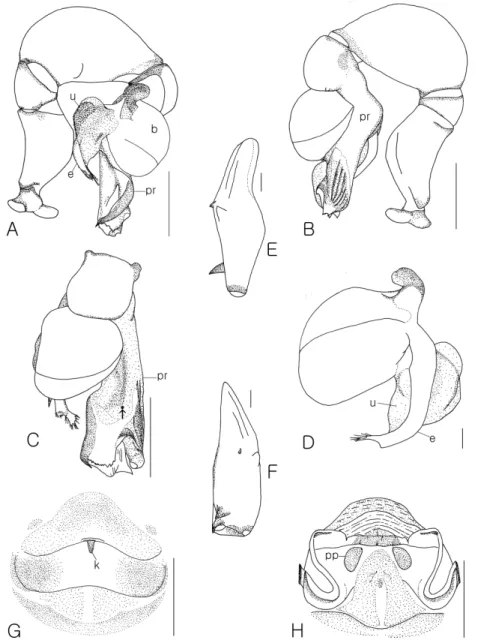
Fig. 4. Pholcus juwangensis. A; left male palp, prolateral view. B; ditto, retrolateral view. C; left genital bulb and procursus, dorsal view (arrow points at spine). D; left genital bulb, retrolateral view. E; left chelicera, dorsal view. F; ditto, prolateral view. G; epigynum. H; internal genitalia, dorsal view. Scale lines: 0.1 mm (D-F), 0.5 mm (the rest).
129° 09′ 31″ E, alt. 291 m), 1.1 km north-northwest of the peak of Mt. Juwang, Budong-myeon, Cheongsong-gun, Gyeongsangbuk- do, 3. vi. 2006, C. W. Lee. Paratype: 3♂♂, 10♀♀, same data as holotype; 1♀, mountainside (36° 24′ 01″ N, 129° 08′ 42″ E, alt. 295 m), 477 m north of Daejeon Temple on Mt. Juwang (37° 19′ 33″ N, 127° 57′ 33″ E, alt. 153 m), 2. vi. 2006, other data is the same as holotype; 1♂, 6♀♀, Juwang valley (36°
23′ 53″ N, 129° 08′ 57″ E, alt. 318 m), 318m north-northeast of Daejeon Temple on Mt. Juwang, other data is the same as holotype; 3♂♂, 1♀, area around Juwang Hermitage on Mt.
Juwang (36° 23′ 45″ N, 129° 09′ 33″ E, alt. 344 m), other data is the same as holotype.
Etymology. The specific name, juwangensis, is derived from the type locality, Mt. Juwang.
Diagnosis. The male of P. juwangensis n. sp. is very similar to that of P. simbok Huber, 2011 in the sharp-tipped uncus, weakly sclerotized embolus, and the procursus with distinctive prolateral process, but can be clearly distinguished by the uncus without a small pointed process near its basis and the procursus with a short stout spine on low elevation (Fig. 4A-D).
The female of P. juwangensis also resembles P. simbok in the shape of epigynum, but can be distinguished by the wider pore plates than the latter and the crooked posterior margin of the sclerotized plate of internal genitalia (Figs. 1M-N, 4G-H).
Description. Male (holotype). Total length 5.10 (with clypeus).
Habitus as in Figure 1 L. Carapace 1.65 long (with clypeus), 1.60 wide, with brown radiated stripes connecting anterior median eyes, lateral and posterior sides from linear median furrow; cervical groove distinct; cephalic region remarkably raised; clypeus brown, height 4.7 times of diameter of AME.
Ocular area darkened around eye triads and AME. AER 0.61, PER 0.68. Eye ratio, ALE = PLE > PME > AME (12:11:10).
AME-AME and AME-ALE 0.04 respectively, PME-PME 0.25, AME-PME 0.09, and PME-PLE and ALE-PLE contiguous.
Median ocular quadrangle, posterior side > height >anterior side (37:27:21). Chelicera brown, with a sclerotized apophysis distally, and an unsclerotized apophysis and a small nodules proximally (Fig. 4E-F). Sternum 1.08 wide, with four pairs of darkened patches along margin, and fused with darkened labium.
Labium 0.35 wide. Legs yellow; femora brown except its distal parts; each distal part of femur with a brown ring; tibiae with four brown rings; faint pseudosegments on distal tarsi. Leg measurements: I 37.15 (9.30, 0.65, 9.40, 15.70, 2.10), II 24.55 (6.90, 0.65, 6.30, 9.30, 1.40), III 17.70 (5.20, 0.60, 4.40, 6.80, 0.70), IV 23.25 (6.90, 0.60, 5.70, 8.70, 1.35). Fem. I l/d 31.00.
Tib. I l/d 42.00. Leg I/c 22.52. Fem. I/c 5.64. Tib I/c 5.70. Met I/c 9.52. Pat. I+tib. I/c 6.09. Met. I/tar. I 7.48. Met. IV/tar. IV 6.44. Abdomen 3.30 long, 1.40 wide, and cylindrical; dorsum yellow with brown dots. Palpal organ (Figs. 1O, 4A-F);
trochanter with a blunt ventral apophysis; tibia with a small nodule ventrally; procursus with distinctive prolateral process and a short stout spine on low elevation; bulb with sharp-tipped uncus and weakly sclerotized embolus with feather-like trans- parent tip, and without uncus process and appendix.
Female (paratype). Total length 5.70 (with clypeus). Habitus as in Figure 1K. Carapace 1.65 long (with clypeus), 1.60 wide;
clypeus height 3.3 times of diameter of AME. AER 0.59, PER 0.64. Eye ratio, PLE > PME = ALE > AME (13:12:9). AME- AME 0.03, AME-ALE 0.01, PME-PME 0.20, PME-PLE conti- guous, AME-PME 0.09, and ALE-PLE 0.01. Median ocular quadrangle, posterior side > height >anterior side (34:27:20).
Sternum 0.99 wide. Labium 0.35 wide. Legs yellow; femora
and tibiae with four brown rings respectively; faint pseudoseg- ments on distal tarsi. Leg measurements: I 30.70 (7.70, 0.60, 7.50, 12.80, 2.10), II 21.80 (5.90, 0.60, 5.50, 8.40, 1.40), III 16.15 (4.50, 0.55, 4.00, 6.00, 1.10), IV 21.90 (6.20, 0.60, 5.50, 8.20, 1.40). Fem. I l/d 25.67. Tib. I l/d 37.50. Leg I/c 18.61.
Fem. I/c 4.67. Tib I/c 4.55. Met I/c 7.76. Pat. I+tib. I/c 4.91.
Met. I/tar. I 6.10. Met. IV/tar. IV 5.86. Abdomen 4.00 long, 2.05 wide. Epigynum chevron-shaped with a pair of concave plates and a brown knob anteriorly and medially; internal genitalia with a pair of oval pore plates and a small sclerotized transverse plate anteriorly (Figs. 1M-N, 4G-H).
Distribution. Korea (Gyeongsangbuk-do).
Pholcus palgongensis n. sp. (Figs. 1P-T, 5A-H)
Type material. Holotype: ♂, rock crevice around cable car summit of Mt. Palgong (36° 00′ 05″ N, 128° 41′ 39″ E, alt. 791 m), Yongsu-dong, Dong-gu, Daegu, 1. ix. 2006, B. K. Seo. Paratype:
1♂, 3♀♀, same data as holotype.
Etymology. The specific name, palgongensis, is derived from the type locality, Mt. Palgong.
Diagnosis. The males of P. palgongensis n. sp. are similar to those of P. juwangensis n. sp. and P. simbok Huber, 2011 in the contour of uncus, weakly sclerotized embolus, and the procursus with distinctive prolateral process. However, P. palgongensis can be easily distinguished from the latter by the blunt-tipped uncus and the procursus without a spine on the low elevation, and differs from P. juwangensis in having a needle-shaped appendix, as well as from P. simbok in not having a small pointed process near its basis (Fig. 5A-D). The females of P.
palgongensis are very similar to those of P. juwangensis in the shape of epigynum, but different in the anterior furrows of concave plates and small elongate pore plates of internal genitalia (Figs. 1R-S, 5G-H).
Description. Male (holotype). Total length 5.30 (with clypeus). Habitus as in Figure 1Q. Carapace 1.75 long (with clypeus), 1.65 wide, with brown radiated stripes connecting anterior median eyes, lateral and posterior sides from linear median furrow; cervical groove distinct; cephalic region remarkably raised; clypeus brown, height about 4.8 times of diameter of AME. Ocular area darkened around eye triads and AME. AER 0.64, PER 0.70. Eye ratio, ALE = PLE > PME >
AME (14:13:10). AME-AME 0.04, AME-ALE 0.03, PME-PME
Fig. 5. Pholcus palgongensis. A; left male palp, prolateral view. B; ditto, retrolateral view. C; left genital bulb and procursus, dorsal view. D;
left genital bulb, retrolateral view. E; left chelicera, dorsal view. F; ditto, prolateral view. G; epigynum. H; internal genitalia, dorsal view. Scale lines: 0.1 mm (D-F), 0.5 mm (the rest).
0.21, AME-PME 0.09, and PME-PLE and ALE-PLE contiguous.
Median ocular quadrangle, posterior side > height >anterior side (38:28:21). Chelicera brown, with a sclerotized apophysis distally, and an unsclerotized apophysis and a small nodules proximally (Fig. 5E-F). Sternum 1.17 wide, with four pairs of darkened patches along margin, and fused with darkened labium. Labium 0.36 wide. Legs yellow; femora brown except its distal parts; each distal part of femur with a brown ring;
tibiae with four brown rings; faint pseudosegments on distal tarsi. Leg measurements: I 40.40 (10.30, 0.70, 10.30, 16.80, 2.30), II 27.85 (7.70, 0.65, 7.00, 11.00, 1.50), III 19.25 (5.50, 0.65, 4.70, 7.30, 1.10), IV 25.65 (7.40, 0.65, 6.40, 9.80, 1.40).
Fem. I l/d 29.43. Tib. I l/d 51.50. Leg I/c 23.09. Fem. I/c 5.89.
Tib I/c 5.89. Met I/c 9.60. Pat. I+tib. I/c 6.29. Met. I/tar. I 7.30.
Met. IV/tar. IV 7.00. Abdomen 3.60 long, 1.50 wide, and cylindrical; dorsum yellow with brown dots. Palpal organ (Figs. 1T, 5A-F); trochanter with a blunt ventral apophysis;
tibia with a small nodule ventrally; procursus with distinctive prolateral process and without a spine on low elevation; bulb with blunt-tipped uncus, long curved embolus with feather-like transparent tip, and needle shaped appendix.
Female (paratype). Total length 5.20 (with clypeus). Habitus as in Figure 1P. Carapace 1.75 long (with clypeus), 1.70 wide;
clypeus height 4.9 times of diameter of AME. AER 0.60, PER
0.65. Eye ratio, PLE > PME = ALE > AME (14:13:9). AME-AME 0.04, AME-ALE 0.03, PME-PME 0.20, PME-PLE 0.01, AME- PME 0.08, and ALE-PLE contiguous. Median ocular quadrangle, posterior side > height >anterior side (34:26:19). Sternum 1.09 wide. Labium 0.36 wide. Legs yellow; femora and tibiae with four brown rings respectively; faint pseudosegments on distal two-thirds of tarsi. Leg measurements: I 32.65 (8.30, 0.65, 8.20, 13.30, 2.20), II 23.15 (6.50, 0.60, 5.65, 8.90, 1.50), III 16.90 (4.90, 0.60, 4.00, 6.30, 1.10), IV 22.60 (6.50, 0.55, 5.70, 8.50, 1.35). Fem. I l/d 20.75. Tib. I l/d 41.00. Leg I/c 18.66.
Fem. I/c 4.74. Tib I/c 4.69. Met I/c 7.60. Pat. I+tib. I/c 5.06.
Met. I/tar. I 6.05. Met. IV/tar. IV 6.30. Abdomen 3.50 long, 1.50 wide. Epigynum chevron-shaped with a pair of concave plates having an anterior furrow and a brown knob anteriorly and medially; internal genitalia with a pair of small elongate pore plates and a small sclerotized transverse plate anteriorly (Figs. 1R-S, 5G-H).
Distribution. Korea (Daegu).
Acknowledgements
I am very grateful to Gyeong Yeon Lee for making the image files.
Literature Cited
Fuesslin, J.C., 1775. Verzeichnis der ihm bekannten schweizerischen Insekten, mit einer ausgemahlten Kupfertafel: nebst der Ankündigung eines neuen Inseckten Werkes, H. Steiner & Co., Zürich and Winterthur.
Huber, B.A., 2003. High species diversity in one of the dominant groups of spiders in East African montane forests (Aranae:
Pholcidae: Buitinga n. gen., Spermophora Hentz). Zool. J. Linn.
Soc. 137, 555-619.
Huber, B.A., 2005. The pholcid spiders of Africa (Araneae:
Pholcidae): state of knowledge and directions for future research, in: Huber B.A., Sinclair, B.J., Lampe, K.H. (Eds.), African Biodiversity: Molecules, Organisms, Ecosystems. Springer Verlag, Berlin Heidelberg, pp. 181-186.
Huber, B.A., 2011. Revision and cladistic analysis of Pholcus and closely related taxa (Araneae, Pholcidae). Bonner Zoologische Monographien 58, 1-509.
Kim, B.W., Lee, W., 2004. A new species of Pholcus (Araneae:
Pholcidae) from Gosu Cave, Korea. Korean J. syst. Zool. 20, 79-85.
Kim, J.P., Park, Y.C., 2009. One new species of genus Pholcus (Araneae: Pholcidae) from Korea. Korean Arachnol. 25, 99-103.
Kim, J.P, Yoo, S.H., 2008. One new species of genus Pholcus (Araneae: Pholcidae) from Korea. Korean Arachnol. 24, 1-6.
Kim, J.P., Yoo, S.H., 2009. One new species of genus Pholcus (Araneae: Pholcidae) from Korea. Korean Arachnol. 25, 41-46.
Koch, C.L., 1850. Übersicht des Arachnidensystems, Heft 5. Zeh, Nürnberg.
Namkung, J., Kim, J.P., 1990. A new species of the genus Pholcus (Araneae: Pholcidae) from Korea. Korean Arachnol. 5, 131-137.
Paik, K.Y., 1978. The Pholcidae (Araneae) of Korea. Educ. J.
Kyungpook Univ. 20, 113-135.
Seo, B.K., 2004. A new species of Pholcus (Araneae: Pholcidae) from Korea. Korean J. Syst. Zool. 20, 73-77.
Walckenaer, C.A., 1805. Tableau des aranéides ou caractères essentiels des tribus, genres, familles et races que renferme le genre Aranea de Linné, avec la désignation des espèces comprises dans chacune de ces divisions. de l'Imprimerie deDentu, Paris.
World Spider Catalog, 2014. World Spider Catalog. Natural History Museum Bern, online at http://wsc.nmbe.ch, version 15.5, accessed on October 17, 2014.