한국정보통신학회논문지(J. Korea Inst. Inf. Commun. Eng.) Vol. 21, No. 3 : 643~650 Mar. 2017
ISMC와 백스테핑을 이용한 유연관절로봇의 강인한 임피던스제어
권성하1* · 박승규2 · 김민찬2
Robust Impedance Control Using Robot Using ISMC and Backstepping in Flexible Joint Robot
Sung-Ha Kwon1* · Seung-kyu Park2 · Min-chan Kim2
1*Department of Control and Instrumentation Engineering, Changwon National University, Changwon 51140, Korea
2Department of Electrical Engineering, Changwon National University, Changwon 51140, Korea
요 약
최근에 유연관절로봇의 제어는 로봇시스템에 있어서 다양한 적용가능성이 증가하고 있기 때문에 점점 그 중요성 이 커지고 있다. 본 논문에서는 유연관절로봇의 제어에 있어서 적분슬라이딩모드제어기와 백스테핑제어기법을 도 입하여 강인성을 증가시키는 방법을 제안한다. 슬라이딩모드제어기를 사용하여 강인성을 향상시키기 위해서는 제 어대상이 정합조건을 만족시켜야 하는데 유연관절로봇은 이 조건을 만족시키지 못한다. 유연관절로봇은 링크측과 모터측으로 나누어 생각할 수 있고 각 측에 외란이 존재하나 실제입력은 모터측에 존재하기 때문에 링크측 외란은 정합조건을 만족시킬 수 없으므로 슬라이딩모드제어기로 제거하기가 어렵다. 이에 본 논문에서는 백스테핑을 도입 하여 이러한 비정합 문제를 해결함으로써 링크측 외란의 영향을 제거할 수 있도록 한다. 이와 더불어 임피던스제어 성능을 가질 수 있도록 적분슬라이딩모드제어기를 함께 사용한다.
ABSTRACT
The control of flexible joint robot is getting more attentions because its applications are more frequently used for robot systems in these days. This paper proposes a robust impedance controller for the flexible joint robot by using integral sliding mode control and backstepping control. The sliding mode control decouple disturbances completely but requires matching condition for disturbances. The dynamic model of flexible joint robot is divided into motor side and link side and the disturbance of the link side does not satisfy matching condition and cannot be decoupled directly by the actual input in the motor side. To overcome this difficulty, backstepping control technique is used with sliding mode control. The mismatched disturbance in the link side is changed into matched one in the respect to virtual control input which is the state controlled by actual input in the motor side. Integral sliding mode control is used to preserve the impedance control performance and the improved robustness at the same time.
키워드 : 백스테핑, 유연관절로봇, 적분슬라이딩모드제어, 정합조건, 강인제어, 임피던스제어
Key word : Backstepping, Flexible Joint Robot, Integral Sliding Mode, Mismatched Disturbance, Robust Control, Impedance Control
Received 05 December 2016, Revised 09 December 2016, Accepted 25 December 2016
* Corresponding Author Sung-Ha Kwon(E-mail:[email protected], Tel:+82-55-213-3661)
Department of Control and Instrumentation Engineering, Changwon National University, Changwon 51140, Korea
Open Access http://doi.org/10.6109/jkiice.2017.21.3.643 print ISSN: 2234-4772 online ISSN: 2288-4165 Communication Engineering
Ⅰ. INTRODUCTION
Nowadays, control of flexible joint robots(FJR) is getting increasing interests [1-5]. Flexibility in robot joints comes from flexible mechanism like series elastic actuator, belt-pully transmission and harmonic drives.
Because of the variety of robotic field, the control of FJR is becoming very important topics.
Main topic of this paper is to propose a robust controller which can decouple disturbances in FJR.
There are representative robust control methods such as
∞control [6,7], disturbance observer(DOB) [8,9], adaptive control [10,11] and sliding mode control(SMC) [12-15]. Among them, sliding mode control decouples disturbances almost completely through the sliding mode. So it is desirable to use SMC for the control of FJRs which have disturbances. However, matching condition is required for the application of SMC but FJR does not satisfy this condition.
To overcome this difficulty, backstepping control technique is used with SMC. The FJR model is considered as two models: link side and motor side.
In the backstepping control of FJR, the motor side angle position is considered as a virtual controller for the link side system and actual control input in the motor side is designed to achieve the desired motor side angle position.
There are some existing results which use backstepping control for FJR but deos not consider SMC and backstepping together [16-19].
Besides robustness, the control performance must be considered in the control of FJR. To have desirable impedance is one of the frequently considered control performance in robotic field.
Integral sliding mode control makes it possible to achieve this control performance and robustness together.
The dynamic characteristic of desired impedance can be involved in a integral sliding surface [20-23].The reaching phase problem is naturally disappeared by choosing the initial virtual state in the integral sliding surface. The link side impedance is chosen as the overall
impedance of FJR and the motor side impedance is determined high enough. Impedance control is one of the core techniqe for the growing field of service robotics and FJR is frequently controlled under impedance consideration [24].
The impedance controllers are designed first and they are capsulized by integral sliding surfaces. An ISMC is designed for the link side first and then for the motor side based on Lyapunov stability.
This paper organized as follows. Chapter II formulates the problem to be solved. The basics of ISMC and backstepping control are discussed in chapter III and their composition and application to FJR is considered in chapter IV. Simulation results are shown in chapter V and conclusions are given in chapter VI.
Ⅱ. PROBLEM FORMULATION
Consider the following dynamics of a flexible joint robot:
sin
(1)
where is the torque input, w is the perturbation, is the link inertia, is the motor inertia, m is the mass, g is the gravitational acceleration, is the link length, is the stiffness constant and and are angular positions of link side and motor side respectively.
Set , , and , then Eq.
(1) is expressed as follows:
(2)
where
sin
,
,
It is desired to improve the robustness of the system against the disturbance by using the SMC, but the matching condition is not satisfied as shown in the difference of g and D in Eq. (2).
To overcome this difficulty, the backstepping control is used with SMC in this paper.
Ⅲ. ISMC AND BACKSTEPPING
3.1. Integral Sliding Mode Control
The ISMC has the robustness of the original sliding mode control and the performance of a nominal system without the effect of existing uncertainties. The ISMC input consists of two parts.
(3) where the term is the nominal controller generated by a high level controller(which can be designed according to any suitable design method), while is a discontinuous control action designed to reject the matched perturbation terms, forcing the states stay on a suitably designed sliding manifold . The integral sliding manifold is defined as
(4) where is chosen to have the following dynamic.
(5)
In the implementation of the ISMC, the system can be on the sliding surface from the initial time, i.e.
, by satisfying
(6) Under the ISMC, the system behaves as nominal
system with no existing disturbances or uncertainties, this can be shown as
(7)
then (8) This shows that the system has nominal characteristics on the sliding surface. To derive the ISMC input through the Lyapunov stability, let the Lyapunov candidate function be
≥ (9)
The sliding function s will converge to zero if the following condition is satisfied.
≤ (10)
The following shows how to derive an ISMC input to satisfy the above condition.
Considering the equation above, complying with the matching condition, the discontinuous input that makes
is
max (11) where is a common matrix of the input and the perturbations.
The ISMCs reject the matched perturbations only.
But as shown in (2), the link side disturbance doesnot comply with the matching condition. To apply the ISMC to the FJR, backstepping control must be used with ISMC.
3.2. Backstepping Control
For backstepping design, the overall system must be divided into cascaded parts and expressed in strict-
feedback form as
(12)
where is link side state and is motor side state,
sin
,
,
,
As part of the backstepping procedure, a state is virtually controlled by the state . Then, the actual state must follow that stabilizing virtual state and this stabilizing virtual control can be denoted as
. This tracking control objective is described as
lim
→∞
(13) The actual control input used to achieve the above control objective. The detailed explanations for the input derivation with the flexible joint robot will be shown in Chapter IV.
Ⅳ. CONTROL OF FJR USING ISMC AND BACKSTEPPING ROBOT
Backstepping control method divides the FJR dynamics into two cascaded local systems. Then, the actual torque input controls the state and then recursively the state controls the state which is the output of the FJR.
To achieve impedance control, the following nonlinear state decoupling and state feedback are applied.
sin
(14)
where are impedance gains for link side and are impedance gains for motor side.
Then error equations are as follows.
(15)
where
,
,
For the link side system, the proposed integral sliding surface is defined as
(16)
where
And for the motor side, sliding surface is defined as
(17)
where
In the first step, the desired is derived based on the ISMC. The first Lyapunov candidate function is chosen as
(18)
Its time derivative is
By substituting (15) and (17) into the above equation,
To ensure to be less than zero, let the discontinuous control input is determined as
(19)
As a result,
(20)
Actually the derived in this step is the reference input of and it can be denoted as
.
(21) The second Lyapunov candidate function is chosen as
(22)
The total Lyapunov candidate function can be defined as
(23)
Its time derivative is
To ensure is less than zero, the
and
||
max
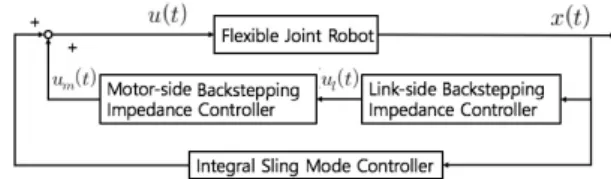
max (24) The overall control scheme is shown in Fig. 1.
By using the proposed controller, the states goes to the sliding surface which has nominal impedance control perfomance even in the case of mismatched disturbances.
Fig. 1 Output Response of FJR with Impedance Controller
Ⅴ. SIMULATION RESULTS
This chapter presents the simulation results. The parameter values used in simulation are shown in Table 1.
Table. 1 Flexible Joint Robot parameter
Quantity Value
Spring stiffness k 100[Nm/rad]
Weight of links m 1[kg]
Inertia I1 1[kgm2]
Inertia I2 1[kgm2]
Link length l 1[m]
Gravity const. g 9.8[m/s2]
Impedance gains are given as follows.
,
The following disturbances are assumed.
sin , sin
and
max
max .
Using the input in (14), the following output responses obtained for the system with and without disturbances respectively.
Fig. 2 shows the outputs of the FJR system for the backstepping impedance control for the case of nominal system and the case of existing disturbance.
In Fig. 2, the blue dotted line is the output response of the impedance control without disturbance and the red line is the case of impedance control with disturbance. it shows that backstepping impedance control performance is affected by disturbances.
Fig. 2 Output Response of FJR with Impedance Controller
Fig. 3 Output Response of FJR with proposed Controller
Fig. 3. shows the output of the FJR controlled by proposed controller in the case of mismatched disturbance.
In Fig. 3, the blue dotted line is the output response of the impedance control without disturbance and the red line is the proposed control with disturbance. it shows that the FJR output controlled by the proposed controller is not affected by mismatched disturbance.
Fig. 4 shows the backstepping impedance control input.
Fig. 4 shows the impedance control input without any chattering shown in the SMC input.
Fig. 4 Impedance Control Input
Fig. 5 Proposed Control Input
Fig. 5 shows the proposed control input signal which shows chattering caused by SMC.
In Fig. 5, the proposed control input has chattering shown in SMC control inputs. From the figures, the robustness of the proposed controller is demonstrated for a bounded mismatched disturbance.
Ⅵ. CONCLUSION
The new robust impedance controller with ISMC and backstepping control scheme is proposed for the
flexible joint robot with mismatched perturbations. The backstepping is introduced to solve mismatched perturbations in the link side. The proposed controller has the performance of nominal impedance control in the case of mismatched disturbances in the link side.
ACKNOWLEDGMENTS
This research is financially supported by Changwon National University in 2015~2016.
REFERENCES
[ 1 ] G. Pratt and M. Williamson, “Series elastic actuators,” in 1995 IEEE/RSJ International Conference on Intelligent Robots and Systems (IROS), vol. 1, pp. 399-406, Aug. 1995.
[ 2 ] M. Zinn, O. Khatib, B. Roth, and J. K. Salisbury, “Playing it safe [human-friendly robots],” Robotics & Automation Magazine, IEEE, vol. 11, no. 2, pp. 12-21, Jun. 2004.
[ 3 ] A. Albu-Schaffer, O. Eiberger, M. Grebenstein, S. Haddadin, C. Ott, T. Wimbock, S. Wolf, and G. Hirzinger, “Soft robotics,” Robotics & Automation Magazine, IEEE, vol. 15, no. 3, pp. 20-30, Sep. 2008.
[ 4 ] S. Ozgoli, H. D. Taghirad, “A Survey on the Control of Flexible Joint Robots,” Asian Journal of Control, vol. 8, no.
4, pp. 332-344, Jul. 2006.
[ 5 ] S. Ulrich, J. Sasiadek, “Extended Kalman Filtering for Flexible Joint Space Robot Control,” 2011 American Control Conference, pp.1021-1016, June 29 - July 01, 2011.
[ 6 ] Y. Choi, K. Yang, W. K. Chung, H. R. Kim, and I. H. Suh,
“On the robustness and performance of disturbance observers for second-order systems,” IEEE Transactions on Automatic Control, vol. 48, no. 2, pp. 315-320, Feb. 2003.
[ 7 ] F. Wang, X. Liu, “Fuzzy H-inf Control of Flexible Joint Robot,” Information Computing and Applications Lecture Notes in Computer Science, vol. 7030, pp. 424-431, Oct.
2011.
[ 8 ] M. J. Kim, W. K. Chung, “Robust Control of Flexible Joint Robots Based On Motor-side Dynamics Reshaping using Disturbance Observer (DOB),” IEEE/RSJ International Conference on Intelligent Robots and Systems, pp. 2381-
2388, 2014.
[ 9 ] J. S. Bang, H. Shim, S. K. Park, J. H. Seo, “Robust tracking and vibration suppression for a two-inertia system by combining backstepping approach with disturbance observer,” IEEE transactions on industrial electronics, vol.
57, no. 9, pp. 3197-3206, Sep. 2010.
[10] R. Lozano, B. Brogliato, “Adaptive Control of Robot Manipulators with Flexible Joints,” IEEE Transactions on Automatic Control, vol. 37, no. 2, pp.174-181, Feb. 1992.
[11] F. Ghorbel, J. Hung, M. Spong, “Adaptive Control of Flexible-Joint Manipulators,” IEEE International Conference on Robotics and Automation, pp. 1188-1193, 1989.
[12] A. Hace, K. Jezernik, and A. Sabanovic, “SMC with disturbance observer for a linear belt drive,” IEEE Transactions on Industrial Electronics, vol. 54, no. 6, pp.
3402-3412, Dec. 2007.
[13] V. Utkin, J. Shi, “Integral sliding mode in systems operating under uncertainty conditions,” Proc. 35th IEEE Conference on Decision Control, Kobe, Japan, pp. 4591-4596, Dec.
1996.
[14] L.E. Jiménezm, A. Loukianov, E.B. Corrochano, “Integral Nested Sliding Mode Control for Robotic Manipulators,”
17th World Congress The International Federation of Automatic Control, Seoul, Korea, July 6-11, pp. 9899-9904, 2008.
[15] M. Rubagotti, F. Castaños, A. Ferrara and L. Fridman,
“Integral Sliding Mode Control for Nonlinear Systems With Matched and Unmatched Perturbations,” IEEE Transactions on Automatic Control, vol. 56, no. 11, pp. 2699-2704, Nov.
2011.
[16] Y. Lin, C. Cheng, “Design of adaptive backstepping tracking controllers for a class of mismatched perturbed chaotic synchronization systems,” SICE Annual Conference, pp.
2549-2544, 2010.
[17] J. H. Oh and J. S. Lee, “Backstepping control design of flexible joint manipulator using only position measurement,”
Proc. IEEE Conference on Decision Control, vol. 1, pp.
931-936, Dec. 1998.
[18] Y. Chang, “A Regressor Free Adaptive Backstepping Design of Flexible Joint Robot Based on Function Approximation Technique,” First International Conference on Robot, Vision and Signal Processing, pp. 3435-3440, Apr. 1997.
[19] J. Oh, J. Lee, “Control of Flexible Joint Robot System by Backstepping Design Approach,” International Conference on Robotics and Automation, pp.131-136, 1997.
[20] P. Tomei, “A Simple PD Controller for Robots with Elastic
Joints,” IEEE Transactions on Automatic Control, vol. 36, no. 10, pp. 1208-1213, Oct. 1991.
[21] A. De Luca, E. Guglielmelli, and P. Dario, “Compliance control for an anthropomorphic robot with elastic joints:
Theory and experiments,” Journal of dynamic systems, measurement, and control, vol. 127, no. 3, pp. 321-328, Jul.
2005.
[22] A. De Luca, B. Siciliano, and L. Zollo, “PD control with on-line gravity compensation for robots with elastic joints:
Theory and experiments,” Automatica, vol. 41, no. 10, pp.
1809-1819, Oct. 2005.
[23] M. J. Kim and W. K. Chung, “Design of nonlinear optimal impedance controllers,” in IEEE/RSJ International Conference on Intelligent Robots and Systems (IROS), pp. 1972-1978, 2013.
[24] A. Kugi, C. Ott, A. Albu-Schaffer, and G. Hirzinger, “On the passivity-based impedance control of flexible joint robots,”
IEEE Transactions on Robotics, vol. 24, no. 2, pp. 416-429, Apr. 2008.
권성하(Sung-Ha Kwon)
Received the B. S., M. S., and Ph. D. degrees in Electrical Engineering from Korea University in 1977, 1981 and 1986, respectively. He was a post doctor of Waseda University, Japan from 1990 to 1991. Since 1985, he is currently a professor in the Department of Control and Instrumentation Engineering at Changwon National University, Changwon, Korea.
※research interests : robust control theory, sliding mode control
박승규(Seung-Kyu Park)
Received the B. S., M. S., and Ph. D. degrees in Electrical Engineering from Korea University in 1984, 1986 and 1990, respectively. He was a visiting professor of Strathclyde University, England from 1995 to 1996. Since 1990, he is currently a professor in the Department of Electrical Engineering at Changwon National University, Changwon, Korea.
※research interests : adaptive control theory, robust control theory and nonlinear control theory
김민찬(Min-Chan Kim)
Received the B. S., M. S., and Ph. D. degrees in Electrical Engineering from Changwon National University in 1996, 1998 and 2003, respectively. From 2006 to 2009, he was a research professor under the Brain Korea 21 Project Corps. He worked with the Human resource development center for Offshore and Plant Engineering(HOPE) at Changwon National University as a research professor from 2009 to 2012. He worked with the Department of Electricity at Gyeongnam Provincial Namhae College from 2012 to 2014. Since 21016, he is currently a visiting professor in the Smart Mechatronics Creative Educational Corp at Changwon National University, Changwon, Korea.
※research interests : H∞ robust control theory, sliding mode control theory, T-S fuzzy control