A Co-expression Network of Drought Stress-related Genes in Chinese Cabbage
Gi-Ho Lee and Young-Doo Park*
Department of Horticultural Biotechnology, Kyung Hee University, Yongin, 17104, Korea
*Corresponding author: [email protected]
Plants have evolved to adapt to abiotic stresses, such as salt, cold, and drought stress. In this study, we conducted an in-depth analysis of drought resistance mechanisms by constructing a gene co-expression network in Chinese cabbage (
Brassica rapa
ssp.pekinensis
L.). This drought stress co-expression network has 1,560 nodes, 4,731 edges, and 79 connected components.Based on genes that showed significant co-expression in the network, drought tolerance was associated with the induction of reactive oxygen species removal by raffinose family oligosaccharides and inositol metabolism. This network could be a useful tool for predicting the functions of genes involved in drought stress resistance in Chinese cabbage.
This work was carried out with the support of
"Cooperative Research Program for Agriculture Science & Technology Development (Project No. PJ01101601)" Rural Development Administration, Republic of Korea.
HORTICULTURAL SCIENCE and TECHNOLOGY 35(2):243-251, 2017
URL: http://www.kjhst.org pISSN : 1226-8763 eISSN : 2465-8588
This is an Open-Access article distributed under the terms of the Creative Commons Attribution NonCommercial License which permits unrestricted non-commercial use, distribution, and reproduction in any medium, provided the original work is properly cited.
Copyrightⓒ2017 Korean Society for Horticultural Science.
OPEN ACCESS Received:
Revised:
Accepted:
November 14. 2016 February 22. 2017 March 2. 2017
Abstract
Additional key words: abiotic stress, microarray, raffinose family oligosaccharides, reactive oxygen species
Introduction
Intermsoffoodsafetyissues
,
droughtisoneofthecriticalmenacestothebiosphere,
owingtoitsimpact onthegrowthandsurvivalofcropplants.
Asthereisalimitedsupplyofwaterworldwide,
manycountries areconcernedbythegrowingdemandforwaterforagriculturalandhumanuse(
SomervilleandBriscoe,
2001).
Manypreviousstudieshaveprovidedconsiderableinformationregardingthemechanismsof droughtresistanceinplants(
Hasegawaetal.,
2000).
Themajoreffectsofdroughtstressthatreducethe yieldofcropsarethereductionofcanopyabsorptionofincidentalphotosyntheticallyactiveradiation,
reductioninradiationuseefficiency,
anddecreaseintheharvestindex(
EarlandDavis,
2003;
Moonetal.,
2017;
Parketal.,
2017).
Whileplantresponsestosingularabioticstressessuchasdrought,
cold,
andsalt,
havebeenextensivelystudied,
thecomplexresponsemechanismstoabioticstresshavereceivedlimited attention.
Thus,
wehaveanincompletepictureofplantresponsestoabioticstressbecauseplantsneedto respondsimultaneouslytomultiplestressesintheenvironment(
Leeetal.,
2016;
Yuetal.,
2016;
Yuand Park,
2016;
Zhouetal.,
2007).
Droughtstressisoneofthemajorfactorsaffectingthegrowth
,
survival,
andultimatelytheyieldof harvestedcrops(
Agarwaletal.,
2006;
Chenetal.,
2002;
Rabbanietal.,
2003).
Recently,
toreducethe damagecausedbydroughtstress,
studiesontheregulationoftranscriptionfactors,
suchasdehydration-
responsiveelementbinding1A
(
DREB1A)
andC-
boxbindingfactor1(
CBF1),
havebeenconducted;
theaimwastoenhance droughtresistanceby understandingand modulatingthe complex changes inthe expressionof downstreamgenesinArabidopsis (
Kasugaetal.,
1999;
Krepsetal.,
2002).
Asecondapproachwastoover-
expressdroughtresistancegenes,
includingcalcium-dependent protein kinase (CDPK), stress-responsive NAC 1 (SNAC1), Arabidopsis Na+/H+ antiporter (AtNHX5),
and ratneuronal NO synthase (nNOS),
toenhancedroughtresistanceinrice(
Krepsetal.,
2002;
Saijoetal.,
2000),
cotton(
Liuetal.,
2014),
papermulberry(Broussonetia papyrifera
L.
Vent;
Lietal.,
2011),
andArabidopsis (
Shietal.,
2014),
respectively.
Inthisstudy
,
weusedtheBrassica
expressedsequencetag(
EST)
andmicroarraydatabase(
RDA,
2008)
toobtainmicroarray datarelatedtodroughtstress,
andconstructedgeneco-
expressionnetworksfordroughtstressresponsesinBrassica
plants throughstatisticalanalysisandvisualizationofthemolecularinteractions.
Materials and Methods
Microarray data collection and construction of a gene co-expression network
Forthisstudy
,
themicroarraydatafordroughtstresstreatmentsofBrassica
plantswereobtainedfromBrEMD (Brassica rapa
EST and microarray database,
http://
www.
brassica-
rapa.
org/
BrEMD;
currently maintained by the national agricultural biotechnologyinformationcenter,
http://
nabic.
rda.
go.
kr).
Thesedatawereoriginallyobtainedfromanexperimentoninbred Chinesecabbage(Brassica rapa
ssp. pekinensis
L.)
growningrowthchambers(
16hday/
8hnightphotoperiod,
40–
70%
relative humanity,
290μmolm−2·
sec−1lightintensity)
forthreeweeks,
afterwhichdroughtstresswasappliedandtotalRNAwasisolated 0.
5,
3,
12,
24,
and48haftertheapplicationofthestress.
Thisexperimentwasconductedwithtwobiologicalreplicates.
Gene expressioninB. rapa
wasthenanalyzedusingaKBGP-
24Kmicroarraychipversion1.
0withtheNimbleGenSystem(
Leeetal.,
2008).
PlantArrayNet
(
GreenGeneBioTechInc.;
http://
bioinfo.
mju.
ac.
kr/
arraynet)
isatoolthatanalyzescorrelationcoefficients(r
values)
betweentheexpressionofdifferentgenesbasedonBrassica
300Kmicroarraydata.
Thistoolwasusedtoanalyzethe interactionsbetweengenesexpressedinB. rapa
inresponsetodroughtstress,
usingastatisticalRiceArrayNetprotocol(
Leeet al.,
2009).
Genesshowingatleasta2-
foldchangeinexpressioncomparedtothecontroltreatment(
0h)
wereidentifiedforall time-
points.
Geneswithcorrelationcoefficientvalueshigherthan0.
85inthePlantArrayNetanalysiswereselectedforthe network.
Theco-
expressionnetworkforgenesrelatedtodroughtstresswasconstructedwiththeCytoscapeprogram(
version 3.
4.
0,
CytoscapeConsortium;
Smootetal.,
2011),
andthestructureofthenetworkwasvisualizedusingaspringembedded layout(
BarnesandHut,
1986).
Analysis of changes in gene expression in
B. rapa
during drought stressThegeneco
-
expressionnetworkwasusedtoanalyzethemajorchangesingeneexpressioncausedbydroughtstressandtheir associated function.
Changes in geneexpressionin the co-
expressionnetwork were ascertained using KEGG(
Kyoto EncyclopediaofGenesandGenomes,
http://
www.
genome.
jp/
kegg)
andTAIR(
TheArabidopsisInformationResource,
http://
www
.
arabidopsis.
org).
DAVID(
TheDatabaseforAnnotation,
VisualizationandIntegratedDiscovery,
http://
david.
abcc.
ncifcrf.
gov)
wasusedforfunctionalannotationofB. rapa
genes(
Huangetal.,
2009;
Kanehisaetal.,
2012).
Basedonthesedata,
gene ontologywasanalyzedandvisualizedusingtheCytoscapeplug-
inprogramClueGO(
Bindeaetal.,
2009).
Results and Discussion
Construction of the drought stress-related gene co-expression network
Ageneco
-
expressionnetworkfordroughtstressresponsegenesinB. rapa
wasconstructedusingtheBrassica
300K microarraydatafromPlantArrayNet,
andmicroarraydatafromacollaborativestudybetweenourresearchteamandtheBrassica
genomicsteamattheNationalInstituteofAgriculturalBiotechnology.
Geneswithexpressioncorrelationvalues higherthan0.
85inresponsetodroughtstresswereselected.
Fromatotalof23,
937probes,
1,
560probesthatshowedsignificant correlationunderthedroughtstressconditionswereselected.
Toanalyzethefunctionsofthesegenes,
thebioinformatics resourceDAVIDwasusedforfunctionalannotationclustering.
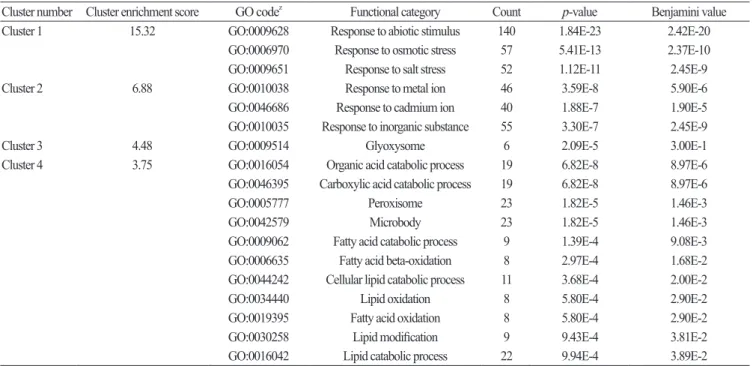
Ofthe176functionalclustersanalyzed,
thefourclusterswith thehighestenrichmentscoreswereselected(
Tables1).
Clusteronehadthehighestenrichmentscoreandcontainedgenes associatedwithabioticstress,
osmoticstress,
andsaltstressresponses.
Theotherclusterscomprisedgenesassociatedwiththe responsetoinorganiccompounds,
carboxylicacidcatabolism,
microbodies,
andperoxisomes.
Theseresultsindicateaclose relationshipbetweendroughtstressandsaltstressresistancemechanisms.
Droughtandsaltstresshavebeenreportedtobe associatedwiththeionicandosmotichomeostasissignalingpathway,
phospholipidsignaling,
photosynthesisrate,
andcell growth(
Chavesetal.,
2009;
Zhu,
2002).
Theseobservationsareconsistentwiththefunctionalannotationofthegenesandgene expressionclustersdiscoveredinourstudy.
Thisindicatesthatthegroupofgenesselectedtoconstructthenetworkwere significantlyassociatedwithdroughtresistance.
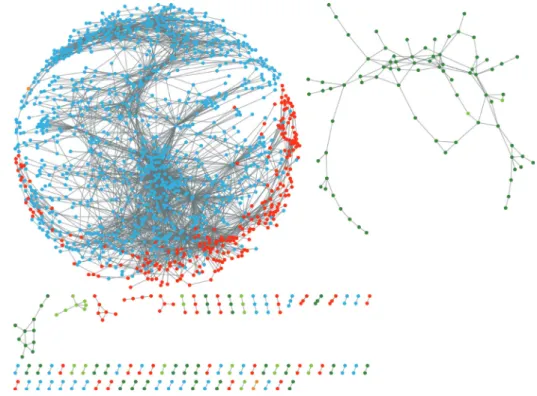
The spring embedded layout in Cytoscape was used to visualize the results of the analysis (Fig. 1). Eachnodeintheco
-
expression networkcorrespondstoagene,
andasignificantcorrelationbetweentheexpressionoftwogenesisrepresentedbyanedge.
Afterconstructingtheco-
expressionnetwork,
multi-
edgenodepairsandself-
loopnodeswereidentifiedandeliminated,
resultinginanetworkwith1,
560nodes,
4,
969edges,
and79connectedcomponents.
Thelargestindependentnetworkamong thesuborder-
connectedcomponentscontained82.
82%
ofallnodes(
1,
292nodes)
and95.
21%
ofalledges(
4,
731edges).
Cluster number Cluster enrichment score GO codez Functional category Count p-value Benjamini value
Cluster 1 15.32 GO:0009628 Response to abiotic stimulus 140 1.84E-23 2.42E-20
GO:0006970 Response to osmotic stress 57 5.41E-13 2.37E-10
GO:0009651 Response to salt stress 52 1.12E-11 2.45E-9
Cluster 2 6.88 GO:0010038 Response to metal ion 46 3.59E-8 5.90E-6
GO:0046686 Response to cadmium ion 40 1.88E-7 1.90E-5
GO:0010035 Response to inorganic substance 55 3.30E-7 2.45E-9
Cluster 3 4.48 GO:0009514 Glyoxysome 6 2.09E-5 3.00E-1
Cluster 4 3.75 GO:0016054 Organic acid catabolic process 19 6.82E-8 8.97E-6
GO:0046395 Carboxylic acid catabolic process 19 6.82E-8 8.97E-6
GO:0005777 Peroxisome 23 1.82E-5 1.46E-3
GO:0042579 Microbody 23 1.82E-5 1.46E-3
GO:0009062 Fatty acid catabolic process 9 1.39E-4 9.08E-3
GO:0006635 Fatty acid beta-oxidation 8 2.97E-4 1.68E-2
GO:0044242 Cellular lipid catabolic process 11 3.68E-4 2.00E-2
GO:0034440 Lipid oxidation 8 5.80E-4 2.90E-2
GO:0019395 Fatty acid oxidation 8 5.80E-4 2.90E-2
GO:0030258 Lipid modification 9 9.43E-4 3.81E-2
GO:0016042 Lipid catabolic process 22 9.94E-4 3.89E-2
z Gene ontology code number
Table 1. Functional annotation clustering of genes related to drought stress in Chinese cabbage.
Analyzing temporal response mechanisms using the drought stress gene expression network
Thegeneco
-
expressionnetworkwasusedtoanalyzetheexpressionpatternsofco-
expressedgenesduringdroughtstress(
dehydration).
Fromthetotalof1,
560genesshowingsignificantcorrelations,
131genes(
8.
40%),
28genes(
1.
80%),
3genes(
0.
19%),
293genes(
18.
78%),
and1,
105genes(
70.
83%)
showedsignificantcorrelationsafter0.
5,
3,
12,
24,
and48hofdrought stress,
respectively(Fig. 1).
Thegenesexpressedafter0
.
5hofdroughtstresswereassociatedwithwater-
solublevitaminmetabolism,
photosynthetic lightharvesting,
andglycerolmetabolism.
Thissuggeststhatwater-
solublevitaminsareassociatedwiththedroughtstress response(
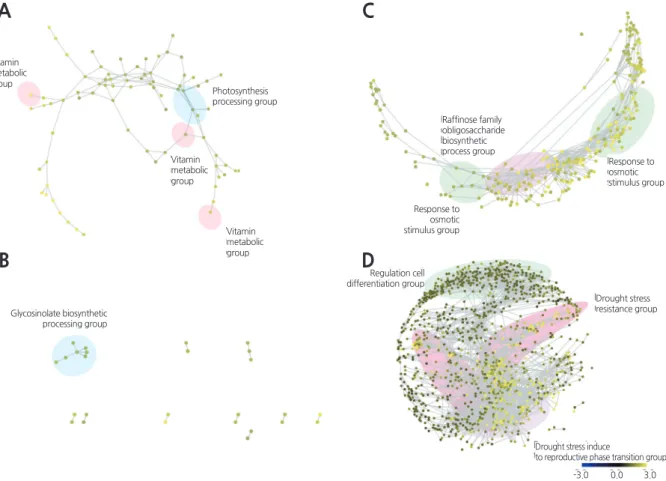
Fig. 2A).
AKEGGpathwayanalysisoftheselectedgenesshowedanassociationwiththecarotenoidpathwayof water-
solublevitaminbiosynthesis.
Continuousdroughtstressleadstodeficienciesinprotein,
phosphorus,
andprovitaminA.
TheexpressionofgenesassociatedwithascorbatebiosynthesissuchasPhosphomannomutase (PMM), ThiaminC (THIC),
andThiamine thiazole synthase (THI1)
were4.
98-,
3.
09-,
and2.
19-
foldhigherthanthecontrol,
respectively.
Previousstudieshave indicatedthatcontinuousabioticstresstriggersoxidativestressandtheformationofreactiveoxygenspecies.
Thisleadstothe productionofnon-
enzymaticantioxidantssuchasvitamins,
glutathione,
andcarotenoidsthatactbyscavengingreactiveoxygen species(
ROS)
bydonationofanelectronorhydrogen(
Asada,
1999;
Jaleeletal.,
2009).
Moreover,
inmammalianresearch,
vitaminAbiosynthesislikelyinvolvesaldehydedehydrogenase(
ALDH),
whichplaysaroleinthedetoxificationofstress-
generatedaldehydes,
andprotectionagainstosmoticimbalance(
Perozichetal.,
1999).
Thus,
carotenoidbiosynthesismayaffect droughttoleranceinB. rapa.
Notably,
Zhanget al. (
2010)
reportedthatdroughtstresscausedareductioninrelativewatercontentFig. 1. Properties and topologies of the co-expression networks of genes related to drought stress in Chinese cabbage (Brassica rapa L. ssp. pekinensis). The data in the co-expression network indicates that the average correlation coefficient (r value) is higher than 0.85. For statistical analysis of the data, RiceArrayNet protocol (Lee et al., 2009) was used. The network is displayed in a Cytoscape spring embedded layout. Nodes represent genes, while edges represent significant co-expression relationships between the genes. Colored dots indicate significantly expressed genes at 0.5 h (131 nodes; green dot ●), 3 h (28 nodes; yellow-green dot ●), 12 h (3 nodes; orange-yellow dot ●), 24 h (293 nodes; red dot ●), and 48 h (1,105 nodes;
turquoise blue dot ●) after dehydration treatment.
(
RWC)
inplantsbypreventingabsorptionofphosphorus(
P)
andnitrogen(
N),
inhibitingphotosynthesisandtranspiration.
Hence,
genechangesrelatedtophotosynthesisinactivationandanincreaseinprovitaminAbiosynthesisthatoccurredafter0.
5 hofdroughtstressmaypromotedroughttolerance.
Manygenesexpressedafter3hofdroughtstresswererelatedtoglycosidebiosynthesis
(
Fig. 2B).
Acorrelationbetween glycosidebiosynthesisanddroughtstresssignalinghasnotbeenreported,
butithasbeenobservedinsomestudiesthatdrought stressleadstoanincreaseintotalphenolicglycosideconcentrations(
Haleetal.,
2005;
Rothetal.,
1997).
Theresultsfromour studyonB. rapa
alsoshowedthattheexpressionofBranched-chain aminotransferase4 (BCTA4), AOP3, Reduced epidermal fluorescence 2 (REF2),
andArabidopsis sulfotransferase 5b (AtSOT18)
were2.
42-
fold,
1.
99-
fold,
1.
82-
fold,
and1.
98-
fold higher,
respectively,
after3hofdroughttreatmentthanthatat0h.
Thegenesexpressedafter12hofdroughtstresswereassociatedwithglycosidebiosynthesis
,
thusexhibitingapatternsimilar tothatobservedat3h.
Therefore,
thegenesrespondingafter12hofdroughtstressdidnothaveasignificanteffectonthe correlationanalysisoftheco-
expressionnetwork.
FunctionalannotationclusteringusingthebioinformaticsresourceDAVID indicatedthatgenesexpressedafter12hofdroughtstresswereclusteredintheRNAbindingandmRNAprocessinggroup.
Morespecifically,
thesegeneswererelatedtoalternativeandpre-
mRNAsplicing.
RNAsarehighlysensitivetoabioticstress,
anddroughtstressaffectsRNAtertiarystructurebyaffectingthebothconcentrationandtypesofionsandosmolytespresentFig. 2. Classification and topologies of co-expression networks of drought stress-related genes in Chinese cabbage. Functional clustering is associated with 0.5 h (A), 3 h (B), 24 h (C), and 48 h (D) after dehydration treatment. Co-expression networks show gene interactions with correlation coefficient values higher than 0.85. The color scale indicates the relative expression on a log2 scale. Yellow indicates higher and blue indicates lower transcript levels than those of the control. Networks are displayed in Cytoscape spring embedded layouts.
A
B
C
D
Vitamin metabolic group
Photosynthesis processing group
Vitamin metabolic group
Vitamin metabolic group
Glycosinolate biosynthetic processing group
Response to osmotic stimulus group
Response to osmotic stimulus group Raffinose family
obligosaccharide biosynthetic process group
Regulation cell differentiation group
Drought stress resistance group
Drought stress induce
to reproductive phase transition group
-3.0 0.0 3.0
(
Chanetal.,
2013;
Reddyetal.,
2013).
ThesechangesinRNAstabilityandstructuremayactivateglycosidebiosynthesisand promoteothermechanismstocounteractabioticstress.
Thegenesthatwereexpressedafter24hofdroughtstresswereassociatedwithosmoticandsaltstressresponses
,
and belongedtothreemajorgroups(Fig. 2C).
Thefirstgroupcontainedgenesinvolvedinraffinosefamilyoligosaccharide(
RFOs)
biosynthesis.
Thisgroupofgenesislinkedtothepositiveregulationofdefenseresponses,
andtheirexpressionindicatesthat genes inB. rapa
involved withthe biosynthesis ofRFOs are associated with droughtresponse.
RFOs are important polysaccharidesforsugarvitrificationinplants.
Vitrificationhasbeenreportedtobeamechanismofcellmembraneprotection asitincreasestolerancetoelevatedtemperaturesandimpedesliposomefusionunderdroughtstress(
Hinchaetal.,
2003;
Valluru andEnde,
2008).
TheexpressionofseveralgenesassociatedwiththebiosynthesisofRFOsincludingRaffinose synthase 5 (RS5), GA insensitive dwarf1b (AtGid1b), Trehalose-6-phosphate phosphatase J (TPPJ),
andTrehalose phosphate synthase (TPS10)
were4.
42-,
2.
37-,
2.
75-,
and2.
42-
foldhigher,
respectively,
thanthecontrol.
Thesecondgroupcontainedgenesassociated withprolinemetabolismandresponsetoosmoticstimulus.
Thisgroupofgenesisassociatedwiththemetabolismofoxygen andreactiveoxygenspecies,
indicatingthatthegenesinvolvedinRFO-
mediatedmembraneprotectioninB. rapa
areultimately linkedtotheROS-
scavengingmechanism.
Thelastgroupofgenesthatrespondedtodroughtstressat24hwereassociatedwith organicacidcatabolism,
porphyrincatabolism,
andleafsenescence,
andshowedanexpressionpatternliketheRFOs-
mediated ROSdetoxificationmechanism.
Finally
,
genesexpressedafter48hofdroughtstresswereassociatedwithtransportandproteintargetingandbelongedto threemajorgroupsincludingthedroughtstress-
mediatedreproductivephasetransitiongroup,
regulationofcelldifferentiation group,
anddroughtstressresistancegroup(Fig. 2D).
Atthistimepoint,
70.
84%
ofallgenesinthenetworkwereexpressed(
1,
105 genes);
thiswasthelargestnumberofsignificantlyexpressedgenesatanytime-
pointintheexperiment.
Genesbelongingtothe firstgroupwereassociatedwiththeresponsetowaterdeprivation,
two-
componentsignaltransductionsystem(
phosphorelay),
andvegetativetoreproductivephasetransition.
Resultsfromthisstudyalsoconfirmedthatabscisicacid(
ABA)
andethylene signalingwereactivatedinB. rapa
after48hofdroughtstress,
andthissignalingledtotheactivationofcarboxylicacid metabolism,
phospholipiddephosphorylation,
andlipidmodification,
aswellasactivationofasignaltransductioncascadeto developsystemicacquiredresistanceviasalicylicacid.
Inresponsetodroughtstress,
anincreaseintheintracellularconcentration ofABAwasobserved.
Thisincreasenegativelyaffectedyieldandcausedadelayinfemaleorgandevelopmentwithoutamajor effectonthemaleinflorescence.
AnincreaseinABAlevelsinreproductiveorgansasaresultofdroughtstressmayinhibitcell division,
therebyimpairingthedevelopmentofflowersandseeds(
Barnabásetal.,
2008;
Yangetal.,
2001).
Theaccumulationof ABAhasbeenshowntoregulateFCS-Like Zinc finger (FLZ)
genesduringthetransitionfromthevegetativetoreproductive phase,
andJamsheerandLaxmi(
2015)
reportedthatABAmediatesgrowthunderdroughtstressconditions.
Theresultsfrom ourstudyonB. rapa
alsoshowedthattheexpressionofProtein arginine methyltransferase 4B (PRMT4B), Vernalization5/Vin3-
like 1 (VEL1), Histone acetyltransferase of the CBP family 1 (HAC1), BCL-2-associated athanogene 6 (BAG6),
andHistone
mono-ubiquitination 1 (HUB1)
were2.
61-,
2.
35-,
2.
48-,
2.
85-,
and2.
13-
foldhigher,
respectively,
after48hofdroughttreatment thanthatat0h.
Moreover,
theABAsignalingwasfurthertransducedtoprovideresistancetodroughtstress;
thisgroupof droughtstress-
relatedgenesiscloselyassociatedwiththebiosynthesisofRFOs.
Thisindicatesthatthesamedroughtstress responsemechanismswereactiveat24hand48h.
Inthisstudy,
theexpressionofRFObiosynthesis-
associatedgenes,
suchasRaffinose synthase 5 (RS5), Trehalose-6-phosphatase synthase S6 (TPS6), Sucrose synthase 3 (SUS3),
andSucrose-6F-
phosphate phosphohydrolase family (
BestArabidopsis thaliana
genematch:
AT2G35840)
were7.
50-,
1.
98-,
25.
77-,
and11.
94-
foldhigher
,
respectively,
at48hthanthatat0h.
Insummary,
accumulationofABAandROSoccurredafter48hofdrought treatment,
followedbyanincreaseinRFOsthatledtoROSscavengingandtheprotectionofthecellmembrane.
Thus,
an increaseinABApromoteddroughtresistanceintheplant.
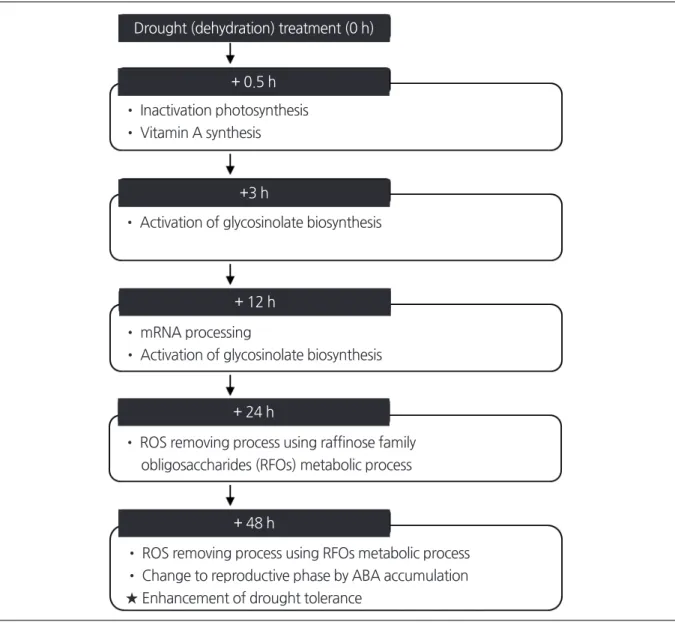
Themajorresponsemechanismsinresponsetodroughtstressin
B. rapa
canbesummarizedasfollows:
after0.
5hofdrought stress,
vitaminAisproducedasaresultoftheinactivationofphotosynthesis.
Thisisfollowedbytheactivationofglycoside biosynthesis,
andanegativeeffectongrowthandphotosynthesisrateat3h.
After12hofdroughtstress,
therearechangesinthe globalRNAtertiarystructurecausedbychangesintheconcentrationofionsandosmolytes.
After24hofdroughtstress,
there isanactivationofROSscavengingbyRFOstoprovidedroughtresistance.
Ifdroughtstresscontinuesfor48h,
theconcentration ofABAandROSincreases,
plantgrowthisinhibited,
femaleorgandevelopmentissuppressed,
transitiontoreproductivephase isaffected,
andyieldisnegativelyaffected.
However,
ABAcanprovidelong-
termdroughtresistancethroughthesynthesisof RFOs(Fig. 3).
Fig. 3. A hypothetical model depicting drought stress-related gene expression at 0.5, 3, 12, 24, and 48 h after dehydration treatment in Chinese cabbage.
Drought (dehydration) treatment (0 h)
+ 0.5 h
+3 h
+ 12 h
+ 24 h
+ 48 h
• Inactivation photosynthesis
• Vitamin A synthesis
• Activation of glycosinolate biosynthesis
• mRNA processing
• Activation of glycosinolate biosynthesis
• ROS removing process using raffinose family obligosaccharides (RFOs) metabolic process
• ROS removing process using RFOs metabolic process
• Change to reproductive phase by ABA accumulation
★ Enhancement of drought tolerance
Literature Cited
Agarwal PK, Agarwal P, Reddy MK, Sopory SK (2006) Role of DREB transcription factors in abiotic and biotic stress tolerance in plants.
Plant Cell Rep 25:1263–1274. doi:10.1007/s00299-006-0204-8
Asada K (1999) The water–water cycle in chloroplasts: scavenging of active oxygens and dissipation of excess photons. Annu Rev Plant Physiol Plant Mol Biol 50:601–639. doi:10.1146/annurev.arplant.50.1.601
Barnab s B, Jä ger K, Feh r A (2008) The effect of drought and heat stress on reproductive processes in cereals. Plant Cell Environ 31:11–38. doi:10.1111/j.1365-3040.2007.01727.x
Barnes Jä, Hut P (1986) A hierarchical O(N log N) force-calculation algorithm. Nature 324:446–449. doi:10.1038/324446a0
Bindea G, Mlecnik B, Hackl H, Charoentong P, Tosolini M, Kirilovsky A, Fridman WH, Pag s F, Trajanoski Z, et al (2009) ClueGO: a Cytoscape plug-in to decipher functionally grouped gene ontology and pathway annotation networks. Bioinformatics 25:1091–
1093. doi:10.1093/bioinformatics/btp101
Chan KX, Wirtz M, Phua SY, Estavillo GM, Pogson BJä (2013) Balancing metabolites in drought: The sulfur assimilation conundrum.
Trends Plant Sci 18:18–29. doi:10.1016/j.tplants.2012.07.005
Chaves MM, Flexas Jä, Pinheiro C (2009) Photosynthesis under drought and salt stress: regulation mechanisms from whole plant to cell. Ann Bot 103:551–560. doi:10.1093/aob/mcn125
Chen W, Provart NJä, Glazebrook Jä, Katagiri F, Chang HS, Eulgem T, Mauch F, Luan S, Zou G, et al (2002) Expression profile matrix of Arabidopsis transcription factor genes implies their putative functions in response to environmental stresses. Plant Cell 14:559–
574. doi:10.1105/tpc.010410.
Earl HJä, Davis RF (2003) Effect of drought stress on leaf and whole canopy radiation use efficiency and yield of maize. Agro J 95:688–
696. doi:10.2134/agronj2003.0688
Hale BK, Herms DA, Hansen RC, Clausen TP, Arnold D (2005) Effects of drought stress and nutrient availability on dry matter allocation, phenolic glycosides, and rapid induced resistance of poplar to two lymantriid defoliators. J Chem Ecol 31:2601–2620.
doi:10.1007/s10886-005-7616-8
Hasegawa PM, Bressan RA, Zhu JäK, Bohnert HJä (2000) Plant cellular and molecular responses to high salinity. Annu Rev Plant Phys 51:463–499. doi:10.1146/annurev.arplant.51.1.463
Hincha DK, Zuther E, Heyer AG (2003) The preservation of liposomes by raffinose family oligosaccharides during drying is mediated by effects on fusion and lipid phase transitions. Biochim Biophys Acta 1612:172–177. doi:10.1016/S0005-2736(03)00116-0 Huang DW, Sherman BT, Lempicki RA (2009) Systematic and integrative analysis of large gene lists using DAVID bioinformatics
resources. Nat Protoc 4:44–57. doi:10.1038/nprot.2008.211
Jäaleel CA, Riadh K, Gopi R, Manivannan P, In s Jä, Al-Jäuburi HJä, Zhao CX, Shao HB, Panneerselvam R (2009) Antioxidant defense response: physiological plasticity in higher plants under abiotic constraints. Acta Physiol Plant 31:427–436.
doi:10.1007/s11738-009-0275-6
Jäamsheer KM, Laxmi A (2015) Expression of Arabidopsis FCS-Like Zinc finger genes is differentially regulated by sugars, cellular energy level, and abiotic stress. Front Plant Sci 6:746. doi:10.3389/fpls.2015.00746
Kanehisa M, Goto S, Sato Y, Furumichi M, Tanabe M (2012) KEGG for integration and interpretation of large-scale molecular data sets. Nucleic Acids Res 40:D109–114. doi:10.1093/nar/gkr988
Kasuga M, Liu Q, Miura S, Yamaguchi-Shinozaki K, Shinozaki K (1999) Improving plant drought, salt, and freezing tolerance by gene transfer of a single stress-inducible transcription factor. Nat Biotechnol 17:287–291. doi:10.1038/7036
Kreps JäA, Wu Y, Chang HS, Zhu T, Wang X, Harper JäF (2002) Transcriptome changes for Arabidopsis in response to salt, osmotic, and cold stress. Plant Physiol 130:2129–2141. doi:10.1104/pp.008532
Lee SC, Lim MH, Kim JäA, Lee SI, Kim JäS, Jäin M, Kwon SJä, Mun JäH, Kim YK, et al (2008) Transcriptome analysis in Brassica rapa under the abiotic stresses using Brassica 24K oligo microarray. Mol Cells 26:595–605
Lee SG, Kim SK, Lee HJä, Choi CS, Park ST (2016) Impacts of climate change on the growth, morphological and physiological responses, and yield of Kimchi cabbage leaves. Hortic Environ Biotechnol 57:470–477. doi:10.1007/s13580-016-1163-9
Lee TH, Kim YK, Pham TT, Song SI, Kim JäK, Kang KY, An G, Jäung KH, Galbraith DW, et al (2009) RiceArrayNet: a database for correlating gene expression from transcriptome profiling, and its application to the analysis of coexpressed genes in rice. Plant Physiol 151:16–33. doi:10.1104/pp.109.139030
Li M, Li Y, Li H, Wu G (2011) Overexpression of AtNHX5 improves tolerance to both salt and drought stress in Broussonetia papyrifera (L.) Vent. Tree Physiol 31:349–357. doi:10.1093/treephys/tpr003
Liu ZW, Shao CR, Zhang CJä, Zhou JäX, Zhang SW, Li L, Chen S, Huang HW, Cai T, et al (2014) The SET domain proteins SUVH2 and SUVH9 are required for Pol V occupancy at RNA-directed DNA methylation loci. PLoS Genet 10:e1003948. doi:10.1371/
journal.pgen.1003948
Moon JäS, Hur YY, Jäung SM, Choi YJä, Nam JäC, Park JäG, Koh SW (2007) Transcript profiling of native Korean grapevine species Vitis flexuosa exposed to dehydration and rehydration treatment. Hortic Environ Biotechnol 58:66–77. doi:10.1007/s13580-017- 0064-x
Park JäS, Yu JäG, Park YD (2007) Characterization of a drought tolerance-related gene of Chinese cabbage in a transgenic tobacco plant.
Hortic Environ Biotechnol 58:48–55. doi:10.1007/s13580-017-0157-6
Perozich Jä, Nicholas H, Lindahl R, Hempel Jä (1999) The big book of aldehyde dehydrogenase sequences. An overview of the extended family. Adv Exp Med Biol 463:1–7. doi:10.1007/978-1-4615-4735-8_1
Rabbani MA, Maruyama K, Abe H, Khan MA, Katsura K, Ito Y, Yoshiwara K, Seki M, Shinozaki K, et al (2003) Monitoring expression profiles of rice genes under cold, drought, and high-salinity stresses and abscisic acid application using cDNA microarray and RNA gel-blot analyses. Plant Physiol 133:1755–1767. doi:10.1104/pp.103.025742
RDA (the rural development administration) (2008) BrEMD: the Brassica rapa EST and microarray database. http://www.brassica- rapa.org/BrEMD
Reddy AS, Marquez Y, Kalyna M, Barta A (2013) Complexity of the alternative splicing landscape in plants. Plant Cell 25:3657–3683.
doi:10.1105/tpc.113.117523
Roth S, MacDonald EP, Lindroth RL (1997) Atmospheric CO2 and soil water availability: consequences for tree-insect interactions. Can J For Res 27:1281–1290. doi:10.1139/cjfr-27-8-1281
Saijo Y, Hata S, Kyozuka Jä, Shimamoto K, Izui K (2000) Over-expression of a single Ca2+-dependent protein kinase confers both cold and salt/drought tolerance on rice plants. Plant J 23:319–327. doi:10.1046/j.1365-313x.2000.00787.x
Shi H, Ye T, Zhu JäK, Chan Z (2014) Constitutive production of nitric oxide leads to enhanced drought stress resistance and extensive transcriptional reprogramming in Arabidopsis. J Exp Bot 65:4119–4131. doi:10.1093/jxb/eru184
Smoot ME, Ono K, Ruscheinski Jä, Wang PL, Ideker T (2011) Cytoscape 2.8: New features for data integration and network visualization. Bioinformatics 27:431–432. doi:10.1093/bioinformatics/btq675
Somerville C, Briscoe Jä (2001) Genetic engineering and water. Science 292:2217. doi:10.1126/science.292.5525.2217
Valluru R, Van den Ende W (2008) Plant fructans in stress environments: emerging concepts and future prospects. J Exp Bot 59:2905–
2916. doi:10.1093/jxb/ern164
Yang Jä, Zhang Jä, Wang Z, Zhu Q, Wang W (2001) Hormonal changes in the grains of rice subjected to water stress during grain filling.
Plant Physiol 127:315–323. doi:10.1104/pp.127.1.315
Yu JäG, Lee GH, Park YD (2016) Characterization of a drought-tolerance gene, BrDSR, in Chinese cabbage. Kor J Hort Sci Technol 34:102–111. doi:10.12972/kjhst.20160011
Yu JäG, Park YD (2015) Isolation and functional identification of a new gene, BrDSR, related to drought tolerance derived from Brassica rapa. Kor J Hort Sci Technol 33:575–584. doi:10.7235/hort.2015.15056
Zhang M, Li G, Huang W, Bi T, Chen G, Tang Z, Su W, Sun W (2010) Proteomic study of Carissa spinarum in response to combined heat and drought stress. Proteomics 10:3117–3129. doi:10.1002/pmic.200900637
Zhou Y, Lam HM, Zhang Jä (2007) Inhibition of photosynthesis and energy dissipation induced by water and high light stresses in rice. J Exp Bot 58:1207–1217. doi:10.1093/jxb/erl291
Zhu JäK (2002) Salt and drought stress signal transduction in plants. Annu Rev Plant Biol 53:247–273. doi:10.1146/annurev.arpla nt.53.091401.143329