INTRODUCTION
Spinal cord disorders involves spasticity, or paresis in the damaged area of spinal cord below it when spinal cord nerve damage or sensory nerve and motor nerve disabilities occur due to a disease or a sudden accident of traffic accidents, sports injuries among others (Le & Price, 1982). In particular, more people with damage to T6 or higher suffer from difficulties in daily life and instrumental activities due to the con- siderable decline of health-related fitness (muscle strength, muscle endurance, flexibility, cardiovascular endurance) as a result of the com- plex issues in the spinal nerves and sensory nerves (Buffart, van den Berg-Emons, van Wijlen-Hempel, Stam, & Roebroeck, 2008). Also, most spinal disordered people perform motions and movement in daily life by relying on a wheelchair due to their lower limb disabilities. Therefore, if muscle strength is lacking among the residual functions of the upper limbs, it can effect musculoskeletal diseases, increases in muscle fatigue, and decreases in movement efficiency (Cruz-Almeida, Martinez-Arizala,
& Widerström-Noga, 2005), and hence, it is necessary to continue the effort to develop and apply exercise programs that allow people with myelopathy to easily perform daily life and instrumental activities. Many
studies on people with spinal cord continuously report that regular exercise for fixed periods aids the improvement of health-related fitness.
In particular, studies applying equipment for improving upper limb func- tions are being additionally carried out, and their methods include the use of elastic bands, and functional electrical stimulus through PNF aquatic isokinetic equipment (Grobelnik & Kralj, 1973).
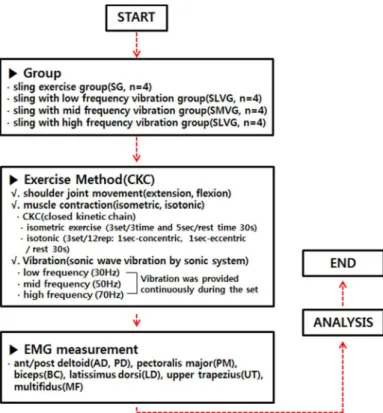
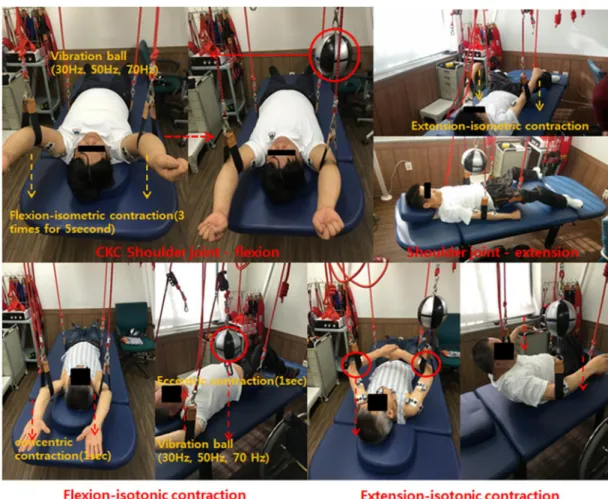
Recent exercise trends have continuously suggested the therapeutic method for improving recovery in terms of active and rehabilitative aspects (Dallmeijer & Van der Woude, 2001), sling exercise therapy and vibration stimulation are attracting attention in these part. Sling exercises can cause static and dynamic muscle contractions and consequently apply neuromuscular stimulus by using suspensions and assistive devices so as to carry out rehabilitation exercises in unstable environments.
Also, vibratory stimulus has the advantage of additionally improving the functions of the neuromuscular system as a mechanism of the tonic vibration reflex by changing the exercise intensity (low intensity, inter- mediate intensity, high intensity) through changes in frequency (Hz), amplitude (mm), and magnitude (Nordlund & Thorstensson, 2007; Oh, Kang, Kwon, & Min, 2015; Oh, Kang, Min, & Kwon, 2015).
However, most of the studies on the whole body vibration situation
KJSB http://e-kjsb.org eISSN 2093-9752 ORIGINAL
The Effect of Sling Exercise Therapy with Vibration Balls on Upper Limb Muscle Activity for Paraplegia-Spinal Cord Injury
Ju Hwan Oh
1, Tae Kyu Kwon
21
Department of Healthcare Engineering, Graduate School of Chonbuk National University, Jeonju, South Korea
2