Herbicidal activity and crop injury of aqueous extracts of sorghum leaves
Ok Jae Won1, Md Romij Uddin1, Jong Yeong Pyon1*
1Department of Agronomy, Chungnam National University, Daejeon305-764, Korea
수수 식물체 추출물의 제초활성 및 작물 선택성
원옥재
1ㆍ로미즈 우딘
1ㆍ변종영
1*
1충남대학교 농업생명과학대학 응용식물학과
Received on 11 April 2011, revised on 2 May 2011, accepted on 20 June 2011
Abstract : Herbicidal effects and crop selectivity of aqueous leaf extracts of sorghum (Sorghum bicolor L.) were evaluated against several weed species for developing sustainable weed management in organic farming. Aqueous sorghum leaf extracts were highly phytotoxic to different weed species. No broadleaf weeds were germinated in the concentration of 5 fold or higher concentrated sorghum leaf extracts and 90% of seed germination was inhibited within that range in grass species. Sorghum leaf extracts strongly inhibited the growth of different weeds by pre-emergence and foliar applications in greenhouse condition. Foliar application of sorghum leaf extracts had a higher inhibitory effect than the pre-emergence application. Broadleaf weed species were more susceptible than grasses to the application of sorghum leaf extract in foliar applications than grasses. Galium spurium, Erigeron candensis, and Rumex japonicus were completely killed at the highest concentrated sorghum leaf extract both in pre-emergence and foliar application. Most broadleaf weed species were inhibited more than 80% at pre-emergence application at 50 fold concentrated sorghum leaf extract. G. spurium, E. candensis, R. japonicus, Eclipta alba, Plantago asiatica and Portulaca oleracea were most susceptible to sorghum leaf extract in foliar application. Growth of most broadleaf weed species was suppressed by greater than 90% at 50 fold concentrated sorghum leaf extract. Most crop species were tolerant to sorghum leaf extract but shoot growth was slightly reduced by the application of 40∼50 fold concentrated extracts. Sorghum leaf extract may used to control weeds in organic farming without affecting the growth of crop.
Key words : Aqueous extracts, Crop selectivity, Herbicidal activity, Organic farming, Sorghum bicolor
*Corresponding author: Tel: +82-42-821-5726 E-mail address: [email protected]
I. Introduction
Weed control by mechanical method is very expensive and is almost out of reach to the resource poor farmers. Chemical control, on the other hand, exhibits residual effects of herbicides in crop produces and leads to environmental pollution. Current agricultural practices involved in weed management rely strongly on the use of synthetic herbicides. Weed management with herbicides, although effective, can be costly and
is increasingly problematic due to public concerns about health and environmental issues (Cheema and Khaliq 2000).
The search for natural weed control methods is emphasized all over the world. Allelopathy has been recognized as natural weed control approach (Hardwood 1979; Rice 1984). Different crops possess allelochemicals, which could be utilized for suppressing weeds (Putnam and Defrank 1979).
Sorghum species are known to us as cover crops and
green manures and also for the production of grain
and molasses. Besides, this crop species has a potential
for allelopathic effect, which was first showed in crops grown in rotation with sorghum (Breazeale 1924) and later confirmed in several studies (Lehle and Putnam 1982; Putnam et al . 1983; Forney et al . 1985;
Einhellig and Rasmussen 1989). The suppressive effects of sorghum on different weed species such as Chenopodium album, Phalaris minor, Cyperus rotundus, Senebiera didyma and Rumex dentatus have been observed (Cheema and Ahmad 1992). Mature sorghum herbage possesses a number of watersoluble all- elochemicals (Putnam and Duke 1974; Cheema 1988).
The use of sorghum water extract (sorgaab) as a foliar weed inhibitor in wheat has been reported (Cheema et al . 1997). Similarly, Iqbal (1997) reported that sorgaab (sorghum shoot extract) reduced weed biomass by 25
∼35% and increased wheat yield by 18.6%. The effects of sorghum allelochemicals are selective, species specific and concentration dependent (Cheema 1988).
Modern agriculture is now challenged to reduce environmental damage and health hazards from che- mical inputs and yet maintain a high level of production. The potential for undesirable environmental contamination from herbicides is relatively high, and there is a need for environmentally safe herbicides that are equally or more effective and selective than currently available synthetic herbicides. Hence, an alternative way is needed to control weeds in crop fields which have no adverse effect on the environment. Sorghum is a potential allelopathic crop, which possesses a number of allelochemicals.
Accordingly, the present study was done to investigate herbicidal effects and crop injury of aqueous extracts of sorghum leaves for developing weed management practices in organic farming.
II. Materials and methods
1. Plant materials and growing condition Sorghum seeds (SS-450) were collected from National
Institute of Animal Science, Sung Hwan, Korea. Seeds were sown in upland field, Experimental Farm of Chungnam National University and allowed to grow for one month.
2. Preparation and extraction of samples
Sorghum leaves were collected from one month old seedlings. The fresh leaves were allowed to dry under shade condition in a vinylhouse for one week. The well dried leaves were brought to the laboratory and chaffed with fodder cutter (2∼3 cm pieces). Chaffed sorghum leaves were soaked in water in the ratio of 1:20 (w/v) for 24 hours at ambient room temperature.
This mixture (leaves + water) was boiled for 3∼4 hours and then water extract was filtered using a coarse mesh to remove the plant residue. The filter extract was evaporated under vacuum for desire concentration of leaf extract.
3. Bioassay of leaf extract of sorghum in a growth chamber
The herbicidal activity of leaf extract of sorghum
was tested on weed species (i.e., Echinochloa crus-galli ;
Digitaria sanguinalis ; Cyperus nipponicus ; Chenopodium
album ; Amaranthus retroflexus ; Plantago asiatica ;
Portulaca oleracea ; Eclipta alba ; Galium spurium ;
Erigeron canadensis ; Polygonum hydropiper ; Rumex
japonicas ) in Petri dishes. Crops (corn, cucumber, red
pepper, tomato, lettuce and perilla) injury of sorghum
leaf extract were investigated in Petri dish culture
system. Fifty seeds of each weed species and 10 seeds
of each crop species were allowed to germinate in
sterile Petri
dishes (100×40 mm) on the surface of sterile Whatman #1 filter paper at concentrations of0, 1, 2.5, 5 and 10 fold concentrated leaf extracts for
2 wk. A 10-ml solution of each concentration was
added to individual Petri dishes. Afterwards, for a 2
wk period, the Petri dishes were placed in a growth
chamber at 25℃ under standard cool-white fluorescent tubes with a flux rate of 550 μmol s
-1m
-2and a 16-h photoperiod. Each treatment was replicated 4 times.
4. Effect of pre-emergence application of sorghum leaf extract on control of weeds and crop injury in greenhouse
The herbicidal efficacy of soil applied aqueous leaf extract of sorghum was evaluated as a pre-emergence compound against several weed species. The concentrated concentrations of sorghum shoot extract was 0, 10, 20, 30, 40 and 50 fold and was applied to different weeds and crop species as pre-emergence applications.
Twelve weed species (i.e., G. spurium; E. candensis ; R. japonicus ; E. alba ; P. asiatica ; P. oleracea ; A.
retroflexus ; C. album ; P. hydropiper ; E. crus-galli ; D. sanguinalis ; C. nipponicus ) and twelve crop species (rice, barley, wheat, corn, soybean, lettuce, tomato, red pepper, radish, perilla, cucumber and Chinese cabbage) were grown in plastic pots (15
×12 cm). Two thirds of the pots were filled with upland cultivated soil, and the pot was seeded with soil. The aqueous leaf extract was applied at concentrations at 0, 10, 20, 30, 40 and 50 fold concentrations using a knapsack CO
2sprayer at a water volume of 1000 L ha
-1. Seedlings were grown in the greenhouse at 25 ± 5℃
for a 5-wk period. Treatments were replicated 4 times and arranged by completely randomized design in the greenhouse. Five weeks after the treatment, the shoot portion of each weed species was collected. The efficacy of sorghum leaf extract was measured from the shoot dry matter content of each weed species.
5. Effect of foliar application of sorghum leaf extract on control of weeds and crop injury in greenhouse
To determine the effect of foliar applied sorghum leaf extract, a post-emergence application test was
performed on the same weeds and crop species used in the pre-emergence assay. Seedlings were grown in the greenhouse as described above for a 3-wk period.
At 21 d after seeding, sorghum leaf extract was applied to the foliage of weed seedlings at 0, 10, 20, 30, 40 and 50 fold concentrations using a knapsack CO
2sprayer at a water volume of 1000 L ha
-1. Three weeks after treatment, the shoot portion of each weed species was collected to determine the biomass.
6. Statistical analysis
Data were analyzed using the SAS Software release 9.2 (SAS Institute Inc., Cary, NC, USA). Means were separated with Tukey’s studentized range test.
III. Results
1. Bioassay of sorghum leaf extract in a growth chamber
Aqueous sorghum leaf extracts were highly phy- totoxic to different weed species. All the applied con- centrations of leaf extract significantly suppressed the germination of all weed species (Table 1). The in- hibition of germination was higher in the broadleaf weed species than in grasses. No broadleaf weeds were germinated following the application of sorghum leaf extract at or above 5 fold concentration and seed germination inhibited by 90% in grass species. The germination was inhibited by 50% in most broadleaf weed species at the original concentration (1 fold).
2. Pre-emergence herbicidal activity under greenhouse condition
After a 5-wk growth period, the presence of leaf
extract resulted in significant reduction in shoot
biomass of weeds. The growth inhibition of R. japonicus
was 92.5% at 30 fold concentration of sorghum leaf
Table 1. Effect of different concentrations of sorghum shoot extract on germination inhibition of weed seeds.
Sorghum leaf extract (fold)a
% inhibition of germination
Ecb Ds Cn Ca Ar Pa Po Ea Gs Ec Ph Rj
1 20.0dc 30.0c 33.3d 40.0c 22.2c 30.0c 50.0c 50.0b 50.0c 30.0c 50.0c 20.0c 2.5 50.0c 60.0b 66.7c 80.0b 77.8b 70.0b 75.0b 100a 83.3b 70.0b 75.0b 60.0b
5 80.0b 90.0a 88.9b 100a 100a 100a 100a 100a 100a 100a 100a 100a
10 100a 100a 100a 100a 100a 100a 100a 100a 100a 100a 100a 100a
atimes concentrated than the original extract concentration.
bEc, Echinochloa crus-galli; Ds, Digitaria sanguinalis; Cn, Cyperus nipponicus Ca, Chenopodium album; Ar, Amaranthus retroflexus;
Pa, Plantago asiatica; Po, Portulaca oleracea; Ea, Eclipta alba; Gs, Galium spurium; Ph, Polygonum hydropiper; Rj, Rumex japonicus.
cMean values indicated by the same letter in a coloum did not differ significantly at the 5% level by Tukey’s studentized range test.
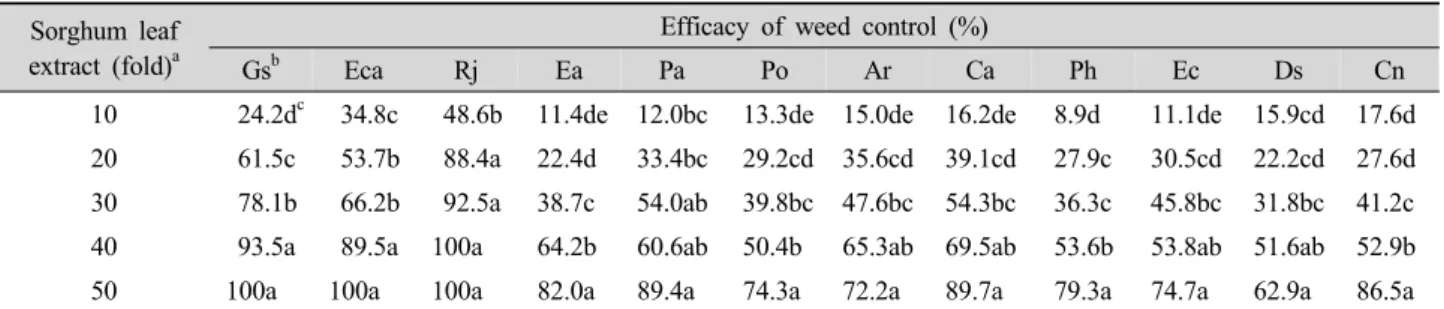
Table 2. Effect of pre-emergence application of sorghum shoot extract on control of weeds by species in greenhouse.
Sorghum leaf extract (fold)a
Efficacy of weed control (%)
Gsb Eca Rj Ea Pa Po Ar Ca Ph Ec Ds Cn
10 24.2dc 34.8c 48.6b 11.4de 12.0bc 13.3de 15.0de 16.2de 8.9d 11.1de 15.9cd 17.6d 20 61.5c 53.7b 88.4a 22.4d 33.4bc 29.2cd 35.6cd 39.1cd 27.9c 30.5cd 22.2cd 27.6d 30 78.1b 66.2b 92.5a 38.7c 54.0ab 39.8bc 47.6bc 54.3bc 36.3c 45.8bc 31.8bc 41.2c 40 93.5a 89.5a 100a 64.2b 60.6ab 50.4b 65.3ab 69.5ab 53.6b 53.8ab 51.6ab 52.9b
50 100a 100a 100a 82.0a 89.4a 74.3a 72.2a 89.7a 79.3a 74.7a 62.9a 86.5a
atimes concentrated than the original extract concentration.
bGs, Galium spurium; Eca, Erigeron candensis; Rj, Rumex japonicus; Ea, Eclipta alba; Pa, Plantago asiatica; Po, Portulaca oleracea;
Ar, Amaranthus retroflexus; Ca, Chenopodium album; Ph, Polygonum hydropiper; Ec, Echinochloa crus-galli; Ds, Digitaria sanguinalis;
Cn, Cyperus nipponicus.
cMean values indicated by the same letter in a coloum did not differ significantly at the 5% level by Tukey’s studentized range test.
extract followed by G . spurium and E . candensis that showed greater than 90% growth inhibition at 30 fold concentration of sorghum leaf extract (Table 2). At the highest sorghum leaf extract (50 fold concentration), R. japonicus, G. spurium and E. candensis were fully suppressed and the other broadleaf weed species was inhibited by more than 80% at pre-emergence appli- cation. E . crus-galli and D . sanguinalis showed 60∼
75% of growth inhibition at 50 fold concentration of sorghum leaf extract.
3. Post-emergence herbicidal activity under greenhouse condition
Aqueous extracts of sorghum applied as foliar spray exhibited significant phytotoxic activity against dif- ferent weed species (Table 3). The foliar application of leaf extract, which was evaluated 21 days after
treatment when seedlings were 6 weeks of age, resulted in significant growth reduction in broadleaf weed species showing greater susceptibility than grass weed species. Foliar application of leaf extract had a greater inhibitory effect on broadleaf weeds than the pre- emergence application. But, the growth inhibition of grass species was slightly less in foliar application.
G. spurium , E. candensis , R. japonicus , E. alba , P.
asiatica and P. oleracea were most susceptible to sorghum leaf extract. Growth of most broadleaf weed species was suppressed by greater than 90% at 50 fold concentration of sorghum leaf extract. G. spurium, E.
candensis and R. japonicus were completely killed at the highest concentration of sorghum leaf extract.
The growth reduction of E. alba, P. asiatica, P.
oleracea , and A . retroflexus were 92.8, 89.6, 86.5 and
84.6%, respectively at 50 fold concentration of
sorghum leaf extract (Table 3).
Table 3. Effect of foliar application of sorghum shoot extract on control of weeds by species in greenhouse.
Sorghum leaf extract (fold)a
Efficacy of weed control (%)
Gsb Eca Rj Ea Pa Po Ar Ca Ph Ec Ds Cn
10 60.5dc 25.6c 25.9e 21.1e 10.0c 10.0e 13.0cd 19.4cd 9.0c 13.9c 13.9d 13.7e 20 73.8c 67.6b 46.8d 40.7d 42.4b 26.2d 30.6bc 27.1c 24.3bc 32.9b 27.0cd 28.9d 30 89.3b 82.5ab 65.0c 54.1c 53.3b 41.4c 44.5b 34.1bc 49.2ab 40.2ab 40.7bc 37.6c 40 100a 90.3ab 87.7b 78.0b 71.0ab 67.6b 68.5a 52.4ab 60.3a 48.1ab 45.4ab 50.8b
50 100a 100a 100a 92.8a 89.6a 86.5a 84.6a 62.4a 65.7a 52.3a 57.7a 59.4a
atimes concentrated than the original extract concentration.
bGs, Galium spurium; Eca, Erigeron candensis; Rj, Rumex japonicus; Ea, Eclipta alba; Pa, Plantago asiatica; Po, Portulaca oleracea;
Ar, Amaranthus retroflexus; Ca, Chenopodium album; Ph, Polygonum hydropiper; Ec, Echinochloa crus-galli; Ds, Digitaria sanguinalis; Cn, Cyperus nipponicus.
cMean values indicated by the same letter in a coloum did not differ significantly at the 5% level by Tukey’s studentized range test.
Table 4. Effect of different concentration of sorghum shoot extract on emergence of crops in growth chamber.
Sorghum leaf extract (fold)a
% emergence
Corn Cucumber Red pepper Tomato lettuce Perilla
0 100.0 100.0 80.0 100.0 80.0 100.0
1 100.0 100.0 70.0 100.0 70.0 100.0
2.5 90.0 95.0 70.0 80.0 60.0 90.0
5 80.0 70.0 60.0 70.0 60.0 90.0
atimes concentrated than the original extract concentration.
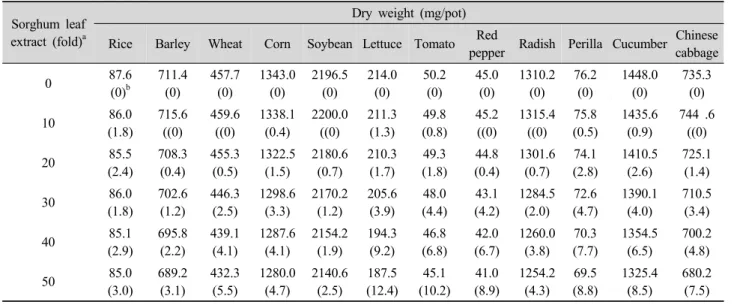
Table 5. Effect of pre-emergence application of sorghum shoot extract on dry weight of crops.
Sorghum leaf extract (fold)a
Dry weight (mg/pot) Rice Barley Wheat Corn Soybean Lettuce Tomato Red
pepper Radish Perilla Cucumber Chinese cabbage
0 87.6
(0)b
711.4 (0)
457.7 (0)
1343.0 (0)
2196.5 (0)
214.0 (0)
50.2 (0)
45.0 (0)
1310.2 (0)
76.2 (0)
1448.0 (0)
735.3 (0)
10 86.0
(1.8)
715.6 ((0)
459.6 ((0)
1338.1 (0.4)
2200.0 ((0)
211.3 (1.3)
49.8 (0.8)
45.2 ((0)
1315.4 ((0)
75.8 (0.5)
1435.6 (0.9)
744 .6 ((0)
20 85.5
(2.4)
708.3 (0.4)
455.3 (0.5)
1322.5 (1.5)
2180.6 (0.7)
210.3 (1.7)
49.3 (1.8)
44.8 (0.4)
1301.6 (0.7)
74.1 (2.8)
1410.5 (2.6)
725.1 (1.4)
30 86.0
(1.8)
702.6 (1.2)
446.3 (2.5)
1298.6 (3.3)
2170.2 (1.2)
205.6 (3.9)
48.0 (4.4)
43.1 (4.2)
1284.5 (2.0)
72.6 (4.7)
1390.1 (4.0)
710.5 (3.4)
40 85.1
(2.9)
695.8 (2.2)
439.1 (4.1)
1287.6 (4.1)
2154.2 (1.9)
194.3 (9.2)
46.8 (6.8)
42.0 (6.7)
1260.0 (3.8)
70.3 (7.7)
1354.5 (6.5)
700.2 (4.8)
50 85.0
(3.0)
689.2 (3.1)
432.3 (5.5)
1280.0 (4.7)
2140.6 (2.5)
187.5 (12.4)
45.1 (10.2)
41.0 (8.9)
1254.2 (4.3)
69.5 (8.8)
1325.4 (8.5)
680.2 (7.5)
atimes concentrated than the original extract concentration.
bValues in parentheses are % growth inhibition.
4. Crop injury of sorghum leaf extract
Most crop seeds germinated with higher percentage at highest concentrated sorghum leaf extract (Table 4). The growth inhibition of crop species as measured by shoot biomass was very low. Most crop species
were tolerant to sorghum leaf extract showing a slight shoot growth reduction at 40∼50 fold concentration.
Among them, lettuce, cucumber and perilla were slight-
ly susceptible to sorghum leaf extract that did not
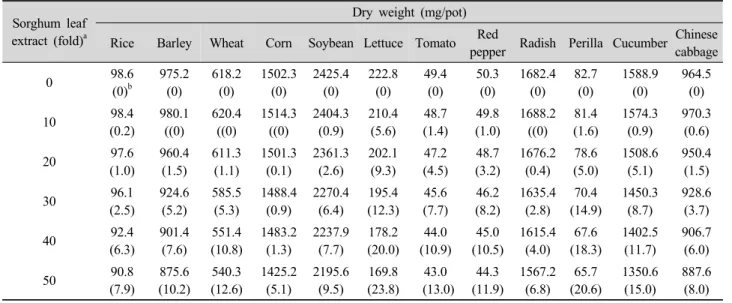
exceed more than 10% (Table 5). Growth inhibition in
crop species was slightly higher at foliar application
Table 6. Effect of foliar application of sorghum shoot extract on dry weight of crops.
Sorghum leaf extract (fold)a
Dry weight (mg/pot) Rice Barley Wheat Corn Soybean Lettuce Tomato Red
pepper Radish Perilla Cucumber Chinese cabbage
0 98.6
(0)b
975.2 (0)
618.2 (0)
1502.3 (0)
2425.4 (0)
222.8 (0)
49.4 (0)
50.3 (0)
1682.4 (0)
82.7 (0)
1588.9 (0)
964.5 (0)
10 98.4
(0.2)
980.1 ((0)
620.4 ((0)
1514.3 ((0)
2404.3 (0.9)
210.4 (5.6)
48.7 (1.4)
49.8 (1.0)
1688.2 ((0)
81.4 (1.6)
1574.3 (0.9)
970.3 (0.6)
20 97.6
(1.0)
960.4 (1.5)
611.3 (1.1)
1501.3 (0.1)
2361.3 (2.6)
202.1 (9.3)
47.2 (4.5)
48.7 (3.2)
1676.2 (0.4)
78.6 (5.0)
1508.6 (5.1)
950.4 (1.5)
30 96.1
(2.5)
924.6 (5.2)
585.5 (5.3)
1488.4 (0.9)
2270.4 (6.4)
195.4 (12.3)
45.6 (7.7)
46.2 (8.2)
1635.4 (2.8)
70.4 (14.9)
1450.3 (8.7)
928.6 (3.7)
40 92.4
(6.3)
901.4 (7.6)
551.4 (10.8)
1483.2 (1.3)
2237.9 (7.7)
178.2 (20.0)
44.0 (10.9)
45.0 (10.5)
1615.4 (4.0)
67.6 (18.3)
1402.5 (11.7)
906.7 (6.0)
50 90.8
(7.9)
875.6 (10.2)
540.3 (12.6)
1425.2 (5.1)
2195.6 (9.5)
169.8 (23.8)
43.0 (13.0)
44.3 (11.9)
1567.2 (6.8)
65.7 (20.6)
1350.6 (15.0)
887.6 (8.0)
atimes concentrated than the original extract concentration.
bValues in parentheses are % growth inhibition.
of sorghum leaf extract than pre-emergence appli- cation. The crop species such as rice, barley, wheat, corn, soybean, tomato, perilla and Chinese cabbage were very tolerant to sorghum leaf extract. Among the crop species studied here, lettuce, perilla and cucumber showed susceptible response in post-emergence appli- cation of sorghum leaf extract showing approximately 10% growth inhibition at 50 fold concentration (Table 6).
IV. Discussion
An increasing number of studies have shown that for managing weeds, allelopathic interactions can be utilized directly or indirectly through the use of allelochemicals as alternatives to herbicides (Dayan et al . 2000; Duke et al . 2002). From our study, significant growth reduction as measured by shoot growth in several broadleaf and grass species was observed after both pre-emergence and post-emergence applications of sorghum leaf extract, with the greatest phyto- toxicity and growth reduction noted for the broadleaf weeds. In particular, R . japonicus , G . spurium , E . candensis , P . asiatica , a nd A . retroflexus were greatly inhibited (Table 3).
Einhellig and Rasmussen (1989) noted that in field grain sorghum residues were located the previous year, the inhibitory effects of grain sorghum were primarily on broadleaf weeds, with little activity observed on grass weeds. Putnam and DeFrank (1983) found that residues of sorghum reduce the number and biomass of common purslane and smooth crabgrass ( D . ischaemum [Schr.] Muhl.) in the fields by 70 and 98%, respectively. All parts of sorghum like roots, herbage and germinating seeds release allelochemicals reducing the growth of grass and broadleaf species such as green foxtail, velvetleaf, and smooth pigweed (Panasiuk et al . 1986, Hoffman et al . 1996). Sorghum residues release sorgoleone, cyanogenic glycosides- dhurrin, and a number of breakdown products of phenolics that bring about weed suppression (Nicollier et al . 1983; Weston et al . 1989).
Foliar application of sorghum leaf extract resulted
in significant growth reduction of weed species in all
the studies. Affected species exhibited severe injuries
in post-emergence application. Burning and growth
inhibition were visually observed immediately after
application in sensitive species, and significant stunting
of growth was also measured by 21 days after treat-
ment. The use of sorgaab as a foliar weed inhibitor has been reported in mung bean (Moosavi et al . 2011), soybean (Khaliq et al . 1999), horse purslane (Randhawa et al . 2002), in wheat (Cheema et al. 1997). The effects of sorghum allelochemicals are selective, species specific and concentration dependent (Cheema 1988).
Most crop species i.e., rice, barley, wheat, corn, soybean, red pepper, radish, tomato, and Chinese cabbage were tolerant to sorghum leaf extract. The growth inhibition was very low in crops; meaning that sorghum leaf extract contained allelopathic compounds and that their phytotoxicity remains lower in crop species.
V. Conclusions
In this study we found that aqueous sorghum leaf extracts were highly phytotoxic to the growth of various weed species. Significant growth reduction in several broadleaf and grass species was determined by both pre-emergence and post-emergence applications of sorghum leaf extract, with the greatest phytotoxicity and growth reduction noted for the broadleaf weeds at 50 fold concentrated concentration of sorghum leaf extract. However, most crop species were tolerant to sorghum leaf extract showing a slight shoot growth reduction at 40-50 fold concentration of sorghum leaves. The strong herbicidal ability of sorghum leaf extract might offer the possibility for effective biorational weed management.
Acknowledgments
This research was financially supported by the research grant (PJ005868 201004) from Rural Deve- lopment Administration in 2010.
References
Breazeale JF. 1924. The injurious after-effects of sorghum. J.
Am. Soc. Agron. 16: 689-700.
Cheema ZA, Khaliq A. 2000. Use of sorghum allelopathic
properties to control weeds in irrigated wheat in semi-arid region of Punjab. Agric. Ecosyst. Environ. 79: 105-112.
Cheema ZA, Ahmad S. 1992. Allelopathy: A potential tool for weed management. Proc. Nat. Sem. Plant Health and Care in Agri. Prod. Dec. 28-29, 1988. Uni. Agri., Faisalabad. pp.
151-156.
Cheema ZA. 1988. Weed control in wheat through sorghum allelochemicals. Ph.D. Thesis, Deptt. Agron., Uni. Agri., Faisalabad, Pakistan.
Cheema ZA, Luqman M, Khaliq A. 1997. Use of allelopathic extracts of sorghum and sunflower herbage for weed control in wheat. J. Animal Plant Sci. 7: 91-93.
Dayan FE, Romagni JG, Duke SO. 2000. Investigating the mode of action of natural phytotoxins. J. Chem. Ecol. 26:
2079-2094.
Duke SO, Dayan FE, Rimando AM, Schrader KK, Aliotta G, Oliva A, Romagni JG. 2002. Chemicals from nature for weed management. Weed Sci. 50: 138-151.
Einhellig FA, Rasmussen JA. 1989. Prior cropping with grain sorghum inhibits weeds. J. Chem. Ecol. 15: 951-960.
Forney DR, Foy CL, Wolf DD. 1985. Weed suppression in no-till alfalfa (Medicago sativa) by prior cropping with summer-annual forage grasses. Weed Sci. 33: 490-497.
Hoffman ML, Weston LA, Snyder C, Regnier EE. 1996.
Allelopathic influence of germinating seeds and seedlings of cover crops on weed species. Weed Sci. 44: 579-584.
Iqbal M. 1997. Response of recent wheat varieties and some rabi weeds to the allelopathic effects of sorghum water extract.
M.Sc. Thesis, Univ. Agri., Faisalabad.
Khaliq A, Cheema ZA, Mukhtar MA, Basra SMA. 1999.
Evaluation of sorghum (Sorghum bicolor) water extract for weed control in soybean. Int. J. Agri. Biol. 1(1/2): 23-26.
Lehle FR, Putnam AR. 1982. Allelopathic potential of sorghum (Sorghum bicolor): isolation of seed germination inhibitors.
J. Chem. Ecol. 9: 1223-1234.
Moosavi A, Tavakkol R, Asadi A, Gharineh MH. 2011.
Allelopathic effects of aqueous extract of leaf stem and root of Sorghum bicolor on seed germination and seedling growth of Vigna radiata L. Not. Sci. Biol. 3(2): 114-118.
Nicollier F, Pope DF, and Thompson AC. 1983. Biological activity of dhurrin and other compounds from johnsongrass (Sorghum halepense). J. Agric. Food Chem. 31: 744-748.
Panasiuk O, Bills DD, Leather GR. 1986. Allelopathic in- fluence of Sorghum bicolor on weeds during germination and early development of seedlings. J. Chem. Ecol. 12: 1533- 1543.
Putnam AR, Duke WA. 1974. Biological suppression of weeds.
Evidenge for allelopathy in accession of cucumber. Sci.
185: 370-372.
Putnam AR, DeFrank J. 1983. Use of phytotoxic plant residues for selective weed control. Crop Prot. 2: 173-181.
Putnam AR, Defrank J, Barnes JP. 1983. Exploitation of allelopathy for weed control in annual and perennial cropping systems. J. Chem. Ecol. 9: 1001-1010.
Putnam AR, Defrank J. 1979. Use of cover crops to inhibit weeds. Proc. IX Int. Cong. Plant Prot. pp. 580-582.
Randhawa MA, Cheema ZA, Ali MA. 2002. Allelopathic effect of sorghum water extract on the germination and seedling growth of Trianthema portulacastrum. Int. J. Agri. Biol.
4(3): 383-384.
Rice EL. 1984. Allelopathy, 2nd edn. Academic Press, Orlando, FL, USA.
Weston LA, Harmon R, Mueller S. 1989. Allelopathic potential of sorghum-sudangrass hybrid (Sudex). J. Chem. Ecol. 15:
1855-1865.