47
<원례보저>
국내 소사육농가의 자가용 가축음용수 오염실태 평가조사
장양호1·이수진1·김효비1·이정학2·이만호2·길혜경2·최농훈1,*
1건국대학교 수의과대학, 2서울시 보건환경연구원 (게재승인: 2011년 1월 6일)
Contamination status of groundwater used as livestock drinking in beef and dairy cattle farms, Korea
Yangho Jang
1, Soojin Lee
1, Hyobi Kim
1, Jeonghak Lee
2, Manho Lee
2, Hyekyoung Gil
2, Nonghoon Choe
1,*
1
College of Veterinary Medicine, Konkuk University, Seoul 143-701, Korea
2
Seoul Research Institute of Public Health and Environment, Seoul 137-734, Korea
(Accepted: January 06, 2011)
Abstract : In Korea, groundwater is main water source in livestock farms. Most dairy and cattle farms have constructed their own wells for human drinking and livestock farming. However, these private residential wells have not been controlled by government and also there was scant study about livestock drinking water quality. Therefore this study was to monitor of the livestock farms' groundwater quality in Korea. Water samples were collected at 123 dairy and cattle farms and were analysed forty six substances with quality standard for drinking water approved by the Minister of Environment. Seventy eight (63.4%) of 123 samples failed to drinking water stand a test. The most frequent contaminants were nitrate-nitrogen and microbial. 22.8% (n = 28) of samples showed nitrate-N concentration of higher than 10 mg/L meant that can’t be used drinking water for human and the Nitrate-N concentration analysed in the range of 0.2 to 61.2 mg/L. All of 78 failed to drinking samples had microbial problems, especially 5.7% (n = 7) of samples indicated water could be contaminated by feces. Other contaminants detected were zinc and evaporation residue. Especially detected zinc concentration (32 mg/L) was about ten times higher than standard of zinc (3 mg/L). Regression analysis indicated that groundwater pH did not influence to nitrate- N concentration but the hardness and chloride could affect to nitrate-N concentration in the groundwater.
Most livestock farms were adjacent to crop farmland in Korea. This could cause contamination of groundwater with nitrate-N and pesticide that could accumulate livestock product. Moreover Heavy metal such as zinc and copper could be released from a corrosive plated water pipe in livestock farm. Put together, Korea livestock system is indoor, not pasture-based, hence livestock could be exposed to potential contaminated water consistently. Therefore on the basis of these data, appropriate livestock drinking water quality standards should be prepared to keep livestock healthy and their product safe. Further, livestock drinking water quality should be monitored continuously in suitable livestock drinking water standards.
Keywords : groundwater contamination, livestock drinking water quality, microbial contamination, NO
3-N
서 론
우리나라의소사양체계는대부분축사사육을하고 있으며가축의음용수는일반적으로농장에서자체개 발한지하수를이용하고있다
.
그러나국내축산농가의자가용지하수수질은수질측정망부족및측정시설의 부재로전국적인오염실태의파악이곤란한상황이다
[2].
지하수를오염시키는원인물질로는산업·
농업폐기물
(
살충제와제초제등)
과가축사육농가에서발생하 는폐기물(
가축분뇨)
등이있다.
가축의배설물은미생*Corresponding author
Tel: +82-2-450-3709, Fax: +82-2-454-3709 E-mail: [email protected]
물학적오염의원인으로작용하며
,
분뇨의단백질성분 이물에가수분해되면암모니아성질소가생성되며이 것이아질산성질소(nitrite-N),
질산성질소(nitrate-N)
로순차적으로변하게된다
.
이와함께농업에사용한질소비 료에의해생성된질산성질소가약80%
지하수오염의원인이되고있다
[17].
이외에일부살충제와제초제들도지하수로유입될수있는데그성상에따라물을섭 취하는동물의지방과근육조직에축적되어전체적인
food chain
을오염시킬수있다[15, 24, 25, 28].
현재까지오염된물을지속적으로섭취하는가축의경우
,
그 생산물에어떠한영향을미치는지는밝혀진바가없으 나가축의사료와사람이섭취하는조리된음식에서유기염소제등의살충제검출이꾸준히보고되고있다
[11,
15, 20, 21, 24, 27].
이와같은이유로우리나라에서도식육과그부산물에서농약의잔류기준을 법적으로정
해놓고있다
[3].
가축음용수의질에대한연구들은주로음용수의화 학적조건들이가축의생산성에미치는영향에초점이 맞춰졌으며
[7, 9, 22, 23],
가축의 건강과안전한축산 물생산을위한가축음용수질기준에관한연구들은거 의수행되지않았고,
가축음용수기준이법적으로고시되어 있는 나라도 없다
.
다만,
미국의 경우2001
년National Research Council
에서발간한자료에가축음용수에대한전반적인기준을정한바있는데염도
,
경도,
질산성질소
,
황산이온, pH,
각종미량원소(
알루미늄,
비 소,
붕소,
카드뮴,
코발트,
구리,
불소,
납,
망간,
수은,
니켈
,
셀레늄,
크롬,
바나듐),
총대장균군에대한기준을권 고사항으로정해놓고있다[5, 26].
그러나우리나라에 는권고사항으로고시된가축음용수기준이없으며사 적으로개발한지하수에대한정부차원의수질검사가 실시된적이없고수질관리도미약하기때문에가축음 용수의안전을보장할수없는실정이다.
국내의가축사육농가들은과수원이나논
·
밭과같은 경작지와인접해있는경우가많고,
중금속으로도금된낡은급수파이프를그대로사용하는농가도많다
.
이와함께자연방목을하는외국과달리대부분의국내가축 사육농가는축사사육을하고있는데이러한사육형태 는검증되지않은물을지속적으로섭취하게되어잠재 적인위험인자로작용할수있다
.
그러므로가축의건 강유지와 나아가안전한축산물의생산을 위해서국 내실정에 적용할수있는가축음용수 기준의 제정이 절실하다.
본연구는경상남도를제외한전국
123
곳소사육농가를대상으로가축음용수를채수하여환경부령제
377
조먹는물수질기준및검사등에관한규칙에따라총
46
항목에대한분석을실시하여가축음용수의오염실태를파악해보고자하였다
.
재료 및 방법
채수지역
,
방법및기간경상남도와제주도를제외한전국의
7
개도에서123
곳 의소사육농가(Table 1)
에서가축음용수로자체개발한지하수를
4 L
멸균채수통에채수하여4
oC
를유지한상태로운송하였다
.
지하수의채취는2008~2009
년7~8
월 사이,
우천시일주일후채수를기준으로시행하였다.
분석방법및항목
물의분석은먹는물공정시험기준
(2008
년)
과수질오염 공정시험기준(
환경부고시 제2008-99
호)
에따라분석하였으며분석항목및방법은
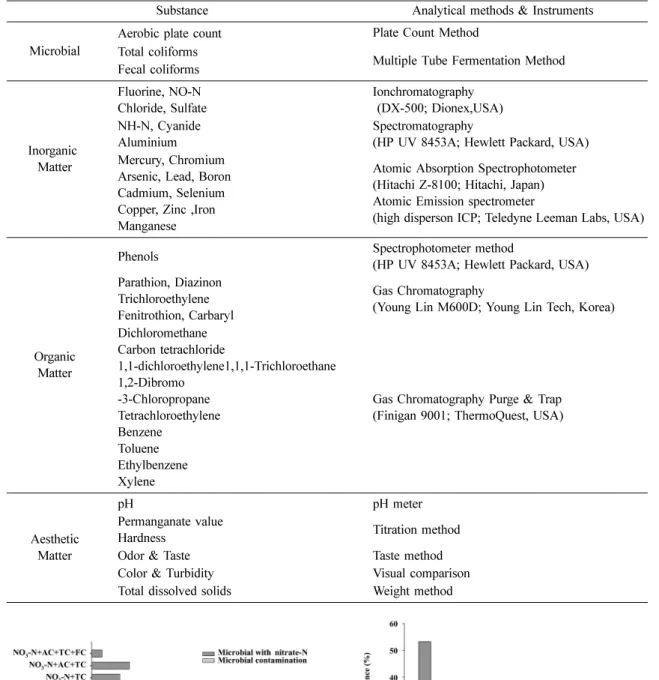
Table 2
와같다.
결 과
총
123
개의시료를먹는물기준으로검사한결과78
개
(
약63.4%)
의시료가부적합판정을받았다.
부적합시료의항목별결과를보면크게질산성질소와미생물
의오염으로나눌수있었다
(Fig. 1).
가장높은빈도를보인부적합항목은일반세균과총 대장균군이함께초과된경우로
78
개시료중16
개가 해당되었다.
질산성질소와 미생물학적오염을함께보인시료는
16
개였으며,
이중분변에오염을시사하는 분원성세균이검출된시료는1
건이었으며,
질산성질소 초과검출없이분원성세균이검출된시료는4
건으로총
5
건의 시료는분변에의해지하수가오염되었음을 확인할수있었다.
총대장균군과분원성세균의검사는시험관내
Durham
시험관이들어있는시험관에기체발생이관찰되었을때확정시험을실시하여최종판단하였 으며
,
미생물의종류를확인하는세부적인실험은진행 하지않았다.
이외에기준치이상으로검출된항목은아Table 1. Sampling regions and each sample number
Location Year
2008 2009
Gyeonggi 10 13
Gangwon 2 5
Chungbuk 2 34
Chungnam 13 1
Jeonbuk 0 1
Jeonnam 0 16
Gyeongbuk 15 11
Total No. of Samples 42 81
Table 2. Analytical methods and instruments for each item
Substance Analytical methods & Instruments
Microbial Aerobic plate count Plate Count Method
Total coliforms Multiple Tube Fermentation Method
Fecal coliforms
Inorganic Matter
Fluorine, NO-N
Chloride, Sulfate Ionchromatography
(DX-500; Dionex,USA) NH-N, Cyanide
Aluminium Spectromatography
(HP UV 8453A; Hewlett Packard, USA) Mercury, Chromium
Arsenic, Lead, Boron Cadmium, Selenium Copper, Zinc ,Iron Manganese
Atomic Absorption Spectrophotometer (Hitachi Z-8100; Hitachi, Japan) Atomic Emission spectrometer
(high disperson ICP; Teledyne Leeman Labs, USA)
Organic Matter
Phenols Spectrophotometer method
(HP UV 8453A; Hewlett Packard, USA) Parathion, Diazinon
Trichloroethylene Fenitrothion, Carbaryl
Gas Chromatography
(Young Lin M600D; Young Lin Tech, Korea) Dichloromethane
Carbon tetrachloride
1,1-dichloroethylene1,1,1-Trichloroethane 1,2-Dibromo
-3-Chloropropane Tetrachloroethylene Benzene
Toluene Ethylbenzene Xylene
Gas Chromatography Purge & Trap (Finigan 9001; ThermoQuest, USA)
Aesthetic Matter
pH pH meter
Permanganate value
Hardness Titration method
Odor & Taste Taste method
Color & Turbidity Visual comparison
Total dissolved solids Weight method
Fig. 1. Histogram of each violations occurrence. AC: Aerobic
plate count, TC: Total coliforms, FC: Fecal coliforms. Fig. 2. Frequency distribution of nitrate-N content in
groundwater samples.
연과증발잔류물이었다
.
증발잔류물의경우3
개의샘플에서기준치
500 mg/L
를초과하였으며그수치는각각555 mg/L, 730 mg/L, 671 mg/L
였다.
특히아연이검출된한개의샘플에서는아연의농도가기준치인
3 mg/L
보다약
10
배이상높은32 mg/L
를보였다.
질산성 질소범위
0~10 mg/L
사이에123
개샘플중95
개가해당되었으며10~20 mg/L
범위에는17
개의농 장이포함되어생활용수기준을적용했을경우약91%
의농장지하수가용도에적합하였고먹는물기준적용 시에는
28
개농장의지하수가질산성질소초과로인해 부적합한것으로분류되었다(Fig. 2).
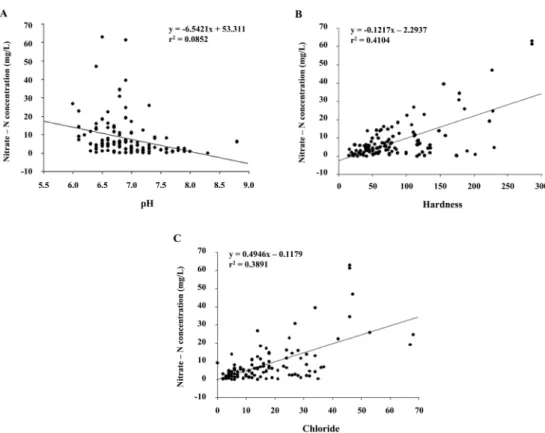
시료의
pH
와경도에따른질산성질소의 농도를살펴본결과지하수의
pH
와질산성질소의농도는연관 성이없었으나물의경도는높을수록질산성질소의농 도도높게나타났으며염소이온은농도도질산성질소 의농도와미약한 상관관계가있는 것으로나타났다(Fig. 3).
고 찰
본조사연구는가축음용수의기준이없는우리나라에
서자가용가축음용수의오염현황을파악해보기위해 가축사육단계
HACCP
지정을준비중인농가의지하수 를대상으로실시되었다.
우리나라에는 가축의음용수에대한수질기준이없고실제로농가에서자체개발 한지하수를식수로사용하는곳도있기때문에먹는물 수질기준및검사등에관한규칙에따라
46
개항목을검사하였다
.
먹는물수질의지표미생물결과를보면분원의오염 가능성을시사하는분원성대장균군이검출된시료는
전체시료의약
5.7%
를차지하였고,
총대장균군이검출되어사람이먹는물로는부적합판정을받은시료가총
44
개로약35.8%
를차지하였다.
분원성대장균군과는달리총대장균군은물이분원에오염되었음을나타내는 지표는아니나오랫동안먹는물수질의기준으로이용 되어왔으며
,
총대장균군의검출은물의오염또는영양소초과등으로설명된다
[12].
그러나최근의연구들에따르면물에서총대장균군과분원성대장균과같은지표 세균군의 검출은
Salmonella, Shigella, Vibrio, Clostri- dium, Legionella, Campylobacter, Aeromonas, Goardia, Cryptosporidium
등과같이사람과동물에게질병을일 으킬수있는병원성미생물이물에오염되어있을수Fig. 3. Relationships of nitrate-N concentration with pH (A), hardness (B) and chloride (C) in groundwater.
있음을의미한다고한다
[12, 13].
미생물학적오염이외에질산성질소단일항목에의
한부적합이전체시료의
12.2%
를차지하였고,
미생물오염과함께질산성질소가부적합검출된시료는전체
의
22.8%
를차지하였다.
지하수의질산성질소농도에영향을주는인자로관정의깊이
, pH,
질소비료를사용하는작물재배여부
,
가축사육여부등을들수있다.
이 들인자와지하수내질산성질소의농도간의상관관계 를분석한연구들에따르면작물의종류,
관정의깊이,
물의
pH,
전기전도도(EC)
는질산성질소농도와통계학적으로유의한상관관계가있다고한다
[10, 16, 19].
본연구에서물의
pH,
경도와질산성질소 농도간의회귀분석결과
,
경도가높을수록질산성질소의농도도높게 나타나는것으로나타났다.
이는지하수의화학적성상에따라질산성질소의용해도가달라짐을의미하며지 역적지질분포의차이에따라지하수오염의원인이나
실태가다를수있음을나타낸다
.
질산염(nitrate)
은그자체만으로는독성이크지않지만소등의초식동물은 사료로부터질산염을 섭취하는 비중이높기때문에
National Research Council
에서1974
년발간된자료를보면가축음용수에서질산성질소의안전한기준을
10
mg/L
이하로정해놓고있다[5, 9, 26]. NRC
자료에따르면질산성질소수치가
10~20 mg/L
이면질산염이적은사료와함께섭취시안전하며
20~40 mg/L
이면장기간음용 시위해할수있다고명시하고있다
. 40~100
mg/L
에서는동물이위험할수있으며죽을수도있다고한다
[5, 14, 16].
실제로아질산염중독은질산염을통해단백질을합성해내는소와같은반추수보다사람 과어린가축에있어심각한문제를일으킨다
.
아질산염은혈관으로들어가서헤모글로빈
(hemoglobin)
과작용하여
methemoglobin
을형성한다. Methemoglobin
은조직으로의산소운반을저지하게되며호흡곤란을일으키
게된다
[10, 16].
또한질산성질소에의한만성적인영향에관한역학적연구의결과에따르면질산성질소를 장기간음용했을때갑상선의비대부터
15
가지종류의암이발생할수있으며선천성기형도유발할수있다 고보고하였다
[6].
또한Payne [19]
의연구에따르면오염된물을통한질산염의섭취가증가하면위암의발생 률도증가한다고한다
.
그외에아연의농도가기준치인
3 mg/L
보다약10.7
배높은수치인
32 mg/L
로나타났다.
아연은필수미량원소로최근에들어
DNA, RNA,
단백질생성에관여하고면역력에도영향을미치는등그기능의범위가넓 어독성보다는섭취결핍에초점이맞춰져있다
.
그러나 물에서기준치이상의아연이검출되는것은아연으로 도금된파이프및아연이포함된배관재의부식에의하여오염되었을가능성이있고고농도의아연은만성중 독을일으킬수있다
.
동물에있어서아연이많이포함된경우물은불쾌한맛을유발하여물섭취량이저하 를유발하며이로인해생산성에영향을미칠수있다
.
이뿐만아니라대부분의가축의경우하루에
2,000 ppm
이상의아연을섭취할경우만성아연중독을일으킬수
있다고한다
[17, 18].
우유생산량이 일일평균35 kg
인체중
650 kg
젖소인경우약101.83 kg
의물을자유음용하게되는데
[1, 8],
이경우매일3,200 ppm
이상의아연을섭취하게되므로만성중독을일으킬수있다
.
섭취 된아연은근육에잔류될수있으며이를섭취한사람에게도영향을미칠수있다
[4, 28].
그러나우리나라뿐아니라세계적으로도축산물에서납
,
카드뮴을제외 한다른중금속에대한잔류기준은정해진바가없어무방비상태로노출되고있다
[3].
그러므로보다광범위한역학조사연구가수행될필요성이있을것으로판단 된다
.
본조사에서는다행히 다이아지논
,
파리티온등과같 은유기인제농약과휘발성오염물질과같은벤젠,
톨루 엔,
크실렌등은검출되지않았다.
그러나채수기간과계절적인특성등을감안한다면인위적오염원에의한오 염도발생할가능성이있을것으로추정된다
.
본연구는사육단계
HACCP
지정을준비하는농가에서가축음용수로사용하는자체개발지하수를대상으 로하였다
.
자가용지하수를개발하여급수용으로사용 하는축산농가의경우, HACCP
을준비하거나그렇게않은농가들에있어서의차이점이없어본연구결과가국 내소사육농가에서사용하는자가용지하수질을가늠하 는척도로써대표성을가질수있을것으로생각된다
.
현재사육단계
HACCP
지정을위해서는환경부령제362
호지하수수질보전등에관한규칙의생활용수기준중
15
개항목(
벤젠,
톨루엔,
에틸벤젠,
크실렌제외)
을만족시키면되지만
,
가축음용수기준이없기때문에 부적합의결과가나와도적절한제재나개선조치가없 는실정이다.
HACCP
의궁극적인목적은사람이축산물을소비하는데있어각종의위해요소로부터안전해야한다는것 이다
.
그러므로그축산물의오염을검사하는데앞서생산단계에서의감시가필요하다
.
미국,
일본,
유럽연합 등어느곳에도법적으로정해진가축음용수기준은없다
.
그러나미국의경우cattle, dairy cow, poultry
등으로축종을나누고가축음용수에대해염도
,
경도,
질산성질소
,
황산이온, pH,
각종미량원소,
총대장균군에대한기준을권고사항으로두고있으며대학을중심으로가축 음용수오염에대한조사연구결과가지속적으로발표 되고있다
.
우리나라의가축사육농가는대부분과수원과경작지 인근에위치하고있어퇴비로사용된가축분뇨및제초 제
,
살충제등과같은오염원에지속적으로노출되어있다
.
이뿐만아니라오래되어부식된중금속도금의급수 배관을사용하고있는농가도많다.
이러한환경적요인과함께축사사육방식으로지속적으로오염된물을섭 취할가능성으로높으며
,
일부오염원의경우,
축산물에 축적될수도있으므로철저한감시가필요하다.
따라서이와같은국내가축사육농가의실정을반영하고
,
안전 한축산식품을생산하기위한최소한의가축음용수기 준을정립하고이를토대로한지속적인가축음용수질 의감시가필요할것으로사려된다.
결 론
본연구는소사육농가에서자체개발하여가축음용수 로쓰고있는지하수의오염실태를파악하여가축음용 수의기준을정립하기위한기초자료조사로써경상남 도와제주도를제외한소사육농가
123
곳을대상으로하 여환경부령제377
조먹는물수질기준및검사등에관한 규칙에 따라
46
개항목을 검사하였다.
검사결과63.4%(n = 78)
의지하수가먹는물기준에미달하였고그원인물질은질산성질소와미생물학적오염
,
아연,
증발잔류물등이었다
.
질산성질소의경우10 mg/L
를초과한 경우음용수로부적합판정을받게되는데123
개시료중28
개가해당되었다.
음용수로부적합판정을받은시료78
개모두는일반세균,
총대장균,
분원성세균에오염된시료들로써특히
7
개의시료는분원성세균이검출되어 분변에의한오염이있음을알수있었다.
그외에한시료에서축산물에축적될수있는아연이기준치
3 mg/L
의약
10
배이상인32 mg/L
가검출되었으며이는아연으로도금된배수관의부식으로인한것으로판단된다
.
대부분의소사육농가가경작지에인접해있기때문에질 산성질소가기준치초과검출된시료의경우
,
경작지와소사육농가지하수오염간의상관관계를밝히는추가적 인연구가필요하며오래된급수배관을사용하는농장 의경우축산물로의축적을배제할수없으므로지속적 인감시가요구된다
.
위의결과를통해추정하건데가축의건강및가축생산물의안전성확보를위해축종별 적합한음용수기준설정이필요하며이를통한지속적 인가축음용수질관리가필요할것으로판단된다
.
감사의 글
이논문은
2010
년건국대학교학술진흥연구비지원에의한논문임
.
참고문헌
1.
농림부,
농촌진흥청축산기술연구소.
한국사양표준(
젖 소). pp. 115~121,
농촌진흥청축산기술연구소,
수원, 2002.
2.
방상원,
정재현.
우리나라와선진국간의지하수수질기준에관한고찰
.
환경정책연구2005, 4 , 57-82.
3.
식품의약품안전청.
식품공전. pp.
별표6, 6-1~6-11,
식품의약품안전청