ISSR 표지를 이용한 국내 재배 대추나무의 유전특성 분석
남재익 ⋅이 욱⋅김세현* 국립산림과학원 산림소득자원연구과
Analysis of Genetic Characteristic of Jujube (Ziziphus jujuba Mill.) Cultivated in Korea Revealed by ISSR Markers
Jae-Ik Nam , Uk Lee and Sea-Hyun Kim*
Division of Forest Special Products, National Institute of Forest Science, Suwon 16631, Korea
요 약: 대추나무는 갈매나무과에 속하며 과실에 높은 영양가를 지니고 있어 전통 한의학에서 널리 사용되고 있는 경제적
으로 중요한 종이다. 국내에서 재배되고 있는 대추나무들의 품종실태를 파악함으로서 우량개체 선발과 육종계획 수립에 유용한 유전정보를 얻고자 보은, 경산 등 대추 주산지 6곳에서 수집된 대추나무 270개체를 대상으로 ISSR 표지 분석을 수행하였다. 그 결과 유전적 다양성을 보여주는 S.I.값은 0.107, 유전적 유사도는 0.935로 높게 나타나 연구에 사용된 대 추나무들이 특정 품종 또는 개체에 편중되어 있었다. 또한 270개체 중 67%인 180개체가 ‘복조’와 동일한 유전자형을 나 타내는 것으로 관찰되었다. 본 연구를 통해 국내 재배 대추나무 개체들의 유전적 다양성이 매우 낮은 것으로 파악되었다.
이에 외부 교란에 취약할 가능성이 큰 것으로 예상되며, 시장에 판매되고 있는 대부분의 대추가 단위결실을 통해 생산되 는 것으로 판단된다.
Abstract: Chinese jujube (Ziziphus jujuba Mill.), a member of family Rhamnaceae, is an economically important species. It has high nutritional value in fruits, and its medicinal properties have led to extensive use in traditional oriental medicine. In this study, we investigated the genetic characteristics of 270 jujube germplasms collected from the six major jujube fruit production areas in Korea including Boeun and Gyeongsan, in order to understand the current situation on cultivated varieties of domestic jujube and to obtain useful data for selection of superior germplasms and establishing their breeding plans. The results of ISSR marker analysis revealed that the Shannon's information index of the 270 germplasms was 0.107 and the genetic similarity was as high as 0.935 showing the dominance of a specific cultivar or germplasm, and almost 67% (180) of them were identified at the same genotype with ‘Bokjo’. The domestic commercial jujube populations could be characterized by very low genetic diversity and thus may be vulnerable to external disturbances. In addition, it seems that most of the jujube fruits in domestic market were largely produced through parthenocarpy.
Key words: Ziziphus jujuba, jujube tree, genetic characteristics, genetic similarity, genetic erosion
서 론
1)
대추나무(Ziziphus jujuba Mill.)는 갈매나무과(Rhamnaceae) 대추나무속(genus Ziziphus)에 속하며, 속내 대부분의 식 물들이 경제적 이용가치가 낮은 것과는 다르게 식량, 연 료, 밀원 등으로 활용할 수 있어 유럽, 아시아 등 넓은 지
* Corresponding author E-mail: [email protected] ORCID
Jae-Ik Nam https://orcid.org/0000-0002-9800-563X
역에서 재배되고 있다(Liu and Cheng, 1995; Azam-Ali et al., 2006). 자생지인 중국의 운남성 남부와 광서구 남동 지역을 중심으로 매년 425만t 이상의 대추가 생산되고 있으며(Hager and Edward, 1989; Han, 2014), 국내에서는 경상남북도와 충청북도에서 연간 1만t 이상이 생산되고 있다(KFS, 2017).
대추는 면역력 증가, 간 기능 회복, 항암, 항산화작용 등에 효과를 인정받아 오래전부터 이용되어 왔으며(Huang et al., 2007; Plastina et al., 2012; Chi et al., 2015) 비타민 A, B1, B2, C, P가 많이 함유되어 있어 다이어트 식품으
JOURNAL OFKOREANSOCIETY OFFORESTSCIENCE ISSN 2586-6613(Print), ISSN 2586-6621(Online) http://e-journal.kfs21.or.kr https://doi.org/10.14578/jkfs.2018.107.4.378
378
로도 각광을 받고 있다(Troyan and Kruglyakov, 1972). 또 한 건조과정을 통하여 저장성과 유통성을 비약적으로 증가 시킬 수 있기에 국가 간 거래가 용이하다는 장점이 있다.
이와 같은 다양한 쓰임새와 높은 이용가치에도 불구하 고 국내의 대추나무 품종 육성과 보급은 1980년대 개발 된 ‘무등’, ‘월출’, ‘금성’ 외에 전무하였으며, 2010년 이 후 몇몇 품종들이 출원⋅등록되었지만 보급은 미미한 상 황이다. 산림청에서 보고된 ‘2014 임산물 생산비 통계’의 대추나무 재배 품종 분포에 따르면 전국적으로 ‘복조’
77.7%, ‘보은대추’ 5.4%, ‘무등’ 3.7%, 기타 13.2%가 재 배되는 것으로 명시되어 있지만 구체적인 재배현황의 파 악에는 어려움이 있다(KFS, 2015).
산림생명자원에 대한 체계적인 관리가 요구되고 있는 최근의 분위기에서 국내 대추나무 유전자원의 보호와 과 수작물로서의 가치를 높이기 위하여, 재배되고 있는 대 추나무들의 실태 파악과 품종 육성을 위한 방안들이 필 요하다고 판단된다. 이를 위해서는 유전정보의 활용이 중요하며 얻어진 정보를 바탕으로 집단의 구성, 집단 또 는 개체들 간의 연관 등에 관한 자료를 제공함으로써 유 전자원 관리뿐만 아니라 육종목표 달성에도 도움을 줄 수 있다(Collard and Mackill, 2008; Cooper et al., 2004;
McCouch, 2004; Niebur et al., 2004).
중국에서 많은 수의 대추나무 품종들을 대상으로 SRAP, SSR 등의 분자표지를 이용하여 유연관계를 분석 한 결과 대부분이 근연 관계의 개체로 추정되었으며, 일 부의 경우 동종이명으로 나타났다(Li et al., 2010; Ma et al., 2011; Wang et al., 2014). 또한 국내에서 육성된 품종 들은 재래종인 ‘복조’와 유사한 유전자형을 보여 유전자 풀이 작을 것으로 추정되었다(Nam, 2016). 이에 국내에 자생지가 없고 종자번식이 어려운 대추나무 유전자원 수 집에 많은 어려움이 따를 것으로 예상되므로 본 연구를 통하여 우량개체 선발과 육종계획 수립에 도움을 줄 수 있는 유전정보를 제공하고자 한다.
재료 및 방법
1. 분석시료
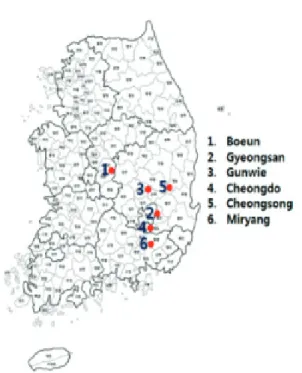
국내 재배 대추나무들의 유전특성 파악을 위한 공시재 료는 대추 주산지인 보은(금굴리, 상궁리, 신궁리, 후평 리), 경산(금구리, 신월리, 일언리), 군위(의흥리), 청도(남 양리), 청송(하평리), 밀양(봉도리) 등 6개 시⋅군 11개 농 가에서 270개체를 수집하였다(Table 1, Figure 1). 수집된 개체들과 국내⋅외 품종들과의 유연관계 비교를 위하여 국립산림과학원 산림생명자원연구부에 식재되어 있는 ‘복 조’, ‘보은대추’, ‘대리조’, ‘대과조’, ‘판조’ 등 대추나무 5
ID* Sample
location
Number of site
Number of samples
1 Boeun 4 61
2 Gyeongsan 3 74
3 Gunwie 1 28
4 Cheongdo 1 41
5 Cheongsong 1 32
6 Miryang 1 34
270
*: Identification number
Table 1. Sample location and sample size of jujube germplasm examined in the ISSR analysis. Six jujube sample collecting locations are the major jujube producing cities in Korea.
Figure 1. Map showing the major jujube producing cities in Korea where jujube samples were collected.
Cities are marked with a red circle and numbered from 1 to 6.
품종과 대추나무의 원종 야생형인 산조(Z. spinosa) 1개 체를 포함하여 총 276개체 및 품종들을 대상으로 분석을 수행하였다.
2. ISSR 표지 분석
각각의 시료는 GENE ALL plant SV DNA purification Kit (Gene all, Korea)를 이용하여 DNA를 추출 한 후, 최 종 농도가 5 ng/μl가 되도록 희석하여 PCR 반응에 이용 하였다. 표지 분석은 UBC SSR primer set #9 (University of British Columbia Nucleic Acid-Protein Service Unit, Canada) 중 3회 이상의 반복 실험을 통하여 다형성을 보
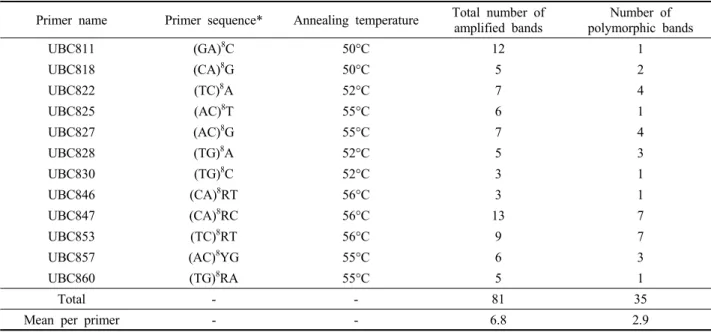
이고 재현성이 우수한 primer들을 사용하였다(Table 2).
PCR 반응액 20μl당 10ng template DNA, 0.4 μM primer, 1.5 mM MgCl2, 250 μM dNTP Mix, 10 mM Tris-HCl (pH 9.0), 1 U Tag DNA polymerase, 30 mM KCl이 포함 되도록 조성하였다. PCR은 94℃에서 5분간 전처리 후 94℃
에서 30초, primer에 따라서 50℃∼56℃에서 30초, 72℃에 서 60초 과정을 40회 반복한 후 72℃에서 10분간 최종 증폭 하였으며, 증폭 산물은 0.5 μM/μl의 Etidium Bromide가 포 함된 2% agarose gel에 분주한 후 1×TAE Buffer에서 50V로 4시간 전기영동하여 InGenius3 (SYNGENE, USA)에서 다 형성 여부를 확인하였다.
3. 재배 개체 식별 및 유전 특성 분석
PCR 증폭산물을 비교하여 270개체에서 나타나는 유전 자형들을 파악하였고 국내⋅외 품종들과의 유연관계를 분 석하였다. 또한 얻어진 정보는 GenAlEx ver. 6.5 program 과 POPGENE ver. 3.2 program을 사용하여 다형성 유전 자좌의 비율(P), 대립유전자 수(Na), 유효대립유전자 수 (Ne), 이형접합도 기대치(He), Shannon의 유전다양성지수 (I), 유전적 유사도(Genetic similarity) 등을 산출하였다 (Nei, 1973; Yeh et al., 1999; Peakall and Smouse, 2012).
결과 및 고찰
주요 생산지에서 재배중인 대추나무 270개체의 유전구 조를 분석한 결과 총 81개의 증폭산물을 얻었으며, 다형 성 증폭산물은 35개로 전체의 43%에 해당하였다(Table
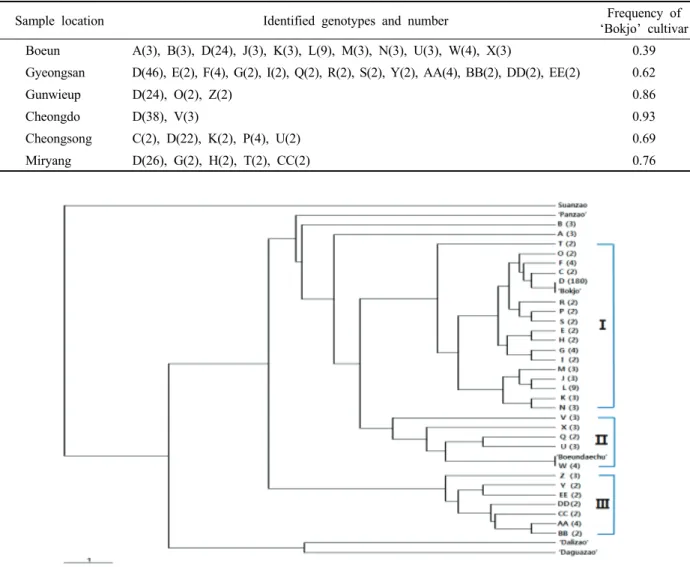
2). 다형성 표지를 이용하여 270개체의 유전자형을 비교 한 결과 31개의 유전자형이 나타났으며, 180개체(67%)가 클론으로 추정되었고, 나머지 90개체에서 30개 유전자형 이 관찰되었다. 지역별로는 6개 시⋅군 모두에서 유전자 형 D가 가장 많았고, 그 밖의 유전자형들은 다양하게 산 재하는 것으로 나타났다(Table 3).
유전자형들을 대조품종들과 비교한 결과 높은 비율을 차지하는 유전자형 D는 ‘복조’와 4개체에서 관찰된 유전 자형 W는 ‘보은대추’와 일치하였다. 그러나 이외 29개 유전자형은 특정한 품종과 일치하지 않는 것으로 나타났 다. 관찰된 유전자형과 대조품종들의 유연관계를 분석하 였다. 그 결과 아웃그룹인 산조가 먼저 분리되었고, 다음 으로 ‘대리조’와 ‘대과조’가 독립적인 군집을 이루었으 며, 이외 품종과 유전자형들은 ‘판조’와 유전자형 A, B를 제외하고 3개의 군집으로 나누어졌다. ‘복조’를 중심으로 많은 유전자형이 유집되었고(Figure 2에 Ⅰ로 표기), 5개 유전자형이 ‘보은대추’와 같은 그룹(Ⅱ)에 속하였으며, 나머지(Ⅲ)는 독립적인 군집을 형성하였다(Figure 2).
‘복조’와 ‘보은대추’의 유전자형과 일치하는 개체의 비 율이 67%와 1.5%로 임산물 생산비 통계 보다 적었다. 그 러나 함께 유집된 유전자형들을 포함하는 경우 군집의 비율이 85.5%와 6.3%로 앞선 자료보다 조금 높은 것으 로 나타났다. 이는 ‘금성’, ‘무등’, ‘월출’이 ‘복조’와 같은 군집에 포함되었기에 나타난 결과로 사료되며, 해당 군 집에 속하는 85% 이상의 개체들이 주로 재배되고 있는 것으로 추정되었다.
Barazani et al.(2014)은 이스라엘과 팔레스타인 자치지 Primer name Primer sequence* Annealing temperature Total number of
amplified bands
Number of polymorphic bands
UBC811 (GA)8C 50°C 12 1
UBC818 (CA)8G 50°C 5 2
UBC822 (TC)8A 52°C 7 4
UBC825 (AC)8T 55°C 6 1
UBC827 (AC)8G 55°C 7 4
UBC828 (TG)8A 52°C 5 3
UBC830 (TG)8C 52°C 3 1
UBC846 (CA)8RT 56°C 3 1
UBC847 (CA)8RC 56°C 13 7
UBC853 (TC)8RT 56°C 9 7
UBC857 (AC)8YG 55°C 6 3
UBC860 (TG)8RA 55°C 5 1
Total - - 81 35
Mean per primer - - 6.8 2.9
*: Single letter abbreviations for mixed-base positions: Y = (C, T), R = (A, G).
Table 2. ISSR primers used in this study and summary of ISSR markers from 270 cultivated jujube samples.
Sample location Identified genotypes and number Frequency of
‘Bokjo’ cultivar Boeun A(3), B(3), D(24), J(3), K(3), L(9), M(3), N(3), U(3), W(4), X(3) 0.39 Gyeongsan D(46), E(2), F(4), G(2), I(2), Q(2), R(2), S(2), Y(2), AA(4), BB(2), DD(2), EE(2) 0.62
Gunwieup D(24), O(2), Z(2) 0.86
Cheongdo D(38), V(3) 0.93
Cheongsong C(2), D(22), K(2), P(4), U(2) 0.69
Miryang D(26), G(2), H(2), T(2), CC(2) 0.76
Table 3. Identified genotypes, their number and ‘Bokjo’ cultivar frequency in the six jujube sample collecting locations.
Figure 2. Dendrogram generated by UPGMA cluster analysis from thirty one jujube genotypes and six jujube cultivars. Genotype D and W were identified as the major cultivated cultivar ‘Bokjo’ and local cultivar ‘Boeundaechu’. The numbers in parenthesis indicate how many individuals are in each genotype.
구 32곳에 식재되어 있는 올리브나무 280개체의 유전자 형을 분석한 결과, 252개체의 유전자형이 일치하여 단일 개체가 영양번식으로 전파되었을 것으로 보고하였다. 뿐 만 아니라 Ganopoulus et al.(2011)과 Bourguiba et al.
(2012)은 지중해연안에서 재배중인 체리와 자두를 대상 으로 유전특성을 분석한 결과, 과실이 크고 재배관리가 수월한 특정 품종이 대부분의 국가에서 재배되고 있음을 보고하여 본 실험 결과와 유사한 경향이 확인되었다.
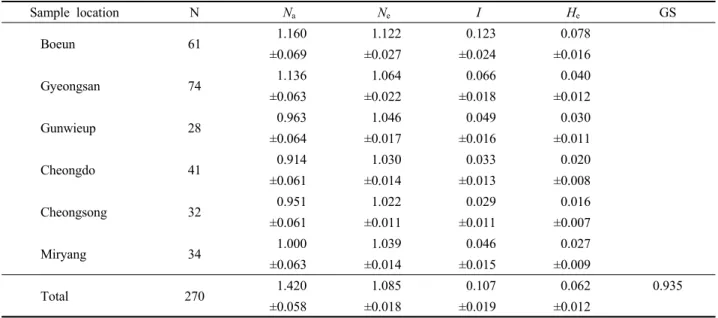
수집개체들의 유전특성을 분석 한 결과 대립유전자 수 (Na)는 1.42, 유효대립유전자 수(Ne)는 1.085, Shanon의 유 전다양성지수(I)는 0.107, 이형접합도 기대치(He)는 0.062 로 낮았으며, 유전적 유사도는 0.935로 높게 나타났다 (Table 4). Li et al.(2009)은 중국 내 45개 마을에서 대추 나무 ‘Huizao’ 품종 117개체를 수집하여 분석한 결과 대
립유전자 수(Na)는 1.79, 유효대립유전자 수(Ne)는 1.294, Shanon의 유전다양성지수(I)는 0.290, 이형접합도 기대치 (He)는 0.183 나타나 본 실험에서 관측된 유전다양성이 낮았음을 추정할 수 있었다. 또한 근연종인 Z. mauritiana (Na: 1.63, Ne: 1.389, I: 0.328)와 Z. spina-christi (Na: 1.93, Ne: 1.449, I: 0.4167, He: 0.269) 또는 유사한 재배⋅번식과 정을 갖고 있는 Pistacia vera (Ne: 1.40, He: 0.22), Spondias Purpurea (I: 0.230, He: 0.142), Adansonia digitata (Na: 1.49, Ne: 1.23, I: 0.21, He: 0.18)에서 관찰된 수치들과 비 교했을 경우에도 유전다양성이 매우 낮은 것으로 사료되 었다(Miller and Schall, 2006; Munthali et al., 2013; Alansi et al., 2016; Singh et al., 2017; Khadivi et al., 2018).
일반적으로 무성번식이 잘되고 재배역사가 오래된 식 물 일수록 선발에 의한 유전적 병목현상이 크게 작용하
며(Doebley et al., 2006; Yuan et al., 2010), 기원이 되는 집단의 수와 크기가 한정된 경우 낮은 유전다양성을 지 니게 된다(Allaby, 2008; Olsen and Gross, 2008). 국내의 대추나무들은 1950년대 발병한 대추나무 빗자루병의 영 향으로 많은 유전자원들이 소실되었다. 이후 1980년과 1987년 원예시험장 나주지장에서 ‘금성’, ‘무등’, ‘월출’
이 육성되어 보급되었으나, 무성번식이 쉬운 대추나무의 특성상 개체 수만 증가하고 유전다양성 회복은 불가능하 였을 것으로 생각된다. 전통적인 품종선발은 형태적 차 이를 이용하지만 기후조건, 토양환경 등의 영향으로 나 타날 수 있는 양적형질의 오차를 반영하지 못하는 위험 이 있다(Smith and Smith, 1992; Cooke et al., 1999). 과거 이루어졌던 대추나무 품종 육성은 비슷한 시기에 수집된 개체들을 대상으로 단편적인 목표로 수행되었기에 동일 개체 혹은 근연관계의 개체들이 선발되었을 가능성이 높 다. 그 결과 근연관계의 개체들이 전국적으로 보급되어 높은 유전적 유사도가 나타난 것으로 추정된다.
단일 품종의 재배는 비배관리, 관수, 약재 처리 등이 수 월하다는 장점이 있지만 동일개체 혹은 근연관계로 구성 된 집단은 유전적 침식으로 인해 외부교란에 취약할 수 있다(Horsfall and Chairs, 1972; Hardner and Potts, 1995;
Charlesworth and Willis, 2009). 실제로 특정형질에 초점 을 맞춘 품종 개발과 단일품종 재배가 방어능력을 낮추 게 되어 외부교란에 큰 피해를 입기도 하였다(Frankel, 1970; Tanksley and McCouch 1997). 과거 아일랜드에서 발생한 감자잎마름병에 의한 대기근, 1943년 인도에서 발생한 붉은별무늬병에 의한 기근, 1970년 옥수수 생산
량을 감소시킨 잎마름병과 같은 문제가 발생하여 경제적 손실은 물론, 인명피해로까지 이어졌다. 최근에는 바나나 작황의 45%를 차지하는 캐번디시 품종에 해를 가하는 곰팡이(Fusarium oxysporum)가 확산되어 많은 손해가 발 생하고 있다(Ploetz, 2006).
대추 주산지 6곳에서 수집된 270개체에서 31개의 유전 자형이 관찰되었지만 그 차이가 미미하여 유전다양성 지 표들이 매우 낮았다. 대다수의 대추나무가 근연관계의 개체들로 외부교란에 취약한 상태로 판단되었으며, 많은 양의 대추가 단위결실의 산물로 배가 없거나 정상적으로 발달하지 못하였다. 대추나무속의 과실은 단위결실로 발생 된 경우 타가수분으로 발생된 것 보다 작고 낙과율과 열과 율이 높은 것으로 알려져 있다(Singh et al., 1991; Neeraja, 1995; Liu et al., 2004; Rajesh and Misra, 2004). 이에 외 부교란에 대비하고 양질의 과실을 얻기 위하여 품종 다 양화, 화분수 식재 등이 필요하며, 이를 위하여 ‘보은대 추’와 같은 지역종과 노거수들에 대한 세밀한 조사는 물 론, 국외 유전자원에 관한 연구가 함께 수반되어야 할 것 으로 생각된다.
References
Alansi, S., Tarroum, M., Qurainy, F.A., Khan, S. and Nadeem, M. 2016. Use of ISSR marker to assess the genetic diversity in wild medicianl Ziziphus spina-christi(L.) Willd.
collected from different regions of Saudi Arabia.
Biotechnology and Biotechnological Equipment 30(5) : 942-947.
Sample location N Na Ne I He GS
Boeun 61 1.160 1.122 0.123 0.078
±0.069 ±0.027 ±0.024 ±0.016
Gyeongsan 74 1.136 1.064 0.066 0.040
±0.063 ±0.022 ±0.018 ±0.012
Gunwieup 28 0.963 1.046 0.049 0.030
±0.064 ±0.017 ±0.016 ±0.011
Cheongdo 41 0.914 1.030 0.033 0.020
±0.061 ±0.014 ±0.013 ±0.008
Cheongsong 32 0.951 1.022 0.029 0.016
±0.061 ±0.011 ±0.011 ±0.007
Miryang 34 1.000 1.039 0.046 0.027
±0.063 ±0.014 ±0.015 ±0.009
Total 270 1.420 1.085 0.107 0.062 0.935
±0.058 ±0.018 ±0.019 ±0.012
*: N = Number of samples, Na = Number of different alleles, Ne = Number of effective alleles, I = Shannon's information index, He = Expected heterozygosity, uHe = Unbiased expected heterozygosity, GS = Genetic similarity.
Table 4. Summary of genetic variation statistics for all loci in 270 cultivated jujube samples.
Allaby, R.G. 2008. The rise of plant domestication: Life in the slow lane. Biologist 55: 94-99.
Azam-Ali, S., Bonkoungou, E., Bow, C., deKock, C., Godara, A. and Williams, J.T. 2006. Ber and other jujubes.
International Centre for Underutilised Crops University of Southampton, Southampton, SO17 1BJ, UK. pp. 289.
Barazani, Q., Westberg, E., Hanin, N., Dag, A., Kerem, Z., Tugendhaft, Y., Hmidat, M., Hijawi, T. and Joachim, W.K.
2014. A comparative analysis of genetic variation in rootstocks and scions of old olive trees – a window into the history of olive cultivation practices and past genetic variation. BMC Plant Biology. doi: 10.1186/1471-2229- 14-146.
Bourguiba, H., Audergon, J.M., Krichen, L., Farah, N.T., mamouni, A., Trabelsi, S., D’Dnofrio, C., Asma, B.M., Santoni, S. and Khadari, B. 2012. Loss of genetic diversity as a signature of apricot domestication and diffusion into the Mediterranean Basin. BMC Plant Biology. doi:
10.1186/1471-2229-12-49.
Charlesworth, D. and Willis, J.H. 2009. The genetics of inbreeding depression. Nature Reviews Genetics 10:
783-796.
Chi, A., Kang, C., Zhang, Y., Tang, L., Guo, H., Li, H. and Zhang, K. 2015. Immunomodulating and antioxidant effects of polysaccharide conjugates from the fruits of Ziziphus jujube on chronic fatigue syndrome rats.
Carbohydrate Polymer 122: 189-196.
Collard, B.C.Y. and Mackill, D.J. 2008. Marker assisted selection: an approach for precision plant breeding in the twenty-first century. Philosophical Transactions of the Royal Society B Biological Sciences 363: 557-572.
Cooke, R.J. 1999. Modern methods for the cultivar identification and the transgenic plant challenge. Seed Science and Technology 27: 669-680.
Cooper, M., Smith, O.S., Graham, G., Arthur, L., Feng, L.
and Podlich, D.W. 2004. Genomics, genetics, and plant breeding: a private sector perspective. Crop Science 44:
1907-1913.
Doebley, J.F., Gaut, B.S. and Smith, B.D. 2006. The molecular genetics of cop domestication. Cell 127: 1309-1321.
Frankel, O.H. 1970. Genetic dangers in the green revolution.
World Agriculture 19: 9-14.
Ganopoulos, I.V., Kazantzis, K., Chatzicharisis, I., Karayiannis, I. and Tsaftaris, A.S. 2011. Genetic diversity, structure and fruit trait associations in greek sweet cherry cultivars using microsatellite based (SSR/ISSR) and morpho-physiological markers. Euphytica 181(2): 237-251.
Hager, M.D. and Edward, T. 1989. My favorite tree, the jujube.
California Rare Fruit Growers Newsletter. California, USA.
21: 31-32.
Hardner, C.M. and Potts, B.M. 1995. Inbreeding depression and changes in variation after selfing in Eucalyptus globulus ssp. globulus. Silvae Genetica 44: 46-54.
Han, C.F. 2014. China agriculture yearbook. China agriculture publishing house, Beijing, China. pp. 221.
Horsfall, T. and Chairs, G. 1972. Genetic vulnerability of major crops. National Academy of Sciences, Washington, USA.
pp. 307.
Huang, X., Kojima-Yuasa, A., Norikura, T., Kennedy, D.O., Hasuma, T. and Matsui-Yuasa, I. 2007. Mechanism of the anti-cancer activity of Zizyphus jujuba in HepG2 cells. The American Journal of Chinese Medicine 35: 517-532.
Khadivi, A., Esmaeili, A. and Mardani, N. 2018. Genetic diversity of cultivated pistachio as revealed by microsatellite molecular markers. Biotechnology and Biotechnolgical Equipment 32(3): 602-609.
KFS (Korea Forest Service). 2015. Forestay production cost survey report. pp. 48. Korea Forest Service. Daejeon. Korea.
KFS (Korea Forest Service). 2017. Production of forest products.
pp. 28. Korea Forest Service. Daejeon. Korea.
Li, J.D., Bi, H.T., Li, H.T., Li, Z.S. and Feng, J.C. 2009. Genetic analysis of Ziziphus jujuba ‘Huizao’ using ISSR marker.
Acta Horticulturae 840: 135-141.
Li, L., Peng, J.Y. and Bai, R.X. 2010. Analysis of the genetic relationships in Chinese Ziziphus with SRAP markers.
Agricultural Sciences in China 9(9): 1278-1284.
Liu, M.J. and Cheng, C.Y. 1995. A taxonomic study of the genus Ziziphus. Acta Horticulturae 390: 161-165.
Liu, P., Xue, H.Z., Zhou, X.Y., Liu, M.J., Mao, Y.M. and Zhou, J.Y. 2004. Study on the biological basis of pollination in chinese jujube (Zizyphus jujuba) and wild jujube (Z. spinosa).
Journal of Fruit Science 21(3): 224-228.
Ma, Q.H., Wang, G.X. and Liang, L.S. 2011. Development and characterization of SSR markers in Chinese jujube (Ziziphus jujuba Mill.) and its related species. Scientia Horticulturae 129: 597-602.
McCouch, S. 2004. Diversifying selection in plant breeding.
PLoS Biology 2: 347.
Miller, A.J. and Schaal, B.A. 2006. Domestication and the distribution of genetic variation in wild and cultivated populations of the Mesoamerican fruits tree Spondias purpurea L. (Anacardiaceae). Molecular Ecology 15:
1467-1480.
Munthali, C.R.Y., Chirwa, P.W., Changadeya, W.J. and Akinnifesi, F.K. 2013. Genetic differentiation and diversity of Adansonia digitata L (baobab) in Malawi using microsatellite markers. Agroforest System 87: 117-130.
Nam, J.I. 2016. Development of genetic markers for
identification of jujube (Ziziphus jujuba Mill.) cultivars.
Cheongju. Chungbuk National University.
Neeraja, G., Reddy, S.A. and Babu, R.S.H. 1995. Fruit set, fruit drop and fruiting behaviour in certain ber (Ziziphus mauritiana Lamk.) cultivars. Journal of Research, Andhra Pradesh Agricultural University, Hyderabad, India. 3(3/4):
17-21.
Nei, M. 1973. Analysis of gene diversity in subdivided populations. National Academy of Sciences, Washington, USA. 70: 3321–3323.
Niebur, W.S., Rafalski, J.A., Smith, O.S. and Cooper, M. 2004.
Applications of genomics technologies to enhance rate of genetic progress for yield of maize within a commercial breeding program. In: Fischer, T., Turner, N., Angus, J., McIntyre, L., Robertson, M., Borrell, A. and Lloyd, D.
(eds.). New Directions for a Diverse Planet: Proceedings for the 4th International Crop Science Congress. Regional Institute, Gosford, Australia.
Olsen, K.M. and Gross, B.L. 2008. Detecting multiple origins of domesticated crops. National Academy of Sciences, Washington, USA. 105: 13701-13702.
Plastina, P., Bonofiglio, D., Vizza, D., Fazio, A., Rovito, D., Giordano, C., Barone, L., Catalano, S. and Gabriele, B.
2012. Identification of bioactive constituents of Ziziphus jujube fruit extracts exerting antiproliferative and apoptotic effects in human breast cancer cells. Journal of Ethnopharmacology 140: 325-332.
Peakall, R. and Smouse, P.E. 2012. GenAlEx 6.5: genetic analysis in excel. population genetic software for teaching and research—an update. Bioinformatics 28(19): 2537- 2539.
Ploetz, R.C. 2006. Fusarium wilt of banana is caused by several pathogens referred to as Fusarium oxysporum f. sp.
cubense. The American Phytopathological Society Journals 96(6): 653-656.
Rajesh, S. and Misra, K.K. 2004. Correlation studies in ber (Ziziphus mauritiana Lam.) Scientific Horticulture 9:
37-40.
Smith J.S.C. and Smith O.S. 1992. Fingerprinting crop varieties.
In: Donald LS, editor. Advances in agronomy. Academic Press. pp. 85-140.
Singh, S.K., Chhajer, S., Pathak, R., Bhatt, R.K. and Kalia, R.K. 2017. Genetic diversity of indian jujube cultivars using SCoT, ISSR and rDNA markers. Tree Genetics and Genomes 13: 12.
Singh, Z., Dhillon, B.S. and Sandhu, A.S. 1991. Relationship of embryo degeneration with fruit drop and its pattern in different cultivars of ber. Indian Journal of Horticulture 48(4): 247-251.
Tanksley, S.D. and McCouch, R. 1997. Seed banks and molecular maps: unlocking genetic potential from the wild.
Science 277: 1063-1066.
Troyan, A.V. and Kruglyakov, G.N. 1972. Produce with high vitamin content. Sadovodstvo 12: 30.
Wang, S.Q., Liu, Y., Ma, L.Y., Liu, H.B., Tang, Y., Wu, L.P., Wang, Z., Li, Y.Y., Wu, R.L. and Pang, X.M. 2014.
Isolation and characterization of microsatellite markers and analysis of genetic diversity in Chinese jujube (Ziziphus jujuba Mill.). PLoS ONE 9(6): e99842. doi: 10.1371/
journal.pone.0099842.
Yeh, F. C., Yang, R. C., Boyle, T. B. J., Ye, Z. H. and Mao, J. X. 1999. POPGENE ver. 1.32: The user-friendly shareware for population genetic analysis. Molecular Biology and Biotechnology Centre. University of Alberta, Canada.
Yuan, Q.J., Zhang, Z.Y., Hu, J., Guo, L.P., Shaq, A.J. and Huang, L.Q. 2010. Impacts of recent cultivation on genetic diversity pattern of a medicinal plant, Scutellaria baicalensis (Lamiaceae). BMC Genetics. doi: 10.1186/
1471-2156-11-29.
Manuscript Received : August 1, 2018 First Revision : November 5, 2018 Second Revision : November 12, 2018 Accepted : November 13, 2018