임목생산방법에 따른 토양교란 영향 평가
이은재
1
⋅Li, Qiwen1
⋅유 송1
⋅한상균2
⋅임상준1,3
*1
서울대학교 산림과학부,2
한국농수산대학 산림조경학과,3
서울대학교 농업생명과학연구원Influences of Timber Harvesting Methods on Soil Disturbance
Eunjai Lee
1
, Qiwen Li1
, Song Eu1
, Sang-Kyun Han2
and Sangjun Im1,3
*1
Department of Forest Sciences, Seoul National University, Seoul 08826, Korea2
Department of Forestry and Landscape Architecture, Korea National College of Agriculture and Fisheries, Jeonju 54874, Korea3
Research Institute of Agriculture and Life Sciences, Seoul National University, Seoul 08826, Korea요 약: 중장비를 이용한 임목생산작업은 산림 내 토양교란을 유발하며, 산림토양은 토양침식에 취약한 구조를 가지게 된 다. 임목생산방법 및 장비에 따라 토양교란 유형 및 토성 변화 정도는 다르게 나타난다. 따라서 이 연구에서는 국내에서 이루어지고 있는 우드그랩을 이용한 단목생산방법과 스윙야더를 이용한 전목생산방법에 따른 토양교란 영향을 평가하였 다. 이를 위하여 토양교란 유형은 시각적 평가방법을 이용하여 분류하였으며, 교란 유형에 따른 토양의 물리성 변화는 토 양시료캔에 의한 샘플링 방법을 이용하였다. 단목과 전목생산작업지에서 관찰된 극심한 교란(deep disturbance)과 토양답 압(compacted) 유형은 각각 48%와 23%로 나타났다. 또한, 임목생산작업에 따른 토양의 물리성 변화는 중장비 차량이 통 행한 곳에서 차이가 발생하였다. 반면 차량 통행과 관련 없는 토양교란 유형에서는 임목수확작업 전 · 후의 토양의 용적밀 도 및 공극률은 통계적으로 차이가 없었다. 이 연구를 통해 산림 내에서 중장비의 통행으로 인하여 주로 토양 교란 및 훼 손이 발생함을 알 수 있었다.
Abstract: Soil disturbance caused by timber harvesting is widely recognized as a potential threat to forest utilization.
The degree and extent of soil disturbance is believed to vary with respect to harvesting methods and logging machines. This study has conducted to assess the degree of soil disturbance associated with ground-based cut-to-length (GC) and cable yarding with whole tree (CW) harvesting methods. Soil disturbance was classified using a visual assessment of harvest unit. The properties of soils in different disturbance levels were also evaluated to understand the influence of timber harvesting on soil structure with soil core sampling method. The deep disturbance and soil compaction were observed in sites by 48% and 23% through harvesting areas for GC and CW logging methods, respectively. The results showed that logging machine and number of machine passage had significant influences on soil bulk density and porosity. Soil disturbance types such as rutted, slash cover, and compact were influenced by equipment travel trends in a GC method.
Key words: soil disturbance, timber harvesting methods, visual assessment, soil sampling
서 론
1)
산지에서 목재를 생산하기 위한 임목생산작업은 주로 펠 러번처(feller-buncher), 스키더(skidder), 하베스터(harvester), 포워더(forwarder), 타워야더(tower yarder) 등의 중장비를 이용하고 있으며, 이로 인하여 산림 내에서 토양교란(soil
* Corresponding author E-mail: [email protected]
disturbance) 및 토양퇴화(soil degradation) 등의 환경피해 가 발생하고 있다(Han et al., 2006; Makineci et al., 2007;
Page-Dumroese et al., 2009). 토양교란은 작업에 이용된 임업기계의 종류, 통행횟수, 지형, 토성, 운반량 등에 따 라 많은 영향을 받는다(Adams and Froehlich, 1984;
McMahon and Evanson, 1994; Mcdonald and Seixas, 1997; Jung and Lee, 2008; Han et al., 2009). 산림경영기 술자는 임황이나 지황 등 작업여건을 고려하여 토양교란 등의 환경 영향이 최소화되도록 임목생산방법 및 임업기
J OURNAL OF K OREAN F OREST S OCIETY ISSN0445-4650(Print), ISSN2289-0904(Online) http://e-journal.kfs21.or.kr
204
assessment)와 토양샘플링 방법을 이용하여 조사한다 (Jensen and Visser, 2005; Curran et al., 2007; Solgi and Najafi, 2014). 시각적 평가방법은 지표토양의 교란 정도 를 몇 개의 등급으로 구분하여 분류하는 것으로, 토양교 란 유형을 정량적으로 분류할 수 있으며 현장조사가 비 교적 쉽다(Aust et al., 1995; McDonald et al., 2002). 토 양샘플링 방법은 토양시료를 채취하여 작업에 따른 토성 변화를 직접 평가하는 방법으로, 시료채취는 토양시료캔 을 이용하거나 굴삭기를 많이 이용하며, 일부에서는 방 사선 등을 활용한다(Page-Dumoroese et al., 1999). 방사선 을 이용하는 방법은 방사선의 수분밀도(nuclear moisture- density)를 이용하여 지표면을 굴삭하지 않고 현장에서 쉽고 빠르게 토양의 물리적 성질을 조사하는 방법이다 (Blake and Hartge, 1986). 이 방법은 조사장비의 무게가 약 20 kg로 무거워 휴대성이 떨어지고, 조사시에는 반드 시 자격을 취득한 사람이 필요하기 때문에 산림지에 적 용하기에는 많은 한계가 있다(Flint and Childs, 1984). 토 양시료캔을 이용하는 방법은 조사과정에서 토양용적밀도 및 공극률이 과다하게 추정되는 경향이 있지만, 현장에서 쉽고 간단하게 토양의 물리적 성질을 측정할 수 있기 때 문에 많이 적용되고 있다(Page-Dumoroese et al., 1999).
임목생산방법에 따라 산림 내에서 발생하는 토양교란 에 대한 연구가 많이 이루어졌다. 지상집재장비를 이용 하여 임목생산작업을 하는 경우에는 집재용 차량이나 장비가 통과하는 지역에서 토양교란이 많이 발생하며, 차량의 주행바퀴에 의한 토양교란 및 답압이 전체 작업 면적의 18~36%에서 나타나는 경우도 있다(Froehlich et al., 1981; Miller et al., 2004). 이 때의 토양교란은 임업 기계 및 타이어의 종류, 주행횟수, 작업시기, 지형, 토양 피복상태, 토성, 토양수분함량 등에 따라 다르게 발생된 다(Froehlich et al., 1981; Laffan et al., 2001; Najafi et al., 2009). 지상집재차량이 많이 통행(3~10회)하면 토 양답압에 의해 토양용적밀도가 10~40% 증가하는 것으 로 나타났다(Froehlich, 1979; Armlovich, 1995; Gomez et al., 2002; Williamson and Nelson 2000; Han et al., 2009). 토양답압은 토양 내 공극을 줄여 수분 침투 및 유 기물 순환을 방해하고, 토양침식을 증가시킨다(Quesnel and Curran, 2000). 반면, 차량의 노선변경 및 경사지를 등판하는 과정에서는 토양구조가 재배열 및 재배치되어 토양공극이 증가되고 토양강도가 감소하기도 한다 (Grigal, 2000).
가선집재 작업지역에서는 약 3~16% 정도의 면적에서
은 지상집재방식과는 다르게 토양답압이나 토양용적밀 도 등의 토양 물리성 변화가 주로 집재장에서 나타나며 (Miller and Sirois, 1986), 임지 내에서는 중장비 차량이 주행하지 않기 때문에 현저한 토성 변화는 거의 발생하지 않는다(Thompson et al., 1998).
국외에서는 임업기계를 이용한 임목생산이 토양교란이 나 토양 물리성 변화에 미치는 영향에 대해 다양한 연구 가 수행되었다. 하지만 국내에서는 임목생산방법에 따른 산림토양 환경평가에 관한 연구는 매우 부족한 실정이 다. 특히 국내의 임목생산방법은 지형경사에 상관없이 우드그랩(굴삭기)을 이용한 단목생산이 95%를 차지하며, 부분적으로 벌채부산물 수집 및 처리 등의 문제를 해결하 기 위하여 가선집재장비(스윙야더)를 이용한 전목수확방 법이 도입되고 있다(Korea Forest Service, 2014a, 2014b).
이 연구에서는 국내에서 많이 이용하고 있는 우드그랩을 이용한 단목생산방법과 스윙야더를 이용한 전목생산방 법을 대상으로, 임목생산작업에 따른 토양교란 정도를 현장조사하였다. McMahon(1995)이 제안한 시각적 평가 방법을 이용하여 임목생산작업 전·후의 토양교란 정도를 평가하였으며, 토양시료를 현장채취하여 작업 전 · 후의 토양용적밀도와 공극률의 변화를 분석하였다.
재료 및 방법
1. 조사대상지 및 임목생산작업 개요
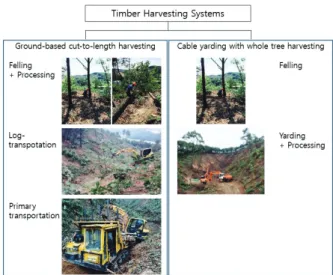
이 연구는 2015년 7월 1일부터 8월 31일까지 임목생산 이 이루어진 경기도 이천시 호법면 매곡리 산 41번지에서 실시하였으며, 임목생산방법은 지상집재장비 우드그랩을 이용한 단목생산방법과 가선집재장비 스윙야더를 이용한 전목생산방법이 각각 이용되었다(Figure 1). Figure 1에서 단목생산작업 대상지의 면적은 2.27 ha이고, 전목생산 대 상지는 1.15 ha이며, 주변 환경에 따른 영향을 최소화하기 위하여 작업지가 서로 인접하도록 대상지를 선정하였다. 단 목생산과 전목생산 작업지에서는 목재 및 산림부산물을 생 산하고, 수종갱신을 위한 산림경영계획 목표에 따라 친환경 모두베기를 실시하였다. 조사지는 활엽수(50%), 리기다 소 나무(20%), 소나무(30%) 등으로 이루어진 침·활혼효림지 역이다. 작업대상지의 평균영급은 4영급, 평균 수고는 15 m, 평균경급은 20 cm, 평균경사는 35%이었으며, 임목축적 은 131 m
3
/ha로서 중경목이 많이 분포하고 있었다.단목생산작업 과정은 벌도-조재-집재의 순서로 진행 되었다. 벌도작업은 체인톱(MS261 C-M, STIHL, United
Figure 2. Overview of timber harvesting process with a excavator and swing-yarder in Korea.
Figure 1. Map of the study site by (a) whole-tree using swing yarder and (b) cut-to-length with ground-based machines timber harvesting systems.
States)을 이용하였으며 조재작업이 이루어진 후, 2~4 m 의 길이로 조재된 원목과 산림부산물은 버킷 용량 0.2 m
3
급 크롤러식 굴삭기를 이용하여 집재하였다. 작업방식은 비탈길을 오를 때에는 원목과 산림부산물을 분류하는 작 업을 하고, 이후 원목을 집어던지거나 밀어 내면서 운재 로(spur road)까지 집재하였다. 이에 따라 임업기계의 작 업로 통행횟수는 최대 2회이다. 이후 일본 모로오카에서 제작된 크롤러식 임업용 캐리어 덤프와 굴삭기 조합으로 소운반 작업을 하였다(Figure 2). 운재로에서 장비의 통행 횟수는 10회 이상이었다. 집재작업에 이용된 굴삭기의 무 게는 5.8 ton이었으며, 소운반작업에 이용된 모로오카 임 업용 캐리어 덤프의 공차와 만차의 무게는 각각 6.3 ton, 11.3 ton이었다.전목생산작업은 체인톱을 이용한 벌도작업 후에 스윙 야더에 의한 하향 전목집재작업과 프로세서를 이용한 조 재작업이 한 곳에서 동시에 이루어졌다(Figure 2). 스윙 야더는 5 ton급 굴삭기에 장착하여 집재작업에 이용하였 으며, 프로세서는 16 ton급 굴삭기에 장착하여 조재작업 에 이용하였다. 집재 및 조재작업 중 장비의 생산성을 개
선하기 위하여 3개의 가선을 설치하였으며, 이와 관련하 여 1회 스윙야더와 프로세서 장비의 위치를 변경하였다.
2. 토양교란 평가 및 물리성 측정 1) 토양교란 평가
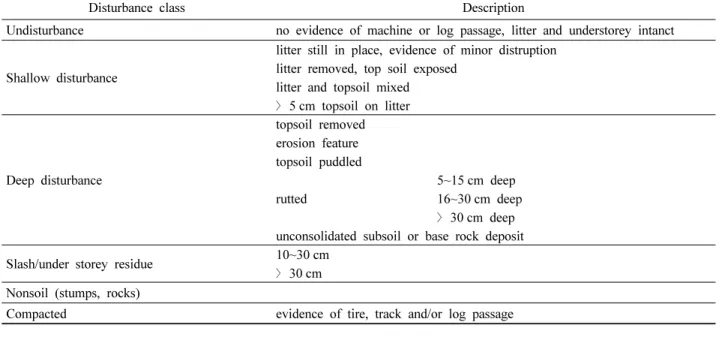
임목생산작업이 이루어진 산림토양의 교란 정도를 정량 적으로 측정하기는 어렵다(Powers et al., 1998). McMahon (1995)은 토양의 교란 정도에 따라 16개의 유형으로 분 류하는 시각적 평가방법을 개발하였으며(Table 1), 산림 토양의 교란 정도를 파악하는데 많이 이용되고 있다 (Jensen and Visser, 2005; Curran et al., 2007; Solgi and Najafi, 2014). 이 연구에서는 토양교란 유형을 Figure 3과 같이 정의하였다.
시각적 평가는 점 조사법(point transect), 선 조사법(line transect), 격자교차법(grid point intercept) 등으로 나눌 수 있다(Page-Dumroese et al., 2009). 이 연구에서는 임목생 산지역의 토양교란 유형을 분류하기 위하여 선 조사법을 이용하였으며, 이 방법은 현장측정 오차를 최소화할 수 있다(McMahon, 1995; Solgi and Najafi, 2014). 사업대상 지에 대해 작업 전 · 후 30 m의 간격으로 각각 400개의 조사지점에 대해 교란 정도를 조사하였다. 조사지점에 대해서는 GPS를 이용하여 위치 좌표를 구하였다.
2) 토양 물리성 측정
토양교란 유형별로 토양의 물리성 변화를 조사하였다.
이를 위하여 토양시료캔(직경 5 cm, 높이 5 cm)을 이용 하여 토양깊이별로 3개씩 토양시료를 채취하였다. 토양 시료 채취는 토심 0~10 cm와 10~20 cm 깊이의 토양층 에서 각각 이루어졌다. 토양시료는 임목생산작업 이전의
Shallow disturbance
litter still in place, evidence of minor distruption litter removed, top soil exposed
litter and topsoil mixed
〉5 cm topsoil on litter
Deep disturbance
topsoil removed erosion feature topsoil puddled
rutted
5~15 cm deep 16~30 cm deep
〉30 cm deep unconsolidated subsoil or base rock deposit Slash/under storey residue 10~30 cm
〉30 cm Nonsoil (stumps, rocks)
Compacted evidence of tire, track and/or log passage
(a) Undisturbance
(b) Shallow disturbance
(c) Deep disturbance
Rutted Topsoil removed
(d) Slash/under storey residue
(e) Nonsoil
(f) Compacted
Figure 3. Soil disturbance classes from a visual assessment by Mcmahon(1995).
토양에서 18개를 채취하였고, 단목생산 작업지에서 58개 와 전목생산 작업지에서 45개의 토양시료를 각각 채취하 였다. 현장에서 채취한 토양시료는 105°C에서 48시간 건 조하여 시료의 무게를 측정하였고, 이로부터 토양용적밀 도(g/cm
3
)와 공극률(%)을 각각 산정하였다.임목생산작업별(단목·전목생산)로 발생된 토양교란 유 형에 대해 토양용적밀도 및 공극률이 집단간 서로 차이 가 있는지 통계적으로 평가하기 위해 ANOVA 분석을 실 시하였다. 통계분석은 SPSS 23.0을 이용하였으며, Levene 분석을 이용하여 사전에 자료의 등분산 여부를 평가한 후 에 토양교란별 자료 수가 다르기 때문에 Scheffe 사후검
정(α=0.05)을 실시하였다.
결과 및 고찰
1. 토양교란 평가
시각적 평가를 통해 임목생산작업에 따른 토양교란 정 도를 평가한 결과는 Table 2와 같다. 임목생산작업 이전의 자연조건에서는 극심한 토양교란 유형(deep disturbance, DE)이 나타나지 않았으며, 전체 조사지점 중에서 20%의 지점에서 경미한 토양교란 유형(shallow disturbance, SH) 이 나타났다.
Disturbance class Pre-harvesting (%)
GC
z
(% )CW
y
(%)Undisturbance 80 24 11
Shallow disturbance 20 18 50
Deep disturbance - 43 22
Slash/under storey residue - 6 13
Nonsoil (stumps, rocks) - 4 4
Compacted - 5 1
z Ground-based cut-to-length harvesting system
y Cable yarding with whole tree harvesting system
Table 2. Percentage of pre-, ground-based cut-to-length(GC), and cable yarding with whole tree harvesting(CW) by soil disturbance classes
단목생산방법 작업지에서는 극심한 교란 유형(DE)이 가장 높은 비율(43%)로 나타났으며, 이 중에서 우드그랩 의 바퀴자국에 의한 교란이 53%를 차지하였다. 지상집재 장비를 이용한 임목생산방법에서는 임업기계의 통행으 로 인한 바퀴자국이 토양교란을 많이 유발하는 것으로 보고되고 있다(Miller et al., 2004; Page-Dumroese et al., 2009). 이 연구에서는 선행연구와 비교하여 차량 통행에 의한 토양교란이 높은 비율을 차지하였다. 일반적으로 지형의 경사가 증가함에 따라 작업차량은 지그재그형으 로 주행하기 때문에 장비의 통행에 의한 토양교란 유형 이 더 증가하게 된다(Solgi and Najafi, 2014).
크롤러식 임업용 캐리어 덤프를 이용하여 10회 이상 소운반작업이 이루어진 작업지에서는 토양의 답압피해 (compacted, CP)가 주로 발생하였으며, 이는 전체 조사지 점의 약 5%에서 관찰되었다. 선행연구에 의하면 토양답 압은 차량이 3~8회 정도 통행하면 발생하기 시작하여 (Botta et al., 2006; Ampoorter et al., 2007), 10회 정도 주 행을 하면 토양답압이 최대가 되고, 그 이후에는 주행횟 수에 따라 답압정도가 크게 변화하지 않는다(Gent and Ballard, 1984; Han et al., 2006). 조사대상지에서는 단목 생산을 위해 10회 이상 우드그랩과 덤프를 이용한 소운반 작업이 이루어졌으며, 이 작업과정에서 토양답압이 발생 한 것으로 보인다.
전목생산 작업지에서는 약 22%의 조사지에서 극심한 교란 유형(DE)이 나타났으며, 주로 가선집재노선을 따라 표토층이 유실되는 형태(topsoil removed, TR)로 나타났 다. 가선집재장비를 이용하여 전목수확을 하게 되면 원 목의 원구부분이 가공본줄(skyline)에 매달려 집재장으로 끌려오는 과정에서 낙엽층 및 표토를 유실시키는 것으로 알려져 있다(Hartsough et al., 1997; Laffan et al., 2001).
한편, 가선집재방식은 지상집재방식보다 극심한 토양교 란(DE) 및 토양답압(CP) 등이 상대적으로 낮게 발생한다
(Allen, 1997; Klepac et al., 1999; Klepac and Reutebuch., 2003). 토양답압은 전체 작업면적의 1~3% 지역에서 관 찰되며, 대체로 집재장에서 발생된다(Miller and Sirois, 1986; McMahon, 1995). 이 연구에서도 토양답압(CP)은 집재장에서 관찰되었으며, 교란 규모는 약 1% 정도였다.
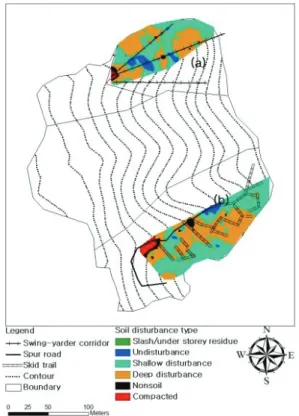
지상집재를 하면 가선집재를 하는 경우보다 극심한 토 양교란(DE)이 2배 정도 증가하였으며, 상당히 넓은 지역 에서 토양답압(CP)이 발생하였다. Figure 4는 임목생산작 업방법에 따른 토양교란 유형을 공간적으로 도시한 것으 로, 지상집재를 이용한 단목생산지역에서 집재장비가 통 행한 노선을 따라 토양교란 및 답압이 많이 발생하였다.
가선집재장비를 이용한 전목수확 작업지에서는 가선노 선을 따라 표토유실 및 나지노출 등의 토양교란이 발생 하였다. 이처럼 임목생산작업에 이용되는 임업기계 및 장비에 따라 토양교란의 유형과 정도가 달라지게 된다 (Megahan, 1980; Klepac et al., 1999).
Figure 4. Timber harvesting methods used in this study.
(a) whole-tree using swing yarder and (b) cut-to-length with ground-based.
2. 토양 물리성 측정
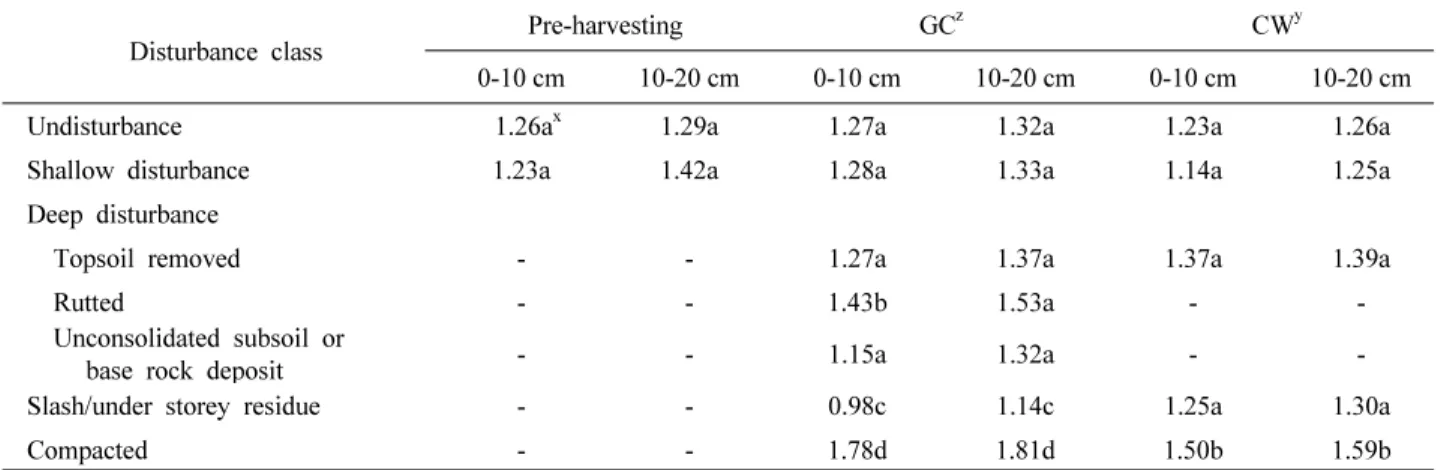
토양의 물리성 변화는 토양용적밀도와 공극률을 이용하 여 평가하였으며, 이에 대한 조사 결과는 Table 3, 4와 같 다. 임목생산작업 이전의 토양용적밀도는 토양층 0~10cm 에서는 1.25 g/cm
3
,10~20 cm 토양층에서는1.35 g/cm3
로0-10 cm 10-20 cm 0-10 cm 10-20 cm 0-10 cm 10-20 cm
Undisturbance 1.26a
x
1.29a 1.27a 1.32a 1.23a 1.26aShallow disturbance 1.23a 1.42a 1.28a 1.33a 1.14a 1.25a
Deep disturbance
Topsoil removed - - 1.27a 1.37a 1.37a 1.39a
Rutted - - 1.43b 1.53a - -
Unconsolidated subsoil or
base rock deposit - - 1.15a 1.32a - -
Slash/under storey residue - - 0.98c 1.14c 1.25a 1.30a
Compacted - - 1.78d 1.81d 1.50b 1.59b
z Ground-based cut-to-length harvesting system
y Cable yarding with whole tree harvesting system
x Comparison with pre-harvesting, GC, and CW on same depth by soil disturbance class, means followed by the same letter are not significantly different(p<0.05)
Disturbance class
Pre-harvesting GC
z
CWy
0-10 cm 10-20 cm 0-10 cm 10-20 cm 0-10 cm 10-20 cm
Undisturbance 52.3a
x
54.1a 52.1a 50.2a 53.4a 52.3aShallow disturbance 53.5a 46.5a 51.7a 50.0a 59.4a 54.9a
Deep disturbance
Topsoil removed - - 52.1a 53.9a 48.3a 49.8a
Rutted - - 45.7b 42.2a - -
Unconsolidated subsoil or
base rock deposit - - 56.4a 50.2a - -
Slash/under storey residue - - 62.9c 57.1c 52.9a 50.8a
Compacted - - 32.8d 31.6d 43.3b 40.0b
z Ground-based cut-to-length harvesting system
y Cable yarding with whole tree harvesting system
x Comparison with pre-harvesting, GC, and CW on same depth by soil disturbance class, means followed by the same letter are not significantly different( p<0.05)
Table 4. Changes in soil porosity(%) by different timber harvesting methods.
나타났으며 공극률은 40-60%의 범위를 보였다. 토양교란 이 거의 없거나(undisturbance, UD) 경미한 토양교란(SH) 이 발생한 지역에서는 임목생산작업 전·후에 대해 토양용 적밀도 및 공극률의 변화가 없었다(p>0.05). 특히, Scheffe 분석을 통한 사후검정에서도 집단 간에 유의한 차이는 발 생하지 않았다(p>0.05).
지상집재장비가 주행한 장소에서는 답압에 의해 토양 용적밀도가 증가하며(Solgi and Najafi, 2014), 공극률은 감소한다(Murray and Buttle, 2004). 이 연구의 결과도 이 와 잘 일치하였다. 임업기계의 1~2회 주행에 의한 바퀴자 국 토양교란 유형(rutted)의 경우, 얕은 토양층(0~10 cm 토양깊이)에서는 토양용적밀도가 약 14% 이상 증가하였
으나, 토양 깊이 10~20 cm에서는 임목수확작업 전의 토 양 상태와 통계적으로 유의한 차이가 나타나지 않았다 (p>0.05). 선행연구에 의하면, 지상집재장비가 3회 이하 통행한 곳에서는 토양 깊이 0~10 cm 범위에서만 토양 의 물리성이 영향을 받으며, 토양용적밀도는 20% 이내의 범위에서 증가하는 것으로 보고되었다(Armlovich, 1995;
Froese, 2004).
토양답압 교란(CP)이 발생한 곳에서는 토양용적밀도가 약 25% 이상 증가하는 것으로 나타났으며, 공극률은 차 량 통행이 많은 곳에서 32.8%(0~10 cm 토양층), 31.6%
(10~20 cm 토양층)로 가장 낮았다. 이는 임목생산작업 전의 토양상태와 비교하였을 때 통계적으로도 유의한 차
이가 나타났다(p<0.05). 상대적으로 통행빈도가 많은 운 재로(통행횟수: 10회 이상)에서 토양용적밀도가 가장 높 았으며[1.77 g/cm
3
(0~10 cm), 1.81 g/cm3
(10~20 cm)], 이는 기존의 연구결과와 일치하였다(McNeel and Ballard, 1992; Ampoorter et al., 2007; Han et al., 2009).지상집재장비 차량이 1회 이상 통행하면 토양용적밀도 는 약 20~28% 증가하는 것으로 보고되고 있다(Armlovich, 1995; McNeel and Ballard, 1992; Han et al., 2009). 특히 차량의 주행빈도가 높아지게 되면 토양용적밀도는 50%
이상 증가하였다(Ampoorter et al., 2007). 한편, 산림부산 물이 쌓여있는 토양교란 유형(slash/under storey residue, SU)은 차량 주행노선 또는 운재로 주변에서 주로 관찰되 었으며, 토양용적밀도는 임목생산작업 이전보다 감소하 였고[0.98 g/cm
3
(0~10 cm),1.13 g/cm3
(10~20 cm)], 공 극률은 증가하였다. 선행연구에 따르면, 벌도와 가지치기 작업으로 인해 발생된 산림부산물은 중장비 차량의 무게 가 직접 산림 토양으로 전달되는 것을 줄이는 역할을 하 며(Han et al. 2009), 토양답압과 교란을 줄이는 것으로 알려져 있다(Jakobsen and Moore, 1981; Froese, 2004;Eliasson and Wästerlund, 2007). 하지만 이 연구에서 이용 된 지상집재장비의 주행 특성은 원목과 산림부산물 분리 작업을 한 후 이동을 하기 때문에 산림부산물의 효과를 볼 수 없었다. 오히러 차량이 지나간 후, 토양이 타이어 및 크롤러 주변으로 밀려올라가는 ‘경운효과’(cultivation effect)로 인하여 토양용적밀도는 감소하고, 공극률은 증 가하는 것으로 추정된다(Braunack, 1986).
반면, 가선집재장비(스윙야더)를 이용한 전목생산지역 전 · 후의 토양용적밀도와 공극률은 토양답압(CP)이 관찰 된 지역을 제외하고는 단목생산작업 지역에 비해 변화 폭이 상당히 적게 나타났으며, 특히 전목수확작업 전·후 의 토양 상태는 통계적으로 유의한 차이를 보이지 않았 다(p>0.05). 토양답압 교란은 집재장 부근에서 관찰되었 으며, 작업 후에 토양용적밀도는 5% 정도 증가하였지만 공극률은 20% 이상 감소하였다.
임목생산작업에 의한 토양 물리성 변화는 지상집재장 비를 이용한 임목생산방법에서 주로 나타난다(McNabb 1994). 가선집재방식은 집재작업과정에서 임지 내에 중 장비가 주행하지 않기 때문에 토양 물리성의 변화는 적 게 나타난다(Thompson et al., 1998). 특히, 경사지에서는 가선집재방식을 이용하면, 장비 이동에 따른 토양 교란 이 적게 발생하고 원지반이 잘 유지되기 때문에 표토 유 실이 적게 발생하여 토양의 비옥도와 생산성이 잘 유지 될 수 있다(Klepac and Reutebuch, 2003).
결 론
임목생산작업은 산림 내 토양교란을 발생시키는 주요 원인으로 알려져 있으며, 임업기계의 주행노선(작업로 및 운재로)을 따라 주로 발생한다. 이러한 토양 교란은 산지의 생산성을 저하시키고, 강우시에 토양 유실을 증 가시키기 때문에 적절한 임목생산방식을 선정하는 것이 중요하다. 이 연구에서는 지상집재 및 가선집재 작업방 식이 토양교란 및 토양 물리성 변화에 미치는 영향을 현 장조사하여 평가하였다.
지상집재장비를 이용한 임목생산방법은 가선집재 작업 방식보다 토양교란이 많이 발생하고 답압피해를 가져오 며, 토양의 물리성을 악화시킨다. 이는 선행연구와 잘 일 치하는 것으로, 임목생산을 위한 중장비는 토양교란을 유발하고, 임업기계의 통행으로 토양이 압밀되어 토양용 적밀도는 증가하고 공극률은 감소하였다. 토양의 물리성 변화는 운재로와 작업로에서 다르게 나타났으며 이는 차 량의 통행횟수가 다르기 때문이다. 가선집재 작업방식에 서는 집재장에서 토양답압이 주로 관찰되었으며, 토양답 압으로 인해 토양의 물리성이 크게 변화하였다. 그러나 임목수확작업 과정에서 토양답압 이외의 토양교란은 크 게 발생하지 않았다.
이 연구에서는 경사지에서 임목생산작업에 따른 토양 교란 유형과 정도를 평가하였으며, 교란유형별로 토양용 적밀도 및 공극률 변화를 각각 분석하였다. 그러나 임목 생산작업에서 차량의 통행횟수, 경사조건, 토양의 종류 등 에 따른 영향을 파악하기에는 한계가 있다. 앞으로 다양 한 작업환경에 대한 조사를 추가하여 임목생산작업이 토 양교란에 미치는 영향을 정량적으로 평가할 필요가 있다.
감사의 글
본 연구는 산림청 ‘임업기술연구개발사업(과제번호: S21131 6L020110)’의 지원에 의하여 이루어진 것입니다.
References
Adams, P.W. and Froehlich, H.A. 1984. Compaction of forest soils. USDA Forest Service Pacific Northwest Research Station 217. pp. 16.
Allen, M.M. 1997. Soil compaction and disturbance following a thinning of second-growth Douglas-fir with a cut-to- length and a skyline system in Oregon cascade. Oregon State University. Master Degree thesis. pp. 105.
Ampoorter, E., Goris, R., Cornelis, W.M. and Verheyen, K.
Aust, W.M., Tippett, M.D., Burger, J.A. and Mckee, J.R. 1995.
Compaction and rutting during harvesting affect better drained soils more than poorly drained soils on wet pine flats. Southern Journal of Application Forest 19: 72-77.
Armlovich, D. 1995. Soil compaction study on a cut-to-length mechanized harvesting system. Forest Engineering Department. Corvallis, Oregon State University. Master Degree thesis. pp. 46.
Blake, G.R. and Hartge, K.H. 1986. Bulk density. pp. 363-375.
In : Klute, ed. Methods of soil analysis. Part 1. Agronomy 9. Madison, WI. U.S.A.
Botta, G.F., Jorajuria, D., Rosatto, H. and Ferrero, C. 2006.
Light tractor traffic frequency on soil compaction in the Rolling Pampa region of Agenda. Soil and Tillage Research 86: 9-14.
Braunack, M.V. 1986. Changes in physical properties of two dry soils during tracked vehicle passage. Journal of Terramechanics 30: 299-311.
Curran, M. Maynard, D., Heninger, R. Terry, T., Howes, S., Stone, D., Niemann, T. and Miller, R.E. 2007. Elements and rationale for a common approach to assess and report soil disturbance. The Forestry Chronicle 83(6): 852-866.
Eliasson, L. and Wästeland, I. 2007. Effects of slash reinforcement of strip roads on rutting and soil compaction on a moist fine-grained soil. Forest Ecology Management 252: 118-123.
Flint, A.L. and Childs, S. 1984. Development and calibration of an irregular hole bulk density sampler. Soil Science Society of America Journal 48: 374-378.
Froehlich, H.A. 1979. Soil compaction from logging equipment:
Effects on growth of young ponderosa pine. Journal of Soil and Water Conservation. pp. 276-278.
Froehlich, H.A., Aulerich, D.E. and Curtis, R. 1981. Designing systems to reduce soil impacts from tractive logging machines. Research Paper 44. Forestry Research Laboratory, Oregon State University. Corvallis OR. pp. 15.
Froese, K. 2004. Bulk density, Soil strength, and Soil disturbance Impacts from a Cut-To-Length Harvest Operation in North Central Idaho. University of Idaho. Master Degree thesis.
pp. 81.
Gent, J.A. and Ballard, R. 1984. Impact of intensive forest management practices on the bulk density of lower Coastal Plain and Piedmont soils. South Journal Applied Forest 9: 44-48.
Gomez, G.A., Powers, R.F., Singer, M.J. and Horwath, W.R.
2002. Soil compaction effects on growth of young ponderosa
soil productivity. Forest Ecology and Management 138:
167-185.
Han, H.S., Page-Dumroese, D., Han, S.K., and Tirocke, J.
2006. Effects of slash, machine passes, and soil moisture on penetration resistance in a cut-to-length harvesting.
International Journal of Forest Engineering 6: 11-17.
Han, H.S. 2007. Economics of Soil Disturbance. USDA Forest Service Proceedings Rocky Mountain Research Station. pp.
44.
Han, S.K., Han, H.S., Page-Dumroese, D.S., and Johnson L.R.
2009. Soil compaction associated with cut-to-length and whole-tree harvesting of a coniferous forest. Canadian Journal of Forest Research 38: 976-989.
Hartsough, B.R., Drews, E.S., McNeel, J.F., Durston, T.A. and Stokes, B.J. 1997. Comparison of mechanized systems for thinning ponderosa pine and mixed conifer stands. Forest Products Journal 47(11/12): 59-68.
Helvey, J.D., Tiedemann, A.R. and Anderson, T.D. 1985. Plant nutrient losses by soil erosion and mass movement after wildfire. Journal of Soil Water Conservation 40: 168-173.
Jakobsen, B.F. and Moore, G.A. 1981. Effects of two types of skidders and of slash cover soil on compaction by logging of mountain ash. Australian Journal of Forest Research 11: 247-255.
Jensen, K. and Visser, R. 2004. Low impact forest harvesting at the urban interface. In Proc. 27th Council on Forest Engineering Annual Meeting; Hot Springs, Arkansas.
Jung, J.H. and Lee, J.S. 2008. Plan measures of soil erosion in mountain area. Journal of Korea Water Resources Association 41(11): 24-28. (in Korean)
Klepac, J.F., Reutebuch, S.E. and Rummer, R.B. 1999.
An assessment of soil disturbance from five harvesting intensities. An ASAE Meeting Presentation Paper. No 99-5052. pp. 1-16.
Klepac, J.F. and Reutebuch, S.E. 2003. Preliminary soil disturbance assessment of a skyline logging operation performing five silvicultural prescriptions. An ASAE Meeting Presentation Paper. No 035014. pp. 1-11.
Korea Forest Service. 2014a. Development of low cost production and supply technology for increasing logging residue and non-commercial thinning log utilization. pp.
204. (in Korean)
Korea Forest Service. 2014b. Comprehensive Plans for sustainable timber utilization. pp. 44. (in Korean) Laffan, M., Jourdan, G. and Duhig, N. 2001. Impacts on soils
from cable-logging steep slopes in northeastern Tasmania,
Australia. Forest Ecology and Mangement 144: 91-99.
Makineci, E., Demir, M. and Yilmaz. E. 2007. Long-term Harvesting Effects on Skid Road in a Fir (Abies bornmulleriana Mattf.) Plantation Forest. Building and Environment 42: 1538-1543.
McDonald, T.P. and Sexias, F. 1997. Effect of slash on forwarder soil compaction. Journal of Forest Engineering 8(2): 15-26 McDonald, T.P., Carter, E.A., and Taylor, S.E. 2002. Using the global positioning system to map disturbance patterns of forest harvesting machinery. Canadian Journal of Forest Resources 30: 310-319.
McMahon, S. 1995. Accuracy of Two Ground Survey Methods for Assessing Site Disturbance. Journal of Forest Engineering.
pp. 27-33.
McMahon, S. and Evanson, T. 1994. The effects of slash cover in reducing soil compaction resulting from vehicle passage.
LIRO Report. New Zealand 19(1): 1-8.
McNabb, D.H. 1994. Tillage of compacted haul roadsand landings in the boreal forests of Alberta,Canada. Forest Ecology and Management 66: 179–194.
McNeel, J.F. and Ballard, T.M. 1992. Analysis of site stand impacts from thining with a harvester-forwarder system.
International Journal of Engineering Science 4(1): 23-29.
Megahan, W. 1980. Nonpoint source pollution from forestry activities in the western United States: results of recent research and research needs. Proceedings of forestry and water quality. pp. 92-151.
Miller, R.E., Colbert, S.R. and Morris, L.A. 2004. Effects of heavy equipment on physical properties of soils and on long-term productivity: a review of literature and current research. NCASI Technical Bulletin 887. National Council for Air and Stream Improvement. pp. 76.
Miller, J.H. and Sirois, D.L. 1986. Soil disturbance by Skyline yarding vs. Skidding in a Loamy Hill forest. Soil Science of America Journal 50(6): 1579-1583.
Murray, C.D. and Buttle, J.M. 2004. Infiltration and soilwater mixing on forested and harvested slopesduring spring snowmelt, Turkey Lakes Watershed,central Ontario. Journal of Hydrology 306: 1–20.
Najafi, A., Solgi, A. and Sadeghi, S.H. 2009. Soil disturbance
following four wheel rubber skidder logging on the steep trail in the north mountainous forest of Iran. Soil and Tillage Research 103: 165-169.
Page-Dumroese, D.S., Jurgensen, M.F., Brown, R.E. and Mora, G.D. 1999. Comparison of methods for determining bulk densities of Rocky forest soils. Soil Science Society of America Journal 63: 379-383.
Page-Dumroese, D.S., Abbott, A.M. and Rice, T.M. 2009.
Forest soil disturbance monitoring Protocol-Volume 1:
Rapid assessment. USDA. pp. 31.
Powers, R.F., Tiarks, A.E. and Boyle, J.R. 1998. Assessing soil quality: practical standards for sustainable forest productivity in the United States. Soil Science Society of America 53: 53-80.
Quesnel, H. and Curran, M. 2000. Shelterwood harvesting in root-disease infected stands― post-harvest soil disturbance and compaction. Forest Ecology and Management 133:
89-113
Solgi, A. and Najafi. A. 2014. The Impacts of Ground-based Logging Equipment on Forest Soil. Journal of Forest Science 60(1): 28-34.
Tenyah, T.M. 2009. Environmental impact of different logging methods in the Bankhead National forest, Alabama: a comparative analysis. Alabama A&M University. Master Degree thesis. pp. 97.
Thompson, M.A., Mattson, J.A., Sturos, J.A., Dahlman, R. and Blinn, C.R. 1998. Case studies of cable yarding on sensitive sites in Minnesota. In Improving Forest Productivity for Timber, A Key to Sustainability, Conference Proceedings.
pp. 118-124.
Williamson, J.R. and Neilsen, W.A. 2000. The influence of forest site on rate and extent of soil compaction and profile disturbance of skid trails during ground-based harvesting.
Canadian Journal of Forest Research. 30: 1196-1205.
Wronski, E.B. and Murphy, G. 1994. Responses of forest crops to soil compaction. In Soil compaction in crop production.
Elsevier, Amsterdam. pp. 317-342.
(Received: March 16, 2017; Accepted: April 27, 2017)