Bioethanol Production Using Lignocellulosic Biomass–review
Part 2. Saccharification and fermentation of biomass for generating ethanol
Mominul Islam Sheikh MD., Chul-Hwan Kim
1†, Shabina Yesmin, Ji-Yong Lee
2, Gyeong-Chul Kim, Byeong-Il Ahn
3, Sung-Ho Kim and Hyeon-Jin Park
(Received November 2, 2010: Accepted December 10, 2010)
∙ Graduate student
1 Associate professor, Division of Environmental Forest Sciences, IALS, Gyeongsang National University, Jinju, 660-701, Korea 2 Assistant professor
3 Assistant professor, Department of Food and Resource Economics, Korea University, Korea
†Corresponding author’s E-mail: [email protected]
ABSTRACT
Bio-ethanol is the most potential next generation automotive fuel for reducing both consumption of crude oil and environmental pollution from renewable resources such as wood, forest residuals, agricultural leftovers and urban wastes. Lignocellulosic based materials can be broken down into individual sugars.
Therefore, saccharification is one of the important steps for producing sugars, such as 6-C glucose, galactose, mannose and 5-C xylose, mannose and rhamnose. These sugars can be further broken down and fermented into ethanol. The main objective of this research is to study the feasibility and optimize saccharification and fermentation process for the conversion of lignocellulosic biomass to low cost bioethanol.
Keywords : Bioethanol, lignocellulosic materials, saccharification, fermentation.
1. Introduction
Ethanol has been a part of human culture since the dawn of time, but it was not until late nineteenth century that ethanol was first used as a fuel source.
However, the role of ethanol as a fuel source was not long lived and was quickly abandoned in favour of petroleum-based fuels. In the nineteen seventies, the
oil crisis ignited a new interest in ethanol and its use a fuel source. Ethanol is a clean-burning renewable resource that can be produced from fermented cellulosic biomass 1). In many parts of the world, demand for bioethanol as an alternative fuel source has steadily increased 2) due to dwindling fossil fuel resources and increased gasoline prices. The lignin component severely reduces the release of sugars in
two ways 3). First, lignin blocks access of the cellulase to its substrate cellulose, and second, lignin non-productively binds the cellulase 4–8). Lignin is a hydrophobic aromatic polymer and binds cellulases mainly via their cellulose-binding domain 9). After the pre-treatment the glucose molecules are still imprisoned in long chains of cellulose and hemicellulose and therefore not readily available for fermentation.
Therefore, saccharification is a crucial method for producing sugars that utilizes enzymatic bond breaking and parallel to the enzymatic activity. The hydrolysis can be done with acids or enzymes or a combination of both. Cellulose based materials, like softwood, even harder to hydrolyze than the starch based equivalent. There are three major types of enzymatic activity for saccharification (1) endo- glucanases (1,4-β-D-glucan 4-glucanohydrolases;
EC 3.2.1.4), (2) exo-glucanases, including cellodextrinases (1,4-β-D-glucan glucanohydrolases; EC 3.2.1.74) and cellobiohydrolases (1,4-β-D-glucan cellobiohydrolases;
EC 3.2.1.91), and (3) β-glucosidases (β-glucoside glucohydrolases; EC 3.2.1.21) 10). Recent technology for conversion of cellulose to ethanol needs chemical or enzymatic conversion of the substrate to fermentable sugars follow by fermentation by microorganisms such as Saccharomyces cerevisiae. The cellulose fraction of lignocelluloses can be converted to ethanol by separate enzymatic hydrolysis and fermentation (SHF), simultaneous saccharification and fermentation (SSF), simultaneous saccharification and co-fermentation (SSCF), hybrid hydrolysis and fermentation (HHF) or consolidated bioprocessing (CBP). SSF is favoured for its low potential costs 11). Hybrid hydrolysis and fermentation is combination process between SHF and SSCF for higher yielding ethanol. Now CBP is more reliable method for bioethanol production. This study is to develop the saccharification and fermentation technology for cost effectiveness, better yields, and shorter processing time.
2. Saccharification or hydrolysis
After pre-treatment, the cellulose molecule is hydrolyzed by water molecule which is converted to glucose molecule.
(C6H10O5)n + nH2O = nC6H12O6 [1]
This reaction is catalyzed by dilute acid, concentrated acid or enzymes (cellulase). It has some advantages i.e. very mild conditions (pH = 4.8 and temperature 318–323 K) give high yields and the maintenance costs are low for not corrosion problems compared to alkaline and acid hydrolysis. Without preceding pre-treatment hydrolysis yields typically <20%, whereas after pre-treatment yielding rate often exceed 90% 12). Lignocellulosic materials may also be hydrolyzed by gamma ray or electron-beam irradiation, or microwave irradiation 13,14). Lignocellulosic materials hydrolysis is more complicated due to the presence of nonglucan components such as lignin and hemicellulose than that of pure cellulose 10).
2.1 Acid hydrolysis
For cellulose hydrolysis by sulfuric acid involving two consecutive first-order reactions was developed by 15).
Cellulose → Glucose → Decomposition products Some scientists examined this model for other polysaccharides, such as xylan, mannan, arabinan etc., which can be popularized as 16)
Polymers → k1 Monomers → k2 Decomposition products
Where k1 and k2 are the first-order reaction rate constants for releasing monomer and decomposition, respectively, both having units of reciprocal time. The polymers can be cellulose, hemicellulose; monomers can be glucose, xylose, arabinose etc., and decomposition products can be furfural, hydroxymethyl furfural, formic acid, levulinic acid, etc. There are two basic types of acid hydrolysis processes commonly used:
dilute acid and concentrated acid.
2.1.1 Dilute acid hydrolysis
The dilute acid process involves a solution of 0.5%
to 2% sulfuric acid concentration and high temperature at 488K 17). Most dilute acid processes are limited to a sugar recovery efficiency of almost 50% 18). The primary challenge for dilute acid hydrolysis processes is how to increase glucose yields higher than 70% in an economically viable while maintaining high cellulose hydrolysis rate and minimizing glucose decomposition.
Strong acids may reduce the crystalline region but they degrade glucose. Dilute acid hydrolysis occurs in two stages. The first stage is performed at low temperature to maximize the yield from the hemicellulose; and the second, higher-temperature stage is optimized for hydrolysis of the cellulose portion of the materials.
The main advantage of this process is that their reaction rate is fast, and their disadvantage is that their yielding sugar is low.
2.1.2 Concentrated acid hydrolysis
Concentrated acid process provides a complete and rapid conversion of cellulose to glucose and hemicelluloses to 5-carbon sugars with little degradation.
The low temperatures and pressure will lead to minimization of the sugar degradation. Reaction times are typically much longer than dilute acid process 16).
These processes typically involve 60–90% H2SO4, mild temperatures (313–323K), and moderate pressures created by pumping materials from one vessel to another vessel for effective hydrolysis. The concentrated acid process offers more potential for cost reductions than the dilute sulfuric acid process.
The primary advantage of the concentrated acid process is the potential for high sugar recovery efficiency 14). The concentrated acid disrupts the hydrogen bond between cellulose chains which is converted to a complete amorphous state. Once cellulose has been decrystallized, it forms a homogeneous gel with the acid 19). It has also some problems i.e.
severe to work with acid and the acid must be
recovered and reconcentrated in order for the process to be economical 20).
2.2 Enzymatic hydrolysis
Enzymatic hydrolysis of cellulose is carried out by cellulase enzymes which are highly specific 21).
Enzymatic hydrolysis is a very slow process because cellulose hydrolysis is hindered by structural parameters of the substrate, such as lignin and hemicellulose content, surface area, and cellulose crystallinity 22).
Both bacteria and fungi can produce cellulases for the hydrolysis of lignocellulosic materials. Bacteria belonging to Clostridium, Cellulomonas, Bacillus, Thermomonospora, Ruminococcus, Bacteriodes, Erwinia, Acetovibrio, Microbispora, and Streptomyces can produce cellulases. Fungi that have been reported to produce cellulases include Sclerotium rolfsii, P.
chrysosporium and species of Trichoderma, Aspergillus, Schizophyllum and Penicillium 23-25). Trichoderma sp. has been most extensively studied for cellulase production 24). Filamentous fungi are the major source of cellulases and hemicellulases 26). Wild type and mutant strains of Trichoderma sp. (T. viride, T.
reesei, T. longibrachiatum) have long been considered to be the most productive and powerful destroyers of crystalline cellulose. During the enzymatic hydrolysis, cellulose is degraded by the cellulases to reducing sugars that can be fermented by yeasts or bacteria to ethanol as depicted in Fig. 1. However, enzymatic hydrolysis is attractive because it produces better yields than acid-catalyzed hydrolysis and enzyme manufacturers have recently reduced costs substantially by using modern biotechnology 27).
2.2.1 Separate or Sequential hydrolysis and fermentation (SHF)
SHF means enzymatic hydrolysis is performed separately from fermentation step 29). In SHF, hydrolysis and fermentation are carried out in separate vessels under their own optimal conditions. However,
Fig. 1. A diagram of the reaction of cellulase in cellulose hydrolysis (C1:exo-glucanases,Cx:
endo-glucanases)28).
end-product inhibitions of enzymes activity and contamination problems are associated with this process. Compared to SSF the final bioethanol yield is higher, less energy is required and production costs are minimized at shorter fermentation time 30). Better performance of SHF approach than SSF report with E.
coli strain and using alkaline peroxide pretreated wheat straw 31). The primary advantage of SHF is that hydrolysis and fermentation occur at optimum conditions. The disadvantage is that cellulolytic enzymes are inhibited to end products. In contrary to substantially faster ethanol productivity in SSF, the fi nal ethanol yield is higher in SHF process (81% of the theoretical compared to 68% in SSF) 32).
2.2.2 Simultaneous saccharification and fermentation (SSF)
In SSF configuration, lignocellulosic materials are pretreated by dilute acid (1.1% sulfuric acid at 160 °C for 10 min) to hydrolyze hemicellulose into sugars.
The liquor is let out from the system and then neutralized by using lime. Then, liquor containing C5 sugars is transferred for the fermentation. Yeast and enzymes are then added to the remaining solids (contain cellulose and lignin) where the enzymes
digest cellulose to produce glucose. Yeast and other microbes ferment glucose to produce ethanol separately 33). Due to the reduction of glucose inhibition in the enzymatic hydrolysis during SSF, the detoxifying effect of fermentation, and the positive effect of inhibitors present in the pretreatment hydrolysate (e.g. acetic acid) on the fermentation, SSF proved to be a better process configuration than SHF 34). Simultaneous saccharification and fermentation (SSF) plays an effective role to overcome enzyme inhibition. SSF combines enzymatic hydrolysis with ethanol fermentation to keep the concentration of low glucose. Major advantages of SSF as described by Sun and Cheng 35) i.e. (i) load lower enzyme, (ii) require lower amount for sterile conditions since glucose is removed immediately and bioethanol is produced, (iii) need shorter process time; and (iv) less reactor volume.
Different temperature optima for saccharification and fermentation are the main disadvantage of SSF 33). In many cases, the low pH, e.g., <5, and high temperature, e.g., >313 K, may be favorable for enzymatic hydrolysis, whereas the low pH can surely inhibit the lactic acid production and the high temperature may affect adversely the fungal cell growth 36).
2.2.3 Simultaneous saccharification and co- fermentation (SSCF)
More recently, the SSF technology has proved advantageous for the simultaneous fermentation of hexose and pentose which is called simultaneous saccharification and co-fermentation (SSCF). In SSCF configuration, the enzymatic hydrolysis continuously releases hexose sugars, which increases the rate of glycolysis such that the pentose sugars are fermented faster and produces higher yield by using of metabolically-engineered microorganisms 37). SSF and SSCF are preferred because both unit operations can be done in the same tank, resulting in lower costs 38). In SSCF, the pretreated materials are exposed to different enzymes/microbes which not only hydrolyze cellulose and hemicelluloses into different sugars but
Fig. 2. Hybrid Hydrolysis and Fermentation (HHF).
also ferment sugars into ethanol. This technology is better than the simultaneous saccharification and fermentation technology for cost effectiveness, better yields, and shorter processing time 39).
2.2.4 Hybrid hydrolysis and fermentation (HHF) Hybrid hydrolysis and fermentation (HHF) process predicts combination between SHF and SSCF configuration that begins with a separate hydrolysis step and ends with simultaneous hydrolysis and fermentation. This system starts with high temperature saccharification step and followed by simultaneous mesophilic hydrolysis and cofermentation as represented in Fig. 2.
2.2.5 Consolidated bioprocess (CBP)
Consolidated bioprocessing (CBP) – featuring cellulase production, cellulose hydrolysis and fermentation in one step – is an alternative approach with outstanding potential. Recent studies of the fundamental principles of microbial cellulose utilization support the feasibility of CBP. The processing of lignocellulosic materials by enzymatic hydrolysis commonly involves four biologically mediated transformations: (i) hydrolysis of carbohydrate components present in pretreated biomass to sugars, (ii) production of saccharolytic enzymes (cellulases and hemicellulases), (iii) fermentation of hexose sugars (glucose, mannose, and galactose), and (iv) fermentation of pentose sugars (xylose, rhamnose and arabinose) 40). These four transformations occur in a single step called consolidated bioprocess (CBP). This is also called direct microbial conversion (DMC). CBP has the potential to provide the lowest cost route for biological conversion of cellulosic
biomass to fuels and other products in processes featuring hydrolysis by enzymes and/or microorganisms.
3. Improving enzymatic hydrolysis
The factors e.g. substrates, cellulase activity, and reaction conditions (temperature, pH, and other parameters) that affect the enzymatic hydrolysis of cellulose. Research has focused on optimizing the hydrolysis process and enhancing cellulase activity for improving the yield and enzymatic hydrolysis rate 41-43).
3.1 Substrates
Substrate concentration is one of the main factors that affect the yield and initial rate of enzymatic hydrolysis of cellulose. At low substrate levels, an increase of substrate concentration normally gives high yield and reaction rate of the hydrolysis 44).
However, high substrate concentration can create substrate inhibition, which substantially reduces the rate of the hydrolysis, and the extent of substrate inhibition depends on the ratio of total substrate to total enzyme 45,46). The susceptibility of cellulosic substrates to cellulases depends on the structural features of the substrate including cellulose crystallinity, degree of cellulose polymerization, surface area, and content of lignin. Lignin interferes with hydrolysis by blocking access of cellulases to cellulose and by irreversibly binding hydrolytic enzymes. Therefore, removal of lignin can dramatically increase the hydrolysis rate 47).
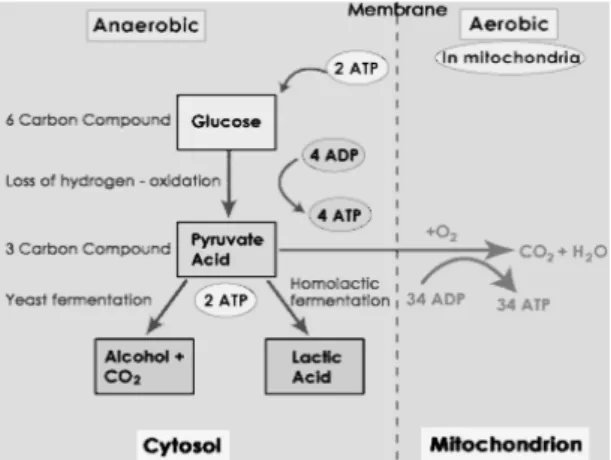
Fig. 3. Anaerobic vs. Aerobic pathways.
3.2 Cellulase
Cellulase dosage of 10 FPU/g cellulose is often used in laboratory studies because it provides a hydrolysis profile with high levels of glucose yield in a reasonable time (48–72 h) at a reasonable enzyme cost 46).
Cellulase enzyme loadings in hydrolysis vary from 7–
33 FPU/g substrates, depending on the type and substrates concentration. Addition of surfactants during hydrolysis is capable of modifying the cellulose surface property and minimizing the irreversible binding of cellulase on cellulose. The surfactants used in the enzymatic hydrolysis include nonionic Tween 20, 80 47), polyoxyethylene glycol 48), Tween 81, Emulgen 147, amphoteric Anhitole 20BS, cationic Q-86W 49), sophorolipid, rhamnolipid, and bacitracin 50). Inhibitory effects have been observed with cationic Q-86W at high concentration and anionic surfactant Neopelex F-25 49). Therefore, nonionic surfactants are considered to be more suitable for enhancing the cellulose hydrolysis.
Cellulases can be recovered more from the liquid supernatant than the solid residues. Enzyme recycling can effectively increase the rate and yield of the hydrolysis and lower the enzyme cost 51).
3.3 Inhibitor of cellulase activity
Cellulase activity is inhibited by cellobiose and to a lesser extent by glucose. Several methods have been developed to reduce the inhibition, including the use of high concentrations of enzymes, the supplementation of β-glucosidase during hydrolysis, and the removal of sugars during hydrolysis by ultrafiltration or simultaneous saccharification and fermentation 35).
4. Ethanolic fermentation
A variety of micro-organisms (bacteria, yeast, or fungi) ferment carbohydrates to ethanol under oxygen-free conditions 52). These microorganisms can typically use the most common 6-carbon sugars,
glucose. During fermentation, both C5 and C6 sugars are fermented to ethanol under anaerobic/aerobic conditions as stated in fig. 3. Historically, yeast (S.
cerevisiae) was used to ferment C6 sugars. Similarly, Zymomonas mobilis also efficiently produces bioethanol from the hexose sugars, glucose and fructose but not from pentose sugars, although a xylose-fermenting Z.
mobilis was generated by introducing a xylose metabolizing pathway from Escherichia coli 34).
Other engineered microbes like E. coli have also been developed which can ferment both C6 and C5 sugars.
Based on the different combinations of technologies adopted at the pretreatment, hydrolysis, and fermentation stages of ethanol synthesis, several integrated technologies have also evolved recently due to the developments in the area of biotechnology. Therefore, cellulosic biomass materials containing high levels of glucose or precursors are the easiest to convert to bioethanol 10).
5. Conclusions
Cellulose conversion is optimized using response surface methods with pH, enzyme loading, solid percentage, and temperature as factor variables. High ethanol yield and low production cost need optimization of saccharification and fermentation processes. An
efficient direct fermentation of amorphous cellulose to ethanol is achieved by developing a yeast strain co-displaying of cellulolytic enzymes. Combination of cellulases with various functions is effective in producing efficient degradation for cellulose hydrolysis.
The intension of this review is to improve the ability to catalyze cellulose degradation for saccharification and its fermentation to high yield ethanol by using bacteria or yeast.
Acknowledgement
This study was carried out with the support of
‘Forest Science & Technology Projects’ (Project No.03-2009-0136) provided by Korea Forest Service.
Literature Cited
1. Yu, Z. and Zhang, H., Ethanol fermentation of acid-hydrolyzed cellulosic pryolysate with, Bioresource Technology. 93:199-204 (2004).
2. Sheoran, A., Yadav, B.S., Nigam, P. and Singh, D., Continuous ethanol production from sugarcane mo- lasses using a column reactor of immobilized S. cer- evisiae HAU-1, Journal of Basic Microbiology.
38:123-128 (1998).
3. Mooney, C. A., Mansfield, S. D., Touhy, M. G. and Saddler, J. N., The effect of initial pore volume and lignin content on the enzymatic hydrolysis of soft- woods, Bioresource Technology. 64(2):113–119 (1998).
4. Chernoglazov, V. M., Ermolova, O. V. and Klyosov, A. A., Enzyme and Microbial Technology. 10:503–
507 (1988).
5. Converse, A. O., Ooshima, H. and Burns, D. S., Applied Biochemistry and Biotechnology. 24–
25:67–73 (1990).
6. Sewalt, V. J. H., Glasser, W. J. and Beauchemin, K.
A., Journal of Agricultural and Food Chemistry.
45:1823–1828 (1997).
7. Pan, X., Xie, D., Gilkes, N., Gregg, D. J. and Saddler, J. N., Strategies to enhance the enzymatic hydrolysis of pretreated softwood with high residual lignin con-
tent, Applied Biochemistry and Biotechnology. 121 –124:1069–1079 (2005).
8. Berlin, A., Balakshin, M., Gilkes, N., Kadla, J., Maximenko, V., Kubo, S. and Saddler, S.J., Inhibition of cellulase, xylanase and β-glucosidase activities by softwood lignin preparations, Journal of Biotechnology. 125:198–209 (2006).
9. Palonen, H., Tjerneld, F., Zacchi, G. and Tenkanen, M., Adsorption of Trichoderma reesei CBH I and EG II and their catalytic domains on steam pretreated softwood and isolated lignin, Journal of Biotechnology.
107:65–72 (2004).
10. Zhang, Y.H. and Lynd, L.R., Toward an aggregated understanding of enzymatic hydrolysis of cellulose:
noncomplexed cellulase systems, Biotechnol Bioeng.
88:797–824 (2004).
11. Wyman, C.E., Ethanol from lignocellulosic biomass:
technology, economics, and opportunities, Bioresour Technol. 50:3–15 (1994).
12. Hamelinck, C.N., van Hooijdonk, G. and Faaij, A.P.C., Ethanol from lignocellulosic biomass: tech- no-economic performance in short-, middle- and long-term, Biomass Bioenergy. 28:384–410 (2005).
13. Demirbas, A., Ethanol from cellulosic biomass re- sources, Int J Green Ener. 1:79–87 (2004).
14. Demirbas, A., Bioethanol from cellulosic materials: a renewable motor fuel from biomass, Energy Sources.
27:327–337 (2005).
15. Saeman, J.F., Ind. Eng. Chem. 37 (1):43 (1945). DOI:
10.1021/ie50421a009
16. Rodriguez-Chong, A., Ramirez, J. A., Garrote, G. and Vazquez, M., J. Food Eng. 61:143 (2004). DOI:
10.1016/S0260-8774 (03)00080-3
17. Graf, A. and Koehler, T., Oregon cellulose-ethanol study: an evaluation of the potential for ethanol pro- duction in Oregon using cellulose based feedstocks.
Salem, Oregon, USA: Oregon Dept of Energy, p:96 (2000) [Cited; available from: /www.ethanol-gec.
org/information/briefing/20aS].
18. Badger, P.C., Ethanol from cellulose: a general re- view, In: Janick J, Whipkey A, editors. Trends in new crops and new uses, Alexandria, VA: ASHS Press, pp:17–21 (2002).
19. Farone, W. A. and Cuzens, J.E., US Pat. 5, 562, 777 (1996).
20. Jeffries, T.W. and Jin, Y.S., Ethanol and thermotol-
erance in the bioconversion of xylose by yeasts, Adv Appl Microbiol. 47:221–68 (2000).
21. Beguin, P. and Aubert, J.P., The biological degrada- tion of cellulose, FEMS Microbiol. Rev. 13:25–58 (1994).
22. Pan, X., Gilkes, N. and Saddler, J.N., Effect of acetyl groups on enzymatic hydrolysis of cellulosic sub- strates, Holzforschung. 60:398–401 (2006).
23. Sternberg, D., Production of cellulase by Trichoderma, Biotechnol. Bioeng. Symp. pp.35–53 (1976).
24. Fan, L.T., Gharpuray, M.M. and Lee, Y.H., Cellulose Hydrolysis, Biotechnology Monographs. Springer, Berlin, p.57 (1987).
25. Duff, S.J.B. and Murray, W.D., Bioconversion of for- est products industry waste cellulosics to fuel etha- nol: a review, Bioresour. Technol. 55:1–33 (1996).
26. Gusakov, V., Salanovich, T.N., Antonov, A.I., Ustinov, B.B., Okunev, O.N. and Burlingame, R., Design of highly efficient cellulase mixtures for en- zymatic hydrolysis of cellulose, Biotechnol Bioeng.
97:1028–38 (2007).
27. Pan, X., Arato, C., Gilk, N., Gregg, D., Mabee, W. and Pye, K.l., Biroefining of softwoods using ethanol or- ganosolv pulping: Preliminary evaluation of process streams for manufacture of fuel grade ethanol and co-products, Biotechnol Bioeng. 90:473–81 (2005).
28. Krassig, H.A., Cellulose: Structure, accessibility, and reactivity, Gordon and Breach Science Publishers S.A. 6-13:187-205 (1993).
29. Chandel, A.K., Es, C., Rudravaram, R., Narasu, M.L., Rao, L.V. and Ravindra, P., Economics and environ- mental impact of bioethanol production technologies:
an appraisal, Biotechnol Molec Biol Rev. 2:14–32 (2007).
30. Chen, H. and Jin, S., Effect of ethanol and yeast on cel- lulase activity and hydrolysis of crystalline cellulose, Enzyme Microb Technol. 39:1430–1432 (2006).
31. Saha, B.C. and Cotta, M.A., Ethanol production from alkaline peroxide pretreated enzymatically saccharifi ed wheat straw, Biotechnology Progress. 22:449–
453 (2006).
32. Farid, T., Dimitar, K. and Irini, A., Production of bio- ethanol from wheat straw: An overview on pretreat- ment, hydrolysis and fermentation, Bioresource Technology. 101:4744–4753 (2010).
33. Krishna, S.H., Reddy, T.J. and Chowdary, G.V.,
Simultaneous saccharification and fermentation of lignocellulosic wastes to ethanol using a thermoto- lerant yeast, Bioresource Technology. 77(2):193–
196 (2001).
34. Ohgren, K., Bura, R., Lesnicki, G., Saddler, J. and Zacchi, G., A comparison between simultaneous sac- charification and fermentation and separate hydrol- ysis and fermentation using steam-pretreated corn stover, Process Biochemistry. 42:834-839 (2007).
35. Sun, Y. and Cheng, J., Hydrolysis of lignocellulosic materials for ethanol production: a review, Bioresource Technol. 83:1–11 (2002).
36. Huang, L.P, Jin, B., Lant, P. and Zhou, J., Simultaneous saccharification and fermentation of potato starch wastewater to lactic acid by Rhizopus oryzae and Rhizopus arrhizus, Biochem Eng J.
23:265–276 (2005).
37. Wright, J.D., Ethanol from lignocellulosics: an over- view, Energy Progress. 84:71-80 (1988).
38. Cantwell, B.A., Sharp, P.M., Gormley, E. and Mcconnell, D.J., Molecular cloning of bacillus β -glucanases. In: Aubert, J.P., Beguin, P., Millet, J.
(Eds.), Biochemistry and Genetics of Cellulose Degradation. Academic Press, San Diego, CA, pp:181–201 (1988).
39. Durand, H., Baron, M., Calmels, T. and Tiraby, G., Classical and molecular genetics applied to T. reesei for the selection of improved cellulolytic industrial strains. In: Aubert, J.P., Beguin, P., Millet, J. (Eds.), Biochemistry and Genetics of Cellulose Degradation.
Academic Press, San Diego, CA, pp:135–151 (1988).
40. Lynd, L.R., Zyl, W.H., McBride, J. E., Laser, M. and Strobel, M., Cellulose conversion by consolidated bi- oprocessing, Curr. Opin. Biotechnol. 16:577-583 (2005). DOI: 10.1016/j.copbio.2005.08.009 41. Orpin, C.G., Genetic approaches to the improvement
of lignocellulose degradation in the rumen. In:
Aubert, J.P., Beguin, P., Millet, J. (Eds.), Biochemistry and Genetics of Cellulose Degradation. Academic Press, London, pp:171–179 (1988).
42. Cheung, S.W. and Anderson, B.C., Laboratory inves- tigation of ethanol production from municipal pri- mary wastewater, Bioresour. Technol. 59:81–96 (1997).
43. Huang, X.L. and Penner, M.H., Apparent substrate in-
hibition of the T. reesei cellulase system, J. Agric.
Food Chem. 39:2096–2100 (1991).
44. Penner, M.H. and Liaw, E.T., Kinetic consequences of high ratios of substrate to enzyme saccharification systems based on Trichoderma cellulase. In:
Himmel, M.E., Baker, J.O., Overend, R.P. (Eds.), Enzymatic Conversion of Biomass for Fuels Production. American Chemical Society, Washington, DC, pp:363–371 (1994).
45. McMillan, J.D., Pretreatment of lignocellulosic bio- mass, In Enzymatic Conversion of Biomass for Fuels Production; Himmel, M.E., Baker, J.O., Overend, R.P., Eds.; ACS: Washington DC, USA, pp.292-324 (1994).
46. Gregg, D.J. and Saddler, J.N., Factors affecting cellu- lose hydrolysis and the potential of enzyme recycle to enhance the efficiency of an integrated wood to etha- nol process, Biotechnol. Bioeng. 51:375– 383 (1996).
47. Wu, J. and Ju, L.K., Enhancing enzymatic saccha- rification of waste newsprint by surfactant addition,
Biotechnol. Prog. 14:649–652 (1998).
48. Park, J.W., Takahata, Y., Kajiuchi, T. and Akehata, T., Effects of nonionic surfactant on enzymatic hy- drolysis of used newspaper, Biotechnol. Bioeng.
39:117–120 (1992).
49. Ooshima, H., Sakata, M. and Harano, Y., Enhancement of enzymatic hydrolysis of cellulose by surfactant, Biotechnol. Bioeng. 28:1727–1734 (1986).
50. Helle, S.S., Duff, S.J.B. and Cooper, D.G., Effect of surfactants on cellulose hydrolysis, Biotechnol.
Bioeng. 42:611–617 (1993).
51. Mes-Hartree, M., Hogan, C.M. and Saddler, J.N., Recycle of enzymes and substrate following enzy- matic hydrolysis of steam pretreated aspen wood, Biotechnol. Bioeng. 30:558–564 (1987).
52. Lynd, L.R., Overview and evaluation of fuel ethanol from cellulosic biomass: technology, economics, the environment, and policy, Annu Rev Energy Env, 21:403-465 (1996).