Journal of Internet Computing and Services(JICS) 2018. Feb.: 19(1): 19-26 19
Design and Implementation of Customized Protocol and Smartphone App for the All-in-One Sensor Device
☆방 정 호1 이 송 연1 백 종 호1*
Jong-ho Bang Song-Yeon Lee Jong-Ho Paik
요 약
최근 범세계적으로 환경 오염에 대한 사회적 관심이 지속적으로 증가하고 있는 추세이다. 특히, 실내외 환경 요소 측정과 데이터 관리를 편리하고 효과적으로 할 수 있는 서비스 요구가 증가하고 있다. 이러한 요구에 따라, 실내외에서 환경 요소를 측정할 수 있는 센서들이 개발되어 왔다. 그러나, 센서는 독립적인 모듈로 구성되어 있기 때문에, 각 센서에서 출력되는 데이터 인터페이스가 서로 다르다. 본 연구에서는, 이 문제를 해결하기 위해 블루투스를 사용하는 스마트폰과 All-in-One 센서 디바이스 보드간 저전력 근거리 무선 통신에 적합한 전용 프로토콜을 제안하고, 블루투스를 통한 사용자 스마트폰과 인터페이스의 성능을 측정하기 위한 검증 프로 그램을 개발하여 제안된 전용 프로토콜에 대한 성능을 분석한다. 또한, 제안된 프로토콜을 사용하는 스마트폰 앱을 구현하여 사용자 가 요구하는 구체적인 서비스를 제시한다.
☞ 주제어 : 센서 장치, 블루투스, 프로토콜, 사물인터넷, 스마트폰 앱
ABSTRACT
Social issues for environmental pollution are continuously increasing globally. Especially, Users require services to measure environmental factors in indoor and outdoor and manage related data effectively and conveniently. According to this demand, sensors that can measure environmental factors in indoor and outdoor have been developed. However, since one sensor is composed of independent module, the interface of output data from each sensor is different. To solve the problem, we propose a customized protocol for low-power short-range wireless communication between smartphone using Bluetooth and All-in-One sensor device board and analyze the performance of the proposed customized protocol by developing program for performance verification of interface with user smartphone through Bluetooth. In addition, we implement a smartphone application using proposed protocol.
☞ keyword : Sensor device, Bluetooth, Protocol, Internet of Thing, Smartphone application
1. Introduction
Due to the rise of the Internet of Things (IoT) recently, through the link between the IoT and smart device, various attempts are being made to provide same the livelihood connected sensor app service as process or control of collected information from surrounding sensors [1, 2, 3].
As social issues about the environment and quality of life have increased, global demand for improvement of 1 Department of Software Convergence, Seoul Women's University,
621 Hwarang-ro, Nowon-gu, Seoul 01797, Korea.
* Corresponding author ([email protected])
[Received 29 August 2017, Reviewed 6 September 2017(R2 22 November 2017, R3 26 December 2017), Accepted 3 January 2018]
☆ A preliminary version of this paper was presented at ICONI 2016 and was selected as an outstanding paper.
☆ This work was supported by a research grant from Seoul Women's University(2017).
environmental pollution has been increasing steadily. In order to prepare for this, they are making efforts to invest in environment-related technologies and policies in various fields. Especially, in the technical field, devices that can measure environmental factors in indoor and outdoor have been introduced. However, the sensors for existing environmental factors such as temperature, humidity, and illumination are composed of individual module. That is, the interface of the output data from each sensor is different.
Therefore, in order to collect many types of environmental data, the use of various modules is inevitable. But costs and times are increased to optimize the integration of the sensor modules.
In order to solve this problem, it is required to develop the All-in-One sensor board which is capable of integrating and transmitting data with a single interface instead of the different types of interfaces provided by the sensor modules.
ISSN 2287-1136 (Onine) http://www.jksii.or.kr
In particular, in order to effective data communication, the All-in-One sensor device board and the smartphone that we propose require a customized protocol for the user.
Therefore, the cost is low and the measured sensor data can be transmitted to the smartphone at 2~4 times faster than existing system with different types of interfaces. Also, the All-in-One sensor device has high stability and compatibility and provides users with the convenience of monitoring and can gather information fast and exactly.
So, in this paper, we propose a design method of customized protocol for low-power short-range wireless communication between smartphone and the All-in-One sensor device board using Bluetooth. Also, based on this, we implement smartphone application that can couple with a portable status measurement device based on Bluetooth.
In Section 2, we discuss trend and overall scope of the development technology. Design method of customized protocol and data parsing process is proposed in Section 3.
Smartphone application functions and UIs are presented in Section 4 and finally we conclude this paper in Section 5.
2. Trend and Overall Scope of Development Technology
2.1 Related Development Technology Trend The Ministry of Environment is forcing to manage indoor air quality in multI-use commercial facilities including all underground facilities. New technologies and products are being developed by USN companies to prepare for this.
Due to the government`s policy support and the vigorous Industry-academic cooperation, the domestic environment market is rapidly expanding. In particular, the hypersensitivity and high performance sensor technology has been actively developed, and lately, the technologies has become increasingly diverse, such as electronic nose, electronic tongue, and nano technology. Domestic companies in Korea are also struggling with the government`s policy support, but they are still inadequate.
The remote monitoring system is used in many areas as well as in the environment, but the remote monitoring and management/control in indoor environments is being used very sparingly in the case of foreign countries.
Recently, Japan and China proposed a mobile wireless access system capable of covering various applications such as environment monitoring, forecasting, meteorological observation, stolen object tracking, monitoring of gas/water/electricity use, public security, health care, remote control and monitoring of plant facilities, disaster prevention and measurements, intelligent transportation and traffic management in the ITU-R standardization and the standardization is under way in WP 5A.
Regarding to measuring sensor related markets, the Environmental Technology Trend Report (sensor / environment chip technology trend) has been analyzed for outlook of the related export and import substitution effects, as well as the size of the domestic USN market [4, 5].
The global environment related market is 580 Billion dollars (2000 basis) and it is growing by more than 5 % each year, and the domestic environmental instrumentation market is very low at around 1.8 % of the global market, but the environment related markets are rapidly growing amid accelerated atmospheric pollution regulations and accelerated environmental pollution. and global environmental biosensor related markets [6, 7].
2.2 Scope of Development Technology In this paper we assume that the combinable multi-functional portable status measurement device is the alarm service system which provides analysis results for temperature, humidity, illumination, smoke and flame in indoor and outdoor environment to users in the real time.
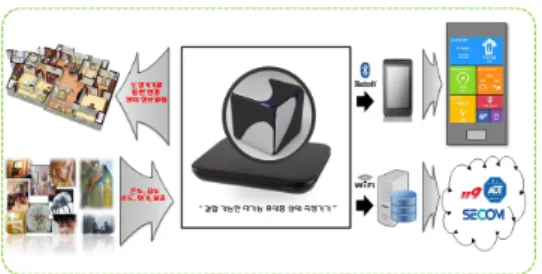
Fig. 1 shows a alarm service system using Bluetooth and WiFi module that provides various status information in indoor and outdoor environment through transmitting analysis results into user's smartphone directly.
The main factor of above mentioned system is to simultaneously measure temperature, humidity, illumination, smoke or flame and to notice the alarm function for safety and the monitoring with smartphone. Therefore this system is helpful for children and elders who live alone, which can provide information of safe and pleasant environment.
After the combinable multi-functional portable status measurement device provides the alarm service to user device at first, if there is no any response from user device, that data is transmitted to analysis server and the server
reports the associated agency based on the transmitted data.
We expect that this system keep the safety of children and elder who live alone in residential space [8].
(Fig.1) Combinable Multi-functional Portable Status Measurement System
3. Design of Customized Protocol and Data Parsing Process 3.1 Design of Customized Protocol
(Fig. 2) Functional diagram of Environmental Measurement system
The ATxmega 128 is used as the main processor of multi-functional device, which is the best among 8 bits MCUs considering low power consumption and multi-functional resource. The interface between temperature or humidity sensor and MCU uses the 2 line serial method, 12C method with 400kbps for the illumination sensor, 12 bit ADC for the flame/smoke sensor.
Fig. 2 shows that the SPP (Serial Port Profile) among Bluetooth protocols is used to communicate between the All-in-One device and the smartphone. The setting of parameters for SPP communication to define uses the same method as the normal UART or RS-232 approach. This method serves as a way for users to search for portable devices as a Bluetooth device, and to collect initial setup information or real-time surveillance data to operate portable devices. Thus, the communication device becomes a user's smartphone, and the portable measurement device transmits event data to the smartphone only if it is paired in case of event.
The parameters for SPP to communicate are defined as follows.
-Baudrate : 115200 bps -Data width : 8bit -Parity Bit : None -Stop Bit : 1bit -Flow Control : None
The basic structure of frame to be used in communications is shown in Table 1.
(Table 1) Basic structure of each frame Sync Length cmd/repo/evt data Check
Sum End
0x02 VAR Predefined VAR LRC 0x03
* Sync : It indicates the beginning of the Start Of Text(STX) packet. The value is fixed by 0x02.
* Length : It indicates the sum of Cmd/Respo/Evt length and Data length. The minimum value is 1 Byte of Cmd/Respo code and has up to 255 Bytes.
* Cmd/Respo : User's smartphone transmits Command code as a master and measurement device transmits Response code as a slave. And measurement device transmits Event code when events occur on the measurement device.
* Data : It indicates the field to send parameters related to the command when user's smartphone transmits a Command to the measurement device. It indicates setup of information transmitted from smartphone or receiving of input data and normal or error for execution when the measurement device responds, and indicates transmitting field for measurement data when smartphone requires measurement information.
* CheckSum : It indicates the value selected from Length to Data.
* End : It indicates the end of the End Of Text(ETX) packet.
Regarding to this, we classify the device setup, measurements, and information. Important packets can be defined as follows:
1) Command & Response packet
* Set_Dev_Name
- Length : 17Byte (Command code 1 + device name 16) - Command : 1Byte (0x10 – setting the nickname of
device)
- Data : ASCII 16 Byte (device name)
- CheckSum : 1byte (Exclusive OR for data values between Sync and End)
This is a command packet for setting the device name among the detailed command and response of device setup information. The command code called response is returned as a normal response and the error response is returned as a wrong response.
(normal response)
Sync Length Response Data CheckSum End
0x02 0x01 0x10 None 0x11 0x03
(error response)
Sync Length Response Data CheckSum End
0x02 0x01 0xFE Error
Code
var 0x03
2) Sensor measurement information response packet
* Get_Evn_Status
- Length : 1Byte(Command code 1)
- Command : 1Byte(measured environment variables information request)
- Data : NONE
- CheckSum : 1Byte (Exclusive OR for data values between Sync and End)
The case of a packet that requires information of the environment variables among the detailed definition and response of information measured in sensor follows the Table 2.
(Table 2) information request packet of environment variables
Sync Length Response Data CheckSum End
0x02 0x0C 0xA0 ASCII
Byte
VAR 0x03
* Length : 12Byte (Response code 1 + measurement value information 11)
* Response : 1Byte(0xA0 return of Command code)
* Data : 11Byte(ASCII) changes information from sensor into 1~3bytes information and returns them.
* CheckSum : 1Byte (Exclusive OR for data values between Sync and End)
3.2 Data Parsing Process
(Fig. 3) Flow Chart for Data Parsing Process
In Fig. 3, first of all, read 256 bytes from the saved list.
After reading first two bytes among 256 bytes, compare them with the command byte defined as sync byte, 0x02. If they match each other, then 256 bytes read from the saved list are stored in the buffer. After the value of data length defined as one byte in the buffer is read and the bytes as many as length value are parsed, next 1 byte is read to interpret the command byte in case that the result value of XOR operation between parsed data and checksum byte is 0.
Next, we can process the data bytes as much as length value. If the result value of XOR operation between parsed
data and checksum byte is 1, the process from the first is repeated to read 256 bytes again.
3.3 Example Codes
Fig. 4 shows the source code for status measurement data protocol parsing. The portable status measurement device requests status data such as temperature, humidity, and illumination, and after parsing the status data transmitted according to the defined protocol, is transmitted to the users.
3.4 Performance Verification
We developed the program for performance verification of interface with user smartphone through Bluetooth. As shown in Table 3, the communication speed for interface connection in cradle system was measured and total two commands were used. The measurement results showed that the proposed protocol can sufficiently satisfy the requirement for communication.
(Table 3) Communication Speed for Interface Connection
Item current
temperature
current humidity
number of times 5 bytes average 427.6 μs 427.6 μs 5 times
1 byte average 85.6 μs 85.6 μs 5 times
* communication speed: 115,200 bps
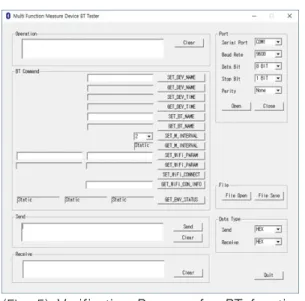
Fig. 5 shows the verification program for BT function test. various functions on tester are specified as following:
- Port signifies the serial port information set up to communicate (This system uses the SPP communication method)
- Operation signifies the data output from BT device.
For example, in case of response for Set Dev Name command, output data will be 02 11 10 4E 41 52 45 00 00 00 00 00 00 00 00 00 00 00 00 32 03 (output data is the hexadecimal number)
- BT Command signifies the device setting informations (such as device time, data receiving time interval, WiFi information to set up) are transmitted to the connected BT device when the right button is push
- Send signifies the sending function, after entering the text message to send to BT device, except setting value.
(Fig. 4) Data Parsing Source Code for Data Request and Transmission
(Fig. 5) Verification Program for BT function Test
4. Smartphone Application Functions
4.1 Application Functions
Fig. 6 indicates that temperature, humidity, illumination, flame and smoke sensors. This is embedded portable status measurement device. Through this device, users can check their surrounding environment in real-time.
After measuring the status, the data is transmitted using the specific protocol, via Wi-Fi for indoors and Bluetooth for outdoors.
1) Alarm function for abnormal data appearance
Following the standard recommendations from the Ministry of Environment, if the real time data turns out to be abnormal, the smartphone application gives the alarm.
This function ensures the users against the environmental risks.
2) Visualization for history records of sensor data information
By processing the gathered data, the big data for given facilities like Welfare Facilities for the aged, daycare facilities and medical facilities can be formed. Utilizing the accumulated sensor data, we can increase the necessity of All-in-One sensor device by applying sensors appropriate for
each user’s environment.
3) Control function for the portable status measurement device Through the mentioned smartphone application, users can control the device with no bounds on time and place. This property enhances usability.
4) Interworking function between other services and gathered data through API
The events occurred without user’s awareness can be reported to the certain institution through the API. Using this function, we can increase safety for a second-class citizen’s dwelling space.
(Fig. 6) The Conceptual Diagram between Portable Status Measurement Device and Smartphone Application
4.2 Application UIs (User Interfaces) We introduce various application UIs which are required in daily life in Fig 7.
1) Main screen - current status
You can check current temperature / humidity / illumination in door which All-in-One device measures through current status tap. The below graph shows each temperature/
humidity/illumination values measured at interval of 3 hours a day.
2) A week's record
The humidity value and the lowest/highest temperature value of one week are stored in an embedded database and displayed as a list.
3) Set-up
Since All-in-One device and smartphone communicate through Bluetooth basically, the Bluetooth can be connected through Bluetooth in of setup window. You can set up the name of All-in-One device/time/Bluetooth connection name/data load interval through the application. WiFi connection function can be used to connect AP and the device so that All-in-One device stores measured values in server.
4) Push Alarm
When the All-in-One device senses flame and smoke (fire), push alarm is displayed on smartphone and you can check the alarm record on the bottom of the setup window through cardview.
1) current status 2) a week's record
3) set-up 4) push alarm (Fig. 7) Implemented Smartphone App’s UI
5. Conclusions
In this paper, we proposed the design method of the customized protocol for low-power short-range wireless communication between smartphone and All-in-One sensor device board using SPP among Bluetooth profiles. And we analyzed the performance of the proposed customized protocol by developing program for performance verification of interface with user smartphone through Bluetooth. Based on these, we also presented the smartphone application that can work with Bluetooth-based portable status measurement device in order to transmit various types of sensor data with only one interface.
참고문헌(Reference)
[1] Soo Son, Seok Park, "Design and Implementation of Smart Gardening System Using Real-Time Visualization Algorithm Based on IoT," Journal of Internet Computing and Services (JICS), vol. 16, no.
6, pp. 31-37, December 2015.
http://dx.doi.org/10.7472/jksii.2015.16.6.31
[2] Hyung Park, Sangmin Lee, "IoT Based Performance Measurement of Car Audio Systems in Korea Recreation Vehicles," Journal of Internet Computing and Services (JICS), vol. 18, no. 1, pp. 57-64, February 2017. http://dx.doi.org/10.7472/jksii.2017.18.1.57 [3] Jae-Hyun Son, Yoon-gi Yang, Hee-Jung Byun,
“Bio-inspired Node selection and Multi-channel Transmission algorithm in wireless sensor Networks,” Journal of Internet Computing and Services (JICS), vol. 15, no. 5, pp. 1-7, October 2017. http://dx.doi.org/10.7472/jksii.2014.15.5.01 [4] Korea Environmental Industry & Technology
Institute, “Environment Technology Trend Survey &
Future Environment New Technology Outlook,"
2007. http://www.keiti.re.kr/en/index.do
[5] The Ministry of Environment, "Environmental Reports,"
2011. http://www.me.go.kr/home/web/main.do [6] Korea Environmental Industry & Technology
Institute, "Environmental Technology Trend Reports:
Water Quality Sensor/Environmental Chip Technology Trend," 2007.
◐ 저 자 소 개 ◑
방 정 호(Jong-Ho Bang)
1990년 중앙대학교 공과대학 전자공학과(공학사)
1997년 Polytechnic Institute of New York University, Electrical Engineering(공학석사) 2001년 New Jersey Institute of Technology(NJIT), Electrical Engineering(공학박사) 2001년~2015년 삼성전자 종합기술원 수석연구원
2015년~2016년 성균관대학교 휴먼ICT융합학과 산학협력교수
2016년~현재 서울여자대학교 미래산업융합대학 소프트웨어융합학과 조교수 관심분야 : IoT, 무선통신네트워크, etc.
E-mail : [email protected] 이 송 연(Song-Yeon Lee)
2017년 서울여자대학교 멀티미디어학과 (공학사) 2017년 서울여자대학교 컴퓨터학과 (공학석사과정)
관심분야 : 차세대 방송통신 시스템, 차세대 영상시스템, IoT, etc.
E-mail : [email protected]
백 종 호(Jong-Ho Paik) 1994년 중앙대학교 전기공학과(공학사) 1997년 중앙대학교 대학원 전기공학과(공학석사) 2007년 중앙대학교 대학원 전자전기공학과(공학박사) 1997년~2011년 전자부품연구원 모바일단말연구센터 센터장
2011년~현재 서울여자대학교 미래산업융합대학 소프트웨어융합학과 부교수 관심분야 : 차세대 방송통신 시스템, 차세대 영상시스템, 소프트웨어 테스팅, IoT, etc.
E-mail : [email protected] http://www.keiti.re.kr/en/index.do
[7] Frost and Sullivan, "World Biosensors Markets,"
2007. https://ww2.frost.com/
[8] Y. Oh, S. Lee, “IoT and the open source development platform,” J. of the Korean Institue of
Information Scientists and Engineers, vol. 32, no. 6, pp. 25-30, June 2014.
https://www.dbpia.co.kr/Journal/ArticleDetail/
NODE02433151