ISSN(Print):1738-7248, ISSN(Online):2287-7428 Korean J. Food Preserv.
23(4), 479-487 (2016)
http://dx.doi.org/10.11002/kjfp.2016.23.4.479
- 479 -
Effect of 1-methylcyclopropene and ethylene-absorbent treatments on quality changes of Prunus mume fruit during storage
Dae-Hyun Kim, Jung Mi Bae, Jin Ju Park, Jeong Hee Choi, Kyung Hyung Ku, Jeong-Ho Lim*
Korea Food Research Institute, Seongnam 13539, Korea
1-MCP 처리 및 에틸렌 흡착제가 ‘백가하’ 매실 저장에 미치는 영향
김대현․배정미․박진주․최정희․구경형․임정호*
한국식품연구원
Abstract
This study was conducted to investigate the effect of 1-methylcyclopropene (1-MCP) and ethylene-absorbent on the qualities of Prunus mume fruit. Prunus mume fruits were stored without film packaging (Cont), packed in LDPE film (Cont-P), and packed with ethylene-absorbent (Cont-PE). Fruits were treated with 1-MCP (1 ppm) for 24 hr at 1℃. After treatment, fruits were packed in LDPE film (MCP-P) and with ethylene-absorbent (MCP-PE) and then stored at 1℃ for 8 weeks. Total soluble solids increased during storage but decreased after 6 weeks while total acidity decreased during storage. Cont was almost completely decayed after 8 weeks of storage while Cont-P, Cont-PE, MCP-PE, and MCP-P were 46, 69, 83, and 5% decayed, respectively. L value decreased but a value increased during storage in all samples. Firmness of peel and flesh of samples decreased gradually for 8 weeks. Respiration rate did not show any significant difference among samples. Ethylene production of Cont showed 0.05 μL/kg/h but immediately after 1-MCP treatment, it showed 0.02 μL/kg/h. Oxalic and malic acids decreased while citric acid increased during storage; fructose and glucose substantially decreased after 8 weeks whereas sorbitol and sucrose increased upto 4 weeks and then decreased thereafter. Based on these results, packing the fruits treated with 1-MCP could extend the freshness of Prunus mume fruit.
Key words:Prunus mume, 1-MCP, ethylene-absorbent, quality
서 론
1)
매실(Prunus mume)은 장미과에 속하는 매화나무의 열매 로 한국, 일본 및 중국 등의 온난한 지역에 널리 분포하며 succinic acid, citric acid, malic acid 및 tartaric acid 등의 유기산을 많이 함유하여 신맛이 강하고 섬유소 및 당분과 칼륨, 칼슘, 마그네슘, 나트륨 등의 무기질이 풍부한 알칼리 성 식품으로 알려져 있다(1-4). 또한 피로회복, 식욕 증진,
*Corresponding author. E-mail:[email protected] Phone:82-31-780-9331, Fax:82-31-780-9333
Received 11 April 2016; Revised 31 May 2016; Accepted 2 June 2016.
Copyright ⓒ The Korean Society of Food Preservation. All rights reserved.
정장 작용 및 간장기능 회복 등과 같이 다양한 기능성이 보고되어 있으며(5,6), 식중독 유발세균의 증식 억제 효능 (7), 항균 작용(8) 및 항돌연변이 작용(9)등이 있다는 보고가 있다.
국내 매실의 생산량 대비 가공 비율은 1990년대 후반 40%였으나, 최근 10%안팎으로 크게 감소하였다. 이는 매 실 장아찌 및 절임 등을 직접 만들어 섭취하는 소비자가 늘어나면서 가공품 소비보다 생과용 수요가 증가하였기 때문이라고 보고되어 있다(10). 매실은 사과, 바나나, 복숭 아 등과 같이 성숙기에 도달하면 호흡이 급격하게 증가하는 climacteric형 과실로 후숙이 빠르게 진행되고 호흡열이 높 아 상온에서 3~4일 내에 황변하고 조직이 급격히 연화되는 선도유지가 어려워 생과 유통의 어려움이 있다(4,11). 매실 의 선도유지를 위한 선행연구로는 저온저장, CA저장 및
포장필름에 따른 연구(12-14)등이 보고되고 있으나, 실험 기간이 한 달 이내로 짧게 이루어졌다.
Climacteric형 과실의 선도유지 연장을 위하여 1-methyl- cyclopropene(1-MCP) 및 에틸렌 흡착제는 주로 사용되는 방법이지만 수확시기, 처리농도, 처리시간 및 온도 등의 조건에 따라 다양한 결과를 나타내는 것으로 알려져 있다 (15). 1-MCP는 과실에 침투하여 에틸렌 수용체와 수용체 단백질과 결합하여 호흡률 및 에틸렌 발생을 억제시켜 저장 성을 증진시킨다고 보고된 바 있으며(16,17) 에틸렌 흡착제 는 MA포장과 함께 첨가 할 경우 포장 내 에틸렌을 제거하 여 후숙을 지연시키는 효과가 있다고 보고되었다(18).
따라서 본 연구는 후숙의 진행속도가 빠르며 수확시기별 선도유지기간에 영향을 많이 받는 매실에 1-MCP 처리 및 에틸렌 흡착제를 첨가하여 매실의 저장성에 미치는 영향 및 선도유지기간을 연구하고자 하였다.
재료 및 방법
실험재료
2015년 6월에 전라남도 광양 소재의 한 농가에서 미숙기 (개화 후 80일)에 수확된 매실 ‘백가하’ 품종을 흠집이 없는 지름 26~36 mm 크기로 선별하여 사용하였다.
1-MCP 및 에틸렌 흡착제 처리
대조구(Cont)는 수확 직후 Plastic box에 담아 저온(1℃)창 고에 저장하였다. 포장구(Cont-P)는 두께 0.04 mm의 LDPE film에 10 kg씩 포장하여 밀봉하였으며, 에틸렌 흡착제 첨 가구(Cont-PE)는 30 g씩 포장된 에틸렌 흡착제(Fresh up, Top Fresh Co., Seoul, Korea)를 LDPE film 내부에 넣은 뒤 밀봉 후 저온(1℃)창고에 저장하였다. 1-MCP 처리구는 1-MCP(Smart Fresh, Agro Fresh Inc., Norristown, USA)발생 키트를 사용하여 선행연구 결과(19)를 바탕으로 1.0 ppm 농도로 저온(1℃)창고에서 24시간 동안 밀봉 후 훈증 처리 하였다. 처리 후 포장구(MCP-P) 및 에틸렌 흡착제 첨가 후 포장구(MCP-PE)로 Cont 그룹과 동일하게 밀봉 후 저장 하였으며 2주 간격으로 8주간 실험하였다.
품질특성
매실의 품질특성으로 중량감소율, pH, 가용성 고형분 함 량, 총산도, 부패율을 측정하였다. 저장 중 중량감소율은 초기치에 대한 차이를 백분율(%)로 나타냈으며, pH 및 가 용성 고형분 함량은 매실과 증류수를 1:1로 마쇄한 후 여과 액을 pH meter(Orion model 520A, Orion Research Inc., Boston, USA)와 굴절 당도계(PAL-BX/RI, Atago Co., Ltd., Tokyo, Japan)를 사용하여 측정하였다. 총산도는 매실 과육 을 마쇄, 여과하여 얻은 여과액을 희석하여 pH값이 8.2로
되는데 소요되는 0.01 N NaOH 용액의 소비량을 구한 후 citric acid로 환산하여 총산 함량 (%, w/v)을 구하였으며, 부패율은 육안으로 외관상태의 갈변 및 연화상태를 조사하 여 백분율(%)로 나타내었다. 모든 실험은 3회 반복 실시하 였다.
색 도
색도는 분광측색계(Spectrophotometer CM-700d, Konica Minolta Optics INC., Tokyo, Japan)를 이용하여 명도(L*, lightness), 적색도(a*, redness) 및 황색도(b*, yellowness)를 측정하였다. 매실의 과피 부분을 측정하였으며 시료 당 2회, 각 그룹 당 10회 반복 시험하여 그 평균값으로 나타내었다.
경 도
경도는 Texture analyzer(TA-XT2, Stable Micro System Ltd., Godalming, UK)를 사용하여 측정하였다. 과피의 경도 는 최대 피크값을 취하였으며, 과육의 피크값은 과육의 시 작점부터 핵에 도달하기 전까지 피크값의 평균을 취하였 다. 지름이 2 mm인 probe를 사용하여 rupture test를 실시하 여 kg/cm2단위로 나타내었다. 각 실험구당 15회 반복 측정 하여 그 평균값으로 나타내었다.
호흡률 및 에틸렌 발생량
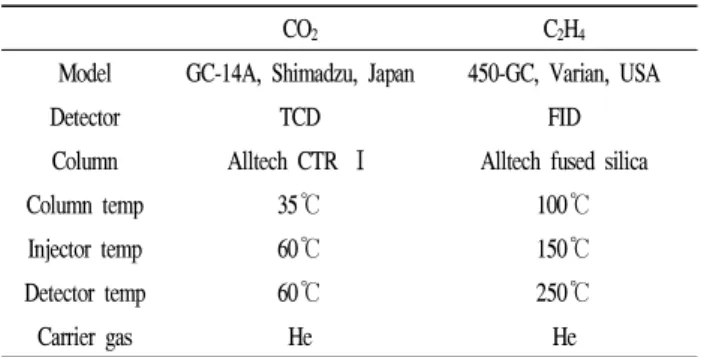
호흡률 및 에틸렌 발생량을 측정하기 위해 시료를 일정 부피의 밀폐용기에 넣어 1℃에서 약 70시간 방치 후 밀폐용 기 내부에 축적된 head space 기체 200 μL를 gas-tight syringe 로 채취한 후 gas chromatography(GC)로 분석하였다. 이산 화탄소 및 에틸렌 농도를 측정하여 호흡률 및 에틸렌 발생 량으로 나타내었다. 각 실험은 3회 반복 실시하였으며, 이 산화탄소와 에틸렌 농도 분석을 위한 GC 조건은 다음과 같다(Table 1).
Table 1. Instrumental conditions for CO2 and C2H4analysis by GC
CO2 C2H4
Model GC-14A, Shimadzu, Japan 450-GC, Varian, USA
Detector TCD FID
Column Alltech CTR Ⅰ Alltech fused silica
Column temp 35℃ 100℃
Injector temp 60℃ 150℃
Detector temp 60℃ 250℃
Carrier gas He He
유기산 및 유리당
매실의 유기산 및 유리당 함량 분석은 HPLC를 이용하여 측정하였다. 유기산 함량은 동결건조 후 분쇄한 매실 과육 0.5 g에 50배수의 증류수를 가한 뒤 shaking incubator
μ
μ
μ
Storage period (weeks)
0 2 4 6 8
L value
45 50 55 60
Storage period (weeks)
0 2 4 6 8
a value
-12 -10 -8 -6 -4 -2 0
Storage period (weeks)
0 2 4 6 8
b value
28 30 32 34 36 38
Storage period (weeks)
0 2 4 6 8
Peel firmness (kg/cm2)
2 4 6 8 10 12
Storage period (weeks)
0 2 4 6 8
Flesh firmness (kg/cm2)
2 3 4 5 6
Storage period (weeks)
0 2 4 6 8
CO2production (mL/kg/h) 0 1 2 3
Storage period (weeks)
0 2 4 6 8
C2H4 production (uL/kg/h)
-0.05 0.00 0.05 0.10
호흡률 및 에틸렌 발생량
저장 기간 중 매실의 호흡률 및 에틸렌 발생량의 변화는 Fig. 3에 나타내었다. 1-MCP는 에틸렌 수용체와 결합하여 에틸렌 작용을 억제하여 신선도를 유지하며, 호흡량의 억 제를 통해 중량 보존 및 부패를 억제하는 효과가 있는 것으 로 보고되었다(24). 매실의 경우 저장성 연장을 위해 수확 시기를 앞당겨 미숙과를 수확하여 유통 중 자연 후숙시키고 있어 수확 시기에 따른 1-MCP의 작용범위가 다를 것으로 예상된다. 본 실험에 사용된 ‘백가하’ 매실의 경우 호흡률은 저장 6주차까지 처리구별 유의적 차이는 없었다. 저장 8주 차 Cont-P 및 Cont-PE구가 1.48 및 2.49 mL/kg/h를 나타냈으 나, MCP-P 및 MCP-PE구는 1.53 및 0.24 mL/kg/h를 나타내 었다. 1-MCP처리에 의해 호흡률 및 에틸렌 생성은 항상 지연되지 않는다고 한 보고(20)와 같이 매실의 호흡률에 큰 영향을 미치지 않은 것으로 판단되었다.
에틸렌 발생량은 초기 0.05 μL/kg/h를 나타냈으나, 1-MCP처리 직후(data not shown) 0.02 μL/kg/h를 나타내어 그 수준이 미비하나 1-MCP처리가 매실의 에틸렌 작용을 억제시킨 것으로 나타났다. 1-MCP를 처리하지 않은 구는 저장기간 중 일정한 에틸렌 발생량을 나타냈으나, 1-MCP 처리구는 저장 4주차까지 감소하는 경향을 나타내었으며 저장 6주차에 0.03 μL/kg/h로 증가하는 것으로 나타났다.
이는 climacteric형 과실에 1-MCP 처리 시 에틸렌 발생량을
Table 3. Changes in organic acid ofPrunus mume fruit treated with 1-MCP and ethylene-absorbent during storage
(g/100 g, dry basis) Organic
acid Treatment Storage period (weeks)
Initial 2 4 6 8
Oxalic acid
Cont 1.53±0.001)c2)A3) 1.18±0.00bD 0.63±0.00aA -4) -
Cont-P 1.53±0.00eA 1.06±0.00dC 0.79±0.01cC 0.76±0.00bB 0.72±0.01aB
Cont-PE 1.53±0.00eA 0.98±0.00dB 0.84±0.00cE 0.79±0.01bD 0.78±0.01aC
MCP-P 1.53±0.00eA 0.91±0.00dA 0.71±0.01cB 0.64±0.00bA 0.53±0.00aA
MCP-PE 1.53±0.00eA 1.28±0.00cE 0.83±0.00bD 0.77±0.00aC 1.44±0.01dD
Malic acid
Cont 23.09±0.27cA 21.98±0.27bB 17.56±0.06aA - -
Cont-P 23.09±0.27eA 20.88±0.40dA 19.73±0.06cC 17.06±0.06bA 14.35±0.08aB
Cont-PE 23.09±0.27dA 20.79±0.43cA 20.80±0.13cD 17.93±0.07bB 14.07±0.07aA
MCP-P 23.09±0.27eA 20.90±0.28dA 18.53±0.06cB 18.15±0.09bC 15.63±0.07aC
MCP-PE 23.09±0.27cA 23.38±0.59cC 18.60±0.07bB 17.16±0.13aA 16.91±0.06aD
Citric acid
Cont 26.44±0.19aA 28.12±0.19bB 27.90±0.07bA - -
Cont-P 26.44±0.19aA 30.03±0.18bC 31.79±0.07dE 31.16±0.25cD 31.37±0.08cC
Cont-PE 26.44±0.19aA 30.80±0.19eD 29.84±0.09cB 30.18±0.06dB 28.31±0.08bB
MCP-P 26.44±0.19aA 29.86±0.20bC 30.56±0.06cC 29.92±0.07bA 31.97±0.09dD
MCP-PE 26.44±0.19bA 27.44±0.19cA 30.74±0.06dD 30.87±0.06dC 25.09±0.09aA
1)Values are means±SD.
2)a-eMeans with different letters within the same row are significantly different at p<0.05.
3)A-EMeans with different letters within the same column are significantly different at p<0.05.
4)Cannot be measured because of decay.
억제 시켜 후숙을 지연시킨다는 연구결과와 유사하였으나 (15), 에틸렌 흡착제와 함께 병용할 경우 그 효과를 나타내 지 못하는 것으로 나타났다.
유기산 및 유리당
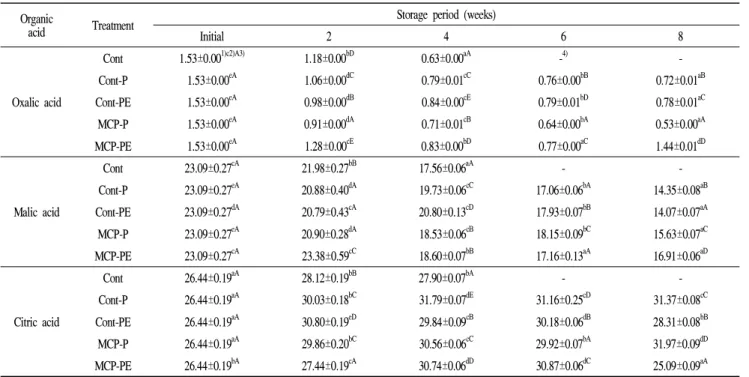
저장 중 매실의 유기산 및 유리당 함량의 변화는 Table 3~4에 나타내었다. 매실의 주요 유기산은 malic acid와 citric acid이며 기능성 성분으로서도 보고되어 있다(25-27). 주로 citric acid는 매실이 성숙함에 따라 증가하는 경향을 나타내 었으며, malic acid는 수확시기가 늦어질수록 감소하는 경 향을 나타낸다고 보고되었다(28,29). 본 연구에서는 oxalic acid, malic acid 및 citric acid를 조사하였으며, 초기함량은 각각 1.53, 23.09 및 26.44 g/100 g을 나타내었다. 저장 기간 중 oxalic acid 및 malic acid 함량은 감소하였으나, citric acid 함량은 증가 후 감소하는 경향을 나타내었다. 이는 후숙작용을 지속하며 citric acid 함량이 증가하다 부패가 진행되면서 감소하는 경향을 나타낸 것으로 선행연구와 유사하였다. 저장 4주차 대조구의 malic acid 및 citric acid 함량은 17.56 및 27.90 g/100 g으로 유의적 차이(p<0.05)를 나타내며 감소하였다. 대조구를 제외한 포장구들의 malic acid 함량은 지속적으로 감소하여 저장 8주차 14.07~16.91 g/100 g을 나타내었으며, citric acid는 저장 8주차 25.09~
31.97 g/100 g을 나타내었다. 특히 MCP-P구는 6주차에서
Effect of 1-methylcyclopropene and ethylene-absorbent on quality changes of Prunus mume fruit during storage 485
Table 4. Changes in free sugar of Prunus mume fruit treated with 1-MCP and ethylene-absorbent during storage
sugarFree Treatment Storage period (weeks)
Initial 2 4 6 8
Fructose
Cont 0.51±0.031)b2)A3) 0.59±0.02cD 0.22±0.01aD -4) -
Cont-P 0.51±0.03cA 0.49±0.06cC 0.18±0.01bC 0.08±0.01aB 0.04±0.01aA
Cont-PE 0.51±0.03cA 0.28±0.03bA 0.07±0.04aA 0.09±0.00aC 0.08±0.01aB
MCP-P 0.51±0.03eA 0.36±0.01dB 0.09±0.00aAB 0.14±0.01bD 0.19±0.03cC
MCP-PE 0.51±0.03cA 0.75±0.00dE 0.11±0.02bB 0.02±0.01aA 0.02±0.01aA
Sorbitol
Cont 1.15±0.06aA 1.34±0.00bA 1.37±0.00bA - -
Cont-P 1.15±0.06aA 1.45±0.01dB 1.53±0.01eC 1.32±0.04bB 1.37±0.01cD
Cont-PE 1.15±0.06bA 1.90±0.02dE 1.37±0.00cA 1.37±0.00cC 0.96±0.01aA
MCP-P 1.15±0.06aA 1.69±0.04dC 1.39±0.01cB 1.29±0.02bB 1.32±0.01bC
MCP-PE 1.15±0.06bA 1.75±0.02cD 1.72±0.01cD 1.09±0.01aA 1.08±0.02aB
Glucose
Cont 1.40±0.04bA 2.48±0.01cE 1.28±0.01aC - -
Cont-P 1.40±0.04dA 1.66±0.14eD 1.09±0.02cC 0.72±0.03bC 0.58±0.08aC
Cont-PE 1.40±0.04cA 0.85±0.20bA 0.77±0.01bB 0.55±0.02aB 0.43±0.03aB
MCP-P 1.40±0.04dA 1.04±0.04cB 0.68±0.06bA 0.96±0.08cD 0.45±0.06aB
MCP-PE 1.40±0.04dA 1.35±0.00dC 0.83±0.07cB 0.28±0.04bA 0.20±0.03aA
Sucrose
Cont 0.34±0.00aA 0.62±0.06bB 1.41±0.01cD - -
Cont-P 0.34±0.00aA 0.53±0.02bA 1.16±0.01eC 1.01±0.01dA 0.89±0.01cB
Cont-PE 0.34±0.00aA 0.88±0.01bD 1.03±0.00cB 1.20±0.00eA 1.04±0.00dC
MCP-P 0.34±0.00aA 0.55±0.01aA 0.97±0.16bB 1.86±0.56cB 1.20±0.01bD
MCP-PE 0.34±0.00aA 0.82±0.00bC 0.81±0.06bA 1.14±0.19cA 0.85±0.01bA
1)Values are means±SD.
2)a-eMeans with different letters within the same row are significantly different at p<0.05.
3)A-EMeans with different letters within the same column are significantly different at p<0.05.
4)Cannot be measured because of decay.
8주차의 citric acid 함량의 증가폭이 가장 높아 1-MCP처리 가 후숙을 지연시키는데 효과가 있는 것으로 나타났다.
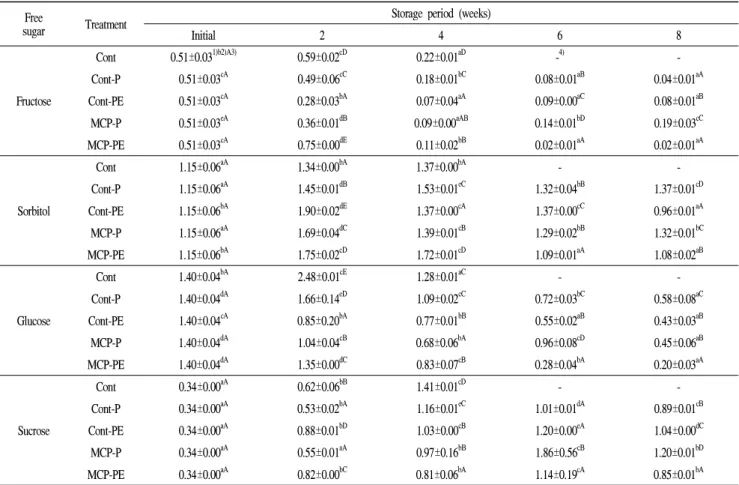
매실의 주요 유리당은 sucrose, glucose, fructose, sorbitol 등이 보고(30)되고 있으며, 단당류가 호흡기질로서 소비되 어 감소하게 되는 경향이 나타난다고 보고되었다(28). 본 연구에서는 fructose, sorbitol, glucose 및 sucrose를 조사하 였으며, 초기함량은 각각 0.51, 1.15, 1.40 및 0.34 g/100 g을 나타내었다. 저장 중 fructose 및 glucose 함량은 감소하였으 며, sorbitol 및 sucrose 함량은 증가 후 감소하는 경향을 나타내었다. 대조구의 경우 저장 2주차 glucose 함량이 2.48 g/100 g으로 급격히 증가한 뒤 저장 4주차 1.28 g/100 g으로 낮아지며 부패율 80%를 나타내었다. 대조구를 제외한 처리 구들은 sucrose 함량이 저장 6주차까지 증가하는 경향을 나타내다 부패율이 높아진 저장 8주차에 감소하는 경향을 보였으나, MCP-P구가 1.20 g/100 g으로 가장 높은 함량을 나타내었다. Sucrose함량은 성숙이 진행될수록 증가한다는 연구결과(11)와 같이 1-MCP처리가 후숙을 지연시켰다고 판단되었다. Sorbitol 함량은 저장 중 증가 후 감소하였으나 처리구별 뚜렷한 경향을 나타내지 않았다. Glucose 및
fructose 함량은 지속적으로 감소하는 경향을 나타내어, 저 장 중 호흡기질로 사용된 것으로 판단된다.
요 약
본 연구는 미숙과 ‘백가하’ 매실의 저장성 향상을 위한 1-MCP 및 에틸렌 흡착제의 효과를 조사하였다. 매실을 선 별 후 Plastic-box(Cont), LDPE 필름포장(Cont-P) 및 에틸렌 흡착제(Cont-PE)를 첨가 후 포장하였으며, 1-MCP 처리구 는 1.0 ppm 농도를 24시간 처리 후 동일한 방법(MCP-P, MCP-PE)으로 포장하여 1℃에서 8주간 저장하며 2주 간격 으로 품질특성을 분석하였다. 중량감소율의 경우 포장처리 구는 저장 중 중량감소율이 1% 이하였으며, 가용성 고형분 함량은 증가 후 감소하였으나, 총산도는 감소하는 경향을 나타내었다. 대조구의 부패율은 저장 4주차에 80%를 나타 내었으나, 포장구들은 6주차까지 10%이하를 나타내었다.
저장 8주차 MCP-P구는 5%를 나타낸 반면, 이외 처리구들 은 46%이상의 부패율을 나타내었다. 저장기간이 길어질수
록 L값은 감소하였으나, a값은 증가하였으며, 과피 및 과육 의 경도는 지속적으로 감소하였다. 호흡률은 저장 중 증가 하였으나 처리구별 유의적 차이는 없었으며, 에틸렌 발생 량은 1-MCP처리 직후 0.02 μL/kg/h을 나타내어 대조구 0.05 μL/kg/h 보다 낮은 값을 나타내었다. 저장 4주차까지 1-MCP처리구의 에틸렌 발생량은 감소하는 것으로 나타났 다. 유기산 함량의 경우 저장 중 oxalic acid 및 malic acid는 감소하는 반면 citric acid는 증가하는 경향을 나타내었다.
유리당 함량의 경우 sucrose는 저장 중 증가 후 8주차에 감소하는 반면 glucose 및 fructose 함량은 지속적으로 감소 하는 경향을 나타내었다. 이상의 결과는 미숙과 ‘백가하’
매실을 1-MCP 처리 후 밀봉하여 1℃에서 저장 할 경우 8주 동안 선도유지가 가능 할 것으로 판단된다.
References
1. Cha HS, Pack YK, Park JS, Park MW, Jo JS (1999) Changes in firmness, mineral composition and pectic substances of mume (Prunus mumeseib. et Zucc) fruit during maturation. Korean J Postharvest Sci Technol, 6, 488-494
2. Kang MY, Jeong YH, Eun JB (1999) Physical and chemical characteristics of flesh and pomace of japanese apricots (Prunus mume seib. et Zucc). Korean J Food Sci Technol, 31, 1434-1439
3. Park LY, Chae MH, Lee SH (2007) Antibacterial activity of fresh Prunus mume and Prunus mume liqueur byproduct. J Fd Hyg Saf 22, 77-81
4. Shim KH, Sung NK, Choi JS, Kang KS (1989) Changes in major components of Japanese apricot during ripening.
J Korean Soc Food Nutr, 18, 101-108
5. Kameoka H, Kitagawa C (1976) The constituents of the fruits of Prunus mumeSieb. et Zucc. Nippon Nog Kag Kaish, 50, 389-393
6. Sheo HJ, Lee MY, Chung DL (1990) Effect of Prunus mume extract on gastric secretion in rats and carbon tetrachloride induced live damage of rabbits. J Korean Soc Food Nutr, 19, 21-26
7. Bae JH, Kim KJ (1999) Effect of Prunus mumeextract containing beverages on the proliferation of food-borne pathogens. J East Asian Soc Diet Life, 9, 214-222 8. Han JT, Lee SY, Kim KN, Baek NI (2001) Rutin,
antioxidant compound isolated from the fruit ofPrunus mume. J Korean Soc Agric Chem Biotechnol, 44, 35-37 9. Dogasaki C, Murakami H, Nisjima M, Yamamoto K, Miyazaki T (1992) Antimutagenic activities of hexane
extracts of the fruit extract and the kernels of Prunus mume Sieb. et Zucc. Yakugaku Zasshi, 112, 577-584 10. Lee YS, Park MS, Shim MH, Park HW, Park JW (2015) Economic trends of agriculture and rural areas. Korea Rural Economic Institue, 1, p92
11. Cha HS, Hwang JB, Park JS, Park YK, Jo JS Lee GP, Kim JK (2006) Changes in chemical composition of mume (Prunus mume Sieb. et Zucc) fruit during maturation. Korean J Postharvest Sci Technol, 6, 481-487 12. Choi SY, Cho MA, Hong YP, Hwang IK, Chung DS, Yun SK (2011) Suppression of chilling injury and maintenance of quality characteristics in Prunus mume fruits stored under controlled atmosphere. Korean J Food Preserv, 18, 143-148
13. Cha HS, Chung MS (2002) Changes in pectic substances of mature-green mume (Prunus mume Sieb. et Zucc) fruit as influenced by the thickness of packaging film during storage. J Korean Soc Food Sci Nutr, 31, 621-628 14. Cha HS, Hong SI, Chung MS (2002) Effect of gas
absorbents on quality attributes and respiration characteristics of mature-green mume (Prunus mume Sieb. et Zucc) fruits during storage at ambient temperature.
Korea J Food Sci Technol, 34, 1036-1042
15. Blankenship SM, Dole JM (2003) 1-Methylclopropene:
a review. Postharvest Biol Technol, 28, 1-25
16. Choi SJ (2005) Comparison of the change in quality and ethylene production between apple and peach fruits treated with 1-methylcyclopropene (1-MCP). Korean J Food Preserv, 12, 511-515
17. Sisler EC, Serek M (1997) Inhibitors of ethylene responses in plants at the receptor level: Recent developments. Physiol Plant, 100, 577-582
18. Cha JH, Lee GP, Hwang BH, Kim JK, Lee EJ (2006) Effect of 1-methylcyclopropene treatment on quality and ethylene production of muskmelon (Cucumins melo L cv Reticulatus) fruit. Kor J Hor Sci Technol, 24, 452-458 19. Cho MA (2014) Set up of cold-chain and quality control system after harvest on horticultural crop in agricultural product processing center. Final Report of NIHHS, NIHHS PJ006477
20. Golding JB, Shearer D, Wyllie SG, Mcglasson WB (1998) Application of 1-MCP and propylene to identify ethylene-dependent ripening processes in mature banana fruit. Postharvest Biol Tech, 14, 87-98
21. Iwata T, Kinoshita M (1978) Studies on storage and chilling injury of japanese apricot (Mume,Prunus mume Sieb. et Zucc.) fruit Ⅱ Chilling injury in relation to
Effect of 1-methylcyclopropene and ethylene-absorbent on quality changes of Prunus mume fruit during storage 487
storage temperature, cultivar, maturity, and polyethylene packaging. J Japan Soc Hort Sci, 47, 97-104 22. Zhang S, Chachin K, Iwata T (1991) Effects of
polyethylene packaging and ethylene absorbent on storage of mature-green mume (Prunus mume Seib. et Zucc.) fruits at ambient temperature. J Jpn Soc Hortic Sci, 60, 183-190
23. Zhang S, Chachin K, Ueda Y, Iwata T (1993) Firmness and pectic substances of mature-green mume (Prunus mume) fruits packaged with polyethylene bags and ethylene absorbent. Nippon Shokuhin Kogyo Gakkaishi, 40, 163-169
24. Watkins CB (2006) The use of 1-methylcyclopropene (1-MCP) on fruits and vegetables. Biotech Adv, 24, 389-409
25. Soury M, Breuils L, Reich M, Roggi A (1976) The acidity of apricots. Fruit, 31, 755
26. Fujita K, Hasegawa M, Fujita M, Kobayashi I, Ozasa
K, Watanabe Y (2002) Anti-Helicobacter pylori effects of Bainiku-ekisu (concentrate of Japanese apricot juice).
Jpn J Gastroenterol, 99, 379-385
27. Kubo M, Yamazaki M, Matsuda H, Gato N, Kotani T (2005) Effect of fruit-juice concentrate of Japanese apricot (Prunus mumeSeib. et Zucc.) on improving blood fluidity. Nat Med, 59, 22-27
28. Shin SC (1995) Changes in components of mume fruit during development and maturation. J Oriental Bot Res, 8, 259-264
29. Son YA, Shin SR, Kim KS (2002) Change of flavor components and organic acids during maturation of Korean apricot. Food Industry and Nutrition, 7, 40-44 30. Kim HR, Kim ID, Dhungana SK, Kim MO, Shin DH (2014) Comparative assessment of physicochemical properties of unripe peach (Prunus persica) and japanese apricot (Prunus mume). Asian Pac J Trop Biomed, 4, 97-103