[논 문] 한국재료학회지 https://doi.org/10.3740/MRSK.2018.28.9.495 Korean J. Mater. Res.
Vol. 28, No. 9 (2018)
495
Microstructure and Mechanical Properties of Ni
3Al Matrix Composites with Fine Aluminum Oxide by PM Method
Chang-Suk Han
†and Dong-Nyeok Choi
Dept. of ICT Automotive Engineering, Hoseo University 201, Dangjin City, Chungnam 31702, Republic of Korea (Received July 19, 2018 : Revised September 5, 2018 : Accepted September 5, 2018)
Abstract
Intermetallic compound matrix composites have been expected to be established as high temperature structural components. Ni3Al is a representative intermetallic alloy, which has excellent ductility even at room temperature by adding certain alloying elements. Ni3Al matrix composites with aluminum oxide particles, which are formed by the in-situ reaction between the alloy and aluminum borate whiskers, are fabricated by a powder metallurgical method. The addition of aluminum borate whiskers disperses the synthetic aluminum oxide particles during sintering and dramatically increases the strength of the composite. The uniform dispersion of reaction synthesized aluminum oxide particles and the uniform solution of boron in the matrix seem to play an important role in the improvement in strength. There is a dramatic increase in strength with the addition of the whisker, and the maximum value is obtained at a 10 vol% addition of whisker. The Ni3Al composite with 10 vol%aluminum oxide particles 0.3µm in size and with 0.1 wt% boron powder fabricated by the conventional powder metallurgical process does not have such high strength because of inhomogeneous distribution of aluminum oxide particles and of boron.
The tensile strength of the Ni3Al with a 10 vol% aluminum borate whisker reaches more than twice the value, 930 MPa, of the parent alloy. No third phase is observed between the aluminum oxide and the matrix.
Key words
matrix composite, aluminum oxide particle, borate whisker, in-situ reaction.1. Introduction
Intermetallic compound matrix composites have been expected to be established as high temperature structural components. Ni
3Al is one of the representative inter- metallic alloy, which has quite excellent ductility even at room temperature by adding certain alloying elements.
1,2)The monolithic alloy, however, decreases the strength drastically beyond about 800
oC. In order to increase the temperature limit higher, reinforcing the alloy by the dispersions of ceramic particles is expected to be one of the effective methods. There have been several reports on the properties of Ni
3Al matrix composites with aluminum oxide particles or fibers fabricated by various processes.
3-5)Aluminum oxide is one of the promising ceramics to reinforce intermetallic compounds because it is quite stable up to the high temperature required for fabrication of the composites. Few works, however, has succeeded to increase strength by using aluminum oxide particles/
fibers even at room temperature. In most cases, strength
decreases by adding aluminum oxide particles/fibers. The reason has not been clear yet but the weak bonding at the aluminum oxide/Ni
3Al interface is considered to have some influence.
The aim of the present work is to examine the new synthetic process to fabricate the Ni
3Al matrix composite with aluminum oxide fine particles. This process utilizes aluminum borate whiskers which react with the alloy to form aluminum oxide fine particles and boron. Tensile properties and structural analysis with TEM on the com- posite are presented.
2. Experimental Procedure 2.1 Materials and Sintering
Nickel powder and aluminum powder were used as the starting materials for the Ni
3Al matrix. Nickel powder was about 99.7 wt% pure and the powder size was bet- ween 3-7 μm(INCO, type123). Aluminum powder was about 99.4 wt% pure and the powder size was below
†Corresponding author
E-Mail : [email protected] (C.-S. Han, Hoseo Univ.)
©Materials Research Society of Korea, All rights reserved.
This is an Open-Access article distributed under the terms of the Creative Commons Attribution Non-Commercial License (http://creative- commons.org/licenses/by-nc/3.0) which permits unrestricted non-commercial use, distribution, and reproduction in any medium, provided the original work is properly cited.
496 Chang-Suk Han and Dong-Nyeok Choi
44 μm(Toyo Aluminum, AC2500). They were mixed by dry ball milling for 24 h at the precise composition of the stoichiometric Ni
3Al compound. During sintering they react to form Ni
3Al compound without any third phase.
The aluminum borate whisker(9Al
2O
3·2B
2O
3), which decomposes into aluminum oxide and boron during sin- tering, was used. The diameter and length of the whisker were 0.5-1.0 μm and 10-30 μm, respectively. This whisker easily reacts at least with aluminum melt to form fine aluminum oxide particles.
6)The reaction is basically ex- pressed as following.
9Al
2O
3·2B
2O
3+ 11Al → 11Al
2O
3+ 4B (1) As the result it is expected that fine aluminum oxide particles disperse in the Ni
3Al matrix and, furthermore, that boron becomes one of the alloying elements and gives ductility to the matrix. In this process there is no need to add the boron powder before sintering. When 10 vol.% of aluminum borate whisker is added to Ni
3Al matrix, aluminum oxide and boron synthesized by the reaction (1) will be 7.8 vol.% and 0.18 wt% against the matrix, respectively.
Reactive sintering was carried out by hot-pressing at 1300
oC for 30 min under a pressure of 20 MPa in a vacuum of about 2-5 × 10
−4Torr. By this condition the Ni
3Al alloy with or without reinforcement was sintered to be full density. The sintered specimens were the disks 50 mm in diameter and 5 mm in thickness.
2.2 Strength Evaluation
Strength was measured both by 3-point bending test and by tensile test at room temperature. The bending speci- men was a 3 mm × 3 mm × 35 mm bar. The span was 30 mm and the crosshead speed was 0.5 mm/min. The tensile specimen had 1.5 mm × 1.5 mm square cross section and 10 mm gage length. The strain rate was 8.3 × 10
−4s
−1.
2.3 Microstructure Observation
Identification of reaction products were carried out by X-ray diffraction method(XRD; JDX-35HS JEOL). Dis- persion structure of aluminum oxide in the matrix was observed by optical microscopy(OM; GX-51 OLYMPUS) and transmission electron microscopy(TEM). Thin speci- mens for TEM were fabricated by argon ion thinning after the conventional electrolytic polishing. Transmission electron microscope used was JEM-3010 operated at 300 kV.
3. Results and Discussion
3.1 Macroscopic Structure of Composite
Fig. 1 shows the macrostructure of the Ni
3Al matrix
composite. Aluminum oxide particles are observed as black dispersions. Without reinforcement, grain size of the matrix was between 30-50 μm. By adding aluminum borate whiskers, it became finer than 10 μm. There is no trace of whisker observed and they completely decom- posed to make fine aluminum oxide particle dispersion.
The sizes of the aluminum oxide particles synthesized by the reactions were below 0.5 μm. The dispersion structure was uniform and little aggregate of aluminum oxide particles was observed. By the conventional powder metallurgical process by mixing aluminum oxide fine powder with the alloy powder could not make such uniform dispersion structure but form aggregates of aluminum oxide particles. This difference is one of the benefits of this reaction synthetic process.
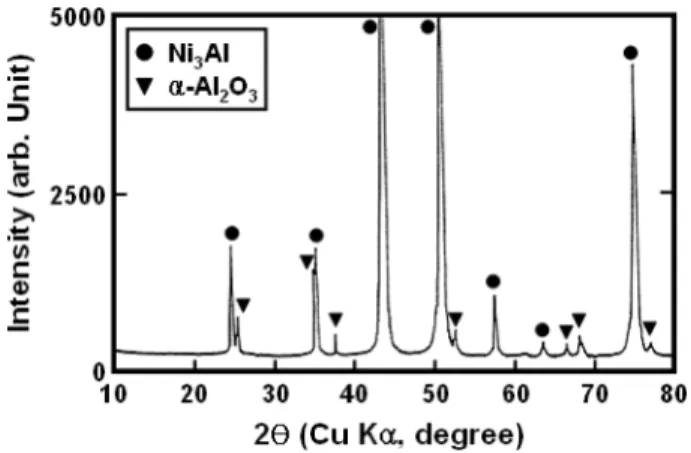
Fig. 2 shows X-ray diffraction profile of the Ni
3Al composite. The matrix was monolithic Ni
3Al compound.
α-aluminum oxide was recognized as the reaction pro- duct. Therefore, aluminum borate whisker decomposed to
Fig. 2. X- ray diffraction profile of the Ni3Al composite with alu- minum oxide dispersion.Fig. 1. Microstructure of the Ni3Al with aluminum oxide disper- sions(OM).
Microstructure and Mechanical Properties of Ni3Al Matrix Composites with Fine Aluminum Oxide by PM Method 497
form α-aluminum oxide particles as a dispersion element.
No sign of the formation of borides was observed and, therefore, boron is expected to exist as the solution element of the matrix.
3.3 Strength
Fig. 3 shows the effects of mixed volume fraction of aluminum borate whisker on bending strength. Strength showed drastic increase by the addition of the whisker and the maximum value was obtained at 10 vol.% addition of whisker. The Ni
3Al composite with 10 vol.% aluminum oxide particles 0.3 μm in size and with 0.1 wt% boron powder fabricated by the conventional powder metal-
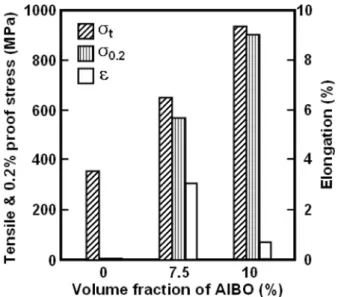
lurgical process did not have such high strength because of inhomogeneous distribution of aluminum oxide particles and of boron. Selected tensile properties are summarized in Fig. 4. Tensile strength of the Ni
3Al with 10 vol.%
aluminum borate whisker reached more than twice higher value, 930 MPa, than that of the parent alloy.
Although, when the volume fraction of aluminum borate whisker addition was lower, the strength was not so high, the composite exhibited quite fascinating elon- gation beyond 3 %. The uniform dispersion structure of aluminum oxide particles shown in Fig. l, which could not be attained by the conventional mixing process of powders, and the presence of boron solution in matrix seems to be two of the main reasons for such improve- ment of tensile properties. Uniform distribution of alumi- num oxide fine particles with no aggregates is expected to give strengthening both by dislocation pinning and by grain refining. In addition, boron solution in the Ni
3Al matrix increases the toughness of the matrix. Thus, the reaction synthetic process using aluminum borate whisker was proved to be effective method to fabricate strong Ni
3Al matrix composite with aluminum oxide particle dispersion.
3.4 Interfacial Microstructure
No evidence of reaction between aluminum oxide and Ni
3Al was observed in all cases. Fig. 5 shows HR-TEM micrograph of the direct interface between an aluminum oxide particle and the matrix. Neither reaction layer nor precipitation was recognized at the interface. Both ma- terials connect directly each other.
Recent study on bonding aluminum oxide to Ni
3Al in a solid-state at 1300
oC and in a liquid-state of Ni
3Al at 1400
oC have revealed weak interface strength below 50 MPa measured by bending test.
7)All joints fractured completely along the interface. It also has been recognized
Fig. 4. Effects of aluminum borate whisker addition on tensileproperties.
Fig. 3. Effects of aluminum borate whisker addition on bending strength.
Fig. 5. HR-TEM micrograph of aluminum oxide particle/Ni3Al matrix interface.
498 Chang-Suk Han and Dong-Nyeok Choi
that no diffusion was observed across the aluminum oxide/Ni
3Al interface. The weak interface is one of the factors which prevent strengthening Ni
3Al matrix com- posites by mixing aluminum oxide fibers/particles. Al- though the observation in Fig. 5, which showed no reaction at the interface, is not the direct evidence of the weak interface, it is expected to increase strength of the composite by modifying the interfacial binding condition or structure between aluminum oxide and Ni
3Al matrix.
4. Conclusion
The present work aimed to increase strength of Ni
3Al alloy by reinforcing with aluminum oxide particle dis- persion. The reaction synthetic method using powder metallurgy has been examined. Then following results were obtained:
1) The addition of aluminum borate whiskers made the synthetic aluminum oxide particles dispersion during sin- tering and increased strength of the composite drastically.
2) The uniform dispersion of reaction synthesized aluminum oxide particles and uniform solution of boron in the matrix seem to play an important role in the
improvement in strength.
3) No evidence of reaction between aluminum oxide and Ni
3Al matrix was observed. Although the interface was direct and clean, the interface between aluminum oxide dispersions/Ni
3Al matrix was weak.
References
1. C. S. Oh, Y. C. Kim, S. C. Kil and C. S. Han, Asian J.
Chem., 26, 1301 (2014).
2. D. H. Bae, C. S. Oh and C. S. Han, Asian J. Chem., 26, 4107 (2014).
3. S. Zhu, Q. Bi, J. Yang, W. Liu and Q. Xue, Tribol. Int., 44, 445 (2011).
4. J. Qu, P. J. Blau, J. E. Shelton, T. N. Tiegs and T. W.
Liao, Ceram. Eng. Sci. Proc., 27, 749 (2006).
5. J. B. Fogagnolo, E. M. J. A. Pallone, D. R. Martin, C.
S. Kiminami, C. Bolfarini and W. J. Botta, J. Alloys Compd., 471, 448 (2009).
6. M. Hoseini and M. Meratian, J. Alloys Compd., 471, 378 (2009).
7. G. Miranda, O. Carvalho, D. Soares and F. S. Silva, J.
Compos. Mater., 50, 523 (2016).