- 622 -
전기분해수 침지처리 박피연근의 랩 및 진공포장 저장 중의 품질변화
박기재․정진웅†․임정호․김범근․정승원 한국식품연구원
Quality Changes in Peeled Lotus Roots Immersed in Electrolyzed Water Prior to Wrap- and Vacuum-Packaging
Kee-Jai Park, Jin-Woong Jeong†, Jeong-Ho Lim, Bum-Kun Kim and Seong-Won Jeong
Korea Food Research Institute, Kyunggi-do 463-746, Korea
Abstract
This study investigated changes in quality characteristics of wrap- and vacuum-packaged peeled lotus roots treated with strong acidic electrolyzed acid water (SAEW pH 2.58, ORP 1,128 mV, HClO 105.0 ppm) or low alkaline electrolyzed water (LAEW pH 8.56, ORP 660 mV, HClO 73.8 ppm) as immersion liquids prior to packaging and storage at 5C. Immersion of peeled lotus roots in SAEW and LAEW reduced initial microbial load by about 1 log compared to treatment with tap water (TW). Hardness differences on storage were observed. However, reduction in PPO activity by electrolyzed water was not reproducible. Changes in Hunter's color value and the color difference value (Δ) of peeled lotus roots immersed in 0.5% (w/v) sodium metabisulfite (SMS) and electrolyzed water were smaller than those of roots treated with TW prior to storage. Sensory characteristics measured during storage were best-preserved in lotus roots previously immersed in 0.5% (w/v) SMS or electrolyzed water, compared to TW.
Immersionin electrolyzed water and vacuum packaging preserves the quality of peeled lotus roots in terms of microbial, visual, and sensory aspects, at levels comparable to those offered by storage after treatment with 0.5% (w/v) SMS.
Key words:electrolyzed water, lotus root, immersion liquid, quality, storage
서 론
1)
식품시장 개방의 가속화와 사회 여건의 변화, 식품의 다 양화, 고급화 및 간편화 추세에 따라 안전하고 편리한 식품 공급체계 확립이 식품산업에서 주요 과제로 부각되고 있다 (1). 한편 신선 식품에 대한 소비 수요가 급격히 증가하여 과일, 채소류와 이를 원료로 한 신선편의 식품시장 규모가 급속히 확대되고 있다(2). 국내 신선편이 농산물 산업은 외식 및 단체급식산업 등의 급속한 신장으로 시장규모가 크게 성장하고 있으며 소매용 샐러드와 과일류를 중심으로 점차 수요가 증가하고 있다(3). 신선편이 농산물은 절단, 박피 공정 등에서 발생하는 생리적 변화로 수분손실, 미생
†Corresponding author. E-mail:[email protected], Phone:82-31-780-9137, Fax:82-31-780-9333
물 감염, 갈변 등의 급속한 변화를 일으키게 된다. 특히 박피나 절단은 조직연화와 표면갈변 등을 가속시켜 품질수 명을 크게 제한하게 된다. 이러한 변화는 농산물의 품목과 품종에 따라서도 그 변화의 양상이 각기 달리 나타난다.
따라서 신선편이 농산물은 품목별 적합한 전처리 방법이 검토되어야 하고 미생물학적 안전성과 변색 등 품질열화를 최소화할 수 있는 공정기술이 적용되어야 한다(4,5).
수련과 다년생 수초인 연근(Nelumbo nucifera G.)은 비대 경을 식용하는 구근류로 우리나라에서는 전통적으로 생식 하거나 튀김, 정과 또는 조림류로서 이용되어 왔다(6,7).
근년 들어 연근에 대한 다양한 기능성이 밝혀지고 있고 (8,9), 연근에 대한 생산과 소비도 증가하고 있으며 박피후 세정하여 포장한 ready-to-use 형태의 제품 또한 그 유통량 이 지속적으로 증가하고 있다. 한편 일본 등지에서 기호도 가 높아 수출 유망으로 주목을 받고 있으나 수확 후 세척,
선별 및 포장 등 관련 제반기술이 아직은 미흡한 부분이 있다(10). 연근은 비교적 조직 손상에 따른 호흡과 에틸렌 발생량 증가 속도, 효소활성 증가에 따른 조직 연화, polyphenol oxidase (PPO)에 의한 효소적 갈변 등이 빠르게 진행되는 점에서 보다 많은 기술적 개발이 필요한 품목이 다. 국내에서도 연근 PPO 효소의 특성과 갈변저해제 및 열처리를 통한 효소적 갈변 억제 방안을 이미 검토한 바 있다(7,11).
박피 연근의 유통방식이 주로 침지액에 포장되어 유통되 는 방식에서 단순한 랩포장이나 진공포장 형태로 전환되고 있다는 점을 감안할 때 포장전 전처리 공정에서 미생물 오염과 갈변을 최대한 억제할 수 있는 효과적인 위생적 전처리 공정의 도입이 필수적이라 판단된다. 이에 따라 전 보(12)에 이어 높은 미생물학적 살균 효과로 주목받고 있는 (13-15) 전기분해수의 활용도 제고를 위해 박피후 연근의 전처리 침지액으로 전기분해수를 활용하고 랩포장과 진공 포장 저장중의 품질변화를 비교․검토하였다.
재료 및 방법
재 료
본 실험에 사용한 연근은 산지(대구)에서 수확하여 실험 당일 수송된 신선한 것을 경기도 성남 소재의 대형 유통점 에서 구입한 후 수도수에 1차 세척하여 이물을 제거하고 자연탈수한 것을 사용하였다. 미생물군 측정에 사용한 plate count agar, potato dextrose agar는 Difco사(Difco Lab., USA)의 것을, chromocult coliform agar는 Merk사(Merk Co, Germany)의 것을 사용하였다. 이외의 시험용 시약은 모두 승인된 분석용 등급의 것이었다.
침지액 및 전기분해수의 물성
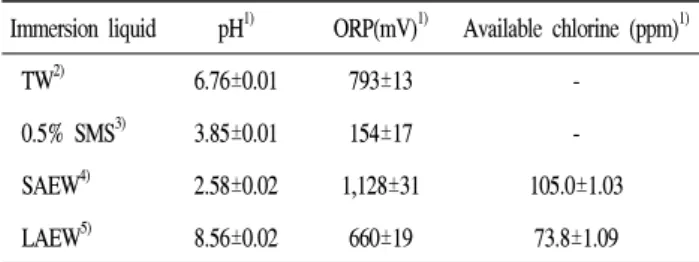
실험에 사용한 침지액은 수도수(TW)와 0.5% sodium metabisulfite 수용액(0.5% SMS)을 대조구로 하였으며 전기 분해수는 강산성 전기분해수(SAEW: strong acidic electrolyzed water)와 약알칼리 전기분해수(LAEW: law alkaline electrolyzed water)로 격막식 1단 및 2단 전기분해, 무격막식 1단 및 2단 전기분해를 동시에 동일 시스템에서 적용할 수 있도록 제작된 시스템으로 생성하였다. 이 때 사용한 전극은 이리 듐 도금 티타늄 재질의 판형(70×140×1 mm) 이었으며, 전해 액 공급은 연속 유수 방식으로 0-10 mL/min으로 조절하여 사용하였다. 각 처리수의 pH, ORP 및 available chlorine 함량은 Table 1과 같으며, pH는 pH meter(Suntex 2000A, USA)로, 산화환원전위는 ORP meter(RM-12P, TOA Electronics, Japan)로, available chlorine 함량은 적정법으로 구하였다(16).
Table 1. pH, oxidation-reduction potential (ORP) and available chlorine contents of immersion liquid for immersion of peeled lotus roots used in this study
Immersion liquid pH1) ORP(mV)1) Available chlorine (ppm)1)
TW2) 6.76±0.01 793±13 -
0.5% SMS3) 3.85±0.01 154±17 -
SAEW4) 2.58±0.02 1,128±31 105.0±1.03
LAEW5) 8.56±0.02 660±19 73.8±1.09
1)All results are presented as mean±standard deviations of triplicate.
2)Tap water.
3)0.5%(w/v) Sodium metabisulfite.
4)Strong acidic electrolyzed water.
5)Law alkaline electrolyzed water.
박피, 세정 및 침지
박피는 (주)타프기계에서 제작한 회전식 브러시형 박피기 로 박피한 후 1 cm 두께로 슬라이스한 것을 5배수(w/w)의 침지액에 30분간 침지한 후 자연탈수하고 500 g씩 일반 식품 용 랩(wrap) 및 진공포장기(SB260, Turbovac, Netherland)로 진 공 포장하여 5℃에 30일 및 42일간 저장하면서 실험에 사용하 였다. 이때 사용한 랩 및 진공포장재는 가정용 랩(유니랩, (주)테이팩스)와 50 μm 두께의 O2 투과도 2.5 mL/m2・hr・atm의 Nylon/PE 적층필름(VF, (주)삼영화학)을 사용하였다.
경 도
Texture analyzer(TA-XT2, Stable Micro System, England) 를 이용하여 rupture test로 측정하였다. 사용되는 probe는 직경 2.0 mm로 고정하였고, 측정결과는 rupture strength (g/m2)로 표시하였으며 포장 시료당 3개 시료를 무작위로 선정, 시료당 3 반복 측정하였다.
미생물군
시료에 10배량의 0.85 % NaCl을 가한 후 균질기 (Stomacher 400 circulator, Seward, UK)로 1분간 균질화하여 1 mL를 취해 단계 희석하고 일반세균은 plate count agar를, 대장균군은 chromocult agar를, 효모 및 곰팡이는 potato dextrose agar를 사용하여 일반세균과 대장균군은 37℃, 48-72시간, 효모 및 곰팡이는 26℃, 72시간 배양한 후 집락 수를 계수하여 환산하였다.
총페놀성 화합물 및 PPO 활성
총페놀성 화합물의 함량은 시료 1 g을 취해 Folin-Denish 법(17)으로 정량하였으며, polyphenol oxidase (PPO) 활성은 Takahashi 등(18)의 방법에 따라 420 nm에서의 조효소액 1 mL가 1분당 흡광도를 0.001 변화시키는 것을 1 unit로 하였다.
색 도
색도는 색도계(CR-200, Minolta Co., Japan)로 Hunter scale의 L, a, b값을 측정하여 ΔE값으로 나타내었다.
관능평가
관능평가는 한국식품연구원에 근무하는 연구원을 선발 하여 처리구별 각 시료의 외관, 색, 냄새, 맛, 경도 및 종합적 인 기호도에 대하여 1(대단히 나쁘다)에서 9(대단히 좋다) 까지의 점수를 사용하여 평가하였다. 시료는 관능검사 시 작 10분전에 관능검사용 시료용기에 담아 관능검사원에게 평가하도록 제시하였다.
통계처리
각 실험당 3회씩 독립적인 시험을 반복하였으며, 실험값 간의 유의성을 검정하기 위하여 SAS 9.0 for windows program을 이용하여 ANOVA test를 실시한 후, p≤0.05 수 준에서 Duncan's multiple range test를 실시하였다.
결과 및 고찰
미생물군
박피와 절단 등의 공정은 최소가공 식품의 품질수명을 결정하는 중요한 요소이다(10,11). 그러나 신선편이 식품은 원료나 특성상 가공공정에서 미생물 혼입을 완전히 제어할 수 없기 때문에 초기 미생물의 수준을 가능한 수준으로 감소시키는 것이 제품의 미생물학적 품질을 결정하는 중요 한 요소가 된다. 랩 및 진공포장의 0.5% SMS, SAEW 및 LAEW 침지 박피 연근의 초기 총균수는 각각 1.5×101 CFU/g, 1.2×101 CFU/g, 3.3×101 CFU/g으로서 대조구인 수 도수 침지 박피 연근의 초기 총균수 3.6×10² CFU/g에 비해 1 log cycle 상대적으로 낮은 총균수를 나타내었다. 이는 0.5% SMS 및 전기분해수의 초기 표면 살균효과에 의한 것으로 판단되었다. 이러한 초기 총균수의 차이는 랩 포장 은 저장 15일, 진공포장은 28-35일까지 대조구에 비해 다소 낮은 수준을 유지하여 박피후 0.5% SMS 및 전기분해수 침지가 초기 균수의 감소에 효과적이었음을 알 수 있었다.
0.5% SMS와 비교할 때 SAEW와 LAEW는 동등한 수준의 효과를 가지며 저장기간 전반을 고려할 때 랩 포장보다는 진공포장이 미생물 증식을 억제하는 효과가 큰 것으로 나타 났다(Fig. 1, 2). 대장균군수의 변화를 검토한 결과에서는 랩포장에서는 0.5% SMS에 의한 초기 균수 감소효과가 가 장 큰 것으로 나타났으며, 진공포장에서도 0.5% SMS 침지 박피 연근은 저장 14일까지, 전기분해수 침지 박피 연근은 모드 저장 7일까지 1.0×101 CFU/g 이하의 균수를 나타내었 고 저장기간 전반에 걸쳐 TW 침지 박피 연근에 비해서는 103-104 CFU/g 수준의 차이를 나타내었다(data not shown).
S to ra ge tim e (d ays)
0 5 1 0 1 5 2 0 2 5 3 0 3 5
Total viable cell count (CFU/g)
1 00 1 01 1 02 1 03 1 04 1 05 1 06 1 07 1 08
Fig. 1. Changes of total viable cell counts of wrap-packaged peeled lotus immersed in various immersion liquids during storage at 5℃.
Immersion liquids were tap water (TW) (○), 0.5% sodium metabisulfite (0.5% SMS) (▽), strong acidic electrolyzed water (SAEW) (□) and low alkaline electrolyzed water (LAEW) (◇). Data represent means of three replications±standard deviation.
S torage tim e (days)
0 7 1 4 21 2 8 35 4 2 49
Total viable cell count (CFU/g)
1 00 1 01 1 02 1 03 1 04 1 05 1 06 1 07 1 08
Fig. 2. Changes of total viable cell counts of vacuum-packaged peeled lotus immersed in various immersion liquids during storage at 5℃.
Immersion liquids were tap water (TW) (○), 0.5% sodium metabisulfite (0.5% SMS) (▽), strong acidic electrolyzed water (SAEW) (□) and low alkaline electrolyzed water (LAEW) (◇). Data represent means of three replications±standard deviation.
경 도
박피 연근의 조직 경도 변화는 Table 2에서와 같다. 침지 직후 경도는 네 가지 침지 처리구 모두에서 평균 5,105.0-5,124.5 g/cm2이었다. 저장기간 전반에 걸쳐 진공포 장 박피 연근이 랩포장에 비해 경도의 저하 수준이 늦어 품질 유지에 효과적인 것으로 나타났다. 동일 포장에서는 처리한 침지액에 따라 다소간의 차이를 나타내어 저장 5일 에서는 0.5% SMS 침지 박피 연근이 가장 높은 값을 나타내 었으나 저장 15일에서는 다른 처리구에 비해 0.5% SMS 침지 박피 연근이 가장 낮은 값을 보였다. 저장 후반인 25일 과 30일에서는 처리구간의 차이를 나타내지 않았다. 진공 포장에서도 저장기간중 경도의 변화는 처리한 침지액에 따라 다소간의 차이를 나타내었다. 저장 14일까지는 수도 수 처리구인 TW 침지 박피 연근의 경도가 다소 높은 것으로 나타났으나 저장 중후반기인 28일 이후에는 4가지 처리구 모두에서 유사한 값을 나타내었다. 저장 후반기인 35일과
42일에는 0.5% SMS, SAEW 및 LAEW 침지 박피 연근에 비해 TW 침지 박피 연근이 각각 평균 3,295.3과 3,170.4 g/cm2으로 상대적으로 낮은 값을 나타내었다. 그러나 이러 한 경도의 차이가 침지액에 따른 유효한 효과인지에 대해서 는 추가적인 연구가 필요하다고 판단된다.
Table 2. Changes in hardness of peeled lotus of wrap- and vacuum-packaged peeled lotus immersed in various immersion liquids during storage at 5℃
(units : g/cm2) Packaging Storage time(days)
Immersion liquid1)
TW 0.5% SMS SAEW LAEW
Wrap
0 5,105.0±49.92) A 5,124.5±36.4 A 5,019.7±127.8 A 5,027.8±66.4 A 5 4,535.6±77.4 A 4,730.5±139.1 B 4,432.5±81.2 B 4,470.1±169.2 B 10 4,372.8±34.9 A 4,179.4±55.3 B 4,434.1±374.3 BC 4,523.3±122.6 C 15 4,381.3±19.7 B 4,185.8±35.5 B 4,284.0±198.6 C 4,410.6±42.5 D 20 4,364.3±108.3 C 3,595.3±120.1 B 4,230.8±89.6 D 4,127.5±75.4 D 25 3,733.7±130.7 C 3,520.4±152.5 B 4,016.8±198.2 D 3,784.0±29.6 D 30 3,753.0±23.5 D 3,622.1±182.1 C 3,734.7±168.1 E 3,800.3±200.5 D
Vacuum
0 5,105.0±49.9 A 5,124.5±36.4 A 5,019.7±127.8A 5,027.8±66.4 A 7 4,958.6±106.3 B 4,645.6±106.3 B 4,609.8±85.9B 4,460.9±71.0 A 14 4,882.2±79.5 B 4,450.6±155.1 C 4,470.7±156.3C 4,471.4±82.9 B 21 4,841.4±101.6 C 4,430.7±99.1 D 4,431.3±91.2D 4,450.5±42.1 B 28 4,095.3±34.9 D 4,010.8±155.5 D 3,905.4±21.5E 4,030.9±28.6 C 35 3,295.3±120.1 D 3,540.4±268.9 D 3,375.5±56.6E 3,495.8±21.2 CD 42 3,170.4±27.9 E 3,449.9±197.7 E 3,597.5±11.9 F 3,573.3±44.1 D
1)Refer to Table 1.
2)All results are presented as mean±standard deviations of triplicate. Values in a column sharing a common letter are not significantly different (p≤0.05).
총페놀성 화합물 함량 및 PPO 활성
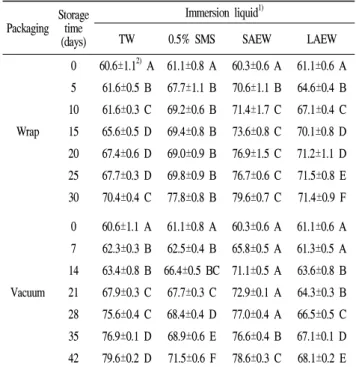
침지액 및 포장 방법에 따른 저장기간별 박피 연근의 총페놀 화합물의 함량 변화는 Table 3과 같다. 초기 총페놀 성 화합물의 함량은 평균 60.3-61.1 mg% 수준이었으며 랩 포장 및 진공포장 모두에서 저장기간의 경과에 따라 전반적 으로 증가하는 경향을 나타내었다. 랩포장에서는 TW 침지 박피 연근에서의 함량증가가 가장 늦었으며, 0.5% SMS, SAEW 및 LAEW 침지 박피 연근에서는 저장 15일까지는 LAEW 침지 박피 연근이 가장 낮은 증가량을 보였다. 진공 포장 박피 연근에서도 LAEW 침지 박피 연근이 TW 침지 박피 연근에 비해 전반적인 증가량이 낮았으며 0.5% SMS 와 LAEW 침지 박피 연근에 비해 SAEW 침지 박피 연근에 서의 증가량이 다소 높은 것으로 나타났다.
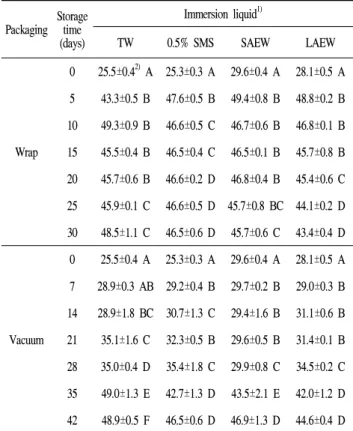
저장기간에 따른 PPO 활성을 살펴보면 Table 4에서와 같이 초기 활성의 차이는 침지에 의한 시료간의 차이로 판단되며, 랩포장에서는 저장 10일후 0.5% SMS와 전기분 해수 침지 박피 연근이 TW 침지 박피 연근에 비해 상대적으
로 낮은 활성을 나타내었다. 이러한 경향은 진공포장에서 도 유사하였으며, 저장 21일부터는 TW 침지 박피 연근에서 의 활성이 가장 높은 것으로 나타났다. 0.5% SMS의 억제 효과는 Son 등(19) 등의 기존 연구 결과와도 일치하는 것이 었으며, 전기분해수 침지에 의해 부분적인 PPO 효소 활성 저해가 발생한 것으로 판단된다. 이는 차아염소산이 신선 절단 과채류의 효소적 갈변을 억제한다는 결과와도 일치하 는 것이었다(20).
Table 3. Changes of total phenolic contents of peeled lotus of wrap- and vacuum-packed peeled lotus immersed in various immersion liquids during storage at 5℃
(Units : mg%) Packaging Storage
time (days)
Immersion liquid1)
TW 0.5% SMS SAEW LAEW
Wrap
0 60.6±1.12) A 61.1±0.8 A 60.3±0.6 A 61.1±0.6 A 5 61.6±0.5 B 67.7±1.1 B 70.6±1.1 B 64.6±0.4 B 10 61.6±0.3 C 69.2±0.6 B 71.4±1.7 C 67.1±0.4 C 15 65.6±0.5 D 69.4±0.8 B 73.6±0.8 C 70.1±0.8 D 20 67.4±0.6 D 69.0±0.9 B 76.9±1.5 C 71.2±1.1 D 25 67.7±0.3 D 69.8±0.9 B 76.7±0.6 C 71.5±0.8 E 30 70.4±0.4 C 77.8±0.8 B 79.6±0.7 C 71.4±0.9 F
Vacuum
0 60.6±1.1 A 61.1±0.8 A 60.3±0.6 A 61.1±0.6 A 7 62.3±0.3 B 62.5±0.4 B 65.8±0.5 A 61.3±0.5 A 14 63.4±0.8 B 66.4±0.5 BC 71.1±0.5 A 63.6±0.8 B 21 67.9±0.3 C 67.7±0.3 C 72.9±0.1 A 64.3±0.3 B 28 75.6±0.4 C 68.4±0.4 D 77.0±0.4 A 66.5±0.5 C 35 76.9±0.1 D 68.9±0.6 E 76.6±0.4 B 67.1±0.1 D 42 79.6±0.2 D 71.5±0.6 F 78.6±0.3 C 68.1±0.2 E
1)Refer to Table 1.
2)All results are presented as mean±standard deviations of triplicate. Values in a column sharing a common letter are not significantly different (p≤0.05).
색 도
표면색도의 변화를 살펴본 결과 침지처리에 관계없이 L값은 점진적인 감소를, a값 및 b값은 점진적인 증가를 나타내었으며, 진공포장이 랩포장에 비해 변화의 폭이 작 았다. 랩포장에서 L값의 변화량이 가장 작았던 것은 LAEW 침지 박피 연근이었으며 진공포장에서는 0.5% SMS와 LAEW 침지 박피 연근이었다(Table 5). 색차(ΔE)의 변화를 살펴보면 랩포장의 경우에는 저장 10까지는 침지액에 따른 초기 색차값의 차이가 크게 변화하지 않았으나 15일 이후 현격한 차이를 나타내어 20일에는 TW 침지 박피 연근은 5.42, 0.5% SMS 침지 박피 연근은 5.27이었던 반면 SAEW 와 LAEW 침지 박피 연근은 각각 2.86과 3.24였다(Fig. 3).
진공포장 박피 연근에서는 색차(ΔE)의 변화가 랩포장에 비해 상대적으로 크지 않아 초기 색차값의 차이가 저장
후반까지 지속되었으나 저장 35일에는 TW 침지 박피 연근 은 2.02, 0.5% SMS 침지 박피 연근은 2.44, SAEW와 LAEW 침지 박피 연근은 각각 2.02와 2.64로 유사한 수준을 나타내 었다(Fig. 4).
S tora g e tim e (d ays )
0 5 1 0 1 5 2 0 2 5 3 0 3 5
E
0 2 4 6 8 1 0 1 2 1 4
Fig. 3. Changes of ⊿E value of wrap-packaged peeled lotus immersed in various immersion liquids during storage at 5℃.
Immersion liquids were tap water (TW) (○), 0.5% sodium metabisulfite (0.5% SMS) (▽), strong acidic electrolyzed water (SAEW) (□) and low alkaline electrolyzed water (LAEW) (◇). Data represent means of three replications±standard deviation.
Table 4. Changes of polyphenol oxidase activity of peeled lotus of wrap- and vacuum-packaged peeled lotus immersed in various immersion liquids during storage at 5℃
(Units : units/g)
Packaging Storage (days)time
Immersion liquid1)
TW 0.5% SMS SAEW LAEW
Wrap
0 25.5±0.42) A 25.3±0.3 A 29.6±0.4 A 28.1±0.5 A 5 43.3±0.5 B 47.6±0.5 B 49.4±0.8 B 48.8±0.2 B 10 49.3±0.9 B 46.6±0.5 C 46.7±0.6 B 46.8±0.1 B 15 45.5±0.4 B 46.5±0.4 C 46.5±0.1 B 45.7±0.8 B 20 45.7±0.6 B 46.6±0.2 D 46.8±0.4 B 45.4±0.6 C 25 45.9±0.1 C 46.6±0.5 D 45.7±0.8 BC 44.1±0.2 D 30 48.5±1.1 C 46.5±0.6 D 45.7±0.6 C 43.4±0.4 D
Vacuum
0 25.5±0.4 A 25.3±0.3 A 29.6±0.4 A 28.1±0.5 A 7 28.9±0.3 AB 29.2±0.4 B 29.7±0.2 B 29.0±0.3 B 14 28.9±1.8 BC 30.7±1.3 C 29.4±1.6 B 31.1±0.6 B 21 35.1±1.6 C 32.3±0.5 B 29.6±0.5 B 31.4±0.1 B 28 35.0±0.4 D 35.4±1.8 C 29.9±0.8 C 34.5±0.2 C 35 49.0±1.3 E 42.7±1.3 D 43.5±2.1 E 42.0±1.2 D 42 48.9±0.5 F 46.5±0.6 D 46.9±1.3 D 44.6±0.4 D
1)Refer to Table 1.
2)All results are presented as mean±standard deviations of triplicate determinations.
Values in a column sharing a common letter are not significantly different (p≤0.05).
관능 평가
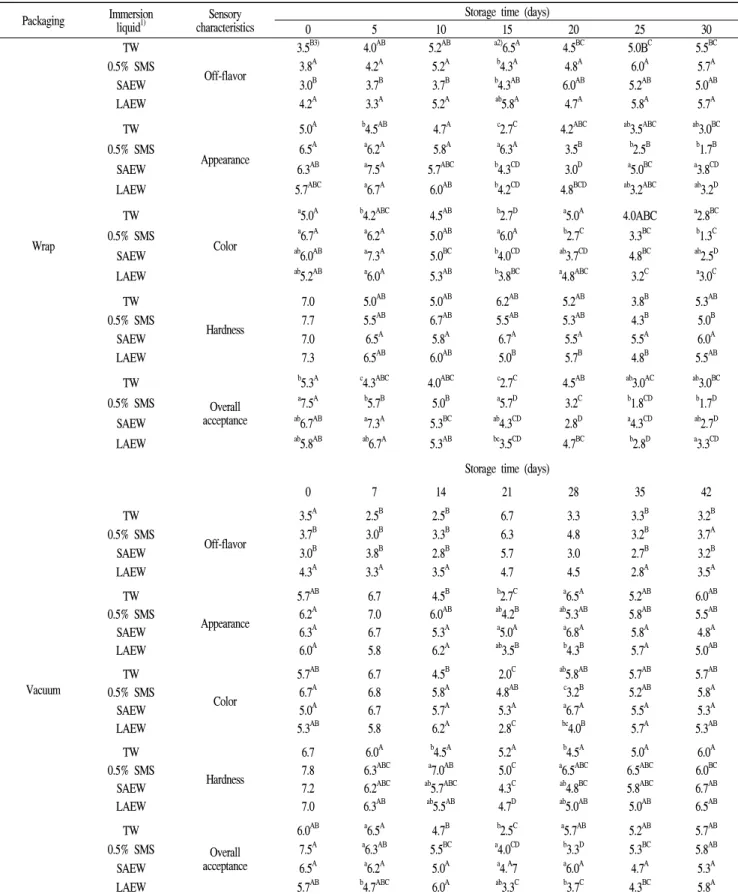
침지 처리별 포장조건에 따라 보관한 박피 연근의 이취, 외관, 색, 경도 및 전반적인 기호도에 대하여 관능평가를 실시한 결과는 Table 6과 같다. 저장기간 전반에 걸쳐 랩포 장에서 종합적 기호도는 0.5% SMS와 전기분해수 침지 박 피 연근이 TW 침지 박피 연근에 비해 다소 높은 값을 나타 내었고, 진공포장 박피 연근에서는 0.5% SMS와 SAEW 침지 박피 연근이 TW 침지 박피 연근에 비해 다소 높은 값을 나타내었다. 랩포장에서는 외관과 색택이 TW 침지 박피 연근에 비해 0.5% SMS와 전기분해수 침지 박피 연근 이 높게 평가되었으며, 진공포장에서는 외관과 조직감이 다소 높게 평가되었다.
S tora ge tim e (da ys)
0 7 14 2 1 2 8 35 4 2 4 9
E
0 .0 0 .5 1 .0 1 .5 2 .0 2 .5 3 .0
Fig. 4. Changes of ⊿E value of vacuum-packaged peeled lotus immersed in various immersion liquids during storage at 5℃.
Immersion liquids were tap water (TW) (○), 0.5% sodium metabisulfite (0.5% SMS) (▽), strong acidic electrolyzed water (SAEW) (□) and low alkaline electrolyzed water (LAEW) (◇). Data represent means of three replications±standard deviation.
요 약
수도수(TW)와 0.5% sodium metabisulfite(0.5% SMS)를 대조구로 하고 강산성 전기분해수(SAEW: strong acidic electrolyzed water, pH 2.58, ORP 1,128 mV, HClO 105.0
ppm)와 약알칼리 전기분해수(LAEW: law alkaline electrolyzed water, pH 8.56, ORP 660 mV, HClO 73.8 mV)를 연근의 박피 후 침지액으로 하여 랩포장과 진공포장하여 5℃ 저장 중 품질 변화를 비교․검토하였다. 0.5% SMS와 전기분해 수 침지로 TW 침지 박피 연근에 비해 1 log cyle의 초기 균수 감소 효과와 저장중 상대적으로 낮은 균수를 나타내었 다. 침지 처리에 의한 초기 및 저장중 경도의 차이를 나타내 었으며 뚜렷한 PPO 활성을 저해하는 효과는 확인할 수 없었다. 전기분해수 침지로 표면색도와 색차는 0.5% SMS 침지와 유사한 억제 효과를 나타내었고 관능적 특성의 변화 에서도 TW 침지 박피 연근에 비해 0.5% SMS 침지 박피 연근과 전기분해수 박피 연근이 다소 높게 평가되었다. 포 장 방식에 있어서는 랩포장에 비해 진공포장이 품질 유지에 보다 효과적이었다.
Table 5. Changes of color value of lotus roots of wrap- or vacuum-packaged peeled lotus immersed in various immersion liquids during storage at 5℃
Packaging Immersion
liquid1) Color value
Storage time (days)
0 7 14 21 28 35 42
Warp
TW
L 74.42±0.052)A 73.89±0.09 A 74.92±1.12 A 73.52±0.13 A 69.54±0.06 A 67.66±0.06 A 63.43±0.04 A a -0.83±0.04 A -0.66±0.05 A -0.57±0.02 AB -0.18±0.10 AB 0.50±0.12 AB 1.91±0.08 AB 0.82±0.10 B b 12.00±0.06 A 12.09±0.05 A 12.55±0.10 A 13.26±0.17 A 13.97±0.23 A 15.31±0.13 A 14.65±0.06 A
0.6% AA
L 73.67±0.10 A 73.88±0.04 A 76.07±0.02 A 73.62±0.05 A 69.84±0.06 A 68.91±0.02 A 65.9±0.13 A a -0.23±0.03 A -0.52±0.08 A -0.88±0.04 A 0.55±0.05 A 0.80±0.04 A 2.71±0.15 A 2.04±0.03 A b 11.99±0.13 A 13.52±0.10 A 13.28±0.01 A 14.66±0.08 A 14.09±0.06 A 18.39±0.16 A 17.73±0.04 A
SAEW
L 73.86±0.05 A 74.04±0.11 AB 74.35±0.05 AB 73.56±0.08 AB 71.71±0.04 AB 71.72±0.10 B 68.82±0.13 B a -0.30±0.03 A 0.04±0.02 A 0.06±0.02 A 0.10±0.01 A 0.03±0.02 A 0.22±0.04 A 0.28±0.06 A b 11.86±0.08 A 11.68±0.06 A 12.94±0.04 A 11.48±0.13 A 12.53±0.09 A 12.22±0.03 A 11.47±0.06 A
LAEW
L 73.68±0.04 A 73.39±0.03 AB 74.62±0.02 AB 72.85±0.04 AB 72.88±0.05 AB 72.93±0.03 AB 71.85±0.11 B a -0.21±0.04 A -0.26±0.01 A -0.29±0.03 A -0.19±0.01 AB 0.51±0.27 AB -0.1±0.11 AB 0.07±0.06 B b 5.53±0.04 A 10.85±0.08 A 10.05±0.06 A 10.4±0.12 A 9.56±0.05 A 9.06±0.01 A 8.89±0.11 A
0 7 14 21 28 35 42
Vacuum
TW
L 74.29±0.13 A 73.46±0.08 D 73.79±0.09 C 73.93±0.04 B 73.94±0.08 B 72.81±0.04 E 72.73±0.18 F a -0.83±0.02 A -0.46±0.01 B -0.55±0.03 C -0.12±0.01 D -0.02±0.01 E -0.06±0.02 F -0.08±0.01 G b 11.93±0.04 A 11.44±0.06 B 11.06±0.04 C 10.43±0.08 D 10.86±0.11 E 10.92±0.10 F 10.83±0.12 E
0.6% AA
L 73.68±0.11 A 73.75±0.61 B 72.66±0.08 C 72.05±0.06 D 72.07±0.06 D 72.1±0.01 D 72.13±0.01 D a -0.22±0.02 A 0.02±0.47 AB -0.04±0.01 AB 0.03±0.01 C 0.04±0.01 C 0.04±0.02 C 0.06±0.01 C b 12.02±0.05 A 12.5±0.13 B 12.39±0.08 C 12.06±0.04 B 12.02±0.01 B 11.96±0.15 D 12.00±0.04 A
SAEW
L 74.38±0.04 A 72.46±0.05 B 72.70±0.13 C 72.88±0.04 D 72.88±0.01 D 72.83±0.04 E 72.61±0.03 F a -0.84±0.04 A -0.44±0.08 B -0.50±0.09 C -0.15±0.05 D -0.02±0.01 E -0.05±0.04 E -0.08±0.01 F b 11.94±0.06 A 11.44±0.02 B 11.06±0.04 C 10.75±0.08 D 10.81±0.04 E 10.95±0.04 F 11.05±0.03 C
LAEW
L 73.73±0.15 A 73.2±0.06 B 72.90±0.13 C 72.06±0.06 D 72.07±0.06 D 71.88±0.08 D 72.04±0.13 E a -0.22±0.05 A -0.22±0.19 A 0.01±0.01 B 0.05±0.04 B 0.06±0.05 B 0.04±0.04 B 0.07±0.06 B b 11.99±0.05 A 12.10±0.13 AB 12.06±0.05 AB 12.05±0.06 B 12.07±0.06 C 11.76±0.09 D 11.15±0.15 F
1)Refer to Table 1.
2)All results are presented as mean±standard deviations of triplicate determinations. Values in a column sharing a common letter are not significantly different (p≤0.05).
Table 6. Sensory evaluation of peeled lotus roots of wrap- and vacuum-packaged peeled lotus immersed in various immersion liquids during storage at 5℃
Packaging Immersion
liquid1) Sensory
characteristics
Storage time (days)
0 5 10 15 20 25 30
Wrap
TW
Off-flavor
3.5B3) 4.0AB 5.2AB a2)6.5A 4.5BC 5.0BC 5.5BC
0.5% SMS 3.8A 4.2A 5.2A b4.3A 4.8A 6.0A 5.7A
SAEW 3.0B 3.7B 3.7B b4.3AB 6.0AB 5.2AB 5.0AB
LAEW 4.2A 3.3A 5.2A ab5.8A 4.7A 5.8A 5.7A
TW
Appearance
5.0A b4.5AB 4.7A c2.7C 4.2ABC ab3.5ABC ab3.0BC
0.5% SMS 6.5A a6.2A 5.8A a6.3A 3.5B b2.5B b1.7B
SAEW 6.3AB a7.5A 5.7ABC b4.3CD 3.0D a5.0BC a3.8CD
LAEW 5.7ABC a6.7A 6.0AB b4.2CD 4.8BCD ab3.2ABC ab3.2D
TW
Color
a5.0A b4.2ABC 4.5AB b2.7D a5.0A 4.0ABC a2.8BC
0.5% SMS a6.7A a6.2A 5.0AB a6.0A b2.7C 3.3BC b1.3C
SAEW ab6.0AB a7.3A 5.0BC b4.0CD ab3.7CD 4.8BC ab2.5D
LAEW ab5.2AB a6.0A 5.3AB b3.8BC a4.8ABC 3.2C a3.0C
TW
Hardness
7.0 5.0AB 5.0AB 6.2AB 5.2AB 3.8B 5.3AB
0.5% SMS 7.7 5.5AB 6.7AB 5.5AB 5.3AB 4.3B 5.0B
SAEW 7.0 6.5A 5.8A 6.7A 5.5A 5.5A 6.0A
LAEW 7.3 6.5AB 6.0AB 5.0B 5.7B 4.8B 5.5AB
TW
Overall acceptance
b5.3A c4.3ABC 4.0ABC c2.7C 4.5AB ab3.0AC ab3.0BC
0.5% SMS a7.5A b5.7B 5.0B a5.7D 3.2C b1.8CD b1.7D
SAEW ab6.7AB a7.3A 5.3BC ab4.3CD 2.8D a4.3CD ab2.7D
LAEW ab5.8AB ab6.7A 5.3AB bc3.5CD 4.7BC b2.8D a3.3CD
Storage time (days)
Vacuum
0 7 14 21 28 35 42
TW
Off-flavor
3.5A 2.5B 2.5B 6.7 3.3 3.3B 3.2B
0.5% SMS 3.7B 3.0B 3.3B 6.3 4.8 3.2B 3.7A
SAEW 3.0B 3.8B 2.8B 5.7 3.0 2.7B 3.2B
LAEW 4.3A 3.3A 3.5A 4.7 4.5 2.8A 3.5A
TW
Appearance
5.7AB 6.7 4.5B b2.7C a6.5A 5.2AB 6.0AB
0.5% SMS 6.2A 7.0 6.0AB ab4.2B ab5.3AB 5.8AB 5.5AB
SAEW 6.3A 6.7 5.3A a5.0A a6.8A 5.8A 4.8A
LAEW 6.0A 5.8 6.2A ab3.5B b4.3B 5.7A 5.0AB
TW
Color
5.7AB 6.7 4.5B 2.0C ab5.8AB 5.7AB 5.7AB
0.5% SMS 6.7A 6.8 5.8A 4.8AB c3.2B 5.2AB 5.8A
SAEW 5.0A 6.7 5.7A 5.3A a6.7A 5.5A 5.3A
LAEW 5.3AB 5.8 6.2A 2.8C bc4.0B 5.7A 5.3AB
TW
Hardness
6.7 6.0A b4.5A 5.2A b4.5A 5.0A 6.0A
0.5% SMS 7.8 6.3ABC a7.0AB 5.0C a6.5ABC 6.5ABC 6.0BC
SAEW 7.2 6.2ABC ab5.7ABC 4.3C ab4.8BC 5.8ABC 6.7AB
LAEW 7.0 6.3AB ab5.5AB 4.7D ab5.0AB 5.0AB 6.5AB
TW
Overall acceptance
6.0AB a6.5A 4.7B b2.5C a5.7AB 5.2AB 5.7AB
0.5% SMS 7.5A a6.3AB 5.5BC a4.0CD b3.3D 5.3BC 5.8AB
SAEW 6.5A a6.2A 5.0A a4.A7 a6.0A 4.7A 5.3A
LAEW 5.7AB b4.7ABC 6.0A ab3.3C b3.7C 4.3BC 5.8A
1)Refer to Table 1.
2)Means with the same superscripts in a column(a-d) are not significantly different from each other at a=0.05 as determined by Duncan's multiple range test.
3)Means with the same superscripts in a row(A-D) are not significantly different from each other at a=0.05 as determined by Duncan's multiple range test.
NSnot significant, * p<0.05, ** p<0.01, *** p<0.001.
참고문헌
1. Hathaway, S. (1999) Management of food safety in international trade. Food Control, 10, 247-254 2. Kim, G.H. and Bang, H.Y. (1998) A survey on
consumption pattern of minimally processed fruits and vegetables. Korean J. Dietary Culture, 13, 267-274 3. Kim, D.M. and Kiim, J.K. (2006) Definition and scope
of fresh-cut agricultural foods. p. 3. In Symposium on the Industry and Quality Control of Fresh-cut Agricultural Foods. National Horticultural Research Institute, Suwon, Korea
4. Oh, D.H. (1999) Microbiological safety of minimally processed vegetables, Food Ind. Nutr., 4, 48-54 5. Soliva-Fortuny, R.C. and Maritin-Belloso, O. (2003) New
advances in extending the shelf-life of fresh-cut fruits:
a review, Trends Food Sci. Technol., 14, 341-353 6. Yang, H.C., Kim, Y.H., Lee, T.K. and Cha, Y.S. (1985)
Physicochemical properties of lotus root. J. Korean Agri.
Chem. Soc., 28, 239-244
7. Park, S.Y., Hwang, T.Y., Kim, J.H. and Moon, K.D.
(2001) Quality changes of minimally processed lotus root(Nelumbo nucifera) with browning inhibitors. Korean J. Postharvest Sci. Technol., 8, 164-168
8. Park, S.H., Ham, T.S. and Han, J.H. (2005) Effects of ethanol-extract of lotus roots on the renal fuction and blood pressure of fructose-induced hypertensive rats. J.
East Asian Soc. Dietary Life, 15, 165-170
9. Park, S.H., Shin, E.H., Koo, J.G., Lee, T.H. and Han, J.H. (2005) Effects on Nelumbo nucifera on the regional cerebral blood flow and blood pressure in rats. J. East Asian Soc. Dietary Life, 15, 49-56
10. Moon, S.M. (2003) Purification and characterization of polyphenol oxidase and prevention of browning of lotus root(Nelumbo nucifera G.). MS thesis, Mokpo National University, Mokpo, Jeolla namdo, Korea
11. Moon, S.M., Kim, H.J. and Ham, K.S. (2003) Purification and characterization of polyphenol oxidase from lotus
root(Nelumbo nucifera G.). Korean J. Food Sci. Technol., 35, 791-796
12. Jeong, J.W., Park, K.J., Sung, J.M., Kim, J.H. and Kwon, K.H. (2006) Comparison of quality of peeled lotus roots stored in various immersion liquids during storage.
Korean J. Food Sci. Technol., 38, 526-533
13. Park, W.P., Cho, S.H. and Lee, D.S. (1998) Screening of antibrowning agents for minimally processed vegetables, Korean J. Food Sci. Technol., 30, 278-282 14. Park, S.Y., Hwang, T.Y., Kim, J.H. and Moon, K.D.
(2001) Quality changes of minimally processed lotus root(Nelumbo nucifera G.) with browning inhibitors, Korean J. Postharvest Sci. Technol., 8, 164-168 15. Kiura, H., Sano, K., Morimatsu, S., Nakano, T., Morita,
C., Yamaguchi, M., Maeda, T. and Katsuoka, Y. (2002) Bactericidal activity of electrolyzed acid water from solution containing sodium chloride at low concentration, in comparison with that at high concentration. J.
Microbiol. Methods, 49, 285-293
16. Koseki, S. and Itoh, K. (2000) Fundamental properties of electrolyzed water. Nippon Shokuhin Kagaku Kogaku Kaishi, 47, 390-393
17. Lavid, N., Schwartz, A., Yarden, O. and Tel-Or, E. (2001) The involvement of polyphenols and peroxidase activities in heavy-metal accumulation by epidermal glands of the waterlily(Nymphaeaceae). Planta, 212, 323-331 18. Takahashi, T., Abe, K. and Chachin, K. (1996) Effect
of air-exposure at low temperature on physiological activities and browning of shredded cabbage (in Japanese). J. Jpn. Soc. Food Sci. Technol., 43, 663-667 19. Son, S.M., Moon, K.D. and Lee, C.Y. (2001) Inhibitory
effects of various antibrowning agents on apple slices.
Food Chemistry, 73, 23-30
20. Brecht, J.K., Sabaa-Srur, A.U.O., Sargent, S.A. and Bender, R.J. (1993) Hypochlorite inhibition of enzyme browning of cut vegetables and fruits. Acta Horticulturae, 343, 341-344
(접수 2008년 6월 16일, 채택 2008년 9월 5일)