Print ISSN: 1738-3110 / Online ISSN 2093-7717 http://dx.doi.org/10.15722/jds.16.12.201812.81
Strategies for Continuous Transactions with Customers for B2B Software Retailers:
Case Study
B2B 소프트웨어 유통 중소기업을 위한 고객과의 지속거래 유지 전략: 사례 연구
Yong-Jun Choi(최용준)*, Wan-Ki Kim(김완기)**
Received: November 01, 2018. Revised: November 21, 2018. Accepted: December 05, 2018.
Abstract
Purpose - The purpose of this study was to propose a specific and empirical continuous transaction strategy through service quality of improvement to small and medium Korean companies whose main business is B2B distribution and sale of general-purpose SW.
Research design, data, and methodology - The research procedure is largely divided into two phases. In the first phase, the service quality, the customer satisfaction, and the continuous transaction research hypothesis and the verification are carried out. Experimental data were collected from 450 companies, CEO companies of SMEs innovation institutes, and 510 companies from medium and large enterprises. From September 15 to October 5, 2015, 215 questionnaires were used. And research hypothesis and test were conducted by SPSS SW Ver. 20.
Results - The results of the study confirm that service quality has a positive effect on customer satisfaction and continuous transaction: as the detailed items for improving the service quality, 'responsiveness', 'assurance' and 'empathy' have been adopted. Therefore, there are critical factors of a company's survival through continuous transaction.
Conclusions - Through this study, we confirmed that the survival of small businesses require continuous improvement in service quality. Among the factors improving service quality, empathy means service satisfaction of customers; so, it is necessary to continuously improve it by evaluating customer satisfaction. Responsiveness means rapid response to customer needs and reliability; it is necessary to enhance customer responsiveness by continuous job training and service training.
Finally, assurance is the same as sales product or after service. This means that it is necessary to not only issue the
“supply contract,” but also improve the reliability of the sales product by securing the competence of the consulting professional. However, because the service quality measurement factors selected in this study are the measurement factors that are mainly applied to large companies or those in the service industries, it is important to consider the type of sales of software distribution companies.
Keywords: Universal Software, Service Quality, Service Satisfaction, Continuous Transactions Strategy.
JEL Classifications: L63, L14, L84, M30.
1. 서론
소프트웨어 산업은 선진국형 지식서비스 중심 경제구조로의 전환에 필수적인 핵심 산업이다. Gartner(2015)에 따르면 세계 소프트웨어 시장규모(패키지 SW + IT서비스)는 2014년 1조 2,692억 달러로 전년 대비 2.8% 성장하였으며, 이중 소프트웨 어 시장 비중은 34.2%을 차지하고 있다. 반면 국내 소프트웨 어 시장의 경우, 110억 달러(2014년 기준)에 IT서비스는 29조
* First Author, Master, Graduate School of Management of Technology, Sogang University, Korea.
** Corresponding Author, Professor, Graduate School of Management of Technology, Sogang University, Korea.
Tel: +82-2-705-4780, E-mail: [email protected]
8천억 원(82%), 패키지 소프트웨어는 6조 6천억 원(18.2%) 이 었다(Jin, 2015).
그러나 패키지 소프트웨어 분야의 영세 중소기업의 경우, 평균 보유인력은 5인 미만으로서 대기업이나 중견기업 대비 상대적 열세에 놓여있는 실정이다(Ministry of science and ICT, 2017). 특히 영세기업의 경우, SW 제품 자체의 제품 성 능이나 가격 경쟁보다는 서비스 품질이 기업생존에 더 영향을 미치고 있는 것으로 알려져 있다. 이러한 현상은 SW 제품 개 발보다는 주로 SW 제품에 대한 유통판매를 주 사업 목적으로 운영하고 있기 때문이다. 또한, B2B(Business to Business) 마 케팅 형태의 경우, SW 제품 품질보다는 자사가 판매한 SW 제품에 대한 서비스 만족도 정도에 따라 기업생존을 결정할 정도로 막대한 영향을 끼친다.
그간 서비스 품질이나 만족도, 재구매 요인에 대한 많은 연 구결과가 발표되었다. 하지만 이런 연구들은 주로 B2C 형태로 서 고객 만족이나 재구매 의도 요인 등에 대한 유의미 여부를 확인하는데 국한된 것이 주류를 이루고 있어, 본 연구 목적인 서비스 품질개선을 통한 구체적이고 실증적인 연구결과는 거 의 없는 실정이다.
이에 본 연구에서는 범용 SW 분야의 국내 B2B 유통판매 영세기업들을 대상으로 기업 생존전략이라 할 수 있는 거래 기업(고객)과의 지속거래 유지 전략을 제안하고자 한다. 연구 절차는 2장에서는 소프트웨어의 정의와 서비스 품질, 사용자 만족, 지속거래 등에 관한 선행연구와 비교를 통하여 본 연구 의 차별성을 확인하고, 3장에서는 연구방법론을 소개한다. 이 어 4장 연구결과에서는 본 연구가설 분석 결과와 이를 활용한 지속거래 유지 전략을 제안하고 마지막 5장에서는 본 연구결 과와 시사점, 그리고 연구 한계점을 제시한다.
2. 선행연구 고찰 2.1. 소프트웨어의 정의
소프트웨어산업 진흥법에 따르면 소프트웨어(SW: Software) 란 “컴퓨터, 통신, 자동화 등의 장비와 그 주변장치에 대한 명 령·제어·입력·처리·저장·출력·상호작용이 가능하게 하는 지시·명 령(음성이나 영상정보 등을 포함한다)”을 의미하며 이중 “패키 지 SW란 일반 사용자에게 판매하기 위해 표준화된 개발 프로 그램으로서 개별적으로는 상품화된 SW”를 의미한다(Kang,
2017). 한편 Sommerville(2008)은 SW 제품을 일반적 제품과 맞춤형 제품으로 나누고, 패키지 SW는 일반적 SW로 정의하 기도 하였다.
참고로 한국정보통신산업협회가 분류한 패키지 SW 관련 산업 분류는 크게 시스템 SW와 응용 SW, 그리고 IT서비스(IT 컨설팅, 시스템관리, 임베디드 SW 등)으로 나누고 있다(Jin, 2015). 이중 Data base, 문서편집기, 프로젝트 관리 도구, 그 래픽 패키지와 같은 PC용 SW도 패키지 SW(Kim & Gim, 2009)에 포함하는데 예를 들어 워드프로세서인 MS사의 ‘Office’
와 한글과 컴퓨터사의 ‘아래아 한글’의 경우, 두 가지 모두 사 무용 SW이지만 이는 사용자의 사용 목적에 따라 선택기준이 다를 뿐만 아니라 제품 품질도 SW 개발기업에 따라 차이가 있다. 따라서 본 연구는 패키지 SW를 범용 SW로 정의하였다.
2.2. 서비스 품질
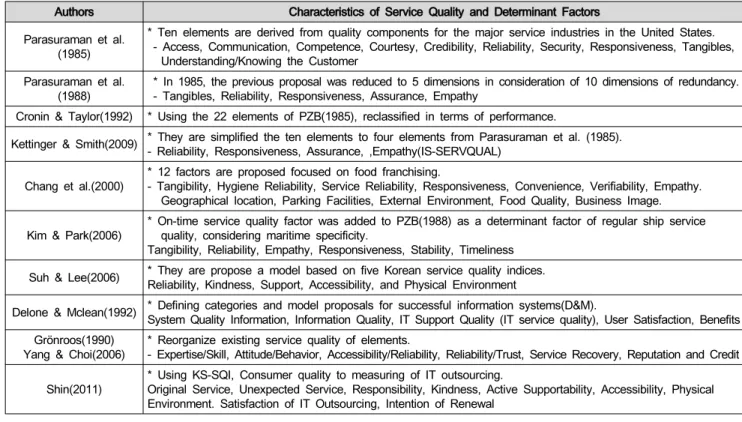
‘서비스 품질(SQ: Service Quality)’이란 고객이 대상 제품에 대해 느끼는 주관적 관점에서 품질을 의미한다. Grönroos (1984)는 서비스 품질을 “기업이 제공하는 서비스의 질을 의미 하며 고객의 기대 대비 서비스 지각의 비교 결과“라 정의하였 다. 서비스 품질 관련 선행연구들을 살펴보면 서비스 품질을 태도로 정의한 Olshavsky(1985)의 연구를 비롯하여 서비스 품 질의 특징을 정의한 Garvin(1984)의 연구, 서비스 수행의 오류 개선을 위한 인지 차이 연구(Koo & Park, 2007), 서비스 품질 측 정 관련 선행연구에 관한 고찰 연구(Yi & Lee, 2014) 등 그간 많 은 연구결과가 발표되었다. 참고로 <Table 1>은 서비스 품질 결 정 요인에 대한 주요 선행연구 특징 및 요인을 정리한 것이다.
Table 1: The Major Characteristics of Service Quality and Determinant Factors
Authors Characteristics of Service Quality and Determinant Factors Parasuraman et al.
(1985)
* Ten elements are derived from quality components for the major service industries in the United States.
- Access, Communication, Competence, Courtesy, Credibility, Reliability, Security, Responsiveness, Tangibles, Understanding/Knowing the Customer
Parasuraman et al.
(1988) * In 1985, the previous proposal was reduced to 5 dimensions in consideration of 10 dimensions of redundancy.
- Tangibles, Reliability, Responsiveness, Assurance, Empathy
Cronin & Taylor(1992) * Using the 22 elements of PZB(1985), reclassified in terms of performance.
Kettinger & Smith(2009) * They are simplified the ten elements to four elements from Parasuraman et al. (1985).- Reliability, Responsiveness, Assurance, ,Empathy(IS-SERVQUAL) Chang et al.(2000) * 12 factors are proposed focused on food franchising.
- Tangibility, Hygiene Reliability, Service Reliability, Responsiveness, Convenience, Verifiability, Empathy.
Geographical location, Parking Facilities, External Environment, Food Quality, Business Image.
Kim & Park(2006) * On-time service quality factor was added to PZB(1988) as a determinant factor of regular ship service quality, considering maritime specificity.
Tangibility, Reliability, Empathy, Responsiveness, Stability, Timeliness Suh & Lee(2006) * They are propose a model based on five Korean service quality indices.
Reliability, Kindness, Support, Accessibility, and Physical Environment
Delone & Mclean(1992) * Defining categories and model proposals for successful information systems(D&M).System Quality Information, Information Quality, IT Support Quality (IT service quality), User Satisfaction, Benefits Grönroos(1990)
Yang & Choi(2006) * Reorganize existing service quality of elements.
- Expertise/Skill, Attitude/Behavior, Accessibility/Reliability, Reliability/Trust, Service Recovery, Reputation and Credit Shin(2011) * Using KS-SQI, Consumer quality to measuring of IT outsourcing.
Original Service, Unexpected Service, Responsibility, Kindness, Active Supportability, Accessibility, Physical Environment. Satisfaction of IT Outsourcing, Intention of Renewal
*Source : Literature surveyed
Fields Authors Repurchase Intention Factor
Internet Shopping
Hong et al. (2009) Consumer confidence, satisfaction, immersion, attachment Chun & Kim(2004) Consumer Satisfaction, High participation, affection
Na & Hong(2008) Consumer Satisfaction of Shopping, Perceived Risk, Efficacy Shopping Mall Attitude, Purchase Intention
Kim(2008) Store atmosphere, product / information service, reliability, after-sales service, convenience, customer satisfaction, repurchase intention, word of mouth intention
Lee & Jung(2008) Product characteristics, site characteristics, service characteristics, usability, satisfaction, reliability, continuous use of Internet shopping Site Jin & Lee(2012) Quality of service of Social commerce are(information, product diversity, responsiveness, price),
satisfaction, and repurchase of social commerce
Dai & Lee(2018) Web Characteristic (security, convenience, interactivity, Information provided), Distribution Service Quality(rapidness, reliability, intimacy, correctness),
Logistics Hong & Park(2011) The ability of the shippers' ability, the reliability, and the long-term continuation of the transaction Aviation Service Yoon & Mun(2012) Social benefits, psychological benefits, economic benefits, special treatment benefits
서비스 품질을 측정하는 방법으로서 SERVQUAL과 SERVPERF 가 대표적 모형이라 할 수 있는데 우선, SERVQUAL 모형은 서비스 품질을 다차원적으로 측정하는 것으로서 기대 불일치 개념으로부터 서비스가 제공되는 과정에서의 고객인지 정도를 평가하는 도구이다. 학계에서는 이를 소위 PZB(Parasuraman, Zeithaml, & Berry, 1988)로 칭하고 있다(Ahn & Lee, 2017;
Choi & Kim, 2004; Song, Yoo, & Park, 2014). Rhim, Baek, and Her(2005)는 “서비스에 대한 고객의 기대에 얼마나 부족 하게/적절하게/완전하게(또는 그 이상으로) 부응하느냐에 따라 서 서비스 품질 지수가 결정된다”라고 하였다. 반면, SERVPERF 모형은 기존의 SERVQUAL 모형이 고객의 만족/
불만족 패러다임에 갇혀 서비스 품질과 고객 만족을 개념적으 로 변별해내지 못한다는 점에서 착안, 수정 제안된 모형 (Cronin & Taylor, 1992)인데 Lee and Lee(2015)는 서비스 품 질 측정 모형 중 SERVPERF 모형이 더 우수하다고 주장하기 도 하였다.
2.3. 사용자 만족
‘사용자 만족(CS: Customer Satisfaction)’이란, 기업이 제공 하는 제품, 서비스 등에 대해 소비자가 제품이나 서비스에 대 한 기대 만족 정도를 의미한다(Niu & Lee, 2018). 사용자 만족 은 고객들이 판매 제품에 대한 소비자 신뢰도(Usman, 2015) 를 높임으로써, 기업이 안정적으로 상품을 판매하여 지속적인 기업경영을 유지하는 역할을 한다. Samadou and Kim(2018) 은 “제품 품질이 좋은 만큼 소비자의 기대 만족도도 높아진다”
라고도 하였다. 따라서 고객이 기업으로부터 받은 서비스에 대 한 가치 인식 정도가 고객의 가치 평가라 할 수 있으며 이는 고객 만족 정도가 곧 기업생존과 지속 성장에 큰 영향을 미칠 수 있는 요소라 할 수 있겠다(Rhim et al., 2005).
‘사용자 만족’ 관련 선행연구들을 살펴보면 “고객 만족의 결 과와 과정, 그리고 소비자 관점에 따라서 달라질 수 있다”라고 주장한 Kim and Gim(2009)과 Sung, Kim, and Youn(2014)의 레스토랑 방문고객의 소비 가치가 만족도 영향, 그리고 서비스 품질 모델의 적용한 온라인 건강의 소비자 수용 연구(Lee, 2017), 부동산관리와 입주자 만족도 연구(Seetharaman,
Saravanan, Patwa, & Bey, 2017) 등 많은 사례가 있다.
한편, 대표적인 사용자 만족 측정 지표로는 고객만족지수 (CSI: Consumer Satisfaction Index)가 있으며 우리나라의 경 우, 미국고객만족지수(ACSI: American Customer Satisfaction Index)를 기반으로 한국생산성본부가 주관하는 국가고객만족도 (NCSI: National Customer Satisfaction Index)와 한국능률협회 가 주관하는 한국고객만족지수(KCSI: Korea Customer Satisfaction Index)가 대표적이라 할 수 있다(Cho & Kim, 2008). Kim and Che(2004)는 한국의 KCSI, NCSI, ACSI에 대 한 특징 및 내용에 대하여 고객 만족 측정 변수들을 종합 정 리한 연구결과를 발표하였다.
2.4. 지속거래
‘지속 거래(CT: Continuous Transaction)’란 고객이 특정 공 급자가 제공하는 각종 제품, 서비스, 특정 기업 등에 대해서 장기적 거래(Long-term transaction)를 의미한다. 이에 대해 Czepiel and Gilmore(1987)는 “과거 경험에 기반을 둔 교환관 계를 지속하려는 특정한 태도”라 하였고, Kelly and Thibaut (1978)는 “구매자는 장기거래가 자신에게 유리하다고 생각되게 하는 것”을 지속거래라 정의하였다. Ganesa(1994)는 지속거래 는 “공동의 결과가 장기간 서로에게 유익하리라는 상호 의존 성에 기인한다“고 하였다. 국내의 경우, Kim, Lim, and Kim (2003)은 지속거래 정도만이 아닌 상대 간 장기적 관계를 유 지하고자 하는 욕구와 기대로, Choi and Lee(2006)는 지속적 이고 안정적인 거래를 나타내는 행동 의도라 각각 정의하였다.
또한 Lee(2010)는 장기 지향성 관계에 대한 관계 지속 의도를 재이용 의도와 구전 의도를 긍정적 구전 의도, 추천 의도로 구 분하기도 하였다. 그밖에 Yi and Lee(2014)의 고객만족지수 (Customer Satisfaction Index)를 사용한 고객 만족과 기업 성 과에 관한 연구와 패키지 SW를 대상으로 서비스 품질과 제품 품질이 구전효과(Oluwafemi & Dastane, 2016) 연구, 재사용 의도 영향 연구 등 많은 사례가 있다(Kim & Gim, 2009; Kim
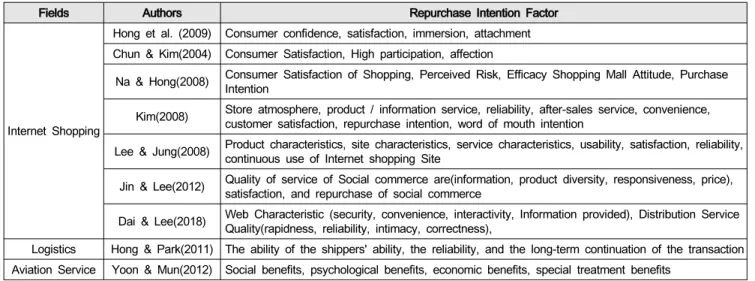
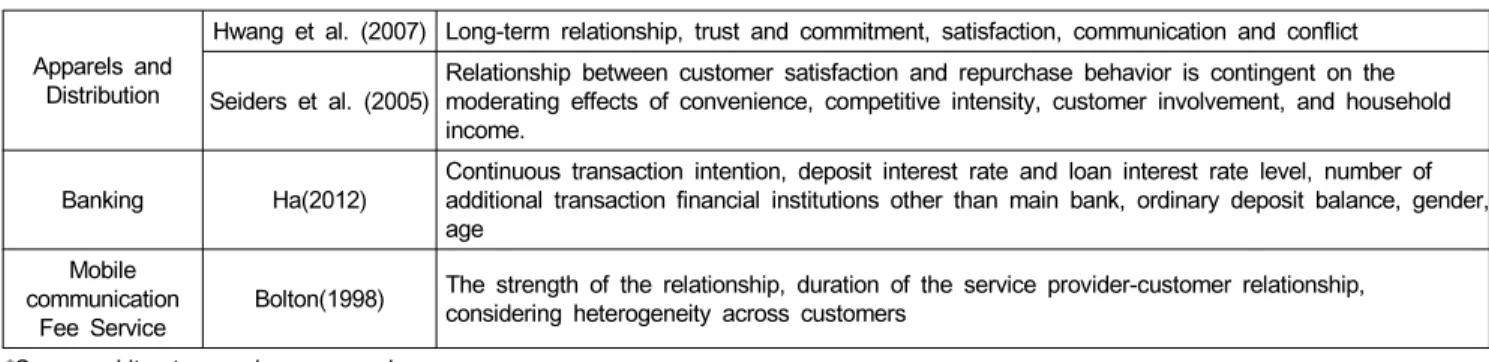
& Lee, 2016). 지속거래(재구매)에 관해 주요 요인들을 요약, 정리하면 <Table 2>와 같다.
Table 2: The Repurchasing Intention Factor and Continuous Transaction Factors by Major Industries
Apparels and Distribution
Hwang et al. (2007) Long-term relationship, trust and commitment, satisfaction, communication and conflict Seiders et al. (2005) Relationship between customer satisfaction and repurchase behavior is contingent on the
moderating effects of convenience, competitive intensity, customer involvement, and household income.
Banking Ha(2012) Continuous transaction intention, deposit interest rate and loan interest rate level, number of additional transaction financial institutions other than main bank, ordinary deposit balance, gender, age
Mobile communication
Fee Service Bolton(1998) The strength of the relationship, duration of the service provider-customer relationship, considering heterogeneity across customers
*Source : Literature review surveyed
Table 3: Comparison of Previous Studies on Service Quality, Customer Satisfaction, and Continuous Transaction(Repurchasing) Author Field Marketing
Type Hypothesis(Variables) Implication
Kim & Lee
(2014) Restaurant B2C Service Quality(Tangibles, Reliability,
Responsiveness, Assurance, Empathy) → Customer Value Customer Satisfaction → Behavioral Intention
With a focus on responsiveness and assurance,
If done, customer satisfaction is higher.
Kim &
Shim
(2017) Coffee Shop B2C
Quality Satisfaction(Service Encounter Quality, Product Quality, Cleanliness, Overall Interior, Convenience, Purchase Quality, Aesthetics) → Quality & Reliability → Customer Satisfaction/Trust → Behavioral Intention
Confirm that the resulting variables of the extended 7 quality factors affect customer satisfaction and reliability.
Kim(2008) Internet Shopping
Moll B2C Service Quality(Interaction Quality, Physical
Environment, Design Quality, Result Quality) → Service Value, Customer Satisfaction → Customer Behavior
Recognition and enhancement of service quality factors can maximize service value and customer satisfaction.
Hong et al.
(2009)
Internet Shopping
Mall B2C
Purchase Review (Amusement, Consensus, Overstatement, Genuineness, Usefulness) → Trust, Satisfaction, Commitment → Word-of Mouth Intention, Repurchase Intention
Consumer confidence needs to be improved through efficient management of purchasing review so that purchasing review is not exaggerated.
An(2013) Marine
Facility B2C
Service Quality(Physical Facility, Worker Attitude, Program, Safety, Support Service) → Service Value (Monetary Value, Non-monetary Value), Customer Satisfaction(Facility Satisfaction, Participation Satisfaction
→ Behavioral Intention (Revisit Intention, Recommendation Intention)
Emphasize the need for quality improvement strategies that maximize the utility value perceived by customers.
Lee & Lee,
(2015) Exhibition B2C
Service Quality(Display Method, Exhibition Contents, Facilities, Event Management, Staff Service,
Supplementary Programs, Promotion, Transportation) → Behavior Intention → Satisfaction
In order to improve the behavioral intention and satisfaction of visitors,
It can be seen that there is a need to improve the service quality.
Kim & Gim
(2009) Package
SW B2C
Service Quality(Tangibles, Reliability, Responsiveness, Assurance, Empathy)/Product Quality(Functionality, Reliability, Usability, Efficiency) → User Satisfaction → Word-of-Mouth/Reuse Intention
User satisfaction on quality of package SW affects word of mouth and intention to reuse.
Koo &
(2007)Park Consulting B2B Service Quality(Reliability, Professionalism, Tangibility, Empathy, Responsiveness) → Customer Satisfaction → Reuse Intention
For IT consultants, service quality factors are reliability, professionalism, and empathy, and customer satisfaction has a great influence on customer's reuse intention.
Hwang et
al. (2007) Apparels B2B Domestic Apparel Firms/Cooperative Companies between Communication → Conflict → Satisfaction → Trust → Commitment → Long-term Relationship
Increase trust and commitment to maintain long-term relationship between trading partners.
This Study UniversalSW B2B
<Step 1> Service Quality(Tangibles, Reliability, Responsiveness, Assurance, Empathy) → Customer Satisfaction → Continuous Transaction
<Step 2> Continuous Transaction Strategy Suggestion
In this study, we derive service quality improvement items through research hypotheses and apply them to case companies, and propose concrete and empirical sustainable continuous transaction strategies.
2.5. 서비스 품질, 서비스 만족도, 재구매 요인 등에 관한 주요 선행연구 비교
그간 서비스 품질, 만족도, 지속거래(재구매) 요인 등과 관 련한 많은 연구가 학계에 발표되었다. 이에 본 연구에서는 국 내 선행연구들을 대상으로 상호 비교하고 본 연구와의 차별성 을 확인하고자 한다. 우선 <Table 3>을 보면 대부분의 연구는 주로 B2C(Business to Consumer) 마케팅 형태이다. B2C 마 케팅은 일반적으로 의사결정자가 소비자(불특정 다수)로서 자 신의 구매 의사에 따라 만족도나 재구매 의사 여부가 결정되 는 구조이다. 반면, B2B(Business to Business)는 거래 기업 당사자 간 신뢰를 기반으로 지속거래 여부가 결정되며 이는 곧 판매기업 수익에 직접적인 영향을 미친다. 또한, 연구대상 에 따라 선정 변수들만 다를 뿐 연구가설 형태는 유사하다. 이 중 정보통신 분야에 관한 선행연구(Kim & Gim, 2009; Koo &
Park, 2007)만이 Parasuraman et al. (1988)의 5가지 요인을 모두 채택하였는데 이는 소프트웨어라는 기술적 속성에 기인 한 것으로 보인다.
이러한 점에서 본 연구 역시, 서비스 품질 변수 선정은 Parasuraman et al. (1988)의 서비스 품질 요인 5가지를 참고 하였다. 하지만 기업현장의 목소리를 직접 반영하고자 별도의 해당 분야 전문가 그룹을 구성하여 정보통신 분야 B2B 마케 팅 형태에 적합한 세부변수들을 재선정하였다. 특히 선행연구 결과들은 주로 불특정 다수를 대상으로 한 서비스 품질이 행 동 의도나 재구매 또는 재사용 의도에 관한 연구들로서 본 연 구의 실증적이고 구체적인 지속거래유지 전략을 기업현장에 제안하고자 하는 것과는 차이가 있음을 확인할 수 있다.
3. 연구방법론
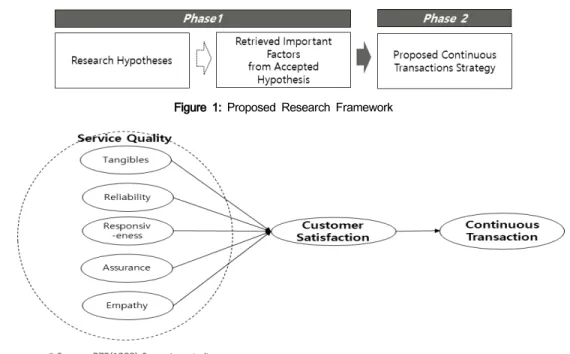
본 연구 방법은 <Figure 1>과 같이 2단계로 나누어 진행한
다. 먼저 1단계인 연구가설과 검증에서는 범용 SW 구매와 사 용 경험이 있는 기업체 임직원을 대상으로 “서비스 품질이 사 용자 만족에 영향을 미친다면 이는 지속거래에 결정적 영향을 미치는가”에 대해 연구가설을 설정하고 검증하고, 채택가설 내 유의미한 서비스 품질개선 필요 항목을 도출한다. 다음 2단계 에서는 ’지속거래 전략‘ 제안 단계로서 1단계의 채택가설 내 중요 요인들을 사례 기업(K사)에 적용, 서비스 품질개선을 통 한 지속거래 유지 전략을 제안한다.
3.1. 연구가설의 설정
먼저 연구가설은 <Figure 1> 중 1단계인 서비스 품질이 ‘사 용자 만족’과 ‘지속거래에 영향을 미치는가를 확인하고자
<Figure 2>와 같이 연구가설을 설정하고 검증한다. 참고로 서 비스 품질 요인은 Parasuraman et al. (1988)과 관련 선행연구 를 참고하여 본 연구에 활용한다.
3.1.1. 서비스 품질과 사용자 만족
우선, ‘서비스 품질(SQ: Service Quality)’ 측정 변수로서 ‘유 형성’은 서비스 제공 회사의 규모, 인력 등의 외형 등을 의미 한다. ‘신뢰성’이란 거래실적, 정보제공, 컨설팅 여부 등 의미가 있는 서비스를 제공하고, 처리 능력에 대해 믿을 수 있도록 하 는 능력을, ‘대응성’은 판매자가 사용자를 돕고 서비스를 제공 하려는 자세를 의미한다. ‘보증성’이란 구매제품에 대한 기술지 원, 계약 내용 준수 여부 등 판매사의 기술력에 대한 고객의 확신을 주는 정도를, 끝으로 ‘공감성’이란 사용자가 기대하는 수준에 대한 판매 회사의 관심이다. 따라서 서비스 품질과 사 용자 만족(CS: Customer Satisfaction)에 대한 <가설 1>을 다 음과 같이 설정하였다.
Figure 1: Proposed Research Framework
Figure 2: Research Hypothesis
H1: 서비스 품질은 사용자 만족에 긍정적 영향(+)을 미칠 것이다.
H1-1: 서비스 품질의 유형성은 사용자 만족에 긍정적(+) 영향을 미칠 것이다.
H1-2: 서비스 품질의 신뢰성은 사용자 만족에 긍정적(+) 영향을 미칠 것이다.
H1-4: 서비스 품질의 보증성은 사용자 만족에 긍정적(+) 영향을 미칠 것이다.
H1-5: 서비스 품질의 공감성은 사용자 만족에 긍정적(+) 영향을 미칠 것이다.
3.1.2. 사용자 만족과 지속거래
우선, ‘사용자 만족(CS: Customer Satisfaction)’ 이란 고객이 서비스 경험 결과에 대한 전체 서비스 품질 만족도로서 서비 스 품질이나 서비스 관련 개선 여부를 의미한다. ‘지속 거래 (CT: Continuous Transactions)’란 서비스를 받은 후 만족 또는 불만족 느낌을 바탕으로 다른 거래처로 이탈하지 않고 계속 거래를 하고 싶은 정도이다. 다만 본 연구에서는 결과변수인
‘사용자 만족’과 ‘지속거래’ 변수는 단일 항목 척도로 측정하고 자 하는데 이는 고객 만족의 복잡성과 여러 가지 무작위적 오 차라든지 항목의 특유성 등으로 인해 척도 신뢰성 평가가 쉽 지 않기 때문이다(Kim & Gim, 2009; Yang & Choi, 2006). 이 에 ‘사용자 만족’과 ‘지속거래’는 다항목 척도로 간주, 측정하고
<가설 2>를 다음과 같이 설정하였다.
H2: 사용자 만족은 지속거래에 긍정적(+)인 영향을 미칠 것 이다.
3.2. 지속거래 유지 전략의 제안
2단계는 채택가설 내 서비스 품질개선 필요 요인을 활용하 여 기업이 필요한 지속거래 유지 전략을 제안한다. 그러나 지 금까지 범용 SW 구매 고객에 대한 사후관리 차원의 서비스 품질 만족도를 측정한 사례가 없어 사례기업(K사)을 선정하여 지속거래 유지 전략을 제안하고자 한다.
4. 연구결과 4.1. 자료수집
1단계 연구가설 검증을 위한 실험 데이터는 국내 중소기업 기술혁신협회 CEO 과정 수료기업인 450여 기업 그리고 중견 기업·대기업 50개 총 510개 기업을 대상으로 하여 2015년 9 월 15일~10월 5일까지 설문조사를 시행하였다. 회수된 설문지 는 226개(44%)이었으며 이중 유효 설문지 215개를 실험 분석 에 활용하였다. 먼저, 설문응답자 특성을 살펴보면 성별은 남 성이 178명(82.8%), 여성이 37명(17.2%)으로 대부분 남성이었 으며, 직위는 직원급이 58명(27.0%), 임원급 45명(20.9%)에 평 균 응답자 직무 경력은 5~15년 사이가 전체의 68.8%인 148명 이었고, 15년 이상 경력자도 21.9%인 47명을 차지하였다. 소 속부서의 경우, 경영지원실 59명(27.4%), 전산실 34명(15.8%), 연구소 35명(16.3%), 디자인실 14명(6.5%), 기타부서 73명 (34.0%)으로 일반부서가 대다수를 이루고 있으며 구매기업의 인력 규모는 종업원 수는 50~200명 미만의 중소기업이 주류
를 이루고 있다. 또한, 주로 사용하는 SW 관련 응답으로는 MS사의 워드프로세서(150명, 69.8%)가 가장 많았고 그래픽이 나 멀티미디어용 SW의 경우, Adobe사의 Autodesk가 거의 독 점하고 있다. 기타 특수업무용이나 프로그램 설계용의 경우, 응답자 수가 극소수로 나타나 본 연구에서는 제외하였다.
4.2. 변수의 조작적 정의 및 측정항목
먼저 본 연구에서는 Dodds and Monroe(1985)의 서비스 품 질 측정 관점에서 변수를 정의하고 측정하고자 한다. 이는 본 연구대상인 SW 유통판매 영세기업의 경우, SW의 자체개발·판 매가 아닌 완성 제품에 대한 판매·유통을 주 사업으로 하고 있 기 때문이다. 이는 “서비스 품질은 서비스 산업 특성에 따라 달라진다.”라고 주장한 관련 Yang and Choi(2006)의 연구결과 와도 부합한다.
따라서 본 연구에서 SW의 서비스 품질 측정은 SERVPERF 성과 중심 접근 방법(Cronin & Taylor, 1992) 관점에서 보편적으 로 가장 많이 활용(Kim & Shin, 2001; Suh & Lee, 2006; Kim
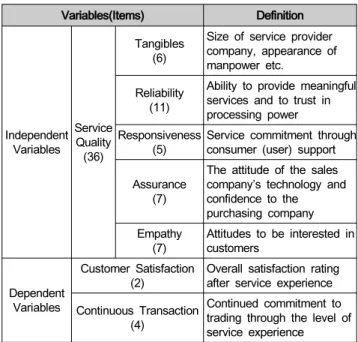
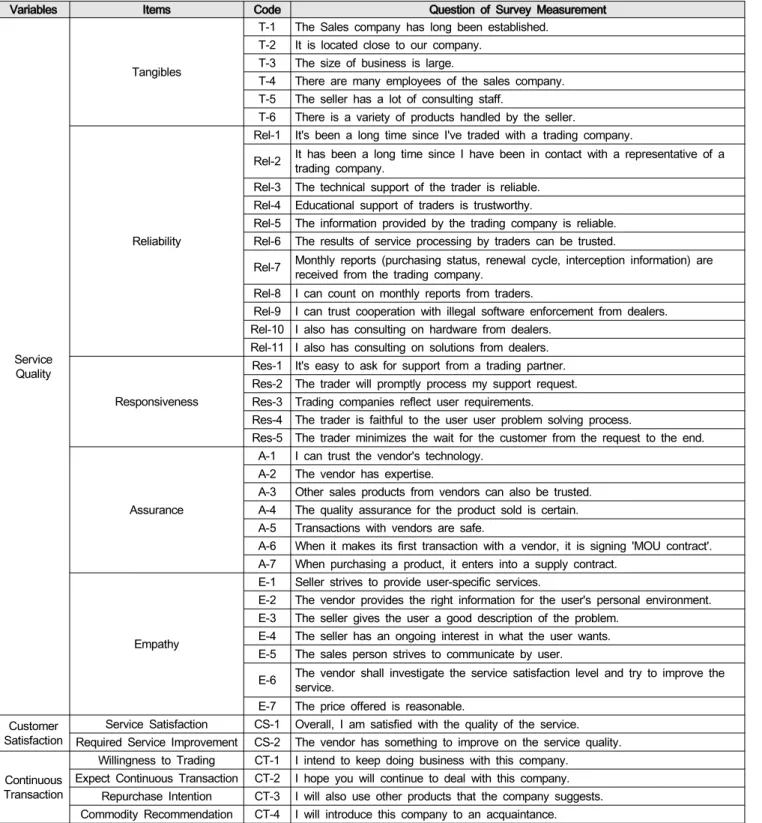
& Gim, 2009)하고 있는 SERVQUAL 5가지 항목(Parasuraman et al., 1988)을 독립변수로 선정하고, 종속변수(결과변수)는 사 용자 만족(2개 항목)과 지속 거래(1개 항목) 2가지로서 Kim and Gim(2009)의 선행연구를 참조하되, 서비스 관련 10명의 전문가 집단과 대면 설문조사 결과를 추가, 반영하여 변수들의 개념 및 조작적 정의를 하였다(<Table 4>). 세부 항목별 측정 (설문)항목은 Appendix <Table A.1>에 별도 정리하였다.
Table 4: Definition of Variables
Variables(Items) Definition
Independent Variables
Service Quality (36)
Tangibles (6)
Size of service provider company, appearance of manpower etc.
Reliability (11)
Ability to provide meaningful services and to trust in processing power Responsiveness
(5) Service commitment through consumer (user) support Assurance
(7)
The attitude of the sales company’s technology and confidence to the purchasing company Empathy
(7) Attitudes to be interested in customers
Dependent Variables
Customer Satisfaction
(2) Overall satisfaction rating after service experience Continuous Transaction
(4)
Continued commitment to trading through the level of service experience
4.3. 신뢰성과 타당성 분석
먼저 신뢰성 검증은 유효 설문지 215건을 대상으로 SPSS Ver. 20 소프트웨어를 활용하여 신뢰성을 검증하였다. 설문 항 목의 신뢰성을 검증한 결과, 전체 내적 일관성 평가방법인 Cronbach's α 값이 0.759~0.964로 나타나 모든 측정 변수의 신뢰도는 우수한 것으로 나타났다(<Table 5>).
Component Responsiveness
(Res) Empathy
(E) Tangibles
(T) Assurance
(A) Reliability (Rel)
Rel-5 .830 .164 .129 .225 .268
Rel-3 .826 .254 .196 -.011 .249
Rel-6 .808 .228 .164 .165 .192
A-5 .788 .273 .307 .135 -.027
A-4 .769 .239 .360 .092 -.064
A-1 .703 .333 .428 -.074 .107
Rel-4 .684 .307 .136 .035 .468
Rel-1 .677 .073 .379 .197 .350
A-3 .673 .313 .354 .131 .101
A-2 .667 .353 .432 -.122 .065
Res-1 .649 .467 -.222 .267 -.010
Res-4 .641 .603 -.086 .185 .099
Res-5 .632 .543 -.114 .230 .062
Res-2 .628 .510 -.114 .278 -.041
Rel-2 .552 .318 .151 .185 .449
Rel-9 .518 .323 -.067 .491 .115
E-5 .196 .855 .070 .157 .191
E-4 .322 .800 .056 .233 .160
E-2 .366 .799 .088 .134 .251
E-3 .419 .795 -.047 .203 .027
E-1 .261 .774 .040 .257 .220
E-7 .171 .658 -.087 .323 -.016
E-6 .335 .629 .086 .213 .270
Res-3 .530 .612 -.236 .239 .152
T-3 .072 -.128 .916 -.039 -.026
T-4 .108 -.141 .901 -.084 -.019
T-5 .104 -.017 .779 .077 .198
T-1 .299 .038 .695 .159 .074
T-6 .277 .186 .589 .319 -.147
A-6 .066 .101 .117 .803 .136
Rel-11 .157 .338 .057 .731 .028
A-7 .165 .209 .098 .727 .001
Rel-10 .066 .412 -.014 .663 .184
Rel-8 .188 .225 .050 .442 .688
Rel-7 .008 .269 .012 .521 .677
T-2 .292 .156 .019 -.114 .670
Table 5: The Resulted of Reliability Test
Variables(Code) Items Cronbach's α
Service Quality(SQ)
Responsiveness(Res) 6 0.964
Empathy(E) 7 0.947
Tangibles(T) 6 0.877
Assurance(A) 7 0.831
Reliability(Rel) 11 0.759
Customer Satisfaction(CS)
Service Satisfaction(CS-1)
2 0.735
Service Improvement Required(CS-2)
Continuous Transaction(CT)
Willingness to Trading(CT-1)
4 0.922
Expect Continuous Transaction (CT-2)
Repurchase Intention(CT-3) Commodity Recommendation(CT-4)
이어 타당성 검증은 탐색적 요인분석을 통한 적합도를 측정 하였다. 먼저 상관행렬과 Bartlett 검정 및 KMO(Kaiser Meyer Olkin) 검증 결과, KMO값은 0.893으로 나타났고, Bartlett의 구 형성 검정 결과도 p<.01에서 유의확률은 0.000으로 나타나 변수 간 상관성은 모두 확보되었고 전체 요인분석결과도 유의미 (<Table 6>)한 것으로 분석되었다. 참고로 요인 추출 시 주성분 분석(PCA)을 통한 베리맥스법을 적용하였고 이때 전체 5개 서 비스 품질 설문 항목의 주성분 분산비는 74.5%이다(<Table 7>).
Table 6: KMO and Bartlett's Test
Kaiser-Meyer-Olkin Measure of Sampling Adequacy .893 Bartlett Test
of Sphericity
Approx. Chi-Square 9226.034
df 630
Sig. .000
Table 7: An Factors Analysis of Service Quality Survey Items
4.4. 상관분석
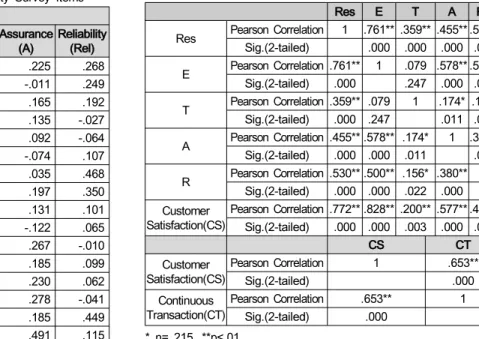
<가설 1>인 ‘서비스 품질(대응성(Res), 공감성(E), 유형성 (T), 보증성(A), 신뢰성(Rel)’)과 ‘사용자 만족’ 요인 간 상관분석 을 실시한 결과, 서비스 품질 요인 5가지 모두 p-value<0.01 보다 낮게 나타나 서비스 품질은 사용자 만족과 매우 높은 상 관관계가 있는 것으로 나타났고, <가설 2> ‘사용자 만족(CS)’
과 ‘지속 거래(CT)’ 간 상관분석 결과 역시, p<.01에서 0.000으 로 나타나 ‘CS’와 ‘CT’도 매우 높은 상관관계가 있음을 재확인 하였다(<Table 8>).
Table 8: Resulted of Correlation Analysis
Res E T A Rel
Res Pearson Correlation 1 .761** .359** .455** .530**
Sig.(2-tailed) .000 .000 .000 .000 E Pearson Correlation .761** 1 .079 .578** .500**
Sig.(2-tailed) .000 .247 .000 .000 T Pearson Correlation .359** .079 1 .174* .156*
Sig.(2-tailed) .000 .247 .011 .022 A Pearson Correlation .455** .578** .174* 1 .380**
Sig.(2-tailed) .000 .000 .011 .000 R Pearson Correlation .530** .500** .156* .380** 1
Sig.(2-tailed) .000 .000 .022 .000 Customer
Satisfaction(CS)
Pearson Correlation .772** .828** .200** .577** .483**
Sig.(2-tailed) .000 .000 .003 .000 .000
CS CT
Customer
Satisfaction(CS)Pearson Correlation 1 .653**
Sig.(2-tailed) .000
Continuous
Transaction(CT)Pearson Correlation .653** 1 Sig.(2-tailed) .000
* n= 215, **p<.01
Non-standardized
Coefficient Standardized Coefficient t-
value p- value Beta Standard Error Beta
Respon- siveness (Res)
(Constant) -.014 .276 -.050 .960
Res-1 .081 .093 .084 .871 .385
Res-2 .032 .094 .034 .344 .731
Res-4 .053 .099 .057 .531 .596
Res-5 .217 .102 .226 2.128 .035
A-1 .071 .145 .069 .488 .626
A-2 -.104 .126 -.099 -.822 .412
A-3 .251 .084 .232 3.000 .003
A-4 .087 .136 .079 .640 .523
A-5 .029 .130 .027 .222 .824
Respon- siveness (Res)
Rel-1 -.203 .083 -.195 -2.450 .015
Rel-2 .205 .080 .188 2.570 .011
Rel-3 -.182 .111 -.172 -1.639 .103
Rel-4 .207 .103 .201 2.016 .045
Rel-5 .134 .115 .124 1.159 .248
Rel-6 .001 .106 .001 .009 .993
Rel-9 .113 .064 .119 1.776 .077
Empathy (E)
(Constant) .483 .192 2.512 .013
E-1 .260 .079 .261 3.293 .001
E-2 -.006 .101 -.006 -.061 .952
E-3 .358 .087 .350 4.117 .000
E-4 .173 .084 .175 2.065 .040
E-5 -.032 .076 -.034 -.414 .679
E-6 .063 .053 .065 1.177 .241
E-7 -.053 .048 -.056 -1.114 .267
Rel-3 .168 .056 .178 3.019 .003
Assurance (A)
(Constant) 2.497 .224 11.131 .000
A-6 -.032 .066 -.040 -.492 .623
A-7 .243 .066 .295 3.714 .000
Rel-10 .179 .096 .193 1.852 .065
Rel-11 .210 .086 .260 2.432 .016
4.5. 회귀분석과 가설 검증
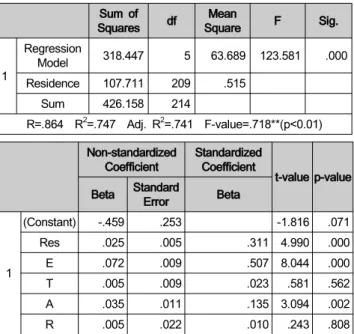
먼저 <가설 1>의 검증을 위한 회귀분석 결과, 모형 적합도 R2 값은 0.747, F의 유의확률은 0.000으로 나타나 p<.01에서 유의하였고 또한, 서비스 품질에 유의한 사용자 만족 관련 요 인(β 값)은 공감성(E), 대응성(Res), 보증성(A)으로 나타났다 (<Table 9>).
Table 9: Regression Analysis Model Summary Results between Service Quality and Customer Satisfaction
Sum of
Squares df Mean
Square F Sig.
1
Regression
Model 318.447 5 63.689 123.581 .000
Residence 107.711 209 .515
Sum 426.158 214
R=.864 R2=.747 Adj. R2=.741 F-value=.718**(p<0.01) Non-standardized
Coefficient Standardized Coefficient
t-value p-value Beta Standard
Error Beta
1
(Constant) -.459 .253 -1.816 .071
Res .025 .005 .311 4.990 .000
E .072 .009 .507 8.044 .000
T .005 .009 .023 .581 .562
A .035 .011 .135 3.094 .002
R .005 .022 .010 .243 .808
따라서 <가설 1>의 경우, 대응성(Res), 공감성(E), 보증성 (A) 3개의 변수만 채택되었고 채택가설 내 세부변수인 ‘대응성 (Res)’은 A-3, Res-5, Rel-4, Rel-2가 유의하였고, ‘공감성(E)’은 E-3, E-1, Rel-3, E-4, 그리고 ‘보증성(A)’은 A-7, Rel-11이 각각 유의한 것으로 분석되었다(<Table 10>).
Table 10: Regression Analysis Results of Significant Variable to Customer Satisfaction
다음으로 <가설 2>에 대한 회귀분석결과, 모형의 적합도는 결정계수(R2) 값이 0.537로 나타났고, F의 유의확률은 0.000 (p<0.01)로 나타났다. 즉, 사용자 만족(Beta=0.733)이 높다는 것은 지속거래도 높아짐을 의미한다 하겠다(<Table 11>).
Table 11: Regression Analysis Model Summary Results of Customer Satisfaction and Continuous Transaction
Sum of
Squares df Mean
Square F Sig.
1
Regression
Model 137.259 1 137.259 149.830 .000b
Residence 118.176 129 .916
Sum 255.435 130
R=.733 R2=.537 Adj. R2=.534 F-value=.9571**(p<0.01) Non-standardized
Coefficient Standardized Coefficient
t-value p-value Beta Standard Error Beta
1 (Constant) 1.962 .278 7.058 .000
CS .650 .053 .733 12.241 .000
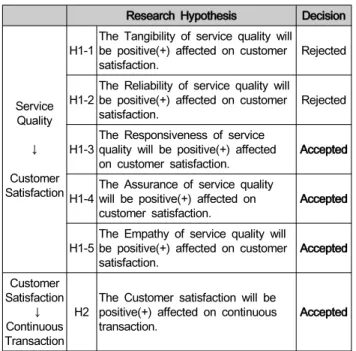
따라서 <가설 1>은 <H1-3>, <H1-4>, <H1-5>만 채택되었으 며, <가설 2>는 모두 채택되었다(<Table 12>). 이러한 결과는 서비스 품질 항목인 ‘대응성’, ‘보증성’, ‘공감성’은 사용자 만족 에 결정적 영향을 미치며 이 3가지를 어떻게 강화하는가가 사 용자가 거래 기업과의 지속거래를 유지하는데 결정적 역할을 하는 것으로 판단된다.
Table 12: Final Resulted of Hypothesis Test
Research Hypothesis Decision
Service Quality
↓ Customer Satisfaction
H1-1The Tangibility of service quality will be positive(+) affected on customer
satisfaction. Rejected
H1-2The Reliability of service quality will be positive(+) affected on customer
satisfaction. Rejected
H1-3The Responsiveness of service quality will be positive(+) affected
on customer satisfaction. Accepted H1-4The Assurance of service quality
will be positive(+) affected on
customer satisfaction. Accepted H1-5The Empathy of service quality will
be positive(+) affected on customer
satisfaction. Accepted
Customer Satisfaction Continuous ↓ Transaction
H2 The Customer satisfaction will be positive(+) affected on continuous
transaction. Accepted
4.6. 서비스 품질개선을 통한 지속거래 유지 전략 본 연구에서는 앞서 4.5장(1단계)의 가설결과(<Table 12>) 중 서비스 품질개선이 필요 한 요인으로서 ‘공감성(E)’, ‘보증성 (A)’, ‘대응성(Res)’에 대하여 <Table A.1>을 활용하여 사례 대 상 기업(K사)에 적용해 지속거래 유지 전략을 제안한다.
4.6.1. 공감성과 서비스 품질개선
‘공감성(E: Empathy)’이란 “고객을 이해하고 배려하는 태도”
이다. 즉, “사용자에게 문제 해결 내용을 잘 설명해 준다 (E-3).”, “사용자별 서비스 제공에 노력한다(E-3).”, “거래업체의 기술지원은 신뢰할 수 있다(Rel-3).”, “사용자가 원하는 것에 대 한 지속적인 관심을 둔다(E-4).”가 유의한 요인들이다. 하지만 본 연구대상 분야의 경우, 서비스 만족도에 관한 선행연구들이 거의 없는 관계로 본 연구에서는 사례 대상기업(K사)과의 지 속거래 기업(소위 충성 고객사) 15개를 대상으로 2015년 10월 11일에서 12일 사이에 별도 유선 조사를 통해 공감성 세부 항 목을 도출하여 본 연구에 적용하였다.
설문 분석 결과, 지속거래 유지를 위해 필요한 고객의 공감 성을 높이기 위해서는 담당자별 평가(6.4/7점 만점), 서비스 완 료 후 담당자 서비스 평가 진행(5.9/7점 만점) 등이 필요한 것 으로 나타났다(<Table 13>). 이는 서비스에 대한 평가 요청 부 분과 담당자의 평가에 따른 교체를 원하는 것으로 보아, 현재 제공 서비스에 대해 사용자 불만이 많은 것으로 보인다. 따라 서 사용자 만족을 위한 서비스 개선이 시급해 해결해야 하는 과제로 판단되며 고객 서비스 평가결과에 대한 등급 점수화를 통한 개선이 필요할 것으로 보인다. 이를 위해 최상급(6점/7점 만점)보다 높은 경우, 우수사원 선발 및 인센티브 지급, 연봉 계약 가산점 부여 등의 혜택을 부여하고, 중급(3점∼6점)인 경 우 서비스 교육 진행하고 하급(3점 이하)인 경우에는 고객 담 당지정 변경 및 연봉계약 감점 부여, 서비스 재교육과 같은 맞
춤형 서비스 개선 노력이 필요할 것으로 판단된다.
Table 13: Customer's View on Adopting a Service Evaluation System
Inquiry Contents Average Score
(7point scale) 1) I would like you to conduct a service
evaluation for the person in charge after
completing the service for all request. 5.9 2) I would like to conduct a service evaluation
for the company on a monthly basis. 5.4 3) I would like to conduct a service evaluation
for the person in charge on a monthly basis. 6.4 4) If the evaluation of the person in charge is
not good, the person in charge should be
replaced. 3.7
*Source : Additional surveyed from 15 royal companies 4.6.2. 대응성과 서비스 품질개선
‘대응성(Res: Responsiveness)’의 경우, “판매업체의 다른 판매 제품들도 믿을 수 있다(A-3).”, “업체 제공 정보는 믿을 수 있다(Res-5).”, 그리고 “업체의 교육 지원은 신뢰할 수 있다 (Rel-4).”, “담당자와 거래한 지 오래되어 믿을 수 있다(Rel-2).”
가 유의미하였다. 이는 결국, 담당자에 대한 인성 및 역량이 중요한 것임을 의미하는 것으로서 제품 교육이나 서비스 품질 향상을 위한 정례 교육 등을 실시하여 고객 요구에 대한 신속 한 대응력 향상과 신뢰성을 높여야 할 것으로 보인다.
4.6.3. 보증성과 서비스 개선
‘보증성(A: Assurance)’이란 판매 제품이나 A/S와 같은 사후 관리 정도를 의미한다. 앞서 유의미한 요인으로서 “제품구매 시 ‘물품공급계약’을 체결하고 있다(A-7).”와 “제품 솔루션에 대 한 컨설팅도 함께 받고 있다(Rel-11).”가 유의미한 것으로 나타 났는데 여기서 ‘A-7’은 소액의 SW 제품구매 시 에도 고객(기 업)들은 ‘물품공급계약’이 이루어져야 한다는 것을 의미하며,
‘Rel-11’은 SW 제품 솔루션에 대한 고객 관심이 높다는 것을 의미함을 알 수 있다. 따라서 단순히 SW 제품 판매에서 행태 에서 한 걸음 더 나아가 고객 상황에 적합한 정기적인 전문 컨설팅이 가능하도록 하는 능력 확보가 필요하다. 이는 서비스 만족이 사용자 만족을 시키면, 기존 거래업체뿐만 아니라 신규 거래업체까지 추가 고객 확보가 가능하기 때문이다.
4.6.4. 기타 항목과 서비스 품질개선
그밖에 서비스 품질개선을 위한 항목으로는 사용자 편의성 을 위한 교육 지원과 사후관리 서비스(AS) 지원이 될 수 있을 것이다. 교육 지원은 제품별 원활한 SW 사용법 습득 지원을 위한 메뉴얼(제조사), 서적(출판사 선정), 오프라인강좌(연락처 정리), 온라인강좌(제조사, 교육 사이트) 등이 될 수 있으며 AS 지원의 경우, 자체 지원 또는 외부 협력(특수업무용과 설 계용은 특수한 분야의 기술로 제조사를 통한 AS가 가능한 경 우)에 따라 고객 요청이 즉각 시행해야 한다. 이를 위해 관련 SW별 길잡이(제조사), A/S 센터(연락처정리) 등의 정비도 필 요할 것으로 사료 된다.
5. 연구결과 및 시사점
본 연구는 범용 SW에 대한 B2B 유통·판매를 주 사업으로 하는 국내 영세 중소기업을 대상으로 서비스 품질개선을 통한 지속거래 유지 전략을 제안하고자 하였다. 연구결과, 서비스 품질이 사용자 만족과 지속거래에 긍정적 영향을 미치는 것을 확인하였다. 특히 서비스 품질개선을 위한 세부 항목으로서 대 응성’, ‘보증성’, ‘공감성’이 채택되었는데 이를 어떻게 개선하는 가가 기업생존에 결정적 역할을 하는 것으로 사료 된다. 즉, 서비스 품질개선을 위해 ‘공감성’은 주기적인 직원 평가를, ‘대 응성’의 경우, 담당자에 대한 정기적인 교육 강화와 서비스 교 육의 필요, 그리고 ‘보증성’의 경우, 구매 금액 크기와 관계없 이 ‘물품공급계약’을 체결하여 신뢰도를 높여야 할 것이다. 그 밖에 서비스 품질개선을 위해 단순히 제품 판매뿐만 아니라 SW 솔루션과 같은 기업 맞춤형 전문 컨설팅 기능도 필요한 것으로 보인다.
본 연구의 의의는 다음과 같다. 첫째, 그간 서비스 품질이나 재구매 의도 등과 같은 대다수 선행연구는 주로 대기업이나 서비스 산업 등에 국한되어 서비스 품질과 재구매 또는 장기 거래를 위한 요인에 대한 해석에서 벗어나 불모지나 다름없는 범용 SW 분야의 영세 B2B 유통 판매기업을 대상으로 선정하 였다는 것이다. 둘째, 일반적인 서비스 품질, 고객 만족, 재구 매 등에 관한 대다수 선행연구는 채택가설 요인 해석에 초점 이 맞추어져 있었다면 본 연구는 기업생존을 위한 구체적이고 실증적인 지속거래유지 전략을 제안함으로써 기업현장에서 실 제 적용해볼 수 있는 실증 사례 연구라는 것이다. 따라서 본 연구결과가 향후 SW 유통· 판매 영세기업의 생존력을 높이는 데, 어느 정도 이바지할 수 있을 것으로 사료 된다.
반면 다음과 같은 연구 한계점도 발견되었다. 첫째, 패키지 SW의 경우, 서비스 품질 측정 시 제품 품질과 서비스 품질 모두를 반영하여 소비자 만족도를 측정하는 것이 일반적이다 (Kim & Gim, 2009). 이는 기업 자체개발/판매 여부에 따라 SW 유통판매 기업에 적용 시 연구결과가 일부 달라질 수 있 기 때문이다. 둘째, 서비스 품질 측정을 위한 요인 선정을 PZB(1988)의 5가지 SERVQUAL 요인과 선행연구들을 참고해 별도 전문가 집단을 활용한 설문 항목을 재구성, 적용하였다.
하지만 이는 주로 B2C 형태의 대기업이나 일반 서비스 기업 에 주로 적용하는 서비스 품질 측정 방법으로서 모든 영세 B2B 유통 판매기업을 대상으로 할 시 연구결과에서 일부 차 이가 있을 수 있다.
따라서 향후 SW 판매 유통기업의 판매형태(자체개발 또는 단순 유통판매)라든지 고객 특성이나 계층별 서비스 개선 방 안 연구 등과 같은 추가적인 연구가 필요할 것으로 사료된다.
References
Ahn, B. O., & Lee, H. K. (2017). A study on the development of mystery shopping checklist for quality measurement of quality of service: Focusing the convenience store. Korea Customer Satisfaction Management Association, 19(4), 39-65.
An, C. K. (2013). The effects of service quality on service value: Customer satisfaction, and behavioral intention in
Marina. Korean Journal of Sports Science, 22(2), 629-642.
Bolton, R. N. (1998). A dynamic model of the duration of the customer's relationship with a continuous service provider: The role of satisfaction. Marketing Science, 17(1), 45-65.
Chang, D. S., Park, S. S., & Shin, C. S. (2000). A comparative study on the services quality of Korean and foreign brand fast food franchisee in Korea. Journal of the Korea Service Management Society, 1(1), 101-124.
Cho, S. B., & Kim, K. Y. (2008). A comparative study on the ks-sqi, ncsi, and kcsi. Korean Journal of Hotel Administration, 17(3), 213-227.
Choi, W.K., & Lee, H. J.(2006). A study of the effect of relational benefits on long-term orientation: Trust and relational commitment as a mediator. Korean Journal of Hotel Administration, 19(6), 15-39.
Choi, Y. S., & Kim, Y. (2004). The influences of perceived service quality on performance of public sports center: The mediating roles of customer loyalty and perceived quality of life. Korean Journal of Sport Science, 15(1), 66-75.
Chun, D. Y., & Kim, C. H. (2004). A comparative study of influencing factors on shopping satisfaction and repeat purchase intention between internet shopping mall types. Journal of Global Academy of Marketing Science, 13(1), 1-27.
Cronin, Jr. J. J., & Taylor, S. A. (1992). Measuring service quality: A reexamination and extension. The journal of marketing, 56(3), 55-68.
Czepiel, J. A., & Gilmore, R. (1987). Exploring the concept of loyalty in services. In C. Congram, J. A.
Czepiel, & J. Shanahan (Eds), The service challenge:
Integrating for competitive advantage. Chicago, IL:
American Marketing Association.
Dai, W., & Lee, J. H. (2018). Effects of website characteristics and delivery service quality on repurchase intention. The International Journal of Industrial Distribution & Business, 9(5), 17-24.
DeLone, W. H., & McLean, E. R. (1992). Information systems success: The quest for the dependent variable.
Information systems research, 3(1), 60-95.
Dodds, W. B., & Monroe, K. B. (1985). The effect of band and price information on subjective product evaluations. Advances in Consumer Research, 12, 85-90.
Ganesan, S. (1994). Determinants of long-term orientation in buyer-seller relationships. The Journal of Marketing, 58(2), 1-19.
Gartner (2015, June). Gartner Market Databook 2015, Update.
Garvin, D. A. (1984). What does “product quality” really mean?. Sloan Management Review, 26(1), 25-43.
Grönroos, C. (1984). A service quality model and its marketing implications. European Journal of marketing, 18(4), 36-44.
Grönroos, C. (1990). Service management and marketing:
Managing the moments of truth service competition.
Lexington, KY: Lexington Books.
Ha, H. Y. (2012). An empirical evaluation of continuous transaction intents using categorical regression in the banking industry. Journal of the Korean Operations Research and Management Science Society, 37(3), 1-12.
Hong, B. S., Lee, E. J., & Cho, M. A. (2009).
Transactions: The effect of purchase reviews on the trust, satisfaction, commitment, and repurchase intention of consumer in internet shopping malls. Journal of the Korean Society of Clothing and Textiles, 33(11), 1817-1827.
Hong, S. L., & Park, H. S. (2011). A study on transaction form of logistics business companies. The Journal of Korea Research Society for Customs, 12(3), 223-241.
Hwang, S. J., Cho, H. J., & Byun, Y. S. (2007). The effect of relational commitment on long-term relationship among domestic apparel firms & cooperative companies. Family and Environment Research, 45(2), 23-31.
Jin, G. S., & Lee, J. H. (2012). Service quality factors affecting satisfaction and repurchase intention of social commerce. Journal of Contents Association, 12(3), 311-321.
Jin, H. Y. (2015, June). Software industry status and implications. KISTI, 27(15), 1-18.
Kang, K. B. (2017). Law and policy study on reverse engineering provisions under the copyright Act.
Copyright Quarterly, 30(2), 5-42.
Kelley H. H., & Thibaut J. W.(1978). Interpersonal relations: A theory of interdependence. New York, NY:
John Wiley & Sons.
Kettinger, W. J., & Smith, J. (2009). Understanding the consequence of information systems service quality on IS service reuse. Information & Management, 46(6), 335-341.
Kim, C. K., Lim, J. Y., & Kim, M. C. (2003). A study of the effect of selling situation based on product types on the long-term orientation between buyer-seller. Asia Marketing Journal, 9(1), 95-121.
Kim, D. N., & Cho, J. R. (2004). An empirical study on integrated customer satisfaction evaluation model for new product development. Journal of the Korean society for Quality Management, 32(4), 113-124.
Kim, H. S., & Shim, J. H. (2017). The effects of service qualities on customer satisfaction and behavioral intention in coffee shops. International Journal of Industrial Distribution & Business, 8(5), 95-109.
Kim, J. H. (2008). A study on the effect of service quality
factors to service value, customer satisfaction and customer behavior in internet shopping mall. Journal of Korea Service Management Society, 9(4), 229-256.
Kim, J. H., & Shin, Y. S. (2001). Empirical research on structural relationship among service quality, service value, satisfaction, relation quality, and re-use intention.
Journal of Global Scholars of Marketing Science, 8(1), 451-473.
Kim, J. S., & Gim, G. Y. (2009). A study on the influence of service quality and product quality of package software on user satisfaction, word-of-mouth intention and reuse intention. Journal of the Korea society of IT services, 8(2), 1-22.
Kim, J. S., Park, J. H., & Choi, S. H. (2014). A study on the effect of service quality on customer value:
customer satisfaction and behavioral intention. Journal of Tourism & Leisure, 26(5), 155-176.
Kim, K. H. (2008). Relationship between store image evaluation, customer satisfaction, and repurchase intention according to the types of internet fashion shopping malls. Textile Research Journal, 10(1), 50-58.
Kim, P. J., & Lee, J. Y. (2016). A study on the effects of perceived quality on whitening cosmetics’ satisfaction and repurchase: Focused on university students. The East Asian Journal of Business Management, 6(2), 15-22.
Kim, Y. D., & Park, M. J. (2006). A study on factors associated with the measurement of the service quality in liners by using servperf model. Journal of Shipping and Logistics, 49(Jun), 43-65.
Kim, Y. J., & Lee, H. R. (2014). Effect of information system quality for restaurant trade area on users`
satisfaction and intention. Journal of Food Service Management, 17(6), 297-320.
Koo, J. M., & Park, J. S. (2007). A study of IT consulting service factors selection and effect on consumer satisfaction-comparative analysis of clients and consultants: View. Journal of Consumer Police Studies, 31(1), 100-130.
Lee, H. J., & Lee, M. Y. (2015). The effect of visitor’s service quality perception on satisfaction and behavior intention: Focusing on the 10th Gwangju Biennale.
Journal of Arts Management and Policy, 34, 91-114.
Lee, M. H. (2010). The study on the effect of airline service quality on value, satisfaction and loyalty. Korean Journal of Tourism Research, 25(5), 101-122.
Lee, J. W. (2017). Critical Factors Affecting Consumer Acceptance of Online Health Communication: An Application of Service Quality Models. The Journal of Asian Finance, Economics and Business, 4(3), 85-94 Lee, S. R., & Jung, Y. O. (2008). A study on continued
use of online shopping site using a weighted expectation-confirmation model. Journal of the Korean operations research and management science society,