834
Copyright © 2020 The Korean Society of Fisheries and Aquatic Science pISSN:0374-8111, eISSN:2287-8815
서 론
김은국내수산물수출
1
위품목으로2019
년수출액규모가5.8
억달러에달한다(MOF, 2020).
그동안김가공식품해외 수출은조미김중심으로이루어졌지만,
최근에는김스낵제품 들이개발되면서다양화되는추세에있다.
김스낵제품중가장 대표적인것이우리나라전통식품인김부각으로김에찹쌀풀 을발라건조후기름에튀기는방식으로제조된다(Park et al.,
1994).
김부각제품도미국등해외로수출되고있지만수작업중심으로제조되고있으며
,
수분이많은찹쌀풀을사용하고있 어건조시간이길고자동화를통한대량생산이어려운문제점이있다
(Yoo and Choi, 2015).
이로인해찹쌀풀대신라이스페 이퍼를부착하여대량생산이가능한김스낵이상용화되었으며 현재김스낵시장을주도하고있다.
대부분의김부각및라이스 페이퍼를이용한김스낵은유탕처리에의해제조되고있다.
식 품산업에서가장보편적으로이용되는유탕법은식품을유지 속에잠길수있도록넣어튀기는deep frying
방식이며(Goni et al., 1997),
대부분의김스낵도deep frying
방식으로가공되 고있다.
유탕과정에서스낵의물리화학및관능적특성이크게 변화되며(Maity et al., 2012),
일반적으로독특한풍미,
색감및 조직감을부여해소비자기호도를상승시키는효과를나타낸 다(Lien, 2016).
따라서,
김스낵제조에있어서유탕조건의최반응표면분석법을 이용한 김(Pyropia sp.)스낵의 유탕공정 최적화
최기범·김동민·최윤진·김선봉·박주동 1 ·배성아 2 ·배기일 2 ·조승목*
부경대학교 식품공학과/식품연구소, 1㈜패리앙, 2세화씨푸드
Optimization of Frying Conditions of Laver Pyropia sp. Snack Using a Response Surface Methodology
Gibeom Choi, Dongmin Kim, Yunjin Choi, Seon-Bong Kim, Joodong Park
1
, Sung-A Bae2
, Ki-Il Bae2
and Suengmok Cho*Department of Food Science and Technology/Institute of Food Science, Pukyong National University, Busan 48513, Korea
1Falien Co., Ltd., Anyang 14047, Korea
2Sewha Seafood Co., Ltd., Busan 46260, Korea
Laver Pyropia sp. is the most exported seafood in Korea and is one of the most consumed edible seaweeds. The ex- port of laver has been centered on seasoned laver products; of note, laver snack products coupled with rice papers or glutinous rice paste are becoming more popular in Western countries. These laver snacks are manufactured using a deep frying process. Therefore, the frying conditions affect the physicochemical and sensory characteristics of fried laver snacks. In this study, we optimized the deep-frying conditions for laver snacks with gelatinized rice dough us- ing a response surface methodology. The frying temperature ( X 1 , 190-220°C) and frying time ( X 2 , 10-30 sec) were selected as independent variables; the dependent variables were the overall acceptance ( Y 1 , points), hardness ( Y 2 , N), and oil content ( Y 3 , %). The optimal values of the frying temperature ( X 1 ) and time ( X 2 ) as per the overall acceptance ( Y 1 ) were 208°C and 23.1 sec, respectively. The predicted overall acceptance ( Y 1 =8.0 points), hardness ( Y 2 =98.74 N), and oil content ( Y 3 =27.69%), were similar to the experimental values under the optimal conditions. Overall, the acceptance was inversely proportional to hardness; the decrease in hardness caused an increase in the crispiness of the laver snacks.
Keywords: Deoiling process, Frying condition, Gelatinized rice dough, Laver snack, Response surface methodology
*Corresponding author: Tel: +82. 51. 629. 5833 Fax: +82. 51. 629. 5824 E-mail address: [email protected]
This is an Open Access article distributed under the terms of the Creative Commons Attribution Non-Commercial Licens (http://creativecommons.org/licenses/by-nc/3.0/) which permits unrestricted non-commercial use, distribution, and reproduction in any medium, provided the original work is properly cited.
Received 28 October 2020; Revised 13 November 2020; Accepted 18 November 2020 저자 직위: 최기범(대학원생), 김동민(학부생), 최윤진(학부생), 김선봉(교수), 박주동(연구소장), 배성아(이사), 배기일(대표), 조승목(교수)
https://doi.org/10.5657/KFAS.2020.0834
Korean J Fish Aquat Sci 53(6), 834-841, December 2020
김스낵의 유탕공정 최적화
835
적화는품질향상및기호도증대에있어매우중요한요소이다
.
본연구에서는김에호화곡물반죽시트를결착시킨김스낵의 유탕조건을최적화하였다.
이를위해최적화통계기법인반응 표면분석법(response surface methodology, RSM)
을적용하였 다.
독립변수로는유탕온도(X
1, °C)
와유탕시간(X
2, sec)
을종 속변수로는전반적기호도(Y
1),
경도(Y
2)
및오일함량(Y
3)
을각 각설정하였다.
유탕김스낵의품질을평가하기위하여관능특 성,
경도,
오일함량및스낵의미세구조를측정하였다.
또한,
유 탕조건의최적화와함께적절한탈유방법설정을위한실험도 병행되었다.
재료 및 방법
재료
호화곡물반죽시트에마른김이결착되어있는건조반제품 을세화씨푸드
(Busan, Korea)
에서제공받아유탕조건최적화 실험에사용하였다.
김스낵제조를위한건조반제품의수분및 오일함량은각각11.6% (w/w)
및0.4% (w/w)
였다.
유탕시사 용된해바라기유는성도물산㈜ (Busan, Korea)
에서구입하였 다.
이외실험에사용된모든시약및화학물질은분석등급을 사용하였다.
유탕 처리
세화씨푸드에서제공받은김스낵건조반제품을
3 cm×3 cm
크기로절단하여유탕조건최적화실험에사용하였다.
김스낵 건조반제품은실험설계에따라서로다른조건에서튀김기(RFA-328G; Rinnai Co., Incheon, Korea)
를이용하여유탕처 리되었다.
반응표면분석법 설계
김스낵의최적유탕조건을규명하기위하여반응표면분석법
(response surface methodology, RSM)
을이용하였다.
실험조 건은 중심합성계획법(central composite design)
에 의거하여 설계하였으며, 4
개의factorial point, 4
개의axial point, 3
개의center point
로구성하였다.
유탕온도(X
1, °C)
및유탕시간(X
2, sec)
을독립변수(independent variable)
로설정하였으며,
종속 변수(dependent variable)
로는종합적기호도(Y
1, points),
경도(Y
2, N)
및오일함량(Y
3, %)
을설정하였다.
실험범위에따라독립변수인유탕온도및유탕시간에대한부호화
(coded value)
및 부호화되지않은실제실험값(uncoded value)
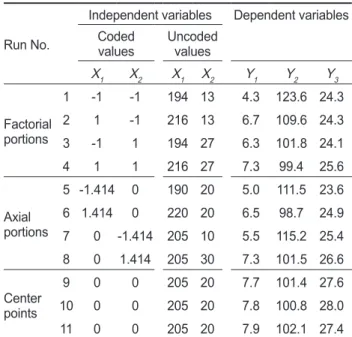
을Table 1
에나 타내었다. Table 2
의11
개의실험군들은통계적인오차를줄이 기위해무작위적인순서로진행되었다.
반응표면분석법 통계분석 및 최적화
Table 2
와같이실험을통해얻어진종속변수(
반응변수)
의값 들은MINTAB
통계프로그램(Version 16; Minitab Inc., State College, PA, USA)
을이용하여분석하였으며,
다음과같은이 차회귀식을도출하였다.
Y=β
0+ ∑
4i=1
β
iX
i+ ∑
4i=1
β
iiX
i2+ ∑
3i=1
∑
4 j=i+1β
ijX
iX
j여기서
Y
는종속변수, β
0는상수, β
i, β
ii, β
ij는회귀계수, X
i, X
j는독립변수를각각의미한다.
김스낵의유탕조건최적화는MINITAB
통계프로그램의response optimizer
를통해이루어 졌으며,
통계적으로추정된최적조건하에서실제실험을통하 여얻어진종속변수의값과의비교를통해추정된종속변수의 값을검증하였다.
또한3
차원그래프는MAPLE software (Ver- sion 7; Waterloo Maple Inc., Waterloo, ON, Canada)
를이용하 여작성하였다.
탈유
최적화된유탕조건에서처리된김스낵의탈유방법선정을위 해압축공기 및원심분리를이용하여탈유처리를하고그품
Table 2. Central composite design matrix and values of overall ac- ceptance, hardness, and oil content for frying conditions in prepa- ration of the laver Pyropia sp. snack
Run No.
Independent variables Dependent variables Coded
values Uncoded values
X1 X2 X1 X2 Y1 Y2 Y3
Factorial portions
1 -1 -1 194 13 4.3 123.6 24.3
2 1 -1 216 13 6.7 109.6 24.3
3 -1 1 194 27 6.3 101.8 24.1
4 1 1 216 27 7.3 99.4 25.6
Axial portions
5 -1.414 0 190 20 5.0 111.5 23.6
6 1.414 0 220 20 6.5 98.7 24.9
7 0 -1.414 205 10 5.5 115.2 25.4 8 0 1.414 205 30 7.3 101.5 26.6 Center
points
9 0 0 205 20 7.7 101.4 27.6
10 0 0 205 20 7.8 100.8 28.0
11 0 0 205 20 7.9 102.1 27.4
X1, frying temperature (°C); X2, frying time (sec); Y1, overall ac- ceptance (points); Y2, hardness (N); Y3, oil content (%).
Table 1. Experimental range and values of frying temperature and time in the central composite design for frying conditions in prepa- ration of the laver Pyropia sp. snack
Independent variables Symbol Range and levels -1.414 -1 0 +1 +1.414 Frying temperature (°C) X1 190 194 205 216 220
Frying time (sec) X2 10 13 20 27 30
질특성을비교하였다
.
압축공기를이용한탈유는공기압축기(EWS40; Geunpoong Power Tool, Seoul, Korea)
를이용하여1
분간김스낵에유량200 L/min
의공기를분사함으로이루어졌다
.
원심분리탈유는원심분리기(1580R; LABOGENE Co., Allerød, Denmark)
를이용하여3,667 g
의속도로5
분동안이 루어졌다.
경도 측정
김스낵의경도
(hardness)
측정은rheometer (CR-100D; Sun Scientific Co. Ltd., Tokyo, Japan)
을이용하였으며,
측정조건 은mode 20, load cell 10 kg, penetration speed 100 mm/min, plunger diameter 15 mm (No. 1)
였다.
무작위로선정된10
개의 김스낵을평평한면이위로오도록시료홀더에올려놓고경도 를측정하였다.
관능평가
관능평가는부경대학교식품공학과소속
22
세에서27
세사 이의훈련된전문패널10
인(
남성5
명및여성5
명)
을구성하 여수행되었으며,
모든패널은맛에친숙해질수있도록훈련 되었다.
관능평가는외관(appearance),
색도(color),
향(flavor),
맛(taste),
바삭함(crispiness),
기름맛(oily taste)
및전반적기 호도(overall acceptance)
항목에대하여9
점평점법(1
점,
대단 히나쁘다; 5
점,
나쁘지도좋지도않다; 9
점,
대단히좋다)
에따 라평가하였다.
오일 함량 측정
오일함량
(oil content)
은식품공전에제시되어있는방법에따 라Soxhlet
법에의해3
회반복측정하였다(MFDS, 2020).
오일 에대한용매로석유에테르(Petroleum ether; Junsei Chemical Co. Ltd., Tokyo, Japan)
를사용하였다.
주사전자현미경
김스낵의 내부 미세구조
(microstructure)
를 관찰하기 위해 주사전자현미경(LV-SEM, JSM-6490LV; JEOL Ltd., Tokyo, Japan)
을 이용하였다.
시료는동결건조기(CoolSafe; LABO-
GENE Co., Allerød, Denmark)
에서24
시간동안완전히건조 된후, 1.0 cm×0.5 cm
크기로절단하고최종적으로금으로도 금하여전도성을갖게하였다(Nath and Chattopadhyay, 2008).
김스낵의미세구조는가속전압
15 kV
의조건에서관찰및촬 영되었다.
통계처리
측정된 값은 평균
±
표준편차로 표시하였으며,
유의차는SPSS
프로그램(SPSS for Windows 11.0; SPSS Inc., Chicago, IL, USA)
을이용하여one-way ANOVA-test (Duncan’s mul- tiple range test)
및t-test
로검정하였다(P<0.05).
결과 및 고찰
반응표면 모델식의 진단
반응표면분석법에있어서독립변수
(factor, independent vari- able)
가종속변수(response, dependent variable)
에미치는영 향을확인하기위해서는반응표면모델식을도출해야한다(Bas and Boyacı, 2007; Bezerra et al., 2008).
김스낵유탕조건최적 화반응표면모델식도출을위한독립변수일차항(X
1, X
2),
이 차항(X
1X
1, X
2X
2)
및교차항(X
1X
2)
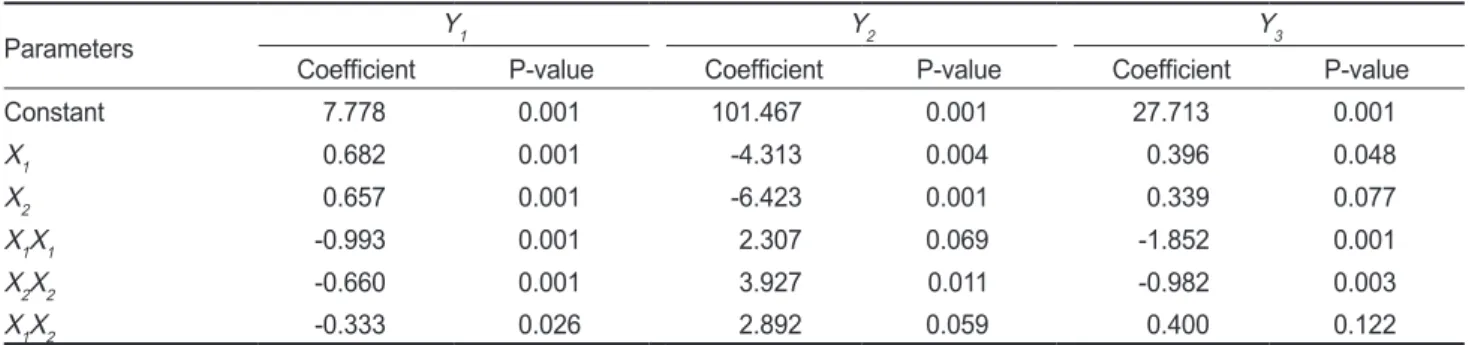
의계수(coefficient)
및유 의확률(P-value)
은Table 3
에나타내었다.
모든종속변수에대 한상수항(constant)
의유의확률은0.001
로유의수준0.05
에서 통계적으로유의한것으로나타났다.
종속변수Y
1(
전반적기 호도)
의경우X
1, X
2, X
1X
1, X
2X
2및X
1X
2항전체가,
종속변수Y
2(
경도)
의경우X
1, X
2및X
2X
2항이,
종속변수Y
3(
오일함량)
의경우X
1, X
1X
1및X
2X
2항이각각통계적으로유의한것으 로나타났다.
종속변수전반적기호도
(Y
1),
경도(Y
2)
및오일함량(Y
3)
에대 한반응표면모델식은Table 4
에나타내었다. 3
가지종속변수모 두0.95
이상의높은결정계수(R
2)
을나타내었는데,
이러한결 정계수는실험설계의적합성을의미하는중요한통계적지표 로활용된다(Shishir et al., 2016).
모든종속변수에있어서반응 표면모델식의유의확률(P-value)
은0.002
이하로통계적인유Table 3. Estimated coefficients of the fitted quadratic polynomial equations for overall acceptance, hardness, and oil content of the laver Pyropia sp. snacks as a function of frying temperature and time based on the t-statistic
Parameters Y1 Y2 Y3
Coefficient P-value Coefficient P-value Coefficient P-value
Constant 7.778 0.001 101.467 0.001 27.713 0.001
X1 0.682 0.001 -4.313 0.004 0.396 0.048
X2 0.657 0.001 -6.423 0.001 0.339 0.077
X1X1 -0.993 0.001 2.307 0.069 -1.852 0.001
X2X2 -0.660 0.001 3.927 0.011 -0.982 0.003
X1X2 -0.333 0.026 2.892 0.059 0.400 0.122
X1, frying temperature (°C); X2,frying time (sec); Y1, overall acceptance (points); Y2, hardness (N); Y3, oil content (%).
김스낵의 유탕공정 최적화
837
의성을보였다
(P<0.05).
이러한반응표면모델식의높은결정계 수(R
2)
및낮은유의확률(P-value)
은예비실험을통해반응표면 분석실험이설계되었기때문으로판단된다(Cho et al., 2005) 분산분석
반응표면모델식의 통계적 유의성은
ANOVA (analysis of variance)
에의해평가되었다(Table 5).
종속변수Y
2(
경도)
및Y
3(
오일함량)
의교차항(interaction)
을제외한모든항에서통 계적으로유의한것으로나타났다(P<0.05).
본연구의반응표 면모델에대한적합성결여(lack of fit)
검정을한결과, 3
가지 종속변수모두유의확률이0.05
이상으로적합한것으로나타 났다.
적합성결여에대한유의확률이0.05
보다크면적합한모 델로간주된다(Isa et al., 2011).
반응표면 3차원 그래프 및 인자의 영향 분석
Deep frying
방식은식품의열처리방법중하나이다(Sahin et
al., 1999).
일반적으로유탕공정에서유탕온도및유탕시간은식품의품질에가장큰영향을미치는중요한인자이다
(Maity
et al., 2012).
따라서,
본연구에서도유탕온도(X
1)
및유탕시간(X
2)
을독립변수로설정하였으며,
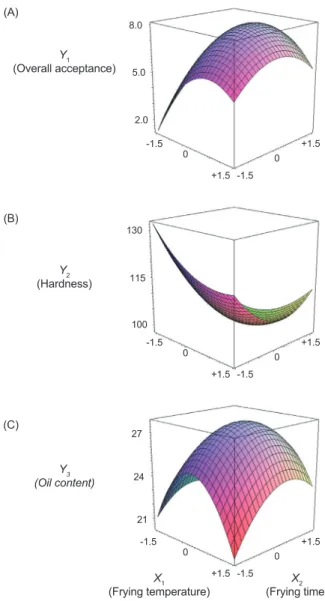
이들이유탕김스낵의품질 에미치는영향을알아보았다(Fig. 1).
전반적기호도
(Y
1)
는유탕온도(X
1)
와유탕시간(X
2)
이증가할 수록높게나타났으며, 210°C
및24
초를넘어서면서다시감소 하는경향을나타내었다(Fig. 1A).
반면에,
경도(Y
2)
의경우는 전반적기호도(Y
1)
와반대의경향을보였다(Fig. 1B).
종속변 수인전반적기호도(Y
1)
및경도(Y
2)
의상관관계를분석한결 과,
경도가낮을수록종합적인기호도는높은것으로나타났다(R
2=0.8574).
바삭함(crispiness)
은유탕스낵에서관능적기호 도에영향을크게미치는물리적인 지표로잘알려져있는데(Bruns and Bourne, 1975; Lujan-Acosta and Moreira, 1997),
일반적으로경도가낮을수록바삭함은증가하는경향을보인다(Nurul et al., 2009).
따라서,
본연구에서도경도(Y
2)
가낮을수 록바삭한조직감이증가하고이는전반적기호도(Y
1)
의상승 에큰역할을한것으로판단된다.
식품의조직감은미세구조와밀접한관련이있다는것이선 행연구를통해잘알려져있다
(Ahza et al., 2015).
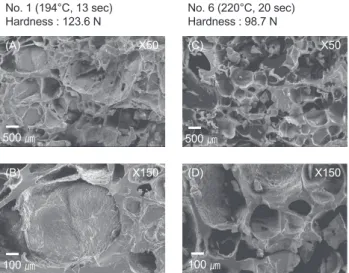
본연구에 서도경도에따른김스낵의미세구조차이를알아보기위하여 경도가가장높은RSM No. 1
실험군(123.6 N)
및가장낮은RSM No. 6
실험군(98.7 N)
을주사전자현미경으로관찰하였다
(Fig. 2).
경도가낮은RSM No. 6
실험군의경우유탕시팽 윤이잘일어나공극이많이형성되어있었으나,
반면에경도가높은
RSM No. 1
실험군의경우는팽윤이덜일어나공극이많Table 4. Response surface model equations for optimizing overall acceptance, hardness, and oil content of the laver Pyropia sp. snacks as a function of frying temperature and time in the frying processing
Quadratic polynomial model equations R2 P-value
Y1=7.778+0.682 X1+0.657 X2-0.993 X12-0.660 X22-0.333 X1X2 0.9842 0.001 Y2=101.467-4.313 X1-6.423 X2+2.307 X12+3.927 X22+2.892 X1X2 0.9555 0.002 Y3=27.713+0.396 X1+0.339 X2-1.852 X12-0.982 X22+0.400 X1X2 0.9619 0.001 X1, frying temperature (°C); X2, frying time (sec); Y1, overall acceptance (points); Y2, hardness (N); Y3, oil content (%)
Fig. 1. Three-dimensional response surface plots of overall accep- tance, hardness, and oil content of laver Pyropia sp. snacks as a function of frying temperature and time.
Y
1(Overall acceptance)
-1.5
+1.5
0 +1.5
2.0 5.0 8.0
0 -1.5
-1.5
+1.5
0 +1.5
100 115 130
0 -1.5
-1.5
+1.5
0 +1.5
21 24 27
0 -1.5 Y
2(Hardness)
Y
3(Oil content)
X
1(Frying temperature) X
2(Frying time) (A)
(B)
(C)
100 ㎛
X150 500 ㎛
X50
100 ㎛
X150
500 ㎛
X50 No. 1 (194°C, 13 sec)
Hardness : 123.6 N No. 6 (220°C, 20 sec) Hardness : 98.7 N
(A) (C)
(D)
(B)
최기범
ㆍ
김동민ㆍ
최윤진ㆍ
김선봉ㆍ
박주동ㆍ
배성아ㆍ
배기일ㆍ
조승목838
지않은것을확인할수있었다
.
유탕스낵에서공극이많을수 록경도가낮아지고바삭함이높아진다는경향이본연구에서 도미세구조분석을통해확인되었다(Van Koerten et al., 2015;
Surojanametakul et al., 2020).
오일함량
(Y
3)
은유탕온도(X
1)
와유탕시간(X
2)
이높아질수록 증가하다가,
유탕온도206°C
및유탕시간21
초를기점으로낮아지는경향을보였다
. Table 3
의유의확률을통해각독립변수가오일함량에유의한
(P<0.05)
영향을미치는주요한독립변수 임을확인할수있었다.
일반적으로스낵은유탕과정중내부의 수분감소와오일증가가함께일어나며,
수분의손실이클수록 오일함량은증가한다(Vitrac et al., 2000; Primo-Martín et al.,
2010).
또한,
유탕온도및유탕시간이증가할수록유탕스낵의오일함량은증가하는경향을보이지만
(Krokida et al., 2000),
더욱높은유탕온도에서는스낵의표면이급격히단단해져오Table 5. ANOVA results of overall acceptance, hardness, and oil content for the laver Pyropia sp. snacks as a function of frying temperature and time in the frying processing
Dependent
variables Sources DF SS MS F-value P-value
Y1
Regression
Linear 2 7.177 3.588 79.53 0.001 Square 2 6.405 3.202 70.97 0.001 Interaction 1 0.444 0.444 9.85 0.026
Residual
Lack of fit 3 0.198 0.066 4.82 0.177 Pure error 2 0.027 0.014
Total 10 14.251
Y2
Regression
Linear 2 478.872 239.436 42.34 0.001 Square 2 95.305 47.652 8.43 0.025 Interaction 1 33.466 33.466 5.92 0.059
Residual
Lack of fit 3 27.317 9.106 18.99 0.050 Pure error 2 0.959 0.479
Total 10 635.918
Y3
Regression
Linear 2 2.170 1.085 5.86 0.049 Square 2 20.543 10.271 55.46 0.001 Interaction 1 0.640 0.640 3.46 0.122
Residual
Lack of fit 3 0.687 0.229 1.91 0.361 Pure error 2 0.239 0.120
Total 10 24.278
DF, degrees of freedom; SS, sum of square; MS, mean square; Y1, overall acceptance (points); Y2, hardness (N); Y3, oil content (%) Fig. 2. Scanning electron microscope (SEM) images of the laver
Pyropia sp. snacks as a function of frying temperature and time.
(Overall acceptance)
-1.5
+1.5
0 +1.5
2.0 5.0
0 -1.5
-1.5
+1.5
0 +1.5
100 115 130
0 -1.5
-1.5
+1.5
0 +1.5
21 24 27
0 -1.5 Y
2(Hardness)
Y
3(Oil content)
X
1(Frying temperature) X
2(Frying time) (B)
(C)
100 ㎛
X150 500 ㎛
X50
100 ㎛
X150
500 ㎛
X50 No. 1 (194°C, 13 sec)
Hardness : 123.6 N No. 6 (220°C, 20 sec) Hardness : 98.7 N
(A) (C)
(D) (B)
Table 6. Response optimization for frying of the dried gelatinized rice dough with laver Pyropia sp. for preparation of the laver snacks Optimal conditions
X1 (Frying temperature, °C) X2 (Frying time, sec)
Coded value Actual value Coded value Actual value
0.2714 208.0 0.4428 23.1
Y1
(Overall acceptance, points)
Target value
Max
김스낵의 유탕공정 최적화
839
일은침투가제한되는특징이나타난다
(Baumann and Escher,
1995).
본연구의김스낵에서도이러한경향의오일함량의변화가관찰되었다
.
유탕조건의 최적화 및 검증
본연구에서는기호도가우수한김스낵을제조하기위하여종 속변수
Y
1(
전반적기호도)
를최대화시킬수있는최적의유탕 조건을통계적으로도출하였다.
종속변수Y
2(
경도)
및Y
3(
오 일함량)
의경우품질특성의변화를알아보기위하여모니터 링하였다. Minitab
통계프로그램의response optimizer
를 사 용하여최적화한결과,
가장우수한전반적기호도(Y
1)
를나타 내는유탕온도(X
1)
및유탕시간(X
2)
의코드값(
실제값)
은각각0.2714 (208°C)
및0.4428 (23.1
초)
로도출되었다(Table 6).
이 러한최적유탕조건에서의김스낵의전반적기호도(Y
1)
의예 측값은8.0
점이었다.
통계적으로도출된최적조건의경우실제 실험을통한검증이이루어져야한다(Cho et al., 2005; Yoon et al., 2017).
최적 유탕조건(
유탕온도, 208.0°C
및유탕시간23.1
초)
에서 실제제조된김스낵의 전반적기호도(Y
1),
경도(Y
2)
및오일함량(Y
3)
은각각8.1±0.9
점, 101.0±10.4 N
및27.1±0.2%
으로나타났으며,
이는통계적인예측값과유사한것으로나타났다
(Table 7).
탈유방법의 설정 결과
스낵의경우유탕처리를통해내부의수분이탈및오일의내
부침투가일어난다
(Bhat and Bhattacharya, 2001; Abdollahi Moghaddam et al., 2015).
유탕스낵의저장안정성및건강성 을 높이기위해탈유는필수적인 공정으로(Fan et al., 2005;
Dueik et al, 2012)
적절한탈유방법의탐색은유탕스낵에있 어서매우중요한분야이다(Sothornvit, 2011).
따라서,
본연 구에서는유탕김스낵의오일을제거하고자식품산업에서널 리이용되고있는압축공기및원심분리를이용하여(Liberty et al., 2019)
탈유처리하고오일함량및품질특성을비교하였다.
원심분리를이용하여탈유한김스낵의오일함량이23.74 %
로 유의적으로가장낮게나타나탈유효과가가장뛰어났다(Table 8).
반면에,
압축공기를이용하여탈유한김스낵의경우오일함 량이28.16 %
로높고경도또한높게나타났다.
본실험을통해 원심분리가유탕김스낵의탈유에가장효과적임을확인할수 있었다.
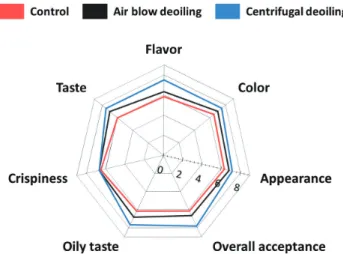
원심분리를이용한탈유는관능평가를통해서도그효 과를알수있는데(Fig. 3),
바삭함(crispiness)
항목을제외한나 머지항목에서원심분리를이용한탈유가나머지방법들에비 해높은점수를받았음을확인할수있었다.
일련의실험들을통 해김스낵제조시원심분리를이용한탈유방법이적절할것으 로판단된다.
유탕감자스낵제조에있어서높은유탕온도및빠 른원심분리속도의조건에서가장낮은오일함량을보였는데(Kim and Moreira, 2012),
본연구의유탕김스낵에있어서도 저온영역을제외하고유탕온도가높아질수록오일함량이낮아지는경향과
(Fig. 1C),
빠른속도의원심분리를이용한탈유방법에서나머지방법과비교하여가장낮은오일함량을보이는 경향을확인했다
(Table 8).
사 사
이논문은
2020
년해양수산부재원으로해양수산과학기술진흥원의지원을받아수행된연구임
(
해역별특성을고려한전통 수산가공식품개발및상품화).
Table 7. Comparison of predicted and experiment values of overall acceptance, hardness, and oil content of the laver Pyropia sp. snacks Y1 (Overall acceptance, points) Y2 (Hardness, N) Y3 (Oil content, %)
Predicted values 8.0 98.7 27.7
Experimental values 8.1±0.9 101.0±10.4 27.1±0.2
Optimized conditions, frying temperature=208.0°C; frying time=23.1 sec.
Table 8. Oil contents and hardness of laver Pyropia sp. snacks de- oiled by different methods
0.5 Oil content (%) Hardness (N)
Control 27.14±0.18 101.01±10.42
Air blow deoiling 28.16±0.22 122.88±16.31*
Centrifugal deoiling 23.74±0.16* 110.42±17.23 Values are mean±standard deviation (oil content, n=3; hardness, n=10).*P<0.05, significantly different from Control group (t-test).
Fig. 3. Sensory evaluation of the laver Pyropia sp. snacks deoiled by different methods.
References
Abdollahi Moghaddam MR, Rafe A and Taghizadeh M. 2015.
Kinetics of color and physical attributes of cookie during deep-fat frying by image processing techniques. J Food Pro- cess Preserv 39, 91-99. https://doi.org/10.1111/jfpp.12268.
Ahza AB, Fidiena TI and Suryatman S. 2015. Physical, senso- rial and chemical characteristics of simulated chips of cas- sava (Manihot esculenta Crantz): Rice (Oryza sativa L.) mix. Procedia Food Sci 3, 82-95. https://doi.org/10.1016/j.
profoo.2015.01.008.
Bas D and Boyacı IH. 2007. Modeling and optimization I: Us- ability of response surface methodology. J Food Eng 78, 836-845. https://doi.org/10.1016/j.jfoodeng.2005.11.024.
Baumann B and Escher F. 1995. Mass and heat transfer dur- ing deep-fat frying of potato slices-1. Rate of drying and oil uptake. LWT-Food Sci Technol 28, 395-403. https://doi.
org/10.1016/0023-6438(95)90023-3.
Bezerra MA, Santelli RE, Oliveira EP, Villar LS and Escaleira LA. 2008. Response surface methodology (RSM) as a tool for optimization in analytical chemistry. Talanta 76, 965- 977. https://doi.org/10.1016/j.talanta.2008.05.019.
Bhat KK and Bhattacharya S. 2001. Deep fat frying char- acteristics of chickpea flour suspensions. Int J Food Sci Technol 36, 499-507. https://doi.org/10.1046/j.1365- 2621.2001.00455.x.
Bruns AJ and Bourne MC. 1975. Effects of sample demensions on the snapping force of crisp foods Experimental Verifica- tion of a Mathematical Model. J Texture Stud 6, 445-458.
https://doi.org/10.1111/j.1745-4603.1975.tb01420.x.
Cho SM, Gu YS and Kim SB. 2005. Extracting optimization and physical properties of yellowfin tuna Thunnus alba-
cares skin gelatin compared to mammalian gelatins. Food
Hydrocoll 19, 221-229. https://doi.org/10.1016/j.food- hyd.2004.05.005.Dueik V, Moreno MC and Bouchon P. 2012. Microstructural approach to understand oil absorption during vacuum and atmospheric frying. J Food Eng 111, 528-536. https://doi.
org/10.1016/j.jfoodeng.2012.02.027.
Fan LP, Zhang M and Mujumdar AS. 2005. Vacuum fry- ing of carrot chips. Dry Technol 23, 645-656. https://doi.
org/10.1081/DRT-200054159.
Goni I, Bravo L, Larrauri JA and Calixto FS. 1997. Resistant starch in potatoes deep-fried in olive oil. Food Chem 59, 269-272. https://doi.org/10.1016/S0308-8146(96)00275-0.
Isa KM, Daud S, Hamidin N, Ismail K, Saad SA and Kasim FH. 2011. Thermogravimetric analysis and the optimisation of bio-oil yield from fixed-bed pyrolysis of rice husk using response surface methodology (RSM). Ind Crop Prod 33, 481-487. https://doi.org/10.1016/j.indcrop.2010.10.024.
Kim TH and Moreira RG. 2012. De-oiling and pretreatment for high-quality potato chips. J Food Process Eng 36, 267-275.
https://doi.org/10.1111/j.1745-4530.2012.00686.x.
Krokida MK, Oreopoulou V and Maroulis ZB. 2000. Water loss and oil uptake as a function of frying time. J Food Eng 44, 39-46. https://doi.org/10.1016/S0260-8774(99)00163-6.
Liberty JT, Dehghannya JD and Ngadi MO. 2019. Effective strategies for reduction of oil content in deep-fat fried foods:
A review. Trends Food Sci Technol 92, 172-183. https://doi.
org/10.1016/j.tifs.2019.07.050.
Lien DTP. 2016. Kinetic of the physical quality changes during deep fat frying of sweet potato chip. Int J Eng Sci 5, 608- 615. https://doi.org/10.5281/zenodo.49805.
Lujan-Acosta J and Moreira RG. 1997. Effects of different dry- ing processes on oil absorption and microstructure of tortilla chips. Cereal Chem 74, 216-223. https://doi.org/10.1094/
CCHEM.1997.74.3.216.
Maity T, Raju PS and Bawa AS. 2012. Effect of freezing on tex- tural kinetics in snacks during frying. Food Bioprocess Tech 5, 155-165. https://doi.org/10.1007/s11947-009-0236-5.
MFDS (Ministry of Food and Drug Safety). 2020. Food sanitary act. Retrieved from https://www.mfds.go.kr/brd/m_211/
view.do?seq=14536&srchFr=&srchTo=&srchWord=%
EC%8B%9D%ED%92%88%EC%9D%98+%EA%B8
%B0%EC%A4%80&srchTp=0&itm_seq_2=0&multi_
itm_seq=0&company_cd=&company_nm=&Data_stts_
gubun=C9999&page=1 on Oct 16, 2020.
MOF (Ministry of Oceans and Fisheries). 2020. Achieved a re- cord-high performance of $2.5 billion in seafood exports in 2019. Retrieved from http://www.mof.go.kr/statPortal/bbs/
report/view.do?ntt_id=924&pageIndex=&searchType=&se archQuery= on Jan 20, 2020.
Nath A and Chattopadhyay PK. 2008. Effect of process pa- rameters and soy flour concentration on quality attributes and microstructural changes in ready-to-eat potato–soy snack using high-temperature short time air puffing. LWT- Food Sci Technol 41, 707-715. https://doi.org/10.1016/j.
lwt.2007.05.001.
Nurul H, Boni I and Noryati I. 2009. The effect of different ra- tios of Dory fish to tapioca flour on the linear expansion, oil absorption, colour and hardness of fish crackers. Int Food Res J 16, 159-165.
Park JI, Chung GH, Kim BS and Hur JH. 1994. A study on the preparation of boogags by traditional methods and improve- ment of preservation. J Korean Soc Food Nutr 23, 986-993.
Primo-Martin C, Sanz T, Steringa DW, Salvador A, Fiszman SM and Val Vilet T. 2010. Performance of cellulose deriva- tives in deep-fried battered snacks: Oil barrier and crispy properties. Food Hydrocolloids 24, 702-708. https://doi.
org/10.1016/j.foodhyd.2010.04.013.
Sahin S, Sastry SK and Bayindirli L. 1999. Heat transfer during frying of potato slices. LWT-Food Sci Technol 32, 19-24.
https://doi.org/10.1006/fstl.1998.0494.
Shishir MRI, Taip FS, Aziz NA, Talib RA and Sarker MSH.
김스낵의 유탕공정 최적화
841
2016. Optimization of spray drying parameters for pink guava powder using RSM. Food Sci Biotechnol 25, 461- 468. https://doi.org/10.1007/s10068-016-0064-0.
Sothornvit R. 2011. Edible coating and post-frying centri- fuge step effect on quality of vacuum-fried banana chips.
J Food Eng 107, 319-325. https://doi.org/10.1016/j.
jfoodeng.2011.07.010.
Surojanametakul V, Karnasuta S and Satmalee P. 2020. Effect of oil type and batter ingredients on the properties of deep- frying flakes. Food Sci Technol Epub ahead of print, https://
doi.org/10.1590/fst.32919.
Van Koerten KN, Schutyser MAI, Somsen D and Boom RM.
2015. Crust morphology and crispness development during deep-fat frying of potato. Food Res Int 78, 336-342. https://
doi.org/10.1016/j.foodres.2015.09.022.
Vitrac O, Trystram G and Raoult-Wack AL. 2000. Deep-fat frying of food: Heat and mass transfer, transformations and reactions inside the frying material. Eur J Lipid Sci Technol 102, 529-538. https://doi.org/10.1002/1438- 9312(200009)102:8/9<529::AID-EJLT529>3.0.CO;2-F.
Yoo SN and Choi YS. 2015. Physical drying and frying char- acteristics of kimbugaks made by a pasting & garnish- ing machine. Korean J Agric Sci 42, 439-446. https://doi.
org/10.7744/cnujas.2015.42.4.439.
Yoon M, Kim JS, Um MY, Yang H, Kim J, Kim YT, Lee C, Kim SB, Kwon S and Cho S. 2017. Extraction optimization for phlorotannin recovery from the edible brown seaweed Eck-
lonia Cava. J Aquat Food Prod Technol 26, 801-810. https://
doi.org/10.1080/104988.