664 Corresponding author: [email protected]
✽동해 연안 영일만 조간대 해조류의 군집구조
박규진・최창근1✽
(주)해양생태기술연구소,
1부경대학교 해양과학공동연구소
A Study on the Community Structure of Intertidal Benthic Marine Algae in Youngil Bay,
Eastern Coast of Korea
Gyu Jin Park and Chang Geun Choi
1✽Marine Eco-Technology Institute, 485-1 Yongdang-dong, Busan 608-830, Korea
1
Korea Inter-University Institute of Ocean Science, Pukyong National University, Busan 608-737, Korea
An intertidal marine benthic algal vegetation and vertical distribution at Youngil Bay, the eastern coast of Korea was investigated to clarify the community structure and vertical distribution by quadrat method from February 2003 to January 2009. Marine algae identified from the area were 152 species; 25 green, 38 brown and 89 red algae. The dominant species were Ulva spp., Ulva pertusa, Chaetomorpha moniligera,
Undaria pinnatifida, Sargassum horneri, S. miyabei, S. thunbergii, Gelidium amansii, Corallina pilulifera, Grateloupia elliptica, G. filicina, Prionitis cornea, Chondrus ocellatus, Chondracanthus intermedia, Acrosorium polyneurum, Chondria crassicaulis, Polysiphonia morrowii and Symphyocladia latiuscula at
study sites. The vertical distribution of intertidal marine algae was divided into three distinct zones. They were characterized by Porphyra spp. and Ulva spp. at the upper, Ulva spp. and Ulva pertusa at the middle, and Sargassum spp., Gelidium amansii, Grateloupia spp., Chondrus ocellatus and Chondria crassicaulis at the lower zones, respectively. Functional form group analysis showed that coarsely branched forms comprised 44.7% of the algal community, whereas thick leathery forms, sheet forms and filamentous forms comprised 6.6-25.7%. R/P, C/P and (R+C)/P values were 2.34, 0.66 and 3.00, respectively.Key words: Community, Functional form, Intertidal, Vertical distribution, Youngil Bay
서 론
한 지역의 해조상 및 군집 연구는 그 지역의 분포에 관련된 자료와 지역 개체군에 대한 유용한 생태학적 정보를 제공해 준다는 측면에서 매우 중요하다 (Boo and Lee, 1986). 동해안 지역의 해조군집은 생물학적인 독특한 특성과 해안 구조의 단조로움, 외해에 인접한 해양환경의 고유성 등에 의한 관심 으로 인하여 많은 학자들에 의해서 연구가 이루어졌다 (Boo and Lee, 1986; Lee and Oh, 1986; Lee and Lee 1988; Chung et al., 1991; Lee et al., 1997; Choi et al., 2006; Sohn et al., 2007).
영일만은 우리나라 동해안에 위치하는 유일한 만 구조를 갖는 해안이며, 이 해역은 쿠로시오 해류의 지류인 쓰시마 난류가 북상하여 영향을 미치는 곳이다 (Lee and Oh, 1986).
이 지역은 주변 해역에 암반이 비교적 잘 발달되어 있지만, 조간대 면적이 넓지 않고 조석 간만의 차는 0.3 m - 0.4 m로 작아서 조간대의 폭이 협소하고 좁게 발달되어 있는 전형적인 동해안 연안의 구조를 보여준다. 이 해역은 포항시와 인접하 여 있는 곳으로 만의 북부 해안은 형산강 하구와 연결되므로
담수가 유입되어 그 주변지역은 모래 해수욕장이 형성되어 있고 만의 내부 주변해안은 암반이 비교적 잘 발달되어 있으 며 좁은 조간대가 발달되어 있는 지역이다 (Lee and Oh, 1986).
한국 동해안의 해조류에 관한 연구는 Kang (1966)이 한국 해조류의 지리적 분포를 논하면서 동해안 출현종으로 남조류 3종, 녹조류 25종, 갈조류 48종, 홍조류 120종으로 총 196종을 보고하였고, 해조상의 조성은 온대계 (70%)가 크게 우세하고 북방계 (10%)가 미약하다는 점을 밝혔다 (Kim et al., 1997).
Kang (1966)은 동해안 출현종 중에서 영일만 출현종으로 총 67종을 보고하였고, 영일만을 대상으로 한 이 후의 연구는 몇몇 연구자에 의해서 해조류 분포의 정성 및 정량적인 해석 이 시도되었다 (Lee and Oh, 1986; Lee and Lee, 1988; Lee et al., 1997). 그렇지만 지금까지 영일만을 대상으로 수행된 연구들이 한, 두 계절에 국한되어 연구가 이루어지거나 해조 군집의 정성적 측면만을 다루었기 때문에 해조군집의 정량적 인 구조적 특성을 분석하는데 어려움이 있었다.
영일만 및 우리나라 각 연안은 다양한 종류의 임해공단이
위치하여 공장폐수 및 도시 건설에 의한 생활하수 등 오염물
질이 꾸준하게 유입되고 있으며, 각종 해상 사고 (Kim, 2008)
및 환경오염 등으로 연안지역의 오염도가 급속히 진행 중이다
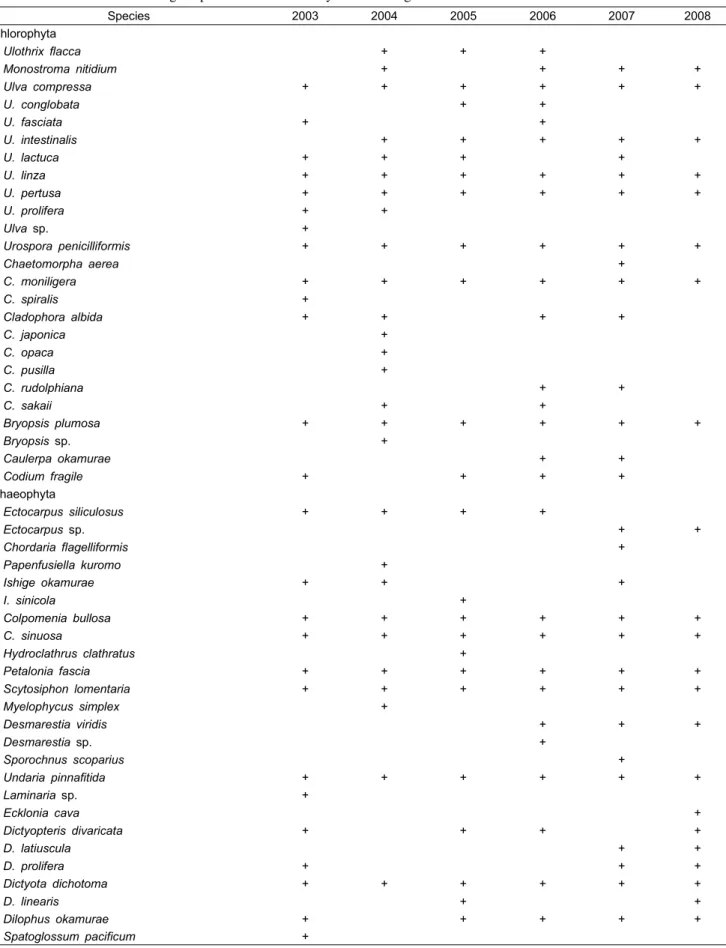
Table 1. A list of marine algal species found at study sites during 2003-2008
Species 2003 2004 2005 2006 2007 2008
Chlorophyta
Ulothrix flacca + + +
Monostroma nitidium + + + +
Ulva compressa + + + + + +
U. conglobata + +
U. fasciata + +
U. intestinalis + + + + +
U. lactuca + + + +
U. linza + + + + + +
U. pertusa + + + + + +
U. prolifera + +
Ulva sp. +
Urospora penicilliformis + + + + + +
Chaetomorpha aerea +
C. moniligera + + + + + +
C. spiralis +
Cladophora albida + + + +
C. japonica +
C. opaca +
C. pusilla +
C. rudolphiana + +
C. sakaii + +
Bryopsis plumosa + + + + + +
Bryopsis sp. +
Caulerpa okamurae + +
Codium fragile + + + +
Phaeophyta
Ectocarpus siliculosus + + + +
Ectocarpus sp. + +
Chordaria flagelliformis +
Papenfusiella kuromo +
Ishige okamurae + + +
I. sinicola +
Colpomenia bullosa + + + + + +
C. sinuosa + + + + + +
Hydroclathrus clathratus +
Petalonia fascia + + + + + +
Scytosiphon lomentaria + + + + + +
Myelophycus simplex +
Desmarestia viridis + + +
Desmarestia sp. +
Sporochnus scoparius +
Undaria pinnafitida + + + + + +
Laminaria sp. +
Ecklonia cava +
Dictyopteris divaricata + + + +
D. latiuscula + +
D. prolifera + + +
Dictyota dichotoma + + + + + +
D. linearis + +
Dilophus okamurae + + + + +
Spatoglossum pacificum +
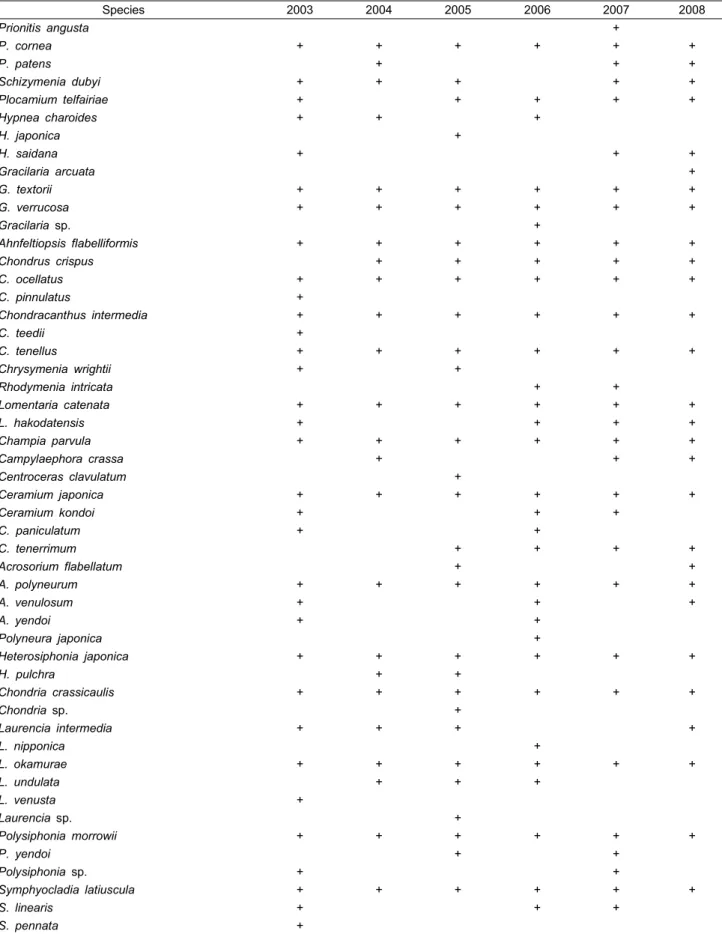
Table 1. Continued
Species 2003 2004 2005 2006 2007 2008
Hizikia fusiformis + + + + +
Sargassum confusum + +
S. fulvellum + + + + + +
S. hemiphyllum + +
S. horneri + + + + + +
S. macrocarpum +
S. miyabei + + + + +
S. nigrifolium + + + + + +
S. patens + +
S. piluliferum + +
S. thunbergii + + + + + +
S. yezoense +
Sargassum sp. +
Rhodophyta
Bangia atropurpurea + + +
Porphyra suborbiculata + + + + + +
P. tenera +
P. yezoensis + + + + +
Asparagopsis taxiformis +
Delisea fimbriata +
Helminthocladia australis +
Galaxaura falcata +
Gelidium amansii + + + + + +
G. divaricatum + + + + +
G. pacificum + + + +
Pterocladia capillacea + + + + +
Dumontia simplex + + + + + +
Hildenbrandtia rubra + + +
Lithophyllum okamurae + + + +
Amphiroa beauvoisii + + + + +
A. dilatata + + + +
A. ephedraea +
Corallina officinalis + +
C. pilulifera + + + + + +
C. squamata + +
Jania arborescens +
Marginisporum crassissima +
Melobesioidean algae + + + + + +
Carpopeltis affinis + + + + + +
C. prolifera +
Grateloupia divaricata + + + +
G. elliptica + + + + + +
G. filicina + + + + + +
G. imbricata + +
G. kurogii + + +
G. lanceolata + + + + +
G. livida + + +
G. okamurae + + + + + +
G. prolongata + + + +
G. sparsa + + +
G. turuturu + + + + + +
Grateloupia sp. +
Table 1. Continued
Species 2003 2004 2005 2006 2007 2008
Prionitis angusta +
P. cornea + + + + + +
P. patens + + +
Schizymenia dubyi + + + + +
Plocamium telfairiae + + + + +
Hypnea charoides + + +
H. japonica +
H. saidana + + +
Gracilaria arcuata +
G. textorii + + + + + +
G. verrucosa + + + + + +
Gracilaria sp. +
Ahnfeltiopsis flabelliformis + + + + + +
Chondrus crispus + + + + +
C. ocellatus + + + + + +
C. pinnulatus +
Chondracanthus intermedia + + + + + +
C. teedii +
C. tenellus + + + + + +
Chrysymenia wrightii + +
Rhodymenia intricata + +
Lomentaria catenata + + + + + +
L. hakodatensis + + + +
Champia parvula + + + + + +
Campylaephora crassa + + +
Centroceras clavulatum +
Ceramium japonica + + + + + +
Ceramium kondoi + + +
C. paniculatum + +
C. tenerrimum + + + +
Acrosorium flabellatum + +
A. polyneurum + + + + + +
A. venulosum + + +
A. yendoi + +
Polyneura japonica +
Heterosiphonia japonica + + + + + +
H. pulchra + +
Chondria crassicaulis + + + + + +
Chondria sp. +
Laurencia intermedia + + + +
L. nipponica +
L. okamurae + + + + + +
L. undulata + + +
L. venusta +
Laurencia sp. +
Polysiphonia morrowii + + + + + +
P. yendoi + +
Polysiphonia sp. + +
Symphyocladia latiuscula + + + + + +
S. linearis + + +
S. pennata +
(Choi et al., 2006). 최근 해양에서 일어나는 환경오염 증가와 갯녹음의 가속화로 인하여 연안에 서식하는 해조류 및 유용 수산생물이 빠르게 감소하고 있으며 (Choi et al., 2002a), 생태 계 변화와 수산자원의 생산력 감소를 유발한다 (Lobban and Harrison, 1994). 이러한 바다 사막화 또는 바다 황폐화를 감소 시키기 위하여, 환경보전의 차원에서 생물을 이용한 생태공학 적 생태복원이 중요하게 거론되는 실정이다 (Choi, 2001; Choi et al., 2002a, b). 생태복원 대상 해역을 선정하여 생태공학적인 복원을 실시할 경우에 가장 우선적으로 고려할 사항은 이식 대상 종에 의한 생태적인 교란이 일어나지 않으며 (Ohno et al., 1983), 대상 지역에서 생육 또는 번식이 가능한 대상 생물 종을 도입하는 것이다 (van Katwijk, 1998; Choi et al., 2006).
따라서 대상 해역에 서식하는 지역 개체군의 생태학적인 정보 는 중요한 자료로서 활용가치가 매우 높다고 할 수 있다.
이 연구는 이러한 배경을 바탕으로 동해안 영일만 연안 해역에 서식하는 해조류 군집의 특성을 보다 명확하게 밝히기 위하여 영일만 지역을 대상으로 변화된 해조군집을 6년간 계절별로 조사하였으며, 서식 해조류의 분포와 특성 등 시공 간적 변화 양상과 같은 정량 자료를 확보하여 이 결과를 토대 로 이전에 연구된 결과와 상호 비교, 고찰하여 해조류의 군집 구조와 특성을 파악하기 위하여 실시하였다.
재료 및 방법
해조상 및 군집조사는 2003년 2월부터 2009년 1월까지 계 절별로 실시하였다. 조사시기별로 조사지역의 해조류 식생을 대표할 수 있는 곳을 중심으로 5개 정점을 선정하여 (Fig.
1) 조간대 상부로부터 해안선에 수직 방향으로 line transect를 설정하여 조사를 실시하였다. 조간대 조위별 상, 중, 하부의 구분은 Lee et al. (1993)의 방법을 참고하여 따랐다.
Fig. 1. Map showing the study sites in Youngil Bay, eastern coast of Korea.
계절별로 해조류의 생육 상한으로부터 설정된 transect를 따라 50 cm×50 cm 크기의 방형구를 이용하여 방형구 내에 출현하는 모든 해조류를 끌칼 등으로 완전히 채집한 후 10%
포르말린-해수 용액으로 고정한 뒤 실험실로 운반하여 분석하 였다. 현존량은 방형구내의 해조류를 실험실에서 담수로 충분 히 씻어 불순물을 제거한 뒤 1 m
2에 대한 종별 습중량으로 환산하였다. 또한 조사 정점의 주변 해역 기질을 자세히 조사 하면서 그 곳에 서식하는 해조류를 정성적으로 채집하였다.
동정된 해조류의 국명 인용과 학명 및 목록 정리는 한국 해조목록의 분류체계 (Kang, 1968; Lee and Kang, 1986; 2002) 및 일본해조목록 (Yoshida et al., 1995)을 참고하여 기준으로 하였다.
조사지에 출현하는 해조류의 분포적 특성 및 해조상을 해석 하는 지표로는 수온의 변동과 밀접한 연관이 있어서 해조상의 지리적 분포한계와 수평분포 지수 등의 특성을 다소 뚜렷하게 확인해주는 것으로 이용되는 R/P (Feldmann, 1937), C/P (Segawa, 1956), (R+C)/P (Cheney, 1977)를 이용하여 분석하였 다. 해조류의 형태적 차이에 의한 특성 파악을 위한 기능형군 분석은 Littler and Littler (1984)의 6가지 기능형군별 분류형을 사용하여 분석하였다.
결과 및 고찰
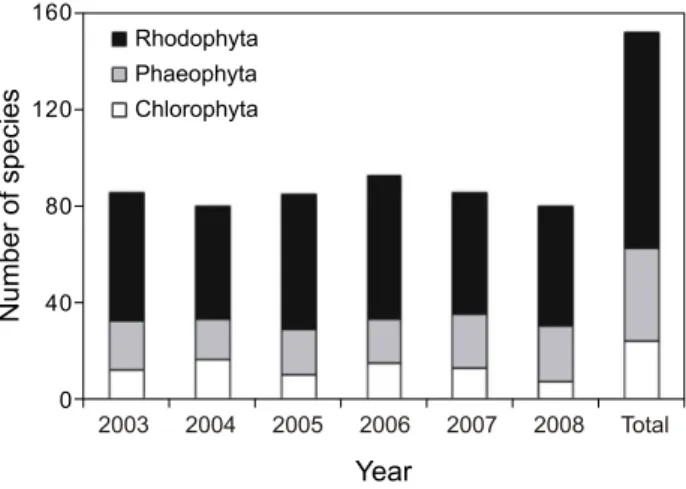
영일만 일대 조사 정점에서 채집 동정된 해조류는 녹조류 25종, 갈조류 38종 및 홍조류 89종으로 총 152종의 해조류가 채집 동정되었다 (Table 1, Fig. 2). 조사 시기별 출현종 수는 매년 총 80-93종이 출현하여 시기별 출현종 수에는 큰 차이를 보이지 않았고, 분류군별 출현종 수도 조사시기별로 유사하였 다.
이번 조사지역에 생육하는 해조류 중 조사 시기별로 매년 출현했던 영일만 해역의 보편적인 해조류로는 녹조류인납작 파래 (Ulva compressa), 잎파래 (U. linza), 구멍갈파래 (U.
pertusa), 초록털말 (Urospora penicilliformis), 염주말 (Chaetomorpha moniligera), 참깃털말 (Bryopsis plumosa), 갈조류인 긴불레기
Fig. 2. Fluctuation of the number of algal species at study
sites during 2003-2008.
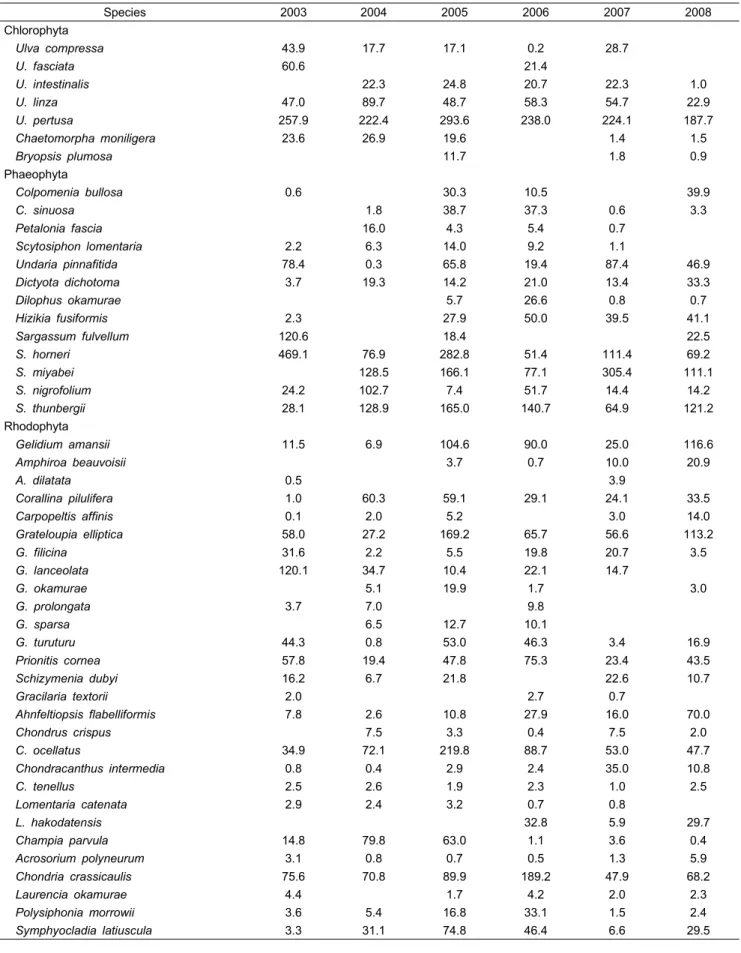
Table 2. Changes of mean biomass (fresh weight g m
-2) according to the major species at the study sites during 2003-2008
Species 2003 2004 2005 2006 2007 2008
Chlorophyta
Ulva compressa 43.9 17.7 17.1 0.2 28.7
U. fasciata 60.6 21.4
U. intestinalis 22.3 24.8 20.7 22.3 1.0
U. linza 47.0 89.7 48.7 58.3 54.7 22.9
U. pertusa 257.9 222.4 293.6 238.0 224.1 187.7
Chaetomorpha moniligera 23.6 26.9 19.6 1.4 1.5
Bryopsis plumosa 11.7 1.8 0.9
Phaeophyta
Colpomenia bullosa 0.6 30.3 10.5 39.9
C. sinuosa 1.8 38.7 37.3 0.6 3.3
Petalonia fascia 16.0 4.3 5.4 0.7
Scytosiphon lomentaria 2.2 6.3 14.0 9.2 1.1
Undaria pinnafitida 78.4 0.3 65.8 19.4 87.4 46.9
Dictyota dichotoma 3.7 19.3 14.2 21.0 13.4 33.3
Dilophus okamurae 5.7 26.6 0.8 0.7
Hizikia fusiformis 2.3 27.9 50.0 39.5 41.1
Sargassum fulvellum 120.6 18.4 22.5
S. horneri 469.1 76.9 282.8 51.4 111.4 69.2
S. miyabei 128.5 166.1 77.1 305.4 111.1
S. nigrofolium 24.2 102.7 7.4 51.7 14.4 14.2
S. thunbergii 28.1 128.9 165.0 140.7 64.9 121.2
Rhodophyta
Gelidium amansii 11.5 6.9 104.6 90.0 25.0 116.6
Amphiroa beauvoisii 3.7 0.7 10.0 20.9
A. dilatata 0.5 3.9
Corallina pilulifera 1.0 60.3 59.1 29.1 24.1 33.5
Carpopeltis affinis 0.1 2.0 5.2 3.0 14.0
Grateloupia elliptica 58.0 27.2 169.2 65.7 56.6 113.2
G. filicina 31.6 2.2 5.5 19.8 20.7 3.5
G. lanceolata 120.1 34.7 10.4 22.1 14.7
G. okamurae 5.1 19.9 1.7 3.0
G. prolongata 3.7 7.0 9.8
G. sparsa 6.5 12.7 10.1
G. turuturu 44.3 0.8 53.0 46.3 3.4 16.9
Prionitis cornea 57.8 19.4 47.8 75.3 23.4 43.5
Schizymenia dubyi 16.2 6.7 21.8 22.6 10.7
Gracilaria textorii 2.0 2.7 0.7
Ahnfeltiopsis flabelliformis 7.8 2.6 10.8 27.9 16.0 70.0
Chondrus crispus 7.5 3.3 0.4 7.5 2.0
C. ocellatus 34.9 72.1 219.8 88.7 53.0 47.7
Chondracanthus intermedia 0.8 0.4 2.9 2.4 35.0 10.8
C. tenellus 2.5 2.6 1.9 2.3 1.0 2.5
Lomentaria catenata 2.9 2.4 3.2 0.7 0.8
L. hakodatensis 32.8 5.9 29.7
Champia parvula 14.8 79.8 63.0 1.1 3.6 0.4
Acrosorium polyneurum 3.1 0.8 0.7 0.5 1.3 5.9
Chondria crassicaulis 75.6 70.8 89.9 189.2 47.9 68.2
Laurencia okamurae 4.4 1.7 4.2 2.0 2.3
Polysiphonia morrowii 3.6 5.4 16.8 33.1 1.5 2.4
Symphyocladia latiuscula 3.3 31.1 74.8 46.4 6.6 29.5
말 (Colpomenia bullosa), 불레기말 (C. sinuosa), 개미역쇠 (Petalonia fascia), 고리매 (Scytosiphon lomentaria), 미역 (Undaria pinnatifida), 참그물바탕말 (Dictyota dichotoma), 모 자반 (Sargassum fulvellum), 괭생이모자반 (S. horneri), 검둥모 자반 (S. nigrifolium), 지충이 (S. thunbergii), 홍조류인 둥근돌 김 (Porphyra suborbiculata), 우뭇가사리 (Gelidium amansii), 미끌풀 (Dumontia simplex), 작은구슬산호말 (Corallina
pilulifera), 무절산호조류 (Melobesioidean algae), 참까막살(Carpopeltis affinis), 참도박 (Grateloupia elliptica), 참지누아 리 (G. filicina), 털지누아리 (G. okamurae), 미끌지누아리 (G.
turuturu), 붉은까막살 (Prionitis cornea), 잎꼬시래기 (Gracilaria textorii), 꼬시래기 (G. verrucosa), 부챗살 (Ahnfeltiopsis flabelliformis), 진두발 (Chondrus ocellatus), 애기돌가사리
(Chondracanthus intermedia), 돌가사리 (G. tenellus), 마디잘록 이 (Lomentaria catenata), 참사슬풀 (Champia parvula), 비단풀사 촌 (Ceramium japonica), 잔금분홍잎 (Acrosorium polyneurum), 엇가지풀 (Heterosiphonia japonica), 개서실 (Chondria crassicaulis), 쌍발이서실 (Laurencia okamurae), 모로우붉은실 (Polysiphonia
morrowii), 참보라색우무 (Symphyocladia latiuscula)로 총 42종이 확인되었다.
이번 연구에서 나타난 영일만에 분포하는 해조류의 분류군 별 출현비율은 녹조류 16.4%, 갈조류 25.0%, 홍조류 58.6%로, 과거에 보고된 다른 연구 결과들 (Lee and Oh, 1986; Lee and Lee, 1988; Lee et al., 1997; Yoo, 2003)의 분류군별 출현비율 결과와 유사하였다. 동해안 지역 해조상 중 출현 빈도가 70%
이상인 종은 구멍갈파래, 불레기말, 미역, 애기마디잘록이, 부챗살, 참보라색우무 등이 있는데 (Yoo, 2003), 이들 해조류 는 이번 연구에서 조사시기별로 매년 출현한 보편적인 해조류 로 나타났다. 한편, 영일만 내외 지역의 출현종 수를 비교하기 위한 과거의 연구 (Lee et al., 1997)를 보면, 만내에서의 출현종 수보다는 영일만 외부 지역에서 더욱 다양한 종조성을 나타냈 다. 해조류 문별 비교시 갈조류와 홍조류는 만내보다 만 바깥 쪽 지역에서 더 많았지만, 녹조류는 유사하게 출현하였다.
영일만 내외 지역 간에 나타난 출현종 수의 차이는 영일만내 지역이 도시에 인접하여 오염물질 농도가 높기 때문에 해조류 생육에 불리한 환경인 반면, 만 외부 해안은 외해의 영향을 지속적으로 받기 때문에 해조류 생육 환경이 연중 다양하게 유지되기 때문이다 (Lee et al., 1997). 따라서 조사지역을 영일 만 내외 해안 지역으로 확대시킨다면 더욱 다양한 해조류가 출현할 것으로 판단된다.
과거의 연구에서 영일만 지역에 연중 출현하는 공통종인 해조류의 특징을 살펴보면 (Lee and Lee, 1988; Lee et al., 1997), 파래류, 붉은실 (Polysiphonia)에 속하는 생장이 빠른 해조류, 청각과 괭생이모자반과 같이 출현 기간이 긴 해조류 및 지충이, 우뭇가사리, 작은구슬산호말, 진두말, 돌가사리처 럼 다년생 종이어서 조사지역에서 연중 출현하는 종들이 많았 는데, 이러한 계절 공통종들의 출현 양상은 이번 연구 결과와 대부분 유사하였다.
이번 연구를 통하여 밝혀진 단위면적당 해조류 생물량의
Table 3. General vertical distribution of marine algae observed at study sites
Intertidal zone Species
Upper zone Porphyra spp., Ulva spp.
Middle zone Ulva pertusa., Ulva spp.
Lower zone Sargassum spp., Gelidium amansii, Grateloupia spp., Chondrus ocellatus, Chondria crassicaulis
조사시기별 변화는 Table 2와 같다. 방형구내 출현종의 조사시 기별 평균은 출현 종 별로 차이를 보이지만 6년간의 조사 기간 동안 높은 생물량을 보이는 우점 해조류는 몇몇 해조류 에 의해 구별되는 것으로 나타났다.
영일만 조간대 해조류의 생물량을 조사 시기 내내 대표하는 해조류는 구멍갈파래와 괭생이모자반, 미아베모자반 (S.
miyabei)으로 이들의 연평균 생물량은 각각 187.7-293.6 g m-2
, 51.4-469.1 g m
-2와 77.1-305.4 g m
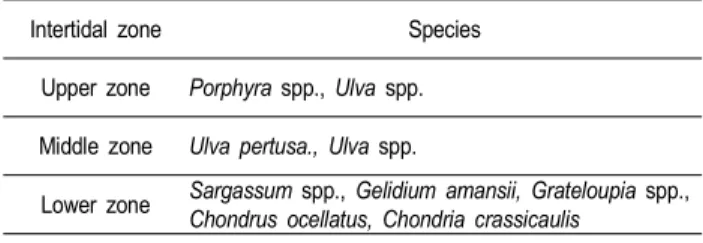
-2였다. 이들 종류는 조사 시기 내내 분포에는 큰 차이를 보이지 않았지만, 모자반류의 생물량은 감소하는 경향을 보였는데 2009년의 조사 (미발표 자료)에서도 이들의 생물량이 감소하는 것으로 나타났다. 또 한 이들 종류는 조간대에서 분포 지역에 있어서도 차이를 보였는데 구멍갈파래가 조간대의 상부에서 중부에 이르는 구역들에서 주로 번무한 반면에 모자반류는 조간대 하부에서 많이 우점하며 출현하는 경향을 나타냈다 (Table 3).
한편 이들 종류의 우점종 외에도 비교적 높은 생물량을 갖는 해조류 들이 있는데, 주로 조간대 하부에 우점하는 갈조 류인 지충이, 홍조류인 우뭇가사리, 참도박, 진두발, 개서실로 조사 시기별로 매년 출현하는 것으로 나타났다. 이들 해조류 의 평균 생물량은 조사 시기별로 다량 출현하는 경우가 대부 분으로 생물량의 큰 차이는 보이지 않았다.
생물량 자료는 군집 특성 이해에 대한 중요한 척도이고 (Kim et al., 1997) 해조군집 특성의 정량적 파악을 위한 생물량 자료 확보가 필요하기 때문에 (Choi et al., 2006), 해조류 군집 조사에 있어서 정량적인 연구의 병행이 바람직하다. Yoo (2003)는 영일만 지역에서 현존량으로 본 우점종을 괭생이모 자반, 미역, 지충이 3종으로 보고하였는데, 이번 연구에서도 이들 해조류의 생물량이 높아서 영일만 지역 조간대의 생물량 을 대표하는 것으로 나타났다. 주문진 조간대 해조류의 생물 량을 연중 대표하는 해조류 (Kim et al., 1997)는 작은구슬산호 말과 지충이로 나타났으며 지충이가 조간대 상부로부터 중부 에 번무한 반면, 작은구슬산호말은 중부 또는 하부에서 많이 출현하는 경향을 보였다. 이 분포 결과는 영일만의 경우 지충 이가 조간대 하부에서 주로 출현하는 경향과 차이를 보였지 만, 홍조류 분포 및 출현 경향은 유사했다. 과거 연구 결과들 중에서 영일만 해역에서 조사된 해조류 생물량 자료는 다양하 지 않지만, 영일만 인근 동해안에서 수행된 연구 결과를 보면 생물량이 주로 갈조류로 인해 좌우되었다고 하여 (Nam, 1986;
Kim et al., 1997; Choi et al., 2006) 이번 연구 결과와 유사하였
다.
한국 연안의 해조군락은 서해안의 경우 출현종 조성이 단순 하고 양적으로 빈약하며 구멍갈파래 군락의 특성을 보이고 (Lee and Lee, 1982), 남해안은 지충이-무절산호조류 군락, 지 충이-애기우뭇가사리-뜸부기 군락, 구멍갈파래-파래류 군락 이 우점한다 (Sohn et al., 1982). 동해안 해조식생의 경우, 구멍 갈파래, 참도박, 지충이, 진두발, 작은구슬산호말 군집으로 이루어져 있음을 알 수 있다 (Lee and Oh, 1986). 이번 연구에서 나타난 대체적인 해조류 수직분포는 조간대 상부 및 중부에서 구멍갈파래와 갈파래류, 하부에서는 모자반류와 우뭇가사리, 진두발, 지누아리류, 개서실 등이 분포했다. 이는 Taniguti (1962)가 지적한 염분농도가 낮은 내만성 해조군집의 특성이 라고 볼 수 있는데, 이러한 해조군집 특성은 과거 연구 (Lee and Oh, 1986)와도 유사하였으며, Boo (1985)가 보고한 동해중 부 해조류의 수직분포와도 유사하게 나타났다.
이 연구기간 동안 영일만에서 출현한 해조류의 기능형군별 구성비는 Table 4와 같다. 기능형군별 비율의 6년간 평균은 성긴분기형 53.3%, 사상형 21.1%, 혁질형 12.5%, 엽상형 5.9%, 유절산호말형 5.3%, 각상형 2.0%로 나타났다. 이 비율을 각 조사시기별로 구분해보면, 시기마다 비율의 차이는 보이지만 평균에 거의 유사하게 나타났다.
Table 4. Composition ratio (%) of macroalgal functional form group investigated at study sites during 2003-2008
Functional form 2003 2004 2005 2006 2007 2008 Total
Sheet 5.8 6.3 5.9 7.5 5.8 5.0 5.9
Coarsely branched 57.0 45.0 55.8 54.8 51.2 58.8 53.3 Thick leathery 14.0 13.8 14.1 11.8 14.0 13.8 12.5 Filamentous 17.4 26.3 18.8 19.4 22.1 15.0 21.1 Jointed calcareous 4.7 7.5 3.5 3.2 3.5 3.8 5.3
Crustose 1.2 1.3 2.4 3.2 3.5 3.8 2.0
Table 5. Comparison of marine algae compositions and floristic ratio between the previous studies at the east coast and Youngil Bay, Korea
Reference Chloroph yta
Phaeoph yta
Rhodoph yta
Total number of
species
Flora characteristics
ratio R/P C/P (R+C)/P Boo and Lee
(1986) 14 28 54 96 1.93 0.50 2.43
Lee and Oh
(1986) 20 35 79 134 2.26 0.57 2.83
Lee and Lee
(1988) 19 37 108 164 2.92 0.51 3.43 Chung et al.
(1991) 8 22 63 93 2.86 0.36 3.23
Lee et al.
(1997) 14 26 76 116 2.92 0.54 3.46
Yoo (2003) 10 19 47 76 2.47 0.53 3.00 This study
(2003-2008) 25 38 89 152 2.34 0.66 3.00 C, Chlorophyta; P, Phaeophyta; R, Rhodophyta.
Fig. 3. Flora characteristics ratio at study sites during 2003-2008.
Sohn (1987)은 우리나라에 서식하는 해조류의 기능형군별 구성비가 서, 남해안의 경우 성긴분기형 - 사상형 - 엽상형 - 혁질형 - 각상형 - 유절산호말형 순으로 직립분기형과 사상 형의 비율이 타 비율에 비해서 높다고 보고하였다. Choi (2008) 은 월성원전 주변의 해조류 군집 연구에서 기능형군별 구성비 는 성긴분지형 (35.4%), 사상형 (27.6%), 엽상형 (19.7%), 혁질 형 (10.2%), 유절산호말형 (4.7%), 각상형 (2.4%) 순으로 높다 고 보고하였다. 이러한 연구 결과들은 우리나라 해역별로 서 식하는 해조류의 기능형군별 구성비가 영일만에 서식하는 해조류의 기능형군별 구성비와 유사하며 성긴분기형과 사상 형의 구성 비율이 각 해역별로 상대적으로 높은 것으로 나타 났다. 이와 같이 성긴분기형과 사상형 해조류의 구성 비율이 상대적으로 높은 것은 우리나라 해조류가 외양성의 온난대성 해조상 특징 (Park et al., 2007)과 연안의 서식처가 교란이 빈번하게 일어나는 환경에 노출되어 있다는 것을 반영 (Choi, 2008)한다고 할 수 있다.
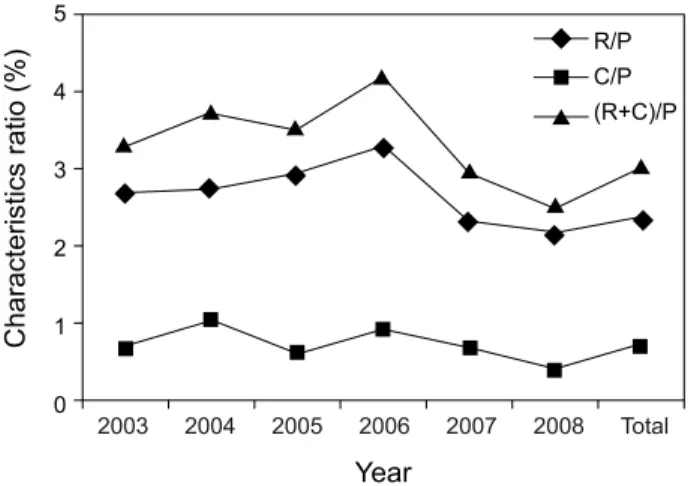
해조상의 특색을 비교할 수 있는 생태지수인 R/P 값, C/P 값, (R+C)/P 값은 Table 5 및 Fig. 3과 같다. R/P 값의 6년간 평균은 2.34, C/P 값의 6년 평균은 0.66 그리고 (R+C)/P 값의 6년간 평균이 3.00으로 나타났다. 생태지수의 6년간 변화를 보면, R/P 값은 2.13에서 2.89 사이의 값을 보였고, C/P 값은 0.35에서 1.00 사이의 값을 나타냈다. (R+C)/P 값의 경우에도 2.48에서 4.17 사이의 값을 나타내, 조사 시기에 따라 구성비의 차이를 보이기는 하지만 조사 기간 동안의 생태지수는 평균값 과 비교시 유사하여 큰 변화는 나타나지 않았다.
해조상의 지리적 분포 양상을 구분하는 방법으로 각 분류군
의 출현종 수에 근거하여 생태적 지수를 사용하고 있다. R/P
값은 한온대 지역에서 1.1, 열대지역은 4.3으로 평가하고,
(R+C)/P 값이 3 이하이면 온대성 또는 한대성 해조상, 6 이상이
면 열대성 해조상, 중간값을 혼합성 해조상으로 구분한다
(Cheney, 1977). 이전의 연구에서(Lee and Oh, 1986; Lee and
Lee, 1988; Lee et al., 1997; Yoo, 2003) 영일만 지역을 대상으로
보고된 생태지수는 (Table 5), R/P 값이 2.26에서 2.92로 이번
조사 결과와 유사하게 나타났다. C/P 값의 경우에도 0.51에서
0.57로 큰 차이를 보이지 않았으며, (R+C)/P 값 또한 과거 값들이 이번 조사 값과 동일하게 나타났다. 이들 생태지수로 판단할 때 출현 해조류 종 수의 변화나 우점종의 변화는 연구 시기와 연구자간에 차이는 있을 수 있지만, 영일만 해역에 분포하는 해조류 분류군별 출현 비율에는 큰 차이를 나타내지 않는 것으로 보인다. 이들 생태지수로 분석할 때 영일만의 해조상은 Kang (1966), Cheney (1977) 등에 따라 온대성 해조 상의 특징을 나타내며, 과거의 연구와 동일한 결과를 나타냈 다.
해양생태계의 일차생산자인 해조류는 부착성 식물의 특징 을 가지며 생물학적, 무생물학적인 환경 변화에 민감하기 때 문에 인위적인 교란 요인인 서식 기질의 변화, 오염물질의 유입, 해안 건설공사와 같은 여러 가지 영향에 대하여 출현종 수, 종다양성, 생물량, 군집구조 등이 변화할 가능성이 높다.
조사지역인 영일만 주변 해역도 최근 다양한 해안 건설, 테트 라포드 설치, 해양 공사 등이 수행되어 인위적인 교란이 꾸준 하게 발생하였음을 알 수 있다. 이러한 인위적인 행위로 인하 여 최근의 모니터링 결과 해조류 출현종 수의 감소와 군집구 조 등이 변화한 것으로 나타났다. 따라서 이들 해역을 대상으 로 지속적인 모니터링 연구를 수행하여, 이와 같은 변화요인 을 저감시킬 수 있는 방안 등이 고려되어야 할 것이다.
참고문헌