ORIGINAL ARTICLE
Sole and Combined Usage of Ultra-sonication and Hydrogen Peroxide as Mitigation Techniques of Bio-fouling
Md. Niamul Haque, Sung-hyun Kwon
1)*Department of Ocean System Engineering, College of Marine Science, Gyeongsang National University, Tongyeong 53064, Korea
1)Department of Marine Environmental Engineering, College of Marine Science, Engineering Research Institute (ERI), Gyeongsang National University, Tongyeong 53064, Korea
Abstract
Mussels are stubborn organism attached to solid substrate by byssus threads and caused operational problems in utility of power generating stations. Sole and combined usage of ultrasonic (28 kHz- and 42 kHz- frequencies) and hydrogen peroxide (H2O2) has studied for control of blue mussel larvae and adult stage in seawater condition. A theoretical wo rking model using disinfection (Chick and Watson type) approaches is presented based on helpful results of experiments. This study also demonstrate that the combined treatment (ultra-sonication with H2O2) is overall highly efficient than individual treatment would, but on the basis of exposure time, the ultra-sonication was the most efficient among them. Therefore the development of sole and combined technique might be effective practical mitigation strategy against mussel attachment for water handling facilities.
Key words : Biofouling, Ultra-sonication, Hydrogen peroxide, Mytilus edulis, Cavitation, Mussel
1)
1. Introduction
Cooling water is used by many industrial facilities.
The largest user of cooling water is the electric power industry, although other significant users include the pulp and paper, chemical, iron and steel, aluminum, and petroleum refining industries (Veil et al., 1999).
Electric generating plants and industries often use water in “once through” cooling system. The consequence of uncontrolled mussel growth in these facilities may include strainer and screen blockage, loss of heat transfer efficiency in condenser tubes, or
interference with service water or fire control system (Harrington et al., 1997). Mussels are the most dominant fouling organisms in the cooling water circuits of coastal power plants throughout the world (Jenner et al., 1998; Rajagopal et al., 2003). Control of mussel fouling in existing cooling water systems can potentially be achieved by several strategies. It can be accomplished by killing larvae before they settle.
Alternatively, biofouling can also be prevented if mussels are prevented from settling by creating a hostile environment in which settlement is postponed.
Finally, control can be exerted by killing the mussels
Received 8 September, 2016; Revised 13 October, 2016;
Accepted 16 October, 2016
*Corresponding author : Sung-hyun Kwon, Department of Marine Environmental Engineering, College of Marine Science, Engineering Research Institute (ERI), Gyeongsang National University, Tongyeong 53064, Korea
Phone: +82-55-772-9132 E-mail: [email protected]
ⓒ The Korean Environmental Sciences Society. All rights reserved.
This is an Open-Access article distributed under the terms of the Creative Commons Attribution Non-Commercial License (http://
creativecommons.org/licenses/by-nc/3.0) which permits unrestricted non-commercial use, distribution, and reproduction in any medium, provided the original work is properly cited.
after they have settled by either continuous or periodic control measures (Klerks et al., 1993). Each strategy focuses on another life stage in the mussel’s life cycle.
Most of the various control measures adopted, concentrate on removing the existing fouling, by combating the adult mussels already present in the system.
The traditional method of controlling biofouling is to use a biocide to kill microorganisms; perhaps in conjunction with a bio-dispersant it reduces the opportunity for cells to accumulate on surface within cooling water system (Bott et al., 2004). Commonly used biocidal substance or disinfectants are chlorine and its related compounds, such as sodium or calcium hypochloride and chlorine dioxide. Chlorine is a widely utilized disinfectant for disinfection of grey water intended for reuse (Winward et al., 2008). The strong oxidizing potential of these reagents provides a minimum level of chlorine residual throughout the distribution system and adequate protection against microbial recontamination (Sadiq et al., 2004).
Among these, the formation of organic halogen compounds are the most dangerous by-products for public health and induced high level of mutagenicity and carcinogenicity in a variety of organism (Yang et al., 2000, Kleiser and Frimmel, 2000). Therefore, the uses of chlorine compounds are limited to minimize the potential toxic effects as well as to prevent the formation of by-products in water bodies. This disadvantage has emphasized the need for exploring alternative disinfectants and new treatment technologies (Gopal et al., 2007). In this respect, ultra-sonication and hydrogen peroxide have been tested due to the simplicity of operation and the relatively affordable operating and maintenance costs (Wait et al., 2007).
The aim of this study is to determine efficiencies of individual and combined treatments of ultra-sonication and hydrogen peroxide for the inactivation/kill of
Mytilus edulis larvae and two sets of mussel. Theresults obtained in the present work will hopefully help to estimate as the primary representative in combination with mechanical and chemical means to remove adult mussel from, and to prevent aggregation in water intake in the marine environment.
2. Materials and Methods
2.1. Larva collection
The mussel larvae along with seawater were provided from the Gyeongsangnam-do Fisheries Resources Research Institute, Tongyeong, South Korea. The collected mussel larvae were being preserved in a 10 L glass container with seawater. The temperature (22℃), pH (7.6), and salinity (33.0%
0) of the preservation container water were properly maintained with caution until completion of the experiment.
2.2. Mussel collection
M. edulis mussels were collected from a well
cultivated site in Jinhae (Changwon, South Korea; 35˚
07ʹ39.5ʹʹN and 128˚44ʹ19.8ʹʹE). Collected mussels have grown on ropes. Separated mussels were immediately transferred to an ice box. The mussels were preserved in a large glass aquarium with seawater. All mussels were classified into two groups, namely 14 mm and 25 mm sizes using slide calipers and digital weighing balance.
2.3. Ultrasound treatment
28 kHz and 42 kHz ultra-sonic machines were used in this experiment. Both ultra-sonic frequencies were applied individually on M. edulis larva and mussel.
Experimental samples were placed inside the
ultrasound machine and ultrasounds were applied for
different exposure time periods. Exposure time
periods for larvae solutions were 2 min, 3 min, 4 min,
5 min and 6 min whereas the exposure time periods of
mussels were 3 min, 5 min, 8 min, 10 min, 15 min, and
20 min.
2.4. Hydrogen peroxide treatment
For larvae experiment, 0.3 mg/L, 0.5 mg/L, 1.0 mg/L and 3.0 mg/L of H
2O
2solutions were prepared from 30% H
2O
2(Merck, Germany). 100 µL larvae solutions were transferred in each solution using micropipette and mortality was checked at 10 min, 20 min, 30 min, 60 min and 90 min. For mussel experiment, 1.0 mg/L 2.0 mg/L, 3.0 mg/L, 4.0 mg/L, and 5.0 mg/L of H
2O
2solutions were prepared from 30% H
2O
2(Merck, Germany). Same size of 20 mussels was placed in each solution and mortality was examined under laboratory condition till 30 days. All solution were diluted using distill water (Daniel, Jos and Enrique, 2015).
2.5. Combined treatment
Combined treatment was done using 42 kHz ultrasound and different concentration of hydrogen peroxide. For larvae experiment, 0.3 mg/L, 0.5 mg/L, 1.0 mg/L, and 3.0 mg/L of H
2O
2solutions were prepared from 30% H
2O
2(Merck, Germany). 100 µL larvae solutions were transferred in each solution using micropipette. 42 kHz ultrasounds were applied for 90s and wait for 10 min for mortality counting. For mussel experiment, 1.0 mg/L, 2.0 mg/L, 3.0 mg/L, 4.0 mg/L, and 5.0 mg/L of H
2O
2solutions were prepared from 30% H
2O
2(Merck, Germany). One-sized 20 mussels were placed in each solution. 42 kHz ultrasounds were applied for 3 min and mortality was examined under laboratory condition till 30 days.
2.6. Larvae counting
The larvae containing solution was filtered using 40 µm pore size sieve at the end of the exposure time.
Several times have been washed the sieve to getting clean larvae solution and then the filtered larvae were transferred to Sedgwick Rafter Counting Cell (Olympus BX40; Olympus America Inc., USA) for counting (200 × magnifications). The distinction between live and dead veligers (larvae) was based upon the
presence or absence of ciliary movement, either inside the translucent shell or on an extended velum (Nalepa and Schloesser, 1993). Experiments were repeated three times to minimize the result deviation.
2.7. Mussels counting
Same size 20 live mussels were taken in each treatment. The live and dead mussels were counted at the end of the exposure time. Mussels were considered dead if mussel shell gapes were no response of exposed mantle tissues to external stimuli (Rajagopal et al., 2003). The experiments were repeated three times.
2.8. Disinfection model
Contact time and concentration of disinfectants are important variables in disinfection model to describe observed mortality data. Harriet Chick observed that for a given concentration of disinfectant, the longer the contact time, the greater the kill. This observation was first reported in the literature in 1908 (Chick, 1908). Form Chick’s equation,
ln (N
t/N
0) = -kt (i)
The value of the inactivation rate constant ‘k’ in Eq.(i) can be obtained by plotting –ln (N
t/N
0)versus the contact time t.
Herbert Watson reported that the inactivation rate constant was related to the concentration (Watson, 1908). Combining the expression proposed by Chick and Watson in differential form yields
dN
t/dt = - kʹC
nNt (ii)
The value of ‘n’ can be obtained by plotting ‘C’
versus t, on log-log paper for a given level of
inactivation. The following explanation has been
offered for various values of n:
Ultra-sonication time (Min)
2 3 4 5 6
Larvae mortality (%)
0 20 40 60 80 100 120
28 KHz 42 KHz
Mortality, k
20 25 30 35 40 45 50 55
Surface Area of mussel, A
1 2 3 4 5 6
14 mm 25 mm
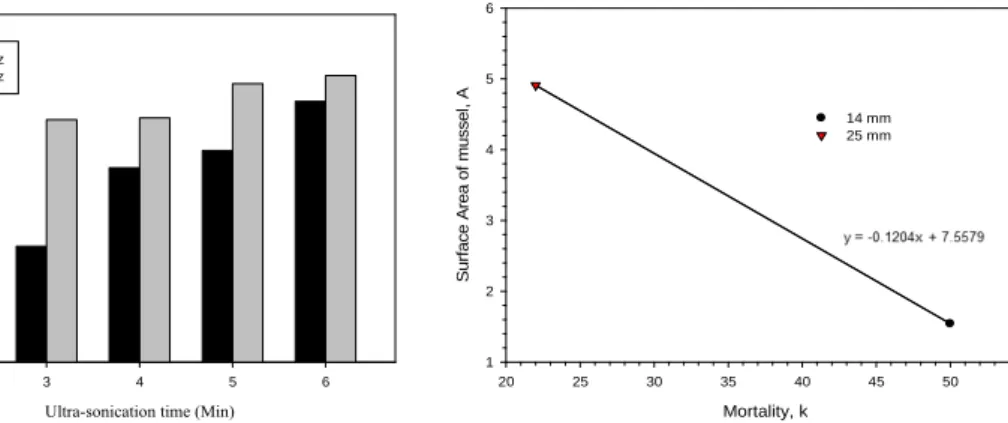
Fig. 1. M. edulis larvae mortality with respect to exposure time for 28 kHz and 42 kHz ultra-sonication.
Fig. 2. M. edulis mortality with respect to surface area for 42 kHz ultra-sonication (20 min) on 14 mm and 25 mm size mussel.
n> 1 concentration is more important than time n< 1 time is more important than concentration n= 1 both the concentration and time are equally
important.
3. Results and Discussion
3.1. Sole ultra-sonication treatment
In our experiment, 28 kHz and 42 kHz of ultrasound were applied on M. edulis larvae for different exposure times. Effects of ultra-sonication on larvae were shown in Fig. 1. The mortality of larvae was counted after 2 min, 3 min, 4 min, 5 min, and 6 min later. The larvae mortality increased with increasing ultra-sonication time and ultra-sonication power. 28 kHz and 42 kHz ultrasound drew 30% and 75% mortality of larvae within 2 min, respectively. In the early times, the higher ultrasound achieved much higher mortality than 28 kHz ultrasound, but the gap reduced in later times as full mortality gained. We postulate that the sonic effect acts as toxicity to blue mussels or larvae in terms of duration (time) and strength (total applied energy) which are analogy to applying time and concentration for disinfectants like chlorine, bromine or ozone. Ultrasound disinfection power is related to the occurrence of cavitation
phenomena (Mason and Peters, 2002). It consists of the production of micro-bubbles, which are generated when a great negative pressure is applied to a liquid (Mason and Peters, 2002). Compression and rarefaction waves rapidly move through the liquid media. If the waves are sufficiently intense they will break the attractive forces in the existing molecules and create gas bubbles. As ultrasound energy enters the liquid, the gas bubbles grow until they reach a critical size beyond which they either implode or collapse, thus releasing a great energy amount and promoting sono-chemical reactions (Neppiras, 1980;
Dehghani, 2005). Somehow, it is promising that even lower powered ultrasound showed fairly good mortality rate, compared with 42 kHz ultrasound.
Larvae mortality reached 90% and 99% within 6 min exposure for 28 kHz and 42 kHz ultrasound, respectively.
Tolerance of mussels against ultrasound cavitation is proportional to their surface area (shell area) that is, mortality is proportional to 1/surface area
k= kʹ/S (vii)
where S=surface area of a mussel, k= morality, and
k’ = constant.
Fig. 2 shows the mortality results with respect to surface area (14 mm→ 1.54 cm
2; 25 mm → 4.91 cm
2, ca 3.2 times) of mussels. 28 kHz ultra-sonication power was applied on 14 mm size mussels for 3 min but no mortality was found. That means 28 kHz was not enough to draw any mortality in mature mussel group. While the 42 kHz ultra-sonication was used for mortality test, and then see that the mortality has increased with ultra-sonication time but decreased with their sizes increment. The mortality rates were significantly reduced with sonication time, especially for 25 mm size mussel group. For instance, 42 kHz ultra-sonication for 20 min achieved 50% mortality for 14 mm size mussels and 23% mortality for 25 mm size of mussels. This result may be attributed to mussel morphology and organ development. The outer shell is hard enough to protect their inside soft organs (gill) from ultrasonic cavitation. In addition, the bigger mussels are likely to have more developed organs to fight against foreign intrusion (local thermal effect, toxic substances, and so on) caused by ultra-sound. Consequently, this sort of protection was found to be the higher in 25 mm size mussel group.
From this study it is clear that higher powered energy is more effective with respect to more developed organisms. In contrast, the lower frequencies energy was effective only on larvae than young mussels. In other words, the mortality of smaller sized or younger ones is higher than bigger mussels because of the latter's stronger protection capability (Bougrier et al., 2005). Therefore, ultra-sonication method might be an efficient control tool for mussel oriented macro fouling at its early ages.
3.2. Sole hydrogen peroxide treatment
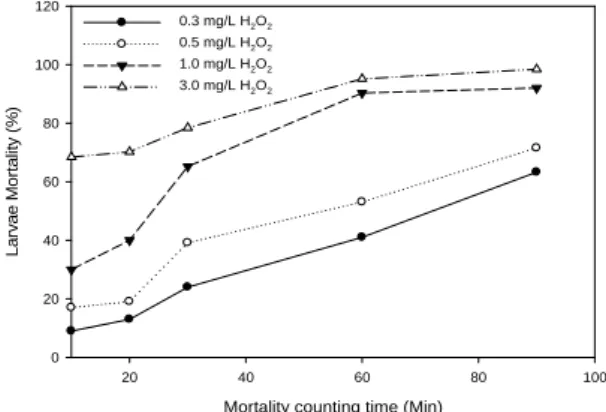
In static experiment, the mortality of larvae was determined at the end of exposure time after hydrogen peroxide input. Exposure times (10-90 min) were computed by stop watch and mortality were counted very carefully. The mortality results were shown in
Fig. 3. It is observed that mortality was increased with exposure time and the concentration of H
2O
2. The maximum mortality was found 98% for 3 mg/L H
2O
2at 90 min exposure. The initial mortality was 68% for 3 mg/L H
2O
2solution at 10 min exposure that was twice greater than 1 mg/L H
2O
2and 4 times greater than 0.5 mg/L H
2O
2.
Mortality counting time (Min)
20 40 60 80 100
Larvae Mortality (%)
0 20 40 60 80 100 120
0.3 mg/L H2O2 0.5 mg/L H2O2 1.0 mg/L H2O2 3.0 mg/L H2O2
Fig. 3. M. edulis larvae mortality with respect to exposure time for different concentrations of H2O2.
Fig. 3 has depicted that the time required for a definite percentage of mortality decreases with increasing concentration. From disinfection phenomena the larvae inactivation (-ln (N
t/N
o)) versus contact time, t for the different concentration of hydrogen peroxide was shown in Fig. 4(A). From this plot, required contact times for 98% larvae mortality were found 351 min, 290 min, 127 min, and 85 min for 0.3 mg/L, 0.5 mg/L, 1.0 mg/L, and 3.0 mg/L H
2O
2respectively. According to the equation (vi), plotted
applied concentration versus time of 98% mortality
(Fig. 4(B)) in log-log scale and found that the slope
value was -1.43 that produce ‘n’ is 0.70 (< 1.0), this
implies that time is more important than concentration
for larva mortality. It is assumed that a multi-cellular
organism may have a self-defensive mechanism
against foreign toxic molecule, such as immunity and
detoxification. Moubad et al.(2001) reported that
mussel`s larvae and spat are sensitive in general
Fig. 4. Plote of laboratory data inactivation of M. edulis larvae (A) - ln (Nt/N0)] vs contact time of different concentration of H2O2 (B) Concentration of H2O2 versus required time to reach 98 percent larvae mortality.
toxins. Some species have been used as sub-lethal indicators of heavy metal toxicity. M. edulis pumping rates respond to stress by pauses for up to 3 min. The current theory assumes that larvae mortality occurs due to hydroxyl free radical diffusion through the cell wall and the toxin molecules are absorbed or adsorbed on the cell wall. Then a certain ‘biocidal pathways’
operates in the inner phase of the cells eventually leading to cell death. Cavaletto et al. reports that H
2O
2enters cells by diffusion, where it is detoxified by catalase activity, but the excess may alter cell physiology. Moubad et al. studied on zebra mussel larvae, at 22˚C, required 9.0 mg/L H
2O
2to achieve 95% mortality. The hydrogen peroxide was applied semi-continuously dosing for 30 min every 12 hours.
The hydrogen peroxide in our work may be dissociated into hydroxyl free radicals to some extent, which might work as main toxin since a number of metallic ions like ferric ions are apt to catalyze the radical formation reactions in seawater mood (Pedahzur et al., 1995).
Toxicity of H
2O
2was examined on mussels under the laboratory condition till 30 days. We observed that toxicity of H
2O
2on mussels were not achieved 100%
mortality during study period. But it was achieved
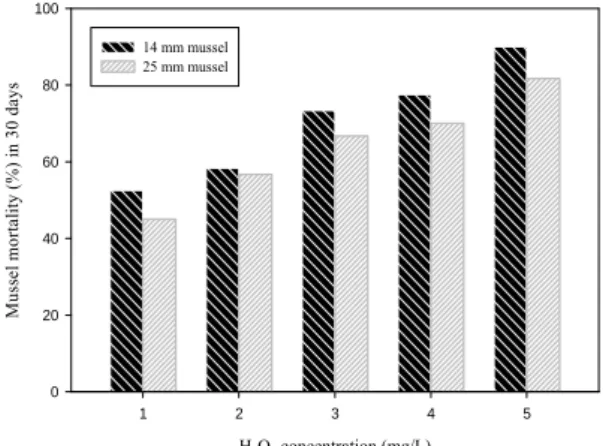
potential percentage at higher concentration. Mussel mortality increased with increased hydrogen peroxide concentration. 14 mm size group mussel showed high mortality compare with 25 mm size group (Fig. 5).
Young mussels have showed high response than older mussel. Therefore toxicity outbreak at high percentage to smaller size group then death occurred swiftly.
While 25 mm size group has shown low response to the toxic environment then death occurred indolently.
At 5 mg/L hydrogen peroxide concentration, within 30 days, 14 mm size mussels showed 90% death but 25 mm size mussels showed 82% death. Martin et al.
(1993) studied adult zebra mussels (2-10 mm), was conducted under static freshwater conditions, and investigated the effects of hydrogen peroxide treatment at two different temperatures and several concentrations. At 22˚C Martin et al achieved 100%
mortality rate at concentration of 30 mg/L, 20 mg/L,
and 12 mg/L, required 72, 120, and 408 hours
respectively. But at 12˚C the same experiment
achieved 100% mortality for hydrogen peroxide
concentration of 30 mg/L and 20 mg/L in 576 and 648
hours respectively. The effectiveness of hydrogen
peroxide is temperature dependent as reactions
proceed faster with rise of temperature (Arrhenius'
H2O2 concentration (mg/L)
0.0 0.5 1.0 1.5 2.0 2.5 3.0 3.5
Larvae mortality (%) in 10 min
0 20 40 60 80 100 120
Only H2O2
42 KHz Ultrasonication for 90 s + H2O2
H2O2 concentration (mg/L)
0 1 2 3 4 5
Mussel mortality (%) in 30 days
0 20 40 60 80 100
14 mm mussel 25 mm mussel
Fig. 6. Mortality of mussel`s larvae comparison between H2O2 and combined treatment.
Fig. 7. Mussel mortality for combined treatment (42 kHz ultrasound for 3 min + H2O2).
activation energy wall gets lower with temperature).
H2O2 concentration (mg/L)
1 2 3 4 5
Mussel mortality (%) in 30 days
0 20 40 60 80 100
14 mm mussel 25 mm mussel
Fig. 5. M. edulis mussel mortality in 30 days for different concentration of H2O2.
3.3. Combined usage of ultrasound and H2O2
Different concentrations of hydrogen peroxide solutions were prepared in glass beaker and 100 µL larvae solution was transferred into the glass beaker by micropipette. These glass beakers were putted inside the ultrasonic machine instantly. 42 kHz ultrasound was applied for 90s (simultaneously) and waits for 10 min for mortality counting. Combined methods were stirring larvae mortality and enhanced mortality rate than individual method. Ultrasonic cavitation might
be increased the amount of hydroxyl free radical inside the solution that helps to increase the effectiveness of H
2O
2. Donskoy and Ludyanski(1995) reported that ultrasonic cavitation at frequencies between 10 to 380 kHz have shown to kill veliger, juvenile and adult mussels. Fig. 6 showed that ultra-sonication enhanced the power of hydrogen peroxide significantly. 3 mg/L H
2O
2achieved 68%
mortality after 10 min whereas combined method achieved 98.35% mortality. Therefore, combined treatment increased 30% larvae mortality than individual treatment of hydrogen peroxide. From fig.
1, 42 kHz ultrasonic was taken 6 min to achieve 99%
mortality, in fig. 2, 3 mg/L H
2O
2solution was taken 90 min to achieve 98% mortality and in Fig. 3, combined treatment was taken 10 min to achieve 98% mortality.
These results indicate that different treatment technique takes different exposure time for same percentage of mortality. Therefore, on the basis of exposure time, ultrasonic treatment is more efficient than combined treatment or H
2O
2treatment.
Combined experiment were done sequentially
applying 42 kHz ultra-sonication for 3 min then
transferred into the hydrogen peroxide solution for
mortality counting after 30 days. Results were
represented in the Fig. 7. Mortality rate were increased
with increasing hydrogen peroxide concentration for 14 mm size mussels and 25 mm size mussels. 5 mg/L H
20
2achieved 95% mortality for 14 mm size mussels and 88% mortality for 25 mm size mussels. Only 42 kHz ultra-sonication achieved 8% mortality for 14 mm mussel and 3% mortality for 25 mm mussel within 3 min. This result indicates that combined treatment is better than any individual treatment. As a result, we can say ultrasound may cause a synergic effect to hydrogen peroxide injection. High waved shock not only facilitates extra hydroxyl radicals out of existing peroxide, but also drives all the hydroxyl free radicals as well as the hydrogen peroxide molecules themselves, known as toxins to the living organisms, directly and instantly into contact with the shell or skin of the mussels. That results in thousands times faster entering 'biocidal pathway' than almost static diffusion of the toxin molecules do if H
2O
2only applied, thus leading to quicker death (Chand et al., 2007; Philli et al., 2011).
4. Conclusion
To evaluate the apparent antifouling mitigation efficiency by hydrogen peroxide and ultra-sonication, two types of experiment were carried out on M. edulis larva and mussel. Firstly, by sole and combine treatment were tested and the motivated outcome was monitored and quantified. Then, the employed results were checked in disinfection effectiveness (model).
Present studies have shown that various factors are responsible for the mortality of M. edulis. For larval mortality, contact time and concentration enhance the mortality efficiency. Mussel mortality depends on its size and applied method. From the results and discussion, mortality of small size mussel (14 mm) is higher than larger size mussel (25 mm). Combined treatment (ultra-sonication with hydrogen peroxide) show better efficiency than individual treatment, but on the basis of contact time, the ultra-sonication
efficiency is better than combined treatment or hydrogen peroxide alone.
Acknowledgment
This research was a part of the project entitled as
‘Improvement Technologies of Hypoxic Water Mass in Semi-Enclosed Coastal Bay’, funded by the Ministry of Oceans and Fisheries, and BK21 plus program, South Korea.
REFERENCES
Bott, T. R., Tianqing, L., 2004, Ultrasound enhancement of biocide efficiency, Ultrasonic Sono-Chemistry, 11, 323-326.
Bougrier, C., Carrere, H., Delgenes, J. P., 2005, Solubilisation of waste activated sludge by ultrasonic treatment, Chemical Engineering Journal, 106, 163-169.
Cavaletto, M., Ghezzi, A., Burlando, B., Evangelisti, V., Ceratto, N., Viarengo, A, 2002, Effect of hydrogen peroxide on antioxidant enzymes and metallo thionein level in the digestive gland of Mytilus galloprovincialis, Comparative Biochemistry and Physiology Part C, 131, 447-455.
Chand, R., Bremner, D. H., Namkung, K. C., Collier, P.
J., Gogate, P. R., 2007, Water disinfection using the novel approach of ozone and a liquid whistle reactor, Biochemical Engineering Journal, 35, 357-364.
Chick, H., 1908, An investigation into the law of disinfection, Journal of Hygiene (Cambridge), 8, 92-158.
Daniel, R., Jos, F. C., Enrique, N., 2015, Assessment of the antifouling effect of five different treatment strategies on a seawater cooling system, Applied Thermal Engineering, 85, 124-134.
Dehghani, M. H., 2005, Effectiveness of ultrasound on the destruction of E. Coli, American Journal of Environmental Science, 1, 187-189.
Donskoy, D. M., Ludyanski, M. L., 1995, Low frequency sound as a control measure for zebra mussels fouling, Proceeding of the Fifth International Zebra Mussels and Other Aquatic Nuisance Organism Conference, 14-21 February 1995, Torento, Canada, 103-112.
Gopal, K., Tripathy, S. S., Bersillon, J. L., Dubey, S. P., 2007, Chlorination byproducts, their toxicodynamics and removal from drinking water, Journal of Hazardous Materials, 140, 1-6.
Harrington, D. K., Van Benschoten, J. E., Jensen, J. N., Lewis, D. P., Neuhauser, E. F., 1997, Combined use of heat and oxidants for controlling adult zebra mussels, Water Research, 31, 2783-2791.
Jenner, H. A., Whitehouse, J. W., Taylor, C. J. L., Khalanski, M., 1998, Cooling water management in European power stations: Biology and Control, Hydro Ecologie Appliquee, 1-225.
Kleiser, G., Frimmel, F. H., 2000, Removal of precursors for disinfection by-products (DBPs) Differences between ozone- and OH-radical induced oxidation, Science of the Total Environment, 256, 1-9.
Klerks, P. L., Fraleigh, P. C., Stevenson, R. C., 1993, Controlling zebra mussel (Dreissena polymorpha) veligers with three oxidizing chemicals: Chlorine, permanganate and peroxide iron, In: Nalepa, Schloesser, T. F., and D. W., (Eds.), Zebra Mussels:
Biology, Impacts and Control, 1993, 621-641, Florida.
Martin, L. D., Mackie, G. L., Baker, M. A., 1993, Acute toxicity tests and pulsed-dose delayed mortality at 12 and 22˚C in the zebra mussel (Dreissena polymorpha), Arch. Environ. Contam. Toxicol., 24, 389-398.
Mason, T. J., Peters, D., 2002, Practical Sono-Chemistry:
Power Ultrasound and Applications, Second Edition, Horwood, Chichester, England.
Moubad, A., Fdil, M. A., Maarouf, A., Pihan, J. C., 2001, Pumping behavior and filtration rate of the fresh water mussel Potamidalittoralis as a tool for rapid detection of water contamination, Aquatic Ecology, 35, 51-60.
Nalepa, T. F., Schloesser, D. W., 1993, Zebra Mussels:
Biology, Impacts, and Control, Boca Raton, FL:
Lewis Publishers, 623-633.
Neppiras, E. A., 1980, Acoustic Cavitation, Physical
Report, 61, 159-251.
Pedahzur, R., Lev, O., Fattal, B., Shuval, H. I., 1995, The interaction of silver ions and hydrogen peroxide in the inactivation of E.coli: A preliminary of a new long acting residual drinking water disinfectant, Water Science and Technology, 31, 123-129.
Philli, S., Bhunia, P., Yan, S., LeBlanc, R. J., Tyagi, R.
D., Surampalli, R. Y., 2011, Ultrasonic treatment of sludge: A review, Ultrasonic Sono-Chemistry, 18, 1-18.
Rajagopal, S., Van der Velde, G., Van der Gaag, M., Jenner, H. A., 2003, How efficient is intermittent chlorination to control adult mussel fouling in cooling water systems?, Water Research, 37(2), 329-338.
Sadiq, R., Rodrssiguez, M. J., 2004, Disinfection byproducts (DBPs) in drinking water and predictive models for their occurrence: A review, Science of the Total Environment, 321, 21-46.
Veila, J. A., Pudera, M. G., Littletonb, D. J., Mosesc, D.
O., 1999, Cooling water use patterns at US nonutility electric generating facilities, Environmental Science and Policy, 2, 477-487.
Wait, I. W., Johnston, C. T., Blatchley, E. R., 2007, The influence of oxidation reduction potential and water treatment processes on quartz lamp sleeve fouling in ultraviolet disinfection reactors, Water Research, 41, 2427-2436.
Watson, H. E., 1908, A note on the variation of the rate of disinfection with change in the concentration of the disinfectants, Journal of Hygiene (British), 8(4), 536- 542.
Winward, G. P., Avery, L. M., Stephenson, T., Jefferson, B., 2008, Chlorine disinfection of grey water for reuse: Effect of organics and particles, Water Research, 42, 483-491.
Yang, L., Chang, W. S., Lo Huang, M. N., 2000, Natural disinfection of water in marine outfall fields, Water Research, 34, 743-750.
![Fig. 4. Plote of laboratory data inactivation of M. edulis larvae (A) - ln (N t /N 0 )] vs contact time of different concentration of H 2 O 2 (B) Concentration of H 2 O 2 versus required time to reach 98 percent larvae mortality.](https://thumb-ap.123doks.com/thumbv2/123dokinfo/5091885.323304/6.892.141.754.214.444/laboratory-inactivation-contact-different-concentration-concentration-required-mortality.webp)