Korean J Intern Med 2018;33:823-828 https://doi.org/10.3904/kjim.2016.065
INTRODUCTION
Systemic lupus erythematosus (SLE) is a chronic autoim- mune disease that involves several organs and manifests diverse clinical symptoms [1]. In lupus, autoimmune an- tibody produced by abnormal immune responses binds with the antigen to form an immune complex, which causes damage to internal organs [2]. Many studies have reported correlation between the clinical significance of autoimmune antibodies and the disease. In particular, the lupus nephritis and its disease activity level criti-
cally affect the treatment course and patient prognosis.
However, only few studies have reported on anti-C-re- active protein (CRP) antibody levels in Korean patients with lupus. In one study conducted by Jung et al. [3] in which 99 lupus patients and 48 controls were compared, anti-CRP antibody levels did not significantly correlate with disease activity or the development of lupus ne- phritis, although the levels significantly differed be- tween the groups. Previous studies conducted in other countries have reported that anti-CRP antibody level is associated with disease activity level and critically associ-
1Division of Rheumatology, Department of Internal Medicine, Keimyung University School of Medicine, Daegu;
2Institute for Medical Science, Keimyung University, Daegu; 3Department of Laboratory Medicine, Keimyung University School of Medicine, Daegu, Korea
Received : February 15, 2016 Revised : April 11, 2016 Accepted : May 3, 2016 Correspondence to Sang-Hyon Kim, M.D.
Division of Rheumatology, Department of Internal Medicine, Keimyung University School of Medicine, 56 Dalseong- ro, Jung-gu, Daegu 41931, Korea Tel: +82-53-250-8038
Fax: +82-53-250-7434
E-mail: [email protected]
*These authors contributed equally to this work.
Background/Aims: Anti-C-reactive protein (CRP) antibody has been introduced as a potential biologic marker in Systemic lupus erythematosus (SLE). The aim of study is to evaluate the level of anti-CRP antibody in patients with SLE.
Methods: This study investigated the relationship between levels of anti-CRP an- tibodies and disease activity markers, such as complement, anti-double-stranded DNA antibody, and SLE disease activity index in 34 patients with SLE.
Results: The serum anti-CRP antibody levels of the patients with SLE were sig- nificantly higher than those of the healthy controls (11.3 ± 5.6 µg/mL vs. 9.1 ± 2.8 µg/mL). The percentages of the positive anti-CRP antibody were 52.9% in SLE and 27.8% in controls. Disease duration of SLE showed significant correlation with the anti-CRP antibody (r = 0.234, p = 0.026). However no significant relation- ship was observed between the levels of anti-CRP antibodies and disease activity markers.
Conclusions: These data show that the anti-CRP antibody levels of the patients with SLE were significantly higher than those of healthy controls. We observed that the presence of the anti-CRP anti-CRP antibody was not associated with dis- ease activity of SLE.
Keywords: Systemic lupus erythematosus; Anti-C-reactive protein antibody
The relationship between anti-C-reactive protein and disease activity in patients with systemic
lupus erythematosus
Chang-Nam Son1,2,*, Tae-Han Lee1,*, Ji-Hye Bang1, Hye-Jin Jeong1, Jin-Nyeong Chae1, Won-Mok Lee3, Ji-Min Kim1,2, and Sang-Hyon Kim1,2
ated with the prediction, treatment response evaluation, and prognosis of the morbidity of lupus nephritis [4-8].
Therefore, in this study, we aimed to examine the rela- tionship of anti-CRP antibody level with disease activity and clinical manifestations in Korean patients with SLE.
METHODS
Subjects and methods
The study subjects included 34 lupus patients treated at the Division of Rheumatology of Keimyung University Dongsan Medical Center between March and November 2014. All the patients met the lupus classification crite- ria of the American College of Rheumatology, revised in 1997 [9], and lupus nephritis was defined according to the World Health Organization (WHO) classifica- tion of the condition [10]. We also recruited 36 age- and sex-matched healthy subjects as the control group. The study was approved by the Keimyung University Dong- san Medical Center Medical Research Ethics Committee (IRB 2013-12-009). Written informed consent was ob- tained from all participants and confirmed by the board.
During their outpatient visits, all the patients under- went testing for serum anti-CRP antibodies, complete blood count, CRP, complement 3 (C3), complement 4 (C4), anti-double-stranded DNA (anti-dsDNA) antibod- ies, and urine. In addition, the systemic lupus erythema- tosus disease activity index (SLEDAI) was assessed.
Measurement of serum levels of anti-CRP antibodies The serum levels of anti-CRP antibodies were measured by using enzyme-linked immunosorbent assay (ELISA).
Capillary blood samples were obtained from both the patients and the controls, and immediately processed in a centrifugal separator at 120,000 rpm for 20 minutes.
Only the separated sera were stored in a freezer at −70°C until measurement of serum anti-CRP antibody levels.
Anti-CRP antibody level was measured by using an an- ti-CRP antibody ELISA kit (Cloud-Clone Corp., Hous- ton, TX, USA). Before measurement, each specimen was diluted to the ratio of 1:100 in phosphate-buffered saline and cultured at 37°C for 2 hours after batches of 100-µL specimen were transferred by using a pipette to a 96- well microtiter plate. After washing with wash buffer, color reaction was induced at 37°C for 25 minutes by the
addition of substrate solution and then stopped by the addition of a stop solution. An ELISA reader (VICTOR3, PerkinElmer Inc., Waltham, MA, USA) was used to mea- sure optical density (OD). The obtained OD was calcu- lated with a standard curve generated through a serial dilution of serum (r² = 0.998). The cutoff value was set as the mean OD + 2SD of the healthy controls.
Statistical analysis
Data handling and statistical analysis were performed by using SPSS version 18.0 (SPSS Inc., Chicago, IL, USA).
Results are presented herein as mean ± standard devia- tion. Anti-CRP antibody levels were compared between the patient and control groups by using the non-para- metric Mann-Whitney U test. The correlation between anti-CRP antibody level and the indicators of disease ac- tivity of lupus nephritis was examined by computing a non-parametric correlation coefficient for ordinal vari- ables (Spearman’s rho). Statistical significance was de- termined if the p value was < 0.05.
RESULTS
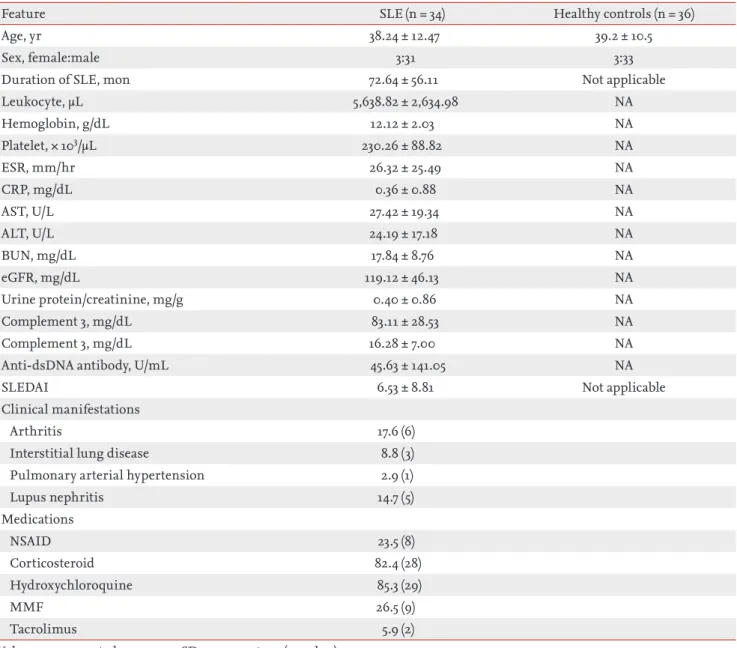
Of the 34 patients, three were male and 31 were female.
The mean age was 38.5 ± 12.28 years, and the mean illness duration was 72.64 ± 56.11 months. Renal biopsy was per- formed for five patients (14.7%), of whom one had class II disease and four had class IV disease according to the WHO classification criteria. The patients with lupus nephritis were only five, so we could not analyzed an- ti-CRP antibody according to lupus nephritis. Laborato- ry examination yielded the following values: leukocytes, 5,638.8 ± 2,635.0/µL; hemoglobin, 12.1 ± 2.0 g/dL; platelets, 230.3 ± 88.8 ´ 103/µL; erythrocyte sedimentation rate, 26.3
± 25.5 mm/hr; CRP, 0.4 ± 0.9 mg/dL; C3, 83.1 ± 28.5 mg/dL;
C4, 16.3 ± 7.0 mg/dL; and anti-dsDNA antibodies, 45.6 ± 141.1 U/mL. The SLEDAI was 6.5 ± 8.8 (Table 1).
The anti-CRP antibody level was 11.3 ± 5.6 µg/mL in the patient group and 9.1 ± 2.8 µg/mL in the control group, demonstrating a higher level in the patient group (p = 0.043) (Fig. 1). The level of positive anti-CRP antibody was 8.6 µg/mL. The percentages of the positive anti-CRP antibody were 52.9% in SLE and 27.8% in controls. The anti-CRP antibody levels, clinical characteristics, and disease activity are compared in Table 2. One variable,
disease duration of SLE, showed significant correlation with the anti-CRP antibody (r = 0.234, p = 0.026). Howev- er, no significant correlations were observed with com- plements, anti-dsDNA antibodies, SLEDAI score, and other variables. The patients were divided into two sub- groups according to disease activity level, and the effect of each anti-CRP antibody was examined. However, no significant differences were found. The subgroups also
did not show significant differences in, for example, blood test results, symptoms, and use of medications (Table 3). We also evaluated between anti-CRP positive patients (n = 18) and anti-CRP negative patients (n = 16).
However there was no statistically different variable be- tween groups (data not shown).
Table 1. Clinical features of the patients with SLE
Feature SLE (n = 34) Healthy controls (n = 36)
Age, yr 38.24 ± 12.47 39.2 ± 10.5
Sex, female:male 3:31 3:33
Duration of SLE, mon 72.64 ± 56.11 Not applicable
Leukocyte, µL 5,638.82 ± 2,634.98 NA
Hemoglobin, g/dL 12.12 ± 2.03 NA
Platelet, × 103/µL 230.26 ± 88.82 NA
ESR, mm/hr 26.32 ± 25.49 NA
CRP, mg/dL 0.36 ± 0.88 NA
AST, U/L 27.42 ± 19.34 NA
ALT, U/L 24.19 ± 17.18 NA
BUN, mg/dL 17.84 ± 8.76 NA
eGFR, mg/dL 119.12 ± 46.13 NA
Urine protein/creatinine, mg/g 0.40 ± 0.86 NA
Complement 3, mg/dL 83.11 ± 28.53 NA
Complement 3, mg/dL 16.28 ± 7.00 NA
Anti-dsDNA antibody, U/mL 45.63 ± 141.05 NA
SLEDAI 6.53 ± 8.81 Not applicable
Clinical manifestations
Arthritis 17.6 (6)
Interstitial lung disease 8.8 (3)
Pulmonary arterial hypertension 2.9 (1)
Lupus nephritis 14.7 (5)
Medications
NSAID 23.5 (8)
Corticosteroid 82.4 (28)
Hydroxychloroquine 85.3 (29)
MMF 26.5 (9)
Tacrolimus 5.9 (2)
Values are presented as mean ± SD or percentage (number).
SLE, systemic lupus erythematosus; NA, not available; ESR, erythrocyte sedimentation rate; CRP, C-reactive protein; AST, as- partate aminotransferase; ALT, alanine aminotransferase; BUN, blood urea nitrogen; eGFR, estimated glomerular filtration rate; dsDNA, double-stranded DNA; SLEDAI, systemic lupus erythematosus disease activity index; NSAID, nonsteroidal an- ti-inflammatory drug; MMF, mycophenolate mofetil.
DISCUSSION
The level of CRP is rarely high in patients with SLE, even in increased disease activity levels. If a patient with SLE has increased CRP level, other causes are consid- ered first [11,12]. Modest elevation of CRP levels in SLE seems to be associated with elimination by autoantibod- ies [13-16]. Several studies have reported that anti-CRP antibody level correlated with disease activity and the occurrence of lupus nephritis. Specifically, Sjowall et al.
[7] showed in a study in which 10 lupus patients were
followed up over time that the anti-CRP antibody level varied depending on disease activity level. In particular, the anti-CRP antibody level increased when the disease activity level of lupus nephritis increased. However, in the present study, we did not find a significant correla- tion between the levels of anti-CRP antibodies and dis- ease activity markers such as complements, anti-dsDNA antibodies, and SLEDAI score. Moreover, the anti-CRP antibody levels did not differ between the patients with and those without co-occurring lupus nephritis. We be- lieve that one reason why we did not find any signifi- cant correlation with disease activity or the occurrence of lupus nephritis in our study, unlike in other studies, may be related to the low disease activity levels of lupus in our patients. The mean levels of the complements in the 34 patients were 83.1 ± 28.5 mg/dL for C3 and 16.3 ± 7.0 mg/dL for C4. The mean SLEDAI was 6.5 ± 8.8. Only five patients had co-occurring lupus nephritis. As men- tioned earlier, anti-CRP antibody levels can change depending on disease activity levels. Furthermore, in patients with lupus nephritis, a significant decrease in anti-CRP antibody level was observed after induction therapy [7]. However, the disease activity in the patients in this study was maintained at a relatively stable lev- el, which is probably why no significant correlation was found.
Table 2. The relationship between anti-C-reactive protein antibody level and clinical Feature
Variable r p value
Age 0.103 0.199
Disease duration, mon 0.234 0.026
White blood count 0.039 0.372
Hemoglobin 0.140 0.124
Platelet –0.041 0.367
Blood urea nitrogen –0.092 0.231
Creatinine –0.024 0.423
Erythrocyte sedimentation rate –0.148 0.112
C-reactive protein –0.023 0.427
Complement 3 0.159 0.094
Complement 4 0.123 0.153
Urine protein/creatinine ratio –0.002 0.493
Anti-dsDNA antibody –0.059 0.370
SLEDAI 0.056 0.327
dsDNA, double-stranded DNA; SLEDAI, systemic lupus erythematosus disease activity index.
30 25 20 15 10 5
0
Healthy control
Serum anti-CRP antibody (µg/dL)
9.09 ± 2.79
SLE 11.27 ± 5.64
p = 0.043
Figure 1. Serum anti-C-reactive protein (CRP) antibody levels in patients with systemic lupus erythematosus (SLE) and healthy control.
However, a significant correlation was found between the anti-CRP antibody levels and the mean illness dura- tion; that is, the longer the illness duration, the higher the anti-CRP antibody level. A previous study did not find any significant difference in mean illness dura- tion between an anti-CRP-positive group and an an- ti-CRP-negative group [17]. However, in the present study, illness duration did not statistically correlate with any of the disease activity markers, including comple- ments, anti-dsDNA antibodies, SLEDAI, and protein- uria. In addition, the mean illness duration was 72.6 ± 56.1 months. However, three patients who had anti-CRP antibody levels higher than the mean level had had lu-
pus for 187, 175, and 167 months, respectively, all of which were greater than twice the standard deviation. There- fore, we think that the finding of significant correlation with illness duration was due to the few high values in a small sample. We recommend that prospective research studies with large patient samples be conducted for a more accurate interpretation of results.
To conclude, in the present study, we confirmed that the anti-CRP antibody levels of the patients with SLE were statistically significantly higher than those of the con- trols. However, unlike the findings reported in a previous research study, the level of anti-CRP antibodies was not significantly correlated with lupus disease activity. For Table 3. The difference of anti-CRP antibody level according to disease activity markers, laboratory findings, and combined clinical manifestations
Variable Number Anti-CRP antibody, µg/mL p value
SLEDAI scores
≥ 6 13 10.2 0.173
< 6 21 13.0
Complement, mg/dL
Low C3 11 10.6 0.302
Low C4 6 11.3 0.991
Low C3 and C4 6 11.3 0.991
Normal C3 and C4 23 11.3
Anti-dsDNA antibody, U/mL
Increased anti-dsDNA antibody 11 12.5 0.070
Normal anti-dsDNA antibody 23 8.8
ESR, mm/hr
Increased ESR 15 10.1 0.306
Normal ESR 19 12.2
CRP, mg/dL
Increased CRP 5 14.5 0.175
Normal CRP 29 10.7
Steroid, mg/day
Low dose steroid (PDS ≤ 7.5 mg/day) 22 10.9 0.228
High dose steroid (PDS ≥ 1 mg/kg/day) 3 13.5 0.563
Pulse therapy (PDS ≥ 250 mg/day) 14 11.5 0.860
Combined manifestations
With arthritis/Without arthritis 6/28 9.4/11.7 0.384
With ILD/Without ILD 3/31 17.1/10.7 0.060
With PAH/Without PAH 1/33 15.0/11.2 0.506
CRP, C-reactive protein; SLEDAI, systemic lupus erythematosus disease activity index; dsDNA, double-stranded DNA; ESR, erythrocyte sedimentation rate; PDS, prednisolone; ILD, interstitial lung disease; PAH, pulmonary arterial hypertension.
further understanding of the effect of anti-CRP antibod- ies in patients with lupus, follow-up prospective research studies with a larger number of patients are needed.
KEY MESSAGE
1. The anti-C-reactive protein (anti-CRP) anti- body levels of the patients with systemic lupus erythematosus were statistically significantly higher than those of the healthy controls.
2. The level of anti-CRP antibodies was not sig- nificantly correlated with lupus disease activity.
Conflict of interest
No potential conflict of interest relevant to this article was reported.
REFERENCES
1. Sherer Y, Gorstein A, Fritzler MJ, Shoenfeld Y. Autoanti- body explosion in systemic lupus erythematosus: more than 100 different antibodies found in SLE patients. Se- min Arthritis Rheum 2004;34:501-537.
2. Tan EM. Antinuclear antibodies: diagnostic markers for autoimmune diseases and probes for cell biology. Adv Immunol 1989;44:93-151.
3. Jung JY, Koh BR, Kim HA, Jeon JY, Suh CH. Autoantibod- ies to C-reactive protein in incomplete lupus and system- ic lupus erythematosus. J Investig Med 2014;62:890-893.
4. Zuniga R, Markowitz GS, Arkachaisri T, Imperatore EA, D’Agati VD, Salmon JE. Identification of IgG subclasses and C-reactive protein in lupus nephritis: the relation- ship between the composition of immune deposits and FCgamma receptor type IIA alleles. Arthritis Rheum 2003;48:460-470.
5. Sjowall C, Bengtsson AA, Sturfelt G, Skogh T. Serum lev- els of autoantibodies against monomeric C-reactive pro- tein are correlated with disease activity in systemic lupus erythematosus. Arthritis Res Ther 2004;6;R87-R94.
6. Tan Y, Yu F, Yang H, Chen M, Fang Q, Zhao MH. Autoan- tibodies against monomeric C-reactive protein in sera
from patients with lupus nephritis are associated with disease activity and renal tubulointerstitial lesions. Hum Immunol 2008;69:840-844.
7. Sjowall C, Zickert A, Skogh T, Wettero J, Gunnarsson I.
Serum levels of autoantibodies against C-reactive protein correlate with renal disease activity and response to ther- apy in lupus nephritis. Arthritis Res Ther 2009;11:R188.
8. O’Neill SG, Giles I, Lambrianides A, et al. Antibodies to apolipoprotein A-I, high-density lipoprotein, and C-reac- tive protein are associated with disease activity in patients with systemic lupus erythematosus. Arthritis Rheum 2010;62:845-854.
9. Hochberg MC. Updating the American College of Rheu- matology revised criteria for the classification of systemic lupus erythematosus. Arthritis Rheum 1997;40:1725.
10. Weening JJ, D’Agati VD, Schwartz MM, et al. The classi- fication of glomerulonephritis in systemic lupus erythe- matosus revisited. J Am Soc Nephrol 2004;15:241-250.
11. Suh CH, Chun HY, Ye YM, Park HS. Unresponsiveness of C-reactive protein in the non-infectious inflammation of systemic lupus erythematosus is associated with interleu- kin 6. Clin Immunol 2006;119:291-296.
12. Suh CH, Jeong YS, Park HC, et al. Risk factors for infec- tion and role of C-reactive protein in Korean patients with systemic lupus erythematosus. Clin Exp Rheumatol 2001;19:191-194.
13. Sjowall C, Eriksson P, Almer S, Skogh T. Autoantibodies to C-reactive protein is a common finding in SLE, but not in primary Sjogren’s syndrome, rheumatoid arthritis or inflammatory bowel disease. J Autoimmun 2002;19:155- 160.
14. Rosenau BJ, Schur PH. Antibodies to C reactive protein.
Ann Rheum Dis 2006;65:674-676.
15. Shoenfeld Y, Szyper-Kravitz M, Witte T, et al. Autoan- tibodies against protective molecules. C1q, C-reactive protein, serum amyloid P, mannose-binding lectin, and apolipoprotein A1: prevalence in systemic lupus erythe- matosus. Ann N Y Acad Sci 2007;1108:227-239.
16. Meyer O. Anti-CRP antibodies in systemic lupus erythe- matosus. Joint Bone Spine 2010;77:384-389.
17. Pradhan V, Rajadhyaksha A, Yadav K, et al. Anti-C reactive protein antibodies in Indian patients with systemic lupus erythematosus. Indian J Nephrol 2013;23:434-437.