
약학회 지 제 47 권 제 4 호 224〜 229 (2003) Yakhak HoejiVol. 47, No. 4
稱學含확
N itrone계 항산화제 (PBN) 의 뇌에서 혈액으로의 배출과 뇌 수송 특성
이나영 • 강영숙#
숙명여자대학교 약학대학
(Received July 9,2003; Revised August 1, 2003)
Characterization of the Brain Transport and Brain-to-Blood Efflux of Nitrone Based Antioxidant, PBN
Na-Young Lee and Young-Sook Kang#
College of Pharmacy, Sookmyung Women's University, Seoul 140-742,Korea
Abstract ᅳ We have investigated the transport characteristics of synthetic antioxidant and free radical scavenger, a-phe- nyl-w-ter^-butyl nitrone (PBN) at the blood-brain barrier (BBB) by in vitro uptake study in conditionally immortalized rat brain capillary endothelial cell line (TR-BBB). Also, the efflux of PBN from brain to blood is estimated using the brain efflux index (BEI) method. Choline is a charged organic cation, including nitrogen-methyl group and shows the carrier-mediated distribution to the brain. [3H]Choline uptake by TR-BBB cells was significantly inhibited by PBN with IC50 of 1.2 mM, which appears to be due to similar structures between choline and PBN. And, PBN was microinjected into F^r2 of the rat brain by BEI method, and was eliminated from the brain with an apparent elimination half-life of about 2 min. Also, [3H]choline efflux was significantly inhibited by PBN using B E I method. In conclusion, the efflux transport of PBN takes place across the BBB and PBN may be transported into the brain and eliminated from the brain by BBB choline transporter.
Keywords □ blood-brain barrier, a-pheny 1-w-tert-bwty\nitrone, choline transporter, conditionally immortalized rat brain capillary endothelial cell line, efflux transport
CH, CH,
-CH, O H -C H — C H - N +~ C H3I
CH, CH,
Choline Fig. 1 - Structure of materials.
N itrone계항산화제로 알려진 (2 -phenyl-w-te;Y-butyl nitrone (PBN , Fig. 1)은free radical과결합하여 상대적으로안정한부 신물을형성하는radical scavenge!로작용한다.1) 실제로 PBN은 뇌손상을 입은흰쥐의 기억장애를억제하였고조직손상을감소 시켰으며,2) lipopolysaccharide(LPS)에의해유도된세균성 뇌수
막염 흰쥐모델에서 nitric oxide(NO)를유의성있게 감소시켜신
#본 논문에 관한 문의는 저자에게로 (전화) 02-710-9562 (팩스) 02-715-9498 (E-mail) [email protected]
경보호효과를나타내었다.3) 또한 PBN은노화및뇌졸중, 알츠 하이머병등과같은퇴행성뇌질환에대하여강력한약리학적활 성을나타낸다고보고되어 있다.4)
위와같이여러가지뇌질환에대해치료효과를나타내는 PBN
은여러 다른spin trapping 약물에 비해상대적으로높은뇌중
약물농도를 나타낸다고 보고되었는데, nitrone 계열의 spin trapping 약물인PO BN (a-4-pyridy 1-« -oxide-« -ter^-buty 1 nitrone) 과PBN을복강내로투여하였을때, PBN은POBN에비해높은
농도로 뇌내에 축적되는 것을 알 수 있다.5> 또한 cerebral
endotheilal cell에서 uptake 실험을 실시하였을 때 PBN은 nicotine보다도높은뇌투과상수를나타내었다.6) 그리고, 본연
구실에서 이미 보고한논문에서 PBN이정맥투여 후 2시간까지
높은뇌이행량을나타내는것을알수있었다.^
이와 같이PBN은뇌로잘이행되는것이 알려져 있지만,그
수송특성에 대해서는이제까지 보고된바가없다. Choline(Fig.
1)은세포막의 구성성분이고신경전달물질인 acetylcholine의전 구물질로써 유기양이온(organic cation)성약물이다. 혈액•뇌 관 문(blood-brain barrier, BBB)에는높은친화력을가지면서 N a+
224
Nitrone 계 항산화제 (PBN) 의 뇌에서 혈액으로의 배출과 뇌 수송 특성 225
비의존성인 choline 수송체(choline transporter)가존재하는것 이보고되어 있다.8} 이러한 BBB의 choline 수송계를 통해서 choline과구조 유사체이며아민성 약물인 eperisone, scopol
amine, thiamine, isoproterenol 등이뇌로수송된다는것이보고 되었다.9) PBN 역시 nitrogen-methyl group!: 가지고있는약물 로써 choline과유사한구조를가지고있기때문에 PBN이 BBB
의 choline 수송계를 통해 뇌로분포될 가능성을 예측해 볼수
있다.
또한,본연구실에서 실험한결과,PBN은투여 초기에 매우 높은뇌투과량를나타내었으나약물투여후 2시간에서는뇌투 과량이 약 80배이상감소하는것을 알수있었다.7) 이와 같이
PBN의뇌분포가감소하는것은 PBN이빠르게 뇌로분포된후
다시 뇌에서 혈액으로배출될가능성을시사하는것으로사료된 다. 뿐만아니라 microdialysis study로실험하였을때에도이러
한가설과동일하게시간이 지날수록 PBN의뇌분포량이 감소
된디는것이보고되었다.5) 최근에 Kakee 등에의해서 brain efflux index(BEI)법이 개발되었으며,10) BEI법을사용하여독성물질 및 대사물질을배출하는 유기 음이온수송계(organic anion trans
porter) 및 Y-aminobutyric acid(GABA)를비롯한여러 아미노산 의배출수송계와 valproic acid와같은약물의 배줄수송계가
BBB에존재하는것이 밝혀지고있다.1w
따라서본연구에서는 PBN의뇌수송특성을 choline 수송계
와관련하여 in vitro BBB 모델인 조건적 불사화흰쥐 뇌모세
혈관 세포주(conditionally immortalized rat brain capillary endothelial cell line, TR-BBB)1^ 를통하여 알아보고자하였다.
또한 BEI법을사용하여 PBN의뇌에서 혈액으로의 배출을in
w'w에서검토하고자하였다. 이때 뇌에남아있는 PBN의양은 high performance liquid chromatography(HPLC)법으로 정량하 여검토하였다.
실험방법
실험돔물
실험동물로는 Sprague-Dawley(SD)계수컷흰쥐를셈타코(주) 에서구입하여일주일간동물실에서 사육하며 8주령된약 250~
300 g의흰쥐를사용하였다. 동물실험실 온도는 22~250C, 습도 는 50~60%, 조명시간은 12시간으로자동조절이 되도록하였다.
시약
a-Phenyl-w-fert-butyl nitrone(PBN) 은 Aldrich Chemical Co.에서 구입하여 사용하였다. [methyl-^HlCholine chloride ([3H]choline, 86.0 Ci/mmol)과 [carboxy-14C]inulin ([14C]inulin, 1.92mCi/g)은 NEN Life Science(부경사(주))에서 구입하였다. 마취제로 사용한염산 ketamine은유한양행(주) 제품을, 근이완
제인 xylazine은 Sigma Co.에서 각각 구입하여 사용하였다. Acetonitrile은 HPLC용으로 덕산이화학(주)에서 구입하였고, choline, betaine은 Sigma Co.에서 구입하였다. 기타 dimethyl sulfoxide(DMSO), polyethylene glycol 200(PEG 200) 등의 시 익은일급이상의제품을덕산이화학(주H서구입하여사§■하였다-
세포 배양
TR-BBB 세포주는 temperature-sensitive SV40 large T- antigen gene을 harboring한 transgenic rat에서 이미 보고된 논 문의 방법12〕으로수립하였다. TR-BBB 세포는 330C, 95% 0 2, 5% C 0 2 조건하에서 20 mM N aH C03, 2 mM L-glutamine, 15 ng/m/ endothelial cell growth factor, 100 U/m/ benzyl peni
cillin, 100 mg/ml streptomycin sulfate, 10% fetal bovine ser
u m # 포함하는 dulbecco's modified eagle's medium (DM EM)에 서배양시켰다.
TR-BBB 세포주에서 [3H]choline uptake study
24-Well plate(Becton Dickinson, Bedford, MA, U.S.A.)에 TR-BBB 세포를 1.0 X 10⁵ cells/well의밀도로깔아서 330C에서 48시간배양하였다. [3H]Choline의 uptake를구하는실험방법은 이미 보고된논문12}을참고하였다. 먼저 TR-BBB 세포를 37°C 에서 ECF buffer(122 mM NaCl, 25 mM N aH C 03, 10 mM D-glucose, 3 mM KC1, 1.4 mM CaCl2, 1.2 mM M gS04, 0.4 mM K2H P 0 4, 10 mM HEPES, pH 7.4)로 3번 세척하였다. 1 나Ci의 [3H]choline과 0.2 |iCi의 [14C]inulin에 choline과 PBN을■ 각각 0.05,0.1, 0.2, 0.5, 5,10 mM이되도록조제한 ECF buffer 200n/를 TR-BBB 세포에 적용하여 37°C에서 반응을 시작하였 다. 5분간 반응시킨 후 적용했던 용액을 흡인제거하고 40C의 isotope-free ECF buffer 1 m/를적용하여 반응을 멈췄다. 세포 들을 I N NaOH 750바로녹이고 그 중 50|i/를사용하여 DC protein assay kit에 적용하여 protein량을 정량하였고 나머지 500|ai를 취하여 scintillation cocktail인 Hionic-F 5 m/와잘혼 합하여 방사활성을측정하였다.
Brain Efflux Index(BEI) Study101
흰쥐에 ketamine(100 m ^k g)과 xylazine(2 mg/kg)을근육주사 하여마취시키고 stereotaxic frame(Stoelting Co.)에고정시킨후 두개골을 노줄시키고 bregma로부터 lateral로 5.5 mm, anterial 로 0.2 m m의위치에 dental drill(Eicom Co.)로 1.0 mm의구멍 을만들어 놓았다. Injectate는 PBN 1 mg을 DMSO로용해시키 고 PEG 200과 ECF buffer로 잘혼합하여 전체가 1 m/가되도 록조제하였는데, 이때시용한 DM SO는 전체량의 1%가되도 록하였다. 조제한 injectate 중 0.5 |a/를 needle(100 나m i.d., 350
|j.m o.d., Natume Co.)을 연결한 5|i/ microsyringe(Hamilton
226 이나명 • 강영숙
Co.)에 취하여 미리 만든 구멍을 통해 흰쥐의 Par2 영역에 2분 간 적용하였다. Injectate를 순시에 주입하고 2, 5, 10분 후에 단 두하여 동측의 뇌를 적출한 다음, 생리완충액(PB, 10mM HEPES, 141 mM NaCl, 4mM KC1, 2.8 mM CaCl2, 1 mM MgS04, 1 mM NaH2P04, 10 mM D-glucose, pH 7.4) 500 를 넣고 균질화한 早 chloroform 3 m/를 넣어 5분간 추출하였다. 추 출액 중 유기층만을 취하고 N2 gas를 적용하여 유기용매를 완전 히 날린 후 acetonitrile 200 |i/에 녹여 pore size가 0.2 nm인 syringe filter(National Scientific Co.)를 시용하여 여과하고 그 중 100야를 HPLC에 적용하였다. 본 실험에서는 BBB를 통과하지 못하는 표준 물질로 inulin을 사용하는 대신 논문에 보고되어진 값을 근거로 制 10> 표준 물질의 뇌내 농도를 보 정 制 계산히였다.
한편 BEI법을 시용하여 choline, PBN 및 betaine이 [3H]choline 의 뇌 배출에 미치는 영향을 살펴보았다. 먼저 choline, PBN 및 betaine을 각각 50, 10,100 — 의 농도로 함유하는 0.5 [d ECF buffer에 ['!H]choline (80nCi)과 [14C]inulin을 (4nCi)를 녹여 injectate를 만들었다. 이들 injectate 0.5 를 위에서 언급한 방 법과 동일하게 needle (100 i.d., 350 pm o.d.)을 연결한 5|i/
microsyringe에 취하여 Par2 영역에 2분■간 적용하였다. Injectate 를 투여하고 40분 후에 단두하여 뇌를 꺼내고 위와 같은 방법으 로 방사활성을 측정하였다.
Brain Efflux Index(BEI)의 산출1이
BEI(%)는 뇌에 주입한 약물의 양에 대해서 뇌에서부터 BBB 를 통과하여 순환혈중으로 배출된 약물의 양의 상대적인 비율로 다음과 같이 정의하였다.
effluxed drug at the BBB , injected drug into the brain clOO
뇌로부터 배출된 약물의 양은 주입한 약물의 양에서 뇌에 남 아있는 약물의 양을 뺀 것과 같으며 , BBB를 통과할 수 없는 표 준물질을 약물과 동시에 뇌로 투여하여 뇌에 남이■있는 약물의 양 을 보정할 수 있도록 하였다. 그러므로 위의 수식은 다음과 같은 식으로 바꾸어 표현할 수 있다.
amount of test drug in the brain amount of reference in the brain amount of test drug injected amount of reference injected
:100
그러므로 BEI법으로 실험한 후에 뇌에 남아있는 약물의 양 {100 - BEI(%)}을 구하는 식은 다음과 같다.
100-BEI(%) =
amount of test drug in the brain amount of reference in the brain amount of test drug injected amount of reference injected )
:100
겉보기 뇌배출 속도 상수(brain efflux rate constant, 는 시간에따른 {100 - BEI(%)} 값으로 semilogarithmic plot을그 려서얻을수있다.
HPLC 분석
HPLC 분석은 Shimadzu LC-10AS gradient liquid chromato
graphic system을사용하여 실시하였고 UV detector를시용하 여 280nm에서 chromatogram을 얻었다. Column은 C18 reverse phase column(CLC-ODS 5 |im, 4 mm x 250 m m )# 사 용하였다. HPLC 이동상은 A액과 B액을각각 0.1% phosphoric acid in water, 0.1% phosphoric acid in acetonitrile로구성하였 는데 , A액과 B액을각각 4 : 6의비율로하며 flow rate는 1 ml/
min의속도로적용하였다.
통계 처리
모든데이터는각실험 횟수에대한평균과표준오차(mean土
S.E.M.)로표시하였다. 두그룹간유의성은 student's t-test로계
산하고 p<0.05인것을통계적으로유의하다고간주하였다.
실험결과 및 고찰
PBN의 뇌 수송 특성
PBN의혈액-뇌 관문수송 특성을밝히기 위하여 본연구에
서는 in vivo 상태를 잘 반영하고 있는 BBB in vitro 모델인 TR-BBB 세포주12>를 사용하여 in wYro에서 구조 유사체인 [3H]choline uptake에대한 PBN의영향을 평가하였다. PBN의 뇌수송특성을알•아보기위하여 세포에서 PBN의 uptake 실험 을실시하는것이이상적인방법이지만 PBN의방4성동위원소
표식체가시판되고있지 않고, 염기성 약물은 amine 수송체를
통하여 BBB를투과한다는이전의 보고9>도있어서 대신구조유
사체인 [3H]choline을선택하여 실험을 실시하였다. Choline은 nitrogen-methyl group을가지는 PBN의구조유사체로써 BBB
에그수송체가존재하는것이 보고되어 있다.8) 먼저 TR-BBB
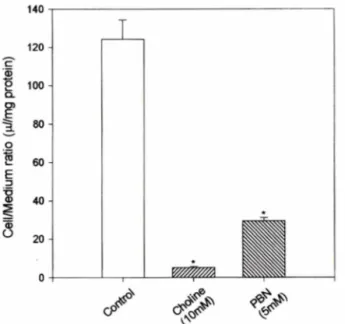
세포에 5m M PBN 또는 10 mM choline을처리한후 5분동안 의 [3H]choline의세포내 uptake는 control과비교하였을때두 그룹모두에서유의적으로감소하는것을알수있었다(Fig. 2).
또한 TR-BBB 세포에서 [3H]choline uptake에대한 choline과 PBN의 I : 은각각 9.4 |aM과 1.2 mM이었다(Fig. 3). 이전의연 구에서 brain uptake index(BUI)법으로 실험하였을 때 choline 수송계를통해 뇌로수송되는 약물로알려진 eperisone은 IC ^ 값이 1.45 mM로 [3H]choline의뇌투과를 저해한다고보고하였 는데, 이는 PBN의 ICsq 값과유사한수치이다.9) 또한 TR-BBB 세포에서 choline은 IC50 값이 9.4 _ 로 [3H]choline의세포내
uptake를농도의존적으로 저해하였다. 이러한결과는 흰쥐 뇌
J. Pharm. Soc. Korea
Nitrone 계 항^화제 (PBN) 의 뇌에서 혈액■으로의 배출과 뇌 수송 특성 227
c / < 夕 會
Fig. 2 - Inhibitory effect of several compounds on [3H]choline uptake in TR-BBB cells. The [3H]choline uptake was measured at 37°C for 5 min in TR-BBB cells. The uptake was per
formed in the absence (control) and presence of each com
pound. Each data point represents the mean±S.E.M. (n = 3—4). *p<0.0001, significantly different from control.
Fig. 4 - HPLC chromatograms of PBN. Injectate (A), bram extract obtained at 2 min after microinjection by BEI method (B) of PBN. The peak of PBN was found at about 4.3 min.
PBN의 뇌에서 혈액으로의 배출
이미보고한연구에서 PBN의뇌투과고유상수는 경동맥투여
후 15초에서 약 240|i//min/g으로높은 값을나타내었지만,정맥 투여 후 120분에서는약 3M //m in/gi:나타내어 투여 초기의 뇌 투과고유상수에 비해약 80배정도낮은 값을나타내었다.7) 이
는 PBN이빠르게뇌로분포된후다시혈중으로배출되고 있는
가능성을 시사하는것이다. 그러므로 본연구에서는 PBN의뇌 에서 혈액으로의 배출을 BEI법을사용하여 검토하였다. B E I법 을 실시하여 얻은 PBN의대표적인 chromatogram을 Fig. 4에 나타내었다. A, B는각각실험에사용한 injectate의 peak, PBN
을 뇌의 Par2 영역에 주입한 후 2분에서 적출한 뇌에서 얻은
peak이다. 두 chromatogram 모두에서 H PLC에 적용한 투 약 4.3분에서 PBN의 peak# 얻을수있었다. HPLC chromatogram
의결과를 바탕으로 뇌에서의 PBN의표준 검량선을 작성한
결과 직선 상관 계수가 인회귀직선을 얻을 수 있었
고이직선을사용하며 적출한 뇌에서의 PBN의농도를 정량하
였다.
흰쥐의 뇌의 Par2 영역에 PBN을 microinjection한후, 시간이
증가함에 따라뇌에남하있는 PBN의양{100-BEI(% )}의변화
0 1 2 3 4
Log [Inhibitor] 0!M)
Fig. 3 - Dose-response relationship for the inhibition of [3H]choline uptake by unlabeled choline and PBN. Uptake of [3H]choline (11.63 nM) was measured in TR-BBB cells with a 5 min incubation in the presence of increasing concentrations of choline and PBN. Results are given as percent of control uptake measured in the absence of inhibitors. ◦ ,unlabeled choline; • , PBN.
모세혈관내피세포주(rat brain capillary endothelial cell line)인 REB4 세포에서 실험하였을때얻은 choline의 ICso인 12 |iM13) 과유사한값으로 TR-BBB에서의 choline의수송이 carrier에의
해서 수송되고있음이잘나타나고 있다. 이러한결과들은 PBN
이 BBB의특수수송계인 amine 수송계를 통해뇌내로수송될
가능성을 시사하고있지만,앞으로 PBN의수송과 choline 수송 계와의 저해특성 등에 대해서 약물측에서 더욱상세한연구가 진행되어야할것이다.
1
60
40 -
20 120
{%)
5 2d n
0UHOLPXJ
CO CO
r*s.
25지Dx>MT.
r n r Cs
cr- T'
寸
(a)
228 이나명 ■강명숙
상태의 뇌에서 PBN이 hydroxyl radical과 결합하여 3,4-dihydro- benzoate 등으로 변화된다는 보고도 있다.15) 그러므로 PBN의 뇌 배출 기전에 대해서는 방사성 동위원소와 대사체 등을 사용하여 앞으로 더 상세한 연구가 수행되어야 할 것이다.
또한 PBN의 뇌에서 혈액으로의 배출 수송계와 choline의 배 출 수송계와의 관계를 알아보기 위하며 in vitro 실험에서와 마 찬가지로 PBN을 대신하여 [3H]choline의 뇌 배출을 BEI법을 사 용하여 검토하였다. 본 연구실에서는 BBB를 통하여 choline의 뇌에서 혈액으로의 배출 수송계가 존재한다는 것을 실험으로 증 명하여 보고 중에 있으므로 본 논문에서는 [3H]choline의 뇌 배 출에 관한 상세한 특성은 나타내지 않았다. 실험 결과, PBN 및 choline, choline의 대사산물이면서 GABA 수송체의 저해제인
0 2 4 6 8 10
Minutes
Fig. 5 - Time-course of PBN in the ipsilateral cerebrum after intracerebral microinjection. PBN was injected into Par2 region of rat brain. Rats were decapitated at 2,5 and 10 min after microinjection. The slope of the line represents the elimination rate constant of a tracer amount of PBN, i.e.
0.32 min'1, obtained using non-linear least squares regres
sion analysis. PBN was eliminated from the brain with an apparent elimination half-life of 2.2 min. Each data point represents the mean±S.E.M. (n = 3).
를 Fig. 5에 나타내었다. 그 결과 대부분의 PBN이 투여 후 10분 이내에 뇌로부터 소실되었고, 그 때의 PBN의 값은 0.32/min, 반감기는 2.2분으로 매우 빠른 속도로 소실되는 것을 알 수 있 었다. 그러나 본 실험에서는 PBN의 steady-state에서의 뇌 분포 용적을 구하지 않았기 때문에 PBN의 뇌투과와 뇌 배출간의 정 확한 차이를 비교할 수는 없었다. 또한 이와 같은 PBN의 빠른 소실은 PBN이 뇌에서 혈액으로 배출될 뿐만 아니라 뇌에서 대 사됨을 통해 소실될 가능성도 배재할 수 없다. 여러 보고에서 PBN은 여러 종류의 radical과 빠르게 반응하여 안정한 화합물로 변화된다고 알려져 있는데,PBN이 간에서 hydroxyl radical과 결 합하여 주로 4-hydroxyPBN로 대사된다는 보고가 있고,14) 허혈
betaine을 [ H]choline과 동시에 뇌의 ftr2 영역으로 투여하였다.
그 결과 뇌에 남아있는 [3H]choline의 양{100-BEI(%)}은 control과 비교하였을 때 PBN, choline에서 각각 33%, 36% 증 가하여 p<0.05인 유의적인 중가를 나타내었는데, 이것은 [3H]choline의 뇌 배출이 PBN 둥에 의해 억제되고 있음을 나타 내고 있다(Table I). 이러한 결과는 PBN이 뇌에서 혈액으로 배 출될 때에도 choline 수송계를 경유할 가능성을 시사하는 것이 다. 그러나 betaine은 control과 유사한 100 - BEI(%)를 나타내어 [3H]choline의 뇌 배출을 억제시키지 못하였다. 이것은 choline의 배출 수송계와 betaine의 배출 수송계가 서로 관여하지 않으며, betaine이 혈중으로 배출될 때 choline 수송계를 경유하고 있지
않음을 나타내고 있는 것이다.
결 론
본 연구 결과,PBN은 TR-BBB 세포에서 구조 유사체인 choline의 수송을 유의적으로 저해하였으며 이와 같은 저해작용 은 농도 의존적인 특이적인 저해 현상을 나타내었다. 또한 BBB 를 통한 PBN의 뇌 배출은 뇌에서 혈액으로 아주 빠르게 배출되 었으며,PBN의 뇌 투과와 뇌 배출 수송은 choline 수송계에 인 식되어 수송될 가능성을 시사하였다.
Table I - Effect of several compounds on [3H]choline efflux from the rat brain Compound Concentration in the
injectate (mM)
Concentration in the
brain (mM) 100 - BEI(%) % of control
Control 0 0 62.5±5.3 100
+ Choline 50 1.7 84.7±l.l 136**
+ PBN 10 0.33 82.9±l.l 133*
+ Betaine 100 3.3 66.8±2.l 107
[ !H]Choline (80 nCi) and [14C]inulin (4 nCi) dissolved in 0.5 yd ECF buffer were injected into Par2 region of the brain in the presence of several compounds.
The brain concentration was estimated from the injectate concentration divided by the dilution factor, i.e., 30.3, which was reported previously.10)
Data, determined at 40 min after intracerebral microinjection, are mean±S.E.M. (n = 3).
*p<0.05, **p<0.01, significantly different from control.
1 00
10
( o/o
)
u j cq-ohc
c!BJq
9£c ᅳ gc l coE al 9 isu6 8J a) Q.
J. Pharm. Soc. Korea
Nitrone 계 항산화제 (PBN) 의 뇌에서 혈액으로의 배출과 뇌 수송 특성 229
감사의 말씀
저자들은본연구의 수행에 있어서 도움을준박지희와이경 은에게깊은감사를드립니다.
문 헌
1) Knecht, K. T. and Mason, R. R : /w vivo spin trapping of xenobiotic free radical metabolites. Arch. Biochem. Biophys.
303,185 (1993).
2) Marklund, N., Lewander, T, Clausen, F. and Hillered, L. : Effects of the nitrone radical scavengers PBN and S-PBN on in vivo trapping of reactive oxygen species after traumatic brain injury in rats. J. Cereb. Blood Flow Metab. 21,1259
(2001).
3) Endoh, H.,Kato,N., Fujii, S., Suzuki, Y.,Sato, S., Kayama, T., Kotake, Y. and Yoshmura, T. : Spin trapping agent, phenyl N- tert-butylnitrone, reduces nitric oxide production in the rat brain during experimental meningitis. Free Radic. Res. 35,583 (2001).
4) Floyd, R. A., Hensley, K.,Forster, M. J., Kelleher-Anderson, J.
A. and Wood, R L .: Nitrones as neuroprotectants and antiaging drugs. Ann. N. Y. Acad. Sci. 959,321 (2002).
5) Cheng, H. Y., Liu, T., Feuerstein, G. and Barone, F. C. : Distribution of spin-trapping compounds in rat blood and brain:
in vivo microdialysis determination. Free Radic. B iol Med. 14, 243 (1993).
6) Dehouck, M. R, Cecchelli, R., Richard-Green, A., Renftel, M.
and Lundquist, S. : In vitro blood-brain barrier permeability and cerebral endothelial cell uptake of the neuroprotective nitrone compound NXY-059 in normoxic, hypoxic and ischemic conditions. Brain Res. 955,229 (2002).
7) 이나영,강영숙 : 흰쥐에서 nitrone계항산화제인 a-phenyl-w-
辦-butyl nitrone(PBN)의뇌투과성 및 체내동태. 약학회지 46,124 (2002).
8) Lockman, R R. and Allen, D. D. : The transport of choline.
Durg Dev. Ind. Pharm. 28,749 (2002).
9) Kang, Y. S., Terasaki, T., Ohnishi, T. and Tsuji, A. : In vivo and in vitro evidence for a common carrier mediated transport of choline and basic drugs through the blood-brain barrier. J.
Pharmacobiodyn. 13,353 (1990).
10) Kakee, A., Terasaki, T. and Sugiyama, Y .: Brain efflux index as a novel method of analyzing efflux transport at the blood-brain barrier. J. Pharmacol. Exp. Ther. 277,1550 (1996).
11) Hosoya, K., Ohtsuki, S. and Terasaki, T. : Recent advances in the brain-to-blood efflux transport across the blood-brain barrier. Int. J. Pharm. 248, 15 (2002).
12) Hosoya, K. I., Takashima, T., Tetsuka, K., Nagura, T., Ohtsuki, S., Takanaga, H.,Ueda, M .,Yanai, N., Obinata, M. and Terasaki, T .: mRNA expression and transport characterization of conditionally immortalized rat brain capillary endothelial cell lines; a new in vitro BBB model for drug targeting. J. Drug Target. 8,357 (2000).
13) Friedrich, A., George, R. L., Bridges, C. C., Prasad, R D. and Ganapathy, V : Transport of choline and its relationship to the expression of the organic cation transporters in a rat brain microvessel endothelial cell line (RBE4). Biochim. Biophys.
Acta 1512, 299 (2001).
14) Reinke, L. A., Moore, D. R., Sang, H., Janzen, E. G. and Kotake, Y. : Aromatic hydroxylation in PBN spin trapping by hydroxyl radicals and cytochrome p-450. Free Radic.. Biol.
Med. 28, 345 (2002).
15) Gido, G., Cronberg, T. and Wieloch, T .: The effect of a-phenyl- tert-bwty\ nitrone (PBN) on free radical formation in transient focal ischaemia measured by microdialysis and 3’4-dihydroxy- benzoate formation. Acta Physiol Scand 168,277 (2000).
![Table I - Effect of several compounds on [3H]choline efflux from the rat brain Compound Concentration in the](https://thumb-ap.123doks.com/thumbv2/123dokinfo/5035660.310428/5.884.53.839.922.1029/table-effect-compounds-choline-efflux-brain-compound-concentration.webp)
