Vol. 18, No. 1 pp. 679-687, 2017
Financial Factors Influencing Corporate Cash Reserves of Firms in Chungcheong Province in the Korean Capital Markets
Hanjoon Kim
Division of Business Administration, Hoseo University
충청권 소재 제조업체들의 현금 유동성 수준에 대한 재무적 분석
김한준
호서대학교 사회과학대학 경영학부
Abstract This study examines financial factors affecting cash holdings of firms in the domestic capital markets.
Specifically, this study focuses on regional firms with headquarters in Chungcheong province, the Republic of Korea, which features little previous research concentrating on the firms in the particular region. Three primary hypotheses were empirically tested utilizing robust econometric models, including static panel data, Tobit regression, and logistic models.Results reveal only five explanatory variables, including DSO, LIQUID, LEVERAGE, PMARGIN, and SIZE, showed statistically significant effects on the level of cash holdings among the nine variables studied. In addition two IDVs, LEVERAGE and FOS, showed significant differentiated effects between firms with headquarters in North and South Chungcheong regions. With continued debate among interested parties on the optimal level of cash reserves, the study provides a new vision for the optimal cash reserves for firms with headquarters in Chungcheong Province, where unprecedented socio-economic factors are driven.
요 약 본 논문의 주제는 국내 자본시장에서 충청권에 본사가 위치한 기업들, 그 중, KOSDAQ 상장 회사들에 대한, 현금유 동성 수준에 대한 재무적 결정요인 분석에 대한 실증연구이다. 본 연구를 수행하게 된 주요 동기로는 국제금융위기 이후, 동 표본회사들을 활용한 국내,외 연구들이 현재까지 미약한 수준이라고 판단되며, 현재 충청권 지역이 행정의 중심지로서의 확대와 인구통계학적 견지에서 점증적으로 수도권 등으로 부터의 동 지역으로의 인구 증가도 예상이 될 수 있다는 점 등이 요인들이다. 이러한 가정 하에서, 동 지역 자본시장 기반의 지속적인 학술 연구가 더욱 필요한 시점이라고 판단된다. 본문에 서는 3가지의 가설들이 상대적 강건성을 보유한다고 판단되는 계량경제적 모형들 (즉, 정태적 패널자료모형, 토빗모형, 그리 고 로지스틱모형 등)을 이용하여 검정이 되었다. 정태적 패널자료모형을 적용한 첫 번째 가설검정 결과와 관련, 동 모형에 입력된 총 9개의 설명변수들 중, 5개의 번수들 (즉, 매출채권회수기간, 유동비율, 부채비울, 매출액순이익률, 그리고 매출액) 이 동 표본기업들의 현금유동성 수준에 통계적 유의성을 주는 변수들로 판명되었다. 추가적으로, 로지스틱모형을 활용한 가 설검정과 관련하여, 총 설명변수들 중, 오직 2개의 변수들 (즉, 부채비율과 외국인지분율)만이 충청권 내의 2개의 행정지역인 충청북도와 충청남도 (대전시, 세종특별자치시 포함)에 각각 본사를 둔 기업들의 현금유동성 수준에 통계적 차별성을 주는 유의 변수들로 판명되었다. 본 연구결과의 학문적 그리고 실무적 관점에서의 기여점과 관련하여, 본 연구에서 유의성있는 변수들로 판명된 재무적 결정요인들을 향후 활용하여, 기업의 이윤 극대화를 위한 ‘최적 현금유동성 수준’에 대한 점진적 접근 가능성에 대한 추가 분석도 가능할 것으로 판단된다.
Keywords: Chungcheong Province; Corporate Cash Reserves; Financial Determinants; Logistic Regression Model;
The Korean Capital Market;
This research was supported by the Academic Research Fund of Hoseo University in 2016. (#: 2016-0032)
*Corresponding Author: Hanjoon Kim(Hoseo University) Tel: +82-41-560-8369 email: [email protected] Received September 5, 2016
Accepted January 6, 2017
Revised (1st October 12, 2016, 2nd October 24, 2016) Published January 31, 2017
1. Introduction
Given the stagnant conditions of the global economy after the financial turmoil in the year, 2008, multinational and./or domestic corporations seems to take more conservative positions in corporate cash management. This phenomenon may, to some extent, arise from corporate strategy to prepare a sudden or abrupt shortage of cash reserves in the case of any plausible period of credit crunch. To exemplify, it was reported that the amount of aggregate cash savings held by the largest 500 Korean firms in the domestic capital market, drastically increased to the level of about KRW 158 trillion as the 3rd quarter of 2014, in comparison with the amounts of KRW 94.5 trillion at the end of the year, 2007.[1] The amounts of corporate cash savings retained by the publicly traded corporations belonging to the top 10 largest chaebols, continued to increase to around KRW 85.9 trillion as of the third quarter of 2015, whose amounts were accordingly higher by 34% point than those in the same quarter of 2014.[2] The following explications are the major motivations to perform the research.
First, the present study is an extension of the previous literature such as [3] and [4], which dealt with identifying financially prominent factors affecting the level of corporate cash holdings in the domestic capital markets. One of the primary differences of the study from those in the previous literature is to focus on investigating the sample firms based in Chungcheong province which is one of the regional areas constituting the Korean capital markets, in comparison with the latter studies testing for relatively large size firms belonging to the Korean chaebols. As described in [5], the socio-economic structures of the particular province are expected to be dynamically changed to affect external and/or internal corporate environments, which, may, in turn, be incorporated in the financial aspects of the firms operating their major businesses in the region. Therefore, it may be of concern to examine any significant financial determinants constituting a firm's
cash liquidity in the province, which seem to be useful to effectively exercise corporate strategies to control for the optimal level of cash reserves. Second, to date, very little researches have been conducted on the motivation of cash reserves for firms based in Chungcheong province, as described in [5], while there may be voluminous studies on the financial issue in the inter- or intra-country context. Therefore, by performing the present study, it is anticipated that the goal of a company in line with maximizing shareholders' wealth, may be closer achieved by controlling financially significant components for an optimal liquidity level.
Lastly, assuming any differences in findings between firms based in the province and the other provinces inclusive of the Seoul Metropolitan Area, the results obtained from the study may be financially utilized to establish any unique standards of the level of cash holdings at the central and/or local levels authorized to proceed related-policy implementations. As presented in [6] on the profitability of the firms headquartered in the region, the outcomes are also expected to be effectively used by the domestic financial institutions located in either the Chungcheong or the other domestic regional areas, when lending capital or replenishing working capital or short-term funds, which may, in turn, affect the level of cash holdings at corporate level.
2. Data and Hypotheses Postulated
2.1 Data Selection and Variables
As a procedure to perform an empirical study, the sample data were collected as follows in [Table 1]. As previously described, the study as an extension of the previous literature, utilized the same procedure as the one in [5] to finalize the sample data. Specially, the data encompass the 5-year period (from 2010 to 2014) comprehending the period after the global financial turmoil, by which any spillover effects caused by the unprecedented credit crunch may be mitigated or
reduced as also presented in [5] and [7].
Table 1. Data Selection Criteria
1. The sample firms were included in the New KisValue database in the Republic of Korea.
2. The firms should be headquartered in 'Chungcheong' province and they were listed on the 'Prime' or 'Venture' section of the KOSDAQ at the end of December 2014
3. All the data for each firm were available for at least 5 years (2010-2014) in the post-era of the global financial crisis 4. Financial and regulated industries were not included when
collecting a final sample.
Moreover, firms listed on the KOSDAQ bourse, were only included in the study, taking into account a majority of the manufacturing firms in the region are engaged in the I/T related industries with relatively short history, as described in [6]. The divisions for the 'Prime' and the 'Venture' sections were regulated by the Korea Exchange based upon financial status such as a firm's size and capitalization.[8]Concerning the variable selection for the dependent variable of the study, the level of corporate cash holdings of the firms based in Chungcheong province were proxied by the following variables, which had been utilized in some of the preceding literatures in the international and domestic context. In other words, the proxy as a dependent variable (DV) was defined as [(Casht + Cash Equivalentst + Marketable Securitiest) / Total Assetst].
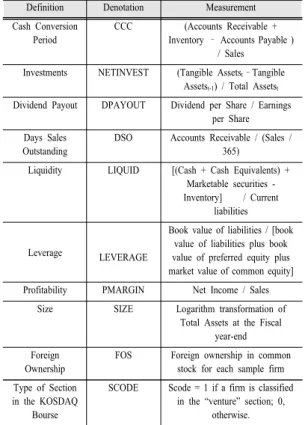
To specify, the dependent variable had also been employed in the previous literature such as in [3] and [9]. With respect to the independent variables (IDVs) accounting for the level of cash holdings as a financial factor, the study employed the following variables as reported in [Table 2]. As an extended study of the previous literature and to mitigate a possibility of measurement error and omitted variables in terms of econometric context, the IDVs which had showed their significant effects on corporate cash reserves in [11], were employed in the models. That is, nine variables had been found to be statistically prominent to explain the cash savings, which tends to be supported by academic theories and practices in the modern finance.
In the present study, in order to overcome or reduce
possible legitimate and redundant problems with which any empirical studies may face, these variables were utilized for consistency and commonality.
Table 2. Definition of Independent Variables Definition Denotation Measurement Cash Conversion
Period
CCC (Accounts Receivable + Inventory – Accounts Payable )
/ Sales Investments NETINVEST (Tangible Assetst–Tangible
Assetst-1) / Total Assetst
Dividend Payout DPAYOUT Dividend per Share / Earnings per Share Days Sales
Outstanding
DSO Accounts Receivable / (Sales / 365)
Liquidity LIQUID [(Cash + Cash Equivalents) + Marketable securities - Inventory] / Current
liabilities
Leverage LEVERAGE
Book value of liabilities / [book value of liabilities plus book value of preferred equity plus market value of common equity]
Profitability PMARGIN Net Income / Sales Size SIZE Logarithm transformation of
Total Assets at the Fiscal year-end Foreign
Ownership
FOS Foreign ownership in common stock for each sample firm Type of Section
in the KOSDAQ Bourse
SCODE Scode = 1 if a firm is classified in the “venture” section; 0,
otherwise.
As presented in [11], the former four financial IDVs (i.e., CCC, NETINVEST, DPAYOUT, and DSO) had been classfied as principle determinants of corporate cash holdings under the 'trade-off' theory, while the second group of the IDVs such as LEVERAGE, QUID and PMARGIN and the latter ones such as SIZE and FOS had been categorized as theoretical variables in association with Pecking order and agency cost theory of free cash flow, respectively.
2.2 Hypothesis Postulation and Estimations Three primary hypotheses were postulated and tested for financial characteristics of the corporate cash holdings for firms with headquarters in Chungcheong province. First, it was an intriguing question to identify
financial factors to determine the level of cash savings, which may be uniquely applied to the firms whose headquarters were based in the region. The following is a postulation for the fist hypothesis to test for the issue:
H0: The firms based in Chungcheong province may not possess any unique and statistically significant financial factors to influence on the level of cash savings during the post-era of the global financial turmoil (from 2010 to 2014).
To proceed econometric estimation techniques to test for the hypothesis, static panel data model was applied to detect the 'best' model among the fixed, random, and pooled OLS models. Moreover, Tobit regression model was also employed to check for robustness on the hypothesis test. Subsequent to the first hypothesis, the study further examined any discriminating components between the 'Prime' and the 'Venture' sections where the firms in the region were listed, in terms of corporate cash reserves. In the preceding researches such as [5] and [11], there had been analogous investigations to detect any financial differences between the two groups of the firms in terms of profitability, but, there were few studies to be conducted, in terms of the cash savings. The following is the second hypothesis to be empirically tested:
H0: Firms in Chungcheong province which are listed on the 'Venture' section of the KOSDAQ stock market, may not overall retain financially discriminating components in comparison with their counterparts on the 'Prime' section.
Finally, it may also be of interest that the firms belonging to one of the regions (that is, North Chungcheong may have a different financial profile in terms of the IDVs tested in the aforementioned hypotheses, in comparison with their counterparts located in the other region (South Chungcheong')
belonging to the same provincial area. So far, very little attention seems to be paid to this issue in the international and domestic researches of finance.
Consequently, it may be necessary to identify any differences between the two compared groups in terms of corporate cash reserves, given that there are ongoing dynamical changes of socio-economic structures in Chungcheong province and it may need to find out any financial aspects to be ameliorated or complemented towards a balanced development of the regional capital market in the whole province. The third hypothesis can be explicated as follows:
H0: There may not exist any differences between the major financial characteristics of firms based in North and South Chungcheong regions in terms of the level of cash holdings, during the post-era of the global financial turmoil.
For statistical estimations for the second and the third hypothesis tests, logistic regression models were utilized to investigate any statistically significant difference in each financial variable amongst the total nine IDVs which were tested in the first hypothesis.
Moreover, for robustness check, two separate logistic models with and without adopting time dummy variables, were implemented to test for the second hypothesis test.
3. Analysis and Discussion
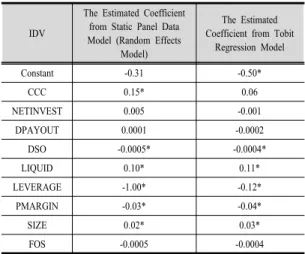
3.1 Analysis for Each Hypothesis Tested This section describes the outcomes obtained from each hypothesis test relevant to the subject of the study. First, the results from static panel data model accompanied by Tobit regression model are presented in [Table 3] for the first hypothesis test on the dependent variable of DV.
Table 3. Results of testing for DV with the explanatory variables (IDVs)
IDV
The Estimated Coefficient from Static Panel Data Model (Random Effects
Model)
The Estimated Coefficient from Tobit
Regression Model
Constant -0.31 -0.50*
CCC 0.15* 0.06
NETINVEST 0.005 -0.001
DPAYOUT 0.0001 -0.0002
DSO -0.0005* -0.0004*
LIQUID 0.10* 0.11*
LEVERAGE -1.00* -0.12*
PMARGIN -0.03* -0.04*
SIZE 0.02* 0.03*
FOS -0.0005 -0.0004
<Note 1> * indicated a statistical significance in t-value at the 5%
level.
Concerning the results of the hypothesis test, the
"best" model in the static panel data analylsis was selected as random effects one, amongst fixed effects, random effects, and pooled OLS models, which was selected the guideline by [12]. To specify a procedure to choose the "best" one, each relevant sub-test as F-static, Breusch-Pagon, and Hausman tests revealed their value of 8.50, 123.35,and 12.35, respectively, indicating that the last test of Hausman was accepted at the 5% statistical level. As reported in [Table3], only five explanatory variables such as DSO, LIQUID, LEVERAGE, PMARGIN, and SIZE, were statistically significant at the 5% level amongst the total nine variables across the two models as static panel data and Tobit regression ones, to determine the level of corporate cash holdings for the sample firms.
As for the analysis of the results on the 2nd hypothesis test to discriminate any prominent financial factors of the firms between being classified into the 'Prime' and the 'Venture' sections, two separate logistic analyses with and without time dummies, were conducted as reported in [Table 4]. (For reference, the results with time dummies are available upon request from the author.)
Table 4. Results of the Logistic Regression Analysis to Identify a Discriminating Factor for Firms Listed Between the "Prime" and the "Venture"
Sections of the KOSDAQ Stock Market
IDV Coefficient Chi-square
Constant 102.4 35.32*
CCC 9.55 12.67*
NETINVEST -0.21 0.02
DPAYOUT -0.005 0.12
DSO -0.006 0.41
LIQUID 0.62 1.11
LEVERAGE 1.02 0.37
PMARGIN -3.92 2.09
SIZE -4.10 34.43*
FOS -0.05 3.66
Goodness of Fit 172.83*
<Note 1> * : Significant at the 5% level with respect to the chi-square test
<Note 2> Coefficients were estimated by the method of maximum likelihood (ML). The test for overall goodness of fit was performed by the likelihood ratio(LR) test, while the Wald test was used to test for the significance of each individual coefficient.
With respect to the consequences obtained from the test, statistically pronounced factors distinguished between the two compared groups were found to be the independent variables as CCC and SIZE among the total variables adopted in the model. Meanwhile, the probability modeled was set "1" for firms classified into the "Venture" section (i.e., SCODE = "1") in the SAS (v.9.4) software. In other words, there may be a higher probability to be classified in the "Venture"
section if a firm in Chungcheong province becomes larger in the terms of CCC, while the probability to be categorized into the "Prime" section will be higher as a firm' size, SIZE, gets larger. As for a check for robustness, the logistic model with employing time dummy variables, showed the same results as those in [Table 4], indicating that only two IDVs such as CCC and SIZE were found to be statistically significant out of the nine total variables.
Finally, one of the untraversed financial aspects to detect financially significant differences or unique features between the firms based in North Chungcheong and South Chungcheong regions were
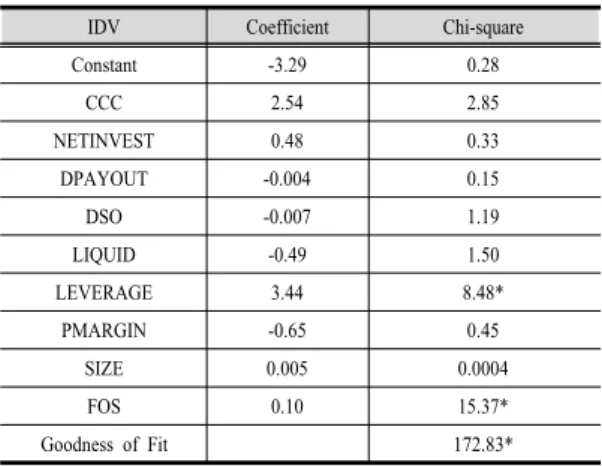
postulated and the results derived from a logistic regression model was presented in [Table 5].
Table 5. Results of the Logistic Regression Analysis to Discriminate Firms Headquartered in Between North and South Chungcheong Regions, which were listed on the KOSDAQ Stock Market
IDV Coefficient Chi-square
Constant -3.29 0.28
CCC 2.54 2.85
NETINVEST 0.48 0.33
DPAYOUT -0.004 0.15
DSO -0.007 1.19
LIQUID -0.49 1.50
LEVERAGE 3.44 8.48*
PMARGIN -0.65 0.45
SIZE 0.005 0.0004
FOS 0.10 15.37*
Goodness of Fit 172.83*
Regarding the last hypothesis test results, it was interesting to have identified that two IDVs such as LEVERAGE and FOS showed their significant power to discriminate between firms with headquarters in North and South Chungcheong regions. (The probability modeled was set as "1" for firms based in North Chungcheong in the logistic model.) In other words, higher leverage and larger proportion of foreign ownership may characterize a firm's financial aspects headquartered in North Chungcheong region, when compared to their counterparts in South Chungcheong district during the studied period.
3.2 Discussion
With respect to the analysis on the first hypothesis, the results shown in [Table 3] may explicate the following financial implications. First, as indicated in the results, a majority of the IDVs (out of the total nine ones) showed their pronounced effects on the level of the cash savings across the two separate models. For the financial interpretations on each significant IDV, it may as well be compared with those
found in the preceding researches inclusive of the studies of [3] and [10], which were the underlying researches of the present study as previously described.
DSO showed its negatively significant effect on the level of corporate cash holdings, which indicates that firms with headquarters in Chungcheong province may retain a lower cash liquidity, as DSO increases. This phenomenon can be supported by the conventional finance theory on cash management in association with a collection period of accounts receivable. Kim [4]
presented that the Korea chaebol firms whose cash level had not been changed on a relative basis since the occurrence of the global financial turmoil in 2008, seemed to maintain their cash reserves for a transactional motive. Consequently, in terms of the relationship between DSO and cash levels, firms in Chungcheong province controlled by the DSO on the liquidity level, seemed to increase their levels, not to be influenced by any transactional deficiencies on corporate cash holdings. However, it was also interesting to find the result of the positive linkage between the dependent variable and CCC consisting of the collection periods of accounts receivable, inventory, and accounts payable, as defined in [Table 2]. Based on the result, firms in the province seemed to have a payable policy with a relatively short period, which may have them maintain a higher level of cash reserves for a transactional purpose in association with a longer CCC period. Therefore, this phenomenon may suggest that the sample firms may, on average, reconsider existing accounts payable policies for extended or deferred periods, in order to approach optimal level of cash holdings to maximize their firm value.
Meanwhile, the estimated coefficient of LEVERAGE for the sample firms showed its negatively significant impact on the level of cash liquidity across the models as reported in [Table 3]. There may be two primary plausible interpretations on the negative relationship between the dependent and the IDV of LEVERAGE:
When borrowing from creditors, higher cost of debt, may deteriorate the level of cash savings for the firms
based in the province, given the relative limitations to access to credit in the domestic capital markets. In part, this phenomenon may be attributable to a small firm effect (in size) equipped with lower collateral value of tangible assets than their counterparts located in the other provincial area inclusive of those in Seoul Metropolitan area. Even if the sample data were finally selected among the firms listed in one of the officially regulated bourses (i.e., the KOSDAQ stock market), there seemed to still be a prevalent phenomenon spilled over from the global financial turmoil, which may have firms prefer debt financing over equity one, to mitigate any effect of informational asymmetry, as presented by [13]. Finally, a firm's size, SIZE, showed its positively significant effect on the level of corporate cash savings. The result obtained from the study was conflicting with those in the preceding studies. As presented In [3] and [14], a firm's size was found not to have its significant impact on the corporate level of cash reserves for the chaebol firms in the domestic capital markets. One the other hand, amongst the chaebol firms categorized by the group levels of cash liquidity, firms belonging to the lowest quantile showed a positively significant influence on the dependent variable, while their counterparts in the highest quantile had a negative importance, as presented in [4]. Lian et al. [15] presented that there was a positive relationship between size and the changes in cash reserves, which was applicable to the small firms in the Chinese capital markets, most of which were engaged in the stage of start-up or early business cycle with a higher possibility of cash scarcity. Kim [4] described that the chaebol firms with a lower category or level of cash savings may face with more limitations to fully access to credit in the domestic markets, resulting, in part, from their early stages of business or engagement in cyclical businesses. Based on the findings from the preceding researches on the relationship between a firm's size and corporate cash holdings, the statistically positive result obtained from the present study may supplement a
following implication in the financial aspect. That is, firms with headquarters in Chungcheong province, most of which are engaged in I/T related businesses classified into the cyclical industries, are still subject to financial constraints to access to credit markets, inducing a higher possession of cash reserves, as their firm size increases. In comparison with the other explanatory variables estimated to be statistically significant in the model, the explanatory variables such as NETINVEST, DPAYOUT, FOS, did not reveal their pronounced importance as a financial determinant of corporate cash reserves in a statistical context.
With respect to the second hypothesis test, only two factors showed their importance in terms of statistical context, as reported in [Table 4]. The official criteria to classify a firm into the two sections such as "Prime"
and "Venture" one in the KOSDAQ bourse, are regulated by the Korea Exchange. To specify, the requirements under the criteria include the size of equity, market capitalization, profitability, and sales.
[8] One of the significant variables which may financially discriminate firms between the two sections, was SIZE in terms of the sales amount, as in [Table 4].
The finding seemed to commensurate with the classification requirements of the Korea Exchange, which mandate a firm's sale amounts more than KRW 10billion to be listed in the "Prime"section, that is larger than that (i.e., KRW 5 billion) of the "Venture"
section. Moreover, the proxy variable, CCC, was the other factor characterizing a firm's cash conversion cycle to financially divide the sample firms into the two sections. In other words, the probability to be classified into the "Venture" section may be higher, if a firm in the Chungcheon province increases the period of the CCC. Based on the result, firms in the section may need to adjust the length of the CCC by changing working capital management policy in terms of the levels of accounts receivables and/or accounts payables. This policy can keep the levels of cash holdings lower, which may, in turn, maximize their firm values. Meanwhile, there was another important
suggestion for firms with headquarters as presented in [Table 4]. That is, the level of capital structure proxied by LEVERAGE, did not reveal any statistical difference between the sample firms listed in the two sections. In modern finance theory, a firm in the cyclical industry may well issue equity than debt for external financing, due to a higher volatility of cash flows [16], which may, in turn, suggest to maintain a lower capital structure for a firm in the "Venture"
section. Consequently, it may be worthwhile to keep current debt ratio lower for the firms in the section to avoid or reduce a possibility of bankruptcy risk.
Otherwise, they may overall need to possess a higher level of cash holdings for a precautionary motive, but, it may deteriorate a firm's value due to a deviation from an optimal cash level from the perspective of shareholders. As reported in [Table 5] for the third hypothesis test, there were only two financial factors (i.e., LEVERAGE and FOS) statistically discriminating the sample firms between the regions of North Chuncheong and South Chungcheong in terms of corporate cash holdings. In other words, firms with headquarters in the former region may, on average, have higher leverage ratios and foreign ownership that their counterparts based in the latter region. One of the implications in association with the higher capital structures of the firms in North Chungcheong region may suggest that they may not, on average, maintain an optimal capital structure, given the statistically insignificant difference of PMARGIN (as profitability), between the firms located in the two separate regions as shown in [Table 5]. It may be plausible that higher borrowing costs due to a higher debt ratios can result in the firms in North Chungcheong region to maintain relatively excess level of cash holdings as a precautionary motive. One the other hand, the study also found that the probability to be classified into those in North Chungcheong region will be larger, if the proportion of foreign ownership (FOS) of a firm, increases. Kim [17] presented that higher degree of foreign ownership may improve or prevent from any
possible moral hazard which is likely to be linked to a firm's mismanagement detriment to the wealth of its shareholders. Accompanied by ongoing activities of the region to host foreign investments in the local business entities at the authority level, it may be possible for the firms to search for an optimal level of cash holdings to maximize their firm value.
4. Concluding Remarks
This study as an extension of the previous researches, investigated an academic subject of the level of corporate cash holdings, which is still one of the contemporary financial issues on debate between policy makers at the government and corporate levels in international and domestic perspectives. It is to identify any significant financial factors of corporate cash reserves focusing on the regional firms headquartered in Chungcheong Province in the domestic capital market. Three hypotheses are postulated to be empirically tested as follows: First, any pronounced financial factors are examined for firms headquartered in the province in the statistical context. Second, as an intra-bourse analysis, firms classified in the "Prime" section of the KOSDAQ market were compared to their counterparts in the
"Venture" one to identify any discriminating factors, followed by the last hypothesis in association with financial differences between firms in North and South Chungcheong regions. The results of the study eventually related to searching for an optimal level of corporate cash holdings for firms with headquarters in Chungcheong province, are expected to shed new light on the untraversed empirical subject of cash holdings, which may enhance or invite new external investment (FDI) derived from funds operated by foreign or domestic institutions. According to the modern finance theory, a firm's cost of capital (i.e, weighted average of capital) may be lowered in accordance with a variety of alternatives available for external financing. In other
words, the capital from foreign financial institutions or cash inflows through portfolio investment will decrease the cost of financing for firms headquartered in Chungcheong province, which may, in turn, help the firms expedite to maximize the stock prices with maintaining an optimal level of cash holdings.
References
[1] The Yonhapnews, Available at
http://www.yonhapnews.co.kr/dev/9601000000.html (accessed Feb.16, 2015)
[2] The Hankuk Kyungje, Available at
http://www.hankyung.com/news/ (accessed Feb. 9, 2016) [3] H. Kim, "Contemporary Financial Profile and Its
Implications on the Level of Corporate Cash Holdings for Korean Chaebol Firms", J. of the Korea Academia-Industrial Cooperation Society, vol. 16, no. 6, pp. 3870-3881, 2015.
DOI: http://dx.doi.org/10.5762/KAIS.2015.16.6.3870 [4] H. Kim, "Categorical Financial Analyses on the Level of
Corporate Cash Reserves for the Korean Chaebol Firms in the Post-Era of the Global Financial Crisis", J. of the Korea Contents Association, vol.16, no. 2, pp. 729-739, 2016.
DOI: http://dx.doi.org/10.5392/JKCA.2016.16.02.729 [5] H. Kim, "Financial Profile of The Growth Engine For
Corporations Headquartered in Chungcheong Province in the Republic of Korea", J. of International Trade &
Commerce, vol. 12, no. 1, pp. 21-33, 2016.
[6] H. Kim,, "A Review of the Financial Profile of Profitability for the KOSDAQ Listed Firms Headquartered in 'Chungcheong' Province in the Republic of Korea", J. of the Korea Academia-Industrial Cooperation Society, vol. 14, no. 11, pp. 5476-5487, 2013.
DOI: http://dx.doi.org/10.5762/KAIS.2013.14.11.5476 [7] H. Kim,, "Searching for Growth Engine: For the Firms
Belonging to the Chaebol in the Korean Capiral Markets", J. of the Korea Academia-Industrial Cooperation Society, vol. 15, no. 12, pp. 7134-7147, 2014.
DOI: http://dx.doi.org/10.5762/KAIS.2014.15.12.7134 [8] Korea Exchange, “Requirements for KODAQ Market
Listing”, Available at
http://listing.krx.co.kr/contents/LST/04/04020100/LST040 20100.jsp](accessed on December 23, 2015).
[9] B. Al-Najjar, “The Determinants of Corporate Cash Holdings: Evidence from Some Emerging Markets”, International Business Review, vol. 22, pp. 77-88, 2013.
DOI: http://dx.doi.org/10.1016/j.ibusrev.2012.02.004 [10] H. Kim,, "Principal Component Analysis on the Theory
of Corporate Cash Holdings for Korean Chaebol Firms", J. of the Korea Academia-Industrial Cooperation Society, Forthcoming, vol. 17, no. 4, 2016.
DOI: http://dx.doi.org/10.5762/KAIS.2016.17.4.255 [11] H. Kim, "Further Investigations on the Financial
Attributes of the Firms listed in the KOSDAQ Stock Market", International J. of Contents, vol. 9, no. 2, pp.
27-37, 2013.
DOI: http://dx.doi.org/10.5392/IJoC.2013.9.2.027 [12] H. Park, Practical Guides To Panel Data Analysis, 2011.
Available at
http://www.iuj.ac.jp/faculty (Accessed Aug. 15, 2013) [13] S. Myers and N. Majluf, "Corporate Financing and
Investment Decisions When Firms have information that Investor do not have", J. of Financial Economics, vol.
13, no. 2, pp. 187-221, 1984.
DOI: http://dx.doi.org/10.1016/0304-405X(84)90023-0 [14] H. Kim, "Further Investigations on the Financial
Characteristics of Cash Reserves for the Chaebol Firms in the Korean Capital Markets", J. of the Korea Contents Association, Vol,15, no. 7, pp. 436-448, 2015.
DOI: http://dx.doi.org/10.5392/JKCA.2015.15.10.436 [15] Y. Lian, M. Sepehri, and M. Foley, “Corporate Cash
Holdings and Financial Crisis: An Empirical Study of Chinese Companies”, Eurasian Business Review, vol. 1, no. 2, pp. 112-124, 2011.
[16] C. Kim, Enterprise Value Based Business Analysis, Seoul, Korea: Myoungkyung Co., 2008.
[17] H. Kim, "Determinants of Leverage for Manufacturing Firms Listed in the KOSDAQ Stock Market", J. of the Korea Academia-Industrial Cooperation Society, vol. 13, no. 5, pp. 2096-2109, 2012.
DOI: http://dx.doi.org/10.5762/KAIS.2012.13.5.2096
Hanjoon Kim [Regular member]
•Sept., 1987 : The George Washington Univ., MBA
•Jan., 1999 : Boston University DBA (Major: Finance)
•Mar. 2010 ~ Present : Hoseo Univ.
Dept. of Business Administration, Assistant Professor
<Research Interests>
Corporate Finance, M&A, Equity Valuation