INTRODUCTION
As the importance of the environment on all aspects of human life has increased, environmental health issues have become much more prominent in the 21st century (Jegatheesan & Shu, 2009). As the envi- ronment becomes more problematic and contaminated and the number of people suffering from diseases brought on by environmental influ- ences increases, the necessity of implementing nursing strategies for people with environment related health problems has also increased. In particular, there has been a rapid increase in the prevalence of allergic diseases that is associated with a decline in air quality and changes in weather patterns and the increase in Western style housing and eating habits in Korea (Son et al., 2007). In fact, the increase in allergies is tak-
ing place across the world (Baiardini et al., 2008). 20% of the world’s population has experienced some kind of allergy (World Health Orga- nization, 2002).
Allergies are the first self-reported health problems students experi- enced in school years (The American College Health Association, 2008).
Allergic diseases include allergic rhinitis, atopic dermatitis, asthma and allergic conjunctivitis etc, and among these, allergic rhinitis represents a global health problem affecting 10% to 20% of the population (Brozek et al., 2010). And it is especially prevalent among people in their twenties, according to a national nutritional and health survey in Korea (Ministry of Health and Welfare, 2009).
The health status of people in their twenties has a particular signifi- cance for our society as they begin to enter adult society, become the
Analysis of Allergy Symptoms and Quality of Life among University Students with Allergic Rhinitis
Mi Ryeong Song
1, Joon Soo Park
21Department of Nursing, Hoseo University, Asan; 2Department of Medicine, Soonchunhyang University, Asan, Korea
Purpose: The purpose of this study was to analyze the symptoms of allergic rhinitis among university students and assess their quali-
ty of life (QOL) in order to establish an effective program for university students with allergic rhinitis. Methods: The data were collect- ed in May, 2012 in a university school health center. The collected data were analyzed in terms of frequency, percentage and mean for the symptom types and QOL among 131 university students with allergic rhinitis. An independent t-test was conducted to determine differences in QOL according to general and disease related characteristics. Results: Symptoms were reported in the following order:
nasal obstruction, rhinorrhea, sneezing, and nasal itching respectively. The mean score of QOL of the participants was 2.24 (5 point).
Nasal symptoms such as rhinorrhea (M= 3.16) and nasal obstruction (M= 3.12) had the highest score and affected QOL badly in the item analysis. QOL differed according to the diagnosis of allergic rhinitis history, skin test reaction, some symptoms and allergens.
Conclusion: To establish an effective management program for increasing QOL among university students with allergic rhinitis,
symptom management methods for nasal obstruction and rhinorrhea should be included in the program.
Key Words: Rhinitis; Quality of life; Students; Allergens 국문주요어: 알레르기성 비염, 삶의 질, 학생, 알레르기원
Corresponding author: Mi Ryeong Song
Department of Nursing, Hoseo University, 20 Hoseo-ro 79beon-gil, Asan 336-795, Korea Tel: +82-41-540-9531 Fax: +82-41-540-9558 E-mail: [email protected]
* This research was supported by Basic Science Research Program through the National Research Foundation of Korea (NRF) funded by the Ministry of Education, Science and Technology (2012014240).
투고일: 2013년 9월 22일 심사의뢰일: 2013년 9월 26일 게재확정일: 2013년 11월 7일
This is an Open Access article distributed under the terms of the Creative Commons Attribution Non-Commercial License (http://creativecommons.org/licenses/by-nc/3.0) which permits unrestricted non-commercial use, distribution, and reproduction in any medium, provided the original work is properly cited.
major economic productive age group, and start to settle down and rear children. Furthermore, as the incidence of allergic rhinitis has increased, the burden of medical costs has also increased (Dalal, Stanford, Henry,
& Borah, 2008; Demoly, Allaert, & Lecasble, 2002) and this has put a tre- mendous strain on health care finances. Allergies are beginning to have a socio-economic impact on society through rising medical costs and the number of days lost at school and work.
Allergic rhinitis is a serious complaint that induces discomfort and seriously impacts the quality of life (QOL) of an individual. Sleep depri- vation and fatigue caused by the symptoms of allergic rhinitis, such as itching and obstruction of nose, leads to lethargy and impaired concen- tration (Song & Suh, 2010). This limits the ability of a person to fully en- gage in activities and can negatively affect the potential for personal achievement as well as negatively impacting on emotions and general personality. Furthermore, allergic rhinitis causes stress and financial hardship to the family of those suffering from this complaint. Finally, allergic rhinitis can adversely impact on a patient’s work, school perfor- mance, and QOL (Greiner, Hellings, Rotiroti, & Scadding, 2011;
Holmes & Scullion, 2012).
Accordingly, proper intervention programs to combat allergy rhinitis and alleviate the distress of sufferers are needed. Allergic rhinitis is diffi- cult to completely cure and self-care is needed to control symptoms. It is important to bring relief to those suffering from allergic symptoms (O’Connor et al., 2008). Allergic symptoms can be alleviated effectively via behavioral changes in daily life. Practical strategies to promote be- havioral changes should be needed for the effective management of al- lergies. According to a survey carried out on peoples’ awareness of the influence of the environment on health in Korea, most people recognize that behavioral practices in daily life are very important to prevent and manage environmental diseases (Ministry of Environment, 2008). This supports the need for a program to prevent and manage allergies that in- cludes strategies to modify behavioral practices in daily life.
As allergic rhinitis is believed to have many causal factors, so various factors should be considered when developing a program to prevent and manage allergic rhinitis. Allergic rhinitis has various symptoms, it has physical symptoms such as sneezing, rhinorrhea, nasal obstruction, na- sal itching and headaches (Demoly et al., 2001; Greiner et al., 2011), and also has psychosocial manifestations such as stress, sleep deprivation and dysfunction (Demoly, Jankowski, Chassany, Bessah, & Allaert, 2011;
Song & Suh, 2010; Thompson, Juniper, & Meltzer, 2000). The factors
that induce this allergy and the methods for alleviating it differ from pa- tient to patient. Therefore, an approach based on an analysis of a patient’
s physical state and situation is desirable to devise a comprehensive pro- gram for the prevention and management of allergic symptoms through behavioral practices in daily life.
Allergies are related to individuals’ physical, chemical, psychosocial sta- tus and should be treated via a complete assessment and analysis of these factors. However, previous studies were chiefly conducted with a focus on the prevalence of allergies so there is a lack of information as to how to es- tablish an effective program for the patients with allergic rhinitis.
Finally, there is a need to analyze symptoms and assess allergic rhini- tis related QOL in order to understand allergic rhinitis properly and to establish an effective management program for university students with allergic rhinitis. The results of this study could serve to enhance QOL of university students with allergic rhinitis.
The purpose of this study was to identify symptoms and assess QOL among university students with allergic rhinitis. The specific goals of this study were as follows.
1) To analyze allergic rhinitis symptoms and the type of allergens.
2) To assess the QOL of university students with allergic rhinitis.
3) To analyze differences in QOL of university students with allergic rhinitis according to general and disease related characteristics.
METHODS
1. Study design
This study used an explorative cross-sectional design to analyze symptoms and assess QOL among university students with allergy rhi- nitis in Korea.
2. Setting and samples
The data were collected in May, 2012 in a university school health center. Students who expressed a willingness to participate in the re- search study were provided with a description of the purpose and meth- od of this study, and then they signed a consent agreement to participate.
A power analysis indicated explanatory powers of over 80% in a total sample size of 131 with the medium effect size (d= 0.5) at alpha=.05 (Fall, Erdfelder, Buchner, & Lang, 2009).
The inclusion criteria were as follows.
• Those who had allergic rhinitis symptoms.
• Those who were university students.
• Those who were in their twenties and had no medical diagnoses.
• Those who had no other chronic illness except allergic rhinitis.
• Those who took no allergy medication (Anti-Histamine).
3. Ethical considerations
This study was approved by the Institutional Review Board of H Uni- versity (No 20120004). The subjects participated in this study voluntarily after hearing an explanation about the purposes and the processes of the study. The subjects were informed that they had the right to refuse to participate, that they could stop participating at anytime during the study, that their confidentiality would be respected, and that they could expect some reward for participating in the study. The subjects then signed an agreement consenting to participate in the study. And then the study proceeded on the basis of the consent given and with the dig- nity of the participants respected at all times. For the safety of the stu- dents, a medical doctor was present at all the times and assessed the stu- dents during the process of skin prick test.
4. Measurements
1) General and disease related characteristics
The variables for general and disease related characteristics employed in this study included: Gender; Any history in the family of allergic dis- ease; Whether the sufferer had ever been diagnosed or treated for allergy rhinitis (Have you ever been diagnosed with allergic rhinitis?, Have you ever been treated for allergic rhinitis?); Symptom experiences (What type of symptom do you experienced?); Occurrence month (When do you have the allergy symptom?); Perceived reason for the occurrence (When do you perceive the allergy symptom occurring?), Management method (What do you do to manage your allergic symptoms?). Symp- tom experiences, occurrence month, perceived reason for the occur- rence and management method were permitted multiple choices.
2) QOL
Five point Likert-type scale for perennial allergic rhinitis patients de- veloped by Park et al. (2002) was used. This scale included a total of 28 items. The scale included 7 subcategories such as ‘practical problems in daily life’, ‘sleep disturbances’, ‘nasal symptoms’, ‘general symptoms’,
‘limitations on activities’, ‘emotional problems’, ‘ocular symptoms’, and each subcategory contained 3-6 items. The higher the score, the lower
the allergic rhinitis related QOL among patients with allergic rhinitis.
The Chronbach’s alpha was .91 in the study by Park et al. (2002). It was .89 in this study.
3) Skin prick test
This test is a kind of allergy skin test to detect allergens in patients re- porting allergic symptoms. The allergen solution is dripped onto the in- side of the lower arm and then gently pricked on to the skin surface with a lancet. 8 allergen solutions (D. Farinae, D. pteronyssinus, Cat hair, Dog hair, Cockroach, Ragweed, Mugwort, Dirch-Alder Mix: produced by Lofarma company in Italy) which are reported as common allergens of allergic rhinitis in Korean were used, and normal saline and a histamine were used as a control in this test. The response was evaluated by exam- ining the prick site for wheal and erythema after 15 minutes (Greiner et al., 2011). The response was evaluated as a positive reaction to each aller- gen when the wheal and erythema were the same or bigger than the his- tamine induced wheal and erythema (Son et al., 2007). Wheal is a hard and elevated mass that develops on the skin after an allergic reaction and erythema refers to the redness of the skin around the wheal. The diame- ter of the wheal was measured with a ruler. The longest diameter of the wheal area was measured in addition to the line running perpendicular to the longest diameter and these numbers were added together and di- vided by two. The wheal was considered more important than the ery- thema in the evaluation process. The wheal was given priority and was given more attention during the evaluation process. The skin prick test was done by a registered nurse who had more than 10 years experience working in a clinic dealing with allergies within a university hospital.
5. Data collection procedure
The process of the data collection was as follows.
• This study was announced by putting posters up around a university.
• Those who wanted to participate in the study visited the school health center.
• The purposes and the processes of the study were explained to the subjects who wanted to participate in this study.
• Subjects who wanted to participate answered the questionnaire (General and disease related characteristics).
• A medical doctor assessed the subjects to determine who was fit to take the skin prick test.
• The skin prick test was performed.
• Participating subjects answered the rest of the questionnaire (QOL of university students with allergic rhinitis).
• The wheal and erythema were measured and evaluated 15 minutes after the skin prick test.
6. Data analysis
The collected data were analyzed using SAS 9.3 version in terms of frequency, percentage and mean and order for the symptom type and QOL among university students with allergic rhinitis. An independent t-test was conducted to determine whether there were any differences in QOL according to general and disease related characteristics.
RESULTS
1. The symptoms and allergens of the participants
Of the total 131 participants, 26.7% were male and 73.3% were female.
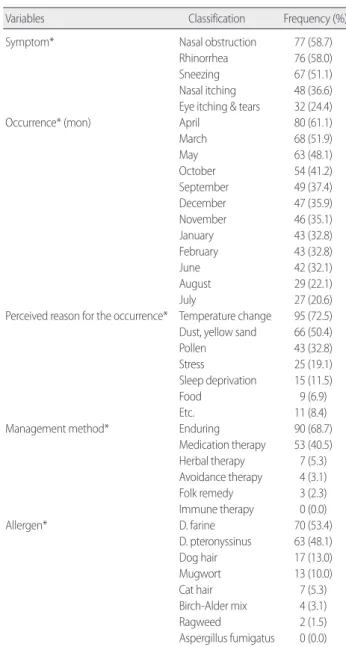
The chief symptoms were nasal obstruction and rhinorrhea and symp- toms mainly occurred in the spring season (March, April, May) and the fall season (September, October). The chief method by which the symp- toms were managed was simple endurance and temperature change was reported as the primary factor for the occurrence of symptoms. The mostly widely occurring antigen is D. Farinae (Positive rate 53.4%) and D. Pteronyssinus (48.1%) is also prevalent. These were followed by dog hair (13.0%), Cat hair (5.3%), Mugwort (10.0%), Birch-Alder (3.1%) and Ragweed (1.5%) (Table 1).
2. QOL of the participants
The mean score of QOL of the participants was 2.24 (5 point scale), which can be reconfigured as 44.7%. Nasal symptoms had the highest score and affected QOL badly. Rhinorrhea (M=3.16) and nasal obstruc- tion (M=3.12) among the nasal symptom had the highest score in the item analysis. Generalized symptoms then followed. Fatigue (M=2.61) and poor concentration (M=2.51) had the highest score among general symptoms. This means that general symptoms which occur due to aller- gic rhinitis can negatively impact QOL. And then, practical problems and sleep disturbances followed respectively. Emotional problems and activity limitation were relatively minor symptoms (Table 2).
3. QOL according to general and disease related characteristics
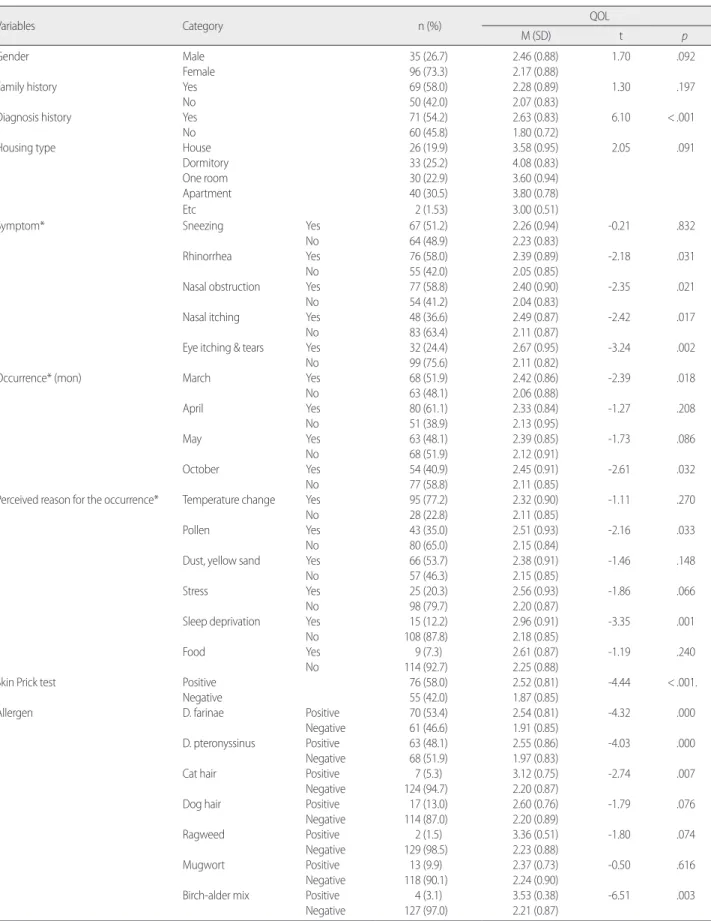
QOL of the participants differed according to history of allergy diag-
nosis (t= 6.10, p<.001). QOL also significantly differed according to the presence of rhinorrhea (t=-2.18, p=.031), nasal obstruction (t=-2.35, p=
.0.21), nasal itching (t=-2.42, p=.017) and eye itching (t=-3.24, p=.002) among the main symptoms. In the season or month, QOL was lower when the symptoms occurred in March (t= -2.40, p=.018) and October (t=-2.62, p=.032). There was a difference in QOL according to the pres- ence of pollen (t=-2.16, p=.033) and sleep deprivation (t=-3.35, p=.001) among the perceived causes of symptom occurrence. QOL of the partic- ipants differed according to allergen reaction (t=-4.44, p<.001). There were differences in QOL according to positive reaction to D. Farinae (t=
Table 1. The Symptoms and Type of Allergens among the Participants (N= 131)
Variables Classification Frequency (%)
Symptom* Nasal obstruction 77 (58.7)
Rhinorrhea 76 (58.0)
Sneezing 67 (51.1)
Nasal itching 48 (36.6) Eye itching & tears 32 (24.4)
Occurrence* (mon) April 80 (61.1)
March 68 (51.9)
May 63 (48.1)
October 54 (41.2)
September 49 (37.4)
December 47 (35.9)
November 46 (35.1)
January 43 (32.8)
February 43 (32.8)
June 42 (32.1)
August 29 (22.1)
July 27 (20.6)
Perceived reason for the occurrence* Temperature change 95 (72.5) Dust, yellow sand 66 (50.4)
Pollen 43 (32.8)
Stress 25 (19.1)
Sleep deprivation 15 (11.5)
Food 9 (6.9)
Etc. 11 (8.4)
Management method* Enduring 90 (68.7)
Medication therapy 53 (40.5)
Herbal therapy 7 (5.3)
Avoidance therapy 4 (3.1)
Folk remedy 3 (2.3)
Immune therapy 0 (0.0)
Allergen* D. farine 70 (53.4)
D. pteronyssinus 63 (48.1)
Dog hair 17 (13.0)
Mugwort 13 (10.0)
Cat hair 7 (5.3)
Birch-Alder mix 4 (3.1)
Ragweed 2 (1.5)
Aspergillus fumigatus 0 (0.0)
*Multiple choice.
-4.32, p =.000), D. Pteronyssinus (t=-4.03, p =.000), Dog hair (t=-1.80,
p=.076), Cat hair (t=-2.73, p=.007) among the allergens (Table3).DISCUSSION
The key to diagnosis of allergic rhinitis is awareness of signs and symptoms (Skoner, 2001). The main symptoms of allergic rhinitis were nasal obstruction and rhinorrhea in our research finding and this con- curred with the study carried out by Szilasi et al. (2012). This result sug- gests management of nasal obstruction and rhinorrhea for the patients with allergic rhinitis is essential.
The main season in which allergic symptoms most frequently occurred was spring (March, April, May) and fall (September, October) in our study. This suggests that allergic rhinitis occurs more on a seasonal basis among university students. Seasonal allergic rhinitis accounted for 52% of the incidences of allergic rhinitis in one study (Szilasi et al., 2012). Seasonal allergy might become more perennial in the future. Allergic rhinitis was identified as a main risk factor for asthma onset (Ciprandi & Passalacqua, 2008) and early intervention is required to prevent this outcome.
Temperature change was reported as the first perceived reason for the occurrence of allergic symptoms, and this indicates that temperature management especially during seasonal changes is important as the above result findings show that allergic symptoms are reported most fre- quently in spring and fall. Endurance was reported as the method of al- lergy management in our study, and this means that many students sim- ply endured despite suffering from severe symptoms; accordingly, they need to be educated or counseled with regarding their symptom manage- ment methods. Also, There is need to identify the reason why they have chosen simply to endure. The next most popular method of management was the use of medication in our research finding. However, it has been recorded in one study that medication is only helpful in relieving the symptoms temporarily, not at dealing with the root cause and allergen avoidance is more highly recommended (Hayden & Womack, 2007).
The main allergen was house dust mite in our study. Positive reaction to house dust mite was over 50% in our participants but previous re- search findings reported that 24.3% (Kong, 2009) 32.9% (Aburuz, Bula- tova, & Tawalbeh, 2011) had a positive reaction. So, we can postulate that the number of people who are becoming sensitive to house dust mite is increasing gradually.
The QOL score among the participants in our study was 2.24 (5 point), or about 44.7%, and is similar to a previous study that included female college students in which the QOL was reported as 44.9% (Kim, 2009). Managing patients with allergic rhinitis can be a very satisfying part of nursing practice, as it often makes a significant difference to an individual’s QOL (Tickle & Sewell, 2007). The worst factor affecting QOL was nasal symptoms and the recorded figure was about 61.4%, in- dicating that many participants suffer because of nasal symptoms. Pre- vious research also reported that over 85% of young adult patients were affected by rhinorrhea, nasal obstruction, nasal itchiness, and sneezing (Demoly et al., 2002). So, when a program for university students with allergic rhinitis is developed, methods of prevention and management
Table 2. Quality of Life of the ParticipantsCategory Item M (SD) Item
order Category
order Practical problems Need to carry a
handkerchief
2.13 (1.20) 17 Need to rub to the nose 2.45 (1.28) 9 Need to blow the nose
repeatedly
2.33 (1.33) 11
Sub-total 2.30 (1.13) 3
Sleep disturbances Lack of good night’s sleep 2.28 (1.19) 13 Difficulty getting to sleep 2.12 (1.16) 18 Waking up during night 2.05 (1.15) 20
Sub-total 2.15 (1.08) 4
Nasal symptoms Nasal obstruction 3.12 (1.32) 2
Rhinorrhea 3.16 (1.33) 1
Sneezing 3.06 (1.32) 3
Pruritus of palate 2.98 (1.38) 4
Sub-total 3.08 (1.14) 1
Generalized symptoms
Fatigue 2.61 (1.30) 5
Thirst 2.28 (1.17) 14
Reduced productivity 2.30 (1.32) 12
Irritability 2.05 (1.21) 19
Poor concentration 2.51 (1.36) 6
Headache 2.25 (1.19) 15
Sub-total 2.33 (1.09) 2
Activity limitations Outside activity 1.75 (1.07) 23 Social activity 1.60 (0.90) 28 Heavy daily activity 1.72 (1.03) 24 Light daily activity 1.66 (1.01) 25
Sub-total 1.68 (0.90) 7
Emotional problems Frustration 1.60 (0.96) 27
Anxiety 1.60 (0.95) 26
Anger 2.43 (1.37) 10
Embarrassment 2.49 (1.34) 8
Sub-total 2.03 (0.97) 6
Ocular symptoms Eye itching 2.50 (1.44) 7
Sore eyes 1.95 (1.20) 21
Epiphora 2.17 (1.29) 16
Swollen eyes 1.87 (1.15) 22
Sub-total 2.12 (1.10) 5
Table 3. Differences in Quality of Life according to General and Disease Related Characteristics
Variables Category n (%) QOL
M (SD) t p
Gender Male 35 (26.7) 2.46 (0.88) 1.70 .092
Female 96 (73.3) 2.17 (0.88)
Family history Yes 69 (58.0) 2.28 (0.89) 1.30 .197
No 50 (42.0) 2.07 (0.83)
Diagnosis history Yes 71 (54.2) 2.63 (0.83) 6.10 < .001
No 60 (45.8) 1.80 (0.72)
Housing type House 26 (19.9) 3.58 (0.95) 2.05 .091
Dormitory 33 (25.2) 4.08 (0.83)
One room 30 (22.9) 3.60 (0.94)
Apartment 40 (30.5) 3.80 (0.78)
Etc 2 (1.53) 3.00 (0.51)
Symptom* Sneezing Yes 67 (51.2) 2.26 (0.94) -0.21 .832
No 64 (48.9) 2.23 (0.83)
Rhinorrhea Yes 76 (58.0) 2.39 (0.89) -2.18 .031
No 55 (42.0) 2.05 (0.85)
Nasal obstruction Yes 77 (58.8) 2.40 (0.90) -2.35 .021
No 54 (41.2) 2.04 (0.83)
Nasal itching Yes 48 (36.6) 2.49 (0.87) -2.42 .017
No 83 (63.4) 2.11 (0.87)
Eye itching & tears Yes 32 (24.4) 2.67 (0.95) -3.24 .002
No 99 (75.6) 2.11 (0.82)
Occurrence* (mon) March Yes 68 (51.9) 2.42 (0.86) -2.39 .018
No 63 (48.1) 2.06 (0.88)
April Yes 80 (61.1) 2.33 (0.84) -1.27 .208
No 51 (38.9) 2.13 (0.95)
May Yes 63 (48.1) 2.39 (0.85) -1.73 .086
No 68 (51.9) 2.12 (0.91)
October Yes 54 (40.9) 2.45 (0.91) -2.61 .032
No 77 (58.8) 2.11 (0.85)
Perceived reason for the occurrence* Temperature change Yes 95 (77.2) 2.32 (0.90) -1.11 .270
No 28 (22.8) 2.11 (0.85)
Pollen Yes 43 (35.0) 2.51 (0.93) -2.16 .033
No 80 (65.0) 2.15 (0.84)
Dust, yellow sand Yes 66 (53.7) 2.38 (0.91) -1.46 .148
No 57 (46.3) 2.15 (0.85)
Stress Yes 25 (20.3) 2.56 (0.93) -1.86 .066
No 98 (79.7) 2.20 (0.87)
Sleep deprivation Yes 15 (12.2) 2.96 (0.91) -3.35 .001
No 108 (87.8) 2.18 (0.85)
Food Yes 9 (7.3) 2.61 (0.87) -1.19 .240
No 114 (92.7) 2.25 (0.88)
Skin Prick test Positive 76 (58.0) 2.52 (0.81) -4.44 < .001.
Negative 55 (42.0) 1.87 (0.85)
Allergen D. farinae Positive 70 (53.4) 2.54 (0.81) -4.32 .000
Negative 61 (46.6) 1.91 (0.85)
D. pteronyssinus Positive 63 (48.1) 2.55 (0.86) -4.03 .000
Negative 68 (51.9) 1.97 (0.83)
Cat hair Positive 7 (5.3) 3.12 (0.75) -2.74 .007
Negative 124 (94.7) 2.20 (0.87)
Dog hair Positive 17 (13.0) 2.60 (0.76) -1.79 .076
Negative 114 (87.0) 2.20 (0.89)
Ragweed Positive 2 (1.5) 3.36 (0.51) -1.80 .074
Negative 129 (98.5) 2.23 (0.88)
Mugwort Positive 13 (9.9) 2.37 (0.73) -0.50 .616
Negative 118 (90.1) 2.24 (0.90)
Birch-alder mix Positive 4 (3.1) 3.53 (0.38) -6.51 .003
Negative 127 (97.0) 2.21 (0.87)
*Multiple choice.
for nasal symptoms, especially nasal obstruction and rhinorrhea should be included.
Fatigue among the generalized symptoms was also a main factor for lower QOL. So, fatigue also needs to be managed. Song & Suh (2010) re- ported that the use of aromatic oil can relieve the fatigue of patients with allergic rhinitis. Poor concentration also should be managed because it can negatively impact school work and productive learning. But, man- agement of nasal symptoms is important above all because fatigue and poor concentration are closely associated with nasal symptoms (Meltzer, Gross, Katial, & Storms, 2012).
In this study, there were differences in quality of life with some vari- ables such as symptoms (presence or absence of rhinorrhea, nasal ob- struction and nasal or eye itching), occurrence month (March and Oc- tober), perceived reason (pollen and sleep deprivation), skin test (mite and cat hair and birch-alder mix positive).
Among nasal symptoms, there were differences affecting QOL ac- cording to whether such symptoms as rhinorrhea, nasal obstruction, na- sal itching and eye-itching and eye watering were present or not. But no such difference affecting QOL was recorded with regard to whether the symptom of sneezing was present or not, which probably indicates that sneezing temporarily alleviates the impulse to itch and helps eliminate materials within the oral cavity and brings some comfort to the patient.
There were differences affecting QOL according to the season (March and October), and this probably is related to the rapid temperature change or increase in pollens in the spring and fall seasons. In our re- search findings, among the perceived causes of symptom occurrence, temperature change did not seem to affect QOL but the presence of pol- lens did. However, the number of participants who had a positive reac- tion to pollens (Ragweed, Mugwort and Birch-alder mix) was small, so further study with regard to temperature change and pollens is needed if we are to learn why QOL is related to the seasons.
Sleep deprivation also had an impact on QOL. It is thought that sleep deprivation impairs the immune system and allergic rhinitis is associat- ed with impaired immune response. In fact, as populations around the world age, greater interest in immunologic responses during the aging process is developing and greater interest in allergic rhinitis is also be- ginning to develop (Ventura et al., 2012). In the future, sleep is needs to be managed for the patients with allergic rhinitis and further study with regard to immunity is also needed.
Additionally, the participants who had a positive reaction to the skin
prick test had lower QOL. There were big differences in QOL according to whether house dust mite sensitivity was present or not. As positive al- lergy skin tests are significant risk factors for development of new symp- toms (Skoner, 2001) and the occurrence of allergic symptoms may be more serious when one has a positive reaction to some allergen, allergens should be detected and treated. Allergen avoidance is essential (Hayden
& Womack, 2007), so a program for university students with allergic rhinitis needs to include methods for treating and avoiding house dust mites as a major allergen that produces allergic reactions.
CONCLUSION
As the number of people suffering from allergic rhinitis brought on by environmental influences increases, the necessity of implementing nursing strategies for people with allergic rhinitis has also increased.
This research was aimed at providing data which would be helpful in developing a program for students with allergic rhinitis. Nasal obstruc- tion and rhinorrhea occurred most frequently among the nasal symp- toms and the most popular allergens were dust ticks and the seasons in which allergic symptoms most commonly occurred were spring and fall. QOL differed according to nasal obstruction and rhinorrhea and dust ticks and the season. A program initiated in the spring and fall that includes management methods for nasal symptom such as nasal ob- struction and rhinorrhea and preventing or managing house dust mites could increase the allergic rhinitis related QOL of university students.
Developing a program for university students that focuses on allergic rhinitis has significance for our society because the incidence of allergic rhinitis among this group has increased and the health status of people in their twenties is important for the economic productivity of our soci- ety. Further study to develop a management program for university stu- dents with allergic rhinitis and to test its’ effects is recommended.
REFERENCES
Aburuz, S., Bulatova, N., & Tawalbeh, M. (2011). Skin prick test reactivity to aeroal- lergens in Jordanian allergic rhinitis patients. Eastern Mediterranean Health Jour- nal, 17, 604-610.
Baiardini, I., Braido, F., Tarantini, F., Porcu, A., Bonini, S., Bousquet, P. J., et al.
(2008). ARIA-suggested drugs for allergic rhinitis: What impact on quality of life? A GA2LEN review. Allergy, 63, 660-669.
Brozek, J. L., Bousquet, J., Baena-Cagnani, C. E., Bonini, S., Canonica, G. W., Casale, T. B., et al. (2010). Allergic rhinitis and its impact on asthma (ARIA) guidelines:
2010 Revision. Journal of Allergy and Clinical Immunology, 126, 466-476. http://
dx.doi.org/10.1016/j.jaci.2010.06.047
Ciprandi, G., & Passalacqua, G. (2008). Allergy and the nose. Clinical and Experi- mental Immunology, 153(Suppl.1), 22-26. http://dx.doi.org/10.1111/j.1365- 2249.2008.03717.x
Dalal, A. A., Stanford, R., Henry, H., & Borah, B. (2008). Economic burden of rhi- nitis in managed care: A retrospective claims data analysis. Annals of Allergy, Asthma & Immunology, 101, 23-29. http://dx.doi.org/10.1016/S1081-1206(10) 60830-7
Demoly, P., Allaert, F. A., & Lecasble, M. (2001). ERASM, a pharmacoepidemio- logic survey on management of intermittent allergic rhinitis in every day general medical practice in France. Allergy, 57, 546-554.
Demoly, P., Jankowski, R., Chassany, O., Bessah, Y., & Allaert, F. A. (2011). Valida- tion of a self-questionnaire for assessing the control of allergic rhinitis. Clinical &
Experimental Allergy, 41, 860-868. http://dx.doi.org/10.1111/j.1365-2222.2011.
03734.x
Faul, F., Erdfelder, E., Buchner, A., & Lang, A. G. (2009). Statistical power analyses using G*Power 3.1: Tests for correlation and regression analyses. Behavior Re- search Methods, 41, 1149-1160.
Greiner, A. N., Hellings, P. W., Rotiroti, G., & Scadding, G, K. (2011). Allergic rhini- tis, Lancet, 378, 2112-2122. http://dx.doi.org/10.1016/S0140-6736(11)60130-X Hayden, M. L., & Womack, C. R. (2007). Caring for patients with allergic rhinitis.
Journal of American Academy of Nurse Practitioners, 19, 290-298.
Holmes, S., & Scullion, J. (2012). Allergic rhinitis: Assessment and treatment. Nurse Prescribing, 10, 222-228.
Jegatheesan, V., & Shu, L. (2009). Special issue on the challenges in environmental science and engineering, CESE-2009 14-17 July, 2009-Jupiters hotel, Townsville, Queensland, Australia. Desalination & Water Treatment, 11, 1-3. http://dx.doi.
org/10.5004/dwt.2009.834
Kim, A. Y. (2009). The Effects of mindfulness meditation on attention and quality of life in allergic rhinitis for female college students. Unpublished master’s thesis. Duck- sung Women’s University, Seoul, Korea.
Kong, S. K. (2009). Epidemiological characteristics of allergy rhinitis patients called at a medical practitioner’s office for otorhinolaryngology. Unpublished master’s thesis.
Chungnam National University, Daejeon, Korea.
Meltzer, E. O., Gross, G. N., Katial, R., & Storms, W. W. (2012). Allergic rhinitis sub- stantially impacts patient quality of life: Findings from the nasal allergy survey assessing limitations. Journal of Family Practice, 6(Suppl. 2), S5-S10.
Ministry of Environment. (2008). The first survey on environmental health awareness of Korean people. The Press Release of Ministry of Environment, 2008. Retrieved February 15, 2012, from http://www.kdi.re.kr/infor/ep_view.jsp?num=98824
Ministry of Health and Welfare. (2009). 2008 National health statistics-The 4th Na- tional Health and Nutritional Survey. Publication No, 11-1351159-000027-10.
Retrieved February 10, 2012, from http://knhanes.cdc.go.kr/knhanes/index.do O’Connor, J., Seeto, C., Saini, B., Bosnic-Anticevich, S., Krass, I., Armour, C., et al.
(2008). Healthcare professional versus patient goal setting in intermittent allergic rhinitis. Patient Education and Counseling, 70, 111-117. http://dx.doi.org/10.1016/
j.pec.2007.09.004
Park, K. H., Cho, J. S., Lee, K. H., Shin, S. Y., Moon, J. H., & Cha, C. I. (2002). Rhino- conjunctivitis quality of life questionnaire (RQLQ) as an evaluator of perennial allergic rhinitis patients -The first report-. Korean Journal of Otolaryngology- Head and Neck Surgery, 45, 254-262.
Schatz, M., Meltzer, E. O., Nathan, R., Derebery, M. J., Mintz, M., Stanford, R. H., et al., (2010). Psychometric validation of the rhinitis control assessment test: A brief patient-completed instrument for evaluating rhinitis symptom control. Annals of Allergy, Asthma & Immunology, 104, 118-124.
Skoner, D. P. (2001). Allergic rhinitis: Definition, epidemiology, pathophysiology, detection, and diagnosis. Journal of allergy and clinical immunology, 108(1 Sup- ple), S2-S8. http://dx.doi.org/10.1067/mai.2001.115569
Son, K. Y., Park, K. S., Hwang, H. H., Yun, B. S., Lee, S. J., Kim, M. A., et al. (2007).
Prevalence of allergic diseases among primary school children in Ilsan, Gyeong- gi and changes of symptoms after environmental control in 2005. Pediatric Aller- gy and Respiratory Disease, 17, 384-393.
Song, M. S., & Suh, Y. S. (2010). Effects of aromatherapy on blood pressure, pulse, fatigue, and sleep for patients with allergic rhinitis. Journal of Korean Society of Biological Nursing Science, 12, 16-23.
Szilasi, M., Galffy, G., Fonay, K., Mark, Z., Ronai, Z., Szalai, Z., et al. (2012). A survey of the burden of allergic rhinitis in Hungary from a specialist’s perspective. Multi- disciplinary Respiratory Medicine, 7, 49. http://dx.doi.org/10.1186/2049-6958-7-49 The American College Health Association. (2008). American college health associ- ation-national college health assessment spring 2007 reference group data report (Abridged). Journal of American College Health, 56, 469-479.
Thompson, A. K., Juniper, E., & Meltzer, E. O. (2000). Quality of life in patients with allergic rhinitis. Annals of Allergy, Asthma & Immunology, 85, 338-347.
Tickle, J., & Sewell, C. (2007). Managing allergic rhinitis. Practice Nurse, 33(8), 15-19.
Ventura, M. T., Gelardi, M., D’Amato, A., Buquicchio, R., Tummolo, R., Misciagna, G., et al. (2012). Clinical and cytologic characteristics of allergic rhinitis in elderly patients. Annals of Allergy, Asthma and Immunology, 108(3), 141-144. http://dx.
doi.org/10.1016/j.anai.2012.01.013
World Health Organization. (2002, January). Prevention of allergy and allergic asth- ma. Retrieved March 4, 2011, from http://www.worldallergy. org/professional/
who_paa2003.pdf/