서 론
혈압과 관련되어 저-나트륨 식이의 중요성은 서구에서 오랫동안 강조되어왔다. 미국 영양정책 및 촉진센터의 일일 나트륨 섭취 가이 드라인은 일반인에서 2,300 mg 이하이며, 심혈관계 질환 위험성이 증 가된 집단에서는 1,500 mg 이하이다.1) 미국 심장연합(American Heart Association)도 ‘이상적인 심혈관 건강’을 2020년까지 달성하고 자 하는 목표를 최근 제시하면서, 이를 위해 하루 1,500 mg 이하의 나
트륨 섭취를 제안하였다. 이러한 범세계적인 저-나트륨 식이 권장의 배후에는 이를 지지하는 수많은 연구들이 있었으며, 이들 중 가장 중 요한 것의 하나는 DASH (Dietary Approaches to Stop Hypertension) study이다.2) 412명(이 중 고혈압 환자는 41%)이 참가한 이 연구는 참가 자들을 무작위로 고-나트륨 식이(150 mmol/d), 중간-나트륨 식이(100 mmol/d), 또는 저-나트륨 식이(50 mmol/d)에 한 달간 배정하고, 이후 각 식이를 교차배치하였다. 연구결과 나트륨 섭취가 감소할수록 혈 압이 감소하였다.
Original Article
한국인에서 나트륨 섭취량과 인슐린저항성과의 상관관계:
제5기 국민건강영양조사자료 2010
노영민, 이계원, 정주혜, 염근상*
가톨릭대학교 의과대학 의정부성모병원 가정의학과
The Relationship between the Levels of Sodium Intake and Insulin Resistance in Korean Population:
Findings from the Fifth Korean National Health and Nutrition Examination Survey 2010
Yeong-Min Noh, Kye-Won Lee, Ju-Hye Chung, Keun-Sang Yum*
Department of Family Medicine, Uijeongbu St. Mary’s Hospital, The Catholic University of Korea College of Medicine, Uijeongbu, Korea
Ba ckground: In the Western countries, it has been considered that sodium restriction reduces cardiovascular events in normotensive, pre-hypertensive, or hypertensive individuals. But, according to recent studies, low sodium diets is associated with an increase in insulin resistance, and may adversely affect serum lipids, and neurohormonal pathways, leading to increases in the incidence of new cardiometabolic disease.
Me thods: The data of 3,835 individuals (1,617 men and 2,045 women) aged 19 years or older from the fifth Korea National Health and Nutrition Examination Survey in 2010 were used. The relationship between the levels of sodium intake and insulin resistance was analyzed using complex sample descriptive and logistic regression analyses, analysis of covariance.
Re sults: According to Korea National Health and Nutrition Examination Survey 2010 data, the amount of estimated daily sodium intake is 3.76 g and 3.47 g, respectively in men and women. In the model which was corrected for confounding variables, the more daily sodium intake, the more insulin resistance increased, and this trend is significant only in women group.
Co nclusion: Unlike the previous study such as that of Garg et al., in Korean population, in which even the lowest quartile of daily sodium intake was above 100 mmol/d, the lower sodium intake, the decreased insulin resistance intake over the entire range. Relatively low to moderate sodium diet is not associated with an increase in insulin resistance, that is not ‘J’ shape, but linear.
Keywords: Diet, Sodium-Restricted; Insulin Resistance; Korean National Health and Nutrition Examination Survey
http://www.kafm.or.kr/kjfp.2015.5.1.38pISSN 2233-9019 · eISSN 2233-9116 Korean J Fam Pract. 2015;5(1):38-42
KJFP
Korean Journal of Family PracticeReceived August 28, 2014, Accepted March 12, 2015 Corresponding author Keun-Sang Yum
Tel: +82-10-6326-3790, Fax: +82-31-848-3179 E-mail: [email protected]
Copyright © 2015 The Korean Academy of Family Medicine
This is an open-access article distributed under the terms of the Creative Commons At- tribution Non-Commercial License (http://creativecommons.org/licenses/by-nc/3.0) which permits unrestricted noncommercial use, distribution, and reproduction in any medium, provided the original work is properly cited.
노영민 외. 한국인의 염분 섭취와 인슐린 저항성과의 연관성 Korean Journal of Family Practice
KJFP
Original Article
Korean Journal of Family Practice 한편 평균 나트륨 섭취량이 서구에 비해서 월등히 높은 한국에서
는 이러한 저-나트륨 식이의 당위성에 대하여 아무도 의문 부호를 달 지 않고 받아들였다. 2010년 한국영양학회, 보건복지부, 식품의약품 안전청이 공동 발간한 한국인 영양섭취기준에 따르면 남녀 모두 19 세에서 49세까지는 하루 평균 1,500 mg, 50–64세까지는 1,400 mg의 나트륨 섭취를 권장하고 있다.3)
그러나 최근 DiNicolantonio 등4)의 리뷰논문에서 보듯이 이러한 맹신적인 저-나트륨 옹호 기류에 대한 우려의 목소리가 나오고 있다.
첫째로, 저-나트륨 식이를 뒷받침하는 주요 연구들에서 나트륨이 심 혈관 관련 결말에 미치는 효과가 혈압과 관련지어 우회적으로 설명 되었다는 점이다. 대리표지자의 감소가 반드시 관심 집단의 이환율 및 사망률의 감소로 이어지는 것은 아니기 때문에 대리표지자와는 독립적으로 이러한 경향성이 증명될 필요가 있다. 둘째로, 나트륨 섭 취 제한이 레닌-안지오텐신 체계를 활성화하고, 카테콜라민 분비의 증가시키며, 인슐린 민감도를 떨어뜨리고, 혈중지질지표를 악화시키 며, 심지어 사망률을 증가시키는 등의 부정적인 효과를 가져온다는 연구결과들이 최근 활발히 제시되고 있다.5-10)
Garg 등11)은 2011년 연구에서 152명의 건강한 피험자를 둘로 나누 어 각각 저염식(소변 나트륨 <20 mmol/d)과 고염식(소변 나트륨
>150 mmol/d)을 1주일간 먹게 한 다음 homeostasis model assessment of insulin resistance (HOMA-IR), 혈청 알도스테론, 24시간 소변 알도 스테론, 24시간 소변 노르에피네프린을 측정하였는데, 모든 항목에 서 통계적으로 유의하게 저염식군에서 더 수치가 높았다.
한편 Townsend 등12)도 2007년 정상혈당 클램프(euglycemic clamp) 를 이용한 실험을 통해 저염식이 인슐린저항성을 높임을 증명하였 는데, 건강한 정상혈압의 실험 지원자들을 둘로 나누어 각각 6일간 의 저염식(하루 나트륨 20 mmol 섭취)과 고염식(하루 나트륨 200 mmol)을 먹게 하고 일정 속도로 인슐린 정맥 주입 시 고염식군에서 통계적으로 더 높은 포도당 소모를 보여주었다.
이에 본 연구자는 나트륨 섭취량이 감소할수록 인슐린저항성이 증가하는 서구 인구집단에서의 경향성이 평균 나트륨 섭취량이 상 대적으로 월등히 높은 한국에서도 유효한지 확인하기 위하여 제5기 (2010–2012) 국가건강영양조사자료를 이용하여 일일 나트륨 섭취량 과 인슐린저항성 간의 관계를 분석하였다.13)
방 법
1. 연구대상
국민건강영양조사 제5기 1차년도(2010)에서 만 19세 이상의 성인 6,740명(남자 2,958명, 여자 3,782명)을 본 연구대상에 포함하였다. 이
조사는 동·읍·면, 주택유형, 연령대별 인구 구성비를 기준으로 층화 후 계통추출방법으로 조사구를 설정하여 최종 조사대상가구를 추 출하고 조사구당 20개의 최종 조사대상가구를 추출하여 전국 약 3,840가구, 만 1세 이상 가구원 전체를 조사대상으로 각각 해당년 1월 부터 12월까지 시행되었다. 이들 가운데 결측 인원 1,283명, 암 환자 65 명, 대사증후군 환자 1,557명의 자료는 제외하였고, 최종적으로 3,835 명(남자 1,617명, 여자 2,045명)의 자료가 통계분석에 사용되었다.
2. 나트륨 섭취량 측정
제5차 국민건강영양조사에서는 ‘식품섭취조사 설문지’를 이용하 여 개인별 24시간 회상조사를 실시하였고, 이를 토대로 일일 나트륨 섭취량을 예측하였다. 다른 한편 임의뇨 나트륨 배설량으로도 일일 나트륨 섭취량을 예측하였다. 이때 사용한 가정은 다음과 같다. (1) 일일 나트륨 섭취량은 일일 나트륨 소변 배설량과 같다. (2) 일일 소변 량은 1.2 L이다.14)
3. 인슐린저항성 관련 지표
12시간 이상 금식 후 공복 인슐린과 혈당의 비율인 HOMA-IR은 국민건강영양조사 자료의 공복혈당과 인슐린 수치를 이용하여 계 산하였다.
HOMA-IR=[fasting insulin (μIU/mL)× fasting glucose (mg/dL)]/405 인슐린 측정 시 사용한 기구는 1470 WIZARD gamma-Counter (PerkinElmer, Waltham, MA, USA)였고, 사용된 시약은 INS-IRMA (Biosource, Nivelles, Belgium)였다. 공복혈당 측정 시 사용한 기구는 Hitachi Automatic Analyzer 7600 (Hitachi, Tokyo, Japan)였고, 사용된 시약은 Pureauto S GLU (Sekisui, Tokyo, Japan)였다.
4. 통계분석
2010년 제5기 국민건강영양조사자료를 이용하여 19세 이상의 성 인을 나트륨 섭취량에 따라 4개의 quartile로 구분하였고, HOMA-IR 로 표현되는 각 하위 그룹의 인슐린저항성 평균값들이 통계적으로 의미 있는 경향성을 보이는지 확인해보았다. 인슐린저항성에 영향 을 미칠 수 있는 나이, body mass index (BMI), 성별, 흡연, 음주, 운동, 대사증후군 이환 여부 등은 통계적으로 보정하였다.
성별에 따라 복합표본설계분석을 이용한 기술적/빈도분석과 공 분산분석을 시행하였다. 기술적/빈도분석은 평균/백분율과 표준오 차로 결과를 제시하였다. 두 집단에서 참가자의 기준점 특성은 연속 변수에 대해서는 t-test, 범주변수에 대해서는 카이제곱검정을 사용 하여 비교하였다. 통계적 유의성 수준은 P-value<0.05로 정의하였고, 자료분석은 SAS ver. 9.2 (SAS Institute Inc., Cary, NC, USA) 통계프로
Yeong-Min No, et al. The Relationship between Sodium Intake Level and Insulin Resistance in Korean
Korean Journal of Family Practice
KJFP
그램을 사용하였다.
결 과
제5기 국민건강영양조사자료의 임의뇨 나트륨 배설량을 통하여 추정한 일일 나트륨 섭취량은 남자에서 평균 136 mmol (3.76 g), 여자 에서는 평균 126 mmol (3.47 g)이었다. 24시간 회상법을 통한 일일 나 트륨 섭취량 추정은 남녀에서 각각 6.3 g, 4,4 g으로 임의뇨 나트륨 배 설량을 통하여 추정한 수치보다 훨씬 높았다.
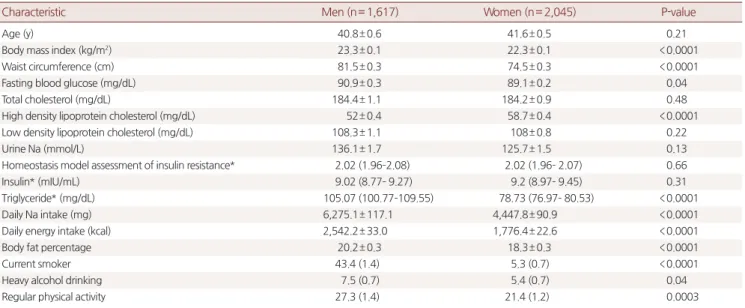
참가자의 기본 특성을 살펴보면(Table 1), BMI, 허리둘레, 공복혈당, 고밀도-콜레스테롤, 중성지방, 일일 나트륨 섭취량, 일일 에너지 섭취 량, 체지방률, 현재 흡연, 폭음, 규칙적 신체활동 등 총 11개 항목에서 남녀 간의 유의미한 차이를 보였고, 이 중 규칙적 신체활동을 제외한 모든 항목에서 남자에서 나쁜 결과를 보였다. 인슐린저항성은 남녀 모두 2.02로 차이가 없었다.
일일 나트륨 섭취량 추정값을 토대로 각각의 성별을 4개의 그룹으 로 나누었다(Table 2). 인슐린저항성에 영향을 미치는 인자로 알려져 있는 나이, BMI, 현재 흡연, 폭음경향, 규칙적 신체활동의 교란변수
에 대하여 통계적으로 보정한 모델에서(Table 3), 남녀 모두 일일 나트 륨 섭취가 증가할수록 인슐린저항성이 증가하는 경향을 보였으며, 이러한 경향성은 여자에서만 통계적으로 유의미하였다(P= 0.048).
고 찰
본 연구는 Garg 등11)의 연구에서 나타난 저염식이 인슐린저항성 을 증가시키는 경향성이 서구에 비해 평균 나트륨 섭취량이 월등히 높은 한국인에서는 어떻게 나타나는지를 알아보기 위한 것이었다.11) 우리의 연구는 저-나트륨 식이가 낮은 인슐린저항성과 연관성이 있 음을 보여준다. 이는 Garg 등11)의 연구결과와는 상반되는 것이다. 저- 나트륨 식이가 인슐린 민감도에 미치는 영향은 현재 정리되어 있지 않고 논란 중이다. 이전의 몇몇 연구들은 저염식으로 인해 인슐린저 항성이 증가한다고 보고하였고,12,15) 반면에 다른 연구들은 인슐린저 Table 1. Baseline characteristics of the participants
Characteristic Men (n= 1,617) Women (n= 2,045) P-value
Age (y) 40.8± 0.6 41.6± 0.5 0.21
Body mass index (kg/m2) 23.3± 0.1 22.3± 0.1 <0.0001
Waist circumference (cm) 81.5± 0.3 74.5± 0.3 <0.0001
Fasting blood glucose (mg/dL) 90.9± 0.3 89.1± 0.2 0.04
Total cholesterol (mg/dL) 184.4± 1.1 184.2± 0.9 0.48
High density lipoprotein cholesterol (mg/dL) 52± 0.4 58.7± 0.4 <0.0001
Low density lipoprotein cholesterol (mg/dL) 108.3± 1.1 108± 0.8 0.22
Urine Na (mmol/L) 136.1± 1.7 125.7± 1.5 0.13
Homeostasis model assessment of insulin resistance* 2.02 (1.96–2.08) 2.02 (1.96– 2.07) 0.66
Insulin* (mIU/mL) 9.02 (8.77– 9.27) 9.2 (8.97– 9.45) 0.31
Triglyceride* (mg/dL) 105.07 (100.77–109.55) 78.73 (76.97– 80.53) <0.0001
Daily Na intake (mg) 6,275.1± 117.1 4,447.8± 90.9 <0.0001
Daily energy intake (kcal) 2,542.2± 33.0 1,776.4± 22.6 <0.0001
Body fat percentage 20.2± 0.3 18.3± 0.3 <0.0001
Current smoker 43.4 (1.4) 5.3 (0.7) <0.0001
Heavy alcohol drinking 7.5 (0.7) 5.4 (0.7) 0.04
Regular physical activity 27.3 (1.4) 21.4 (1.2) 0.0003
Values are presented as the mean± SE or % (SE), unless otherwise stated.
SE, standard error.
*Geometric mean (95% confidence interval).
Table 2. Estimated daily Na intake quartiles
Variable Q1* Q2† Q3‡
Men (g) 2.65 3.62 4.69
Women (g) 2.37 3.39 4.42
*25th percentile. †50th percentile. ‡75th percentile.
Table 3. HOMA-IR in each daily Na intake quartile
Variable HOMA-IR
Men Women
Group 1 (lower fence–Q1) 1.962 (1.871–2.058) 2.08 (1.978–2.186) Group 2 (Q1–Q2) 1.994 (1.902–2.091) 2.022 (1.926–2.122) Group 3 (Q2–Q3) 2.115 (2.037–2.195) 2.073 (1.986–2.165) Group 4 (Q3–upper fence) 2.053 (1.968–2.141) 2.021 (1.933–2.113)
P for trend 0.60 0.048
Values are presented as the geometric mean (95% confidence interval).
HOMA-IR, homeostasis model assessment of insulin resistance.
노영민 외. 한국인의 염분 섭취와 인슐린 저항성과의 연관성 Korean Journal of Family Practice
KJFP
항성에 아무런 영향을 미치지 못하거나 심지어 감소시킨다고 주장
하였다.16-19) 이러한 불일치는 연구 집단의 차이에서 기인하거나 염분
제한의 수준 등이 달라서 일 수 있다. 한국 인구집단은 전반적으로 나트륨 섭취가 서구에 비해 높기 때문에 가장 낮은 사분위수 집단에 서조차 레닌-안지오텐신 시스템을 켜는 수준으로까지 나트륨 섭취 가 낮지 않기 때문에 최근 제기되고 있는 ‘J’형태의 인슐린저항성과 나트륨 섭취와의 관계가 본 연구에서는 관찰되지 않았을 수 있다. 또 한 본 연구에서 사용된 일일 나트륨 섭취 추정은 몇 가지 가정을 토 대로 얻어졌기 때문에 이것이 유효한지에 대한 검증 또한 필요하다.
본 연구는 단면적 연구이므로 관련성은 제시하더라도 인과관계 를 평가할 수 없는 제한점이 있다. 병원이 아닌 지역사회에서 참여한 연구대상자이긴 하나 검사자료에 영향을 주는 질병과 약물복용과 같은 교란변수들을 보정하지 못하였으므로 본 연구에서 관찰된 결 과에 이들 변수의 효과가 영향을 주었을 가능성이 있다. 아울러 연 구자료에 포함된 검사항목이 제한적이어서 aldosterone, epinephrine 등 더욱 다양한 지표에 대한 분석을 시행할 수 없는 제한점도 있다.
그렇지만 이런 제한점을 고려하더라도 본 연구는 한국 성인의 대표 성 있는 집단을 대상으로 하였으므로 본 연구결과를 한국 성인에게 일반화하는 것은 타당할 것으로 보인다.
요 약
연구배경:
서구에서 나트륨 제한은 정상인, 고혈압전단계, 고혈압 환 자에서 심혈관계 사고의 위험을 줄여준다고 생각되어왔다. 그러나 최근의 연구에 의하면 저-나트륨 식이는 인슐린저항성 증가와 관련 되어있고, 혈청 지질, 신경호르몬 경로에 악영향을 끼침으로써 새로 운 심장대사질환의 유병률을 높인다는 보고가 있다.방법:
제5차 2010년 국민건강영양조사에 참여한 19세 이상 성인 3,835명(남자 1,617명, 여자 2,045명)에서 나트륨 섭취 수준과 인슐린 저항성과의 관련성을 공변량분석, 복합표본추출 로지스틱회귀분석 으로 평가하였다.결과:
제5기 국민건강영양조사자료에 근거한 일일 나트륨 섭취량은 남자에서 평균 136 mmol (3.76 g), 여자에서는 평균 126 mmol (3.47 g) 이었다. 참가자의 기본 특성에서 body mass index (BMI), 공복혈당, 중 성지방, 일일 나트륨 섭취량, 일일 에너지 섭취량, 현재 흡연, 폭음, 규 칙적 신체활동 등 총 11개 항목에서 남녀 간의 유의미한 차이를 보였 고, 이 중 규칙적 신체활동을 제외한 모든 항목에서 남자에서 나쁜 결과를 보였다. 인슐린저항성은 남녀 모두 2.02로 차이가 없었다. 나 이, 성별, BMI 등의 교란변수에 대하여 통계적으로 보정한 모델에서 남녀 모두 일일 나트륨 섭취가 증가할수록 인슐린저항성이 증가하는 경향을 보였으며, 이러한 경향성은 여자에서만 통계적으로 유의 미하였다(P= 0.048).
결론:
한국인에서 남녀 모두 일일 나트륨 섭취가 증가할수록 인슐린 저항성이 증가하는 경향을 보였으며, 이는 여성 집단에서만 통계적 으로 의미가 있었다.중심단어:
저-나트륨 식이; 인슐린저항성; 국민건강영양조사REFERENCES
1. US Department of Agriculture, Center for Nutrition Policy and Promotion.
Dietary guidelines for Americans, 2010 [Internet]. Alexandria (VA): US De- partment of Agriculture, Center for Nutrition Policy and Promotion [cited 2012 Dec 18]. Available from: http://www.cnpp.usda.gov/Publications/Di- etaryGuidelines/2010/PolicyDoc/Chapter3.pdf.
2. Sacks FM, Svetkey LP, Vollmer WM, Appel LJ, Bray GA, Harsha D, et al. Ef- fects on blood pressure of reduced dietary sodium and the Dietary Ap- proaches to Stop Hypertension (DASH) diet. DASH-Sodium Collaborative Research Group. N Engl J Med 2001;344:3-10.
3. The Korean Nutrition Society. Dietary reference intakes for Koreans. Seoul:
The Korean Nutrition Society; 2010.
4. DiNicolantonio JJ, Niazi AK, Sadaf R, O’Keefe JH, Lucan SC, Lavie CJ. Dietary sodium restriction: take it with a grain of salt. Am J Med 2013;126:951-5.
5. Ekinci EI, Clarke S, Thomas MC, Moran JL, Cheong K, MacIsaac RJ, et al.
Dietary salt intake and mortality in patients with type 2 diabetes. Diabetes Care 2011;34:703-9.
6. Graudal NA, Hubeck-Graudal T, Jurgens G. Effects of low sodium diet versus high sodium diet on blood pressure, renin, aldosterone, catecholamines, cholesterol, and triglyceride. Cochrane Database Syst Rev 2011;(11):
CD004022.
7. O’Donnell MJ, Yusuf S, Mente A, Gao P, Mann JF, Teo K, et al. Urinary sodi- um and potassium excretion and risk of cardiovascular events. JAMA 2011;
306:2229-38.
8. Alderman MH, Cohen H, Madhavan S. Dietary sodium intake and mortali- ty: the National Health and Nutrition Examination Survey (NHANES I).
Lancet 1998;351:781-5.
9. Cohen HW, Hailpern SM, Fang J, Alderman MH. Sodium intake and mor- tality in the NHANES II follow-up study. Am J Med 2006;119:275.e7-14.
10. Cohen HW, Hailpern SM, Alderman MH. Sodium intake and mortality fol- low-up in the Third National Health and Nutrition Examination Survey (NHANES III). J Gen Intern Med 2008;23:1297-302.
11. Garg R, Williams GH, Hurwitz S, Brown NJ, Hopkins PN, Adler GK. Low- salt diet increases insulin resistance in healthy subjects. Metabolism 2011;60:965-8.
12. Townsend RR, Kapoor S, McFadden CB. Salt intake and insulin sensitivity in healthy human volunteers. Clin Sci (Lond) 2007;113:141-8.
13. Korea Centers for Disease Control and Prevention. The fifth Korea National Health and Nutrition Examination Survey (KNHANES V-3). Cheongju:
Korea Centers for Disease Control and Prevention; 2012.
14. Yang ES, Kim YS, Park CY, Song HJ, Kim JD. Concentration calibration of
Yeong-Min No, et al. The Relationship between Sodium Intake Level and Insulin Resistance in Korean
Korean Journal of Family Practice
KJFP
urine biomarkers for diagnosis improvement of ovarian cancer. Int J Bio-Sci Bio-Technol 2014;6:65-72.
15. Perry CG, Palmer T, Cleland SJ, Morton IJ, Salt IP, Petrie JR, et al. Decreased insulin sensitivity during dietary sodium restriction is not mediated by ef- fects of angiotensin II on insulin action. Clin Sci (Lond) 2003;105:187-94.
16. Donovan DS, Solomon CG, Seely EW, Williams GH, Simonson DC. Effect of sodium intake on insulin sensitivity. Am J Physiol 1993;264(5 Pt 1):E730-4.
17. Fliser D, Fode P, Arnold U, Nowicki M, Kohl B, Ritz E. The effect of dietary
salt on insulin sensitivity. Eur J Clin Invest 1995;25:39-43.
18. Grey A, Braatvedt G, Holdaway I. Moderate dietary salt restriction does not alter insulin resistance or serum lipids in normal men. Am J Hypertens 1996;9(4 Pt 1):317-22.
19. Lastra G, Dhuper S, Johnson MS, Sowers JR. Salt, aldosterone, and insulin re- sistance: impact on the cardiovascular system. Nat Rev Cardiol 2010;7:577- 84.