Ⅰ. 서 론
생활수준의 향상과 더불어 치과환자의 심미에 대 한 요구가 증가되고 있다. 이와 같은 심미에 대한 요 구와 복합레진의 발달에 힘입어 복합레진의 임상적 인 적용은 최근 치의학분야에서 지대한 관심의 대상 이 되고 있다. 특히 심미성, 접착성, 간편한 임상술식 의 장점을 가지고 있기 때문에 1962년 Ray Bowen이 Bis-GMA형태의 복합레진을 개발한 이래로 다양한 형태와 종류의 복합레진이 도재수복물과 함께 보철, 보존, 교정분야에서 광범위하게 사용되고 있다.
그러나 복합레진은 무기질 filler와 레진기질간의 경도차이로 인해 활택한 표면을 얻기 어렵다1). 활택 한 면은 만족스런 수복물을 얻기 위한 필수적인 요 건중의 하나로서 거친면은 음식물 잔사나 치태의 침 착을 야기하며, 치은염증, 치아 경조직의 이차우식을 초래하고 수복물의 색조 변화를 가져와 결과적으로 수복물이 실패하게 된다. 복합레진의 연마방법은 복 합레진의 개발과 연마기구, 연마방법의 향상에 따라 다소의 차이점을 나타내고 있다. 1970년대 Marcro- fill복합레진 시기에는 텅스텐 카바이드 바, 다이아몬 드 디스크, 씰리콘 카바이드 디스크, white stone, silicone rubber, white aluminum point 등6,8,9,13-18)
이 우수한 결과를 보인다고 보고되었다. 1978년 microfill복합레진이 개발된 이후에는 aluminum- oxide disc가 활택한 표면을 얻는 데 적절하다고 보고 한 연구들이 많았으며, hybrid 복합레진의 경우에서 도 aluminum-oxide disc로 연마한 면이 활택했으며
19-25), 연마기구뿐 아니라 연마재로서 polishing paste
의 효용성을 부각시킨 연구들도 있었다26,27).
통상적으로 복합레진의 표면조도에 관한 연구방법 으로는 profilometer를 이용하여 정량적으로 계측하
는 방법6,7,16,25,27)이 있고 주사 전자현미경을 이용하여
표면의 성상을 분석하는 방법1-4,8,9,11-13,19-21,33,35)이 이용 되어 왔다. 또한 위의 두 방법을 동시에 시행하여 정 량적인 면 뿐만 아니라, 정성적인 면에서도 비교 관 찰한 연구들6,7,10,14,15,17,18,22,32)
도 많이 시도되어 왔다.
본 연구에서는 표면조도기 Surfcoder SEF- 30D(Kosaka lab. Ltd)를 사용하여 연마시행에 따른 복합레진의 표면조도에 대해서 비교 연구하여 다음 과 같은 결과를 얻었기에 보고하는 바이다.
Ⅱ. 연구 재료 및 방법
복합레진은 Z100(3M Dental Products, U.S.A.) 를 사용하였으며 각 군당 시편을 5개씩 제작하였다.
시편 제작은 두께 4mm의 vinyl plate에 직경 4mm의 구멍을 형성하여 유리평면 위에 놓고 레진을 복합레 진 충전기구 (GC, japan)를 사용하여 충전하였으며, 충전후 광조사기(Visilux 2 ,3M Dental Products, U.S.A.)로 제조자의 지시에 따라서 광중합하였다.
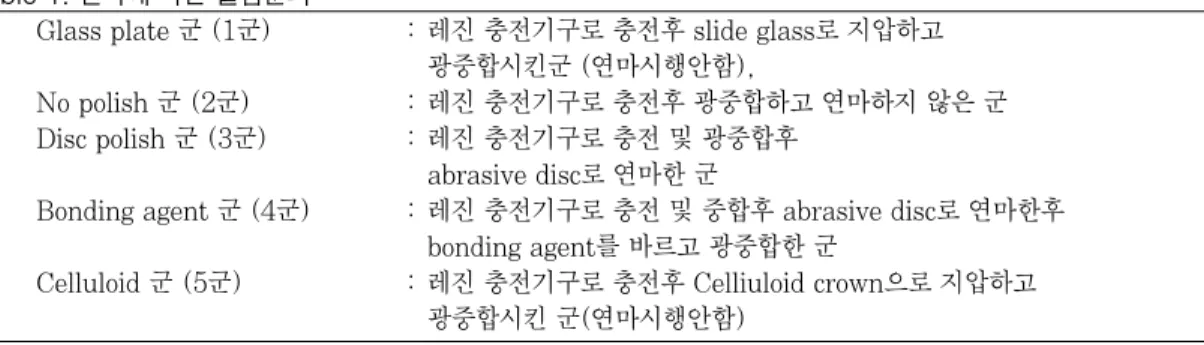
연마기구는 abrasive disc (3M Dental Products, U.S.A.)를 사용하였으며 Table 1 과 같은 군으로 구 분하여 시행하였다.
표면조도의 측정기계는 Surfcoder SEF-30D (Kosaka lab. Ltd)를 사용하였으며, 조도 측정시의 대한치과보철학회지:Vol. 38, No. 1, 2000
복합레진의 표면조도에 관한 연구
순천향대학교 의과대학 치과학교실 보철과 박 기 현
cut off파장은 0.08mm, 측정길이는 0.8mm로 하였 다. 측정 stylus의 속도는 0.05mm/s, 수평확대는 40 배 수직확대는 5,000배로 하였다. 측정은 Ra, Rt, Rmax, Rz 및 F-profile의 4가지 항목으로 각 시편당 2회씩 측정하였다. 이해를 위해 각 측정값의 개념은 다음과 같다.
1) 조도곡선(F profile, Fig. 1)
단면곡선(P profile)에서 표면의 곡면을 제거한 곡선으로 순수한 표면조도를 볼수 있다.
2) 평균조도 (Ra :㎛, Fig. 2)
F-profile에서 조도를 평균선에 적분한 수치.
즉 표면조도를 두께로 표현한 것 3) Rt (㎛, Fig. 3 )
F-profile에서 최대-최저값 4) Rmax (㎛, Fig. 4)
P-profile에서 최대-최저값 Table 1. 연마에 따른 실험군의
Glass plate 군 (1군) : 레진 충전기구로 충전후 slide glass로 지압하고 광중합시킨군 (연마시행안함),
No polish 군 (2군) : 레진 충전기구로 충전후 광중합하고 연마하지 않은 군 Disc polish 군 (3군) : 레진 충전기구로 충전 및 광중합후
abrasive disc로 연마한 군
Bonding agent 군 (4군) : 레진 충전기구로 충전 및 중합후 abrasive disc로 연마한후 bonding agent를 바르고 광중합한 군
Celluloid 군 (5군) : 레진 충전기구로 충전후 Celliuloid crown으로 지압하고 광중합시킨 군(연마시행안함)
Fig. 1. 단면곡선과 조도곡선3000
Fig. 2. 평균조도(Ra) Fig. 3. Rt (㎛)
Fig. 4. Rmax (㎛) Fig. 5. Rz (㎛)
5) Rz (㎛, Fig. 5)
F-profile에서 측정구간을 5등분하여 각구간의 Rt의 평균값
Ⅲ. 연구성적
1. 조도곡선(F-profile)에 의한 평가
측정결과 관찰된 각 군의 조도곡선은 (Fig. 6)과 같 다.
대조군인 slide glass 나 celluloid 에 의해 지압후 중 합시킨 군(1군과 5군)이 가장 활택한 표면으로 관찰 되며 disc에 의해 연마한 군(3군)이 연마를 시행하지 않은 군(2군)보다 더 불규칙한 표면을 나타 내었고 disc에 의해 연마후 bonding agent를 도포한 군(4군) 도 불규칙한 표면을 보여주었다. 육안으로 평가시에 도 불빛에 반사되는 양이 실험결과와 유사하게 나타 났다. 한편 no polish군에서는 육안으로 관찰시 얇은 흰색의 막이 관찰되었는데, 이는 산소억제층에 의한 것으로 추정되어 진다.
2. 평균조도에 의한 평가(Table 2, Fig. 7)
순수 표면조도값인 Ra값을 비교시에, 1군(0.007�
0.009)이 가장 매끄러운 것으로 나타났으며, 그 다음
이 5군(0.017�0.019), 2군(0.065�0.073), 4군 (0.065�0.125), 3군(0.134�0.158) 순으로 나타났 다. 이중 4군의 범위가 가장 넓었는데, 조도곡선(F- profile)을 관찰하면 조도가 다양한 면이 불규칙하게 섞여있음을 알 수 있다.
3. Rt에 의한 평가(Table 2, Fig. 7)
연마정도를 평가하는 Rt는 전반적으로 Ra보다 큰 수치로 나타났는데, 마찬가지로 1군이 가장 활택했 고 그다음으로 5군, 2군, 3군, 4군 순으로 Ra값과 동 일한 순서로 나타났다. Rt에서 더 확실해 진 것은 2 군이 확실히 3군보다 활택하다는 점이었다.
4. Rmax에 의한 평가(Table 2, Fig. 7)
가공정도를 평가하는 Rmax는 1군(3.2�3.3)이 가장 우수했고 나머지는 비슷한 수치(약7�8)를 나 타냈다. 1회 측정시와 2회 측정시의 수치변화가 크 게 나타났다. 이는 표면에 따라 불규칙한 면이 많이 섞여 있음을 의미한다.
5. Rz에 의한 평가(Table 2, Fig. 7)
측정길이에서 Rt를 5회 구하여 평균값을 구한 Rz
1 군 (Glass plate) 2 군 (No polish) 3 군 (Disk polish)
4 군 (Bonding agent) 5 군 (Celluloid) Fig. 6. 각 군의 조도곡선(F-profile)
는 1군이 가장 우수했고 그 다음이 5군이었으며, 나 머지는 비슷한 결과값을 나타냈다.
Ⅳ. 총괄 및 고찰
이전 연구6,7)에서 복합레진 수복물에서 얻을 수 있 는 가장 활택한 표면은 matrix strip의 사용으로 가능 하다고 보고한 바 있으나 임상적으로 치아의 해부학 적인 형태를 재연해 낼 수 있는 matrix strip은 존재 하지 않으며 따라서 형태재연을 위해 연마기구를 사 용한 연마하는 과정이 필요하다고 보고하였다
본 연구에서도 slide glass를 이용한 군이 가장 활택 한 레진표면을 보였으며 그 다음이 celluloid를 이용 한 군이었다. 특이한 점은 연마하지 않고 레진충전 기구를 사용해 충전만 한 군이 충전후 연마한 군보 다 통계적으로 유의성 있게 레진 표면의 활택도가 높게 나타났다는 것이다. 이것은 과거의 문헌보고에 서도 유사한 결과가 있었음을 확인할 수 있었다. 이 런현상은 복합레진을 연마하지 않은 경우 레진의
matrix가 filler를 둘러쌈으로써 불규칙한 filler가 표 면에 노출되지 않기 때문으로 추측이 되며, 표면을 연마한 경우는 filler를 둘러싸는 matrix가 벗겨짐으 로써 불규칙한 filler가 노출되기 때문인 것으로 사료 된다.
이런 결과를 고려해 볼 때 일반적으로 레진충전후 연마과정을 시행하면 표면이 활택해 질 것이라는 기 존의 개념이 잘못되었을 수 있을 의미한다. 이에 대 한 과거의 견해는 레진을 충전후 잘못된 외형을 다 듬어주어야 하기 때문에 연마를 해야 함을 지지하고 있다. 그러나 표면의 보다 높은 활택도를 위한다면, 복합레진의 외형을 가능한 한 완전히 다듬은 후에 광중합하는 것이 바람직할 것으로 사료되며, 광중합 후에는 가능한 연마부위를 최소로 하는 것이 보다 바람직할 것이다.
따라서 3급 치아와동이나 전치부 순면의 와동 등 에 복합레진으로 충전시 중합전 적절한 형태를 부여 하여 마무리를 적게 함으로써 연마면적을 가능한 한 최소화하는 것이 바람직하리라 사료된다.
또한 일부 임상에서 복합레진 충전, 연마후 표면 활택을 얻기 위해 bonding agent를 도포하기도 하는 데 본 실험결과 일부는 효과가 있으나 부분적으로 덜 활택한 면이 불규칙적으로 발생함이 증명되었다.
van Dijkene19)Ferreira20)Louka21)Lambrechts
22)Berastegui25)등은 aluminum oxide disc를 사용 한 경우 여러 복합레진에서 활택한 표면을 얻을 수 있었다고 보고하였고 본 연구에서도 연마시 abra- sive disc를 사용하였다. Chandler 등13)은 paper disc 에 작은 입자의 diamond 입자를 붙인 연마 기구와 cuttlefish disc간의 연마효과를 비교한 연구에서 연마 기구가 갖추어야할 조건에 대해 다음과 같이 기술하 였다. 첫째, 복합레진 표면에 광택성을 부여하여야 Table 2. 각군의 Ra, Rt, Rmax, Rz 및 F-profile 수치
Ra 평 균 0.007 0.073 0.146 0.095 0.020
표준편차 0.001 0.010 0.010 0.035 0.005
Rt 평 균 0.123 0.647 1.708 0.969 0.250
표준편차 0.046 0.017 0.318 0.064 0.030
Rmax 평 균 3.310 11.543 9.727 9.584 6.465
표준편차 0.056 2.280 0.655 1.651 1.526
Rz 평 균 0.665 2.462 2.407 2.180 1.374
표준편차 0.012 0.275 0.064 0.353 0.276
1군 2군 3군 4군 5군
Fig. 7. 각군의 Ra수치비교
한다. 즉 연마기구에 의해 형성된 흠집들이 가시광 선의 파장보다 작아 가시광선이 산란보다는 반사되 어야 한다. 둘째 연마기구의 입자가 복합레진의 filler 입자보다 단단해야한다. 셋째 연마입자가 연마기구 표면에 견고하게 붙어 있거나, paste형태로 사용하야 하는지의 방법상의 문제다. 넷째 모든 잔사와 연마 기구에서 떨어져 나온 연마입자를 빨리 제거해야한 다. 다섯째 연마기구의 표면상태가 지속적으로 연마 를 해도 편평해야한다. 여섯째 연마기구가 어느정도 유연성이 있거나 mandrel에 부착되어 유연성을 가져 야 넓은 부분을 힘을 적게 가하면서 연마를 할 수 있 다고 보고 하였다.
van Noort 등35)은 filler 입자크기와 분포가 복합레 진의 표면활택도에 큰 영향을 미친다고 했으며 filler 의 입자크기에 따라 large-particle, small-particle, microfine 복합레진으로 분류하여 large-particle 복 합레진의 경우에는 aluminum-oxide disc인 Soflex disc, small-particle 복합레진인 경우에는 polishing paste가 더 우수한 연마면을 형성하며, microfine 복합레진의 경우에는 Soflex disc와 polishing paste 간의 큰 차이가 없다고 보고하였다.
본 연구에서는 복합레진의 연마한것과 연마하지 않은 군에 대해 표면 조도를 조사하였는데 향후 여 러 연마기구의 종류에 따른 표면조도의 차이와 잇솔 질등 구강내 환경에 노출후 표면조도의 변화를 관찰 하는 것이 필요하리라 사료된다.
Ⅴ. 결 론
복합레진은 심미적인 수복방법의 하나로 많이 이 용되고 있으나 표면조도가 연마방법에 따라서 크게 영향을 받으며 특히 연마가 불충분한 경우에는 치태 침착, 치은 염증, 비심미적인 수복물등을 야기할수 있다. 이에 저자는 연마에 따른 복합레진의 표면조 도를 표면조도기 (Surfcoder SEF-30D)를 이용하여 관찰, 분석한 결과 다음과 같은 결론을 얻었다.
1. Glass plate로 지압하면서 광중합한 군(1군)이 다른 군에 비해 표면조도가 가장 낮았다.
2. 광중합후 연마하지 않은 군(2군)이 광중합후 abrasive disc로 연마한 군(3군) 보다 표면조도가 낮았다.
3. 연마후 bonding agent를 도포한 군(4군)과 광중합 후 abrasive disc로 연마한 군(3군)은 표면조도의 차이를 보이지 않았다.
4. Celluloid crown을 사용한 군(5군)은 .glass plate 로 지압하면서 광중합한 군(1군)과 거의 유사한 표면조도를 보였다.
참 고 문 헌
1. Bauer JG, Caputo AA.:The surface of com- posite resin finished with instruments and matrices. J. Prosthet. Dent. 1983;50:35l- 357.
2. Weitman RT, Eames WS.:PIaque accumulation on composite surfaces after various finishing procedures. JADA. 1975;91:101-106.
3. Lui JI, Low T.:The surface finish of the new microfiII restorative materials. J. Oral Rehab. 1982;9:67-82.
4. Serio FG, Strassler HE, Litkowski LJ, Moffitt WC, and Krupa CM.:The effect of polishing pastes on composite resin surfaces. J.
PeriodontoI. 1988;31:837-840.
5. Chan KC, Fuller JL, and Hormati AA.:The ability of foods to stain two composite resins.
J Prosthet. Dent. 1980;43:642.
6. Dennison JB, and Craig RG.:Physical prop- erties and finished surface texture of com- posite restorative resins. J.A.D.A, 1972;85:101-108.
7. Glantz PO, Larsson LA.:Surface roughness of composite resin before and after finishing Acta OdontoI. Scand. 1972;30:336-347.
8. Johnson LN, Jordan RE, Lynn JA.:Effects of various finishing devices on resin surfaces, J.A.
D.A. 1971;83:-33l.
9. Mclundie AC, Murray FD.:Comparison of methods used in finishing composite resin - a scanning electron microscope study. J.
Prosthet. Dent. 1974;31:163-171.
10. Dennison JB, Fan PI, Powers JM.:Surface roughness of microfilled composites. J.A.D.A.
1981;102:859-862.
11. Hannah C, McD, Smith GA.:The surface fin- ish of composite restorative matenals. Br. Dent.
J. 1973;135:483-488.
12. Pameijer CH, Stallard RE.:The fallacy of pol- ishing composite restorations. Dent. Survey 1973;49:33-36.
13. Chandler HH, Bowen RL, Paffenbarger GC.
:Method for finishing composite restorative materials. J.A.D.A, 1971;344-348.
14. ToIIey LG, Dennison JB, O’Brien WJ.:
Surface finish of composite materials. J.
Dent. Res. 56 : B217 Abst. No. 663, 1977.
15. Horton CB, Paulus HM, PeIIeu GB, Rudolpp JJ.:An evalution of commercial pastes for finishing composite resin sur- faces. J. Prosthet. Dent. 1977;674-679.
16. Kim BL.:A Study of suface finishing of com- posite resin. The Journal of Korea Academy of Preventive Dentistry. 1983;8(1):97-105.
17. McCabe JF, Caddick RJK.:The finishing of composite restorations. Br. Dent. J. 1978;146:
17:101-104.
l8. Rassiouny MA, Grant AA.:Surface finish of a new visible light-cured composite restora- tive system. J. Dent. Res. 1978;338 Abst. No.
1053.
19. Van Dijken JWV, Meurman JH, Jarvinen J.
:Effect of finishing procedures on surface textures of some resin restorstives. Acta OdontoI. Scand. 1980;38:293-301.
20. Ferreira MR, de Wet FA.:Effect of finishing agents on new restorative resins : a SEM study. J. Dent. Res. 1982;61 .606 Abst. No.
22.
2l. Louka AN, StiIIwater JC.:Effectiveness of dif- ferent finishing system on composite resin sur- faces. J. Dent. Res. 1982;61:605 Abst. No.
22.
22. Lambrechts P, Vanherle G.:Observation and comparison of polished composite surfaces with the aid of SEM and profilometer. J. OraI
Rehab. 1982;9:169-182.
23. Chen RCS, Chan, DCN, Chan KC.:A quan- titative study of finishing and polishing techniques for a composite. J. Prosthet.
Dent. 1988;59:292-297.
24. Pratten DH, Johnson GH.:An evaluation of finishing instruments for an anterior and a posterior composite. J. Prosthet. Dent.
1988;60:154-158.
25. Berastegui E, Canalda C, Brau E, MiqueI C.
: Surface roughness of finished composite resins.
J. Prosthet. Dent. 1992;68:742-749.
26. Northeast SE, van Noort R.:Finishing and polishing procedure for a postenor com- posite resin. J. Dent. Res. 1986;66:798 Abst.
No. 656.
27. Moom EJ.:A study of surface roughness and reflection rate of Microfill, hybrid composite resin after polishing. The Journal of Korea Academy of Preventive dentistry. 1994;19(2).
513-533.
28. Hansma PK, Elings VO, Bracker CE.:
Scanning tunneling microscopy and atomic force microscopy : Application to biology and tech- nology Science 1988;242:209-216.
29. Lal R, Jolm SA.:Biological applications of atomic force microscopy. Am. J. Physiol1.
1994;266:21.
30. MarshaII GW, Jr. Balooch M, Kinney JH, MarshalI SJ.:Atomic force microscopy of conditioning agents on dentin. J. Biomed. Mater Res, 1995;29:1381-1387.
31. Cassinelli, C., and Morra, M.:Atomic force microscopy studies of the interaction of a dentin adhesive with tooth hard tissue. J. Biomed.
Mater. Res. 1994;21:1427-1431.
32. Lutz F, Setcos JC. and Phillips RW.:New fin- ishing instruments for composite resins.
J.A.D.A. 1983;107:575-580.
33. Boghosian AA, Randolph RG. and Jekkals VJ.
:Rotary instrurment finishiung of microfiIIed and smaIl-particle hybrid composite resins.
J.A.D.A. 1987;115:299-301.
34. Goldstein RE. : Finishing of composites and Iaminates. Dent. CIin. North America l989;33 :305-318.
35. Van Noort R. and Davis LG.:Surface finish of composite resin restorative materials. Br Dent. J. 1984;167:360-364.
Reprint request to:
Ki-Hyun Park D.D.S., M.S.D.
Department of prosthodontics, College of Medicine Soonchunhyung University 657, Hannam-Dong, Yongsan-Ku, Seoul 140-743, Korea
This study was designed to compare the effect of polishing on surface roughness of composite resin. We used Z100(3M) composite resin and placed the composite resin in the hole (4mm thick and 4mm in diameter) of vinyl plate and polymerized it under manufacturer’s instructions. Samples were divided into 5 groups by polishing methods. Group 1 was control: resin was polymerized under glass plate, Group 2: resin was polymerized without any polishing procedure, Group 3: resin was polymerized with a polishing procedure of abrasive disc, Group 4: bonding agent was applyed in thin layer and polymerized on the polished polymerized resin surface, Group 5: resin was poly- merized under transparent celluloid strip.
The surface roughness of each specimen was measured with Sufacoder SEF-30D (Kosaka lab.
Ltd) under 0.08mm cut off, 0.05mm/s stylus speed, ×40 horizontal magnification, ×5000 ver- tical magnification.
The results were as follows :
1. Group 1 showed the most smooth surface in this study.
2. Group 3 showed more rough surface than Group 2. Considering the surface roughness, it would be better to make the shape completely before polymerize the resin. To finish and polish after the polymerization of resin makes less smooth surface.
3. When we use the transparent celluloid strip, minimum finishing procedures are recommended.
Any polishing procedure could not recover the smooth resin surface of celluloid strip.
4. Application and polymerization of the thin layer of bonding agent on the polished surface showed the minimum surface smoothing effect.
A STUDY OF SURFACE ROUGHNESS OF COMPOSITE RESIN
Ki-Hyun Park D.D.S., M.S.D.
Department of prosthodontics, Department of Dentistry, College of Medician, Soonchunhyung University
ABSTRACT