Printed in the Republic of Korea DOI 10.5012/jkcs.2011.55.1.063
수송체로서 아민페놀을 이용한 은(I) 이온-선택 전극의 제조와 실제 샘플에서 은의 선택적 측정
Wen-Ju Xu, Ya-Qin Chai, and Ruo Yuan*
Chongqing Key Laboratory of Analytical Chemistry, School of Chemistry and Chemical Engineering, Southwest University, Tiansheng Road 2, Chongqing 400715, P. R. China
(접수 2010. 10. 27; 수정 2010. 12. 7; 게재확정 2010. 12. 14)
Construction of a Silver(I) Ion-Selective Electrode Using Amine Phenol Ligand as Carrier and the Selective Determination of Silver in Actual Samples
Wen-Ju Xu, Ya-Qin Chai, and Ruo Yuan*
Chongqing Key Laboratory of Analytical Chemistry, School of Chemistry and Chemical Engineering, Southwest University, Tiansheng Road 2, Chongqing 400715, P. R. China
*E-mail: [email protected]
(Received October 27, 2010; Revised December 7, 2010; Accepted December 14, 2010)
요 약. 이 작업은 수송체로서 N,N’-bis(2-hydroxybenzyl)-1,3-diaminopropane (L1)과 N,N’-bis(2-hydroxybenzyl)-2,2-dimethyl-1,3- diaminopropane (L2)에 기초한 Ag+ 이온-선택 전극의 제조, 개발 그리고 전압반응에 대해 토의한다. Ag+에 대하여 L1에 기 초한 전극은 58.7 mV/dec에 도달하는 안정한 Nernst에 가까운 기울기와 1.0×10⁻⁶ M의 검출한계를 갖는 등급의 최소 다섯 가지 순서의 선형범위에서 최적의 전압 반응 특징을 보이는 것을 나타낸다. 제안된 전극은 다른 테스트한 양이온과 비교
하여 Ag+에 우위의 선택성을 보였다. 훌륭한 전압 분석적 특징은 중요한 진짜 샘플에서 은의 순도분석의 성공적인 응용을
이끌 것이다. 그리고 그것은 제안된 Ag+-ISE가 측정 능력의 중요한 진보를 보여준다는 것을 나타내고 있다. 그러나 L2에
기초한 전극에 대해서는, 약한 전압 반응 특징들이 전체 실험 과정에서 관측되었다.
주제어: 이온-선택 전극, 은(I)이온, 전압 반응, N,N’-bis(2-hydroxybenzyl)-1,3-diaminopropane, N,N’-bis(2-hydroxybenzyl)-2,2- dimethyl-1,3- diaminopropane
ABSTRACT. This work discusses the fabrication, development and potential response behaviors of Ag+ ion-selective elec- trodes (Ag+-ISE) based on N,N’-bis(2-hydroxybenzyl)-1,3-diaminopropane (L1) and N,N’-bis(2-hydroxybenzyl)-2,2-dimethyl-1,3- diaminopropane (L2) as carriers. The observations indicated that the resulting electrode based on L1 toward Ag+ showed sta- ble near-Nernst slope approaching 58.7 mV/dec and the optimum potential response characteristics in a linear range at least five orders of magnitude with a detection limit of 1.0×10⁻⁶ M. The proposed electrode displayed the preferential selectivity to Ag+ against other tested cations. The excellent potential analytical characteristics could lead to the successful applications of silver assay in significant real samples, indicating that the proposed Ag+-ISE showed a significant advancement of mea- surement capabilities. But for the electrode based on L2, the poor potential response characteristics were observed in total experiment process.
Keywords: Ion-selective electrode, Silver(I) ion, Potential response, N,N’-bis(2-hydroxybenzyl)-1,3-diaminopropane, N,N’- bis(2-hydroxybenzyl)-2,2-dimethyl-1,3-diaminopropane
INTRODUCTION
Potentiometric detectors based on ion-selective elec- trodes (ISEs) are especially suitable for fast, accurate, and selective detection of various target ions, because ion- selective electrodes can offer high selectivity and sensi- tivity and are simple, handy and inexpensive as compared with other analytical instruments. Up to now, the design and synthesis of new carriers as the active components in
ISEs have been received extensive attentions.1 It was delightful that many effective compounds have been suc- cessfully used as suitable carriers in ISEs which were found to be sensitive to various alkali, alkaline earth and transition metal ions, such as Na+, K+, Mg2+, Ca2+, Ba2+, Hg2+, Cu2+, Ni2+, Pb2+ and etc.2-10
Correspondingly, the same interest has been focused on the fabrication and development for Ag+-ISEs. Some polymeric membrane and coated graphite Ag+-ISEs based
on diffferent sensing materials as carriers have been suc- cessively reported in literatures.11-20 However, most of the Ag+-ISEs seemed to be mainly based on crown ether derivatives and calixarene derivatives as carriers.11-17 And those derivatives with functional groups containing nitro- gen or sulfur atoms as donors were found to show par- ticular selectivity toward soft heavy metals ions, such as Ag+, and Hg2+ ion.11,12,14-16 Thus, such Ag+-ISEs inevita- bly suffer serious interference from Hg2+ ion. Moreover, complicated and tedious synthesis of crown ether deriv- atives and calixarene derivatives limited the analytical applications of these Ag+-ISEs.
As well known, the Schiff bases can easily form stable complexes with transition metal ions due to the perfor- mances of giving geometric and cavity control of host- guest complexation and modulation of lipophilicity, which can lead to their remakable sensitivity and selectivity for a specific ion. And almost all of metals form 1:1 metal com- plexes with them. Therefore, the applications and inves- tigations for Schiff bases as sensing materials in ISEs have received increasing attentions. The Schiff bases with nitro- gen and oxygen as donor atoms, which are well known to form strong complexes with transition metal ions, have been used as the carriers in ISEs which showed prefer- ential selectivity to various metal ions, such as Ca2+, Cu2+, Ni2+,Mn2+, Pb2+, Fe3+, Cr3+ and Cd2+.6,8,10,21-25 However, Ag+-ISEs based on the Schiff bases as carriers have received little attentions.17 In this work the easily synthe- sized and simple amine phenol (i.e. Schiff base) ligands, N,N’-bis(2-hydroxybenzyl)-1,3-diaminopropane (L1) and N, N’-bis(2-hydroxybenzyl)-2, 2-dimethyl-1, 3-diaminopr- opane (L2) with N and O as donor atoms, were used as the sensing components in ISEs. We found that the resulting electrode based on L1 as a simple and an effective carrier gave preferential selectivity and high sensitivity toward silver(I) ion against other tested cations. To our knowledge, this is the first time for the amine phenol ligands as the car- riers in ISEs.
EXPERIMENTAL
Reagents and apparatus
The amine phenol ligands used in this work were pre- pared according to the literature.26 1,3-diaminopropane was obtained from Alfa Aesar China (Tianjin, China) Co. Ltd.
2,2-dimethyl-1,3-diaminopropane was purchased from Sigma-Aldrich. o-Nitrophenyl octyl ether (o-NPOE) was synthesized according to the literature method.27 Salicy- laldehyde, poly vinyl chloride (PVC), sodium tetraphe-
nylborate (NaTPB), ammonium and metal nitrates and other reagents were of analytical grade and available from Shanghai Chemical Reagent Co. (Shanghai, China). All aqueous solutions were prepared with deionized distilled water.
All potential measurements were performed by using a MP230 pH meter (Mettler Toledo, Switzerland) and a pHS-3C digital ion analyzer (Shanghai Dazhong Analytical Instruments, Shanghai, China). The conductance of solu- tions was measured with a conductivity meter (DDBJ-350, Shanghai Instrument Co., Shanghai, China). A conven- tional pH glass electrode was used to monitor pH values of working solutions. A double-junction-type Hg-Hg2Cl2
electrode connected to the solution via a salt bridge con- taining 0.1 M KNO3 solution was used as the external ref- erence electrode.
Electrodes fabrication
The general procedure for the ion-sensing polymeric membranes, according to Thomas, etc.28 is as follows: amine phenol ligand (10.0 mg), plasticizer (200.0 mg), PVC (100.0 mg) and NaTPB (1.0 mg) were dissolved in 3 mL of freshly distilled THF. The resulting mixture was poured in a 3.5×
3.5 cm2 glass plate, and then an elastic, semitransparent membrane with a thickness of approximate 0.2 mm was formed after gradual evaporation of the THF at room tem- perature (usually 24 h). The resulting membrane consisted of 3.22 wt% carrier, 64.31 wt% plasticizer, 32.15 wt% PVC and 0.32 wt% NaTPB. A smaller disc of about 8 mm diameter was cut from each master membrane and fixed into an electrode body. After that, 0.1 M KNO3+0.01 M AgNO3 were used as the internal filling solution. Condi- tioning of the electrodes was done by soaking them in 0.01 M AgNO3.
Potential measurements
The electrochemical cell was as following: Hg-Hg2Cl2
|KCl(sat.)|0.1 M KNO3|sample solution|PVC-membrane|
0.1 M KNO3+0.01 M AgNO3|Ag-AgCl. The performance of the electrode was examined by measuring the cell emf for aqueous solutions of given ions. All emf values were measured at room temperature. To obtain the calibration curve of potential response, the data were constructed by plotting the potential (E/mV) vs. the logarithm of the con- centration of silver(I) ion species (log[Ag+]) in tested solutions.
According to IUPAC, selectivity coefficients, , were determined by the fixed interference method (FIM).29 10-2 Mconcentration of interfering cations was kept in various
KAg+j
, pot
AgNO3 solutions (pH 4.0) with concentrations of 10-7-10-1 M.
RESULTS AND DISSCUSSION
Preliminary study
In preliminary experiments, the complexation of carri- ers L1 and L2 with different cations was investigated con- ductometrically in dimethyl sulfoxide solution at 25oC,30 in order to obtain a clue about the stability of the resulting complexes. The results obtained by the basic experiments showed addition of the ligand to the metal ion solution caused a continuous decrease in the molar conductance, and the decrease began to level off at molar ratios up to 1.
The much sharper inflection point in the case of L1 rel- ative to that for L2 was also observed. This indicated that the 1:1 complexes (metal ion:L1 or L2) may be formed in solutions and the complex of metal ion:L1 was more sta- ble than metal ion:L2. Further, the formation constants (logKf) of the resulting complex (Ag+:L1) obtained is 5.51±0.06, and it is 3.23±0.05 for the complex (Cu2+:L1).
But for the other complexes formed by Pb2+, Co2+, Hg2+, Cr3+, Al3+, Mg2+, K+, Cd2+, Zn2+, Ba2+ and L1, logKf is between 2.77 and 2.08. Therefore the most stable com- plex of L1 with Ag+ reveals the much higher selectivity of L1 for Ag+ over other cations, indicating that L1 is expected to act as a suitably selective carrier for constructing Ag+-ISE.
Potential response characteristics of the electrodes For carriers L1 and L2, some membrane electrodes con- taining anion additive NaTPB and plasticized with o- NPOE were prepared. The potential response calibration curves of the resulting electrodes toward Ag+ are com- pared in Fig. 1. It can be seen that the electrode based on L1 displayed the optimum potential response to Ag+. This is likely due to the suitable size of the C-shaped cavity of the ligand L1,25 which can lead to the effective formation of the affinities. The sub-Nernst sensitivity to Ag+ for the L2-based electrode, on the other hand, might be attributed
to the unfit size of L2 and larger steric hindrance for Ag+, which in turn cause the difficult complexing of L2 and Ag+ and the inefficient cation exchange in the membrane interface.
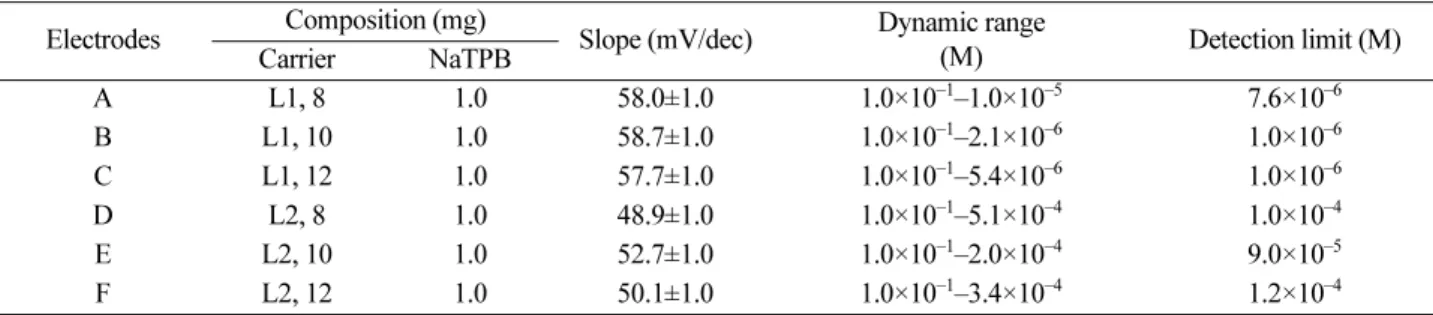
The more detailed analytical characteristics of the elec- trodes based on L1 and L2 are summarized in Table 1.
Clearly, 10.0 mg carrier in the membrane is the best help- ful to achieve the optimum potential response for L1 and L2. The electrode B based on L1 displayed near-Nernst response to Ag+ in the dynamic concentration range of 1.0×10⁻¹-2.1×10⁻⁶ M with the slope of 58.7±1.0 mV/dec and the IUPAC-defined detection limit of 1.0×10⁻⁶ M.29 The L2-based electrode E did not give good potential response, such as comparably low slope of the calibration curve (52.7±1.0 mV/dec) and narrow linear range about four orders of magnitude. Here, the Ag+-ISE based on the amine phenol L1 as simple and effective carrier showed better potential analytical characteristics, such as near- Nernst slope, wider linear range and lower detection limit, compared with the electrodes based on crown ether deriv- atives and calixarene derivatives.11,12,14-16
Fig. 1. The calibration curves of the potential response of the electrodes based on L1 and L2 as carriers.
Table 1. Potential response characteristics of the electrodes based on carriers L1 and L2 toward Ag+ (o-NPOE:PVC = 2:1 (w/w)) Electrodes Composition (mg)
Slope (mV/dec) Dynamic range
(M) Detection limit (M)
Carrier NaTPB
A L1, 8 1.0 58.0±1.0 1.0×10⁻¹–1.0×10⁻⁵ 7.6×10⁻⁶
B L1, 10 1.0 58.7±1.0 1.0×10⁻¹–2.1×10⁻⁶ 1.0×10⁻⁶
C L1, 12 1.0 57.7±1.0 1.0×10⁻¹–5.4×10⁻⁶ 1.0×10⁻⁶
D L2, 8 1.0 48.9±1.0 1.0×10⁻¹–5.1×10⁻⁴ 1.0×10⁻⁴
E L2, 10 1.0 52.7±1.0 1.0×10⁻¹–2.0×10⁻⁴ 9.0×10⁻⁵
F L2, 12 1.0 50.1±1.0 1.0×10⁻¹–3.4×10⁻⁴ 1.2×10⁻⁴
IUPAC definition of response time is the time when 90% of the final value of the potential has been reached upon a change in concentration.29 For the optimized elec- trode B, at Ag+ concentrations above 1.0×10⁻⁴ M, 60-80 s was sufficient to reach less than 0.3 mV/min change in the potential, while about 2-3 min was required for lower con- centrations. When the electrode that had been exposed to 0.1 M AgNO3 was immersed into a buffer solution with- out AgNO3, its potential returned to the baseline potential within 3 min. Thus, the reversibility of the fast potential response of the proposed electrode B to Ag+ was sug- gested according to the above observations.
When the electrode B was immersed into 1.0×10⁻² M AgNO3 solution over a period of 10 h, 0.67 mV (n=40) of the standard deviation (SD) of the potential readings was observed. The potential readings for the same electrode dipped alternately into solutions of 1.0×10⁻³ and 1.0×10⁻² M AgNO3 gave a SD of 0.81. For the proposed electrode which was successively traced over 10 weeks, no detect- able loss of the potential response characteristics was observed.
The effect of pH on the potential response was tested by immersing the electrode B into 1.0×10⁻² M AgNO3 solu- tion with different pH values (1.0-9.0). As shown in Fig.
2, pH range of 3.0-7.5 was suitable for the proposed elec- trode, and instable potential response behaviors were observed at lower (<3.0) or higher pH (>7.5) values.
Selectivity
For the electrode B, the logarithm of selectivity coef- ficients, , is summarized in Fig. 3. Obviously, the optimized electrode gave a high selectivity toward Ag+ ion over other tested alkali and alkaline-earth metal ions,
some transition metal ions and even a soft metal ion, Hg2+. Conventional Ag+-ISEs based on Ag2S generally suffer from terrible interference from Hg2+. Definitely, the present electrode based on the amine phenol ligand L1 is superior to the conventional Ag2S-based electrodes from this point of view.
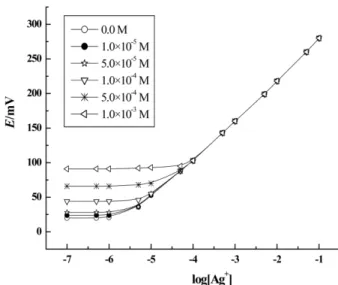
On the other hand, it should be noted that there was some interference of a bivalent metal ion, Cu2+, according to the selectivity coefficient(log =1.05), indicat- ing that Cu2+ ion is the stronggest interferent. But the selectivity of an ion-selective electrode is concentration dependent. In order to establish the Cu2+ concentration that can be tolerated in determining Ag+ ion, the potential response of the electrode B was investigated in the 1.0×10⁻⁷-1.0
×10-1M AgNO3 solutions containing different concentra- tions of Cu2+ ion. From Fig. 4, the presence of Cu2+ at a concentration of 5.0×10⁻⁵ M resulted in no deviation in the potential calibration curve (E vs log[Ag+]) compared with that obtained in pure Ag+ solutions. Thus, the elelctrode B can tolerate Cu2+ at concentration 5.0×10⁻⁵ M over the KAg+j
, pot
KAg+,Cu2+
pot
Fig. 2. The potential response curves of the electrode B in 1.0×10⁻² M AgNO3 solutions at different pH values.
Fig. 3. Selectivity coefficients, log , of the electrode B determined by FIM.
KAg+,j pot
Fig. 4. Potential response curves of the electrode B toward Ag+ in the presence of different concentrations of Cu2+: 1.0×10⁻³, 5.0×10⁻⁴, 1.0×10⁻⁴, 5.0×10⁻⁵, and 1.0×10⁻⁵ M.
whole dynamic concentration ranges. But Cu2+ ion at higher concentrations caused a decrease of linear range and an increase of detection limit. So, Ag+ can be determined in the concentration ranges larger than 8.3×10⁻⁶, 4.5×10⁻⁵, 8.9×10⁻⁵ M in the presence of 1.0×10⁻⁴, 5.0×10⁻⁴ and 1.0×10⁻³ M Cu2+ ion, respectively, which sugggested that the elec- trode B could be used to determine Ag+ content in the presence of Cu2+ ion of at least 10-fold concentration.
Preliminary applications
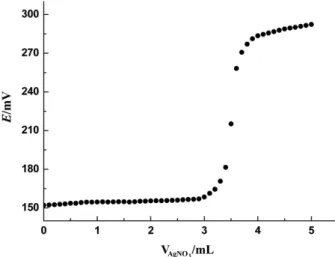
The proposed electrode B was found to work well under laboratory conditions. It was used as an indicator to deter- mine the end-point in the direct potential titration of 1.0×10⁻³ M KCl solution with 5.0×10⁻³ M AgNO3. As shown in Fig. 5, the resulting titration curve gave a rel- atively sharp inflection break at inflexion point.
In order to investigate the utility of the proposed Ag+- ISE in medicinal analysis, the potential response toward drug preparations was also investigated. Vitamin B1 (VB1) is a chloride salt which has two chloride ions in a Vitamin B1 molecule. The potential titration using the electrode B as the indicator one could be applied to the determination of the VB1 content in Vitamin B1 tablets. The resulting titration curve is shown in Fig. 6. The content (w) of VB1
obtained was 15.22% ± 0.5 (n=3). For comparison, the content of VB1 given by the conventional titration method,31 in which the standard AgNO3 solution as the titrant and K2CrO4 as the indicator, was 15.17%±0.5 (n=3).
The applicability of the electrode is further illustrated by measuring the Ag+ ion potentiometrically in doubly distilled deionised water spiked with 40.0, 20.0 and 10.0 mg L-1 Ag+ ion. The Ag+ concentrations were determined
by a standard curve method and atomic absorption spec- trometric (AAS), respectively. The statistical comparison for the results obtained by the two methods was performed concerning precision and accuracy by using t test and F test. The results shown in Table 2 were found in good agreement. Moreover, at 95% confidence level ( f = 3), the obtained t value and F value don’t exceed the critical t value (3.18) and F value (9.28), indicating that there is no significant difference between the two methods with regard to precision and accuracy.
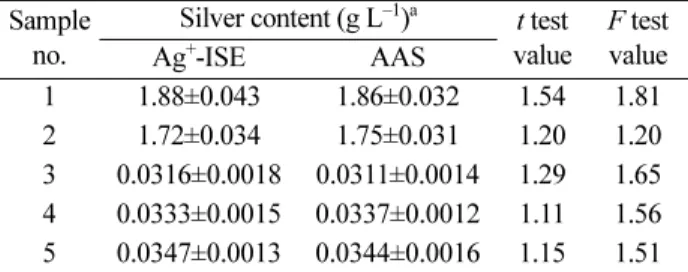
Moreover, to demonstrate the analytical usefulness of the proposed Ag+-ISE in environmental analysis, it was used for silver content assay in waste fixing solution for photography (Samples 1 and 2 in Table 3) and electro- plating wastewater (Samples 3-5 in Table 3) collected from local Xianghui Photographyshop and Electroplating Factory, respectively. The silver content was determined by using Gran’s plots method 32 with the electrode B as the indicator and compared with that given by AAS. The sta- tistical comparison for the results was performed with regard to precision and accuracy by using t test and F test.
From Table 3, we can see that the silver content in waste Fig. 5. Potential titration curves of 1.0×10⁻³ M KCl solution
with 5.0×10⁻³ M AgNO3 using electrode B as the indicator one.
Fig. 6. Potential titration curves of Vitamin B1 solution with AgNO3 standard solution using electrode B as the indicator one.
Table 2. Analysis of water samples spiked with silver(I) ion using the Ag+-ISE and AAS
Sample no.
Silver(I) concentration (mg L–1)a t test value
F test value
Ag+-ISE AAS
1 39.5±0.71 40.0±0.47 2.21 2.28
2 19.1±0.65 19.7±0.34 2.42 3.65
3 9.4±0.31 9.8±0.20 2.63 2.40
aAverage of four replicate measurements±standard deviation (SD).
fixing solution and electroplating wastewater given by the two methods shows good agreement. At 95% con- fidence level ( f = 3), the lower t value and F value than the critical t value (3.18) and F value (9.28) indicates that there is no significant difference between the two methods concerning precision and accuracy. The above observations display that the proposed electrode B can be successfully used to determine silver content in real samples.
CONCLUSION
In this work, two amine phenol ligands, N,N’-bis(2-hydrox- ybenzyl)-1,3-diaminopropane (L1), N,N’-bis(2-hydroxy- benzyl)-2,2-dimethyl-1,3-diaminopropane (L2), were used as the sensing carriers to construct ISEs, and a Ag+-ISE based on L1 was successfully prepared and characterized.
The experimental observations indicated that the result- ing electrode B incorporating L1 exhibited preferential potential recognition process and near-Nernst potential analytical performances toward Ag+ in a wide linear range with a low detection limit. The proposed electrode could be used for silver assay in presence of Cu2+ ion at 10-fold concentration at least. The excellent potential response characteristics such as near-Nernst sensitivity and high selectivity to Ag+ over other tested cations could lead to the satisfactory measurement capabilities of silver con- centration analysis in medicinal samples, environmental samples and etc.. Thus, the proposed Ag+-ISE based on L1 would be a promising and an alternative substitute for the silver assay in actual samples.
Acknowledgements. The authors would like to thank the PhD Foundation Project of Southwest University (No.
SWU109026) and the National Nature Science Founda- tion of China (No. 20675064) to support this work.
REFERENCES
1. Buhlmann, P.; Pretsch, E.; Bakker, E. Chem. Rev. 1998, 98, 1593.
2. Oliveira, I. A. M.; Risco, D.; Vocanson, F.; Crespo, E.;
Teixidor, F.; Zine, N.; Bausells, J.; Samitier, J.; Errachid, A. Sens. Actu. B 2008, 130, 295.
3. Kim, S.; Kim, H.; Noh, K. H.; Lee, S. H.; Kim, S. K.;
Kim, J. S. Talanta 2003, 61, 709.
4. Hassan, A. Z.; Azizollah, N.; Malyheh, S. Anal. Lett.
2008, 41, 2727.
5. Gupta, V. K.; Singh, A. K.; Gupta, B. Anal. Chim. Acta 2007, 583, 340.
6. Mohammad, R. A.; Hassan, A. Z. Anal. Lett. 2008, 41, 2251.
7. Mahajan, R. K.; Kaur, R.; Bhalla, V.; Kumar, M.; Hat- tori, T.; Miyano, S. Sens. Actu. B 2008, 130, 290.
8. Susan, S.; Moslem, J. Anal. Lett. 2009, 42, 2026.
9. Ma, Y. H.; Yuan, R.; Chai, Y. Q.; Wu, X.; Zhou, W.; Liu, X. L.; Deng, F. Anal. Lett. 2009, 42, 2411.
10. Ion, I.; Culetu, A.; Costa, J.; Luca, C.; Ion, A. C. Desali- nation 2010, 259, 38.
11. Siswanta, D.; Nagatsuka, K.; Yamada, H.; Kumakura, K.;
Hisamoto, H.; Shichi, Y.; Toshima, K.; Suzuki, K. Anal.
Chem. 1996, 68, 4166.
12. Shamsipur, M.; Javanbakht, M.; Lippolis, V.; Garau, A.;
Flippo, G. D.; Ganjali, M. R.; Mousavi, M. F.; Yari, A. Anal.
Chim. Acta 2002, 462, 225.
13. Gupta, V. K.; Singh, A. K.; Pal, M. K. Anal. Chim. Acta 2009, 631, 161.
14. O’Connor, K. M.; Henderson, W.; O’Neill, E.; Arrigan, D.
W. M.; Harris, S. J.; Mckervey, M. A.; Svehla, G. Electro- analysis 1997, 9, 311.
15. Chen, L. X.; Zeng, X. S.; Ju, H. F.; He, X. W.; Zhang, Z.
Z. Microchem. J. 2000, 65, 129.
16. Chen, L. X.; Ju, H. F.; Zeng, X. S.; He, X. W.; Zhang, Z.
Z. Anal. Chim. Acta 2001, 437, 191.
17. Mahajan, R. K.; Kaur, I.; Kumar, M. Sens. Actu. B 2003, 91, 26.
18. Singh, A. K.; Saxena, P. Anal. Bioanal. Chem. 2006, 385, 90.
19. Mittal, S. K.; Kumar, A. S. K.; Kaur, S.; Kumar, S. Sens.
Actu. B 2007, 121, 86.
20. Yan, Z. N.; Lu, Y. Q.; Li, X. Sens. Actu. B 2007, 122, 174.
21. Mashhadizadeh, M. H.; Taheri, E. P.; Sheikhshoaie, I. Tal- anta 2007, 72, 1088.
22. Jeong, T.; Lee, H. K.; Jeong, D.; Jeon, S. Talanta 2005, 65, 543.
23. Zamani, H. A.; Ganjali, M. R.; Salavati-Niasari, M. Tran.
Metal Chem. 2008, 33, 995.
24. Singh, A. K.; Gupta, V. K.; Gupta, B. Anal. Chim. Acta 2007, 585, 171.
25. Gupta, V. K.; Khayat, M. A.; Singh, A. K.; Pal, M. K. Anal.
Chim. Acta 2009, 634, 36.
26. Pillai, M. R. A.; Lo, J. J. M.; Schlemper, E. O.; Troutner, D. E. Inorg. Chem. 1990, 29, 1850.
Table 3. Comparison of silver content in waste fixing solution and electroplating wastewater determined by the proposed Ag+- ISE and AAS
Sample no.
Silver content (g L–1)a t test value
F test value
Ag+-ISE AAS
1 1.88±0.043 1.86±0.032 1.54 1.81 2 1.72±0.034 1.75±0.031 1.20 1.20 3 0.0316±0.0018 0.0311±0.0014 1.29 1.65 4 0.0333±0.0015 0.0337±0.0012 1.11 1.56 5 0.0347±0.0013 0.0344±0.0016 1.15 1.51
aAverage of four replicate measurements±standard deviation (SD).
27. Horning, E. C. Organic Synthesis Colloids, Vol. 3; John Wiley & Sons: New York, U.S.A., 1955; pp140-141.
28. Moody, G. J.; Oke, R. B.; Thomas, J. D. R. Analyst 1970, 95, 910.
29. Buck, R. P.; Lindner, E. Pure Appl. Chem. 1994, 66, 2527.
30. Ganjali, M. R.; Akbar, V.; Norouzi, P.; Moghimi, A.; Sepe-
hrifard, A. Eelectroanalysis 2005, 17, 895.
31. Pan, Z. T. (Wuhan University), Analytical Chemistry; 5th Edn; Higher Education Press: Beijing, China, 2006; p271.
32. Zeng, Y. H.; Lin, S. C. Analytical Chemistry (Instrument Analysis Section); 2nd Edn; Higher Education Press:
Beijing, China, 2004; pp277-279.