EMG Study for Muscle Activation during Variable Gait
Training in Stroke Patients: Stepper Climbing, Stair-up and Level-ground Gait.
Purpose: The purpose of this study was to compare muscle activation patterns of lower extremities in stroke patients during stepper climbing, stair-up, and level-ground gait conditions by surface electromyography (EMG).
Methods: Subjects included 19 hemiplegic patients comprehensive rehabilitation center for inpatients with stroke. Surface EMG was used to measure the subjects’ medial gastrocnemius (GCM), tibialis anterior (TA), biceps femoris (BF), and rectus femoris (RF) activity as they took six steps during stepper climbing, stair-up, and level-ground gait conditions.
Results: There was no significant difference in the BF or RF muscle activity for the stepper climbing, stair-up, and level-ground gait conditions. However, there were significant differences in the medial GCM and TA muscle activity between each condition on the patients’ hemiplegic side(p<0.05). There was significant difference in the medial GCM, TA, RF, and BF muscle activity between each condition on the patients’ non-hemiplegic side (p<0.05).
Conclusion: As a result, the overall muscle activity during the level-ground gait was higher than the stair-up condition, and the muscle activity during the stair-up condition was higher than the muscle activity during the stepper climbing condition. As one of the many methods used for gait training, we suggest that the stepper exercise could be applied at an earlier stage in the gait training process.
Key Words:Electromyography, Stepper, Stroke Cho-Rong Kim1, Sung-Jin Choi2, Won-Seob Shin3
1Department of Physical Therapy, Graduate School of Health and Sports, Daejeon University, 2Department of Physical Therapy, Graduate School of Daejeon University, 3Department of Physical Therapy, College of Natural Science, Daejeon University
The Journal of Korean Society of Physical Therapy Original articles
Ⅰ. Introduction
Stroke is a one of major diseases caused by a problem in the blood vessels of brain.1,2 It is the second most common cause of mortality and a leading cause of serious, long- term disability in adult patients.3 Among those with disabilities, gait is the most commonly impaired form of movement. For that reason, the major goal in post-stroke rehabilitation is the restoration of the patient’s walking
Copylight ⓒ 2013 The Korea Society of Physical Therapy
This is an Open Access article distribute under the terms of the Creative Commons Attribution Non-commercial License (Http:// creativecommons.org/license/by-nc/3.0.) which permits unrestricted non-commercial use, distribution,and reproduction in any medium, provided the original work is properly cited.
Received Nov 6, 2013 Revised Dec 9, 2013 Accepted Dec 9, 2013
Corresponding author Won-Seob Shin, [email protected]
ability.4 Restoration and improvement of gait are important goals of stroke rehabilitation and pivotal roles for social and vocational reinstatement.5,6 While climbing up and down stairs is a basic part of a person’s everyday activity, only 5% to 25% of stroke patients can master that activity when they are discharged home from rehabilitation.7 To achieve this goal, task-repetitive training seems to be the most encouraging form of activity.8 Currently, a task- specific repetitive training approach is regarded as the most promising method to restore motor function after stroke.9 Consequently, various types of training, such as stepper climbing, stair-up, and level-ground gait training methods, are being applied.10,11
Stepping machines have become a popular method for lower extremity conditioning and rehabilitation.12 Exercise
on stepping machines has the advantage of reducing stress at the knee joint.13 Because level-ground is the most common locomotion surface, gait training on level-ground could be a more functional and cost-effective method.4,14 Moreover, physical activities that impose higher strength and aerobic demands, such as walking up stairs, are also recommended.15
Recently, many studies have been promoting the importance of walking ability in stroke patients. They have recommended various gait training methods that should be performed for acquisition of beneficial treatment effects.
Thus, many studies have focused on the use of stepper climbing, stair-up, and level-ground gait training.16,17 However, there is no study to compare the muscle activities of lower limb during various gait training methods.18 The information of muscle activation during gait training will help therapist to configure an appropriate training program for stroke patients. Therefore, the aim of this study was to compare the limb muscle activation patterns of hemiplegic subjects during stepper climbing, stair-up, and level- ground gait training by means of surface electromyography.
II. Methods
1. Subjects
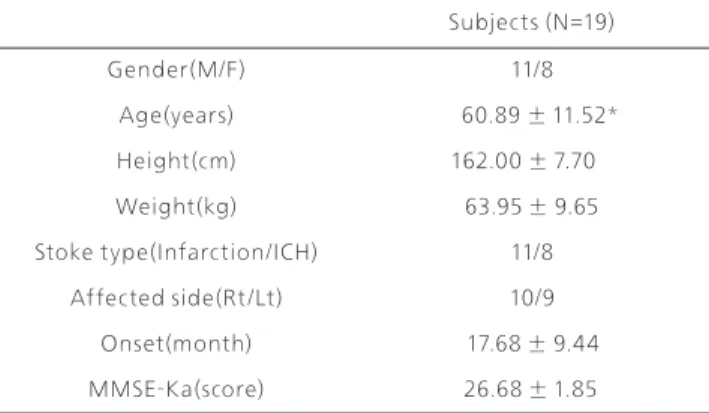
The subjects of this study consisted of 19 stroke patients from one center that offered comprehensive inpatient stroke rehabilitation. Subjects were informed of the research purpose and agreed to voluntary participation. The inclusion criteria were: (1) unilateral brain injury, due to hemorrhage or infarct confirmed by MR images, (2) chronic impairment, lasting for more than six months after the onset of the stroke, (3) no cognitive function impairment (above 24 points using the Mini-Mental Status Examination [MMSE]), (4) no pathological disease that could affect the results of study, clinically, (5) ability to walk with a walking aid or alone for at least 30 meters and ability to stand alone for at least 30 seconds, (6) a Modified Ashworth Scale (MAS) of the lower extremities value of G2 or lower. Nineteen subjects were used to analyze the results of the measured value. General characteristics of subjects were described in table 1.
2. Experimental procedure
The lower limb muscle activity of the subjects was measured as they engaged in stepper climbing, stair-up, and level-ground gait conditions. A randomized condition by subjects, using a repeated measures design, was successively administered twice to each subject. The measurement sequence was administered using a 6-second trial followed by a 1-minute rest period. While exercising on the stepping machine (7020 Stepper, Egojin, Korea)(Fig 1) and the stairs(Fig 2), the subjects were instructed to minimize force by lightly resting their hands on the handrails for balance purposes only. The step height of the stepper machine and the stairs was set equal to 7.5 cm. A step rate of 60 steps-per-minute was selected and was assumed to be accurate. A metronomewas used to set the cadence at 60 steps-per-minute. Therapist was always waiting beside the subjects to prepare for accidents.
Figure1. The stepping machine
Subjects (N=19)
Gender(M/F) 11/8
Age(years) 60.89 ± 11.52*
Height(cm) 162.00 ± 7.70
Weight(kg) 63.95 ± 9.65
Stoke type(Infarction/ICH) 11/8
Affected side(Rt/Lt) 10/9
Onset(month) 17.68 ± 9.44
MMSE-Ka(score) 26.68 ± 1.85
Table 1. General characteristic of subjects
*mean ± SD
aMMSE-K: Mine-Mental State Examination Korean version
3. EMG measurement
We placed surface electrodes on both lower limbs to record surface electromyography (Telemyo 2400T, Noraxon, USA)(Fig 3) from four muscles: rectus femoris, biceps femoris, tibialis anterior, medial gastrocnemius(Fig 4). Pairs of Ag/AgCl electrodes (3M, RedDot) with a surface diameter of 2cm were arranged parallel to the muscle belly. Electrode sites were prepared by shaving and rubbing the skin with alcohol to ensure good contact.
A personal computer sampled each EMG channel at 1,024Hz. EMG signals were filtered with a band-pass filter (cutoff frequency 80-250㎐) and then full wave rectified the signals, notch filter was 60Hz during the EMG measurement.
To quantify muscle activation during stepping, we calculated root-mean-square (RMS) amplitude of the filtered. For each condition on stepper and stair up and level-ground gait, we averaged six step cycles of data. A ground electrode was
placed on the right medial malleolus. The reference voluntary contraction (RVC) was performed as a static task for EMG normalization. During RVC testing, the subjects were instructed to hold standing posture for five seconds. There was a 1 minute rest period between each RVC trial. The average RVC was used to normalize the EMG values (%RVC).
Collected data was analyzed Noraxon MyoResearch software 1.07 (Myoresearch XP Master Edition, Noraxon Inc.).
4. Statistical analyses
All data were analyzed with SPSS for Windows version 18.0.
The Shapiro-Wilks test was used to assess the normality of the data. Normally distributed data are presented as mean
± sd. One-way repeated ANOVA was used to compare among three types of intervention. The post-hoc analysis was used Bonferroni method. A significance level of 0.05 was set for all analyses
Figure3. Surface electromyography
Figure4. Placement of EMG (rectus femoris, biceps femoris, tibialis anterior, medial gastrocnemius) Figure2. The stairs
Ⅲ . Results
1. Muscle activity of hemiplegic side
The RMS amplitude of hemiplegic side results expressed as
%RVC. There was no significant difference in muscle activity of BF, RF between stepper climbing, stair up and level- ground gait. There was significant difference in muscle activity of medial GCM, TA between each condition (p<0.05).
Muscle activity of medial GCM was much higher during the stair up and level-ground gait than during the stepper climbing condition. Muscle activity of TA was much higher during the stair up than during level-ground gait than during the stepper climbing condition (Table 2).
2. Muscle activity of non-hemiplegic side
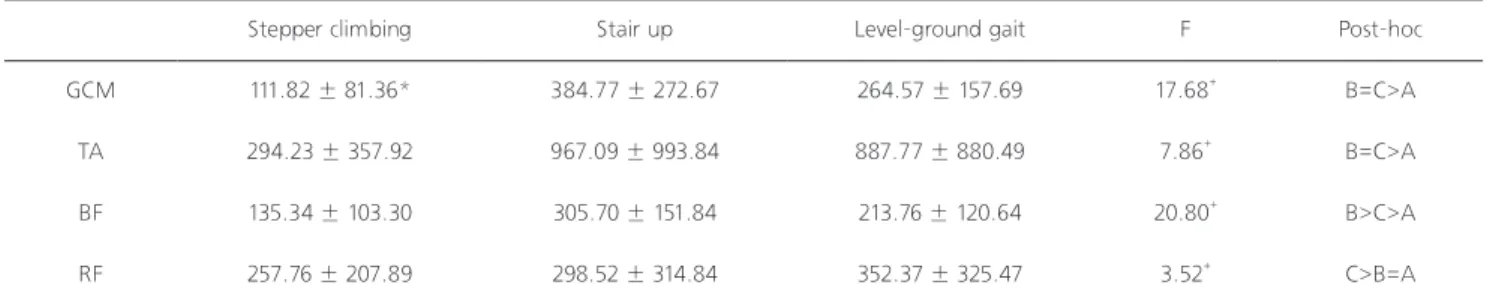
The RMS amplitude of non-hemiplegic side results expressed as %RVC. There was significant difference in muscle activity of medial GCM, TA, RF, BF between each condition (p<0.05).
Muscle activity of medial GCM was much higher during the stair up and level-ground gait than during the stepper
climbing condition. Muscle activity of medial TA was much higher during the stair up and level-ground gait than during the stepper climbing condition. Muscle activity of BF was much higher during the stair up than during level-ground gait than during the stepper climbing condition. Muscle activity of RF was much higher during the level-ground gait than during the stepper climbing and the stair up condition (Table 3).
IV. Discussion
Surface EMG provides a simple, noninvasive alternative for clinical application as compared to intra-muscular investigations.19 In this study, we examined whether differences existed in the muscle activities of the lower limbs during stepper climbing, stair-up, and level-ground gait conditions by means of surface EMG. As a result, the overall muscle activity during level-ground gait condition was higher than the stair-up condition, and the stair-up condition was higher than the stepper climbing condition.
The gastrocnemius muscle (GCM) in the ankle plantar
Stepper climbing Stair up Level-ground gait F Post-hoc
GCM 236.97 ± 181.75* 404.94 ± 374.59 349.18 ± 237.20 9.19+ B=C>A
TA 542.24 ± 476.71 1679.63 ± 1474.77 1105.10 ± 898.97 8.16+ B>C>A
BF 446.30 ± 612.61 455.53 ± 488.81 389.67 ± 373.67 2.28 -
RF 362.25 ± 323.57 399.70 ± 330.53 356.04 ± 332.09 2.34 -
Stepper climbing Stair up Level-ground gait F Post-hoc
GCM 111.82 ± 81.36* 384.77 ± 272.67 264.57 ± 157.69 17.68+ B=C>A
TA 294.23 ± 357.92 967.09 ± 993.84 887.77 ± 880.49 7.86+ B=C>A
BF 135.34 ± 103.30 305.70 ± 151.84 213.76 ± 120.64 20.80+ B>C>A
RF 257.76 ± 207.89 298.52 ± 314.84 352.37 ± 325.47 3.52+ C>B=A
Table 2. Muscle activity of hemiplegic side
Table 3. Muscle activity of non-hemiplegic side
GCM: medial gastrocnemius, TA: tibialis anterior, BF: biceps femoris, RF: rectus femoris A: Stepper climbing, B: Stair up, C: Level-ground gait
*mean ± SD, +p<0.05
GCM: medial gastrocnemius, TA: tibialis anterior, BF: biceps femoris, RF: rectus femoris A: Stepper climbing, B: Stair up, C: Level-ground gait
*mean ± SD, +p<0.05
flexor is utilized the most during the stance phase and it controls the forward movement of the tibia. Uncontrolled forward tibial action will cause excessive ankle plantar flexion and knee flexion.20 GCM muscle plays an important role during the middle to terminal stance phase in gait.21 As a strong prognostic factor, GCM muscle activity can predict gait speed.22 In this study, medial GCM activity on the patients’ hemiplegic side is more greatly increased during level-ground gait condition than it is during the stepper climbing condition. No significant differences were found in the medial GCM activity during the level-ground gait and stair-up conditions. Moreover, the muscle activity on the patients’ non-hemiplegic side was found to increase more during the level-ground gait condition than during the stepper climbing condition. No significant differences were found for the level-ground gait and stair-up conditions. It is thought that performing in-place movements on a stepper will not cause greater forward movement in the tibia. These results suggest that gait training for increasing gait speed using stepper machine may have a disadvantage compared to other methods.
Cho et al.23reported that tibialis anterior (TA) muscle activity increased during stepper exercises using PNF patterns. The TA has twice of muscle activity during normal gait period. The TA have eccentric activity in order to decelerate of the ankle plantar flexion during body weight is applied to the heel. And TA is necessary to help avoid dragging feet on the ground during the swing phase.20 In this study, the TA activity on the hemiplegic side was higher when the subjects engaged in stair-up, level-ground gait, and stepper climbing conditions. TA activity on the non- hemiplegic side was found to increase more during level- ground gait condition than it did during stepper climbing condition. No significant differences were found between the level-ground gait and the stair-up conditions. This is considered to be due to the fact that the dorsiflexor muscle could not be put to good use because the subjects’ heels did not touch the ground when they used the stepper machine.
In this study, the BF activity on the non-hemiplegic side was higher during the stair-up, level-ground gait, stepper climbing conditions. Cho et al.24 reported that biceps femoris
(BF) muscle activity increases more during forward walking than backward walking, and the hip extensor muscles mainly act to promote muscle activity during the stance phase. This is considered to be due to the fact that an increase in BF activity is required in order to maintain balance when going up stairs and when engaging in forward walking.
In this study, RF activity on the non-hemiplegic side was much higher during the level-ground gait condition than it was during the stepper climbing and the stair- up conditions. Na et al.25 reported that rectus femoris (RF) muscle activity increased when the hip joint was at a 90- 130˚ angle. This is considered to be due to the fact that level ground is a more familiar environment for maintaining balance in the stance phase and the subject’s hip joint angle is appropriate for that form of movement.
Traditionally, Gait training of hemiplegic patients is carried out on the level-ground of the first. In the final step, stair climbing training is conducted generally.26 Previous studies related stepper, the results were that a stepper exercise made significantly increase ankle strength and balance.23,27 Interestingly in this study, the muscle activity during stepper climbing was lower than the muscle activity during the stair-up and the level-ground gait conditions.
The possible explanation for this finding is that the stepper exercise requires less muscle activity in the lower limb.
Moreover, stepper helps to acquire normal gait pattern during an alternating stepping motion. Kirker et al.28 emphasized a normal gait pattern is important to acquire first in stroke patient. Therefore, we suggest that the stepper exercise could be applied during the earlier stage of gait training in stroke patients.
A potential limitation of this study is that, due to recording EMG data from a smaller set of muscles, we were only able to identify three conditions. However, this study analyzed EMG data from each of the muscle conditions on both the subject’s hemiplegic side and non-hemiplegic side to allow for a direct comparison between the stepper climbing, stair- up, and the level-ground gait conditions. Future studies will try to incorporate data from a larger number of muscles and from different conditions.
References
1. Bae SS, Lee JH. The study of clinical pictures and received rehabilitation service patterns of stroke patients. J Korean Soc Phys Ther. 2001;13(3):799-814.
2. Pontes-Neto OM, Silva GS, Feitosa MR et al. Stroke awareness in razil: Alarming results in a community-based study. Stroke.
2008;39(2):292-6.
3. Warlow C, Sudlow C, Dennis M et al. Stroke. Lancet.
2003;362(9391):1211-24.
4. Prado-Medeiros CL, Sousa CO, Souza AS et al. Effects of the addition of functional electrical stimulation to ground level gait training with body weight support after chronic stroke. Rev Bras Fisioter. 2011;15(6):436-44.
5. Lee KS, Kim CS. The effect of medio-lateral balance to head rotation in stroke patient. J Korean Soc Phys Ther.
2012;24(5):334-9.
6. Hesse S, Tomelleri C, Bardeleben A et al. Robot-assisted practice of gait and stair climbing in nonambulatory stroke patients. J Rehabil Res Dev. 2012;49(4):613-22.
7. Paolucci S, Bragoni M, Coiro P et al. Quantification of the probability of reaching mobility independence at discharge from a rehabilitation hospital in nonwalking early ischemic stroke patients: A multivariate study. Cerebrovasc Dis.
2008;26(1):16-22.
8. Hesse S, Waldner A, Tomelleri C. Innovative gait robot for the repetitive practice of floor walking and stair climbing up and down in stroke patients. J Neuroeng Rehabil. 2010;7:30.
9. Dobkin BH. Strategies for stroke rehabilitation. Lancet Neurol.
2004;3(9):528-36.
10. Kao P-C, Ferris DP. The effect of movement frequency on interlimb coupling during recumbent stepping. Motor Control.
2005;9(2):144-63.
11. Kim YS, Kim EJ, Seo CJ. The comparative analysis of EMG and gait patterns of lower extremities during going up stairs and down. The Korean Journal of Physical Education.
2006;45(4):535-45.
12. Brask B, Lueke RH, Soderberg GL. Electromyographic analysis of selected muscles during the lateral step-up exercise. Phys Ther. 1984;64(3):324-9.
13. Cook TM, Zimmermann CL, Lux KM et al. EMG comparison of lateral step-up and stepping machine exercise. J Orthop Sports Phys Ther. 1992;16(3):108-13.
14. Alton F, Baldey L, Caplan S et al. A kinematic comparison of overground and treadmill walking. Clin Biomech (Bristol, Avon).
1998;13(6):434-40.
15. Nadeau S, McFadyen BJ, Malouin F. Frontal and sagittal plane
analyses of the stair climbing task in healthy adults aged over 40 years: What are the challenges compared to level walking?
Clin Biomech (Bristol, Avon). 2003;18(10):950-9.
16. Han JT, Gong WT, Lee YS. Comparison of muscle activity with lower extremity during stairs and ramp climbing of old adults by EMG. J Korean Soc Phys Ther. 2009;21(1):35-40.
17. Han JT. Kinematic analysis of head and trunk movements of young adults while climbing stairs or a ramp. J Korean Soc Phys Ther. 2010;22(6):21-8.
18. Park SK, Cheon DW. Analysis of muscle activity with lower extremity during stairs and ramp ascending of hemiplegic patients. J Korean Soc Phys Ther. 2012;24(4):247-52.
19. Marshall P, Murphy B. The validity and reliability of surface EMG to assess the neuromuscular response of the abdominal muscles to rapid limb movement. J Electromyogr Kinesiol.
2003;13(5):477-89.
20. Neumann DA. Kinesiology of the musculoskeletal system. St.
Louis, Mosby, 2002: Pages.
21. Den Otter AR, Geurts A, Mulder T et al. Speed related changes in muscle activity from normal to very slow walking speeds.
Gait & posture. 2004;19(3):270-278.
22. Kim CM, Eng JJ. The relationship of lower-extremity muscle torque to locomotor performance in people with stroke. Physical Therapy. 2003;83(1):49-57.
23. Cho NJ, Kim KH, Choi MS et al. The effects of the stepper exercise using lower extremity patterns of pnf on ankle muscle strength and balance ability of females in their twenties.
Jounal of the Korean Proprioceptive Neuromuscular Facilitation Association. 2010;8(3):27-37.
24. Cho KK, Kim YS, Cho SH. The comparative analysis of EMG depending on variations of speed in forward walking and backward walking. Korean Journal of Sport Biomechanics.
2007;17(3):1-10.
25. Na YM, Lim KB, Kim HS et al. The myoelectrical activities of quardriceps femoris according to hip joint angle by electromyographic analysis. The Korean Journal of Sports Medicine. 2002;20(2):201-8.
26. D.K. K. Change of walking and stair up in hemiplegia by proprioceptive neuromuscular facilitation techniques. J Korean Soc Phys Ther. 1999;11(3):57-64.
27. Choi WJ, Jo EM, Chun JW et al. The effects of ankle plantar flexion exercise and stepper on the balance ability in normal peoples. Jounal of the Korean Proprioceptive Neuromuscular Facilitation Association. 2009;7(3):7-16.
28. Kirker S, Simpson D, Jenner J et al. Stepping before standing:
Hip muscle function in stepping and standing balance after stroke. J Neurol, Neurosurg Psychiatry. 2000;68(4):458-64.