| Abstract |
7)PURPOSE: This study aimed to analyze the factors influencing the improvement of global synkinesis (GS) and gait in stroke patients by the weight shift exercise.
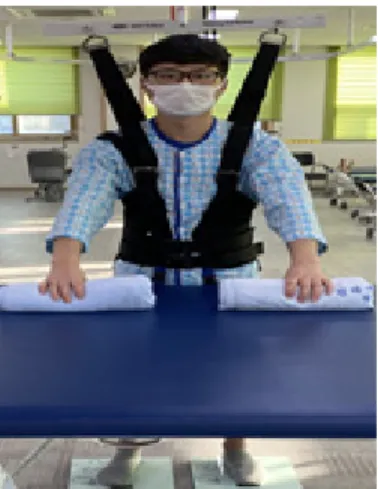
METHODS: Twenty stroke patients were randomly assigned to experimental group I (n = 10) and experimental group II (n = 10). In experimental group I, weight shift with upper extremity exercises in a standing position were mediated and in experimental group II, upper extremity exercises in a standing position were mediated. These interventions were conducted in both groups for three sessions per week, 30 minutes per session over four weeks.
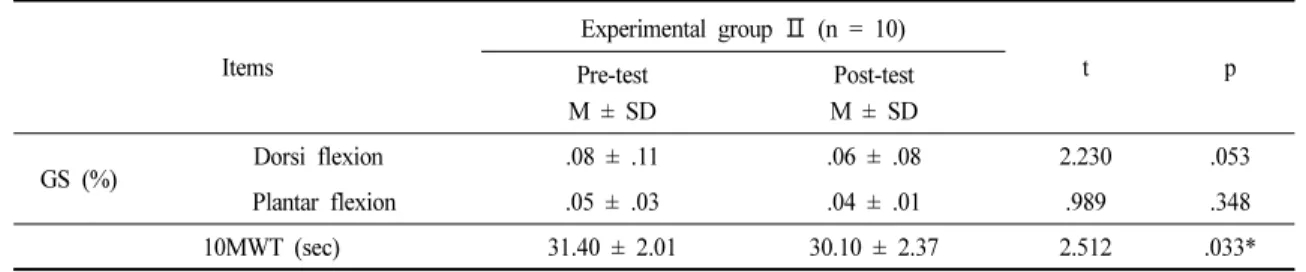
Before the interventions, leg GS was measured using surface electromyography and the 10m walk test (10MWT). The same parameters were measured four weeks later.
RESULTS: The GS and 10MWT of the experimental group I showed that there was a statistically significant difference Corresponding Author : Seung-Yun Baek
[email protected], https://orcid.org/0000-0002-0473-2562 This is an Open Access article distributed under the terms of the Creative Commons Attribution Non-Commercial License (http://creativecommons.org/licenses/by-nc/3.0) which permits unrestricted non-commercial use, distribution, and reproduction in any medium, provided the original work is properly cited.
between dorsiflexion (p < .05) and plantarflexion (p < .01) and 10MWT (p < .01). In experimental group II, there was a statistically significant difference only in 10MWT (p < .01).
The comparison between the changes in both groups showed that in the case of GS, there was a statistically significant difference in the dorsiflexion (p < .01) and plantarflexion (p
< .05), and in the 10MWT too (p < .05).
CONCLUSION: GS of the lower extremities was decreased by improving posture control and enlarging soft tissues due to the symmetrical weight shift in experimental group I, which turned out to be effective in improving the gait speed.
Key Words: Global Synkinesis, 10 m walk test, Stroke
Ⅰ. 서 론
뇌졸중이란 뇌에 공급되는 혈류가 차단되거나 출혈 로 인하여 뇌조직이 손상되어 신체의 장애를 일으키는 질환이다[1]. 뇌졸중 환자들은 운동감각(sensorimotor) 신경로의 손상으로 팔과 다리의 근약화와 비정상적인 근긴장도로 인해 신체의 기능적 움직임과 자세유지와 선택적인 운동조절이 어려워진다[2,3]. 마비측 근육의 비운동성 기간이 길어짐에 따라 결합조직의 점성이 증
Research Article Open Access
체중이동 운동이 뇌졸중 환자의 다리 Global Synkinesis와 보행에 미치는 영향