• 검색 결과가 없습니다.

Vanishing Venous Coronary Artery Bypass Grafts after SepsisSoo Jin Park, M.D., Ji Ye Park, M.D., Joonho Jung, M.D., You Sun Hong, M.D., Cheol Joo Lee, M.D., Sang Hyun Lim, M.D., Ph.D.

N/A
N/A
Protected

Academic year: 2021

Share "Vanishing Venous Coronary Artery Bypass Grafts after SepsisSoo Jin Park, M.D., Ji Ye Park, M.D., Joonho Jung, M.D., You Sun Hong, M.D., Cheol Joo Lee, M.D., Sang Hyun Lim, M.D., Ph.D."

Copied!
5
0
0

로드 중.... (전체 텍스트 보기)

전체 글

(1)

ISSN: 2233-601X (Print) ISSN: 2093-6516 (Online)

Received: September 30, 2015, Revised: October 27, 2015, Accepted: October 27, 2015, Published online: October 5, 2016

Corresponding author: Sang Hyun Lim, Department of Thoracic and Cardiovascular Surgery, Ajou University School of Medicine, 164 World cup-ro, Yeongtong-gu, Suwon 16499, Korea

(Tel) 82-31-219-5210 (Fax) 82-2-2228-2140 (E-mail) [email protected]

© The Korean Society for Thoracic and Cardiovascular Surgery. 2016. All right reserved.

This is an open access article distributed under the terms of the Creative Commons Attribution Non-Commercial License (http://creativecommons.org/

licenses/by-nc/4.0) which permits unrestricted non-commercial use, distribution, and reproduction in any medium, provided the original work is properly cited.
Vanishing Venous Coronary Artery Bypass Grafts after Sepsis

Soo Jin Park, M.D., Ji Ye Park, M.D., Joonho Jung, M.D., You Sun Hong, M.D., Cheol Joo Lee, M.D., Sang Hyun Lim, M.D., Ph.D.

Department of Thoracic and Cardiovascular Surgery, Ajou University School of Medicine

The dehiscence of saphenous vein grafts (SVGs) is a rare, often fatal, complication of coronary artery bypass grafting (CAB G). We present the case of a 57-year-old man who underwent hemiarch graft interposition and CABG for a Stanford type A aortic dissection. Five months after discharge, the patient developed strepto- coccal sepsis caused by a hemodialysis catheter. Complete rupture of the proximal anastomoses of the saphe- nous veins and containment by the obliterated pericardial cavity was observed 25 months after the initial operation. The patient was successfully treated surgically. This report describes a patient who developed po- tentially fatal dehiscence of SVGs secondary to infection and outlines preventive and management strategies for this complication.

Key words: 1. Saphenous vein graft 2. Infection

3. Graft rupture

Case report

A 57-year-old man was transferred to emergency department of Ajou University Hospital for treatment of Stanford type A aortic dissection. The patient had chronic kidney disease (serum creatinine, 1.8 mg/dL) and mild cognitive impairment (Mini-Mental State Examination score, 16) due to previous tuberculous meningitis. The initial electrocardiogram showed in- ferior myocardial infarction, complete atrioventricular block, and a temporary pacemaker that was inserted before transfer to our hospital. Emergency surgery was performed, and the operative findings showed intimal tearing at the proximal ascending aorta with occlusion of both coronary ostia by the flap. We per- formed hemiarch graft interposition with a Hemas- hield 22-mm graft and coronary artery bypass graft- ing (CABG) to the left anterior descending (LAD) ar-

tery and right coronary artery with saphenous vein grafts (SVGs). The patient was treated with hemodial- ysis during the early postoperative period, but was discharged on the 100th postoperative day without renal replacement.

Three months after discharge, the patient was ad- mitted to the nephrology division to manage acute renal failure on preexisting chronic renal failure (serum creatinine, 4.3 mg/dL). A permanent hemo- dialysis catheter was inserted and hemodialysis was performed for 3 days. The patient’s renal function improved gradually, and he was therefore discharged on the 11th day of hospitalization with a permanent hemodialysis catheter (serum creatinine, 2.1 mg/dL).

Two months after discharge (8 months after first op- eration), the patient was admitted to the infectious diseases division to treat hemodialysis catheter-re- lated sepsis. The patient’s white blood cell (WBC)

http://dx.doi.org/10.5090/kjtcs.2016.49.5.387

(2)

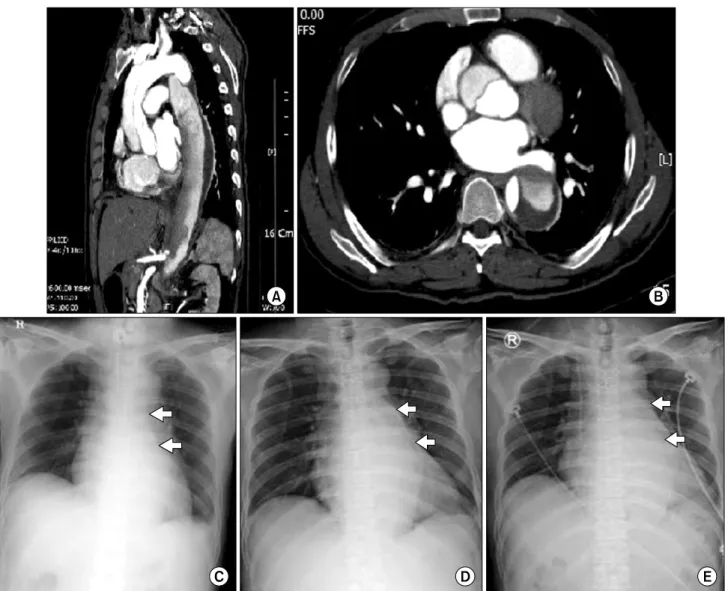
Fig. 1. (A) Preoperative computed tomography revealed a Stanford type A aortic dissection (sagittal plane). (B) Preoperative computed tomography revealed a Stanford type A aortic dissection (axial plane). (C) Chest X-ray after hemiarch graft interposition and coronary ar- tery bypass grafting surgery. (D) Apparent mediastinal widening on the chest X-ray (arrow) during outpatient follow-up. (E) Chest X-ray before re-operation.

count, percentage of neutrophils, and C-reactive pro- tein (CRP) level were 7,900/μL, 93.2%, and 26.02 mg/dL. The causative organism was Streptococcus pyogenes. The permanent hemodialysis catheter was removed and the patient was treated successfully with systemic antibiotics for 3 weeks.

Twelve months after that admission (21 months af- ter first operation), the patient revisited our emer- gency department complaining of a 3-day history of general weakness and fatigue. The mediastinum was wider than had been observed in a previous study (Fig. 1), and contrast-enhanced chest computed to- mography (CT) was performed (Fig. 2A). This re-

vealed a 5×4×5-cm hematoma alongside the ascend- ing aorta graft. Contrast enhancement of the hema- toma suggested rupture of the artificial graft, and we performed aortography to obtain a precise diagnosis.

This showed the extravasation of contrast medium from the proximal portion of the ascending aorta and rapid flow of contrast medium in the pseudo-lumen alongside the ascending aorta (Fig. 2B). We per- formed an emergency explorative sternotomy under the impression of a rupture of the artificial graft.

The upper portion of the pericardium was bulging

and resembled a pseudoaneurysm sac. Before opening

the bulging pericardial sac, we started cardiopulmo-

(3)

Fig. 2. (A) Preoperative computed tomography revealed a ruptured artificial ascending aorta. (B) Ex- travasation of the contrast medium from the ascending aortic graft (mid-segment) and rapid flow of the contrast medium in the pseu- do-lumen alongside the ascending aorta. (C) Proximal anastomosis site of the saphenous vein grafts to the ascending aortic graft (arrows).

Fig. 3. (A) Obstruction of the SVGs from the ascending aorta to the distal LAD artery with 7.6 mm of ectasia at the distal SVG (arrow) and diffuse mild-to-moderate steno- sis (up to 58%) at the proximal and middle LAD. (B) Obstruction of the SVG from the ascending aorta to the RCA with a 5.2 mm aneurysm at the distal RCA and discrete mild stenosis at the proximal RCA (34%).

SVG, saphenous vein graft; LAD, left anterior descending; RCA, right coronary artery.

nary bypass and lowered the patient’s temperature to 28

o

C. After opening the pericardial sac under total circulatory arrest, two oval defects were seen in the proximal portion of the artificial graft. The inner sur- face of the sac was smooth and clean, with no evi- dence of pus or current infection. The defects in the artificial graft were the sites of the proximal anasto- moses of the SVGs from the previous CABG, but no visible SVGs were present in the operative field (Fig.

2C). The flow of the native coronary arteries was in- tact in preoperative aortography, and no newly de- veloped regional wall motion abnormality was found on intraoperative transesophageal echocardiography.

We resected the original artificial graft and inter-

posed a new artificial graft. No evidence of coronary

artery malperfusion was found while weaning the pa-

tient from cardiopulmonary bypass or during the

postoperative period. Coronary artery multidetector

(4)

CT (MDCT) performed postoperatively revealed ob- structed SVGs and ectatic changes of the distal por- tion of the SVG to the LAD artery (Fig. 3). The sys- tolic function of the left ventricle and the flow in the native coronary artery were intact. The patient was discharged on the 42nd postoperative day.

Discussion

We are not certain of the exact cause of the SVGs dehiscence from the ascending aorta graft in this case. There are two possible causes: infection and aneurysmal changes in the saphenous vein and sub- sequent rupture.

The dehiscence of SVGs at the proximal anasto- mosis site is a rare complication of CABG that is usu- ally fatal. In some cases, the blood is contained with- in the obliterated pericardial cavity [1,2]. Fatal de- hiscence of proximal anastomosis can occur due to graft infection. Douglas et al. [3] reported a case with dehiscence of the proximal aorta graft anasto- mosis secondary to staphylococcal mediastinitis, peri- carditis, and phlebitis, and a mycotic aneurysm was found in the mid-portion of the graft. Microscopically, a dense, partially organizing polymorphonuclear in- filtrate was found covering the surface of the SVGs and heart [3]. The rupture of the SVGs into the dense pericardial cavity might also have been con- tained by mediastinal adhesions from the previous operations [1,2].

The first report of aneurysmal dilatation of aorto- coronary SVGs was published in 1975, and the re- ported incidence is up to 14% of vein grafts 6–12 years after CABG [4,5]. The time interval between the operation and the detection of aneurysmal changes in the SVGs has been reported for range from 11 days to 21 years [4,5]. Various pathophysiologies have been proposed, but the mechanism of aneurysmal di- latation of aortocoronary SVGs is still unclear, although several causative factors have been suggested [4,5].

Saphenous vein graft aneurysms (SVGAs) have dif- ferent pathophysiologies according to the timing of occurrence. Early SVGAs (appearing within several months after surgery) are generally related to graft infections, undetected varicosities, and some operative factors (e.g., technical factors related to graft harvest- ing and anastomosis) [1,5,6]. Late SVGAs (appearing more than 5 years after surgery) are thought to oc-

cur by atherosclerotic degeneration of the saphenous vein as the main cause, especially in patients with hyperlipidemia [4,5]. These atherosclerotic changes, as well as graft endothelial dysfunctions with changes in the medial smooth muscle cells around the valve sites, play a key role in late aneurysm de- velopment [5,6]. SVGAs are usually found incidentally on imaging as a simple mediastinal mass or an enlarg- ing pulsatile mass [4,5]. In cases of rupture, fistula formation with surrounding structures and hemody- namic instability caused by compression of the ad- jacent cardiac and vascular structures are possible [1,5].

Our patient was admitted for sepsis related to a hemodialysis catheter 8 months after evidence of de- hiscence or aneurysmal dilatation of the grafts. How- ever, serial chest X-rays showed a subsequent gradu- al widening of the mediastinum, although this finding was neglected by several doctors who provided care to the patient during OPD follow up after first oper- ation (Fig. 1D). The WBC count, percentage of neu- trophils, and CRP were 11,300/μL, 83.1%, and 9.93 mg/dL, respectively, a week after a chest X-ray showing mediastinal widening was obtained from the patient. When the patient came to our emergency room, the WBC count, percentage of neutrophils, and CRP levels had decreased to 6,400/μL, 78.2%, and 0.46 mg/dL, respectively. From these data, we de- duced that the SVGs were dissolved by a previous in- fection and that the unruptured sac was formed by a chronic infection.

We performed a second operation under cardiopul-

monary bypass with femoral artery cannulation and

hypothermic (28

o

C) total circulatory arrest to identify

exact ruptured site. On operation table, we found no

remnant of saphenous vein graft and there was no

bleeding from surrounding tissue. A smooth- surfaced

capsule-like space was found around the proximal as-

cending aorta graft, and 2 holes for the previous sa-

phenous vein anastomoses were seen with no rem-

nant tissue, except suture material. The infection

seemed to have dissolved the saphenous veins. We

resected the previous graft, including the coronary

anastomosis sites and interposed a new graft. We ini-

tially attempted primary repair, but there was a risk

of aortic stenosis. Therefore, we performed a seg-

mental replacement with a new graft (22 mm, same

size) to prevent aortic stenosis. We did not perform

(5)

CABG for the second operation because no evidence of myocardial ischemia was present in the pre- operative evaluations and no newly developed re- gional wall motion abnormalities were observed on intraoperative transesophageal echocardiography.

Postoperative coronary artery MDCT showed intact native coronary arterial flow (Fig. 3). The patient’s postoperative course was uneventful, with no evi- dence of infection, including mediastinitis.

We report the very rare complication of saphenous vein graft dehiscence from an artificial ascending aorta after CABG with ascending aorta replacement.

The cause of the dehiscence was likely infection caused by hemodialysis catheter-related sepsis. To detect such complications earlier, we must have a greater level of suspicion regarding abnormal find- ings on imaging or laboratory examinations and also perform regular echocardiography or CT imaging.

Conflict of interest

No potential conflict of interest relevant to this ar- ticle was reported.

References

1. Kallis P, Keogh BE, Davies MJ. Pseudoaneurysm of aorto- coronary vein graft secondary to late venous rupture: case report and literature review. Br Heart J 1993;70:189-92.

2. Holinski S, Konertz W, Beholz S. Covered perforated aorto- coronary saphenous vein graft aneurysm. J Card Surg 2009;24:91-3.

3. Douglas BP, Bulkley BH, Hutchins GM. Infected saphenous vein coronary artery bypass graft with mycotic aneurysm:

fatal dehiscence of the proximal anastomosis. Chest 1979;75:76-7.

4. Puri R, Dundon BK, Leong DP, Worthley SG, Worthley MI.

Giant saphenous vein graft pseudoaneurysm rupture pre- senting with cardiac tamponade. Heart Lung Circ 2009;18:52-4.

5. Ramirez FD, Hibbert B, Simard T, et al. Natural history and management of aortocoronary saphenous vein graft ane- urysms: a systematic review of published cases. Circul- ation 2012;126:2248-56.

6. Gukop P, Karapanagiotidis GT, Chandrasekaran V. Ruptur-

ed saphenous vein graft aneurysm. Eur J Cardiothorac Surg

2014;45:1111-2.

수치

Fig. 1. (A) Preoperative computed tomography revealed a Stanford type A aortic dissection (sagittal plane)

참조

관련 문서

size 바이트만큼의 메모리 공간을 할당하며 그 시작주소를 void* 형으로 반환한다..

• 파이썬은 연산자와 동일한 결과를 산출하는 함수로서 특수 메소드의 정의를 허용한다.이 메소드들은 파이썬이 인식할 수 있도록 특별한

#define 에서 인자 사용 예제 compoundassign.c... 관계와

▪ 실세계의 객체에서 불필요한 부분을 제거하여 필요한 부분만을 간결하고 이해하기 쉬운 클래스 로 만드는 작업. ▪

Scale Min 과 Scale Max 아래의 각 채널에 Disable 로 표시 되면 기본값으로 설정 되어 있는 상태 입니다.. 스케일 설정 값은 EEPROM에 저장되어 전원

One might try to solve the problem by copying the first d elements of x to a temporary array, moving the remaining n − d elements left d places, and then copying the first d

(바) “액체 밀봉드럼 (Liquid seal drum)”이라 함은 플레어스택의 화염이 플레어시 스템으로 거꾸로 전파되는 것을 방지하거나 또는 플레어헤더에

• 글로벌 거버넌스란 국제사회에서 과거 주권국가들이 유읷핚 행위자로서 그들의 관계로 형성되었던 국제관계가 다양핚 다른 행위자들이 등장하고 새로욲 행위자들이 국가들과