Letter to the Editor
Vol. 26 No. 3, 2014 417
Received April 1, 2013, Revised May 28, 2013, Accepted for publication June 24, 2013
Corresponding author: Beom Joon Kim, Department of Dermatology, Chung-Ang University Hospital, 102 Heukseok-ro, Dongjak-gu, Seoul 156-755, Korea. Tel: 82-2-6299-1525, Fax: +82-2-823-1049, E-mail: [email protected]
This is an Open Access article distributed under the terms of the Creative Commons Attribution Non-Commercial License (http://
creativecommons.org/licenses/by-nc/3.0) which permits unrestricted non-commercial use, distribution, and reproduction in any medium, provided the original work is properly cited.
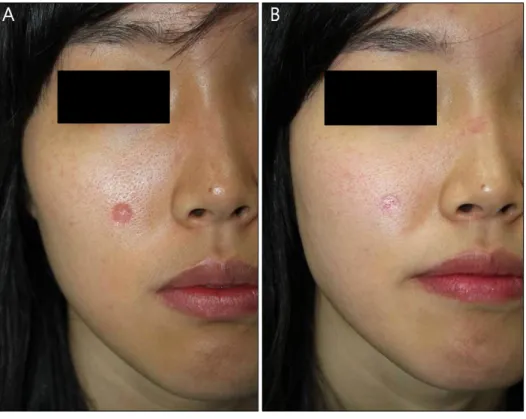
Fig. 1. (A) Post-laser depressed scar on the face. (B) Marked improve- ment after 8 sessions.
http://dx.doi.org/10.5021/ad.2014.26.3.417
Depressed Facial Scars Successfully Treated with
Autologous Platelet-Rich Plasma and Light-Emitting Diode Phototherapy at 830 nm
In Young Oh, Beom Joon Kim, Myeung Nam Kim
Department of Dermatology, Chung-Ang University College of Medicine, Seoul, Korea
Dear Editor:
Depressed facial scars not only lead to cosmetic problems, but also have psychological effects such as emotional debilitation, embarrassment, poor self-esteem, and social isolation. Many techniques are available for the correction
of depressed facial scars, including subcision, derma- brasion, chemical peeling, laser technology, fat grafting, and use of fillers; however, these techniques have resulted in varying degrees of success and associated adverse effects1,2.
Letter to the Editor
418 Ann Dermatol
It has been postulated that autologous platelet-rich plasma (PRP) could be used for the treatment of depressed facial scars, because it can enhance wound healing, which has been shown to accelerate tissue repair3. In addition, we evaluated the additional effects of treatment with light- emitting diode (LED) phototherapy at 830 nm after injec- tions of autologous PRP.
A 20-year-old woman presented with a single erythe- matous, atrophic, depressed, and round defect on the right cheek (Fig. 1A). She had been treated with 1,064-nm long-pulse Nd:YAG laser for a small acne scar 2 weeks before her visit to our clinic and thereafter the scar had become larger and painful. She was worried about the cosmetic appearance of the defect. We decided to use autologous PRP along with LED phototherapy at 830 nm and she received 8 sessions of treatment to the scar lesion at 2-week intervals. PRP was produced by using a commercially available 2-part system (Prosys PRP; T-Cell Bio Inc., Seoul, Korea) consisting of a disposable sepa- ration kit and a concentration kit. Approximately 3 ml of PRP was produced for each session. After autologous PRP injection, the lesion was illuminated with an LED at 830 nm (SmartluxTM; Medmix, Seoul, Korea; light dose 72 J/cm2) for 20 minutes. The treatment caused a substantial improvement of the lesion and symptoms, with good cosmetic results (Fig. 1B). No adverse effects were evident except for some spot bleeding at the injection sites and slight erythema that resolved within 48 hours. She agreed to use her clinical photographs in this study.
The possible mechanism of PRP in the reconstruction of a depressed scar is by promoting the recovery of laser- damaged skin through the numerous growth factors pre- sent in PRP, especially platelet-derived growth factor. This growth factor may help stimulate the production of other growth factors important in tissue remodeling, which pro- mote connective tissue healing by upregulating collagen and protein synthesis3.
Infrared wavelength phototherapy with an LED at 830 nm has anti-inflammatory effects, and is useful for the regene- ration of damaged skin. The wavelength of 830 nm is well known to dramatically increase the action potentials of wound-healing cells, particularly those in the inflamma-
tory and remodeling stages4, and would therefore cause a considerably faster resolution of post-laser adverse effects such as erythema and pain5.
Although comparative studies between the use of only PRP, only LED, combined therapy of PRP and LED, and control treatments are needed to evaluate the precise results of these modalities, the present study may provide evidence supporting the clinical efficacy of autologous PRP and LED phototherapy at 830 nm in treating scars caused by laser application. These techniques might be used for various kinds of dermatologic scars and surgical scars to obtain excellent clearance in an easy and safe manner. In conclusion, autologous PRP injection and ad- ditional LED phototherapy at 830 nm are effective, safe treatment options for depressed facial scars.
ACKNOWLEDGMENT
This report was supported by Basic Science Research Pro- gram through the National Research Foundation of Korea (NRF) funded by the Ministry of Education, Science and Technology (2012-0002647).
REFERENCES
1. Cooper JS, Lee BT. Treatment of facial scarring: lasers, filler, and nonoperative techniques. Facial Plast Surg 2009;25:311- 315.
2. Alster T, Zaulyanov L. Laser scar revision: a review. Der- matol Surg 2007;33:131-140.
3. Ganio C, Tenewitz FE, Wilson RC, Moyles BG. The treat- ment of chronic nonhealing wounds using autologous pla- telet-derived growth factors. J Foot Ankle Surg 1993;32:
263-268.
4. Trelles MA. Phototherapy in anti-aging and its photobiologic basics: a new approach to skin rejuvenation. J Cosmet Der- matol 2006;5:87-91.
5. Russell BA, Kellett N, Reilly LR. A study to determine the efficacy of combination LED light therapy (633 nm and 830 nm) in facial skin rejuvenation. J Cosmet Laser Ther 2005;
7:196-200.