introduction
Osteoarthritis (OA) represents one of the most important causes of musculoskeletal disability and is a major burden to the healthcare system. In the United Kingdom (UK), 8.5 million
people have pain reportedly attributed to arthritis1). It results in 36 million working days lost annually in the UK and an es
timated 115,000 hospital admissions1). Knee OA is additionally the most common form of OA causing disability in the UK. The symptomatic treatment of OA focuses mainly on physical thera
py, analgesics, nonsteroidal antiinflammatory drugs (NSAIDs) and intraarticular injections of corticosteroids2). However, the sideeffects of NSAIDs and intraarticular steroid injections have directed the interest towards alternative forms of treatment, such as viscosupplementation with hyaluronic acid (HA)3,4).
HA has been shown to increase elasticity and reduce viscosity in high shear, as well as reduce elasticity and increase viscosity in low shear stress57). In addition to mechanical properties, experi
mental studies have shown a chondroprotective effect attributed to antiprotease and antiapoptotic actions as well as an upregula
tion of endogenous HA8,9). Kim et al.10) demonstrated improved
Hylan GF20 Viscosupplementation in the Treatment of Symptomatic Osteoarthritis of the Knee: Clinical Effect Survivorship at 5 Years
Tarek Boutefnouchet, MBChB, MRCS, PGCMed, MSc
1, Guru Puranik, MBBS, MCh
2, Esther Holmes, BSc
2, and Karl M Bell, FRCS
21Department of Trauma Orthopaedics, University Hospital Coventry and Warwickshire NHS Trust, Coventry; 2Department of Trauma Orthopaedics, Alexandra Hospital, Redditch, UK
purpose: Controversies remain surrounding the choice of hyaluronic acid products and patient selection. A study was conducted to report the long
term survivorship of intraarticular injection effect of high molecular weight hyaluronic preparation hylan GF20 (SynviscOne) for patients with symptomatic knee osteoarthritis.
Materials and Methods: A retrospective observational analysis of a single therapeutic series was carried out. The analysis was conducted to determine therapeutic effect survivorship taking arthroplasty and any other surgical interventions as endpoint results.
results: Seventyseven consecutive patients (82 knees) were followed up for five years. At oneyear followup, 71 knees (87%) responded to treatment and only 8 knees (10%) were offered arthroplasty due to persistence of symptoms. At fiveyear followup, 41 (50%) were still considered responders.
During the study period, repeat injection was given in 9 knees (11%). Arthroplasty (either total or unicompartmental) was required in 26 (31%).
KaplanMeier survivorship analysis of therapeutic effect demonstrated 67% survival at 5 years with arthroplasty as endpoint and 58% survival at 5 years with all secondary interventions as endpoint.
conclusions: This study demonstrates a significantly longer duration of clinical benefit of hylan GF20 injection. Present results may suggest a notion of an ideal delay therapeutic strategy for patients not ready to receive an arthroplasty. Further studies will be required to help characterise these subsets of patients.
Keywords: Knee, osteoarthritis, intra-articular injections, viscosupplementation, hyaluronic acid, treatment outcome, Survival pISSN 2234-0726 · eISSN 2234-2451
Knee Surgery & Related Research
Received October 17, 2016; Revised (1st) February 6, 2017;
(2nd) February 27, 2017; (3rd) March 13, 2017; Accepted April 23, 2017 Correspondence to: Tarek Boutefnouchet, MBChB, MRCS, PGCMed, MSc Department of Trauma Orthopaedics, University Hospital Coventry and Warwickshire NHS Trust, Clifford Vridge Road, Coventry CV2 2DX, UKTel: +447809677302, Fax: +442476966262
Email: [email protected]
129
This is an Open Access article distributed under the terms of the Creative Commons Attribution NonCommercial License (http://creativecommons.org/licenses/bync/4.0/) which permits unrestricted noncommercial use, distribution, and reproduction in any medium, provided the original work is properly cited.
Copyright © 2017 KOREAN KNEE SOCIETY www.jksrr.org
osteochondral defect healing in animal models treated with intra
articular HA. Both native and crosslinked hyaluronan are being used for the treatment of human OA. Lower molecular weight preparations (e.g. Artzal, Fassverksamheten, Stockholm, Swe
den) generally range in molecular weight from 0.5 to 1 million dalton, while the molecular weight of crosslinked preparations (e.g. SynviscOne, SanofiAventis, Ridgefield, NJ, USA) is consid
erably higher at 6,000 kilodaltons (kDa)11,12). New evidence has recently also demonstrated the relative importance of molecular weight and the concentration of hyaluronan for its efficacy13). Even though previous trials have reported that intraarticular hyaluronan is a safe and welltolerated treatment, controversies remain surrounding choice of products and patient selection1417). In addition, there has been paucity of studies demonstrating lon
ger duration of clinical benefit following viscosupplementation in the treatment of knee OA18). Consequently, conditional recom
mendations have been put forward in relation to its utilisation according to a variety of specialist societies such as Osteoarthritis Research Society International, the European League Against Rheumatism and the American College of Rheumatology, and the American Academy of Orthopedic Surgeons19). Reviewed recommendations also suggest attention to patient selection due to different phenotypes of OA19).
A retrospective observational analysis of a single centre single therapeutic clinical series was conducted in order to evaluate longterm results following intraarticular injections of high mo
lecular weight hyaluronic preparation hylan GF20 (SynviscOne) in selected patients with symptomatic knee OA. The objective of the study was to report the fiveyear therapeutic effect survivor
ship taking knee arthroplasty and any other surgical intervention as endpoints.
Materials and Methods
From 2010 to 2011 a total of 77 consecutive patients received SynviscOne knee intraarticular injection carried out in a spe
cialist orthopaedic knee outpatient clinic. Selection criteria were derived from a multidisciplinary management algorithm. All patients were treated with initial medical management of OA, which includes weight loss, analgesia and activity modification advice. Inclusion criteria consisted of symptomatic knee OA and radiologically confirmed disease on standard weight bearing knee radiographic views. All patients included had confirmed ar
thritic symptoms following clinical evaluation in the knee clinic.
In addition to those having radiographs confirming tibiofemoral compartment location of disease, patients not medically fit for
surgery, considered too young for arthroplasty, or patients whose occupation would have precluded them from having an arthro
plasty were included in the intervention protocol. Using data from our National Joint Replacement Registry (NJR), the catego
ries tooyoung and notfit for surgery were respectively bench
marked at <40 years and American Society of Anaesthesiologists grade 4 (severe systemic disease that is a constant threat to life).
The latter categories both represented an outlying cohort of <1%
on the NJR database20).
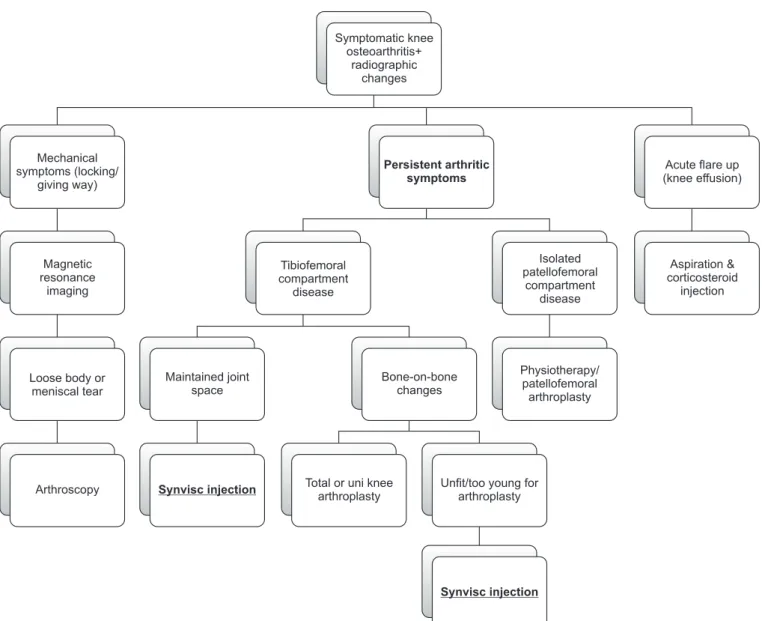
Exclusion criteria consisted of patients with predominantly mechanical symptoms and well preserved joint who required further imaging in the form of magnetic resonance imaging and progression to arthroscopic treatment where indicated. Acute cases of flareup were treated with aspiration and injection of intraarticular corticosteroid and subsequently managed accord
ing to the management algorithm outlined in Fig. 1. In addition, patients with a predominantly patellofemoral location of disease were considered for physiotherapy or patellofemoral arthroplasty depending on the extent of functional loss and severity of de
generative changes. Rheumatoid arthritis or other inflammatory joint diseases were excluded. Furthermore, patients were not included if they had a known allergy to any substance related to the injection. The study analysis included only patients who were treated with SynviscOne from the outset.
The HA injection used was hylan GF20 with a molecular weight of 6,000 kDa (SanofiAventis). The technique for injection followed a standardised method of aseptic no touch technique.
The skin is prepared with alcoholic chlorhexidine and allowed to air dry. The knee joint is positioned in extension and the injec
tion portal follows the patellofemoral compartment to allow easy access to the anterior portion of the joint space. The injection is carried out using a prefilled sterile packed syringe and ‘white’
hypodermic needle. The injection site is covered with a simple dry dressing and the patient is allowed to mobilise fully and discharged back to primary care. Repeat of injection was not rou
tinely carried out unless patients experienced symptomatic ben
efit for a minimum period of nine months following the initial injection. As per our local protocol, if there was no response or limited response, patients needed to be referred back to second
ary care to consider other surgical interventions.
Baseline characteristics and diagnostic data were recorded at the initial visit and patients were entered into a prospectively collect
ed database for evaluation of clinical outcomes at one year and at five years after the initial injection. The primary efficacy pa
rameter at one year and during the total fiveyear duration of the study was defined as absence of subsequent referral to secondary
care other than for repeat SynviscOne injection. These patients were defined as responders to the injection therapeutic effect if they had not returned for a secondary intervention excluding re
peat SynviscOne injection. The parameters were recorded from the hospital electronic medical record. If no hospital records were identified, clinical data was checked with the primary care general practice in case the patients had represented with knee symptoms and/or referred to another centre. The secondary ef
ficacy parameter consisted of time to clinical failure as defined by the need for secondary treatment for the study knee excluding repeat SynviscOne injection. Secondary interventions included arthroscopic procedures or arthroplasty during the study period as well as patients awaiting arthroplasty surgery at the end of the fiveyear study period. Similarly, these parameters were recorded
from the trust electronic medical record and checked with the primary care practice in case patients were referred for treatment in another centre in order to reduce errors and loss of cases. All patients who received the initial intervention were accounted for at five years of followup. Finally, duration of clinical benefit was measured using survival analysis taking arthroplasty and all sec
ondary interventions as endpoint results. Safety of injections was evaluated by the presence of any adverse reaction immediately after the treatment and the presence of any subsequent complica
tions related to the injection.
In terms of ethical provisions, the study was conducted in ac
cordance with the principles of good clinical practice and in accordance with the declaration of Helsinki, and was approved by the trust audit department (ID/647). Approval for product
Acute flare up (knee effusion)
Aspiration &
corticosteroid injection Isolated
patellofemoral compartment
disease Mechanical
symptoms (locking/
giving way)
Magnetic resonance
imaging
Tibiofemoral compartment
disease
Loose body or meniscal tear
Maintained joint space
Bone-on-bone changes
Physiotherapy/
patellofemoral arthroplasty
Arthroscopy Synvisc injection
Synvisc injection Total or uni knee
arthroplasty
Unfit/too young for arthroplasty Persistent arthritic
symptoms Symptomatic knee
osteoarthritis+
radiographic changes
Fig. 1. Symptomatic knee osteoarthritis management algorithm.
utilisation had been obtained from the regional clinical commis
sioning group and regional prescribing committee. Results were initially collated online and tabulated using Excel 2010 (Microsoft, Redmond, WA, USA). Multiple regression analysis was used to assess correlation between baseline characteristics and clinical outcomes. KaplanMeier survivorship analysis was performed to evaluate duration of clinical benefit.
results
A total of 77 consecutive patients (82 knees) were eligible for the intervention and had clinical outcome measures recorded and followup of outcomes at one year and five years following initial injection of SynviscOne. The cohort comprised 36 male (47%) and 41 female (53%) patients. The mean age at the time of index intervention was 58 years (standard deviation [SD], 11.9; range, 32 to 88 years) (95% confidence interval, 51.5–73.2).
Multivariate regression analyses of the baseline characteristics and potential confounding factors were carried out. There was no significant relationship between gender and clinical outcomes in the form of secondary interventions (p=0.41). Mean ages per intervention group were: 58.8 years (SD, 13) in the arthroplasty group; 57.5 years (SD, 14.9) among patients who had no further interventions; and 57.9 years (SD, 9.4) among patients who had a repeat injection. There was no significant difference in mean age in the different clinical outcome groups at fiveyear followup for any subsequent intervention (p=0.72) and for all interventions grouped together (p=0.64).
At one year, 71 (87%) of knees, which received the intervention, responded to treatment and only 8 (10%) were listed for arthro
plasty due to persistence of symptoms. Within the responders, a total of 53 (65%) were reviewed and 18 (22%) were discharged.
According to our protocol, these cases were considered respond
ers in terms of primary therapeutic efficacy. At fiveyear follow
up, 41 (50%) of knees, which received the initial injection, were Table 1. Outcomes at 1 Year and 5 Years of Followup
Variable No. (%)
Outcomes at 1 year
Responders 71 (87)
Waiting list arthroplasty 8 (10)
Arthroscopic procedure 1 (1)
Reviewed+symptomatic 1 (1)
No followup records 1 (1)
Outcomes at 5 years
Responders 41 (50)
Total knee arthroplasty 19 (23)
Unicompartmental knee arthroplasty 6 (7) Patellofemoral joint arthroplasty 1 (1)
Waiting list arthroplasty 5 (6)
Symptomatic 3 (4)
Arthroscopic procedure 2 (3)
Patient deceased 5 (6)
Table 2. Cumulative Probability of Patients Not Requiring Arthroplasty
Period (yr) At risk Censored Arthroplasty Survived KaplanMeier (%)
1 80 2 8 72 0.90
2 71 1 6 65 0.82
3 63 2 3 60 0.79
4 60 0 5 55 0.72
5 55 0 4 51 0.67
Values are presented as number.
Table 3. Cumulative Probability of Patients Not Requiring Any Secondary Interventiona)
Period (yr) At risk Censored Secondary intervention Survived KaplanMeier (%)
1 80 2 10 70 0.88
2 69 1 6 63 0.80
3 61 2 3 58 0.76
4 58 0 5 53 0.69
5 53 0 9 44 0.58
Values are presented as number.
a)Excluding repeat SynviscOne injections.
classed as responders. These included 32 (39%) asymptomatic and 9 (11%) who required a repeat of one injection only as per protocol. All cases which received a repeat injection did so within the time frame of six to nine months postulated in the original treatment plan. During the fiveyear period, 26 (31%) required arthroplasty, either total or unicompartmental. Clinical outcomes are outlined in Table 1. Within secondary surgical procedures carried out during the study period, there was one arthroscopic microfracture at one year and two arthroscopic debridements of meniscal tears at five years due to development of mechani
cal symptoms. There were no records of adverse reactions to the injections reported during the study period. One patient was not available for followup at one year but was later identified and reviewed at five years. This particular case did not require further intervention and remained asymptomatic at five years.
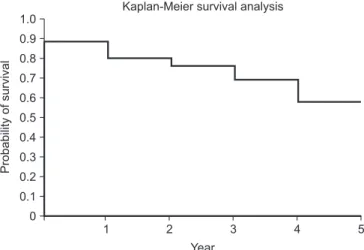
KaplanMeier failuretime curves were used to analyse the cumulative probability of patients not requiring additional treat
ment for their study knee during the followup period. The analysis demonstrated 67% survival at 5 years with arthroplasty as the endpoint and 58% survival at 5 years with all secondary interventions, excluding repeat SynviscOne injection, as the endpoint (Tables 2 and 3, Figs. 2 and 3). Throughout the five
year study period, there were no adverse reaction or longterm complications related to the injection of HA.
discussion
The painrelieving mechanism of intraarticular injections of HA is yet to be fully elucidated. It has been suggested that the injections may stimulate the synthesis of endogenous HA and act as a scavenger, reducing the amount of inflammatory degrada
tion products in the joint. Furthermore, the viscoelastic and anti
inflammatory functions of the synovial fluid may be improved by the treatment. The utilisation of this treatment has been closely monitored within our unit. The present study constitutes a de
tailed longterm analysis of consecutive patients treated by a mul
tidisciplinary team and followed up for five years. The principal findings were the longterm efficacy and safety of intraarticular injections of hyaluronic preparation (SynviscOne/hylan GF
20) for patients with symptomatic knee OA. The present study demonstrates a significantly longer duration of clinical benefit.
One third of patients required arthroplasty surgery and over half of the patients did not require any further secondary intervention at five years of followup. In a pragmatic setting, our primary and secondary efficacy parameters support the use of this interven
tion in adequately selected patients with purely arthritic symp
toms, who are either ‘not ready’ or ‘not willing’ to undergo joint replacement surgery.
The subject of HA injection in the treatment of OA has been vastly studied. Within the literature a large number of clinical tri
als, systematic reviews and metaanalyses had sought to answer the question of HA injection efficacy and how it compares to other treatment modalities. Wang et al.15) conducted a metaanal
ysis, which confirmed the therapeutic efficacy and safety of intra
articular injection of HA for the treatment of OA of the knee.
Bellamy et al.16) demonstrated a therapeutic effect superior to pla
cebo but not significantly different to NSAIDs or intraarticular corticosteroid injections. This metaanalysis, which included 76 trials looking at 20 different HA products, echoes our results of sustained efficacy over a long period of time in adequately select
ed patients. Lo et al.17) demonstrated a moderate therapeutic ef
fect when compared to placebo in a metaanalysis of 22 selected
1 2 3 4
0 1.0 0.9 0.8 0.7 0.6 0.5 0.4 0.3 0.2 0.1
5 Year
Probabilityofsurvival
Kaplan-Meier survival analysis
Fig. 2. Therapeutic effect survivorship analysis with arthroplasty as the endpoint.
1 2 3 4
0 1.0 0.9 0.8 0.7 0.6 0.5 0.4 0.3 0.2 0.1
5 Year
Probabilityofsurvival
Kaplan-Meier survival analysis
Fig. 3. Therapeutic effect survivorship analysis with any secondary inter
vention as the endpoint.
trials. Results were more significant with high molecular weight HA injections17). Nevertheless, publication bias and heterogene
ity of the studies included mitigated these results. Similar results were widely reported in the international literature, with added evidence of favourable costeffectiveness in the utilisation of HA injection for symptomatic arthritic “dry” knees21,22). A more re
cent metaanalysis reported similar methodological limitations.
The authors suggested a significant association between cross
linked hyaluronan and longterm results, yet not beyond the two
year mark18). A recent randomised controlled trial compared hylan GF20 single shot injection with corticosteroid injection.
The authors reported that both groups had similar improvement in pain, knee function, and range of motion during the 6month followup (p<0.001)23,24). In contrast, an earlier study by Anand et al.25) showed that multipledose injections of HA when given in advanced arthritis lasted for up to three years and delayed the need for knee arthroplasty in 58% of the cases.
The scope of our clinical series was not to replicate the results previously published in the literature. Our present study adds valuable observations, which can easily be applied in other insti
tutions. In adequately selected patients with knee OA who are not medically fit or ready for arthroplasty according to the criteria defined above and reports from the NJR database20), SynviscOne injection can constitute a satisfactory treatment modality even in the longterm. Patient selection remains a difficult challenge. We demonstrated results following the implementation of a rigorous management algorithm. We believe that a more liberal approach could have attenuated the overall therapeutic effect within this patient population. Factors predicting longterm efficacy of in
jection have been previously reported. Conrozier et al.26) reported results at 14 months with a 78% global therapeutic effect lasting up to that point. Factors significantly associated with a favourable response in their series were: moderate effusion, injection lateral to the patella, joint space loss in a single compartment, and radio
logical meniscal calcinosis26).
All studies investigating the efficacy of HA injections appear to share numerous and recurring limitations such as: sample size, clinical environment, outcome measures, disease duration, ra
diological grade, and rescue medications. Even in the most con
trolled environment, such factors will inadvertently mitigate the interpretation of evidence reported. The present study followed a pragmatic approach, reflecting a normal clinical environment to which patients are exposed. The principal limitation of the present study was therefore the lack of filter for all possible con
founding factors, which could influence the results of treatment.
Nevertheless, it is the authors’ viewpoint that this contributes to
evidence for the efficacy of HA injection within this heteroge
neous patient population. It is often difficult to translate evidence extracted from the very tightly regulated environment of ran
domised controlled studies and apply to the realism of everyday practice. It can be attributed to the very fact that outside the controlled environment represented in such studies, patients are exposed to numerous confounding factors. This is especially true for knee OA, a condition with a complex natural history. Con
sequently, our results characterise a pragmatic approach to the question. The efficacy parameters reported above may have been heavily influenced by external factors. However, when patients are adequately selected, such approach adds external validity to the results reported in our study. Instead of becoming a single therapeutic answer, the longterm results presently reported can become an addition in the armamentarium of the orthopaedic surgeon when discussing treatment options with their patients.
conclusions
The majority of patients with symptomatic knee OA who were treated with hylan GF20 injection using our protocol showed clinical improvement. Our treatment algorithm incorporating a single product SynviscOne injection demonstrated longterm effect when arthroplasty and any other surgical intervention were measured as endpoints. This therapeutic series demonstrates a significantly longer duration of clinical benefit for SynviscOne injection compared to previous studies. Only a third of patients required arthroplasty surgery and over half of the patients did not require any further surgical intervention at fiveyear follow
up. Results are echoed in the literature, most likely attributed to molecular weight of preparation and improved patient selection.
These results can suggest a notion of an ideal delay therapeutic strategy for patients not ready to receive an arthroplasty. The present study should also pave the way for further research with attention to product and patient selection, in order to determine whether such a pragmatic approach can be widely implemented.
conflict of interest
No potential conflict of interest relevant to this article was re
ported.
references
1. National Institute for Health and Clinical Excellence. Osteo
arthritis: care and management [Internet]. London: National
Institute for Health and Clinical Excellence; 2014 [cited 2016 Aug 26]. Available from: https://www.nice.org.uk/Guidance/
cg177.
2. Garcia Rodríguez LA, Jick H. Risk of upper gastrointestinal bleeding and perforation associated with individual non
steroidal antiinflammatory drugs. Lancet. 1994;343:76972.
3. Rashad S, Revell P, Hemingway A, Low F, Rainsford K, Walker F. Effect of nonsteroidal antiinflammatory drugs on the course of osteoarthritis. Lancet. 1989;2:51922.
4. Bradley JD, Brandt KD, Katz BP, Kalasinski LA, Ryan SI.
Treatment of knee osteoarthritis: relationship of clinical fea
tures of joint inflammation to the response to a nonsteroidal antiinflammatory drug or pure analgesic. J Rheumatol.
1992;19:19504.
5. Ghosh P, Read R, Armstrong S, Wilson D, Marshall R, McNair P. The effects of intraarticular administration of hy
aluronan in a model of early osteoarthritis in sheep. I. Gait analysis and radiological and morphological studies. Semin Arthritis Rheum. 1993;22(6 Suppl 1):1830.
6. Ludwig TE, McAllister JR, Lun V, Wiley JP, Schmidt TA.
Diminished cartilagelubricating ability of human osteoar
thritic synovial fluid deficient in proteoglycan 4: restoration through proteoglycan 4 supplementation. Arthritis Rheum.
2012;64:396371.
7. Ludwig TE, Hunter MM, Schmidt TA. Cartilage boundary lubrication synergism is mediated by hyaluronan concentra
tion and PRG4 concentration and structure. BMC Musculo
skelet Disord. 2015;16:386.
8. Ghosh P, Read R, Numata Y, Smith S, Armstrong S, Wilson D. The effects of intraarticular administration of hyaluro
nan in a model of early osteoarthritis in sheep. II: cartilage composition and proteoglycan metabolism. Semin Arthritis Rheum. 1993;22(6 Suppl 1):3142.
9. Oliveira MZ, Albano MB, Namba MM, da Cunha LA, de Lima Gonçalves RR, Trindade ES, Andrade LF, Vidigal L. Ef
fect of hyaluronic acids as chondroprotective in experimen
tal model of osteoarthrosis. Rev Bras Ortop. 2014;49:628.
10. Kim SS, Kang MS, Lee KY, Lee MJ, Wang L, Kim HJ. Thera
peutic effects of mesenchymal stem cells and hyaluronic Acid injection on osteochondral defects in rabbits’ knees.
Knee Surg Relat Res. 2012;24:16472.
11. Marshall KW. The current status of hylan therapy for the treatment of osteoarthritis. Todays Ther Trends. 1997;15:99
108.
12. Aviad AD, Houpt JB. The molecular weight of therapeutic hyaluronan (sodium hyaluronate): how significant is it? J
Rheumatol. 1994;21:297301.
13. Puttick MP, Wade JP, Chalmers A, Connell DG, Rangno KK.
Acute local reactions after intraarticular hylan for osteoar
thritis of the knee. J Rheumatol. 1995;22:13114.
14. Karlsson J, Sjogren LS, Lohmander LS. Comparison of two hyaluronan drugs and placebo in patients with knee osteoarthritis: a controlled, randomized, doubleblind, paralleldesign multicentre study. Rheumatology (Oxford).
2002;41:12408.
15. Wang CT, Lin J, Chang CJ, Lin YT, Hou SM. Therapeutic ef
fects of hyaluronic acid on osteoarthritis of the knee: a meta
analysis of randomized controlled trials. J Bone Joint Surg Am. 2004;86:53845.
16. Bellamy N, Campbell J, Robinson V, Gee T, Bourne R, Wells G. Viscosupplementation for the treatment of os
teoarthritis of the knee. Cochrane Database Syst Rev.
2006;(2):CD005321.
17. Lo GH, LaValley M, McAlindon T, Felson DT. Intraartic
ular hyaluronic acid in treatment of knee osteoarthritis: a metaanalysis. JAMA. 2003;290:311521.
18. Jevsevar D, Donnelly P, Brown GA, Cummins DS. Visco
supplementation for osteoarthritis of the knee: a systematic review of the evidence. J Bone Joint Surg Am. 2015;97:2047
60.
19. Migliore A, Bizzi E, HerreroBeaumont J, Petrella RJ, Ra
man R, Chevalier X. The discrepancy between recommen
dations and clinical practice for viscosupplementation in osteoarthritis: mind the gap! Eur Rev Med Pharmacol Sci.
2015;19:11249.
20. National Joint Registry. National Joint Registry for England and Wales: 13th annual report [Internet]. Hemel Hemp
stead: National Joint Registry; 2016 [cited 2016 Aug 26].
Available from: http://www.njrcentre.org.uk/njrcentre/
Reports,PublicationsandMinutes/Annualreports/tabid/86/
Default.aspx.
21. Uthman I, Raynauld JP, Haraoui B. Intraarticular therapy in osteoarthritis. Postgrad Med J. 2003;79:44953.
22. Kahan A, Lleu PL, Salin L. Prospective randomized study comparing the medicoeconomic benefits of hylan GF20 vs.
conventional treatment in knee osteoarthritis. Joint Bone Spine. 2003;70:27681.
23. Tammachote N, Kanitnate S, Yakumpor T, Panichkul P. In
traarticular, singleshot hylan GF20 hyaluronic acid injec
tion compared with corticosteroid in knee osteoarthritis: a doubleblind, randomized controlled trial. J Bone Joint Surg Am. 2016;98:88592.
24. Khanasuk Y, Dechmaneenin T, Tanavalee A. Prospective randomized trial comparing the efficacy of single 6ml in
jection of hylan GF20 and hyaluronic acid for primary knee arthritis: a preliminary study. J Med Assoc Thai. 2012;95 Suppl 10:S927.
25. Anand A, Balduini F, Rogers K. Hyaluronic acid in manage
ment of advanced osteoarthritis of the knee: retrospective
analysis. Euro J Orthop Surg Traumatol 2010;20:6459.
26. Conrozier T, Mathieu P, Schott AM, Laurent I, Hajri T, Crozes P, Grand P, Laurent H, Marchand F, Meignan F, Noel E, Rozand Y, Savoye JF, Vignon E. Factors predicting long
term efficacy of hylan GF20 viscosupplementation in knee osteoarthritis. Joint Bone Spine. 2003;70:12833.