Journal of Bacteriology and Virology 2008. Vol. 38, No. 4 p.235 – 237
Purification of Protein Expressed from Three Different Regions of Norovirus (NoV)
Jin-Young Kim1, Jang Won Choi2, Seung-Won Park3, Sung-Guen Lee3, Jong-Min Kim4, Weon-Hwa Jheong4, Dong-Wook Kim5, Jin-Man Kim5, Young-Sun Sohn and Soon-Young Paik3*
1Department of Food Science and Technology, Ewha Womans University, Seoul, Korea,
2Department of Bioindustry, College of Life and Environment, Daegu University, Daegu, Korea,
3Department of Microbiology, College of Medicine, the Catholic University of Korea, Seoul, Korea
4Department of Environmental Health Research, National Institute of Environmental Research, Incheon, Korea,
5Catholic Hematopoietic Stem Cell Transplantation Center, the Catholic University of Korea, Seoul, Korea
Received : November 24, 2008 Revised : December 9, 2008 Accepted : December 10, 2008
Norovirus (NoV), which belongs to the family Caliciviridae, is one of the major causes of nonbacterial acute gastroenteritis in the world. In this study, we purified proteins from the epitope region of norovirus for development of the rapid diagnosis system using polyclonal antibodies. As antigens, parts of the ORF (open reading frame) 2, ORF2-P domain, ORF2-Epi, and ORF3 regions were selected and their expressions were induced. The antigenicity of the purified proteins was identified by Western blotting. Each of the purified proteins was injected into mice for the production of novel antibodies and after 3 months of immunization, sera from the mice were obtained. The polyclonal antibody titer was tested by enzyme-linked immunosorbent assay (ELISA) and antibody against ORF2-Epi showed the highest titer.
Those polyclonal antibodies can be used in further immunoassay for the rapid detection of NoVs from food and clinical specimens.
Key Words: Norovirus, Purified protein, Polyclonal antibody, ELISA
INTRODUCTION
Norovirus (NoV) is one of the most important viral etiologies of acute gastroenteritis in humans (1,2). Recently, food-born disease caused by NoV has been increasing (3).
Antibodies are a useful tool for detection of various types
of NoVs to evaluate the spread of disease. Therefore, in this study, we purified proteins expressed from the epitope regions of the NoV to develop polyclonal antibodies that can be used in an immunoassay for the rapid detection of NoVs from food and clinical specimens.
MATERIALS AND METHODS
As antigens, the ORF2-P domain, ORF2-Epi and ORF3 regions [nucleotide positions 5,745 to 6,560, 6,336 to 6,686 (5), 6,704 to 7,450, reference strain accession number X 86557] were amplified by RT-PCR and the fragments were identified on 1.8% agarose gel electrophoresis. Then, those RT-PCR products were inserted into the pET-SUMO protein 235
*Corresponding author: Soon-Young Paik. Department of Microbiology, College of Medicine, The Catholic University of Korea, Seoul, 137-701, Korea.
Phone: +82-2-590-1217, Fax: +82-2-535-6473 e-mail: [email protected]
**This work was supported by a Korea Research Foundation Grant (KRF-2003-E00011), Basic Research Program of the Korea Science &
Engineering Foundation (R01-2008-000-20343-0) and the BK21 project (2006-0546-3-7).
236 J-Y Kim, et al.
expression vector (Invitrogen Corp., Carlsbad, CA, USA), and the plasmids were transformed into Escherichia coli Mach 1. The positive transformants were identified by cutting the plasmid DNA with the restriction enzymes EcoRI and SmaI, and sequencing of the nucleotides. The plasmids from the positive transformants were transformed further into E.
coli BL21 Star cells. After overnight culture in 1 liter of broth containing kanamycin, expression was induced by adding 0.5 mM of isopropyl-β-D-thiogalactopyranoside (IPTG); the cells were then grown for an additional 3 hrs at 37℃. The cultures were centrifuged and the inclusion bodies expressed in the pellet were denatured using denaturation buffer containing 8 M urea. After the second centrifugation, the supernatant containing proteins was loaded into a Ni-TED resin-packed column (Macherey-Nagel, Düren, Germany) to purify the target proteins by his-tag binding. Elution was performed with a 250 mM imidazole. Protein concentration of every eluted fraction was measured by a BSA assay and the specificity of the eluted fraction was identified by per- forming SDS-PAGE and Western blot analysis.
Next, each of the proteins was injected into mice for the production of novel antibodies. After 3 months of immuni- zation, sera from the mice were obtained. The polyclonal antibody titer was tested by enzyme-linked immunosorbent assay (ELISA).
RESULTS
Each of the 816, 351 and 747 bp sized RT-PCR fragments was identified on agarose gel electrophoresis, as shown in Fig. 1.
After the RT-PCR products were inserted into the expression vector, the positive transformants (cloned trans- formants) were selected by enzyme restriction and these
A
B
C
1 : RT-PCR fragment of ORF-P 2 : RT-PCR fragment of ORF2-Epi 3 : RT-PCR fragment of ORF3 M: DNA size Marker
Figure 1. Amplified fragments of ORF2-P (816 bp), ORF2-Epi (351 bp) and ORF3 (747 bp) of the NoV capsid gene by RT-PCR.
1: Non-induced cell 2: Induced cell 3: Purified protein
Figure 2. Evaluation of the specificity of purified proteins as antigens by SDS-PAGE (left) and Western blotting (right). (A) ORF2-P (43.1 kDa) (B) ORF2-Epi (26.4 kDa) (C) ORF3 (30.7 kDa)
Norovirus Antibody Production 237
were confirmed by DNA sequencing of the inserted frag- ments.
To evaluate the specificity of the expressed and purified proteins, SDS-PAGE gel electrophoreses and Western blotting were performed. As indicated in Fig. 2, the sizes of the analyzed proteins were 43.1 kDa, 26.4 kDa and 30.7 kDa, respectively. These proteins were used to immunize the mice for making polyclonal antibodies.
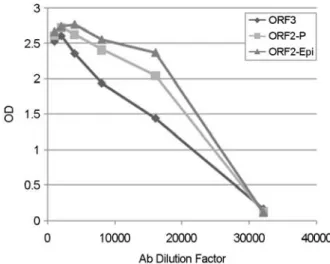
ELISA was performed to evaluate the titer of the poly- clonal antisera from the immunized mice. The purified proteins were used as antigens and serially-diluted mouse serum was used as the capture antibody. As indicated in Fig.
3, the highest titer was detected in the antisera against ORF2-Epi at the 1:2,000 dilution of the sample.
DISCUSSION
NoV is one of the major causative agents of nonbacterial gastroenteritis (1,2). The effective control of NoV infection begins by rapid identification of the pathogens (4). Therefore, in this study we attempted to develop an immunoassay method using polyclonal antibodies for the detection of a variety of NoV types.
Proteins were expressed from the epitope regions of NoV and purified to develop antigens in immunized mice. The
specificity and antigenicity of the proteins were identified by SDS-PAGE and Western blot analysis. These proteins were used to develop novel antibodies in mice. From the antisera, the antibody titer was determined. With the anti- body dilution that has the highest titer, further experiments, on the specificity to various NoV types, and the detection rate from clinical samples, are needed to develop an ELISA kit for NoV diagnosis that can be used for food and other environmental exposures.
REFERENCES
1)Almanza H, Cubillos C, Angulo I, Mateos F, Coastón JR, van der Poel WH, Vinje J, Bárcena J, Mena I:
Self-Assembly of the recombinant capsid protein of a swine norovirus into virus-like particles and evaluation of monoclonal antibodies cross-reactive with a human strain from genogroup II. J Clin Microbiol 46: 3971 -3979, 2008.
2) Glass RI, Noel J, Ando T, Fankhauser R, Belliot G, Mounts A, Parashar UD, Bresee JS, Monroe SS: The epidemiology of enteric caliciviruses from humans : a reassessment using new diagnosis. J Infect Dis 181:
S254-S261, 2000.
3)Le Guyader FS, Mittelholzer C, Haugarreau L, Hedlund KO, Alsterlund R, Pommepuy M, Svensson L: Detection of noroviruses in rasberries associated with a gastroenteritis outbreak. Int J Food Microbiol 97: 179-186, 2004.
4) Okame M, Shiota T, Hansman G, Takagi M, Yagyu F, Takanashi S, Phan TG, Shimizu Y, Kohno H, Okitsu S, Ushijima H: Anti-norovirus polyclonal anti- body and its potential for development of an antigen- ELISA. J Med Virol 79: 1180-1186, 2007.
5) Shiota T, Okame M, Takanashi S, Khamrin P, Takagi M, Satou K, Masuoka Y, Yagyu F, Shimizu Y, Kohno H, Mizuguchi M, Okitsu S, Ushijima H: Characteri- zation of a broadly reactive monoclonal antibody against norovirus genogroups I and II: recognition of a novel conformational epitope. J Virol 81: 12298-12306, 2007.
Figure 3. Titration of the polyclonal antibodies to the ORF2-P, ORF-2-Epi and ORF3 of the NoV capsid by ELISA